
FIRE PROTECTION EQUIPMENT AND SYSTEMS Chapter 4 Sprinkler


- Slides: 37
FIRE PROTECTION EQUIPMENT AND SYSTEMS Chapter 4 Sprinkler and Water Spray Fire Suppression Systems Ronald R. Spadafora, Fire Protection Equipment and Systems © 2015 by Pearson Education, Inc.
Introduction • Sprinklers are among the most popular and valuable fire protection systems. • A fire sprinkler system cools down a fire and prewets surrounding areas by distributing water on them. • Water droplets from sprinkler systems help to reduce byproducts and weigh down smoke particles to make it safer for occupants to breathe and escape.
Sprinkler Systems • Fire sprinklers are active fire protection systems. • Sprinkler systems are intended to control or suppress fire.
Sprinkler Systems (cont’d) • Sprinkler systems prewet surrounding combustibles to prevent fire spread. • Control mode sprinkler applications are designed to limit the heat release rate (HRR) of the fire.
Types of Fire Sprinkler Systems • The most common types of fire sprinkler systems used today are: – Wet pipe automatic sprinkler systems – Dry pipe automatic sprinkler systems – Nonautomatic dry pipe systems – Deluge sprinkler systems – Preaction sprinkler systems
Wet Pipe Automatic Sprinkler Systems • Wet pipe automatic sprinkler systems are the most commonly installed fire sprinkler. • They have water in their piping at all times, which helps to make them be the most reliable sprinkler system. • The minimum temperature that they can be used at is 40˚F (4˚C).
FIGURE 4. 2 Wet pipe automatic sprinkler system
Wet Pipe Automatic Sprinkler Systems (cont’d) • A rise in temperature to a predetermined level causes the sprinkler head to operate. • Once this happens, water is discharged. • Most standard sprinkler systems automatically sound an alarm when a sprinkler head discharges water.
Wet Pipe Automatic Sprinkler Systems (cont’d) • Automatic wet sprinkler systems should not be completely shut off and drained to avoid freezing during cold weather. • In locations where freezing can occur, automatic wet sprinkler systems may require an antifreeze solution.
Wet Pipe Automatic Sprinkler Systems (cont’d) • Wet pipe automatic sprinklers should be regularly checked for sediment accumulation and loading in the piping of the system.
Dry Pipe Automatic Sprinkler System • Dry pipe automatic sprinkler systems are installed where a wet pipe system cannot be heated to prevent freezing. • Under normal conditions there is no water in the pipes.
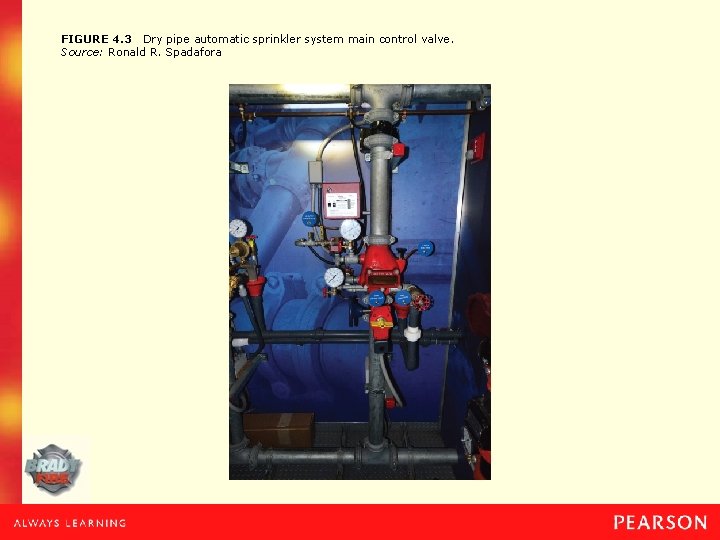
Dry Pipe Automatic Sprinkler System (cont’d) • When a sprinkler head is activated by the heat from a fire, the pressure is reduced in the piping. • The drop in pressure causes the dry pipe valve to open. • Water then flows into the piping and out of the activated sprinkler.
FIGURE 4. 3 Dry pipe automatic sprinkler system main control valve. Source: Ronald R. Spadafora
Dry Pipe Automatic Sprinkler System (cont’d) • Dry pipe sprinkler systems are more complicated than wet pipe systems and require more inspection, maintenance, and testing. • A typical system model uses differential water and air pressure on a single clapper valve.
Dry Pipe Automatic Sprinkler System (cont’d) • Dry pipe systems are often used in: – Unheated warehouses – Loading dock areas – Attic spaces – Parking garages – Refrigerated coolers
Nonautomatic Dry Pipe Systems • In nonautomatic dry pipe systems, all piping is normally dry, and water is supplied by firefighters through pumping water into the system via a fire department connection (FDC).
Nonautomatic Dry Pipe Systems (cont’d) • There are several nonautomatic dry pipe application systems: – Open sprinkler heads or fixed spray nozzles – Exterior exposure sprinklers – Foam
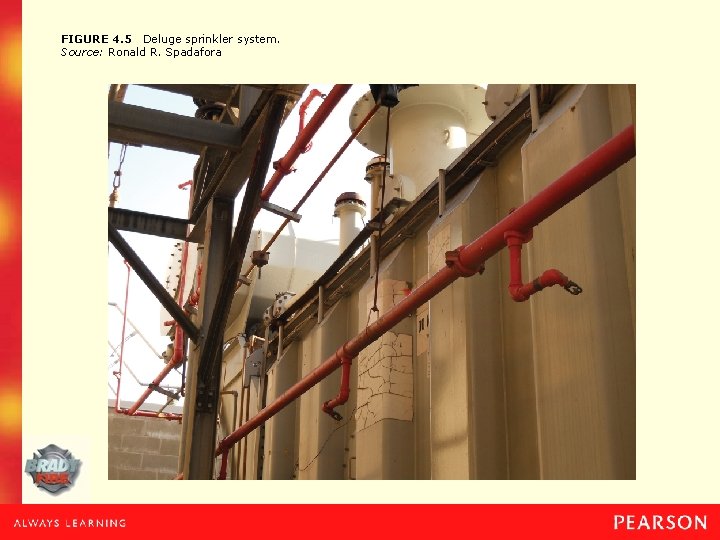
Deluge Sprinkler System • A deluge system is applicable for extrahazard occupancies in which rapid fire spread is expected. • Deluge systems are connected to a water supply through a deluge valve that is commonly released via a detector signaling a fire alarm control unit (FACU).
FIGURE 4. 5 Deluge sprinkler system. Source: Ronald R. Spadafora
Deluge Sprinkler System (cont’d) • When the deluge valve is activated, water enters the piping and discharges through all of the sprinkler heads in the system. • Some deluge systems incorporate the use of a foam concentrate to mix with water to form a foam solution.
Deluge Sprinkler System (cont’d) • Deluge systems are used in chemical storage/processing facilities and industrial plants, where plenty of water is required over a large area to cool combustibles. • These systems may also be installed in personnel egress paths or building openings to slow travel of fire.
Preaction Sprinkler System • Preaction sprinkler systems are designed to protect against accidental situations in which there is danger of serious water damage to valuable property.
Preaction Sprinkler System (cont’d) • Water will not enter into the piping until the detection system is activated and water will not be applied on the fire until sufficient heat causes the individual sprinkler head to fuse.
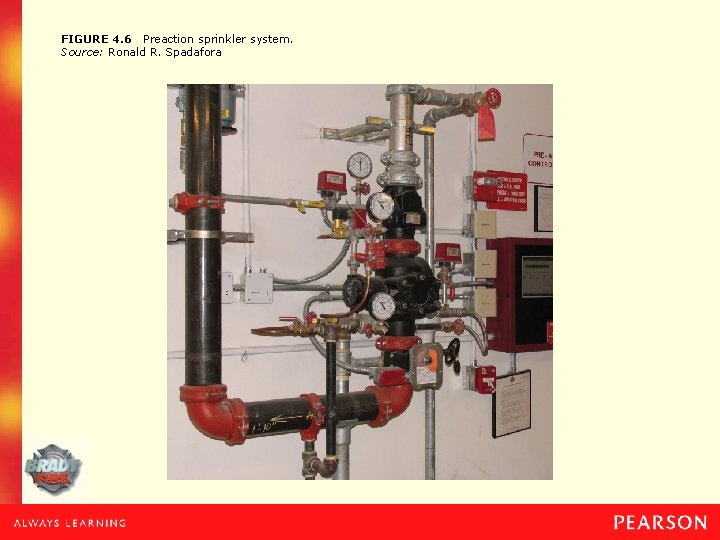
FIGURE 4. 6 Preaction sprinkler system. Source: Ronald R. Spadafora
Preaction Sprinkler System (cont’d) • A preaction sprinkler systems has advantages over a dry pipe system: – Its valves open sooner. – Water is positioned at the sprinkler heads allowing for quick discharge when needed. – The quick response of the system leads to less property damage.
Inspection, Testing, and Maintenance • Automatic fire sprinkler systems are required to be inspected, tested, and maintained in accordance with NFPA 25. • The requirements contained in NFPA 25 are based on the type of sprinkler system installed.
System Components • Fire pumps – It is dedicated to fire protection. – It can be powered by electric, diesel or steam. – It provides enhanced water flow and pressure to the sprinkler system risers. – It is commonly found inside a room that is fire resistant or constructed of noncombustible material.
System Components (cont’d) • Fire pumps – Since they are used infrequently, they must be systematically inspected to determine their condition, operability, and need for routine maintenance.
System Components (cont’d) • Alternate power – Fire pumps powered by a reliable electrical supply are generally only required to have a single source. – Often the code official will decide if an alternate power supply is required.
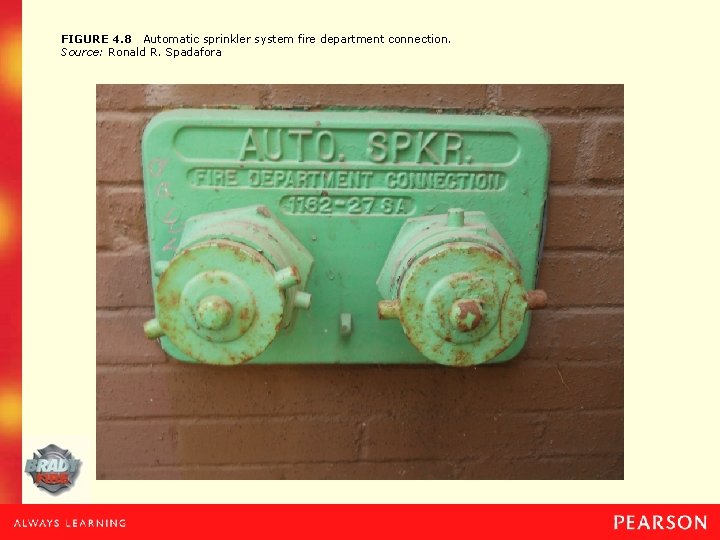
System Components (cont’d) • Fire department connection (FDC) – A FDC is normally located on the exterior of the building. – Through a FDC, fire apparatus can pump supplemental water into a fire protection system for fire extinguishment.
System Components (cont’d) • Fire department connection (FDC) – FDCs should be installed on the street side of the building and be fully visible and recognizable from the street or point of fire department vehicle access or as otherwise approved by the fire chief.
FIGURE 4. 8 Automatic sprinkler system fire department connection. Source: Ronald R. Spadafora
System Components (cont’d) • Valves – Sprinkler systems that are supplied from a public water main and have a control valve. – The valve allows for the entire system to be shut down. – A special key will be required to operate this valve.
System Components (cont’d) • Gate and control valves – Gate valves allow for the sprinkler system to be shut off for repairs or maintenance. – Types of control valves are: • Outside screw and yolk (OS&Y) valve • Post indicator valve (PIV) • Wall post indicator valve (WPIV)
System Components (cont’d) • Sprinkler heads – They distribute water over a defined fire hazard area. – The deflector determines the spray pattern of the water discharged. – Generally there is an umbrella-shaped spray pattern.
In-Rack Sprinkler System • In-rack sprinkler systems are manufactured to release water into a targeted area to control fire and minimize damage and downtime. • They can contain a fire within a short period of time when it starts in a specific area.
Early-Suppression, Fast-Response Sprinkler Systems • Early-suppression, fast-response (ESFR) sprinkler systems are designed to release two to three times the amount of water of conventional sprinkler heads. • Their droplets are also larger, which gives them greater momentum than droplets emitted from conventional heads.