
Fire Protection Engineering Research Erin Griffith felidaeumd edu
- Slides: 1
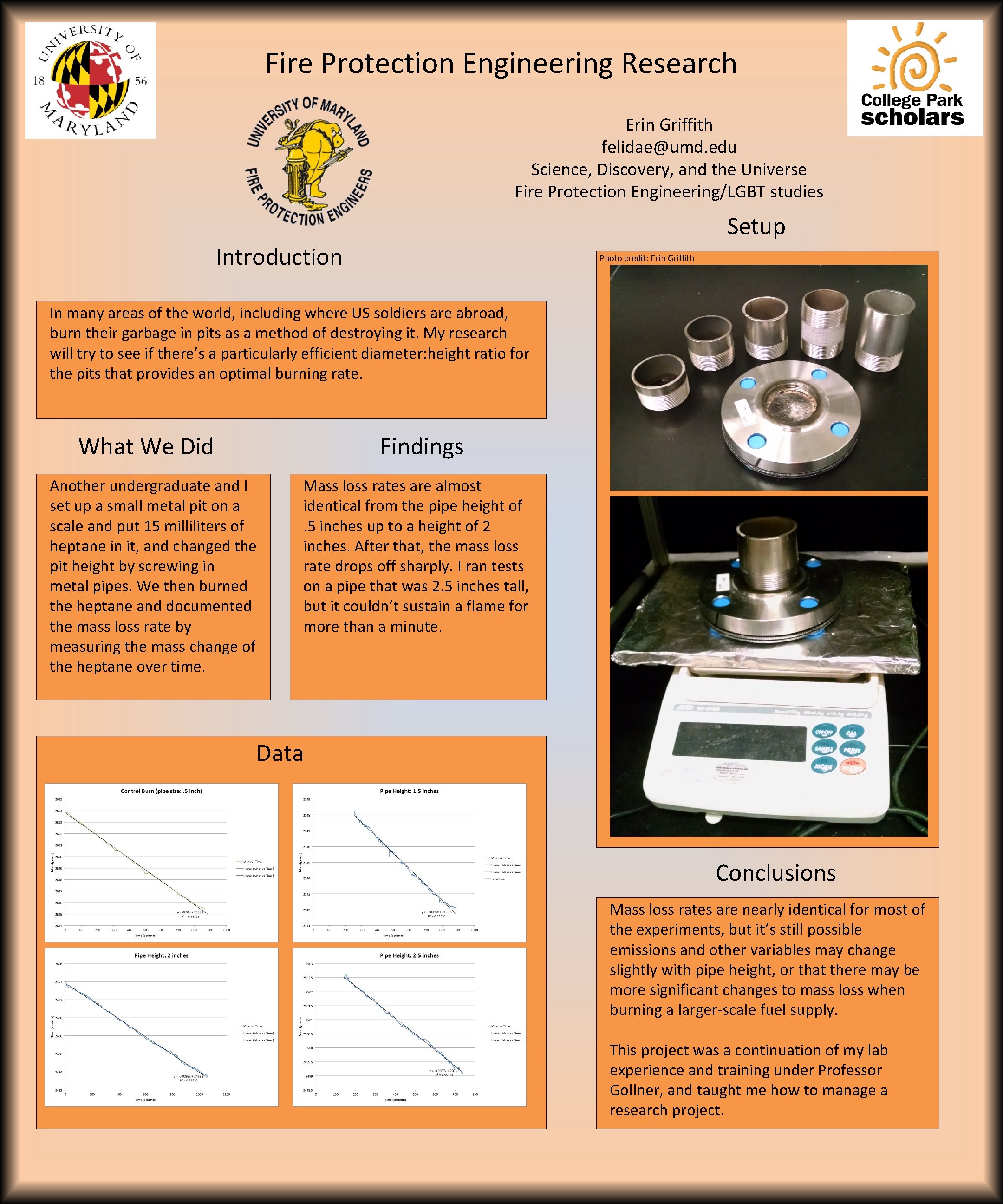
Fire Protection Engineering Research Erin Griffith felidae@umd. edu Science, Discovery, and the Universe Fire Protection Engineering/LGBT studies Setup Introduction Photo credit: Erin Griffith In many areas of the world, including where US soldiers are abroad, burn their garbage in pits as a method of destroying it. My research will try to see if there’s a particularly efficient diameter: height ratio for the pits that provides an optimal burning rate. What We Did Findings Another undergraduate and I set up a small metal pit on a scale and put 15 milliliters of heptane in it, and changed the pit height by screwing in metal pipes. We then burned the heptane and documented the mass loss rate by measuring the mass change of the heptane over time. Mass loss rates are almost identical from the pipe height of. 5 inches up to a height of 2 inches. After that, the mass loss rate drops off sharply. I ran tests on a pipe that was 2. 5 inches tall, but it couldn’t sustain a flame for more than a minute. Data Conclusions Mass loss rates are nearly identical for most of the experiments, but it’s still possible emissions and other variables may change slightly with pipe height, or that there may be more significant changes to mass loss when burning a larger-scale fuel supply. This project was a continuation of my lab experience and training under Professor Gollner, and taught me how to manage a research project.