
FIRE PROTECTION Classes of Fire Volume 2 Issue
- Slides: 6
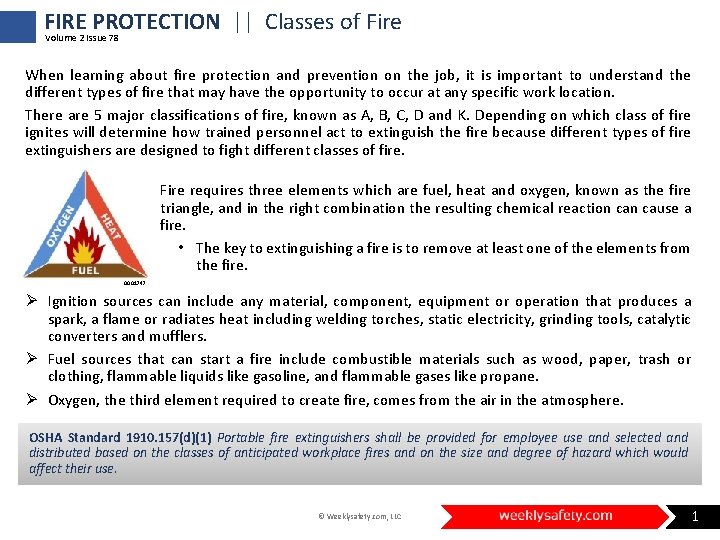
FIRE PROTECTION || Classes of Fire Volume 2 Issue 78 When learning about fire protection and prevention on the job, it is important to understand the different types of fire that may have the opportunity to occur at any specific work location. There are 5 major classifications of fire, known as A, B, C, D and K. Depending on which class of fire ignites will determine how trained personnel act to extinguish the fire because different types of fire extinguishers are designed to fight different classes of fire. Fire requires three elements which are fuel, heat and oxygen, known as the fire triangle, and in the right combination the resulting chemical reaction cause a fire. • The key to extinguishing a fire is to remove at least one of the elements from the fire. 0001747 Ø Ignition sources can include any material, component, equipment or operation that produces a spark, a flame or radiates heat including welding torches, static electricity, grinding tools, catalytic converters and mufflers. Ø Fuel sources that can start a fire include combustible materials such as wood, paper, trash or clothing, flammable liquids like gasoline, and flammable gases like propane. Ø Oxygen, the third element required to create fire, comes from the air in the atmosphere. OSHA Standard 1910. 157(d)(1) Portable fire extinguishers shall be provided for employee use and selected and distributed based on the classes of anticipated workplace fires and on the size and degree of hazard which would affect their use. © Weeklysafety. com, LLC 1
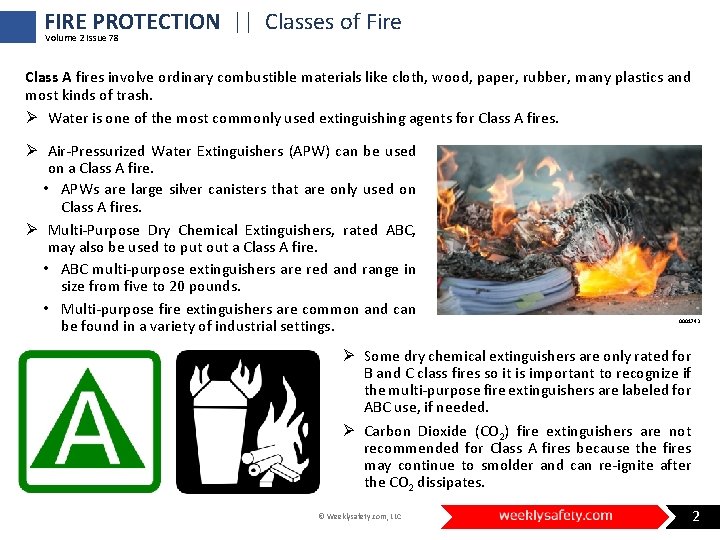
FIRE PROTECTION || Classes of Fire Volume 2 Issue 78 Class A fires involve ordinary combustible materials like cloth, wood, paper, rubber, many plastics and most kinds of trash. Ø Water is one of the most commonly used extinguishing agents for Class A fires. Ø Air-Pressurized Water Extinguishers (APW) can be used on a Class A fire. • APWs are large silver canisters that are only used on Class A fires. Ø Multi-Purpose Dry Chemical Extinguishers, rated ABC, may also be used to put out a Class A fire. • ABC multi-purpose extinguishers are red and range in size from five to 20 pounds. • Multi-purpose fire extinguishers are common and can be found in a variety of industrial settings. 0001743 Ø Some dry chemical extinguishers are only rated for B and C class fires so it is important to recognize if the multi-purpose fire extinguishers are labeled for ABC use, if needed. Ø Carbon Dioxide (CO 2) fire extinguishers are not recommended for Class A fires because the fires may continue to smolder and can re-ignite after the CO 2 dissipates. © Weeklysafety. com, LLC 2
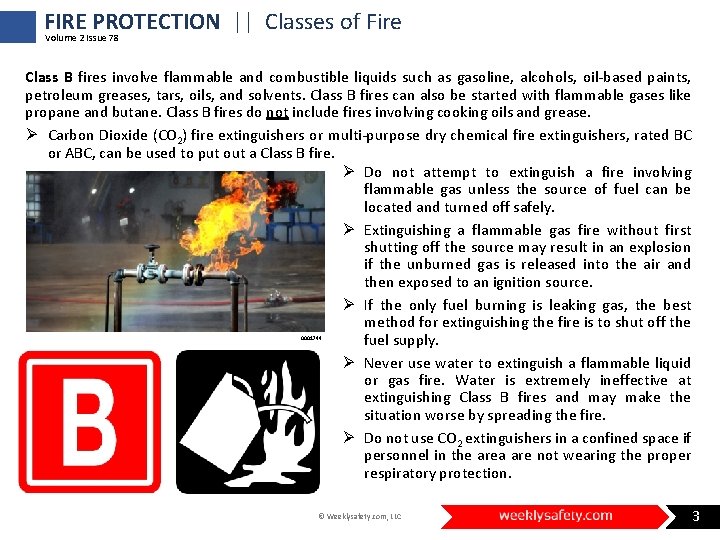
FIRE PROTECTION || Classes of Fire Volume 2 Issue 78 Class B fires involve flammable and combustible liquids such as gasoline, alcohols, oil-based paints, petroleum greases, tars, oils, and solvents. Class B fires can also be started with flammable gases like propane and butane. Class B fires do not include fires involving cooking oils and grease. Ø Carbon Dioxide (CO 2) fire extinguishers or multi-purpose dry chemical fire extinguishers, rated BC or ABC, can be used to put out a Class B fire. Ø Do not attempt to extinguish a fire involving flammable gas unless the source of fuel can be located and turned off safely. Ø Extinguishing a flammable gas fire without first shutting off the source may result in an explosion if the unburned gas is released into the air and then exposed to an ignition source. Ø If the only fuel burning is leaking gas, the best method for extinguishing the fire is to shut off the fuel supply. Ø Never use water to extinguish a flammable liquid or gas fire. Water is extremely ineffective at extinguishing Class B fires and may make the situation worse by spreading the fire. Ø Do not use CO 2 extinguishers in a confined space if personnel in the area are not wearing the proper respiratory protection. 0001744 © Weeklysafety. com, LLC 3
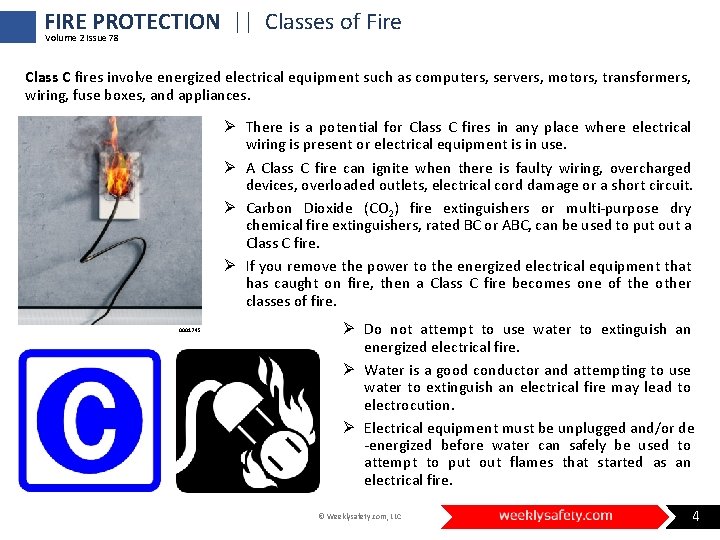
FIRE PROTECTION || Classes of Fire Volume 2 Issue 78 Class C fires involve energized electrical equipment such as computers, servers, motors, transformers, wiring, fuse boxes, and appliances. Ø There is a potential for Class C fires in any place where electrical wiring is present or electrical equipment is in use. Ø A Class C fire can ignite when there is faulty wiring, overcharged devices, overloaded outlets, electrical cord damage or a short circuit. Ø Carbon Dioxide (CO 2) fire extinguishers or multi-purpose dry chemical fire extinguishers, rated BC or ABC, can be used to put out a Class C fire. Ø If you remove the power to the energized electrical equipment that has caught on fire, then a Class C fire becomes one of the other classes of fire. 0001745 Ø Do not attempt to use water to extinguish an energized electrical fire. Ø Water is a good conductor and attempting to use water to extinguish an electrical fire may lead to electrocution. Ø Electrical equipment must be unplugged and/or de -energized before water can safely be used to attempt to put out flames that started as an electrical fire. © Weeklysafety. com, LLC 4
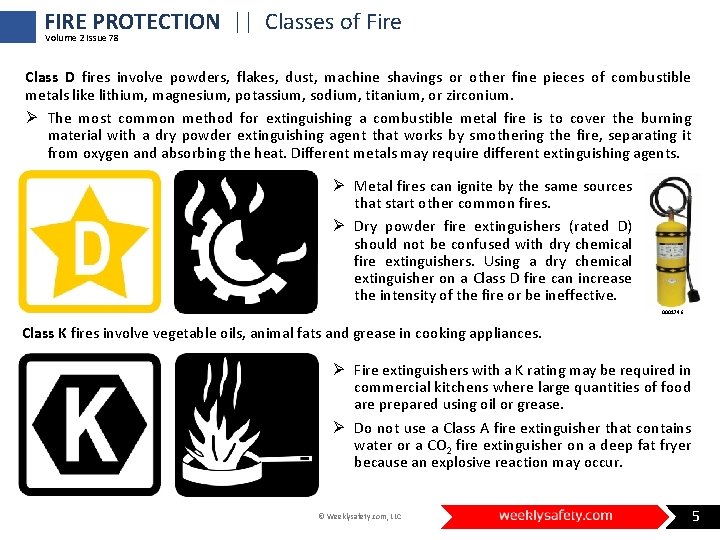
FIRE PROTECTION || Classes of Fire Volume 2 Issue 78 Class D fires involve powders, flakes, dust, machine shavings or other fine pieces of combustible metals like lithium, magnesium, potassium, sodium, titanium, or zirconium. Ø The most common method for extinguishing a combustible metal fire is to cover the burning material with a dry powder extinguishing agent that works by smothering the fire, separating it from oxygen and absorbing the heat. Different metals may require different extinguishing agents. Ø Metal fires can ignite by the same sources that start other common fires. Ø Dry powder fire extinguishers (rated D) should not be confused with dry chemical fire extinguishers. Using a dry chemical extinguisher on a Class D fire can increase the intensity of the fire or be ineffective. 0001746 Class K fires involve vegetable oils, animal fats and grease in cooking appliances. Ø Fire extinguishers with a K rating may be required in commercial kitchens where large quantities of food are prepared using oil or grease. Ø Do not use a Class A fire extinguisher that contains water or a CO 2 fire extinguisher on a deep fat fryer because an explosive reaction may occur. © Weeklysafety. com, LLC 5
FIRE PROTECTION || Classes of Fire Volume 2 Issue 78 COPYRIGHT AND DISCLAIMER This material is the copyrighted property of Weeklysafety. com, LLC. Purchase of this material from Weeklysafety. com, LLC grants the owner the right to use this material for workplace safety and education purposes only. Use of this material for any other purpose, particularly commercial use, is prohibited. This material, including the photos, may not be resold. Weeklysafety. com, LLC does not warrant or assume any legal liability or responsibility for the accuracy, completeness, or usefulness of any information, apparatus, product, or process disclosed in these materials. Photos shown in this presentation may depict situations that are not in compliance with applicable Occupational Safety and Health Administration (OSHA) safety requirements. These materials are meant for informational purposes only and it is not the intent of Weeklysafety. com, LLC to provide compliance-based training. The intent is more to address hazard awareness in the construction and related industries, and to recognize the potential hazards present in many workplaces. These materials are intended to discuss Federal Regulations only, as individual State requirements may be more stringent. Many states operate their own state OSHA and may have standards that are different from information presented in this training. It is the responsibility of the employer and its employees to comply with all pertinent OSHA safety rules and regulations in the jurisdiction in which they work. PHOTO ACKNOWLEDGMENTS Unless specified below, all photos are the copyrighted property of Weeklysafety. com, LLC and may not be used in any other training materials or resold for any purpose. • 0001743 – 0001745 Shutterstock License for Weeklysafety. com • 0001746 Amerex; Class D. amerex-fire. com/products/class-d-stored-pressure-dry-powder-extinguisher/ • 0001747 Wikimedia Commons; Fire triangle. en. wikipedia. org/wiki/File: Fire_triangle. svg For more information on this weekly safety topic, other topics that are available and the full list of FAQs please visit www. weeklysafety. com or email safety@weeklysafety. com. © Weeklysafety. com, LLC 6