
Fire Protection and Safety Management Written by Tony
Fire Protection and Safety Management Written by Tony Vinckx

Overview The Fire Protection Safety Management plan is designed to protect persons within the facility from danger of fire, and it provides guidelines for response in the event of an actual fire or fire drill. It is crucial that all employees be familiar with this plan so that they may react appropriately in an emergency situation, and by doing so ensure the safety of patients, visitors, other employees, and themselves.

Learning Objectives Upon completion of this lesson, you will be able to: Ø Identify characteristics of a fire Ø Respond appropriately if a fire occurs Ø Operate a fire extinguisher Ø Recognize alarm and sprinkler systems
Safety Management Plan In order to protect patients, visitors, employees and property from fire and smoke, our hospital has implemented a Life Safety Management Plan that contains the following processes: : Protect patients, visitors, employees and property from fires. Ensure properation of fire detection, alarm, and suppression systems through a program of inspection, testing, and maintenance. Provide portable fire extinguishers according to established criteria. Ensure that acquisitions such as curtains, furniture, waste baskets, bedding, and other equipment meet established fire safety criteria. Investigate and recommend actions to correct deficiencies, failures, and user errors in established fire safety criteria. Provide fire safety orientation for new employees and annual refreshers thereafter. Establish fire safety criteria.

Staff Training All employees are trained in the proper response to fire/smoke conditions, and know their roles in such an event, through: - new employee orientation - participation in regular fire drills - periodic retraining
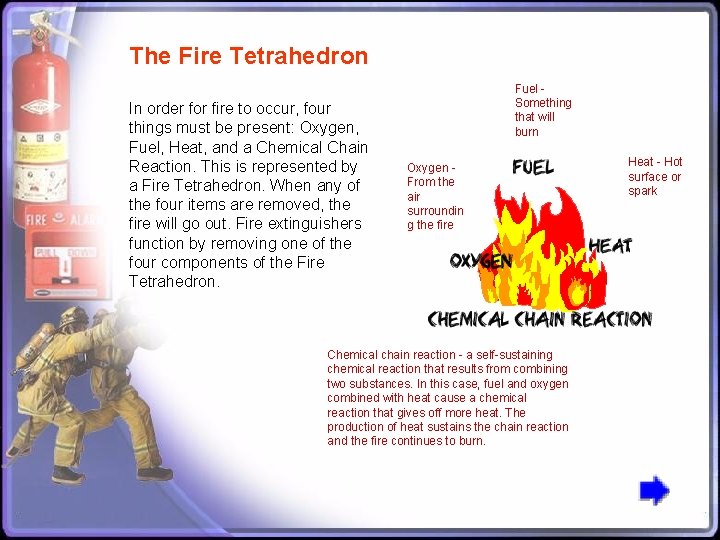
The Fire Tetrahedron In order for fire to occur, four things must be present: Oxygen, Fuel, Heat, and a Chemical Chain Reaction. This is represented by a Fire Tetrahedron. When any of the four items are removed, the fire will go out. Fire extinguishers function by removing one of the four components of the Fire Tetrahedron. Fuel Something that will burn Oxygen From the air surroundin g the fire Chemical chain reaction - a self-sustaining chemical reaction that results from combining two substances. In this case, fuel and oxygen combined with heat cause a chemical reaction that gives off more heat. The production of heat sustains the chain reaction and the fire continues to burn. Heat - Hot surface or spark
RACE In the event of a fire you have to act fast. Use the word RACE to remember what to do.

The "R" in RACE is for Rescue Personnel. Your first priority is to get patients, visitors, and other employees out of immediate danger. Warn personnel! Help those who need help to safety. You must be the judge of when you should cease rescue and get yourself to safety!
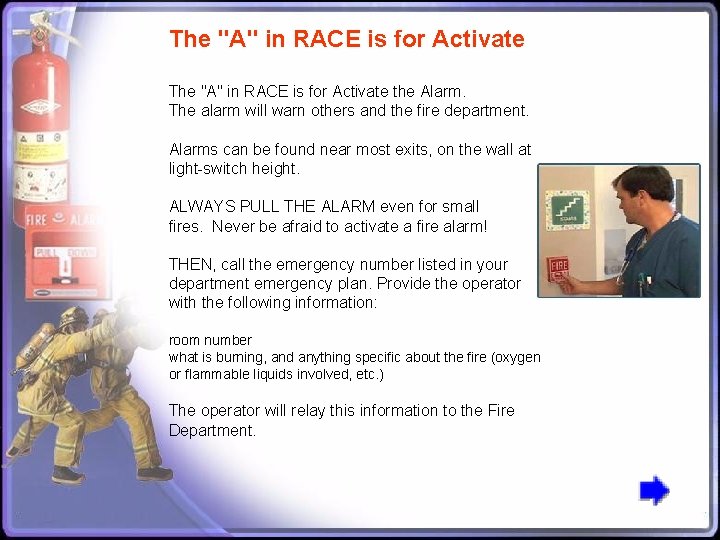
The "A" in RACE is for Activate the Alarm. The alarm will warn others and the fire department. Alarms can be found near most exits, on the wall at light-switch height. ALWAYS PULL THE ALARM even for small fires. Never be afraid to activate a fire alarm! THEN, call the emergency number listed in your department emergency plan. Provide the operator with the following information: room number what is burning, and anything specific about the fire (oxygen or flammable liquids involved, etc. ) The operator will relay this information to the Fire Department.
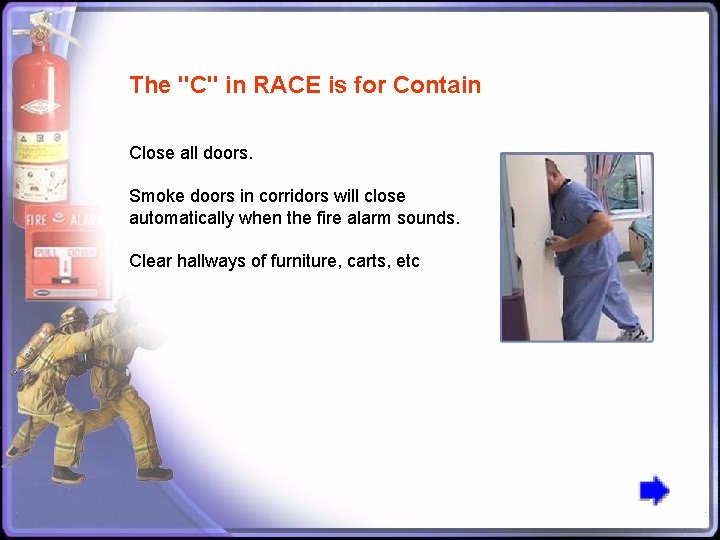
The "C" in RACE is for Contain Close all doors. Smoke doors in corridors will close automatically when the fire alarm sounds. Clear hallways of furniture, carts, etc
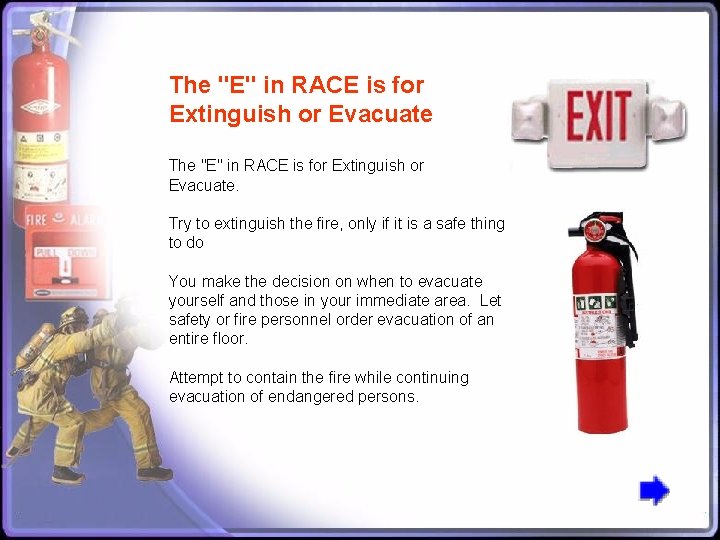
The "E" in RACE is for Extinguish or Evacuate. Try to extinguish the fire, only if it is a safe thing to do You make the decision on when to evacuate yourself and those in your immediate area. Let safety or fire personnel order evacuation of an entire floor. Attempt to contain the fire while continuing evacuation of endangered persons.
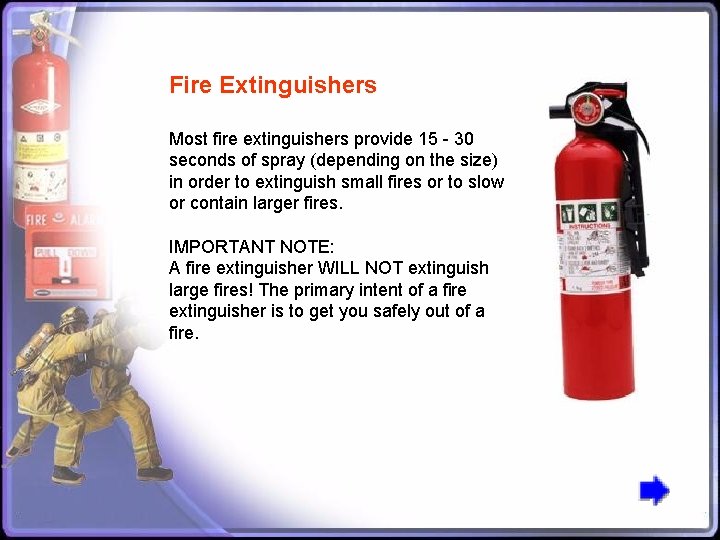
Fire Extinguishers Most fire extinguishers provide 15 - 30 seconds of spray (depending on the size) in order to extinguish small fires or to slow or contain larger fires. IMPORTANT NOTE: A fire extinguisher WILL NOT extinguish large fires! The primary intent of a fire extinguisher is to get you safely out of a fire.
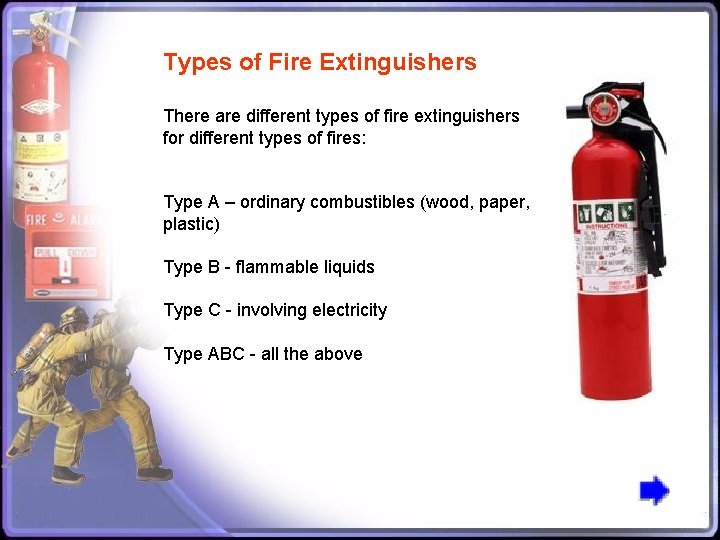
Types of Fire Extinguishers There are different types of fire extinguishers for different types of fires: Type A – ordinary combustibles (wood, paper, plastic) Type B - flammable liquids Type C - involving electricity Type ABC - all the above
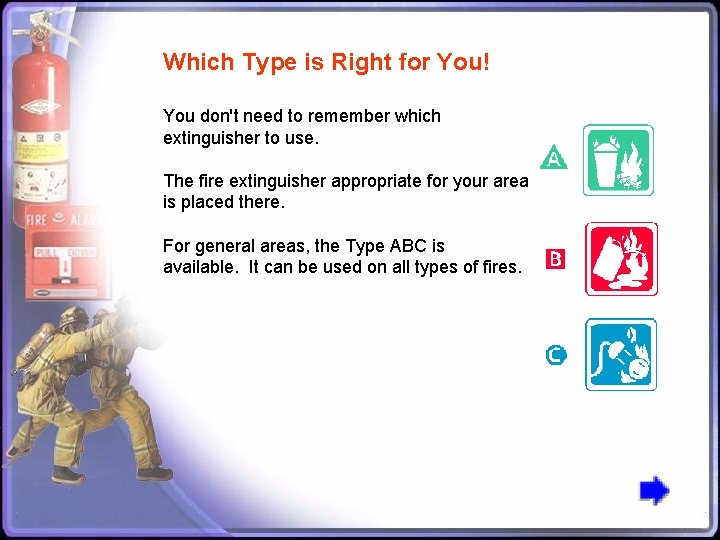
Which Type is Right for You! You don't need to remember which extinguisher to use. The fire extinguisher appropriate for your area is placed there. For general areas, the Type ABC is available. It can be used on all types of fires.
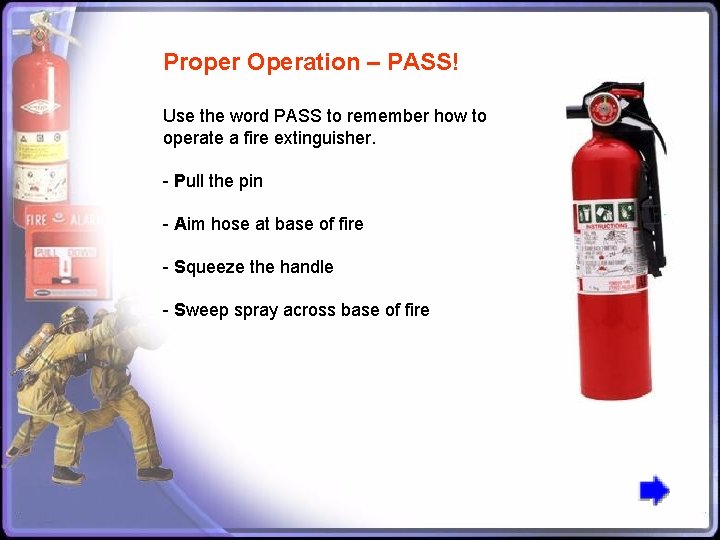
Proper Operation – PASS! Use the word PASS to remember how to operate a fire extinguisher. - Pull the pin - Aim hose at base of fire - Squeeze the handle - Sweep spray across base of fire
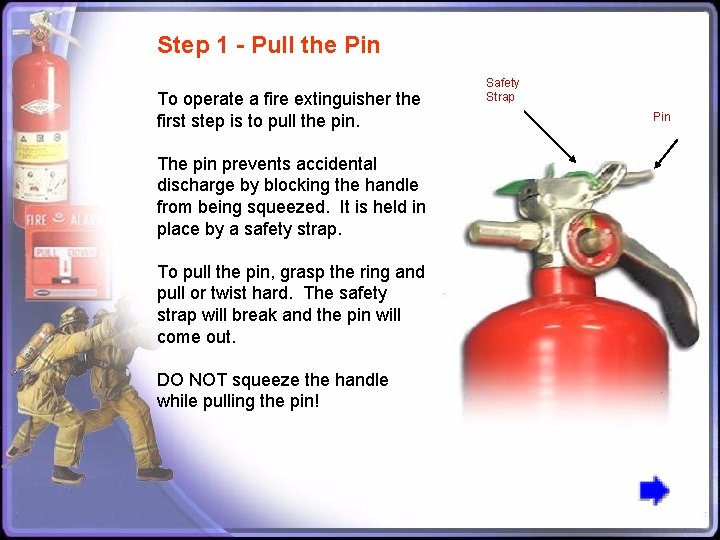
Step 1 - Pull the Pin To operate a fire extinguisher the first step is to pull the pin. The pin prevents accidental discharge by blocking the handle from being squeezed. It is held in place by a safety strap. To pull the pin, grasp the ring and pull or twist hard. The safety strap will break and the pin will come out. DO NOT squeeze the handle while pulling the pin! Safety Strap Pin
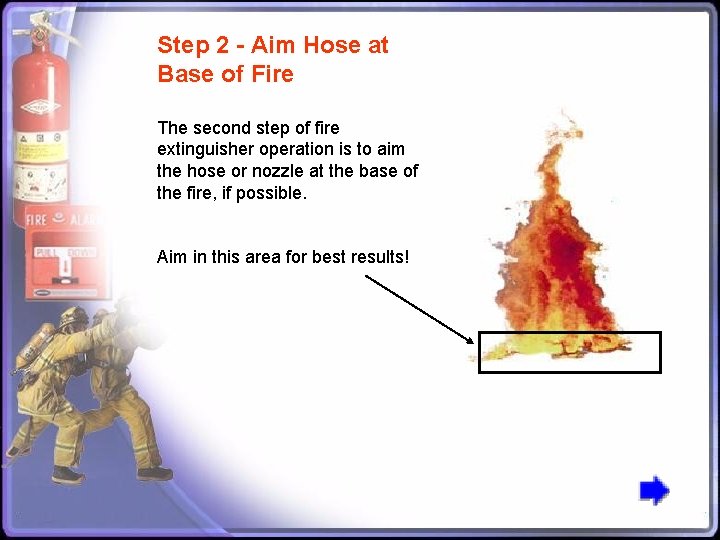
Step 2 - Aim Hose at Base of Fire The second step of fire extinguisher operation is to aim the hose or nozzle at the base of the fire, if possible. Aim in this area for best results!
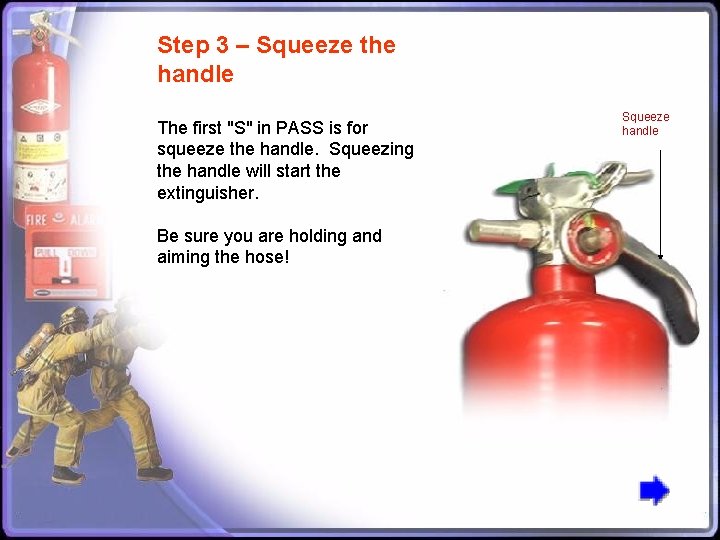
Step 3 – Squeeze the handle The first "S" in PASS is for squeeze the handle. Squeezing the handle will start the extinguisher. Be sure you are holding and aiming the hose! Squeeze handle
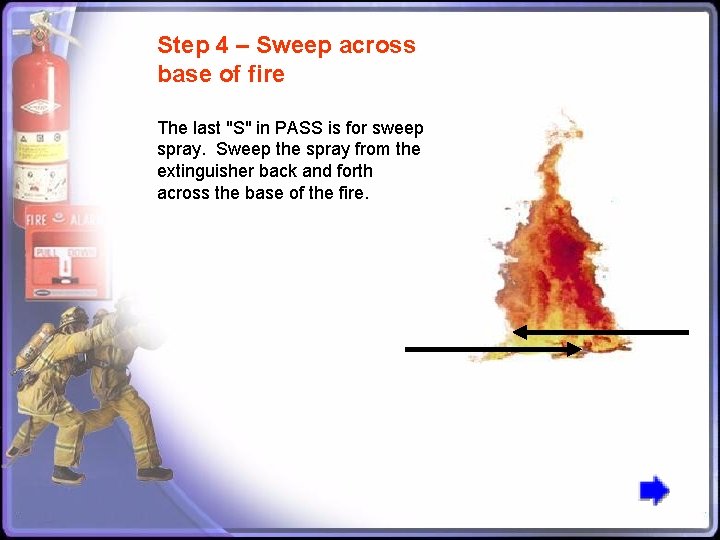
Step 4 – Sweep across base of fire The last "S" in PASS is for sweep spray. Sweep the spray from the extinguisher back and forth across the base of the fire.
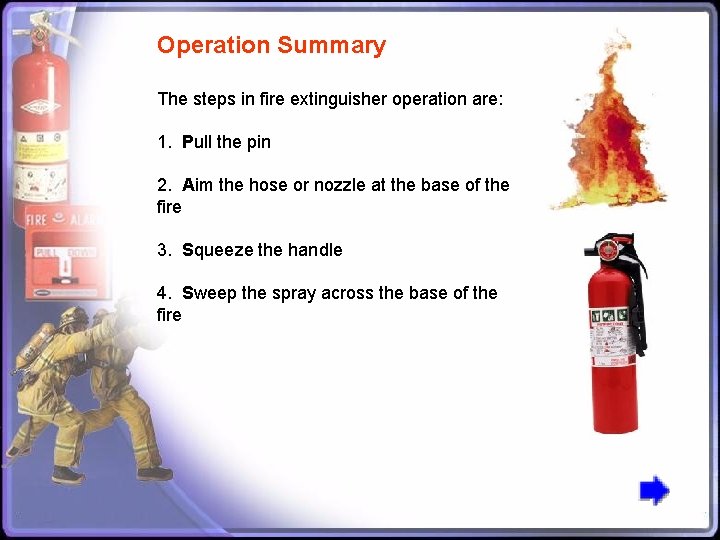
Operation Summary The steps in fire extinguisher operation are: 1. Pull the pin 2. Aim the hose or nozzle at the base of the fire 3. Squeeze the handle 4. Sweep the spray across the base of the fire
- Slides: 20