
Fire Protection and Prevention l 29 CFR 1926


- Slides: 57
Fire Protection and Prevention l 29 CFR 1926, Subpart F Presented by: ETTA, OSH Division, 919 -807 -2875 This presentation was created by the N. C. Department of Labor for safety and health training.
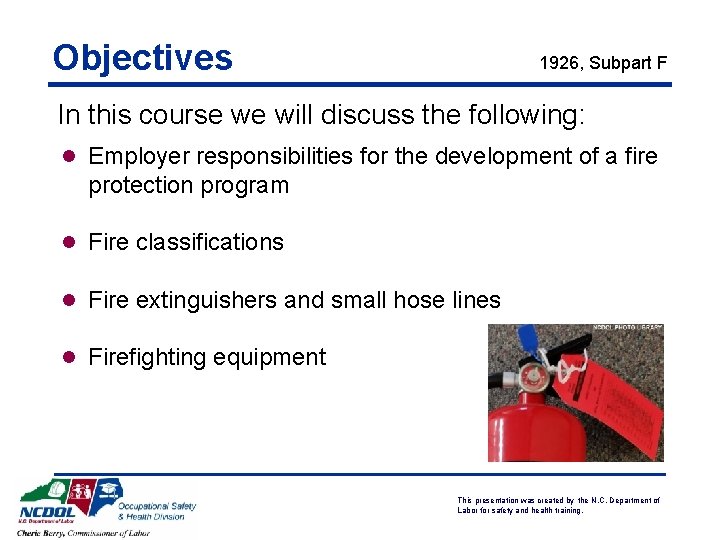
Objectives 1926, Subpart F In this course we will discuss the following: l Employer responsibilities for the development of a fire protection program l Fire classifications l Fire extinguishers and small hose lines l Firefighting equipment This presentation was created by the N. C. Department of Labor for safety and health training.
Objectives 1926, Subpart F l Ignition hazards l Temporary buildings l Open yard combustible material storage l Indoor material storage This presentation was created by the N. C. Department of Labor for safety and health training.
General Requirements 1926. 150(a)(1) l Employer is responsible for - Development of a fire protection program to be followed throughout all phases of the construction and demolition work - Providing for the firefighting equipment as specified in this Subpart - As fire hazards occur, there shall be no delay in providing the necessary equipment This presentation was created by the N. C. Department of Labor for safety and health training.
Types of Fires 1926. 150 Table F-1 l Fires are classified by the type of FUEL they burn l 4 Types: - A: Normal combustibles - B: Flammable liquids - C: Electrical - D: Combustible metals This presentation was created by the N. C. Department of Labor for safety and health training.
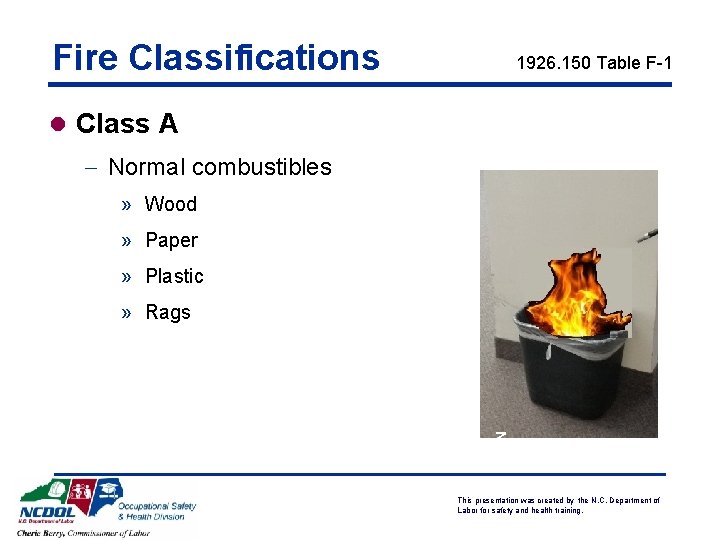
Fire Classifications 1926. 150 Table F-1 l Class A - Normal combustibles » Wood » Paper » Plastic » Rags This presentation was created by the N. C. Department of Labor for safety and health training.
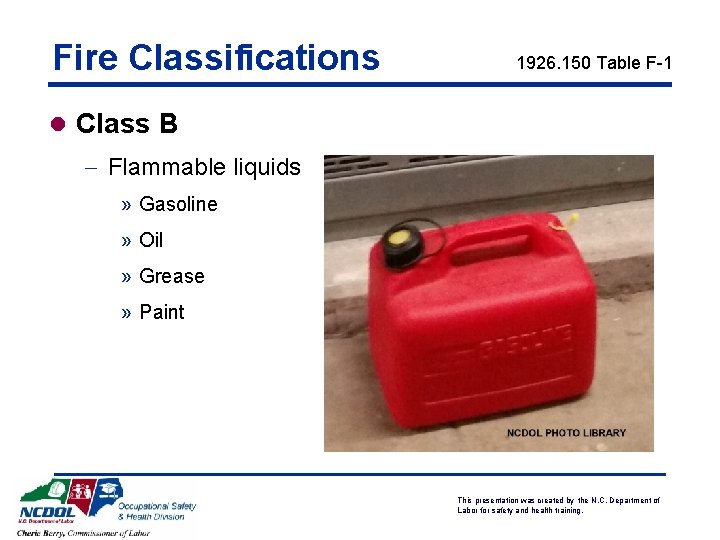
Fire Classifications 1926. 150 Table F-1 l Class B - Flammable liquids » Gasoline » Oil » Grease » Paint This presentation was created by the N. C. Department of Labor for safety and health training.
Fire Classifications 1926. 150 Table F-1 l Class C - Electrical » Electrical junctions » Motors » Generators » Heaters This presentation was created by the N. C. Department of Labor for safety and health training.
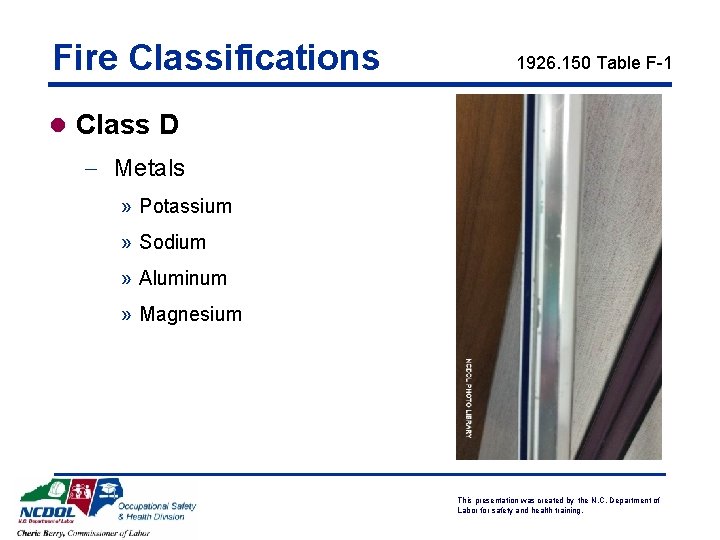
Fire Classifications 1926. 150 Table F-1 l Class D - Metals » Potassium » Sodium » Aluminum » Magnesium This presentation was created by the N. C. Department of Labor for safety and health training.
Water Supply 1926. 150(b) l Water supply (temporary or permanent) required to properly operate firefighting equipment - Must be of sufficient volume, duration and pressure - To be made available as soon as combustible materials accumulate l Where underground water mains are to be provided, must be installed, completed and available for use as soon as practicable This presentation was created by the N. C. Department of Labor for safety and health training.
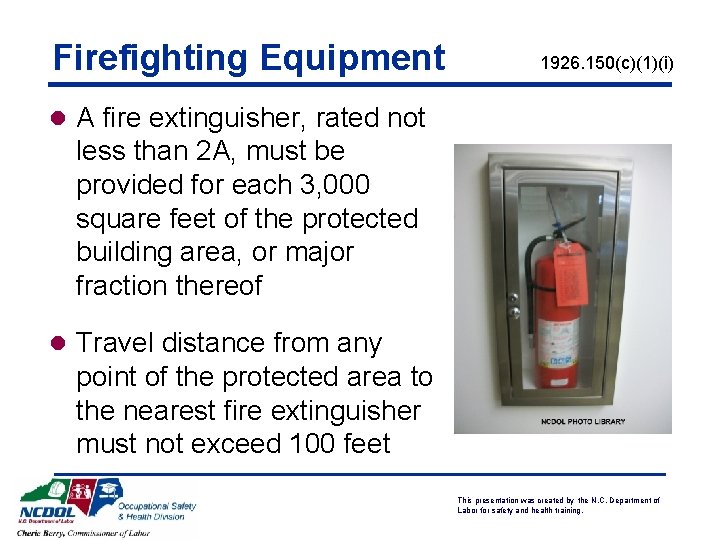
Firefighting Equipment 1926. 150(c)(1)(i) l A fire extinguisher, rated not less than 2 A, must be provided for each 3, 000 square feet of the protected building area, or major fraction thereof l Travel distance from any point of the protected area to the nearest fire extinguisher must not exceed 100 feet This presentation was created by the N. C. Department of Labor for safety and health training.
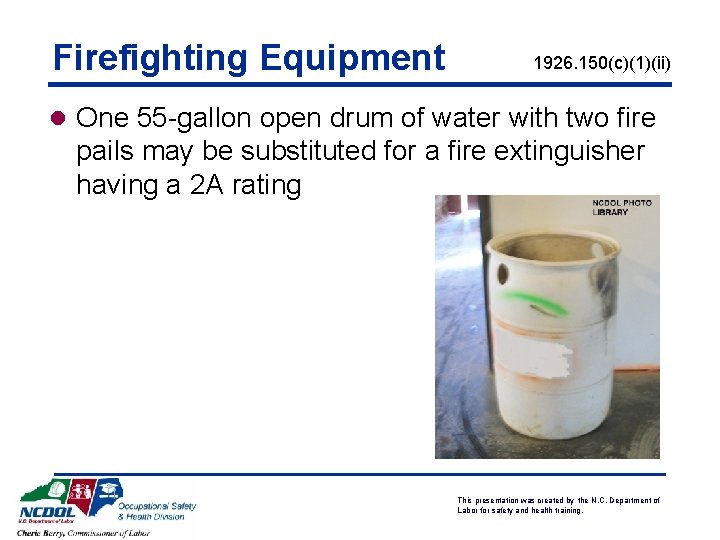
Firefighting Equipment 1926. 150(c)(1)(ii) l One 55 -gallon open drum of water with two fire pails may be substituted for a fire extinguisher having a 2 A rating This presentation was created by the N. C. Department of Labor for safety and health training.
Firefighting Equipment 1926. 150(c)(1)(iii) l A ½-inch diameter garden-type hose line, not to exceed 100 feet in length and equipped with a nozzle, may be substituted for a 2 A-rated fire extinguisher, provided it’s capable of discharging a minimum of 5 gallons per minute with a minimum hose stream range of 30 feet horizontally l Garden-type hose lines shall be mounted on conventional racks or reels l Number and location of hose racks or reels shall be such that at least one hose stream can be applied to all points in the area This presentation was created by the N. C. Department of Labor for safety and health training.
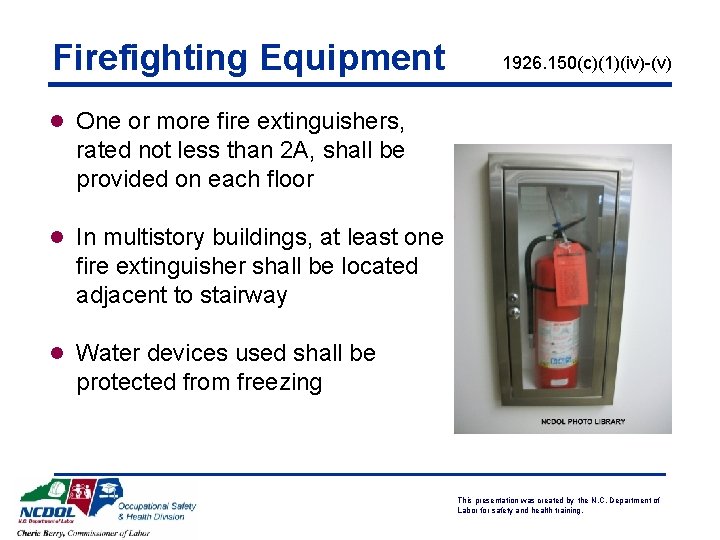
Firefighting Equipment 1926. 150(c)(1)(iv)-(v) l One or more fire extinguishers, rated not less than 2 A, shall be provided on each floor l In multistory buildings, at least one fire extinguisher shall be located adjacent to stairway l Water devices used shall be protected from freezing This presentation was created by the N. C. Department of Labor for safety and health training.
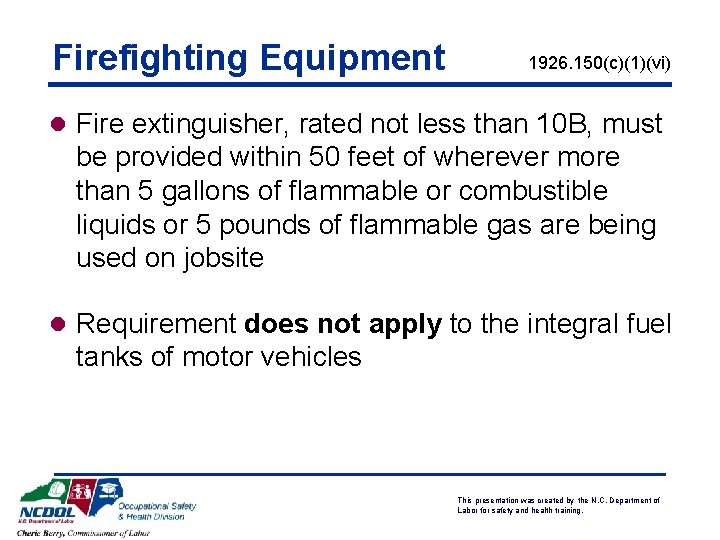
Firefighting Equipment 1926. 150(c)(1)(vi) l Fire extinguisher, rated not less than 10 B, must be provided within 50 feet of wherever more than 5 gallons of flammable or combustible liquids or 5 pounds of flammable gas are being used on jobsite l Requirement does not apply to the integral fuel tanks of motor vehicles This presentation was created by the N. C. Department of Labor for safety and health training.
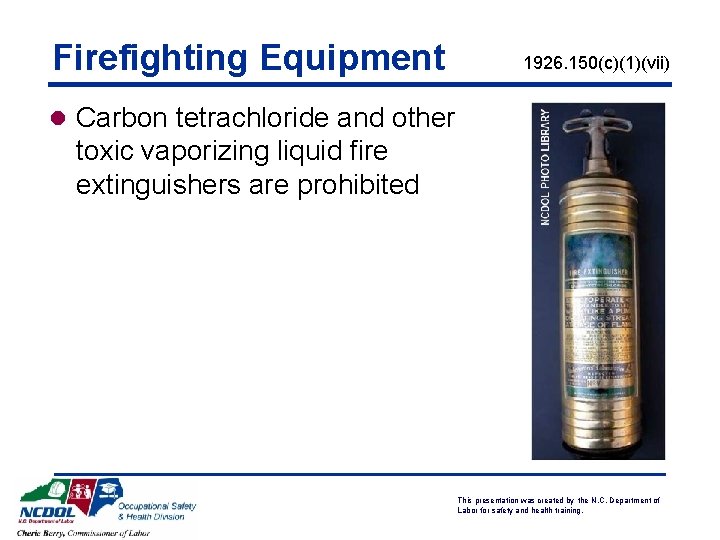
Firefighting Equipment 1926. 150(c)(1)(vii) l Carbon tetrachloride and other toxic vaporizing liquid fire extinguishers are prohibited This presentation was created by the N. C. Department of Labor for safety and health training.
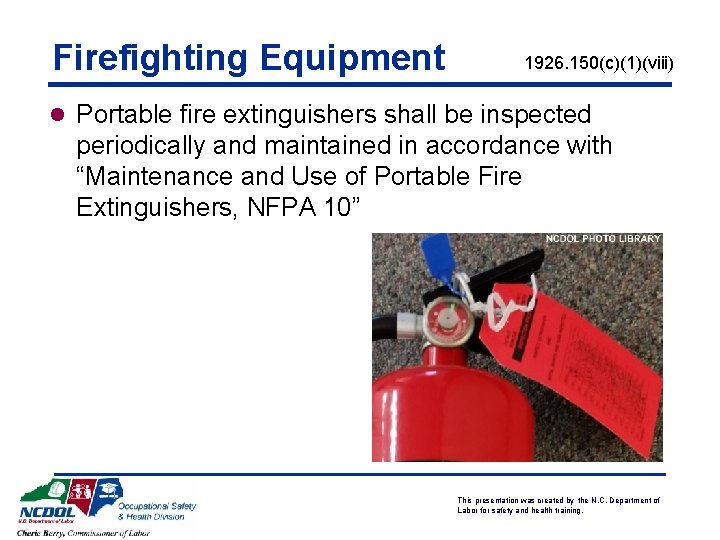
Firefighting Equipment 1926. 150(c)(1)(viii) l Portable fire extinguishers shall be inspected periodically and maintained in accordance with “Maintenance and Use of Portable Fire Extinguishers, NFPA 10” This presentation was created by the N. C. Department of Labor for safety and health training.
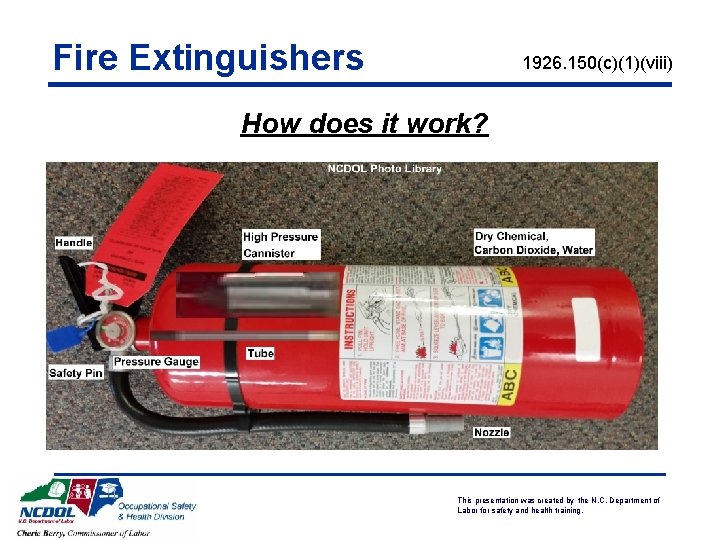
Fire Extinguishers 1926. 150(c)(1)(viii) How does it work? This presentation was created by the N. C. Department of Labor for safety and health training.
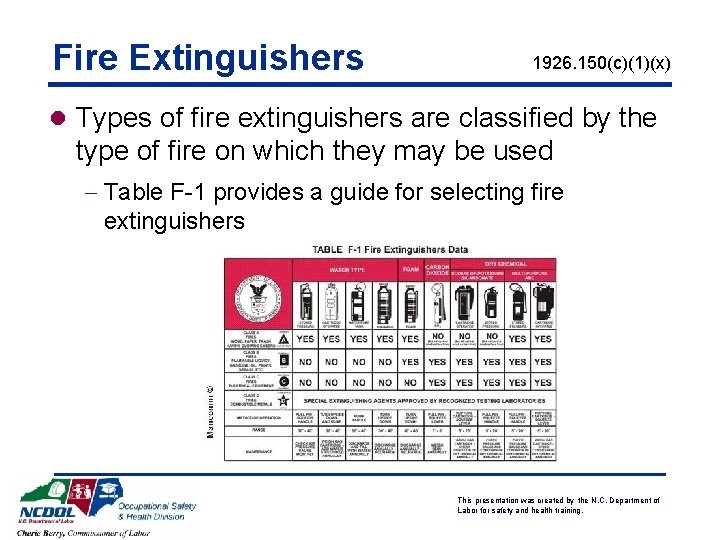
Fire Extinguishers 1926. 150(c)(1)(x) l Types of fire extinguishers are classified by the type of fire on which they may be used - Table F-1 provides a guide for selecting fire extinguishers This presentation was created by the N. C. Department of Labor for safety and health training.
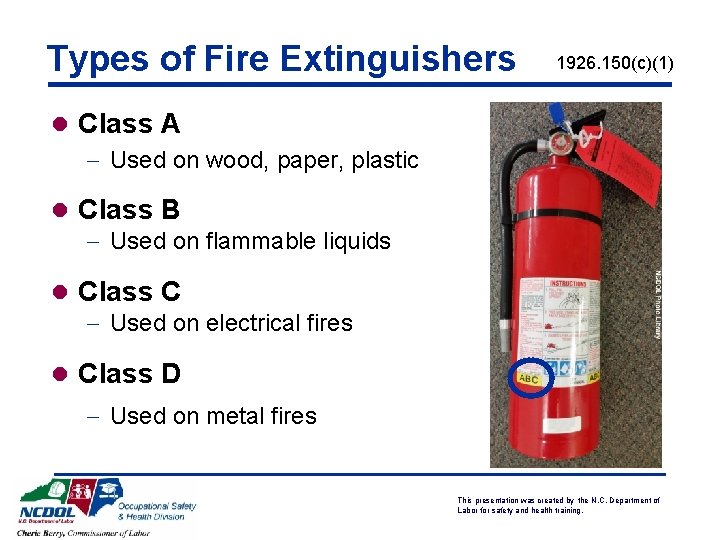
Types of Fire Extinguishers 1926. 150(c)(1) l Class A - Used on wood, paper, plastic l Class B - Used on flammable liquids l Class C - Used on electrical fires l Class D - Used on metal fires This presentation was created by the N. C. Department of Labor for safety and health training.
Use of Fire Extinguishers 1926. 150 l Using a fire extinguisher - Type (classification of fire) - Correct extinguisher l Use the PASS system This presentation was created by the N. C. Department of Labor for safety and health training.
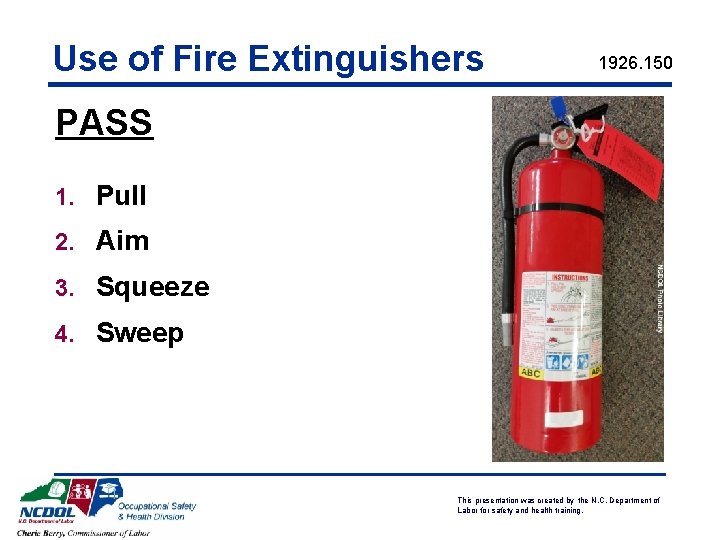
Use of Fire Extinguishers 1926. 150 PASS 1. Pull 2. Aim 3. Squeeze 4. Sweep This presentation was created by the N. C. Department of Labor for safety and health training.
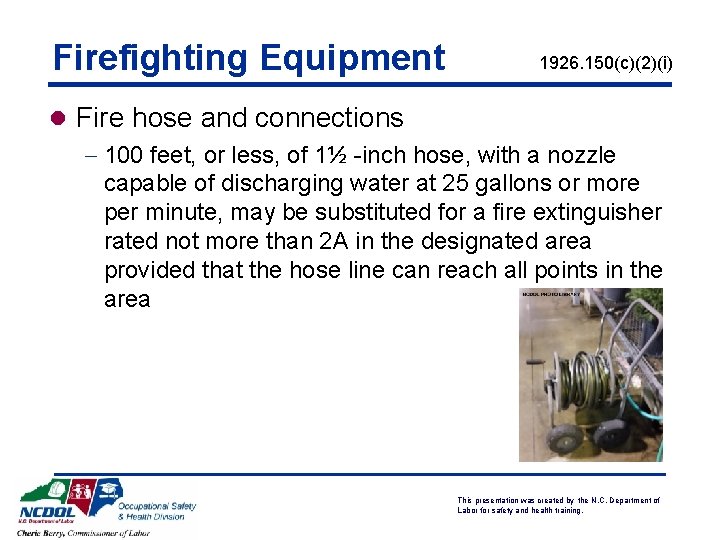
Firefighting Equipment 1926. 150(c)(2)(i) l Fire hose and connections - 100 feet, or less, of 1½ -inch hose, with a nozzle capable of discharging water at 25 gallons or more per minute, may be substituted for a fire extinguisher rated not more than 2 A in the designated area provided that the hose line can reach all points in the area This presentation was created by the N. C. Department of Labor for safety and health training.
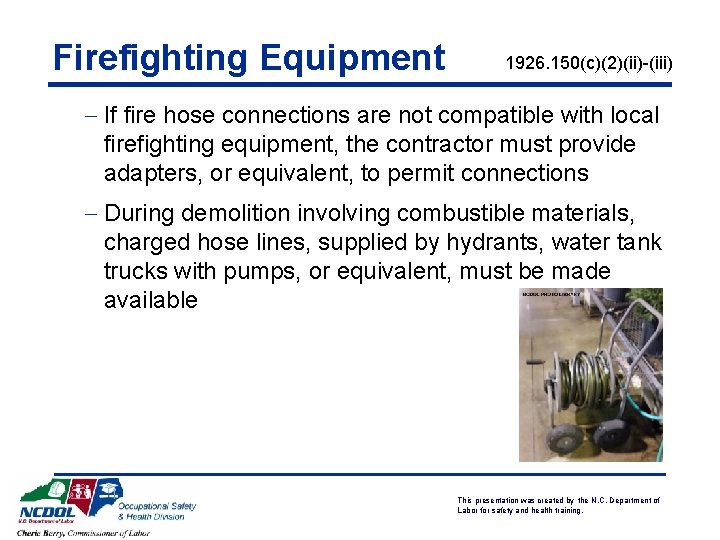
Firefighting Equipment 1926. 150(c)(2)(ii)-(iii) - If fire hose connections are not compatible with local firefighting equipment, the contractor must provide adapters, or equivalent, to permit connections - During demolition involving combustible materials, charged hose lines, supplied by hydrants, water tank trucks with pumps, or equivalent, must be made available This presentation was created by the N. C. Department of Labor for safety and health training.
Firefighting Equipment 1926. 150(d)(1)(i) l Sprinkler protection - If the facility being constructed includes the installation of automatic sprinkler protection, the installation shall closely follow the construction and be placed in service as soon as applicable laws permit following completion of each story - During demolition or alterations, existing automatic sprinkler installations must be retained in service as long as reasonable » Operation of sprinkler control valves is permitted only by properly authorized persons This presentation was created by the N. C. Department of Labor for safety and health training.
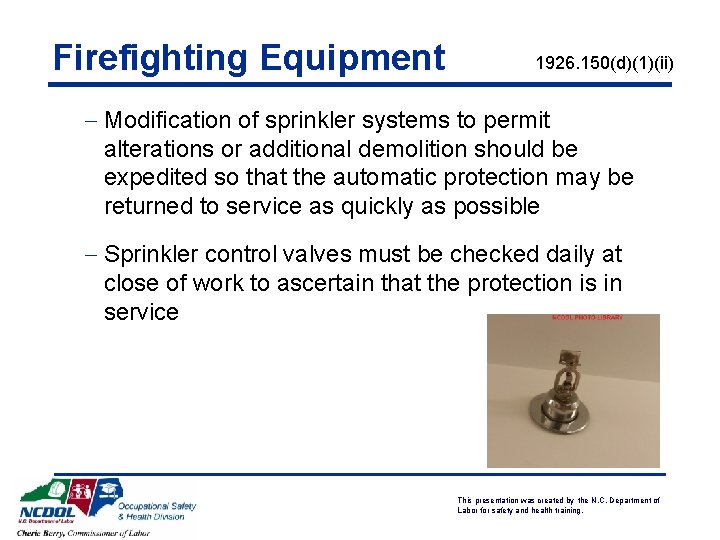
Firefighting Equipment 1926. 150(d)(1)(ii) - Modification of sprinkler systems to permit alterations or additional demolition should be expedited so that the automatic protection may be returned to service as quickly as possible - Sprinkler control valves must be checked daily at close of work to ascertain that the protection is in service This presentation was created by the N. C. Department of Labor for safety and health training.
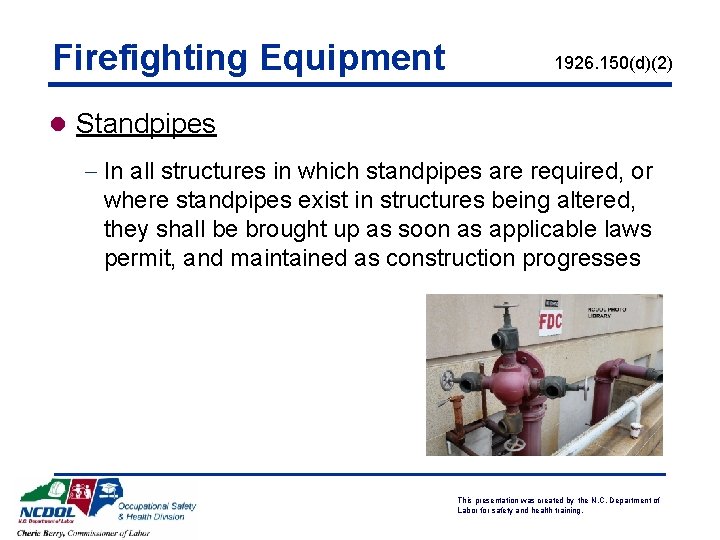
Firefighting Equipment 1926. 150(d)(2) l Standpipes - In all structures in which standpipes are required, or where standpipes exist in structures being altered, they shall be brought up as soon as applicable laws permit, and maintained as construction progresses This presentation was created by the N. C. Department of Labor for safety and health training.
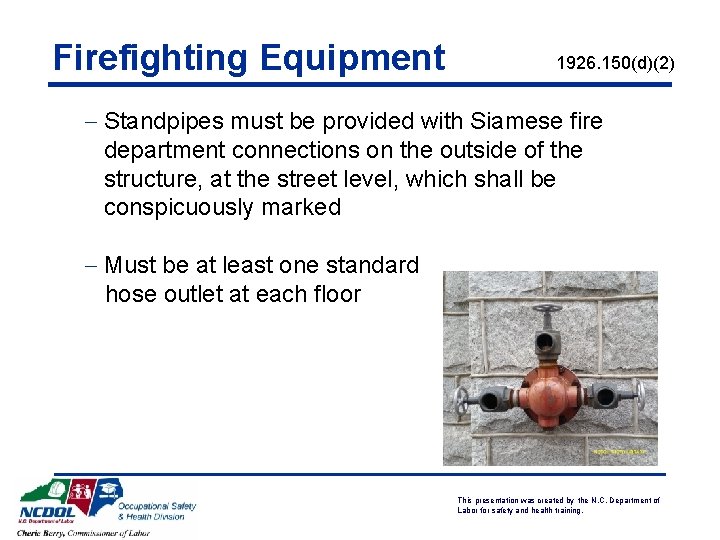
Firefighting Equipment 1926. 150(d)(2) - Standpipes must be provided with Siamese fire department connections on the outside of the structure, at the street level, which shall be conspicuously marked - Must be at least one standard hose outlet at each floor This presentation was created by the N. C. Department of Labor for safety and health training.
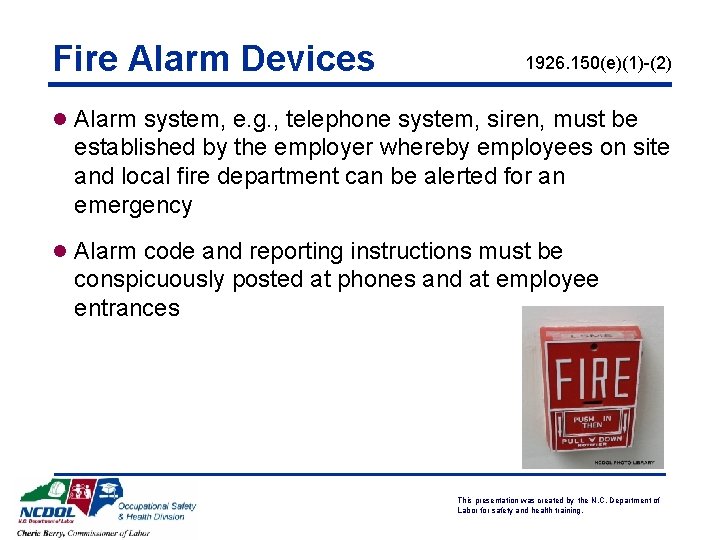
Fire Alarm Devices 1926. 150(e)(1)-(2) l Alarm system, e. g. , telephone system, siren, must be established by the employer whereby employees on site and local fire department can be alerted for an emergency l Alarm code and reporting instructions must be conspicuously posted at phones and at employee entrances This presentation was created by the N. C. Department of Labor for safety and health training.
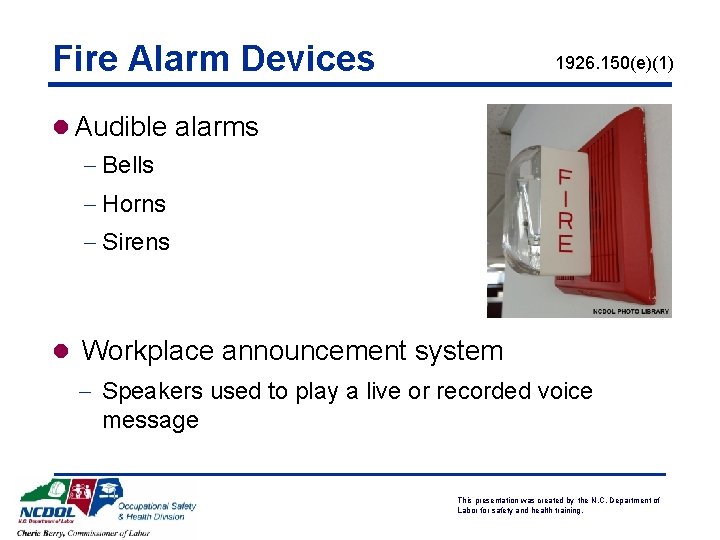
Fire Alarm Devices 1926. 150(e)(1) l Audible alarms - Bells - Horns - Sirens l Workplace announcement system - Speakers used to play a live or recorded voice message This presentation was created by the N. C. Department of Labor for safety and health training.
Fire Cutoffs 1926. 150(f)(1)-(2) l Fire walls and exit stairways, required for the completed buildings, must get construction priority l Fire doors, with automatic closing devices, must be hung on openings as soon as practicable l Fire cutoffs must be retained in buildings undergoing alterations or demolition until operations necessitate their removal This presentation was created by the N. C. Department of Labor for safety and health training.
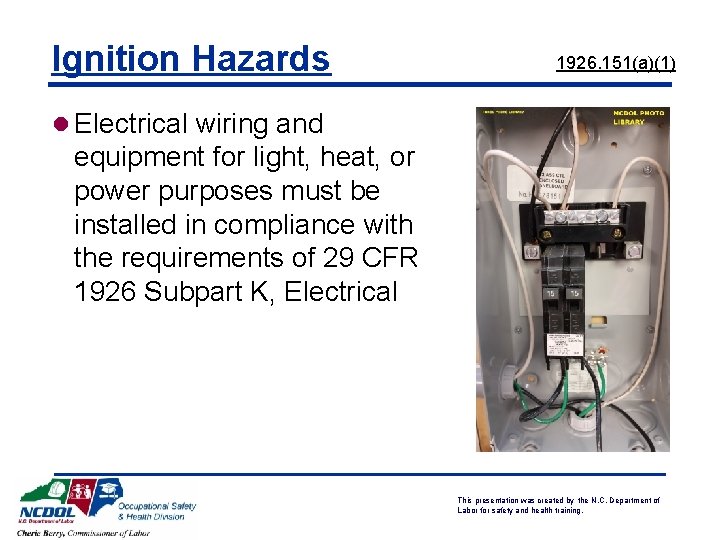
Ignition Hazards 1926. 151(a)(1) l Electrical wiring and equipment for light, heat, or power purposes must be installed in compliance with the requirements of 29 CFR 1926 Subpart K, Electrical This presentation was created by the N. C. Department of Labor for safety and health training.
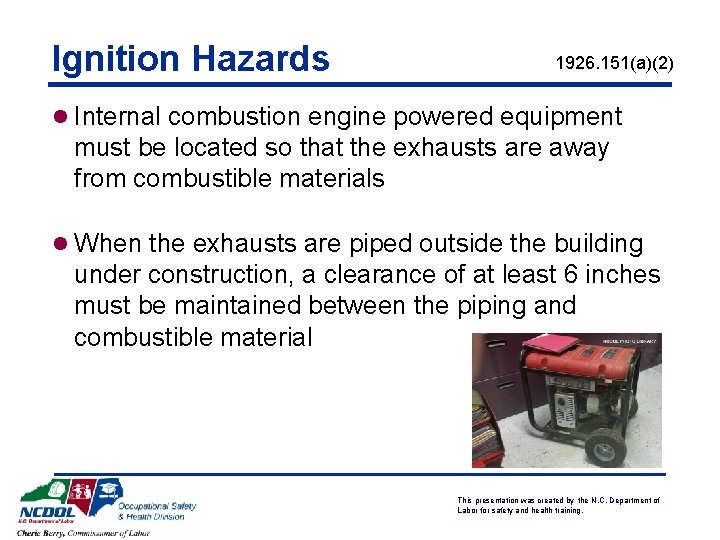
Ignition Hazards 1926. 151(a)(2) l Internal combustion engine powered equipment must be located so that the exhausts are away from combustible materials l When the exhausts are piped outside the building under construction, a clearance of at least 6 inches must be maintained between the piping and combustible material This presentation was created by the N. C. Department of Labor for safety and health training.
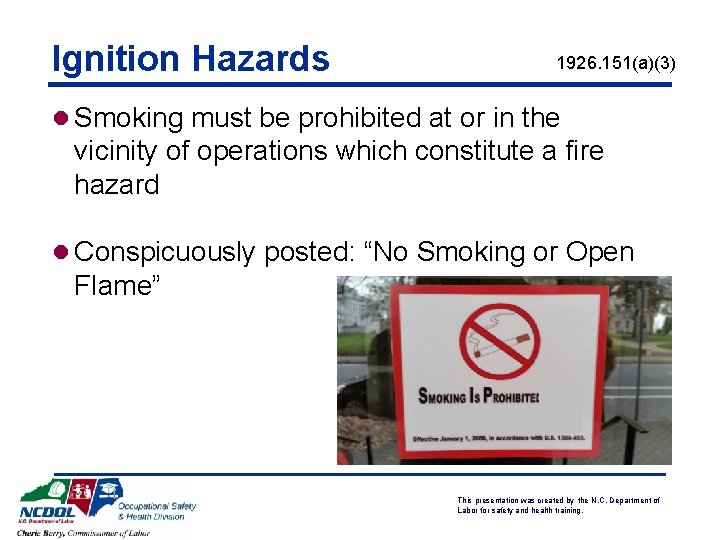
Ignition Hazards 1926. 151(a)(3) l Smoking must be prohibited at or in the vicinity of operations which constitute a fire hazard l Conspicuously posted: “No Smoking or Open Flame” This presentation was created by the N. C. Department of Labor for safety and health training.
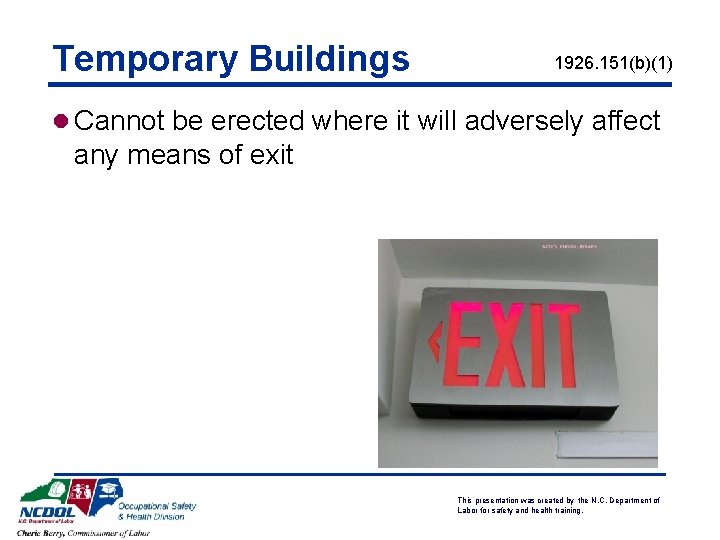
Temporary Buildings 1926. 151(b)(1) l Cannot be erected where it will adversely affect any means of exit This presentation was created by the N. C. Department of Labor for safety and health training.
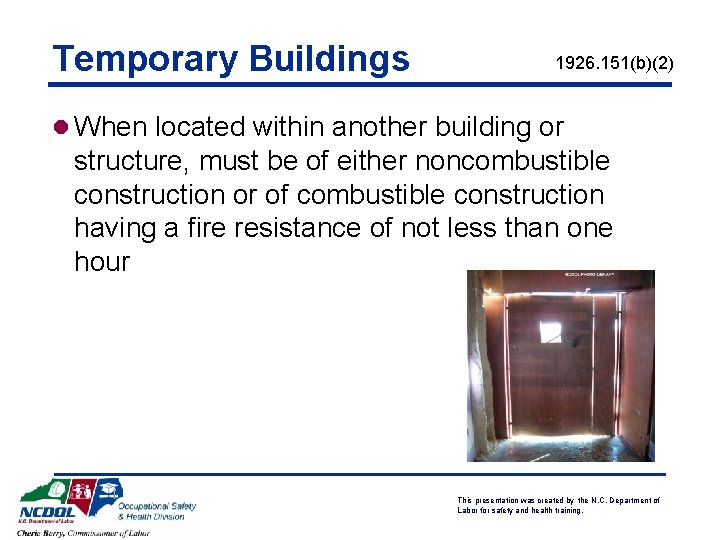
Temporary Buildings 1926. 151(b)(2) l When located within another building or structure, must be of either noncombustible construction or of combustible construction having a fire resistance of not less than one hour This presentation was created by the N. C. Department of Labor for safety and health training.
Temporary Buildings 1926. 151(b)(3) l Located other than inside another building l Not used for storage, handling, or use of flammable or combustible liquids, flammable gases, explosives, or blasting agents, or similar hazardous occupancies l Must be located at a distance of not less than 10 feet from another building or structure This presentation was created by the N. C. Department of Labor for safety and health training.
Temporary Buildings 1926. 151(b)(3) l Groups of temporary buildings, not exceeding 2, 000 square feet in aggregate l Must, for the purposes of 1926 Subpart F, be considered a single temporary building This presentation was created by the N. C. Department of Labor for safety and health training.
Open Yard Storage 1926. 151(c)(1)-(2) l Combustible materials must be piled with due regard to the stability of piles and in no case higher than 20 feet l Driveways between and around combustible storage piles must be at least 15 feet wide and maintained free from accumulation of rubbish, equipment, or other articles or materials This presentation was created by the N. C. Department of Labor for safety and health training.
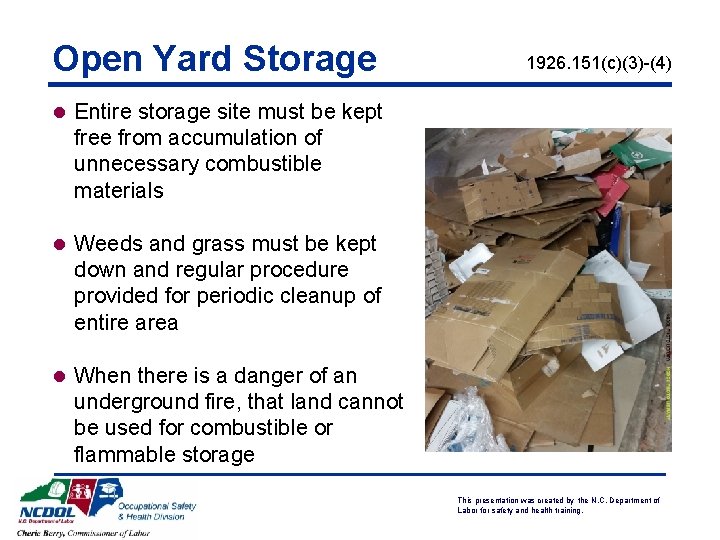
Open Yard Storage 1926. 151(c)(3)-(4) l Entire storage site must be kept free from accumulation of unnecessary combustible materials l Weeds and grass must be kept down and regular procedure provided for periodic cleanup of entire area l When there is a danger of an underground fire, that land cannot be used for combustible or flammable storage This presentation was created by the N. C. Department of Labor for safety and health training.
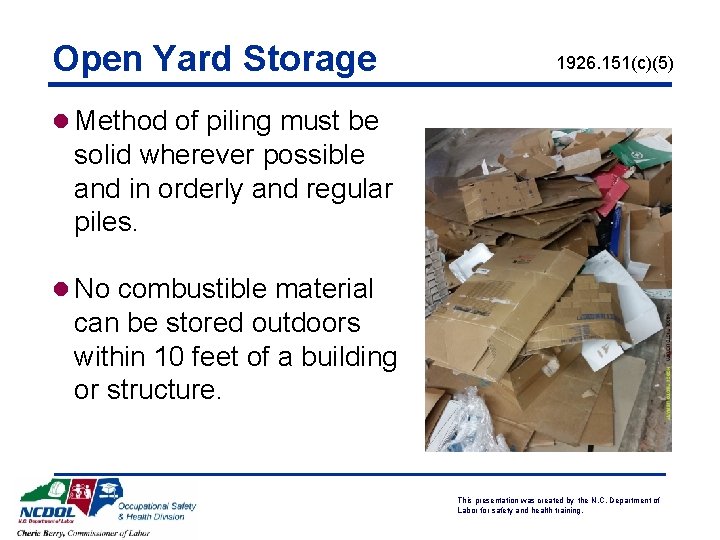
Open Yard Storage 1926. 151(c)(5) l Method of piling must be solid wherever possible and in orderly and regular piles. l No combustible material can be stored outdoors within 10 feet of a building or structure. This presentation was created by the N. C. Department of Labor for safety and health training.
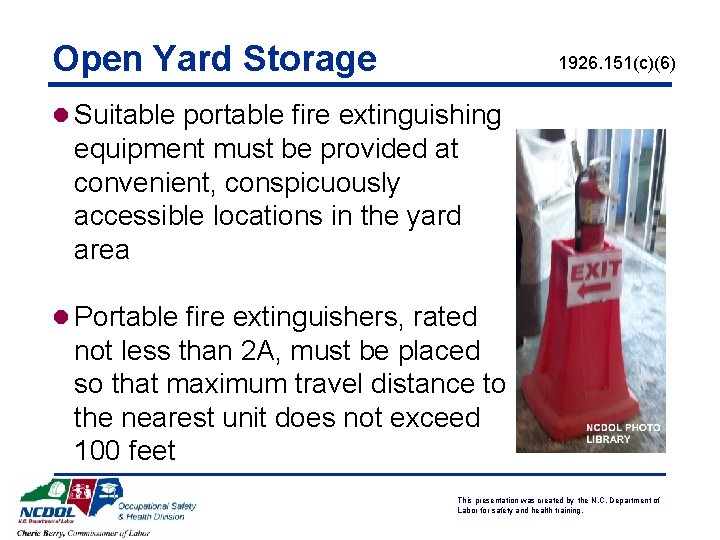
Open Yard Storage 1926. 151(c)(6) l Suitable portable fire extinguishing equipment must be provided at convenient, conspicuously accessible locations in the yard area l Portable fire extinguishers, rated not less than 2 A, must be placed so that maximum travel distance to the nearest unit does not exceed 100 feet This presentation was created by the N. C. Department of Labor for safety and health training.
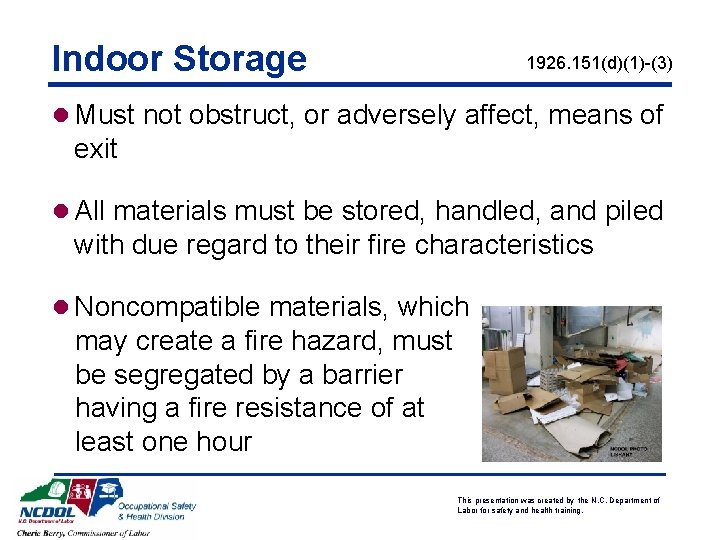
Indoor Storage 1926. 151(d)(1)-(3) l Must not obstruct, or adversely affect, means of exit l All materials must be stored, handled, and piled with due regard to their fire characteristics l Noncompatible materials, which may create a fire hazard, must be segregated by a barrier having a fire resistance of at least one hour This presentation was created by the N. C. Department of Labor for safety and health training.
Indoor Storage 1926. 151(d)(4) l Material must be piled to minimize the spread of fire internally and to permit convenient access for firefighting l Stable piling must be maintained at all times l Aisle space must be maintained to safely accommodate the widest vehicle that may be used within the building for firefighting purposes This presentation was created by the N. C. Department of Labor for safety and health training.
Indoor Storage 1926. 151(d)(5)-(6) l Clearance of at least 36 inches must be maintained between the top level of the stored material and the sprinkler deflectors l Clearance must be maintained around lights and heating units to prevent ignition of combustible materials This presentation was created by the N. C. Department of Labor for safety and health training.
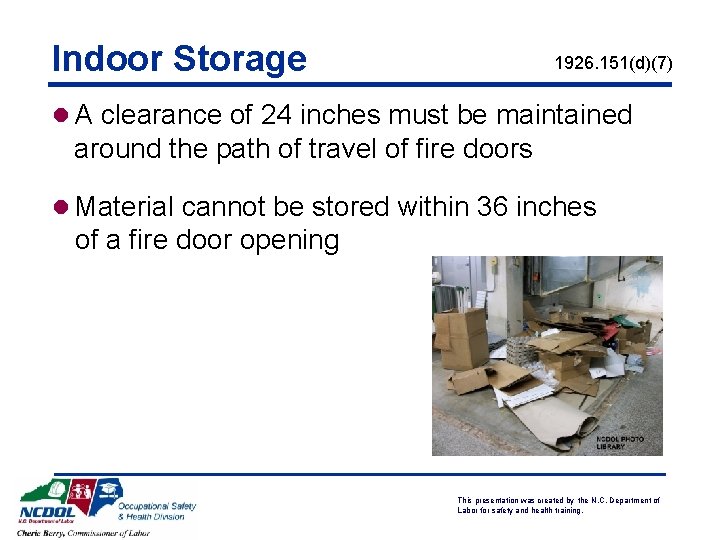
Indoor Storage 1926. 151(d)(7) l A clearance of 24 inches must be maintained around the path of travel of fire doors l Material cannot be stored within 36 inches of a fire door opening This presentation was created by the N. C. Department of Labor for safety and health training.
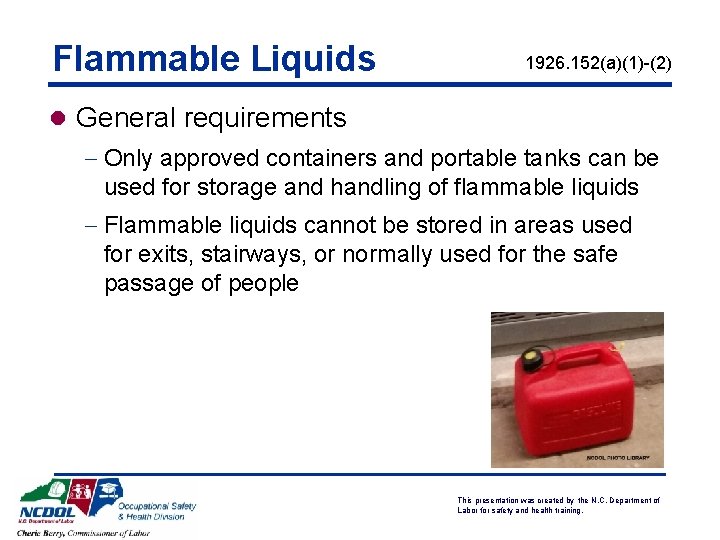
Flammable Liquids 1926. 152(a)(1)-(2) l General requirements - Only approved containers and portable tanks can be used for storage and handling of flammable liquids - Flammable liquids cannot be stored in areas used for exits, stairways, or normally used for the safe passage of people This presentation was created by the N. C. Department of Labor for safety and health training.
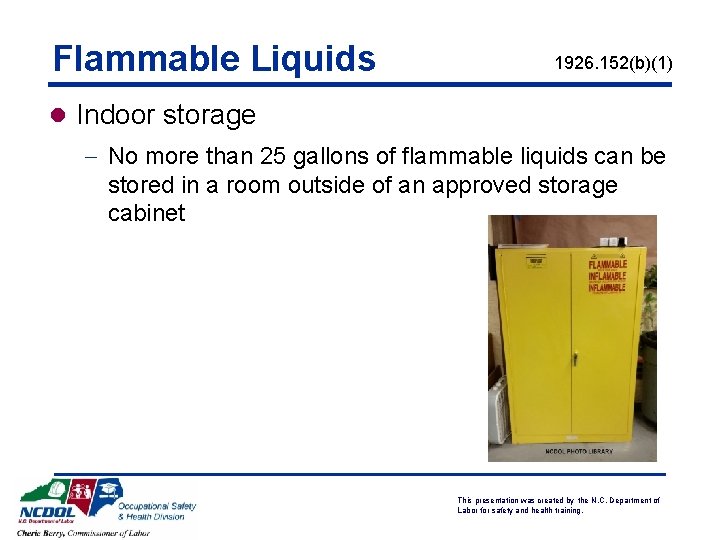
Flammable Liquids 1926. 152(b)(1) l Indoor storage - No more than 25 gallons of flammable liquids can be stored in a room outside of an approved storage cabinet This presentation was created by the N. C. Department of Labor for safety and health training.
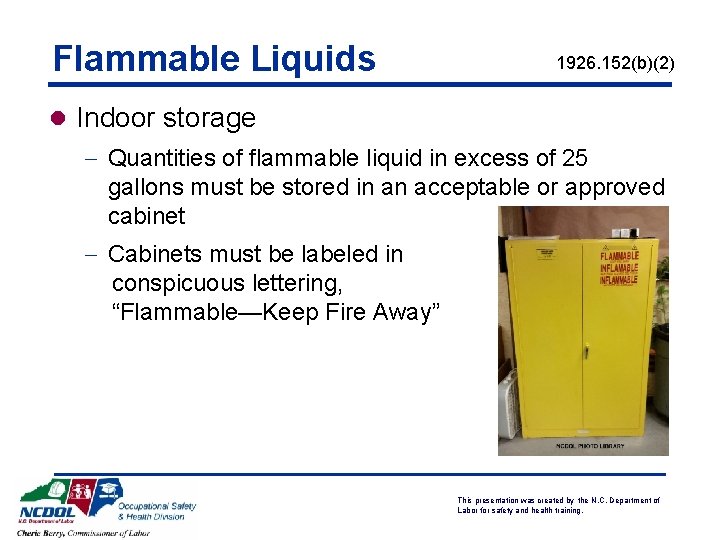
Flammable Liquids 1926. 152(b)(2) l Indoor storage - Quantities of flammable liquid in excess of 25 gallons must be stored in an acceptable or approved cabinet - Cabinets must be labeled in conspicuous lettering, “Flammable—Keep Fire Away” This presentation was created by the N. C. Department of Labor for safety and health training.
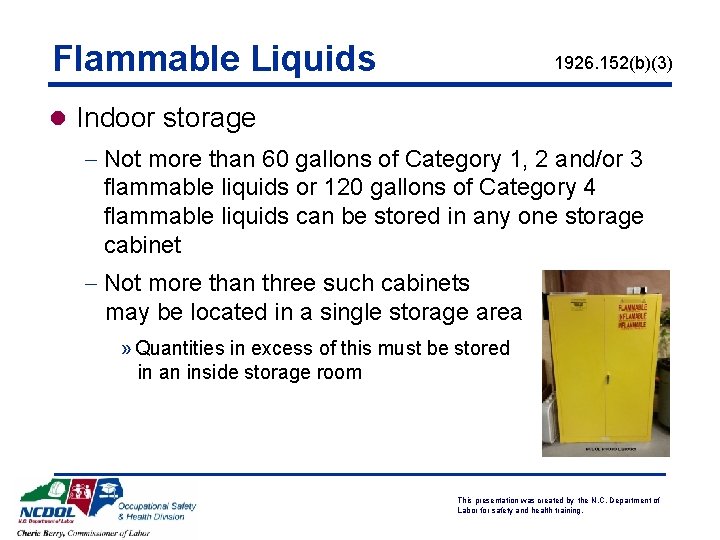
Flammable Liquids 1926. 152(b)(3) l Indoor storage - Not more than 60 gallons of Category 1, 2 and/or 3 flammable liquids or 120 gallons of Category 4 flammable liquids can be stored in any one storage cabinet - Not more than three such cabinets may be located in a single storage area » Quantities in excess of this must be stored in an inside storage room This presentation was created by the N. C. Department of Labor for safety and health training.
Flammable Liquids 1926. 152(b)(4) l Indoor storage - Constructed to meet the required fire-resistive rating for their use - Room must have raised sills or ramps at least 4 inches in height - Electrical wiring and equipment must be approved for Class I, Division 1, Hazardous Locations - Provided with either a gravity or a mechanical exhausting system This presentation was created by the N. C. Department of Labor for safety and health training.
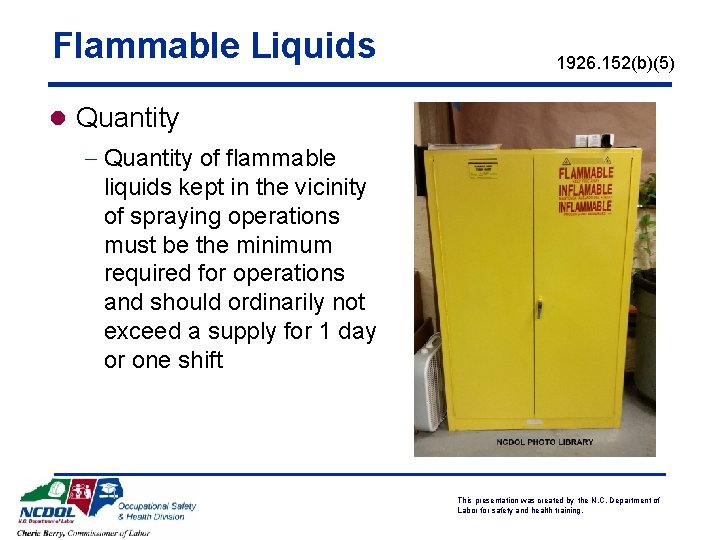
Flammable Liquids 1926. 152(b)(5) l Quantity - Quantity of flammable liquids kept in the vicinity of spraying operations must be the minimum required for operations and should ordinarily not exceed a supply for 1 day or one shift This presentation was created by the N. C. Department of Labor for safety and health training.
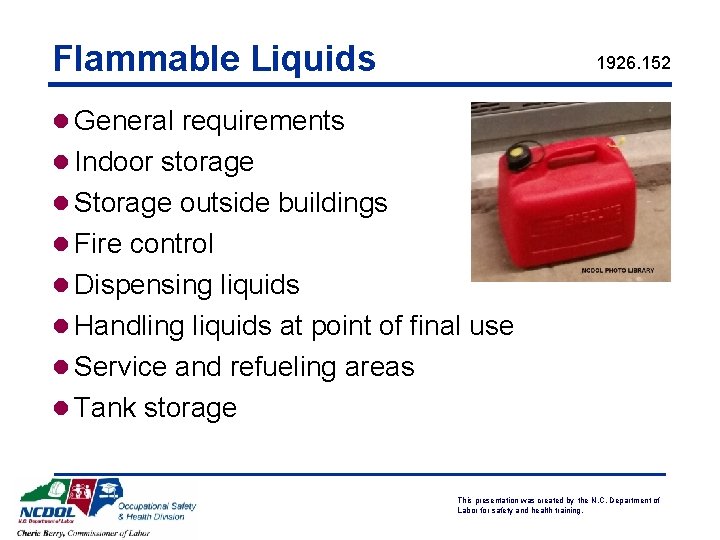
Flammable Liquids 1926. 152 l General requirements l Indoor storage l Storage outside buildings l Fire control l Dispensing liquids l Handling liquids at point of final use l Service and refueling areas l Tank storage This presentation was created by the N. C. Department of Labor for safety and health training.
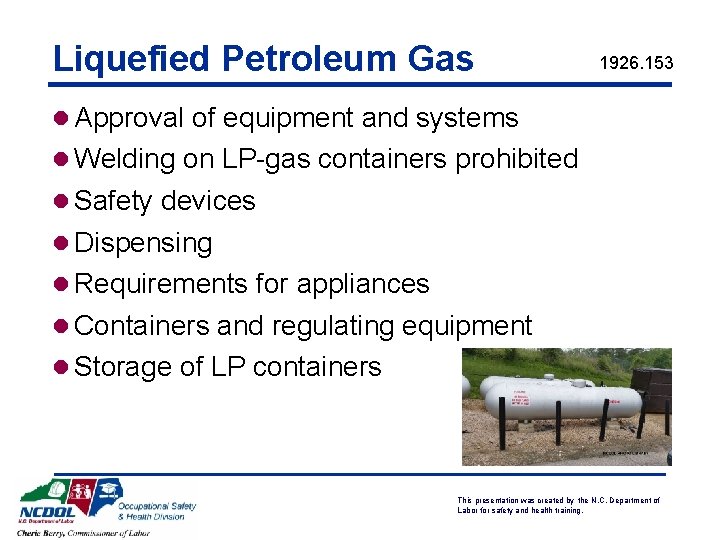
Liquefied Petroleum Gas 1926. 153 l Approval of equipment and systems l Welding on LP-gas containers prohibited l Safety devices l Dispensing l Requirements for appliances l Containers and regulating equipment l Storage of LP containers This presentation was created by the N. C. Department of Labor for safety and health training.
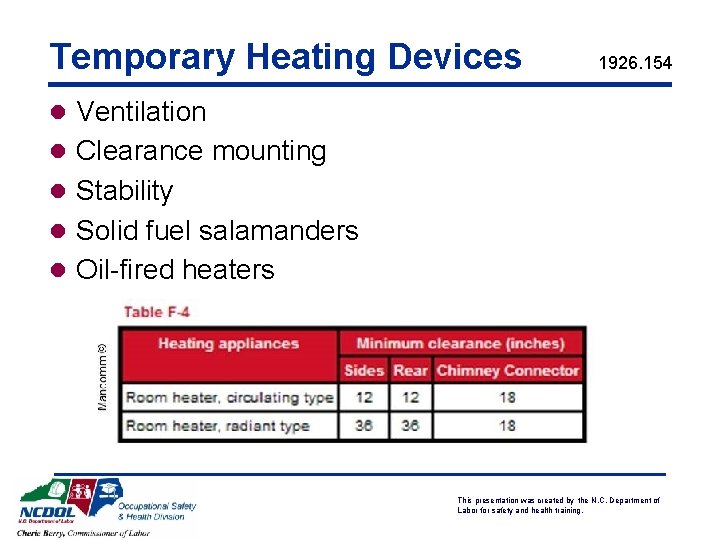
Temporary Heating Devices 1926. 154 l Ventilation l Clearance mounting l Stability l Solid fuel salamanders l Oil-fired heaters This presentation was created by the N. C. Department of Labor for safety and health training.
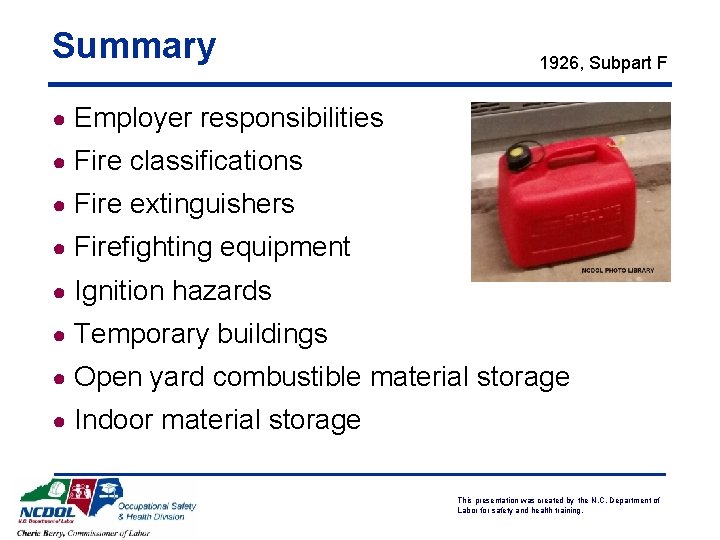
Summary 1926, Subpart F ● Employer responsibilities ● Fire classifications ● Fire extinguishers ● Firefighting equipment ● Ignition hazards ● Temporary buildings ● Open yard combustible material storage ● Indoor material storage This presentation was created by the N. C. Department of Labor for safety and health training.
Thank You For Attending! Final Questions? This presentation was created by the N. C. Department of Labor for safety and health training.