
Fire ITK 24 October 2019 Agenda 1 Presentation
Fire – ITK 24 October 2019
Agenda 1. Presentation of IS 41, main aspects and specific questions related to resin and polyethylene 2. Current situation for ITk detector 2. 1. Common mechanics 2. 2. Strips 2. 3. Pixel 3. Discussion on how to go ahead 3. 1. Comparison between the current material and alternative solutions for Resins 3. 2. Comparison between the current material and alternative solutions for Polyethylene 3. 3. Discussion around fire reaction tests, possible risks, mitigation measures, derogation procedure, etc.
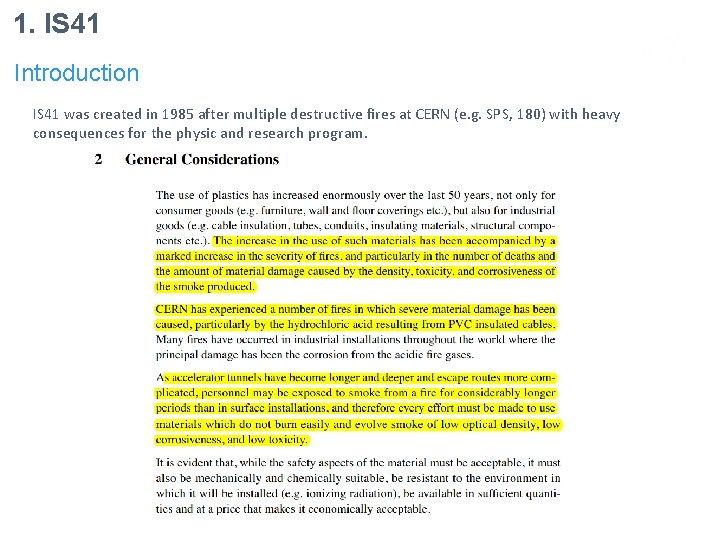
1. IS 41 Introduction IS 41 was created in 1985 after multiple destructive fires at CERN (e. g. SPS, 180) with heavy consequences for the physic and research program.
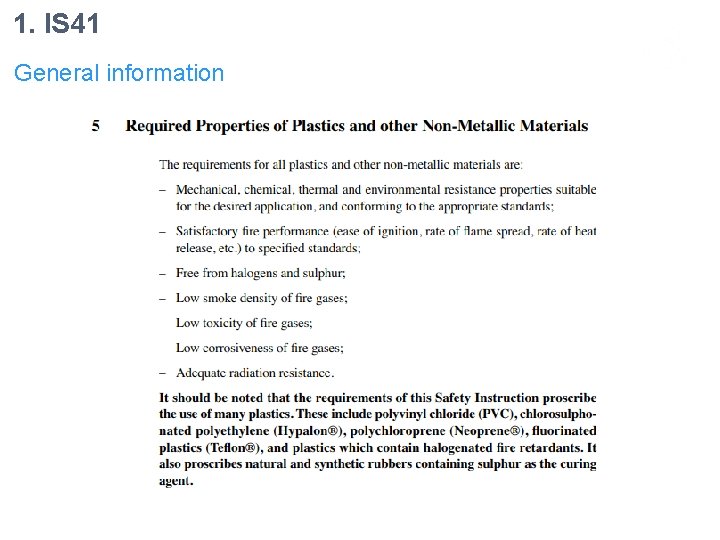
1. IS 41 General information
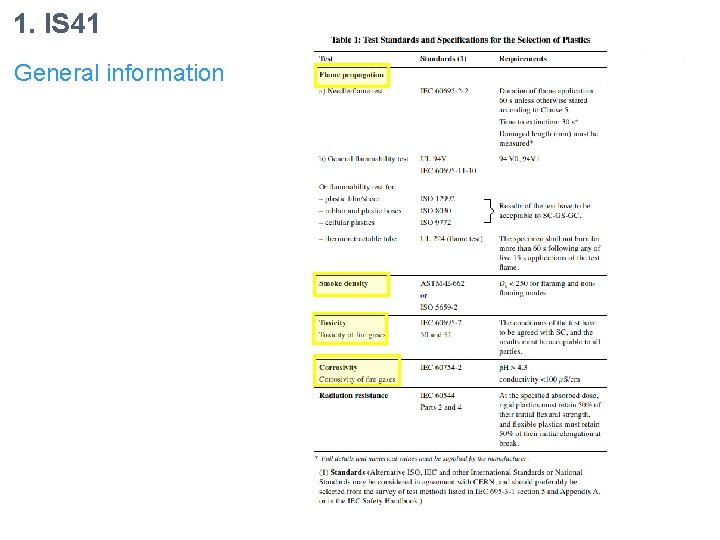
1. IS 41 General information
1. IS 41 General information
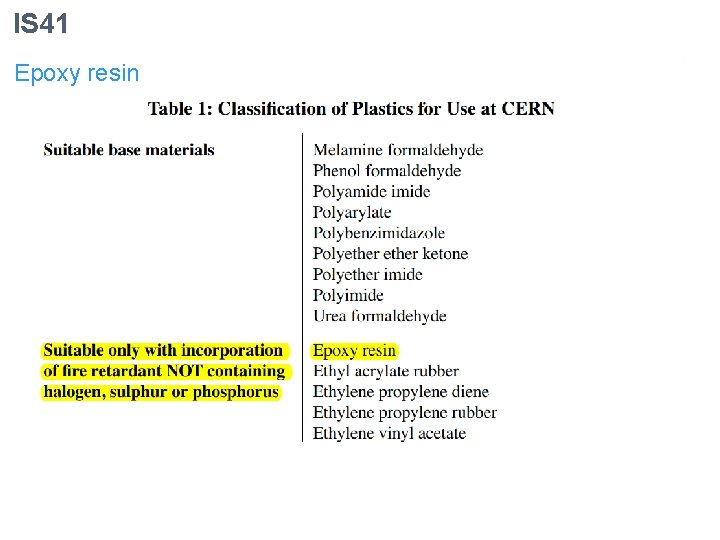
IS 41 Epoxy resin
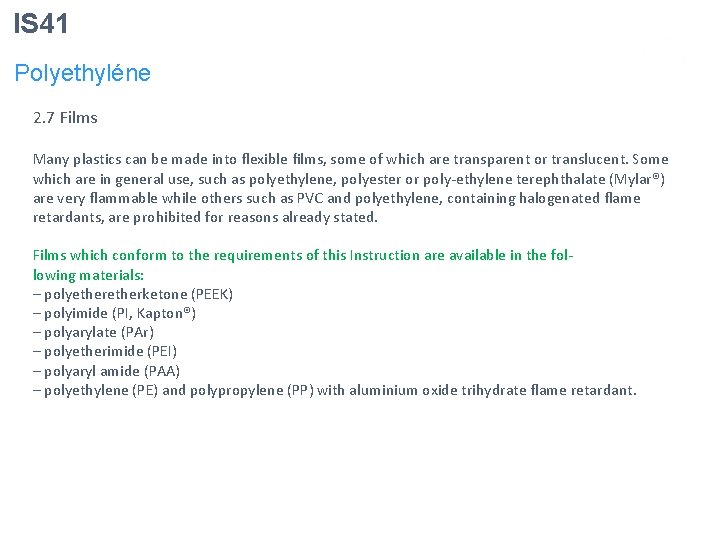
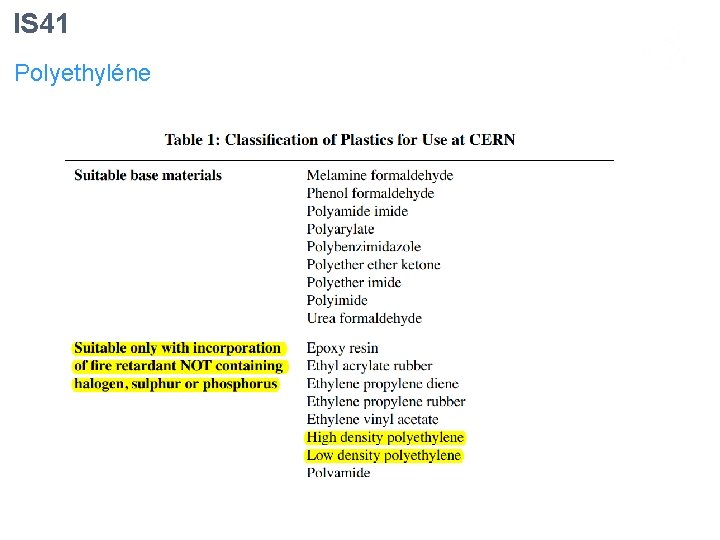
IS 41 Polyethyléne 2. 7 Films Many plastics can be made into flexible films, some of which are transparent or translucent. Some which are in general use, such as polyethylene, polyester or poly-ethylene terephthalate (Mylar®) are very flammable while others such as PVC and polyethylene, containing halogenated flame retardants, are prohibited for reasons already stated. Films which conform to the requirements of this Instruction are available in the following materials: – polyetherketone (PEEK) – polyimide (PI, Kapton®) – polyarylate (PAr) – polyetherimide (PEI) – polyaryl amide (PAA) – polyethylene (PE) and polypropylene (PP) with aluminium oxide trihydrate flame retardant.
IS 41 Polyethyléne
2. Current situation for ITk detector Common mechanics Email from Eric Anderssen There is ~150 kg of Cyanate Ester EX 1515 and/or RS 3 (40% Volume fraction) within Carbon Fiber Laminates of OC and Strip Barrel Shells. This is glued together with ~5 kg of Epoxy (Hysol EA 9396 and/or EA 9394 --both are same resin, just different fillers) In round numbers composites are ~15 -20% the mass of the system, and resins are ~30% of that by mass. Note there is ~300 kg of Polyethelyne polymoderator inside of the OC, and another ~800 kg outside the OC. Strips Pixel
3. Discussion on how to go ahead Comparison between current and alternative Resins See table. Summary – To be discussed/confirmed Þ Resin currently do not contain fire retardant Þ Fire reaction classification is not known Þ Contains bisphenol A for Epoxy resin Þ Difficult to obtain the answer from the provider Þ Test to be performed for each parts are expensive Þ What are the problematic with alternative resins used in aerospace industry? Þ Is the cyanite ester resin less problematic? Þ The cost of tests seems to be high (4000 € per material), what was requested?
3. Discussion on how to go ahead Comparison between current and alternative Polyethylène moderator Þ Is the product to be used already known? Þ Does it contain non halogenated fire retardant? Þ Borated polyethylene can be accepted, in addition to the ones mentioned in IS 41
3. Discussion on how to go ahead Discussion – Fire reaction tests, potential risks, derogation Fire reaction tests If all fire safety data per material is still necessary, in which way do we organise the testing? By a CERN lab, to be setup? Þ CERN HSE do not have anymore a lab to perform test in term of fire reaction classification and do not plan to set up one. (TBC HSE) Þ We should define which material should be tested. By comparing MSDS's of the materials to fire safety specification of the materials listed in IS 41 Þ MSDS do not provide information regarding the fire classification.
3. Discussion on how to go ahead Discussion – Fire reaction tests, potential risks, derogation Fire risks - Detection system and evacuation paths Þ Smoke detection is made via the sniffer system which must be installed in the ITK volume The sniffer system detects smoke at an early stage. One sensor detecting smoke triggers the evacuation alarm. Þ Evacuation paths • TS: the zone is not accessible • YETS: two escape roads are possible at the level of the endplate: sector 1 and sector 13. Self-Rescue Mask are available in the zone • LS in large opening: two escape roads are possible at the level of the endplate: via Forward platform and sector 13/Truck. Self-Rescue Mask are available in the zone
3. Discussion on how to go ahead Discussion – Fire reaction tests, potential risks, derogation Fire Risk - Scenarios Assembly period during LS 3 in the pit Þ Risk in case of fire starting from the other system around the ITK. Liquid Argon, Tile, … Þ Will Liquid argon and Tile be also turned off during LS 3? Þ During test period, start of fire in ITK? Will there be dry air and electronics on ITK? RUN Þ ITK will be filled with N 2 Technical Stops: Short access, TS, YETS, LS Þ In case of fire in ITK, smoke will start to be released in the cavern. • ITK volume will be flushed to dry air. Due to ODH risk? Is there a risk assessment of this risk? • For people working, with the early detection on the sniffer and the evacuation path, the risk is almost not existent, except in case of injured person while evacuating who cannot move. The approach is to use a Self-Rescue mask located in the zone. • However, if fire starts in the ID volume, it is not possible for fire fighter to intervene in the volume as generally closed with the endplate. It should be study the possibility to flush to N 2 manually when it is insured that nobody is in the region. • The DSS matrix for ITK must stop the detector in case of smoke detection, but doesn’t prevent a fire to propagate.
3. Discussion on how to go ahead Discussion – Fire reaction tests, potential risks, derogation Fire Risk - Scenarios Technical Stops: Short access, TS, YETS, LS Þ If fire from outside the volume, it should not be entering ITK as it is in overpressure even with dry air (TBC). Could be problematic if the endplate is fully/partially removed (such as in LS 2).
- Slides: 16