
Fire Inspection and Code Enforcement 7 th Edition
- Slides: 68
Fire Inspection and Code Enforcement, 7 th Edition Chapter 4 — Construction Types and Occupancy Classifications Inspector I
DISCUSSION QUESTION How are construction types and occupancy classifications established? Inspector I 4– 2
Learning Objective 1 Describe each of the construction types defined by the model codes. Inspector I 4– 3
United States Construction • International Building Code® (IBC®) and National Fire Protection Association® (NFPA®) – Recognize five types, defined by materials and fire performance for each building element Inspector I 4– 4
DISCUSSION QUESTION What building elements make up every type of structure? Inspector I 4– 5
Type I Construction • Noncombustible or limited combustible materials • Highest level of safety • May include combustible materials in small quantities (Continued) Inspector I 4– 6
Type I Construction Inspector I 4– 7
DISCUSSION QUESTION What is protected steel? Inspector I 4– 8
Type II Construction • Building materials that will not contribute to fire development or spread • Noncombustible materials that do not meet stricter requirements of Type I (Continued) Inspector I 4– 9
Type II Construction Inspector I 4– 10
DISCUSSION QUESTION When is Type II construction used? Inspector I 4– 11
Type III Construction • Churches, schools, apartment dwellings, mercantile structures • Exterior walls constructed of noncombustible materials and interior elements of any permitted material (Continued) Inspector I 4– 12
Type III Construction Inspector I 4– 13
Type IV Construction • Large-dimensioned lumber for all structural elements • Extremely stable and more resistant to collapse • May include small-dimensioned lumber glued together • Limitation (Continued) Inspector I 4– 14
Type IV Construction Inspector I 4– 15
DISCUSSION QUESTION How does heavy timber construction react when involved in fire? Inspector I 4– 16
Type V Construction • Exterior bearing walls entirely wood or other combustible materials • Framing materials include wood studs, steel or aluminum studs, or wood sill plates • Includes wood truss systems (Continued) Inspector I 4– 17
Type V Construction Inspector I 4– 18
Canadian Construction • National Building Code of Canada (NBC) – Combustible construction – Noncombustible construction – Heavy timber construction Inspector I 4– 19
Learning Objective 2 Explain the purpose of occupancy classifications. Inspector I 4– 20
Occupancy Classification • Use of all or a portion of a building or structure • Established because certain occupancies will have higher fire loads and greater numbers of occupants within them than others • Helps gain reasonable expectation of hazard building presents Inspector I 4– 21
Learning Objective 3 Compare the occupancy classification groups used by the three main building codes. Inspector I 4– 22
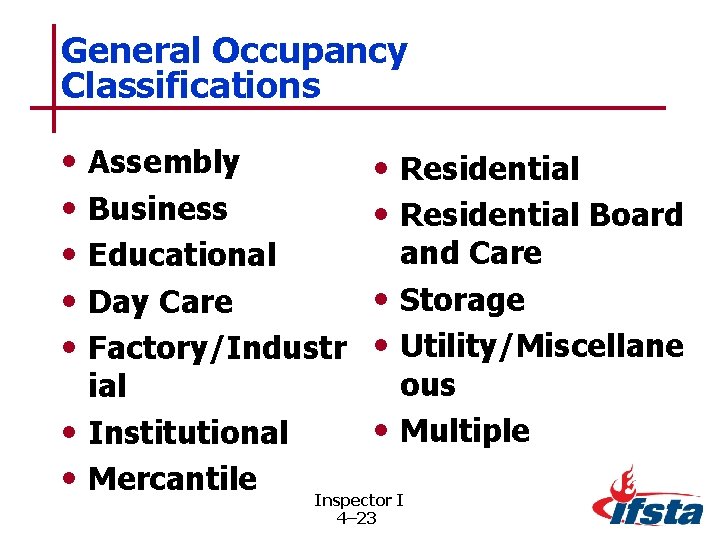
General Occupancy Classifications • Assembly • Business • Educational • Day Care • Factory/Industr ial • Institutional • Mercantile • Residential Board and Care • Storage • Utility/Miscellane ous • Multiple Inspector I 4– 23
Learning Objective 4 Describe the types of uses classified as assembly by the model building codes. Inspector I 4– 24
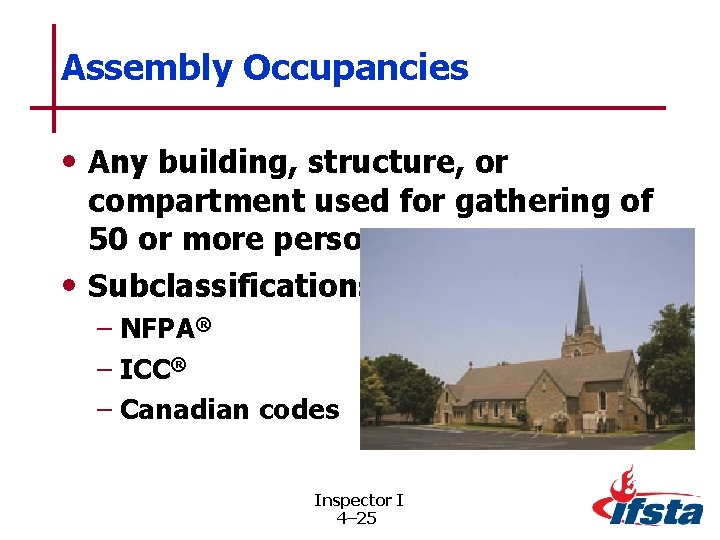
Assembly Occupancies • Any building, structure, or compartment used for gathering of 50 or more persons • Subclassifications – NFPA® – ICC® – Canadian codes Inspector I 4– 25
Learning Objective 5 Describe business and educational occupancies. Inspector I 4– 26
Business Occupancies • Buildings that provide working place for large numbers of occupants in an office environment • Divided into group areas and individual working spaces Inspector I 4– 27
DISCUSSION QUESTION What are some examples of business occupancies? Inspector I 4– 28
Educational Occupancies • Any building or portion used for • • education of six or more persons from preschool through 12 th grade Significant challenges NFPA® 101® and NFPA® 5000 ICC® building and fire codes Canadian codes Inspector I 4– 29
Learning Objective 6 Compare the factory, industrial, and high-hazard occupancies defined by each model code. Inspector I 4– 30
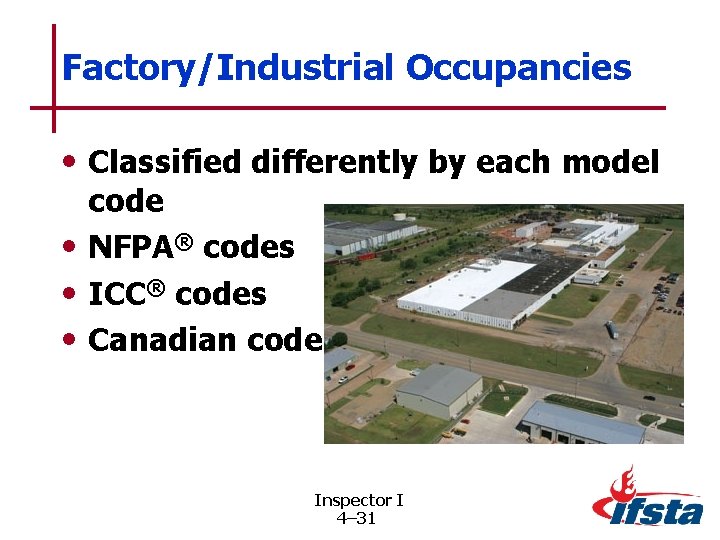
Factory/Industrial Occupancies • Classified differently by each model code • NFPA® codes • ICC® codes • Canadian codes Inspector I 4– 31
DISCUSSION QUESTION What are the industrial occupancies subdivisions of NFPA® codes? Inspector I 4– 32
Learning Objective 7 Compare the International Code Council® (ICC®) institutional occupancies to the NFPA® occupancy classifications. Inspector I 4– 33
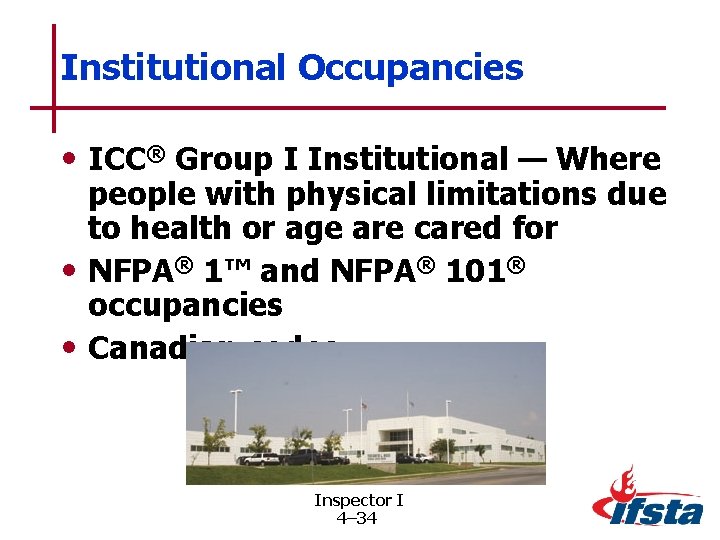
Institutional Occupancies • ICC® Group I Institutional — Where people with physical limitations due to health or age are cared for • NFPA® 1™ and NFPA® 101® occupancies • Canadian codes Inspector I 4– 34
Learning Objective 8 Describe various institutional occupancies. Inspector I 4– 35
Health Care Occupancies • Provide health services to four or more individuals who cannot evacuate themselves • Only in NFPA® 1™ and 101® • ICC® codes • Canadian codes Inspector I 4– 36
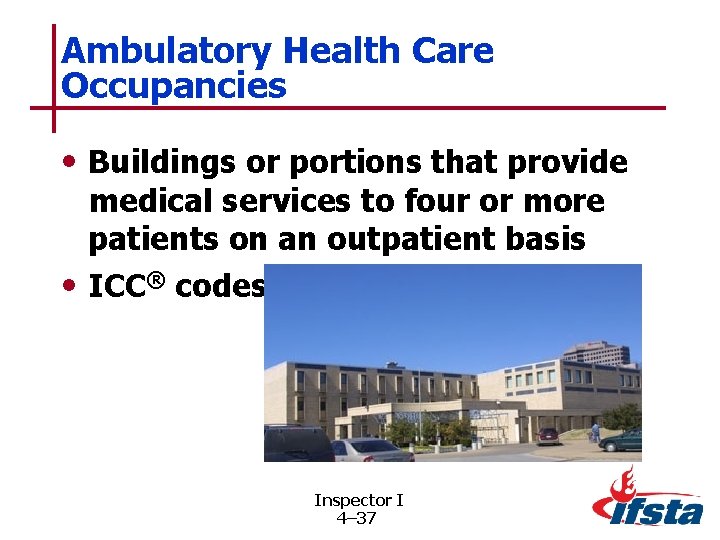
Ambulatory Health Care Occupancies • Buildings or portions that provide medical services to four or more patients on an outpatient basis • ICC® codes Inspector I 4– 37
Detention and Correctional Occupancies • Locations where the occupants are held under restraint or security • Include locks on doors where occupants are kept • ICC® codes • Canadian codes Inspector I 4– 38
DISCUSSION QUESTION What may occupants of a detention and correctional occupancy do in an emergency situation? Inspector I 4– 39
Residential Board and Care Occupancies • NFPA® 1™ and NFPA® 101® – Provide lodging, boarding, personal care to four or more residents unrelated to owner • ICC® codes • Canadian codes • Responsibilities of staff members Inspector I 4– 40
DISCUSSION QUESTION What are the evacuation classifications of residential board and care occupancies? Inspector I 4– 41
Learning Objective 9 Explain the primary concern or hazard found in day-care occupancies. Inspector I 4– 42
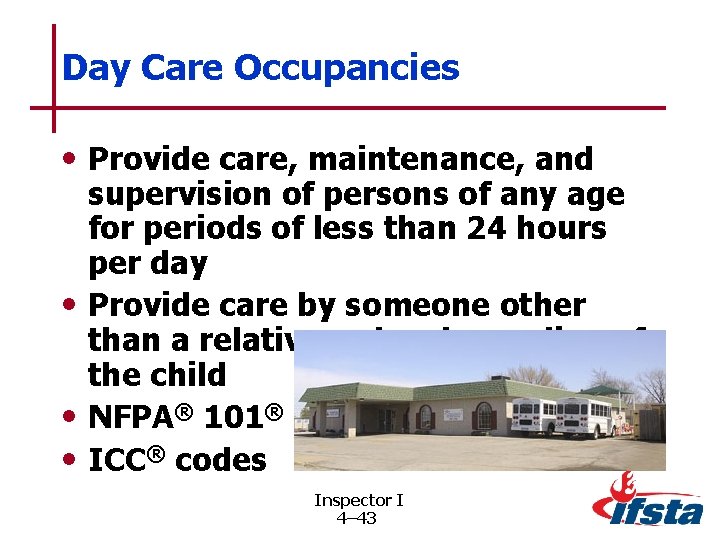
Day Care Occupancies • Provide care, maintenance, and supervision of persons of any age for periods of less than 24 hours per day • Provide care by someone other than a relative or legal guardian of the child • NFPA® 101® • ICC® codes Inspector I 4– 43
Learning Objective 10 Describe the hazards usually associated with mercantile occupancies. Inspector I 4– 44
Mercantile Occupancies • Any building that is used to display or sell merchandise • Contain large quantities of combustible materials and potential for high life loss • Arrangement of merchandise can result in high fire load and can (Continued) restrict exit access Inspector I 4– 45
Mercantile Occupancies Inspector I 4– 46
DISCUSSION QUESTION What are some examples of mercantile occupancies? Inspector I 4– 47
Learning Objective 11 Compare each of the residential occupancy classifications. Inspector I 4– 48
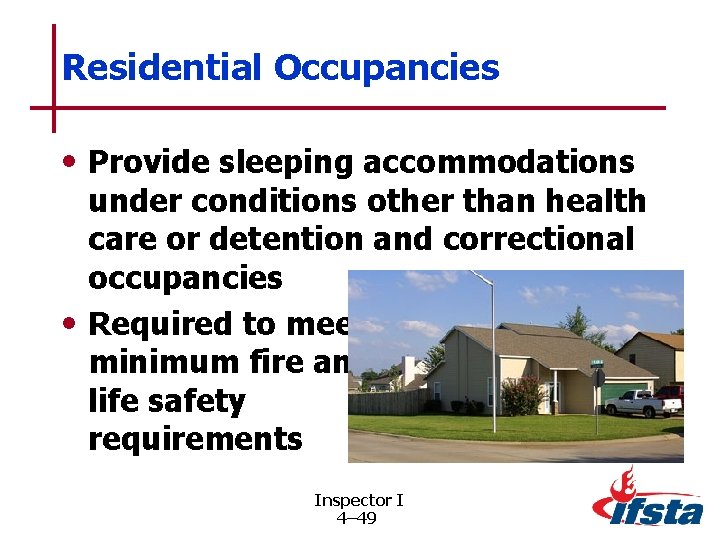
Residential Occupancies • Provide sleeping accommodations under conditions other than health care or detention and correctional occupancies • Required to meet minimum fire and life safety requirements Inspector I 4– 49
One- or Two-Family Dwelling • NFPA® — Structures having no more than two dwelling units, including detached units, semidetached units, and duplexes • Not exempted in model codes • Not subject in periodic inspections • Exception Inspector I 4– 50
DISCUSSION QUESTION What is a lodging or rooming house? Inspector I 4– 51
Lodging (Boarding) or Rooming House • NFPA® 1™ and NFPA® 101® • ICC® and Canadian codes • Boarding or rooming houses • Most common problem — Knowing number of individuals permitted Inspector I 4– 52
Hotels • Provides sleeping rooms for transients • Present wide range of fire and life safety challenges • ICC® and Canadian codes Inspector I 4– 53
DISCUSSION QUESTION What types of functions can a hotel include? Inspector I 4– 54
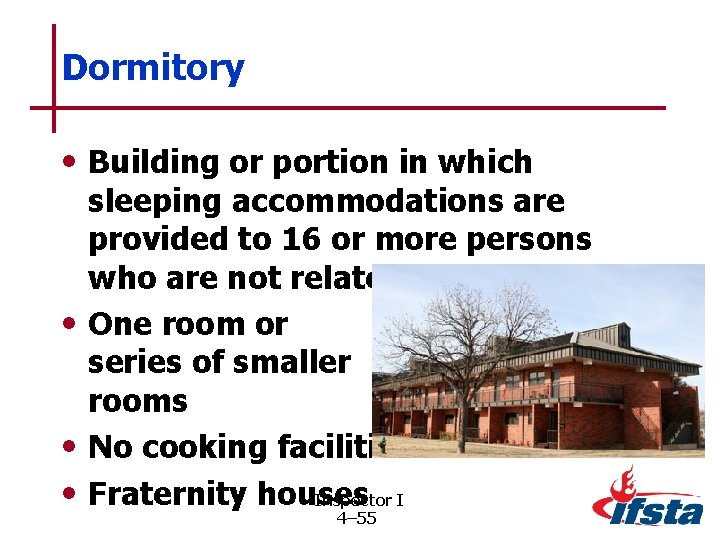
Dormitory • Building or portion in which sleeping accommodations are provided to 16 or more persons who are not related • One room or series of smaller rooms • No cooking facilities • Fraternity houses Inspector I 4– 55
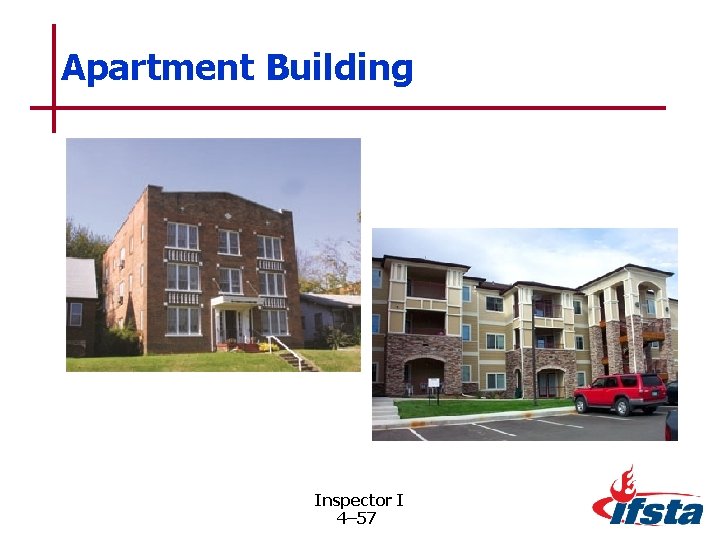
Apartment Building • Single or multistory structures containing three or more independent dwelling units with cooking and bathroom facilities in each • May have direct access to exterior or have interior corridors (Continued) • Greater than 7 stories — High-rise structures Inspector I 4– 56
Apartment Building Inspector I 4– 57
DISCUSSION QUESTION What unique problems do apartment buildings present for fire inspectors? Inspector I 4– 58
Learning Objective 12 Describe storage, utility, and miscellaneous occupancies. Inspector I 4– 59
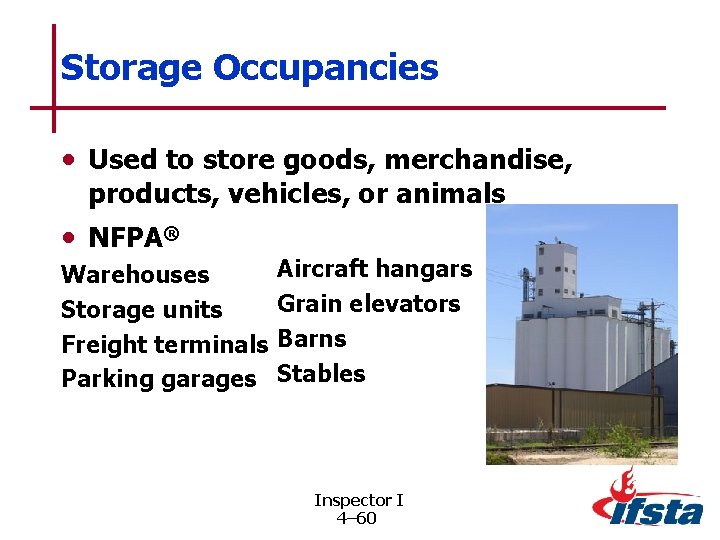
Storage Occupancies • Used to store goods, merchandise, products, vehicles, or animals • NFPA® Warehouses Storage units Freight terminals Parking garages Aircraft hangars Grain elevators Barns Stables Inspector I 4– 60
DISCUSSION QUESTION What usually determines the classification of a storage occupancy? Inspector I 4– 61
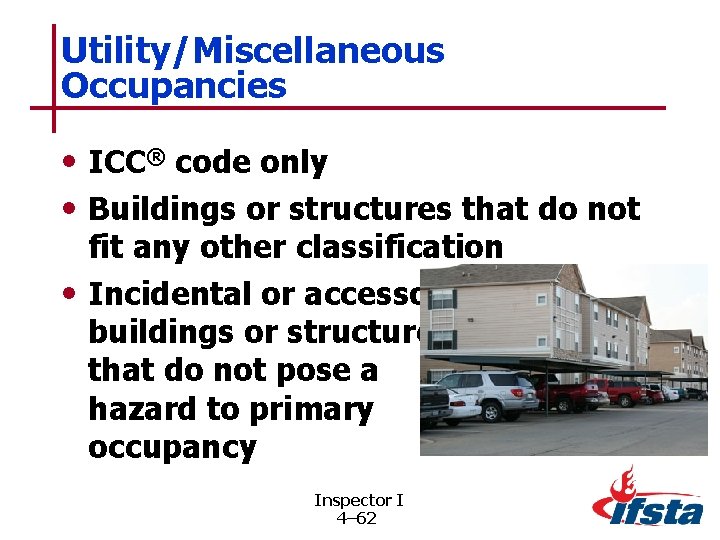
Utility/Miscellaneous Occupancies • ICC® code only • Buildings or structures that do not fit any other classification • Incidental or accessory buildings or structures that do not pose a hazard to primary occupancy Inspector I 4– 62
DISCUSSION QUESTION What are some examples of utility/miscellaneous occupancies? Inspector I 4– 63
Learning Objective 13 Determine occupancy classification of a single-use occupancy. Learning Objective 13 is measured in Learning Activity 4 -I-1. Inspector I 4– 64
Summary • The ability of the inspector to determine the construction type and occupancy classification of a structure is critical to the success or failure of an inspection. (Continued) Inspector I 4– 65
Summary • During periodic inspections and when alterations are made, inspectors must ensure that fire and life safety requirements are consistent with current use and alterations. • Model building and fire codes provide the inspector with guidelines for ensuring that life safety requirements are met. Inspector I 4– 66
Review Questions 1. How many types of construction are recognized by the International Building Code® (IBC®)? 2. What is heavy timber construction? 3. What type of occupancy is a jail? (Continued) Inspector I 4– 67
Review Questions 4. How many stories must an apartment building be to be considered a high-rise structure? 5. List several types of incidental-use areas. Inspector I 4– 68