
Fire in confined spaces Dynamic confinement of FIRE
- Slides: 22
Fire in confined spaces Dynamic confinement of FIRE ESS | Fire management within confined spaces| 2012 -01 -21 | Andrea Polato
CONTENTS • Fire Sectorization; • Fire Sector’s Characteristics; • Ventilation During a Fire in Confined Spaces • Some Rough Calculations: Dilution Effect; • Some Tests Results; • Special Products; • Conclusions; ESS | Fire management within confined spaces| 2012 -01 -21 | Andrea Polato
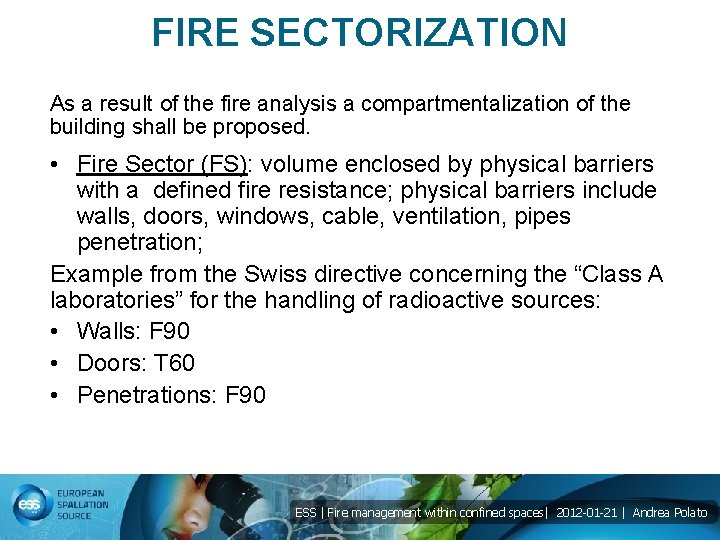
FIRE SECTORIZATION As a result of the fire analysis a compartmentalization of the building shall be proposed. • Fire Sector (FS): volume enclosed by physical barriers with a defined fire resistance; physical barriers include walls, doors, windows, cable, ventilation, pipes penetration; Example from the Swiss directive concerning the “Class A laboratories” for the handling of radioactive sources: • Walls: F 90 • Doors: T 60 • Penetrations: F 90 ESS | Fire management within confined spaces| 2012 -01 -21 | Andrea Polato
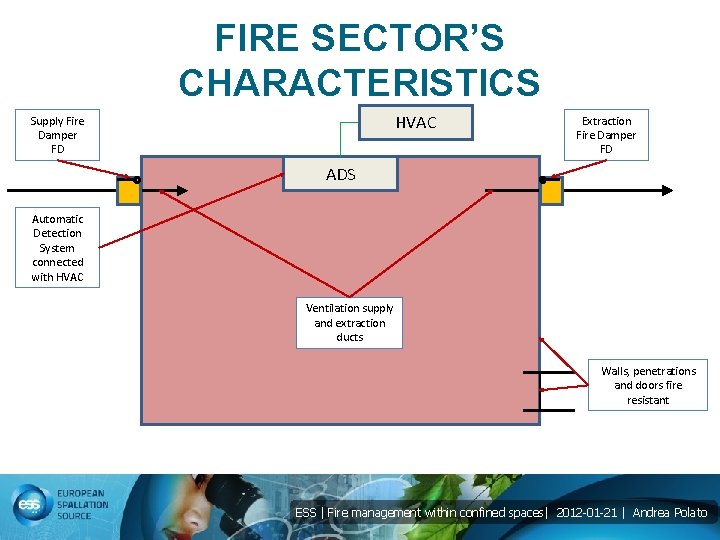
FIRE SECTOR’S CHARACTERISTICS HVAC Supply Fire Damper FD Extraction Fire Damper FD ADS Automatic Detection System connected with HVAC Ventilation supply and extraction ducts Walls, penetrations and doors fire resistant ESS | Fire management within confined spaces| 2012 -01 -21 | Andrea Polato
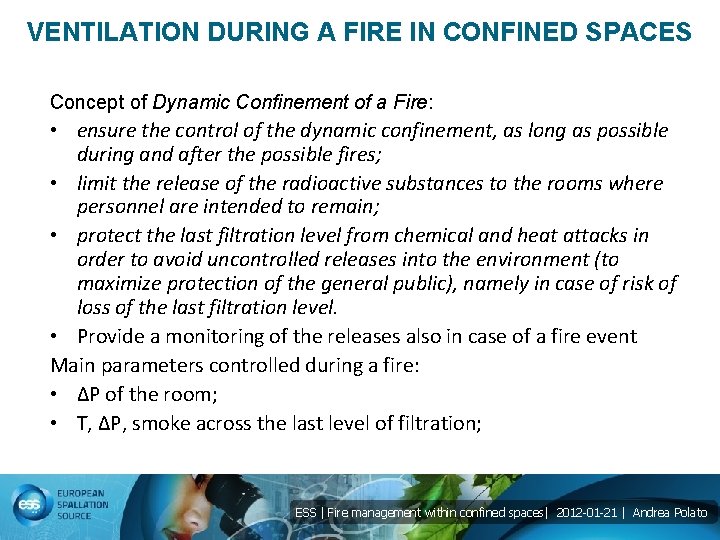
VENTILATION DURING A FIRE IN CONFINED SPACES According to ISO 17873: 2007 (ventilation of nuclear facilities) @ sect. 9. 6. 2: • […] For areas that have a high inventory of dispersible radiotoxic material or for a multi-compartment building where spread of smoke through the ducting may be a problem, dynamic confinement must be a prime consideration […]. • […] The option of providing an automatic immediate closure of all the ventilation ducts of the room or cell when a fire occurs within it can have the opposite effect to the desired isolation, as the increasing internal pressure and production of smoke may spread the contamination to adjoining rooms […] ESS | Fire management within confined spaces| 2012 -01 -21 | Andrea Polato
VENTILATION DURING A FIRE IN CONFINED SPACES Concept of Dynamic Confinement of a Fire: • ensure the control of the dynamic confinement, as long as possible during and after the possible fires; • limit the release of the radioactive substances to the rooms where personnel are intended to remain; • protect the last filtration level from chemical and heat attacks in order to avoid uncontrolled releases into the environment (to maximize protection of the general public), namely in case of risk of loss of the last filtration level. • Provide a monitoring of the releases also in case of a fire event Main parameters controlled during a fire: • ΔP of the room; • T, ΔP, smoke across the last level of filtration; ESS | Fire management within confined spaces| 2012 -01 -21 | Andrea Polato
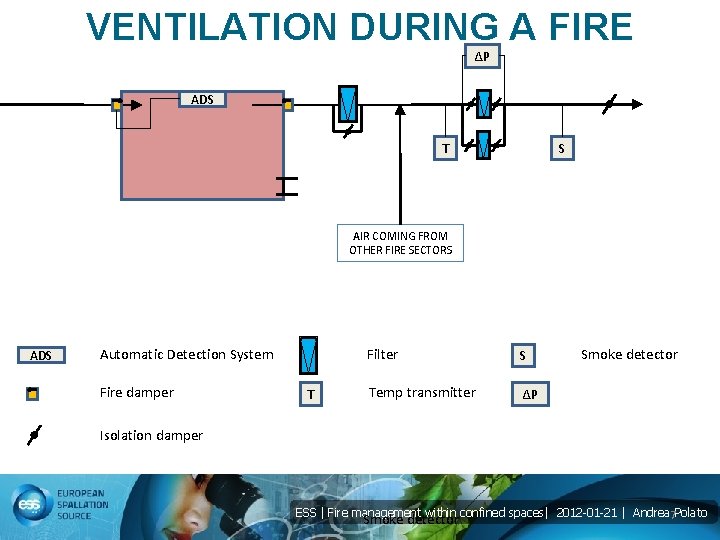
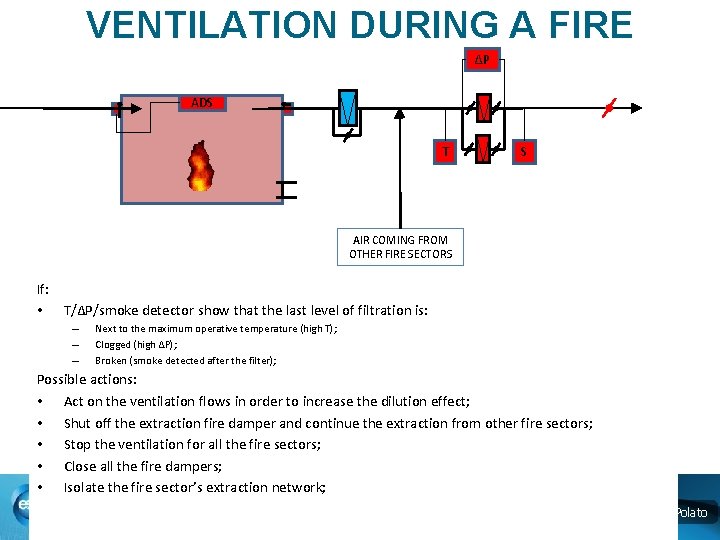
VENTILATION DURING A FIRE ΔP ADS T S AIR COMING FROM OTHER FIRE SECTORS ADS Automatic Detection System Fire damper T Filter S Temp transmitter ΔP Smoke detector Isolation damper ESS | Fire management within confined spaces| 2012 -01 -21 | Andrea 7 Polato Smoke detector
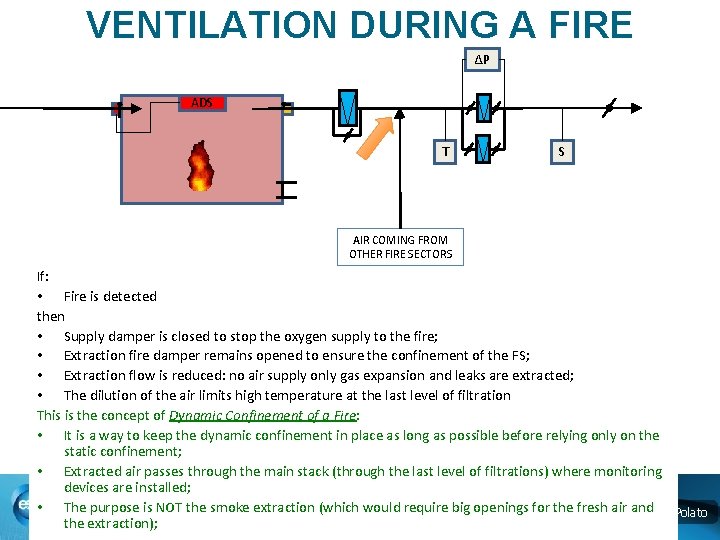
VENTILATION DURING A FIRE ΔP ADS T S AIR COMING FROM OTHER FIRE SECTORS If: • Fire is detected then • Supply damper is closed to stop the oxygen supply to the fire; • Extraction fire damper remains opened to ensure the confinement of the FS; • Extraction flow is reduced: no air supply only gas expansion and leaks are extracted; • The dilution of the air limits high temperature at the last level of filtration This is the concept of Dynamic Confinement of a Fire: • It is a way to keep the dynamic confinement in place as long as possible before relying only on the static confinement; • Extracted air passes through the main stack (through the last level of filtrations) where monitoring devices are installed; • The purpose is NOT the smoke extraction would require openings for the fresh air| and ESS (which | Fire management withinbig confined spaces| 2012 -01 -21 Andrea 8 Polato the extraction);
VENTILATION DURING A FIRE ΔP ADS T S AIR COMING FROM OTHER FIRE SECTORS If: • T/ΔP/smoke detector show that the last level of filtration is: – – – Next to the maximum operative temperature (high T); Clogged (high ΔP); Broken (smoke detected after the filter); Possible actions: • Act on the ventilation flows in order to increase the dilution effect; • Shut off the extraction fire damper and continue the extraction from other fire sectors; • Stop the ventilation for all the fire sectors; • Close all the fire dampers; • Isolate the fire sector’s extraction network; ESS | Fire management within confined spaces| 2012 -01 -21 | Andrea 10 Polato
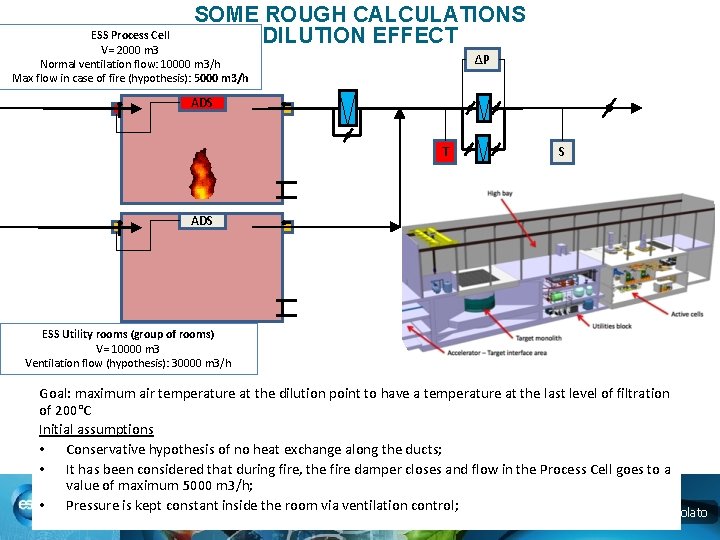
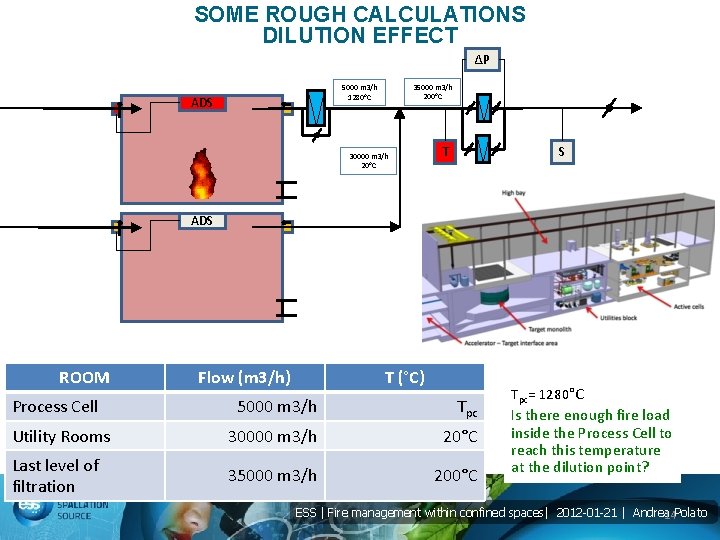
SOME ROUGH CALCULATIONS DILUTION EFFECT ESS Process Cell V= 2000 m 3 Normal ventilation flow: 10000 m 3/h Max flow in case of fire (hypothesis): 5000 m 3/h ΔP ADS T S ADS ESS Utility rooms (group of rooms) V= 10000 m 3 Ventilation flow (hypothesis): 30000 m 3/h Goal: maximum air temperature at the dilution point to have a temperature at the last level of filtration of 200°C Initial assumptions • Conservative hypothesis of no heat exchange along the ducts; • It has been considered that during fire, the fire damper closes and flow in the Process Cell goes to a value of maximum 5000 m 3/h; • Pressure is kept constant inside the room via ventilation control; ESS | Fire management within confined spaces| 2012 -01 -21 | Andrea Polato 13
SOME ROUGH CALCULATIONS DILUTION EFFECT ΔP 35000 m 3/h 200°C 5000 m 3/h 1280°C ADS 30000 m 3/h 20°C T S ADS ROOM Process Cell Flow (m 3/h) T (°C) 5000 m 3/h Tpc Utility Rooms 30000 m 3/h 20°C Last level of filtration 35000 m 3/h 200°C Tpc= 1280°C Is there enough fire load inside the Process Cell to reach this temperature at the dilution point? ESS | Fire management within confined spaces| 2012 -01 -21 | Andrea 14 Polato
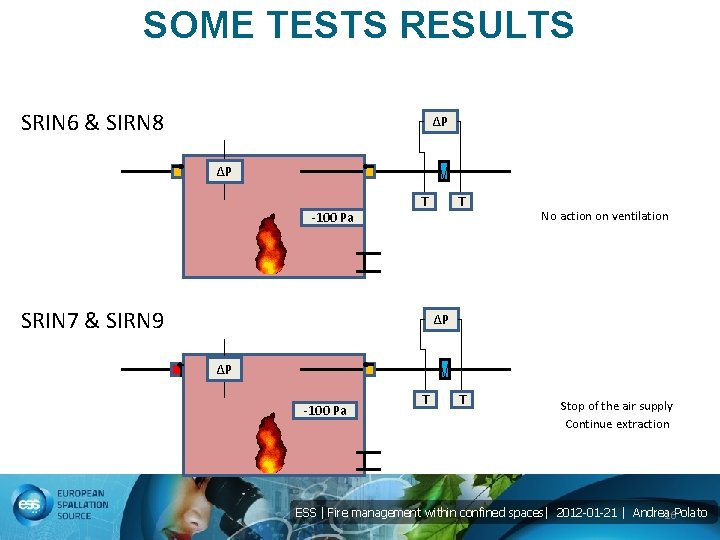
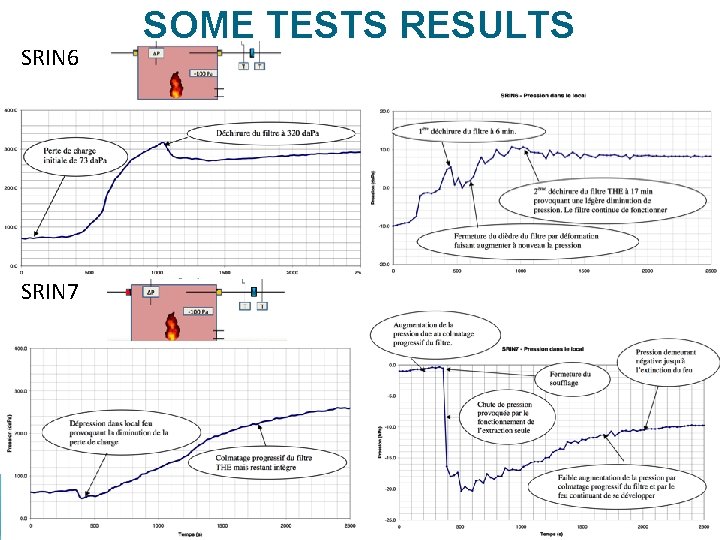
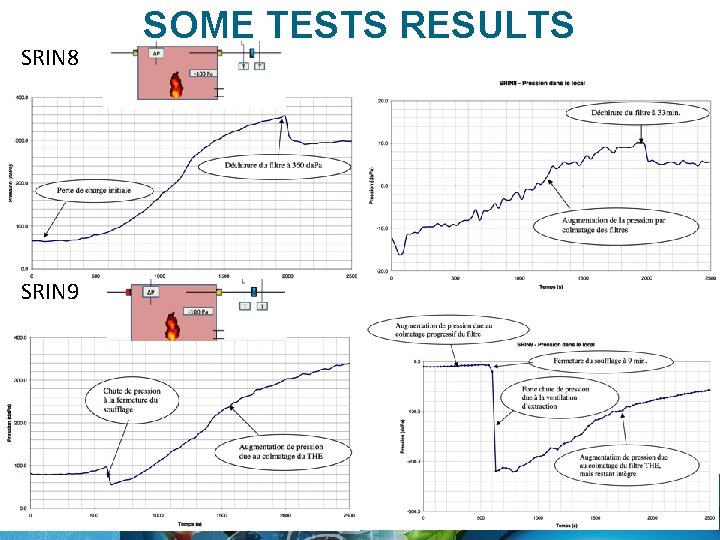
SOME TESTS RESULTS • Test Performed at CEA/IPSN Grenoble* • MELANIE test room: 100 m 3 reinforced concrete structure; • Goal of the test: – Study the behavior of filters during a fire event – Examine the evolution of the pressure inside a room • Combustible used: – 11 kg Plexiglas_PMMA (275 MJ) (tests SIRN 6 and SIRN 7) – 11 kg 70%Plexiglas_PMMA + 30%PVC (252 MJ) (SIRN 8 and SIRN 9) *Courtesy of P. Lamuth (CEA) ESS | Fire management within confined spaces| 2012 -01 -21 | Andrea Polato
SOME TESTS RESULTS SRIN 6 & SIRN 8 ΔP ΔP -100 Pa T SRIN 7 & SIRN 9 T No action on ventilation ΔP ΔP -100 Pa T T Stop of the air supply Continue extraction ESS | Fire management within confined spaces| 2012 -01 -21 | Andrea 16 Polato
SRIN 6 SOME TESTS RESULTS SRIN 7 ESS | Fire management within confined spaces| 2012 -01 -21 | Andrea 17 Polato
SRIN 8 SOME TESTS RESULTS SRIN 9 ESS | Fire management within confined spaces| 2012 -01 -21 | Andrea 18 Polato
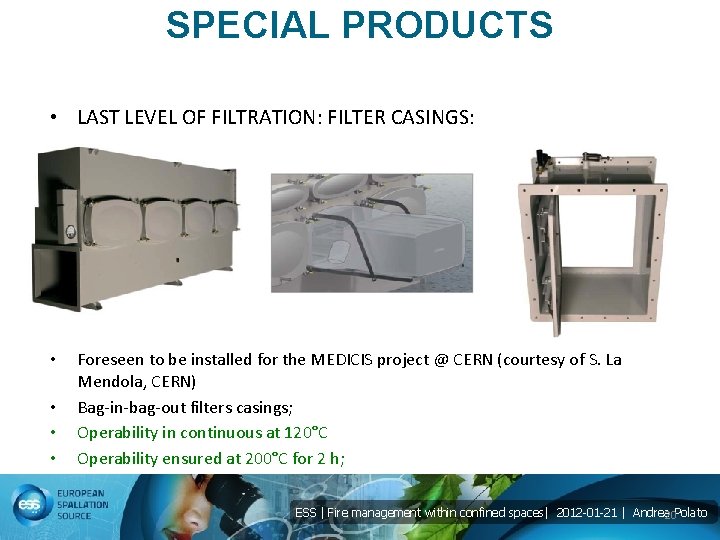
SPECIAL PRODUCTS • LAST LEVEL OF FILTRATION: FILTER CASINGS: • • Foreseen to be installed for the MEDICIS project @ CERN (courtesy of S. La Mendola, CERN) Bag-in-bag-out filters casings; Operability in continuous at 120°C Operability ensured at 200°C for 2 h; ESS | Fire management within confined spaces| 2012 -01 -21 | Andrea 20 Polato
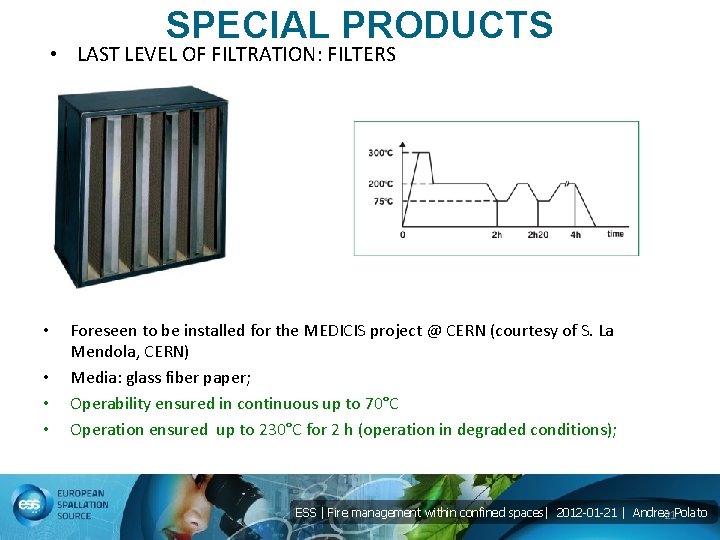
SPECIAL PRODUCTS • LAST LEVEL OF FILTRATION: FILTERS • • Foreseen to be installed for the MEDICIS project @ CERN (courtesy of S. La Mendola, CERN) Media: glass fiber paper; Operability ensured in continuous up to 70°C Operation ensured up to 230°C for 2 h (operation in degraded conditions); ESS | Fire management within confined spaces| 2012 -01 -21 | Andrea 21 Polato
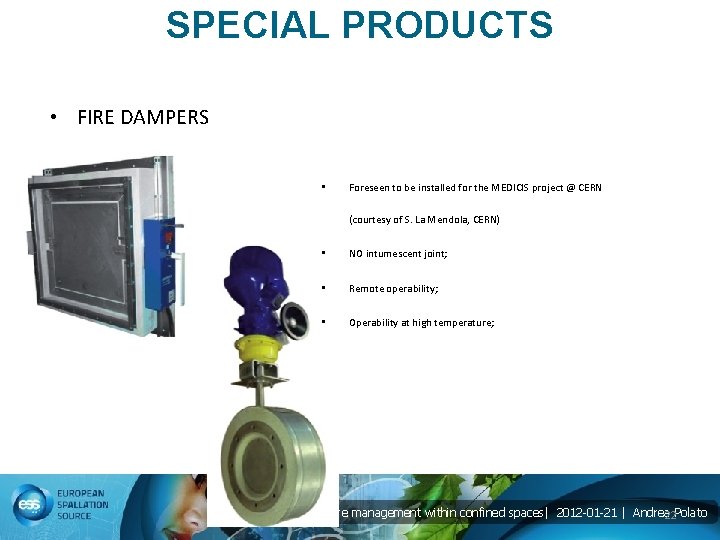
SPECIAL PRODUCTS • FIRE DAMPERS • Foreseen to be installed for the MEDICIS project @ CERN (courtesy of S. La Mendola, CERN) • NO intumescent joint; • Remote operability; • Operability at high temperature; ESS | Fire management within confined spaces| 2012 -01 -21 | Andrea 22 Polato
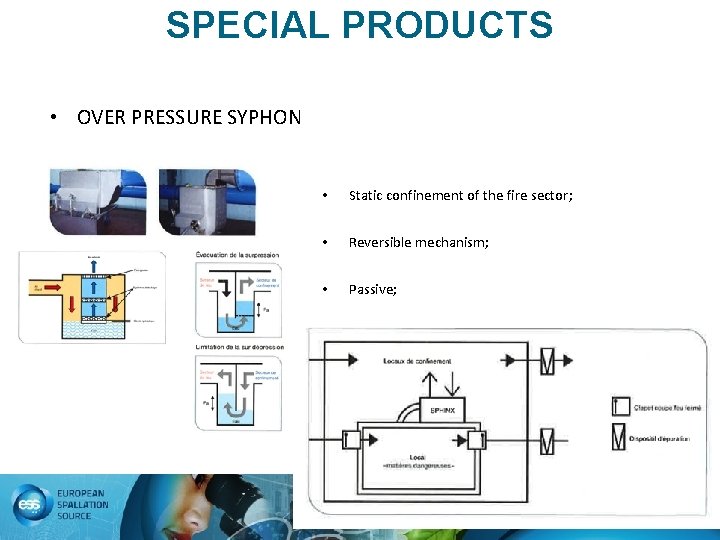
SPECIAL PRODUCTS • OVER PRESSURE SYPHON • Static confinement of the fire sector; • Reversible mechanism; • Passive; ESS | Fire management within confined spaces| 2012 -01 -21 | Andrea 23 Polato
CONCLUSIONS • In case of confined spaces the normal fire protection requirements have to take into account the release factors and the dose to operators and public; • With regards to the smoke extraction, in case of fire in a confined space, points that have to considered: – Is there the necessity for fire brigade/rescue teams access the inside of the premise with respect to the dose limits? – What are the consequences on the operators due to the loss of dynamic confinement? – What is the impact on the public of the smokes extracted in terms of dose? – If smoke extraction is released directly outside the facility, how to measure the entity of the releases? ESS | Fire management within confined spaces| 2012 -01 -21 | Andrea Polato
CONCLUSIONS • ISO 17873: 2004 describes a way to control the ventilation system during a fire in order to: – ensure the control of the dynamic confinement, as long as possible during and after the possible fires; – limit the release of the radioactive substances to the rooms where personnel are intended to remain; – protect the last filtration level from chemical and heat attacks in order to avoid uncontrolled releases into the environment (to maximize protection of the general public), namely in case of risk of loss of the last filtration level; – Provide a monitoring of the releases also in case of a fire event • The procedure described implies a control of the ventilation system on the base of the: – ΔP of the room; – T at the last level of filtration; – Integrity/functionality of the last level of filtration; ESS | Fire management within confined spaces| 2012 -01 -21 | Andrea Polato
CONCLUSIONS • Applied in CEA Research Centers in facilities where a radiotoxic inventory is present; • Recently implemented at CERN for the MEDICIS Project connected to the ISOLDE Facility; • A series of products has been studied specifically to control the ventilation during a fire event in a confined space; • This strategy doesn’t preclude the implementation of automatic fire extinguishing agents where is necessary/possible; ESS | Fire management within confined spaces| 2012 -01 -21 | Andrea Polato