
Fire Extinguisher Use Introduction How to Use this
- Slides: 49
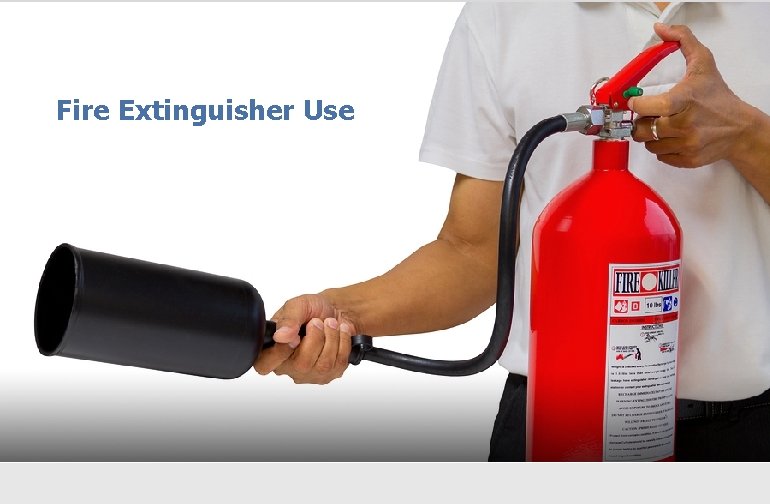
Fire Extinguisher Use
Introduction How to Use this Presentation This presentation contains base material for use in an instructor-led training setting. You may modify this presentation to satisfy the specific training needs of your organization. On some slides, the display text is supplemented with additional material in the slide notes. This content is licensed for modification and use in a classroom setting. You may not redistribute this material in any form. DISCLAIMER This training material presents very important, pertinent information. It should not be assumed, however, that this program satisfies every legal requirement of every state. Some states require the training be developed and delivered by an individual with specific training and experience. This training is AWARENESS LEVEL and does not authorize any person to perform work or validate their level of competency; it must be supplemented with operation and processspecific assessments and training, as well as management oversight, to assure that all training is understood and followed. Your organization must do an evaluation of all exposures and applicable codes and regulations. In addition, establish proper controls, training, and protective measures to effectively control exposures and assure compliance. This program is neither a determination that the conditions and practices of your organization are safe, nor a warranty that reliance upon this program will prevent accidents and losses or satisfy local, state, or federal regulations.
Introduction Fire is a potential threat in nearly every industry or environment. Topics: • Fire kills hundreds and injures thousands. • Extinguisher selection • When trained to use fire extinguishers, you can save lives. • Extinguisher use • Fire extinguishers are not appropriate or safe for every situation. • When to evacuate
Introduction Course Overview 1. The Science of Fire 2. Fire Classes 3. Preparation 4. Risk Assessment 5. The PASS System
1 The Science of Fire What you need to know: 1. The stages of fire 2. What is required for sustained combustion and extinguishment
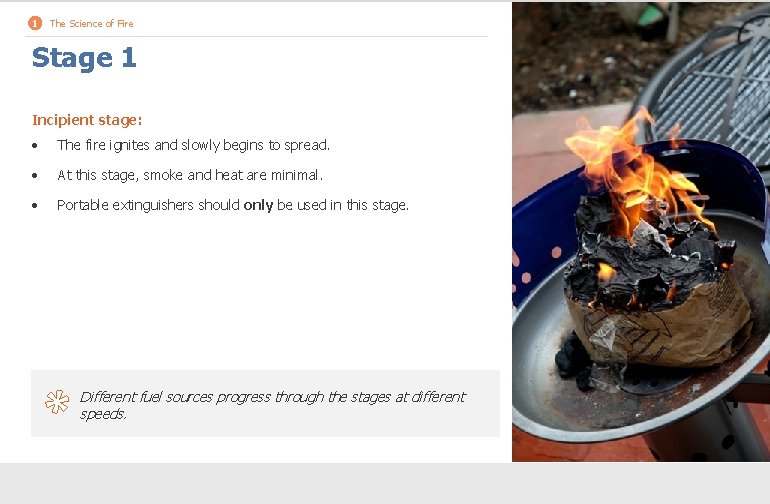
1 The Science of Fire Stage 1 Incipient stage: • The fire ignites and slowly begins to spread. • At this stage, smoke and heat are minimal. • Portable extinguishers should only be used in this stage. * Different fuel sources progress through the stages at different speeds.
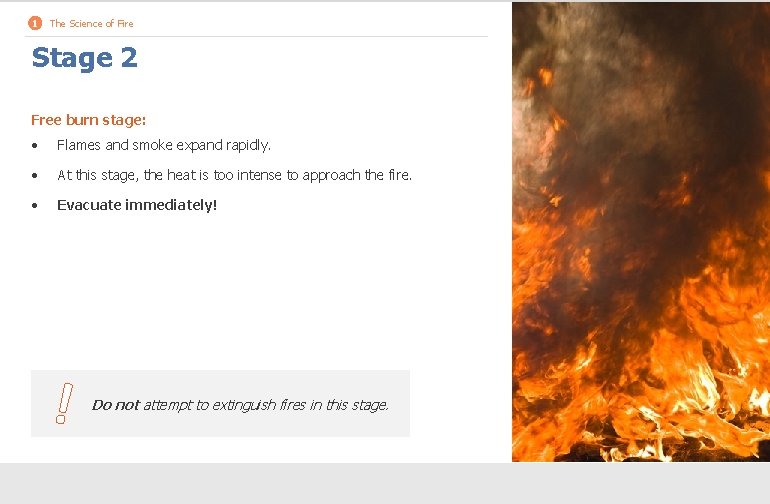
1 The Science of Fire Stage 2 Free burn stage: • Flames and smoke expand rapidly. • At this stage, the heat is too intense to approach the fire. • Evacuate immediately! ! Do not attempt to extinguish fires in this stage.
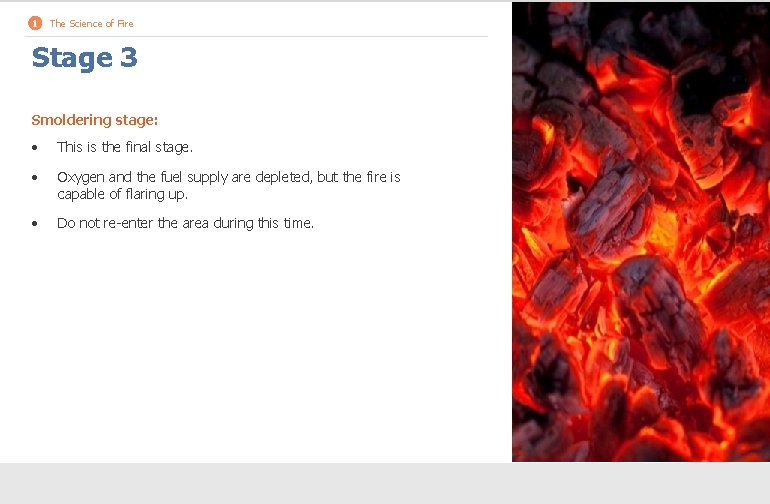
1 The Science of Fire Stage 3 Smoldering stage: • This is the final stage. • Oxygen and the fuel supply are depleted, but the fire is capable of flaring up. • Do not re-enter the area during this time.
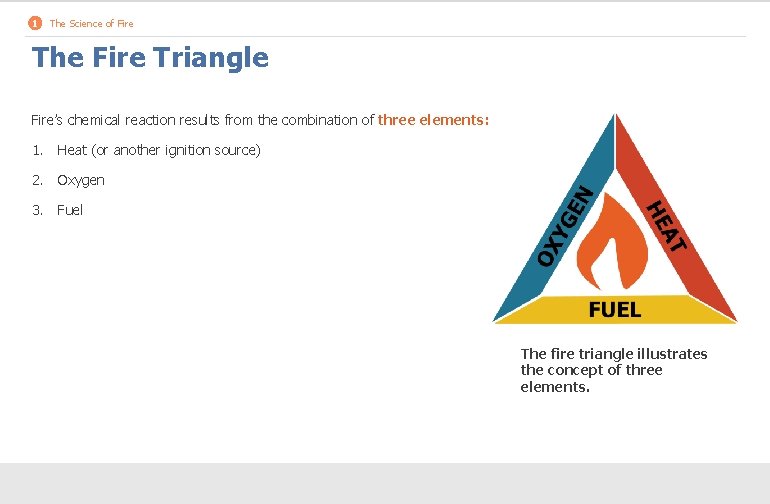
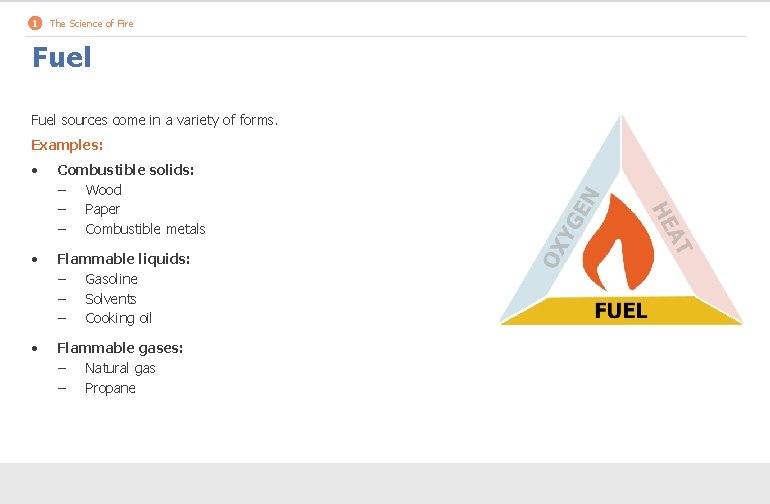
1 The Science of Fire The Fire Triangle Fire’s chemical reaction results from the combination of three elements: 1. Heat (or another ignition source) 2. Oxygen 3. Fuel The fire triangle illustrates the concept of three elements.
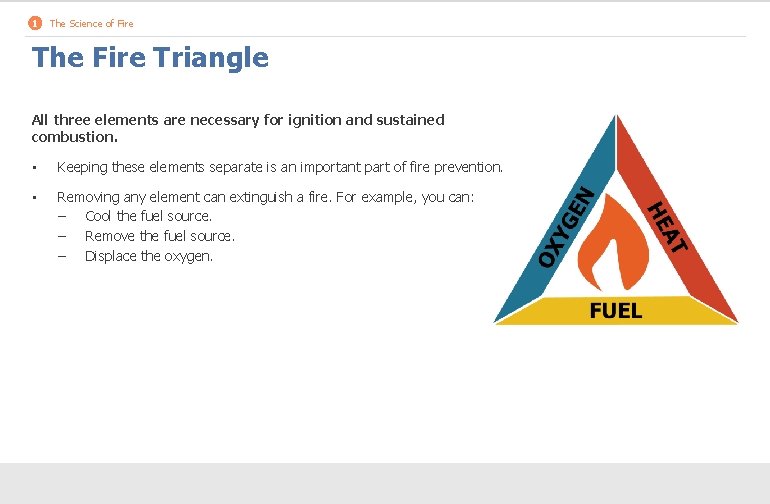
1 The Science of Fire The Fire Triangle All three elements are necessary for ignition and sustained combustion. • Keeping these elements separate is an important part of fire prevention. • Removing any element can extinguish a fire. For example, you can: ‒ Cool the fuel source. ‒ Remove the fuel source. ‒ Displace the oxygen.
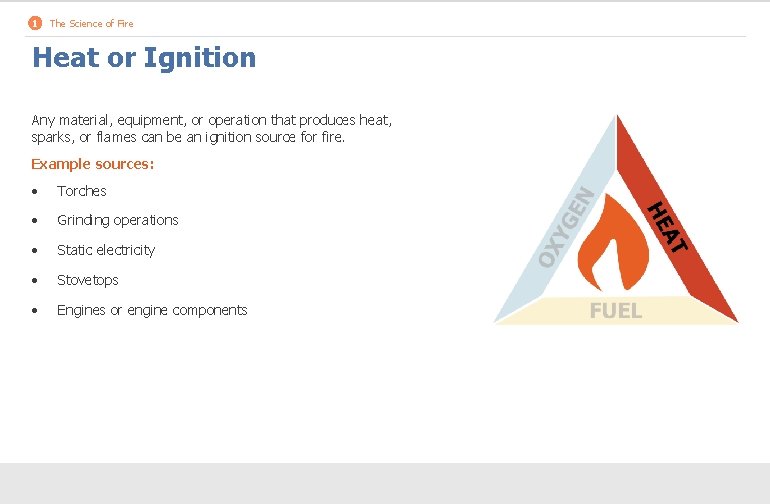
1 The Science of Fire Heat or Ignition Any material, equipment, or operation that produces heat, sparks, or flames can be an ignition source for fire. Example sources: • Torches • Grinding operations • Static electricity • Stovetops • Engines or engine components
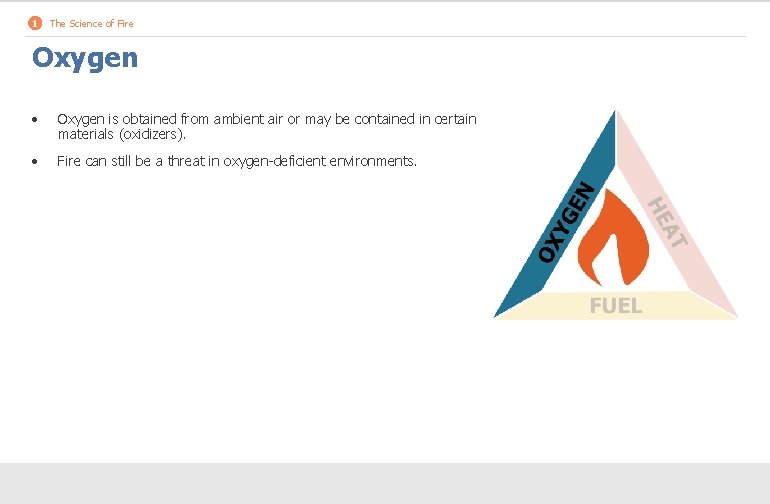
1 The Science of Fire Oxygen • Oxygen is obtained from ambient air or may be contained in certain materials (oxidizers). • Fire can still be a threat in oxygen-deficient environments.
1 The Science of Fire Fuel sources come in a variety of forms. Examples: • Combustible solids: ‒ Wood ‒ Paper ‒ Combustible metals • Flammable liquids: ‒ Gasoline ‒ Solvents ‒ Cooking oil • Flammable gases: ‒ Natural gas ‒ Propane
2 Fire Classes What you need to know: 1. Classes of fire 2. Specialized extinguishers for each class
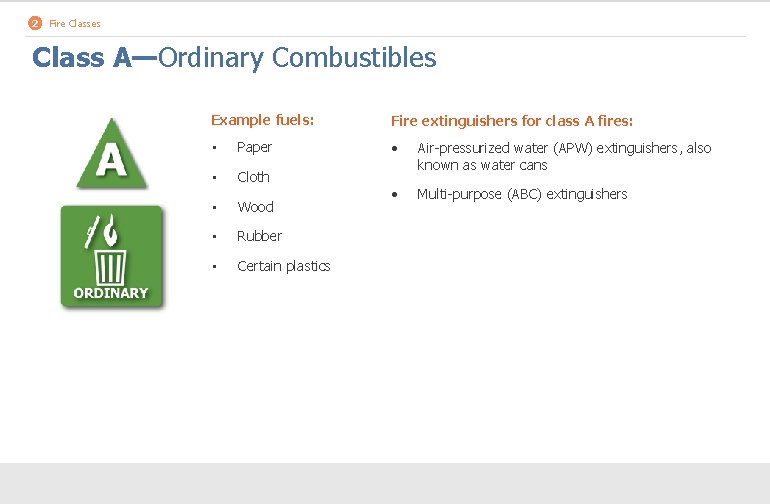
2 Fire Classes Class A—Ordinary Combustibles Example fuels: • Paper • Cloth • Wood • Rubber • Certain plastics Fire extinguishers for class A fires: • Air-pressurized water (APW) extinguishers, also known as water cans • Multi-purpose (ABC) extinguishers
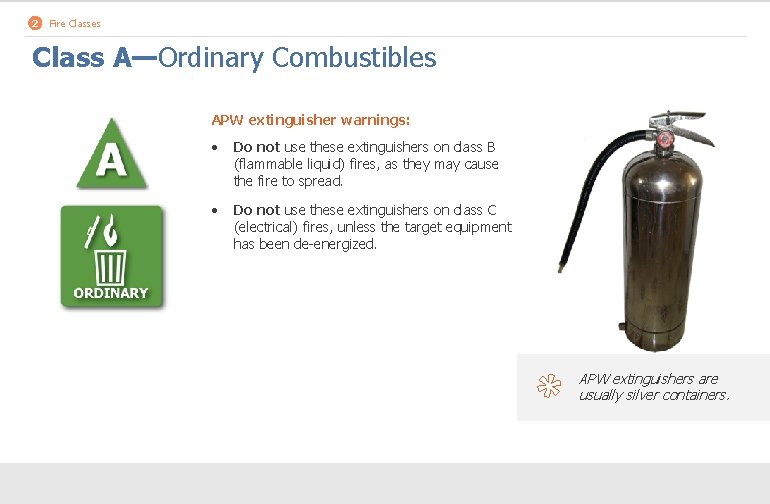
2 Fire Classes Class A—Ordinary Combustibles APW extinguisher warnings: • Do not use these extinguishers on class B (flammable liquid) fires, as they may cause the fire to spread. • Do not use these extinguishers on class C (electrical) fires, unless the target equipment has been de-energized. * APW extinguishers are usually silver containers.
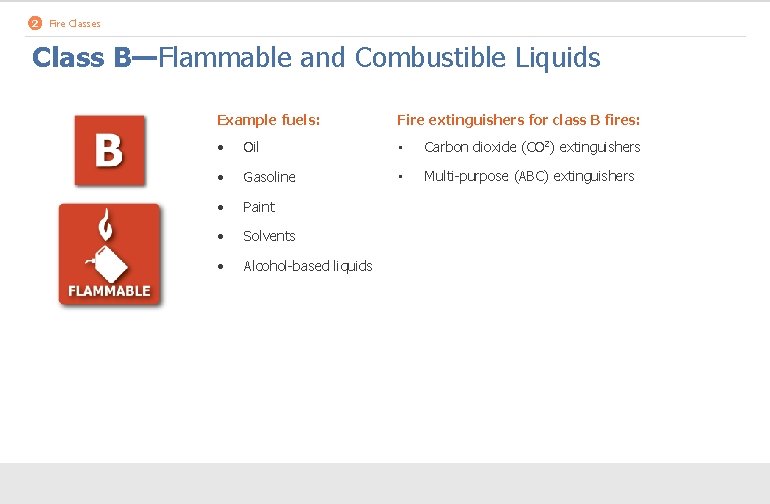
2 Fire Classes Class B—Flammable and Combustible Liquids Example fuels: Fire extinguishers for class B fires: • Oil • Carbon dioxide (CO 2) extinguishers • Gasoline • Multi-purpose (ABC) extinguishers • Paint • Solvents • Alcohol-based liquids
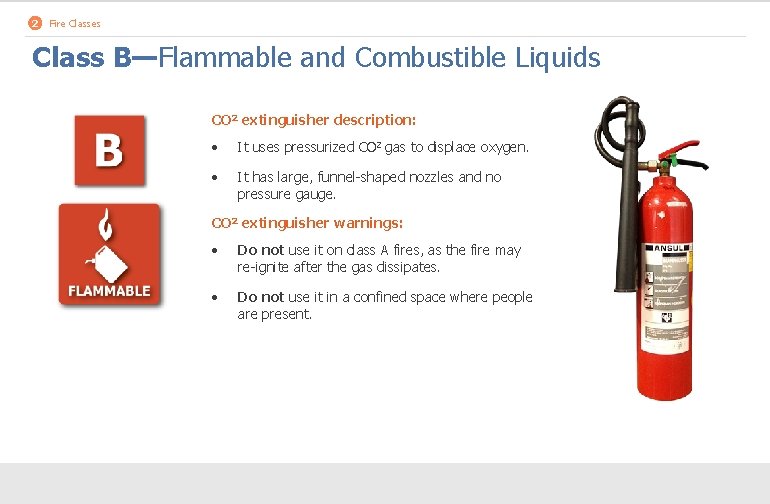
2 Fire Classes Class B—Flammable and Combustible Liquids CO 2 extinguisher description: • It uses pressurized CO 2 gas to displace oxygen. • It has large, funnel-shaped nozzles and no pressure gauge. CO 2 extinguisher warnings: • Do not use it on class A fires, as the fire may re-ignite after the gas dissipates. • Do not use it in a confined space where people are present.
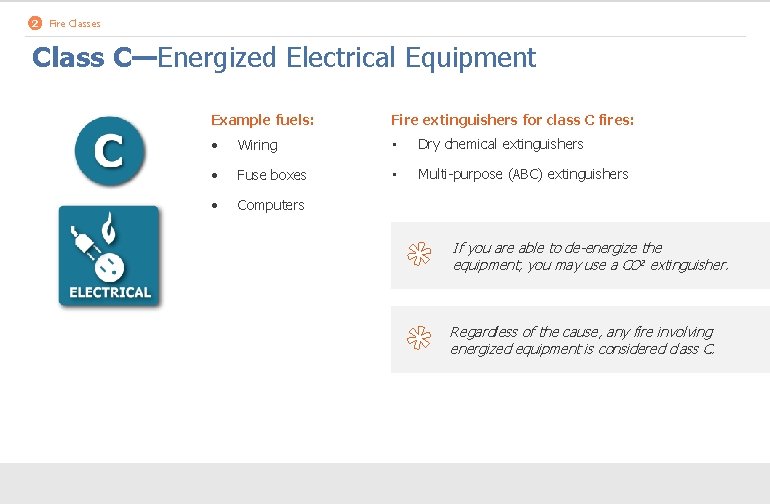
2 Fire Classes Class C—Energized Electrical Equipment Example fuels: Fire extinguishers for class C fires: • Wiring • Dry chemical extinguishers • Fuse boxes • Multi-purpose (ABC) extinguishers • Computers * * If you are able to de-energize the equipment, you may use a CO 2 extinguisher. Regardless of the cause, any fire involving energized equipment is considered class C.
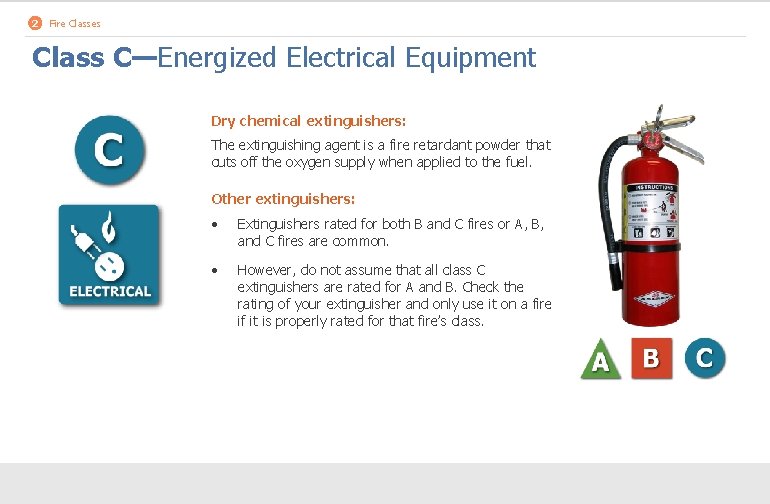
2 Fire Classes Class C—Energized Electrical Equipment Dry chemical extinguishers: The extinguishing agent is a fire retardant powder that cuts off the oxygen supply when applied to the fuel. Other extinguishers: • Extinguishers rated for both B and C fires or A, B, and C fires are common. • However, do not assume that all class C extinguishers are rated for A and B. Check the rating of your extinguisher and only use it on a fire if it is properly rated for that fire’s class.
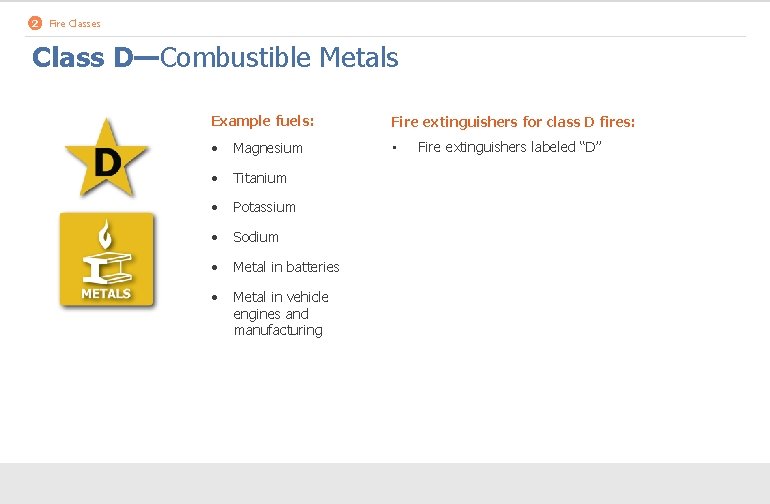
2 Fire Classes Class D—Combustible Metals Example fuels: Fire extinguishers for class D fires: • Magnesium • • Titanium • Potassium • Sodium • Metal in batteries • Metal in vehicle engines and manufacturing Fire extinguishers labeled “D”
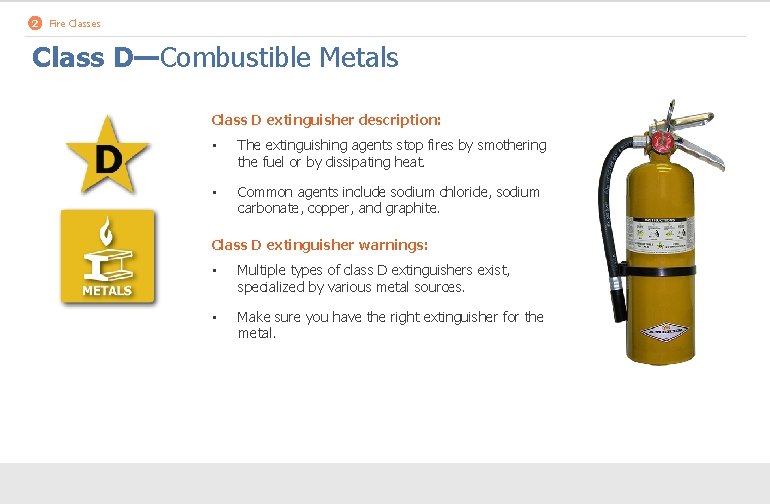
2 Fire Classes Class D—Combustible Metals Class D extinguisher description: • The extinguishing agents stop fires by smothering the fuel or by dissipating heat. • Common agents include sodium chloride, sodium carbonate, copper, and graphite. Class D extinguisher warnings: • Multiple types of class D extinguishers exist, specialized by various metal sources. • Make sure you have the right extinguisher for the metal.
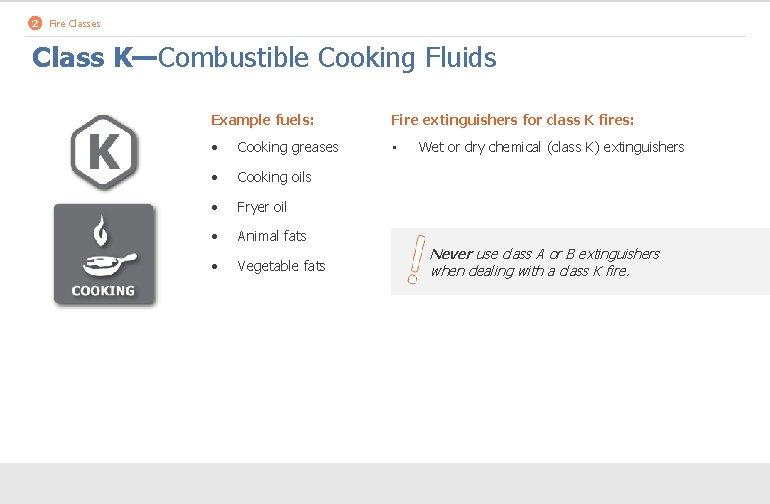
2 Fire Classes Class K—Combustible Cooking Fluids Example fuels: Fire extinguishers for class K fires: • Cooking greases • • Cooking oils • Fryer oil • Animal fats • Vegetable fats Wet or dry chemical (class K) extinguishers Never use class A or B extinguishers when dealing with a class K fire.
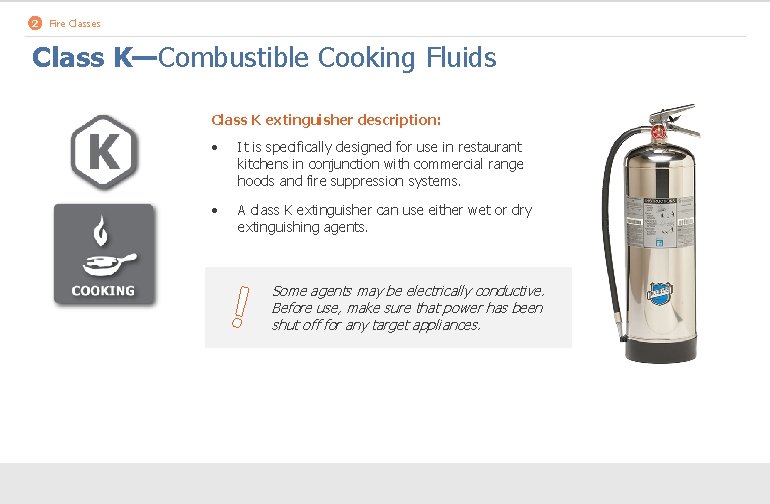
2 Fire Classes Class K—Combustible Cooking Fluids Class K extinguisher description: • It is specifically designed for use in restaurant kitchens in conjunction with commercial range hoods and fire suppression systems. • A class K extinguisher can use either wet or dry extinguishing agents. ! Some agents may be electrically conductive. Before use, make sure that power has been shut off for any target appliances.
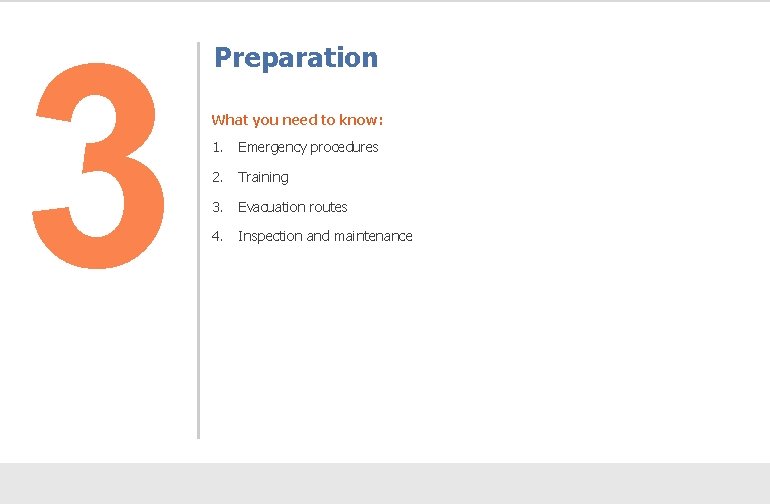
3 Preparation What you need to know: 1. Emergency procedures 2. Training 3. Evacuation routes 4. Inspection and maintenance
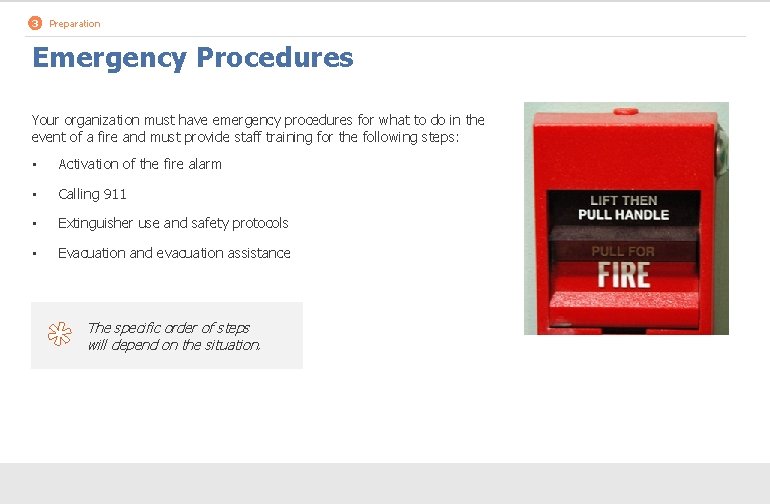
3 Preparation Emergency Procedures Your organization must have emergency procedures for what to do in the event of a fire and must provide staff training for the following steps: • Activation of the fire alarm • Calling 911 • Extinguisher use and safety protocols • Evacuation and evacuation assistance * The specific order of steps will depend on the situation.
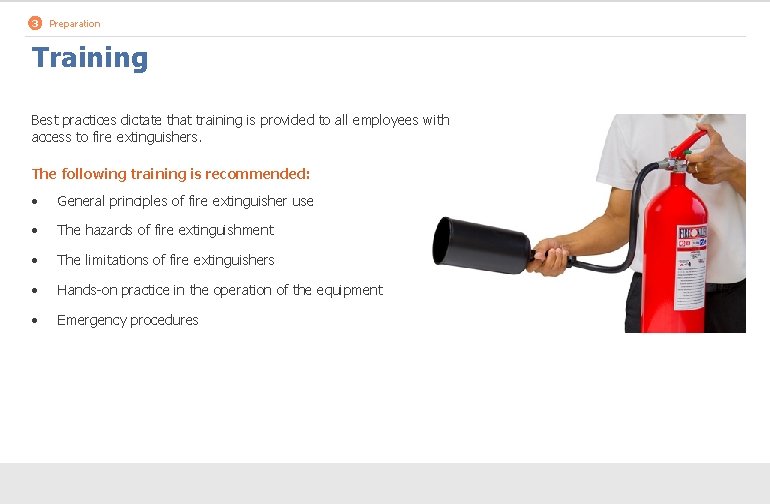
3 Preparation Training Best practices dictate that training is provided to all employees with access to fire extinguishers. The following training is recommended: • General principles of fire extinguisher use • The hazards of fire extinguishment • The limitations of fire extinguishers • Hands-on practice in the operation of the equipment • Emergency procedures
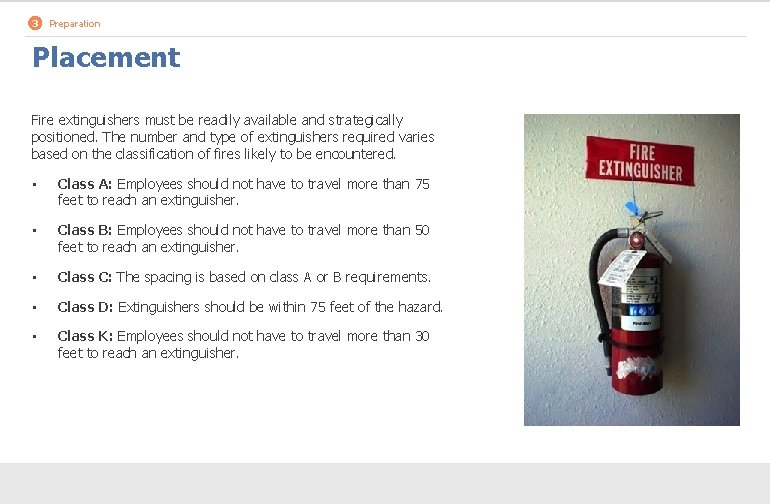
3 Preparation Placement Fire extinguishers must be readily available and strategically positioned. The number and type of extinguishers required varies based on the classification of fires likely to be encountered. • Class A: Employees should not have to travel more than 75 feet to reach an extinguisher. • Class B: Employees should not have to travel more than 50 feet to reach an extinguisher. • Class C: The spacing is based on class A or B requirements. • Class D: Extinguishers should be within 75 feet of the hazard. • Class K: Employees should not have to travel more than 30 feet to reach an extinguisher.
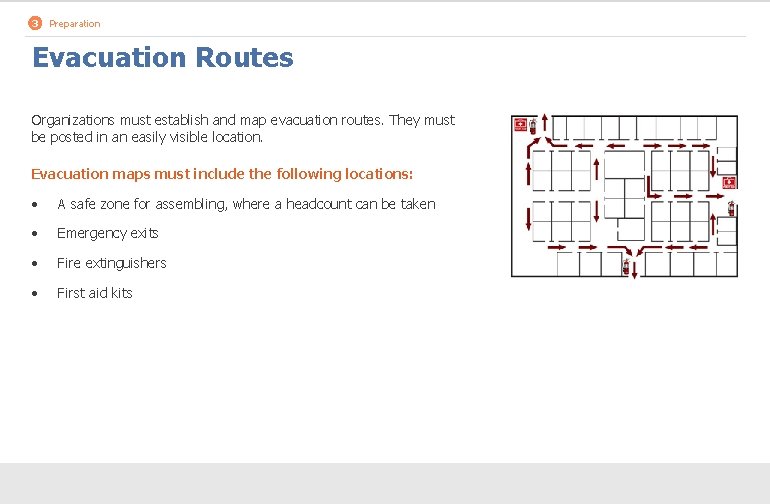
3 Preparation Evacuation Routes Organizations must establish and map evacuation routes. They must be posted in an easily visible location. Evacuation maps must include the following locations: • A safe zone for assembling, where a headcount can be taken • Emergency exits • Fire extinguishers • First aid kits
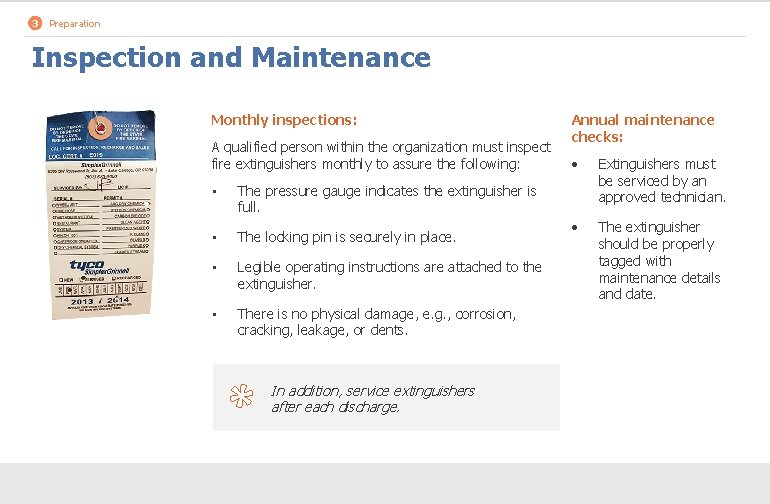
3 Preparation Inspection and Maintenance Monthly inspections: A qualified person within the organization must inspect fire extinguishers monthly to assure the following: • The pressure gauge indicates the extinguisher is full. • The locking pin is securely in place. • Legible operating instructions are attached to the extinguisher. • There is no physical damage, e. g. , corrosion, cracking, leakage, or dents. * In addition, service extinguishers after each discharge. Annual maintenance checks: • Extinguishers must be serviced by an approved technician. • The extinguisher should be properly tagged with maintenance details and date.
4 Risk Assessment What you need to know: 1. Methods to size up threat
4 Risk Assessment Overview Prior to using an extinguisher, perform a quick assessment of the fire. Assess the following: • Fuel type • Extinguisher type • Fire size • Atmosphere • Evacuation route
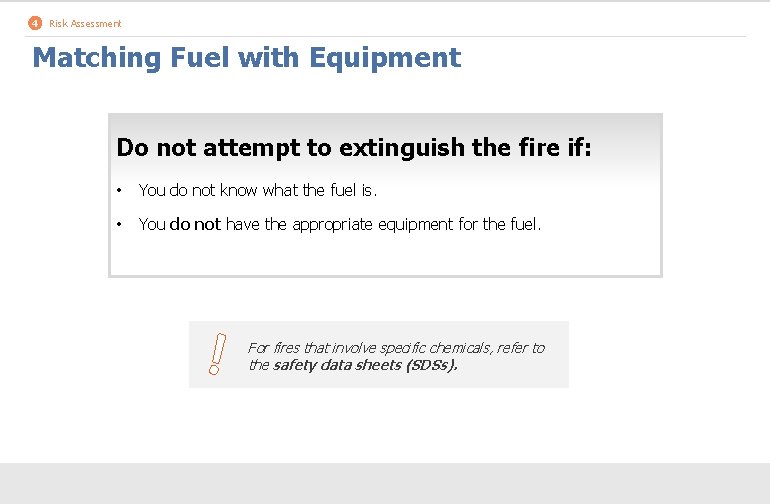
4 Risk Assessment Matching Fuel with Equipment Do not attempt to extinguish the fire if: • You do not know what the fuel is. • You do not have the appropriate equipment for the fuel. ! For fires that involve specific chemicals, refer to the safety data sheets (SDSs).
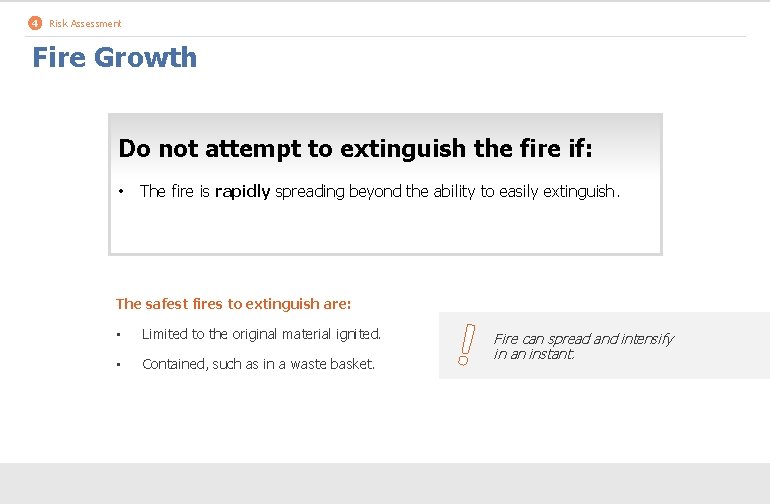
4 Risk Assessment Fire Growth Do not attempt to extinguish the fire if: • The fire is rapidly spreading beyond the ability to easily extinguish. The safest fires to extinguish are: • Limited to the original material ignited. • Contained, such as in a waste basket. ! Fire can spread and intensify in an instant.
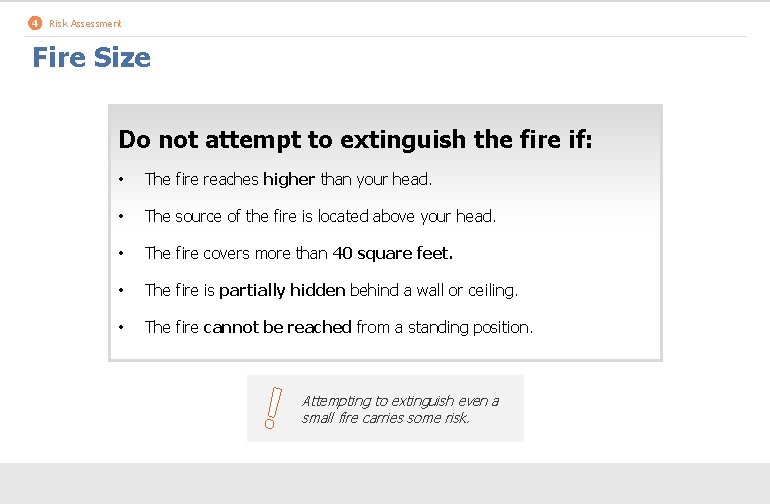
4 Risk Assessment Fire Size Do not attempt to extinguish the fire if: • The fire reaches higher than your head. • The source of the fire is located above your head. • The fire covers more than 40 square feet. • The fire is partially hidden behind a wall or ceiling. • The fire cannot be reached from a standing position. ! Attempting to extinguish even a small fire carries some risk.
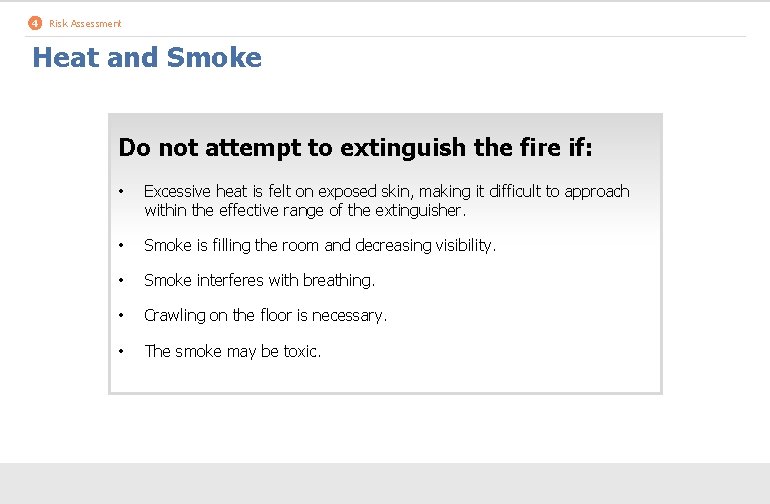
4 Risk Assessment Heat and Smoke Do not attempt to extinguish the fire if: • Excessive heat is felt on exposed skin, making it difficult to approach within the effective range of the extinguisher. • Smoke is filling the room and decreasing visibility. • Smoke interferes with breathing. • Crawling on the floor is necessary. • The smoke may be toxic.
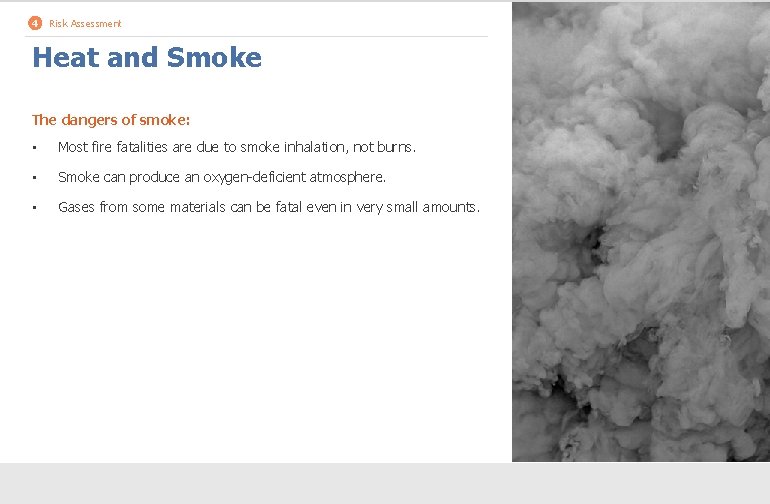
4 Risk Assessment Heat and Smoke The dangers of smoke: • Most fire fatalities are due to smoke inhalation, not burns. • Smoke can produce an oxygen-deficient atmosphere. • Gases from some materials can be fatal even in very small amounts.
4 Risk Assessment The Evacuation Route Do not attempt to extinguish the fire if: • Fire, heat, or smoke is starting to block the evacuation route or looks like it soon could. ! * Always position yourself with an exit or means of escape behind you. In case of evacuation, keep the fire extinguisher with you to protect the evacuation route.
4 Risk Assessment Additional Considerations Do not attempt to extinguish the fire if: • You are not sure whether the fire is safe to extinguish. • You are uncertain in your ability to extinguish the fire.
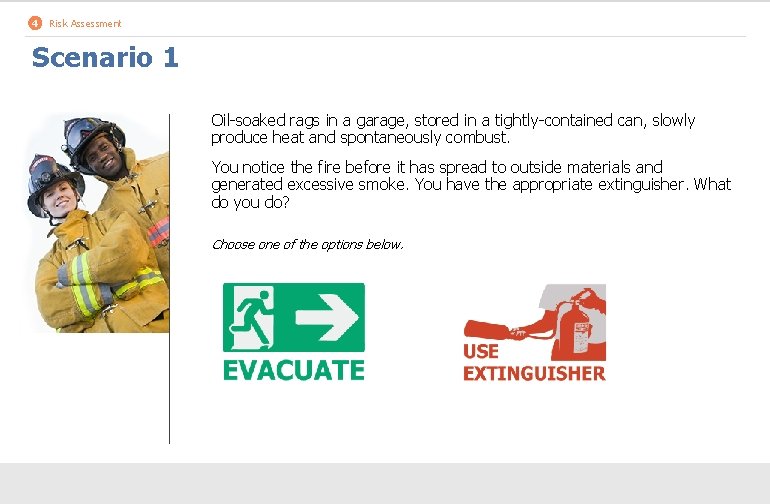
4 Risk Assessment Scenario 1 Oil-soaked rags in a garage, stored in a tightly-contained can, slowly produce heat and spontaneously combust. You notice the fire before it has spread to outside materials and generated excessive smoke. You have the appropriate extinguisher. What do you do? Choose one of the options below.
4 Risk Assessment Scenario 2 A portable heater catches a curtain on fire. The flames race up the curtain to eye level, and the synthetic material generates thick black smoke. You have the appropriate extinguisher. What do you do? Choose one of the options below.
4 Risk Assessment Scenario 3 You notice a small portion of the wall on fire near a charred electrical outlet. Flames are at a minimum. The air is still clear, but the area is actively producing light smoke. You have the appropriate extinguisher. What do you do? Choose one of the options below.
4 Risk Assessment Scenario 4 A grease fire has a started in an industrial kitchen. You notice that the fire is contained. You feel the kitchen temperature starting to rise, and notice smoke accumulating on the ceiling. You have a class K extinguisher. What do you do? Choose one of the options below.
5 Risk Assessment What you need to know: 1. The P. A. S. S. technique
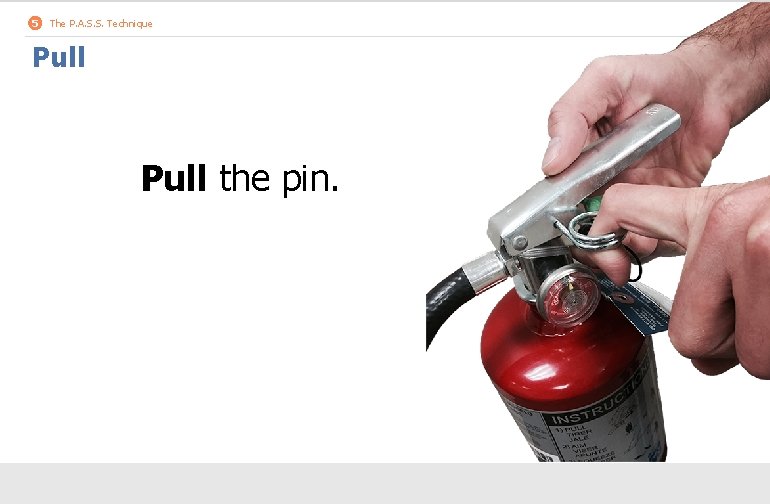
5 The P. A. S. S. Technique Pull the pin.
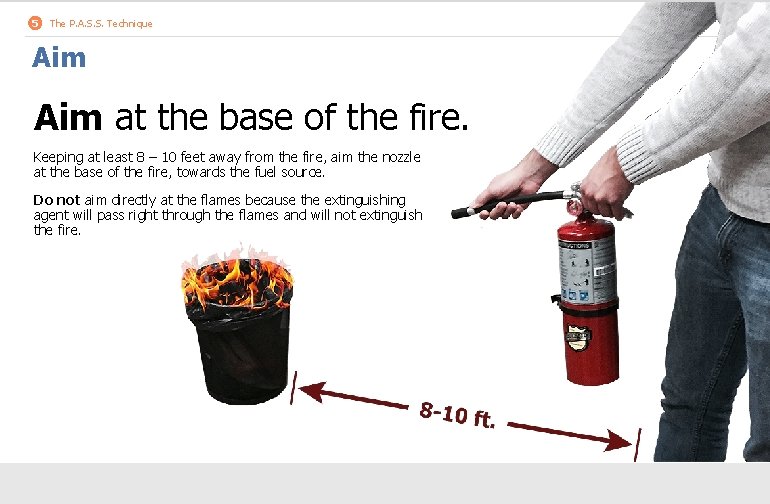
5 The P. A. S. S. Technique Aim at the base of the fire. Keeping at least 8 – 10 feet away from the fire, aim the nozzle at the base of the fire, towards the fuel source. Do not aim directly at the flames because the extinguishing agent will pass right through the flames and will not extinguish the fire.
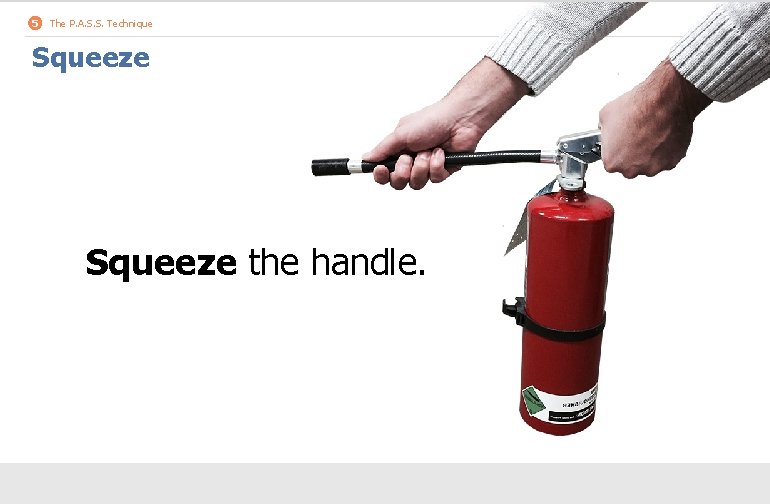
5 The P. A. S. S. Technique Squeeze the handle.
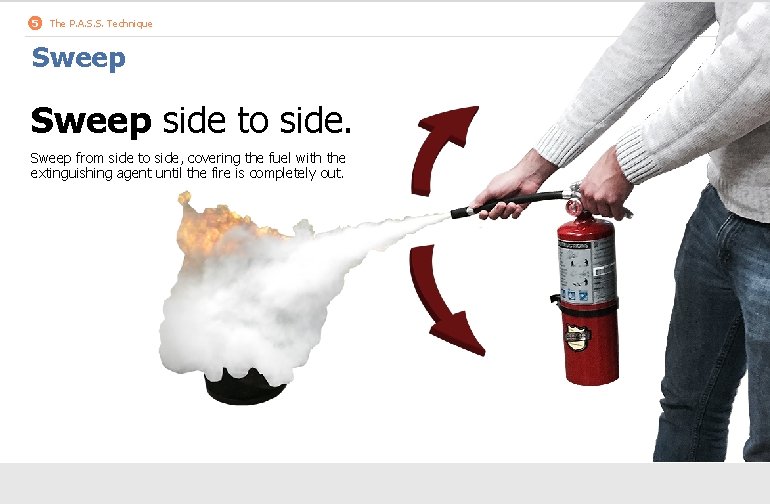
5 The P. A. S. S. Technique Sweep side to side. Sweep from side to side, covering the fuel with the extinguishing agent until the fire is completely out.
5 Finish Summary • The incipient phase is the safest time to use the fire extinguisher. • Removal of either heat, fuel, or oxygen extinguishes the fire. • Identify the class of fire. • Assess the fire’s size and the safety of the atmosphere. • Keep an open evacuation route. • Use the P. A. S. S. technique.