
Fire Droid Hardening Security in AlmostStock Android Giovanni
![Security Policies Requester Operation [param-list] on Target [if condition] then outcome [do action] •](https://slidetodoc.com/presentation_image/2e60dc6138725f35b638ba446ffacbb6/image-17.jpg "Security Policies Requester Operation [param-list] on Target [if condition] then outcome [do action] •")
![Information Harvesting App get [code] on i. Phone. Sub. Info if (code == IMEI)](https://slidetodoc.com/presentation_image/2e60dc6138725f35b638ba446ffacbb6/image-20.jpg "Information Harvesting App get [code] on i. Phone. Sub. Info if (code == IMEI)")

- Slides: 29
Fire. Droid: Hardening Security in Almost-Stock Android Giovanni Russello, Arturo Blas Jimenez, Habib Naderi, Wannes van der Mark University of Auckland, New Zealand 1
Roadmap • • • Introduction System Design Implementation Security Policy Evaluation Discussion of EMM 2
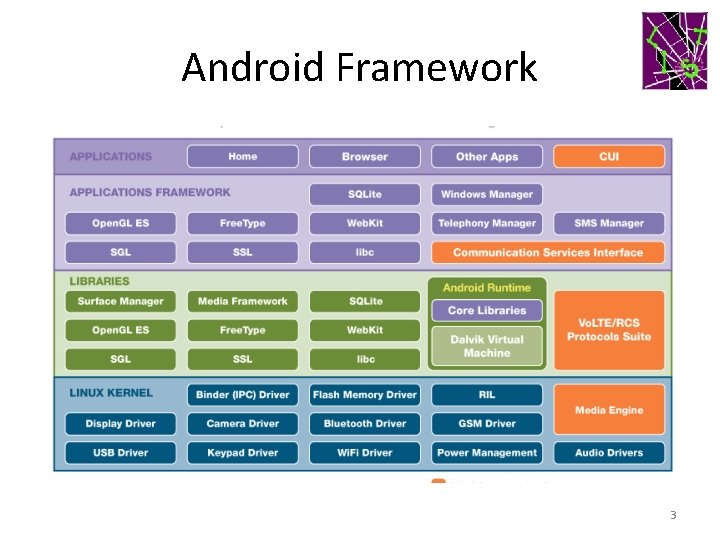
Android Framework 3
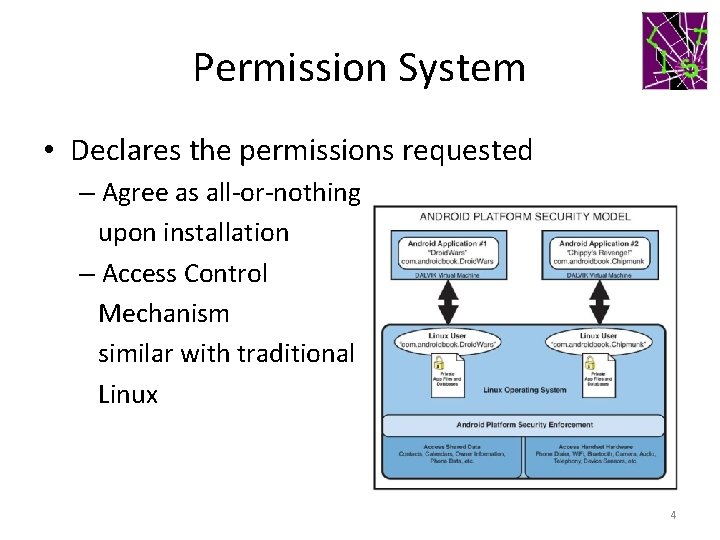
Permission System • Declares the permissions requested – Agree as all-or-nothing upon installation – Access Control Mechanism similar with traditional Linux 4
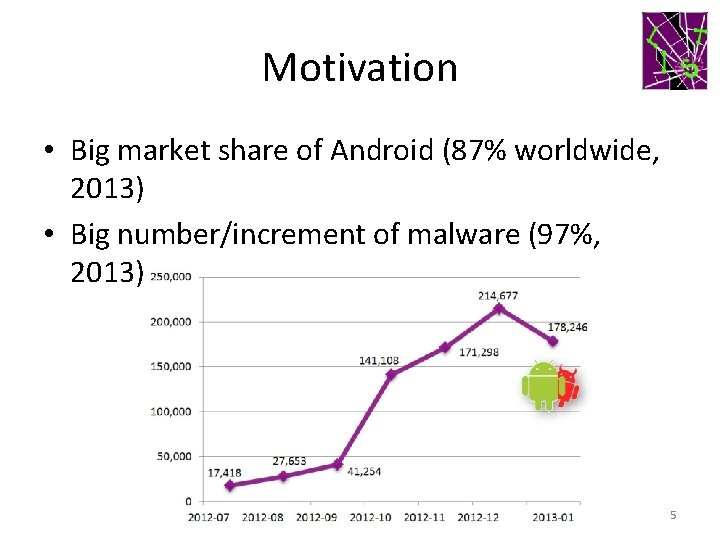
Motivation • Big market share of Android (87% worldwide, 2013) • Big number/increment of malware (97%, 2013) 5
Motivation • Rapid evolution of malware – Commercial tools fail to detect 21% of malwares • Inflexible security mechanism/policy enforcement of Android 6
Desired System • • Light modification of OS No recompilation of middleware and OS Enforce security policies in Native Code Layer Not rely on user 7
Roadmap • • • Introduction System Design Implementation Security Policy Evaluation Discussion of EMM 8
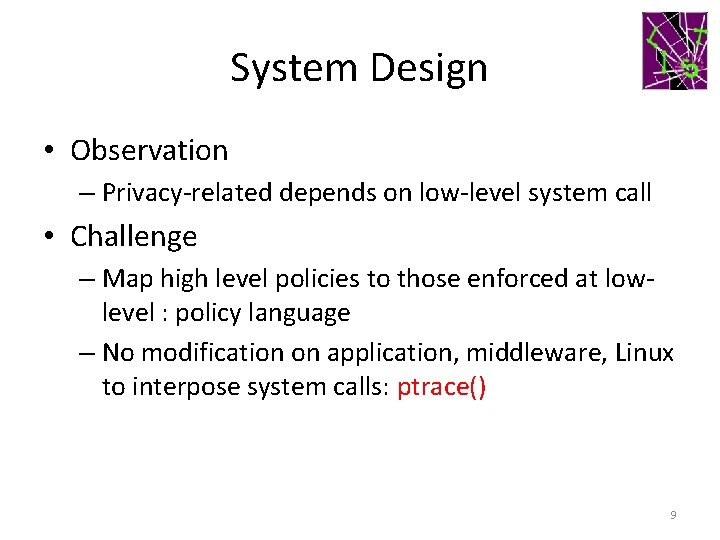
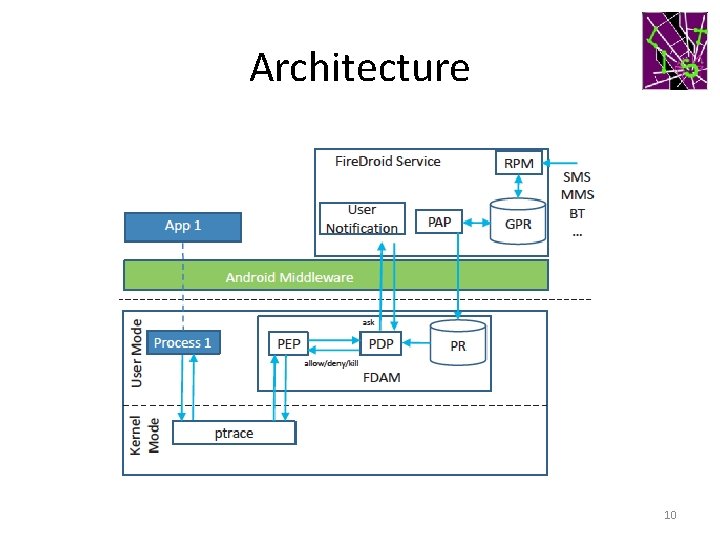
System Design • Observation – Privacy-related depends on low-level system call • Challenge – Map high level policies to those enforced at lowlevel : policy language – No modification on application, middleware, Linux to interpose system calls: ptrace() 9
Architecture 10
Roadmap • • • Introduction System Design Implementation Security Policy Evaluation Discussion of EMM 11
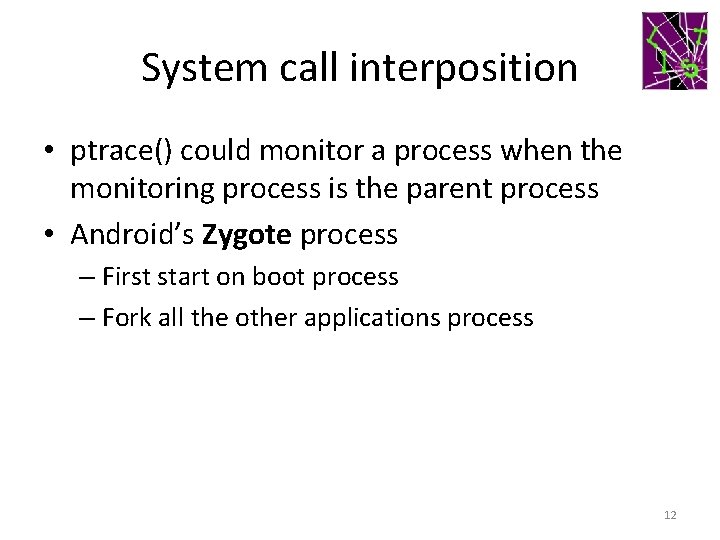
System call interposition • ptrace() could monitor a process when the monitoring process is the parent process • Android’s Zygote process – First start on boot process – Fork all the other applications process 12
System call interposition (cont’d) • Monitoring process starts earlier than Zygote • Modify the configuration file “init. rc” – Need to get the root privilege – No need to recompile the OS image (light modification) • On-the-air update disable Fire. Droid? – Modify init. rc – Disable ptrace() 13
System call interposition (cont’d) • Avoid side effects caused by system call interposition – Incorrectly replicating OS semantics – Race conditions – Denying system calls – Android memory sharing 14
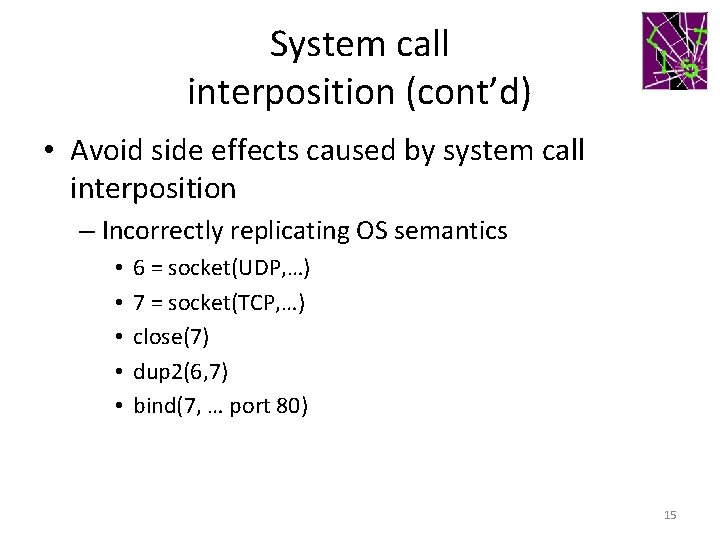
System call interposition (cont’d) • Avoid side effects caused by system call interposition – Incorrectly replicating OS semantics • • • 6 = socket(UDP, …) 7 = socket(TCP, …) close(7) dup 2(6, 7) bind(7, … port 80) 15
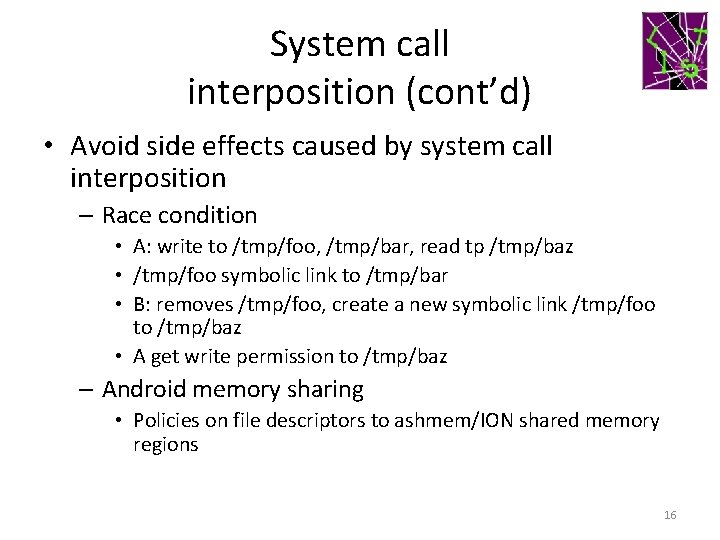
System call interposition (cont’d) • Avoid side effects caused by system call interposition – Race condition • A: write to /tmp/foo, /tmp/bar, read tp /tmp/baz • /tmp/foo symbolic link to /tmp/bar • B: removes /tmp/foo, create a new symbolic link /tmp/foo to /tmp/baz • A get write permission to /tmp/baz – Android memory sharing • Policies on file descriptors to ashmem/ION shared memory regions 16
Security Policies Requester Operation [param-list] on Target [if condition] then outcome [do action] • outcome: allow, deny, kill, ask • do action: invoke functions in Android layer 17
Roadmap • • • Introduction System Design Implementation Security Policy Evaluation Discussion of EMM 18
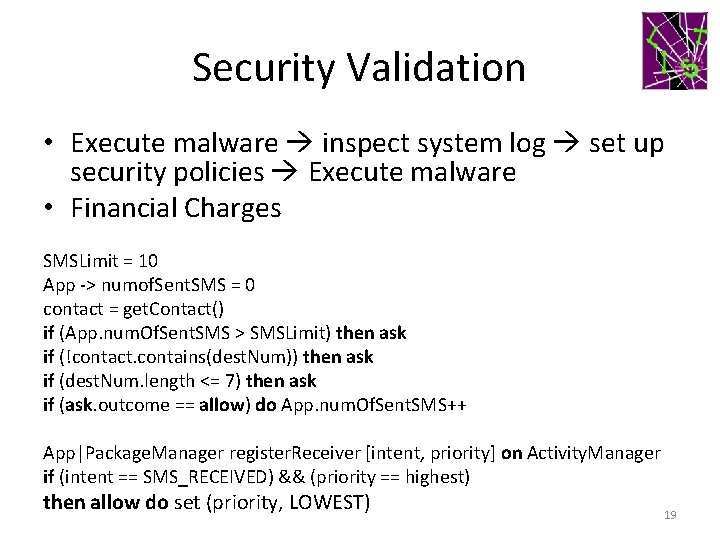
Security Validation • Execute malware inspect system log set up security policies Execute malware • Financial Charges SMSLimit = 10 App -> numof. Sent. SMS = 0 contact = get. Contact() if (App. num. Of. Sent. SMS > SMSLimit) then ask if (!contact. contains(dest. Num)) then ask if (dest. Num. length <= 7) then ask if (ask. outcome == allow) do App. num. Of. Sent. SMS++ App|Package. Manager register. Receiver [intent, priority] on Activity. Manager if (intent == SMS_RECEIVED) && (priority == highest) then allow do set (priority, LOWEST) 19
Information Harvesting App get [code] on i. Phone. Sub. Info if (code == IMEI) then allow do replace(fake. IMEI) and notify. User(imei. Message) if (code == IMSI) then allow do replace(fake. IMSI) and notify. User(imsi. Message) if (code == ICC) then allow do replace(fake. ICC) and notify. User(icc. Message) if (code == PHONE_NUMBER) then ask App query on Content. Provider if (call_log/calls) then ask if (sms/inbox || sms/sent) then deny and notify. User(stoedsms. Message) 20
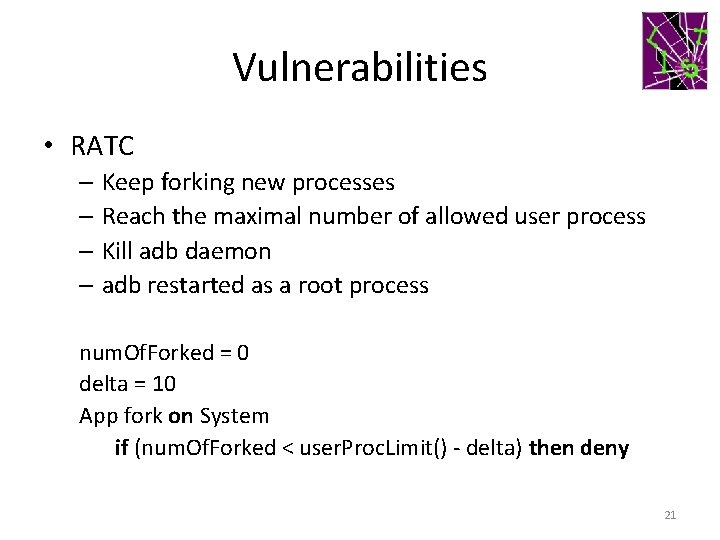
Vulnerabilities • RATC – Keep forking new processes – Reach the maximal number of allowed user process – Kill adb daemon – adb restarted as a root process num. Of. Forked = 0 delta = 10 App fork on System if (num. Of. Forked < user. Proc. Limit() - delta) then deny 21
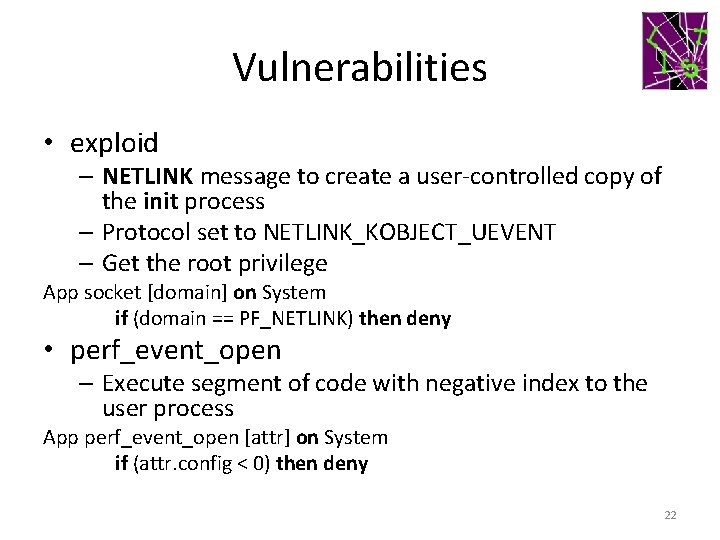
Vulnerabilities • exploid – NETLINK message to create a user-controlled copy of the init process – Protocol set to NETLINK_KOBJECT_UEVENT – Get the root privilege App socket [domain] on System if (domain == PF_NETLINK) then deny • perf_event_open – Execute segment of code with negative index to the user process App perf_event_open [attr] on System if (attr. config < 0) then deny 22
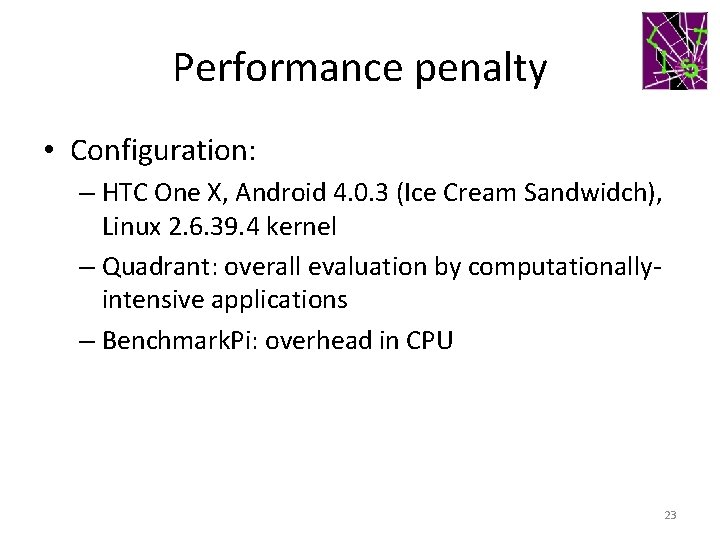
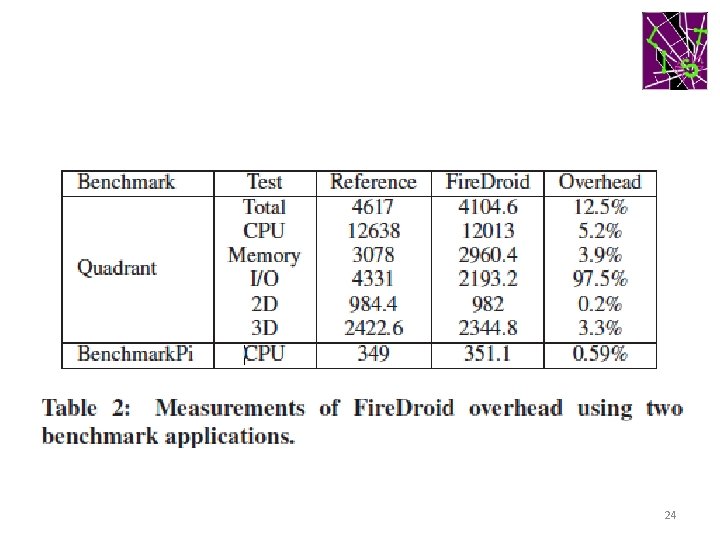
Performance penalty • Configuration: – HTC One X, Android 4. 0. 3 (Ice Cream Sandwidch), Linux 2. 6. 39. 4 kernel – Quadrant: overall evaluation by computationallyintensive applications – Benchmark. Pi: overhead in CPU 23
24
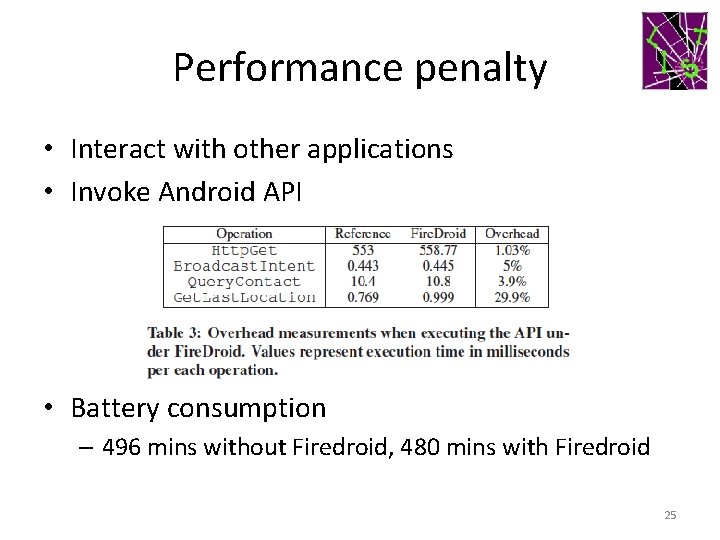
Performance penalty • Interact with other applications • Invoke Android API • Battery consumption – 496 mins without Firedroid, 480 mins with Firedroid 25
Roadmap • • • Introduction System Design Implementation Security Policy Evaluation Discussion of EMM 26
Fire. Droid • Pros: – Unmodified apps – any app including built-in system apps – No modification and recompilation of OS or middleware – Completely Handle Native Code • Cons: – Need root privilege of device (modify the init. rc file) – Performance penalty and battery consumption – Security policy not so flexible, only allow/deny… 27
App Rewriting + API hooking • Disassembles apps, rewrite them and hook the security-sensitive APIs to enforce behavior (e. g. open(), read()) • Pros: – Much more flexible security policies (app-level granularity) – No need to root the device, no modification on OS – Handle Native Code • Cons: – Need to installed modified version of app – Not able to monitor the system/preinstalled apps 28
Thank you! Questions? 29