
Finite State Morphology Alexander Fraser Liane Guillou fraser



- Slides: 54
Finite State Morphology Alexander Fraser & Liane Guillou {fraser, liane}@cis. uni-muenchen. de CIS, Ludwig-Maximilians-Universität München Computational Morphology and Electronic Dictionaries So. Se 2016 -05 -09
Outline • Today we will cover finite state morphology more formally – We'll review concepts from the first lecture and from the exercises – And define operations in finite state more formally • We will then show to convert regular expressions to finite state automata
Exercise • Please check the website tomorrow for the exercise location (may also be cancelled)
Credits • Credits: – Slides mostly adapted from: – Finite State Morphology – Helmut Schmid – U. Tübingen - Summer Semester 2015 – Thanks also to Kemal Oflazer and Lauri Kartunnen
Review: Computational Morphology • examines word formations processes • provides analyses of word forms such as Tarifverhandlungen: Tarif<NN>verhandeln<V>ung<SUFF><+NN><Fem><Nom><Pl> • splits word forms into roots and affixes • provides information on – part-of-speech such as NN, V – canonical forms such as „verhandeln“ – morphosyntactic properties such as Fem, Nom, Pl
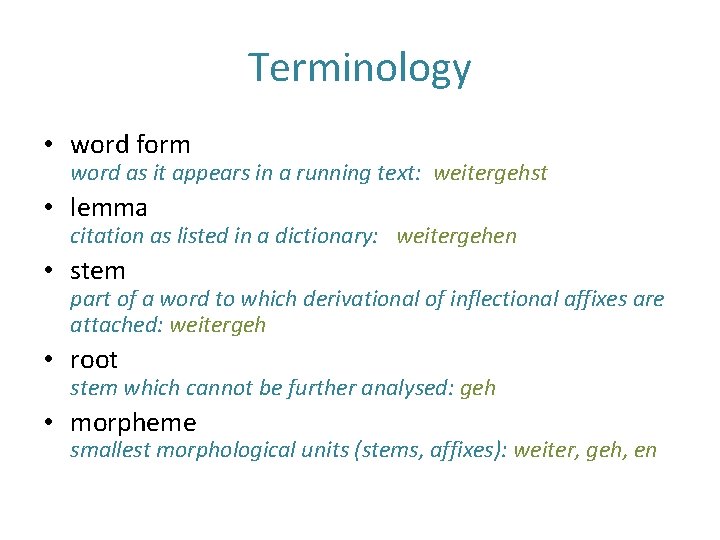
Terminology • word form word as it appears in a running text: weitergehst • lemma citation as listed in a dictionary: weitergehen • stem part of a word to which derivational of inflectional affixes are attached: weitergeh • root stem which cannot be further analysed: geh • morpheme smallest morphological units (stems, affixes): weiter, geh, en
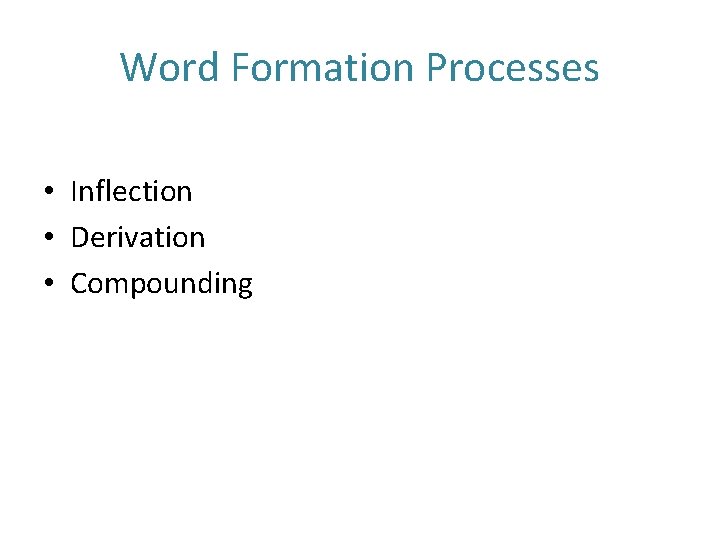
Word Formation Processes • Inflection • Derivation • Compounding
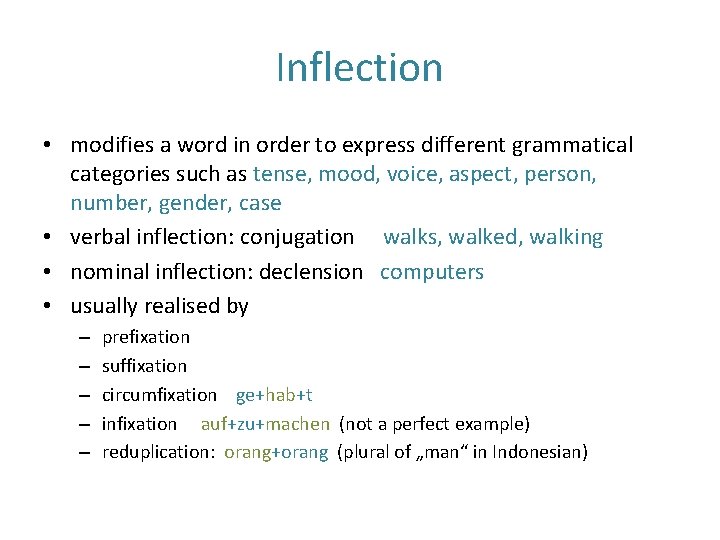
Inflection • modifies a word in order to express different grammatical categories such as tense, mood, voice, aspect, person, number, gender, case • verbal inflection: conjugation walks, walked, walking • nominal inflection: declension computers • usually realised by – – – prefixation suffixation circumfixation ge+hab+t infixation auf+zu+machen (not a perfect example) reduplication: orang+orang (plural of „man“ in Indonesian)
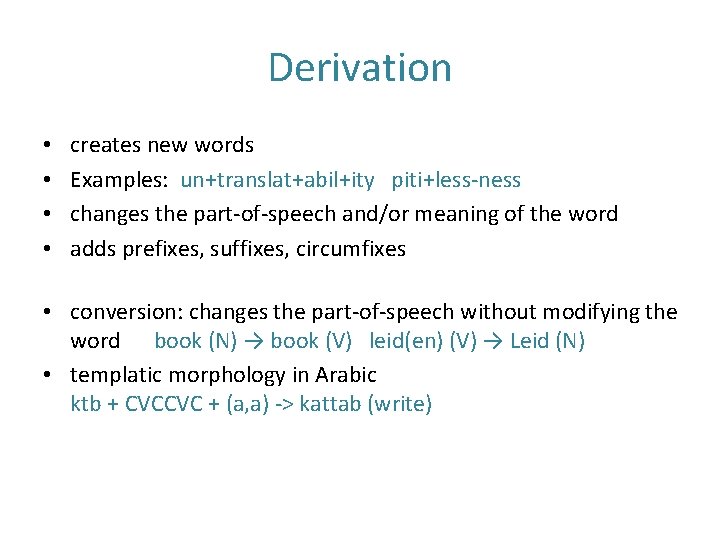
Derivation • • creates new words Examples: un+translat+abil+ity piti+less-ness changes the part-of-speech and/or meaning of the word adds prefixes, suffixes, circumfixes • conversion: changes the part-of-speech without modifying the word book (N) → book (V) leid(en) (V) → Leid (N) • templatic morphology in Arabic ktb + CVCCVC + (a, a) -> kattab (write)
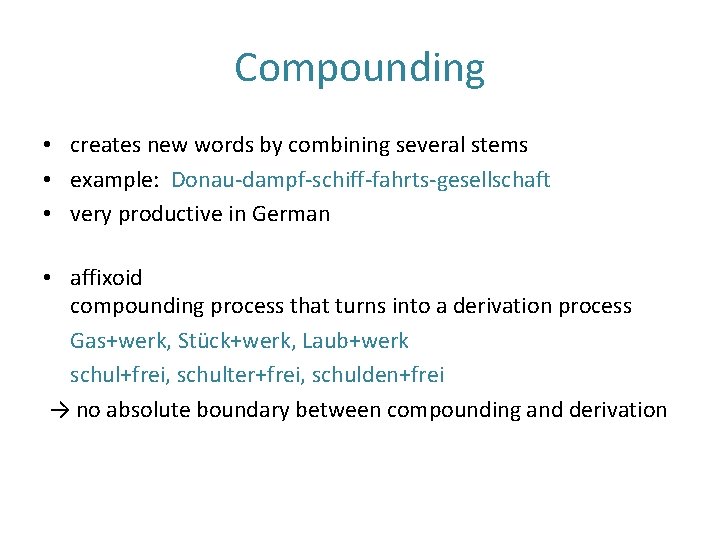
Compounding • creates new words by combining several stems • example: Donau-dampf-schiff-fahrts-gesellschaft • very productive in German • affixoid compounding process that turns into a derivation process Gas+werk, Stück+werk, Laub+werk schul+frei, schulter+frei, schulden+frei → no absolute boundary between compounding and derivation
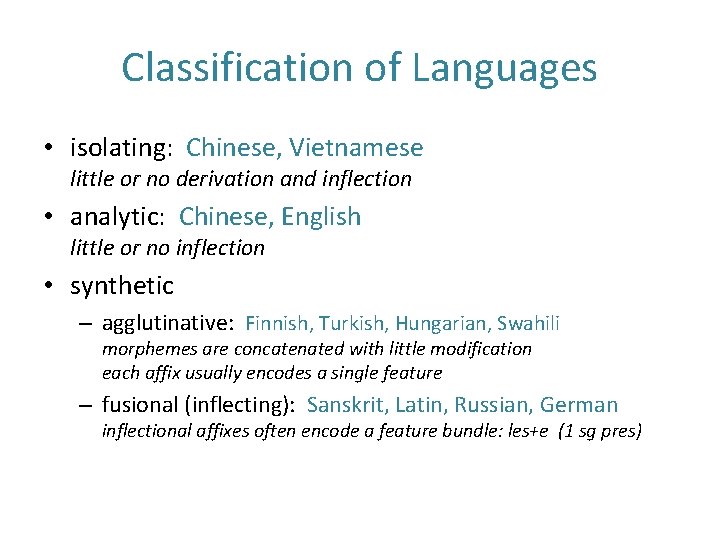
Classification of Languages • isolating: Chinese, Vietnamese little or no derivation and inflection • analytic: Chinese, English little or no inflection • synthetic – agglutinative: Finnish, Turkish, Hungarian, Swahili morphemes are concatenated with little modification each affix usually encodes a single feature – fusional (inflecting): Sanskrit, Latin, Russian, German inflectional affixes often encode a feature bundle: les+e (1 sg pres)
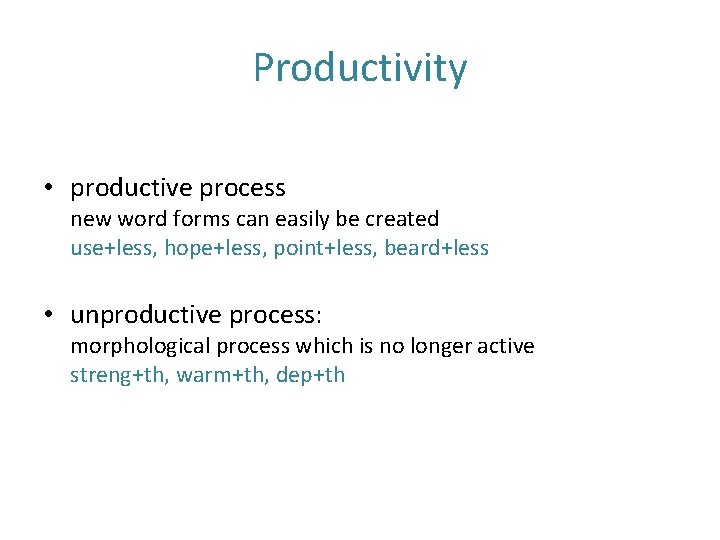
Productivity • productive process new word forms can easily be created use+less, hope+less, point+less, beard+less • unproductive process: morphological process which is no longer active streng+th, warm+th, dep+th
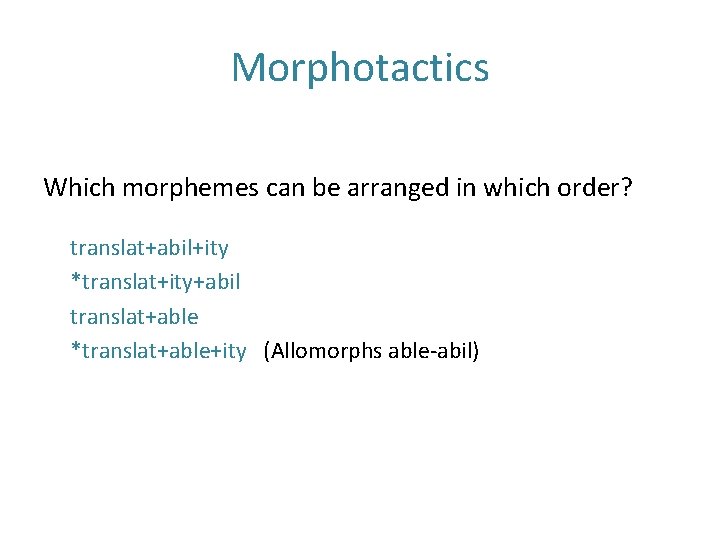
Morphotactics Which morphemes can be arranged in which order? translat+abil+ity *translat+ity+abil translat+able *translat+able+ity (Allomorphs able-abil)
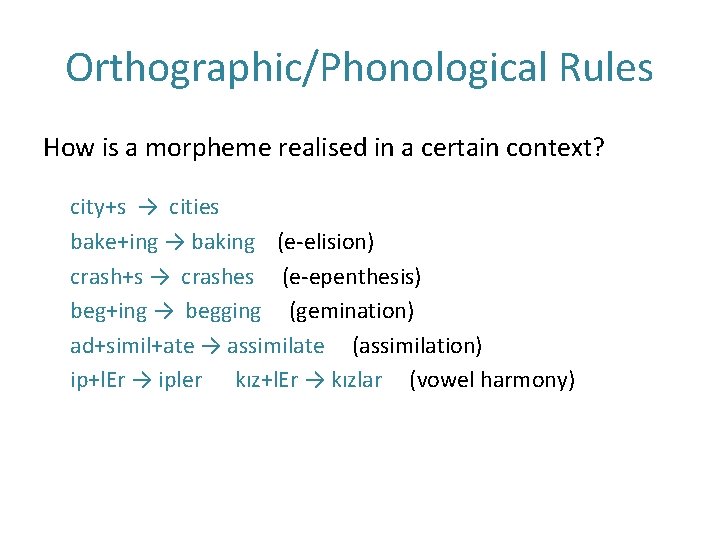
Orthographic/Phonological Rules How is a morpheme realised in a certain context? city+s → cities bake+ing → baking (e-elision) crash+s → crashes (e-epenthesis) beg+ing → begging (gemination) ad+simil+ate → assimilate (assimilation) ip+l. Er → ipler kız+l. Er → kızlar (vowel harmony)
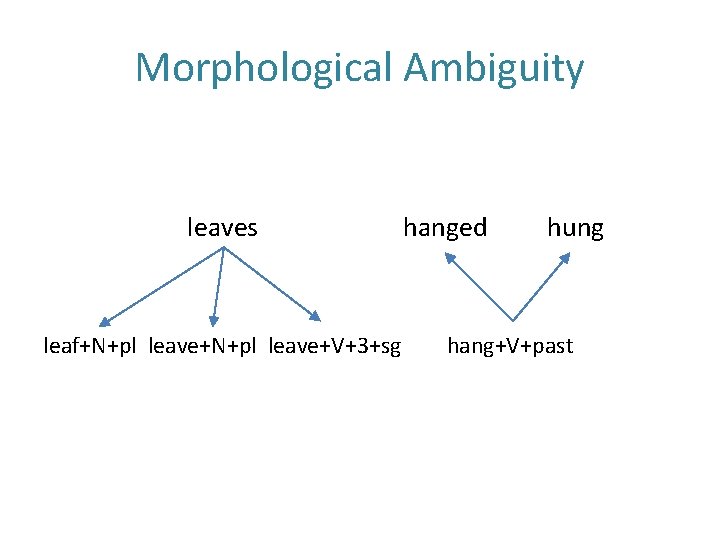
Morphological Ambiguity leaves leaf+N+pl leave+V+3+sg hanged hung hang+V+past
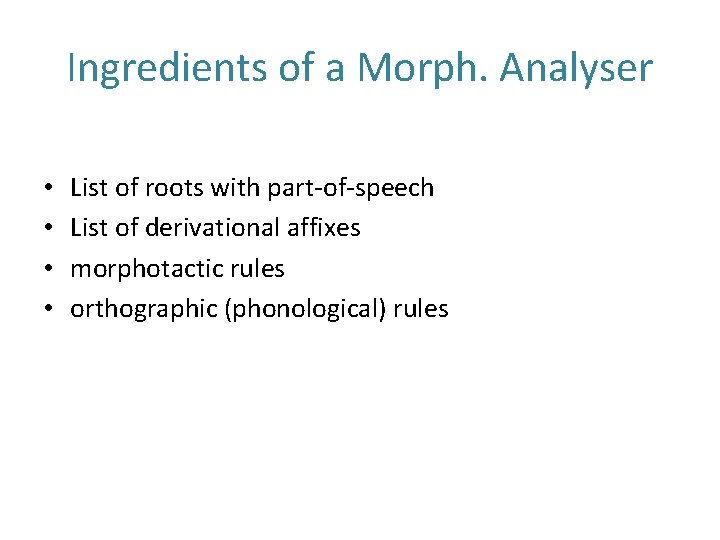
Ingredients of a Morph. Analyser • • List of roots with part-of-speech List of derivational affixes morphotactic rules orthographic (phonological) rules
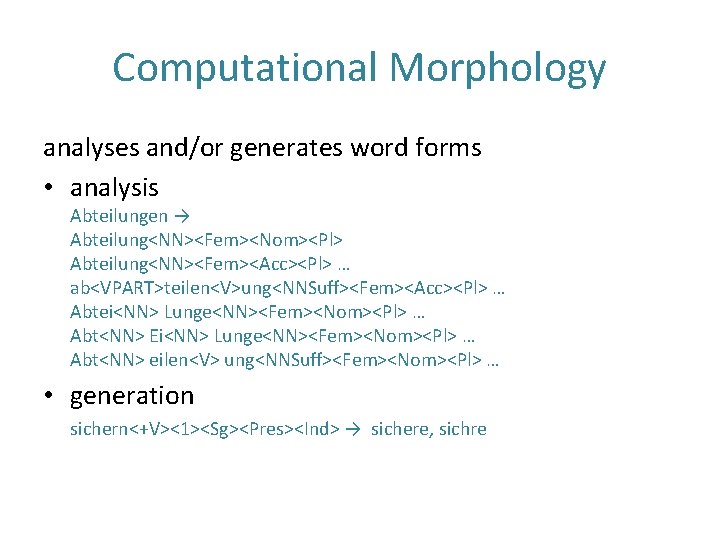
Computational Morphology analyses and/or generates word forms • analysis Abteilungen → Abteilung<NN><Fem><Nom><Pl> Abteilung<NN><Fem><Acc><Pl> … ab<VPART>teilen<V>ung<NNSuff><Fem><Acc><Pl> … Abtei<NN> Lunge<NN><Fem><Nom><Pl> … Abt<NN> Ei<NN> Lunge<NN><Fem><Nom><Pl> … Abt<NN> eilen<V> ung<NNSuff><Fem><Nom><Pl> … • generation sichern<+V><1><Sg><Pres><Ind> → sichere, sichre
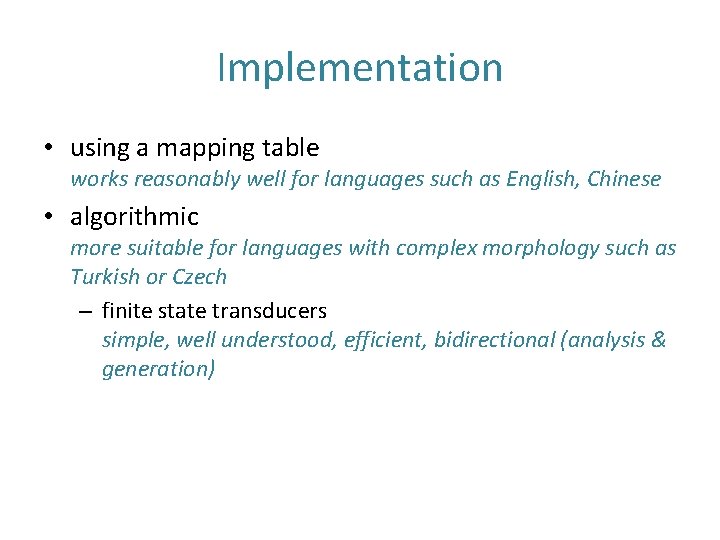
Implementation • using a mapping table works reasonably well for languages such as English, Chinese • algorithmic more suitable for languages with complex morphology such as Turkish or Czech – finite state transducers simple, well understood, efficient, bidirectional (analysis & generation)
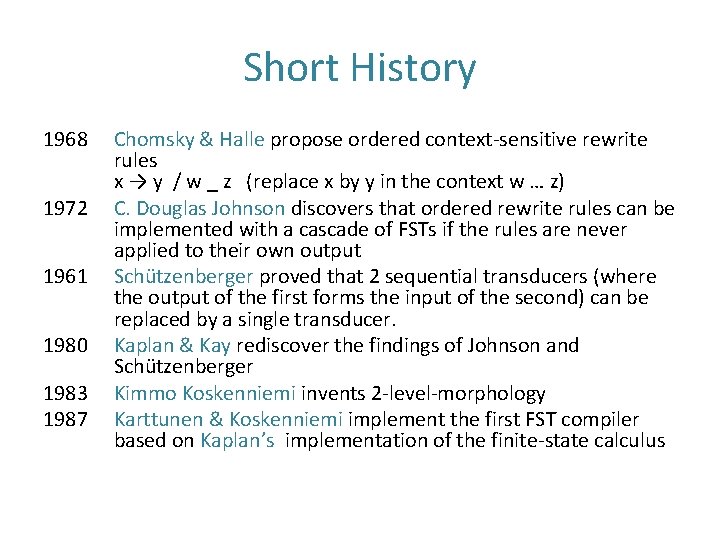
Short History 1968 1972 1961 1980 1983 1987 Chomsky & Halle propose ordered context-sensitive rewrite rules x → y / w _ z (replace x by y in the context w … z) C. Douglas Johnson discovers that ordered rewrite rules can be implemented with a cascade of FSTs if the rules are never applied to their own output Schützenberger proved that 2 sequential transducers (where the output of the first forms the input of the second) can be replaced by a single transducer. Kaplan & Kay rediscover the findings of Johnson and Schützenberger Kimmo Koskenniemi invents 2 -level-morphology Karttunen & Koskenniemi implement the first FST compiler based on Kaplan’s implementation of the finite-state calculus
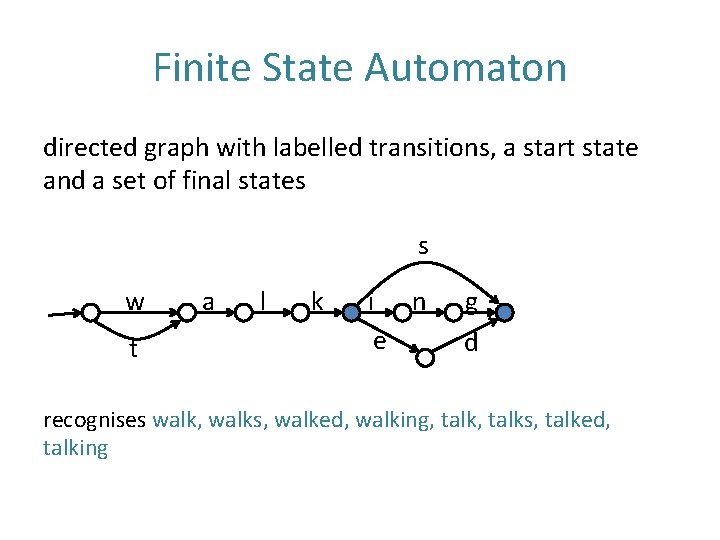
Finite State Automaton directed graph with labelled transitions, a start state and a set of final states s w t a l k i n e g d recognises walk, walks, walked, walking, talks, talked, talking
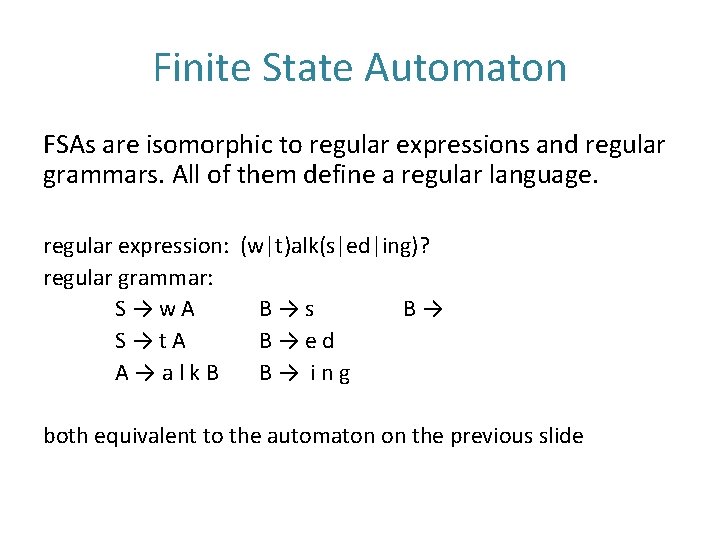
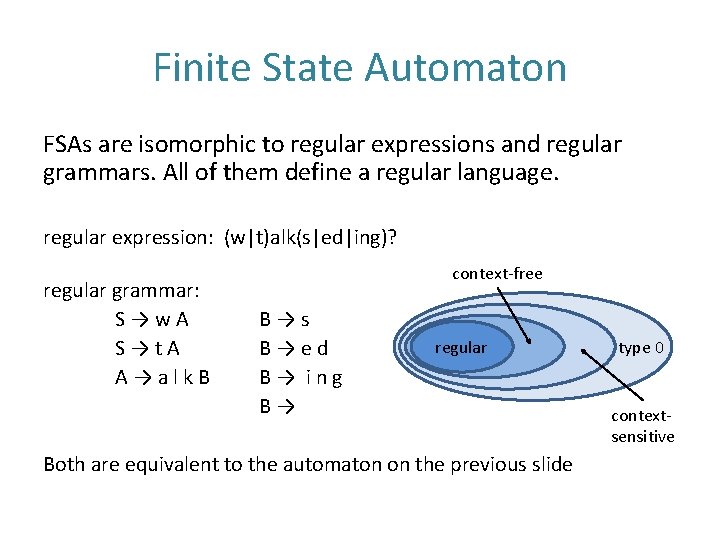
Finite State Automaton FSAs are isomorphic to regular expressions and regular grammars. All of them define a regular language. regular expression: (w|t)alk(s|ed|ing)? regular grammar: S→w. A B→s B→ S→t. A B→ed A→alk. B B→ ing both equivalent to the automaton on the previous slide
Finite State Automaton FSAs are isomorphic to regular expressions and regular grammars. All of them define a regular language. regular expression: (w|t)alk(s|ed|ing)? regular grammar: S→w. A S→t. A A→alk. B context-free B→s B→ed B→ ing B→ regular Both are equivalent to the automaton on the previous slide type 0 contextsensitive
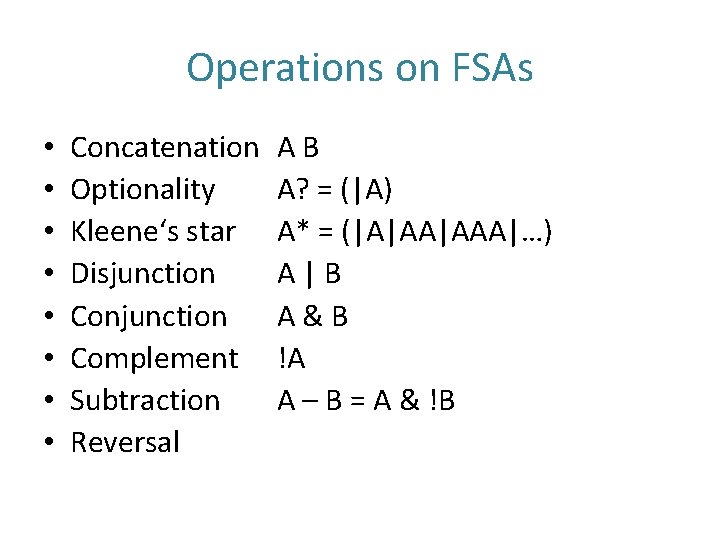
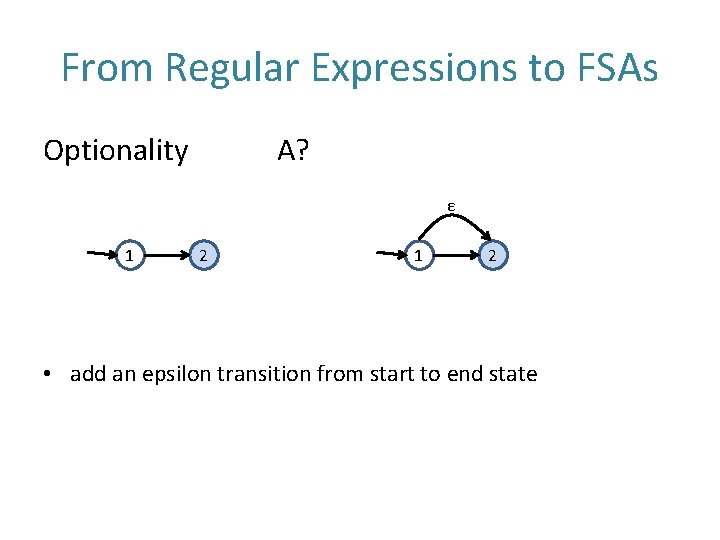
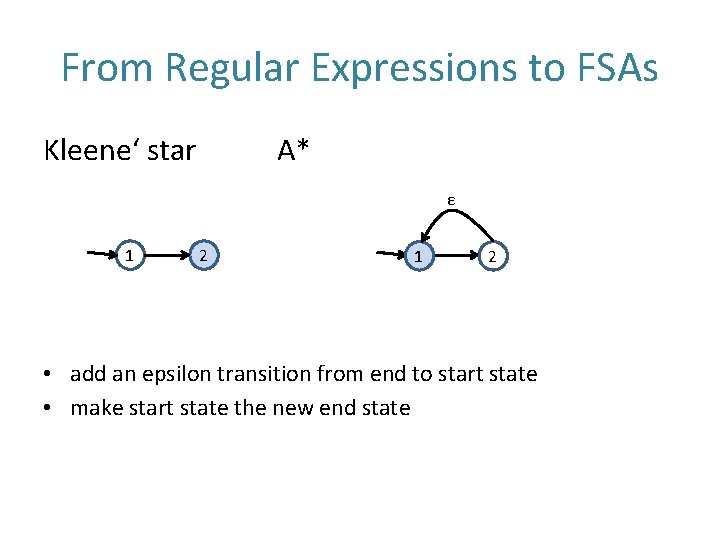
Operations on FSAs • • Concatenation Optionality Kleene‘s star Disjunction Conjunction Complement Subtraction Reversal AB A? = (|A) A* = (|A|AA|AAA|…) A|B A&B !A A – B = A & !B
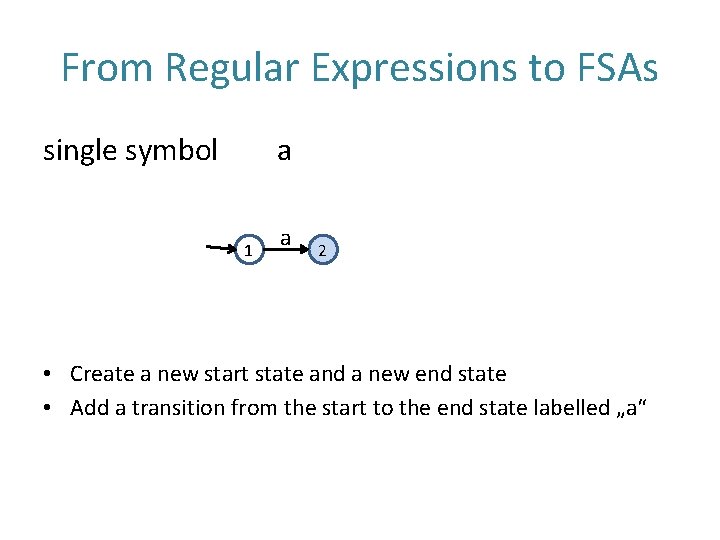
From Regular Expressions to FSAs single symbol a 1 a 2 • Create a new start state and a new end state • Add a transition from the start to the end state labelled „a“
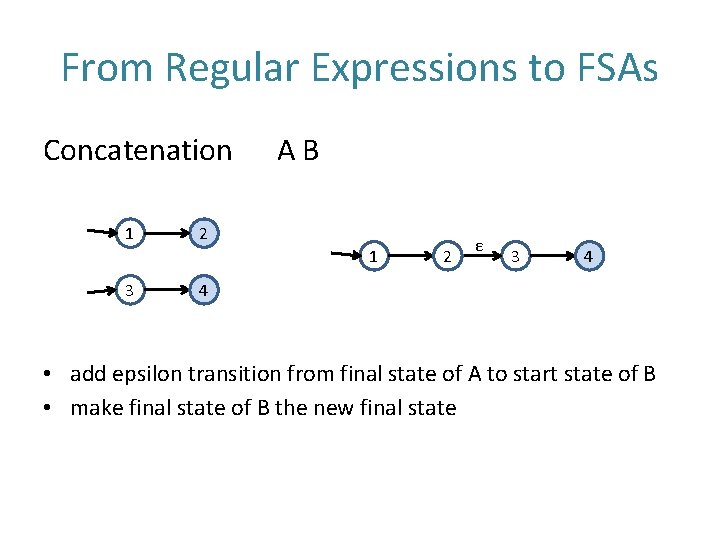
From Regular Expressions to FSAs Concatenation 1 AB 2 1 3 2 ε 3 4 4 • add epsilon transition from final state of A to start state of B • make final state of B the new final state
From Regular Expressions to FSAs Optionality A? ε 1 2 • add an epsilon transition from start to end state
From Regular Expressions to FSAs Kleene‘ star A* ε 1 2 • add an epsilon transition from end to start state • make start state the new end state
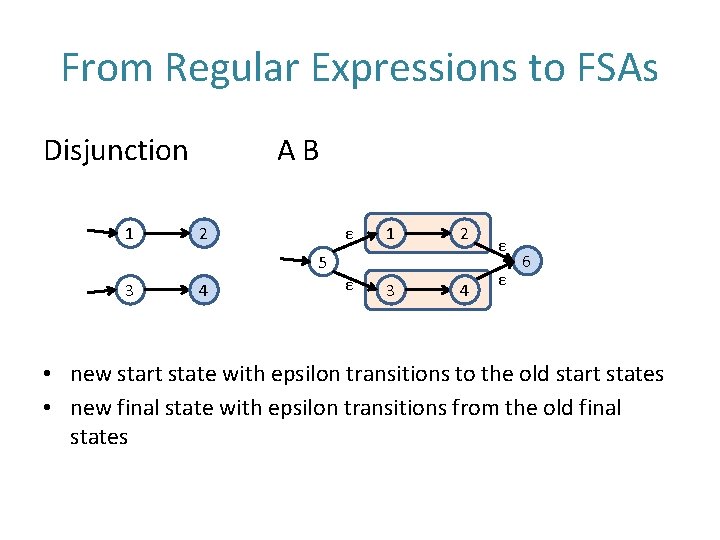
From Regular Expressions to FSAs Disjunction 1 AB 2 ε 5 3 4 ε 1 3 2 4 ε ε 6 • new start state with epsilon transitions to the old start states • new final state with epsilon transitions from the old final states
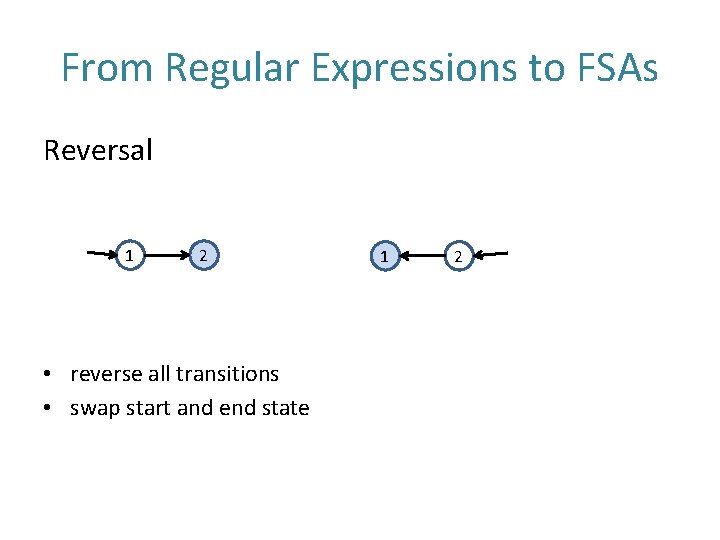
From Regular Expressions to FSAs Reversal 1 2 • reverse all transitions • swap start and end state 1 2
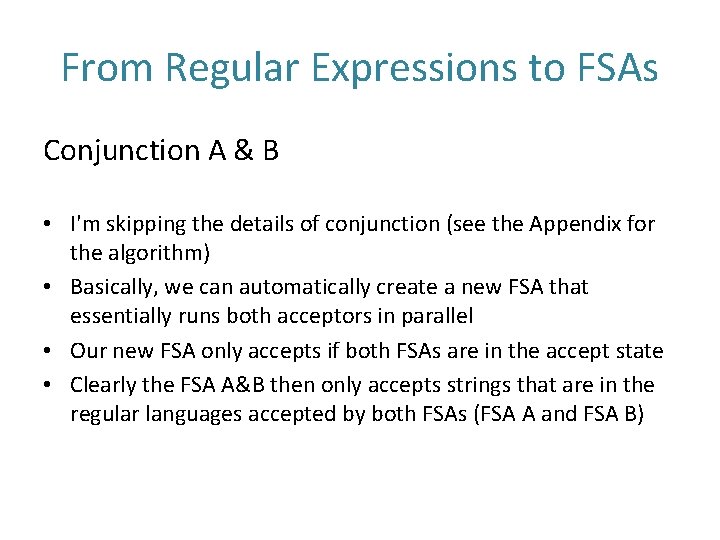
From Regular Expressions to FSAs Conjunction A & B • I'm skipping the details of conjunction (see the Appendix for the algorithm) • Basically, we can automatically create a new FSA that essentially runs both acceptors in parallel • Our new FSA only accepts if both FSAs are in the accept state • Clearly the FSA A&B then only accepts strings that are in the regular languages accepted by both FSAs (FSA A and FSA B)
Properties of FSAs • epsilon-free no transition is labelled with the empty string epsilon • deterministic epsilon-free and no two transitions originating in the same state have the same label • minimal no other automaton has a smaller number of states
Properties of FSAs II • We can algorithmically construct a new FSA from the old FSA such that it is: – epsilon-free – deterministic – minimal • See the Appendix for the algorithms
Conclusion: Finite State Acceptors • Any regular expression can be mapped to a finite state acceptor – However, "regexes" in Perl are misnamed! • "Regexes" contain more powerful constructs than mathematical regular expressions – For instance /(. +)1/ – However, these constructs are not used much • See EN Wikipedia page on regular expressions, subsection "Regular expressions in programming languages" for details • We will now move on to finite state transducers
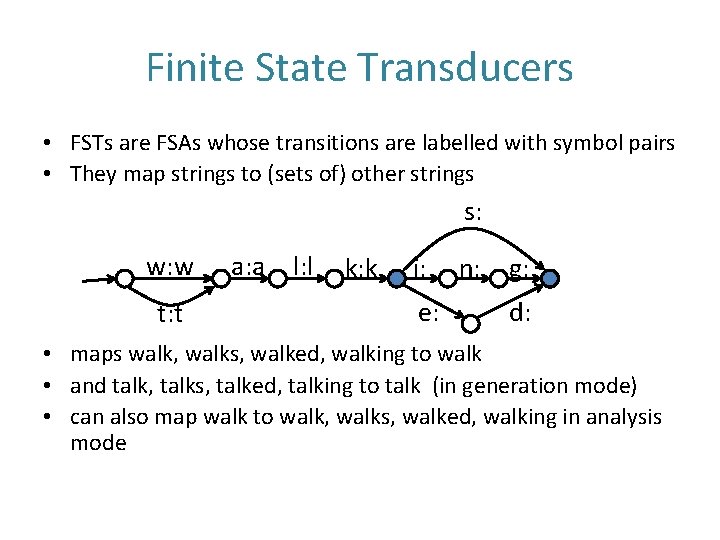
Finite State Transducers • FSTs are FSAs whose transitions are labelled with symbol pairs • They map strings to (sets of) other strings s: w: w t: t a: a l: l k: k i: e: n: g: d: • maps walk, walks, walked, walking to walk • and talk, talks, talked, talking to talk (in generation mode) • can also map walk to walk, walks, walked, walking in analysis mode
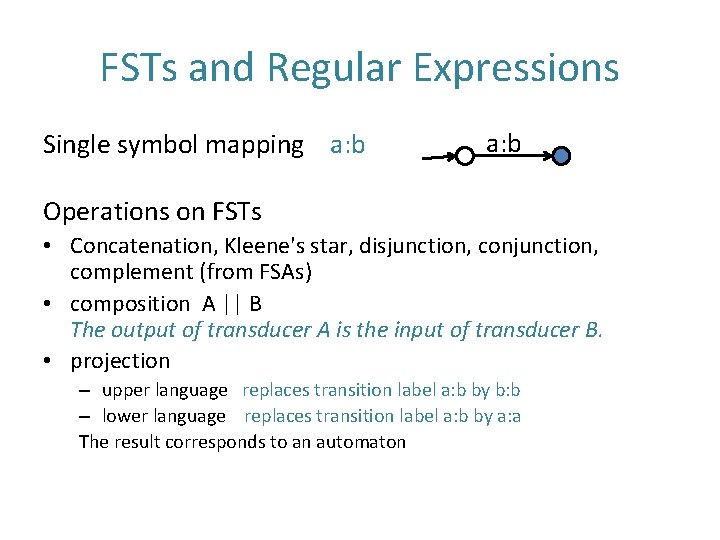
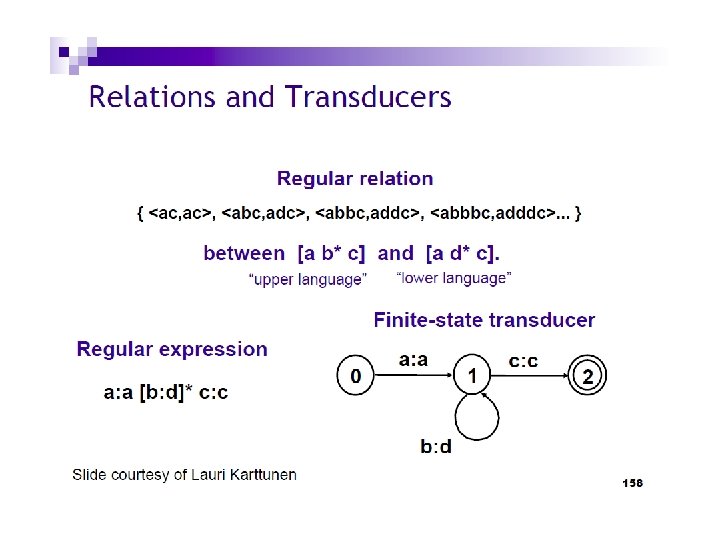
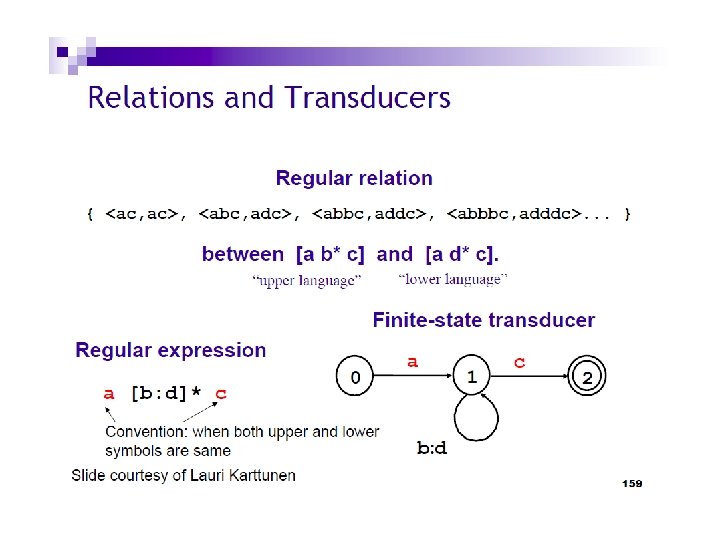
FSTs and Regular Expressions Single symbol mapping a: b Operations on FSTs • Concatenation, Kleene's star, disjunction, conjunction, complement (from FSAs) • composition A || B The output of transducer A is the input of transducer B. • projection – upper language replaces transition label a: b by b: b – lower language replaces transition label a: b by a: a The result corresponds to an automaton
Weighted Transducers • A weighted FST assigns a numerical weight to each transition • The total weight of a string-to-string mapping is the sum of the weights on the corresponding path from start to end state. • Weighted FSTs allow disambiguation between different analyses by choosing the one with the smallest (or largest) weight
Working with FSTs • FSTs can be specified by means of regular expressions (like FSAs). The translation is performed by a compiler. • Using the same algorithms as for FSA – FSTs can be made epsilon-free in the sense that no transition is labelled with ε: ε (a pair of empty string symbols) – FSTs can be made deterministic in the sense that no two transitions originating in the same state have the same label pair – FSTs can be minimised in the sense that no other FST which produces the same regular relation with the same input-output alignment is smaller. (There might be a smaller transducer producing the same relation with a different alignment. ) • FSTs can be used in both directions (generation and analysis)
FST Toolkits Some FST toolkits • Xerox finite-state tools xfst and lexc well-suited for building morphological analysers • foma (Mans Hulden) open-source alternative to xfst/lexc • AT&T tools weighted transducers for tasks such as speech recognition little support for building morphological analysers • open. FST (Google, NYU) open-source alternative to the AT&T tools • SFST open-source alternative to xfst/lexc but using a more general and flexible programming language
SFST • programming language for developing finite-state transducers • compiler which translates programs to transducers • tools for – applying transducers – printing transducers – comparing transducers
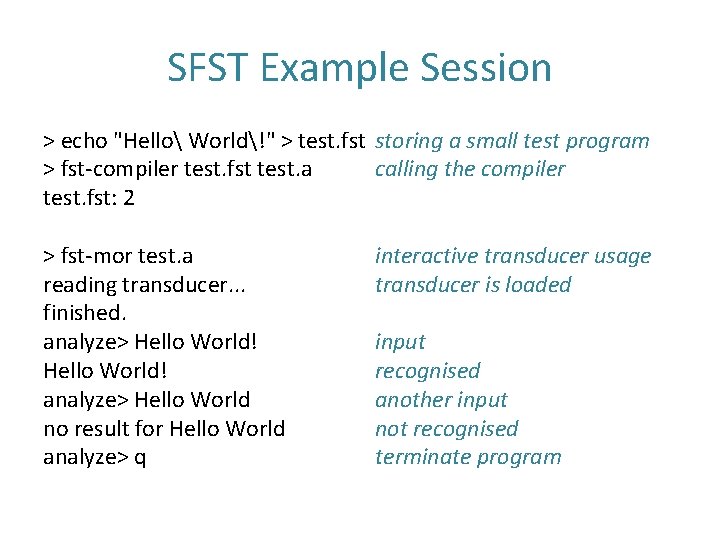
SFST Example Session > echo "Hello World!" > test. fst storing a small test program > fst-compiler test. fst test. a calling the compiler test. fst: 2 > fst-mor test. a reading transducer. . . finished. analyze> Hello World! analyze> Hello World no result for Hello World analyze> q interactive transducer usage transducer is loaded input recognised another input not recognised terminate program
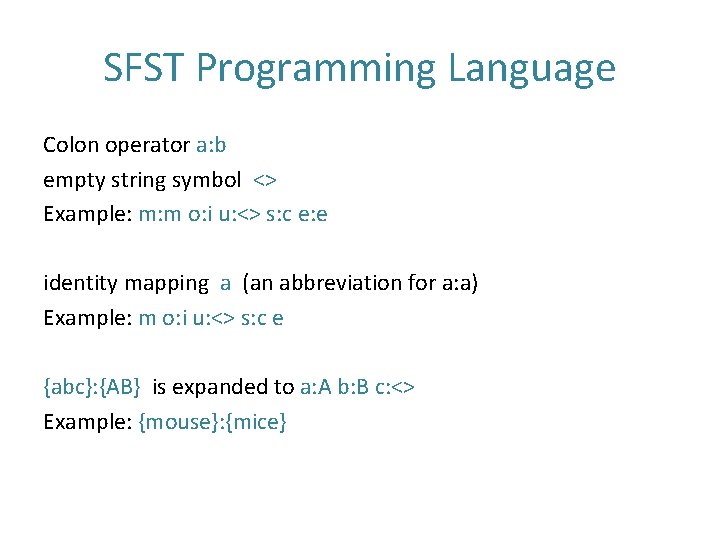
SFST Programming Language Colon operator a: b empty string symbol <> Example: m: m o: i u: <> s: c e: e identity mapping a (an abbreviation for a: a) Example: m o: i u: <> s: c e {abc}: {AB} is expanded to a: A b: B c: <> Example: {mouse}: {mice}
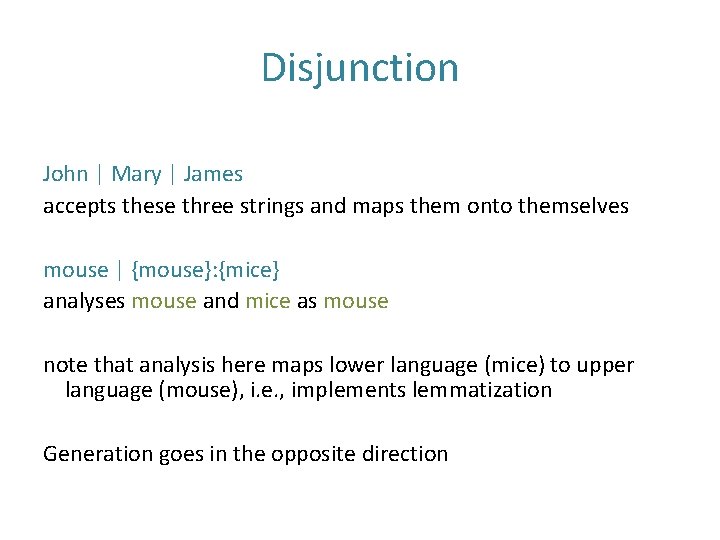
Disjunction John | Mary | James accepts these three strings and maps them onto themselves mouse | {mouse}: {mice} analyses mouse and mice as mouse note that analysis here maps lower language (mice) to upper language (mouse), i. e. , implements lemmatization Generation goes in the opposite direction
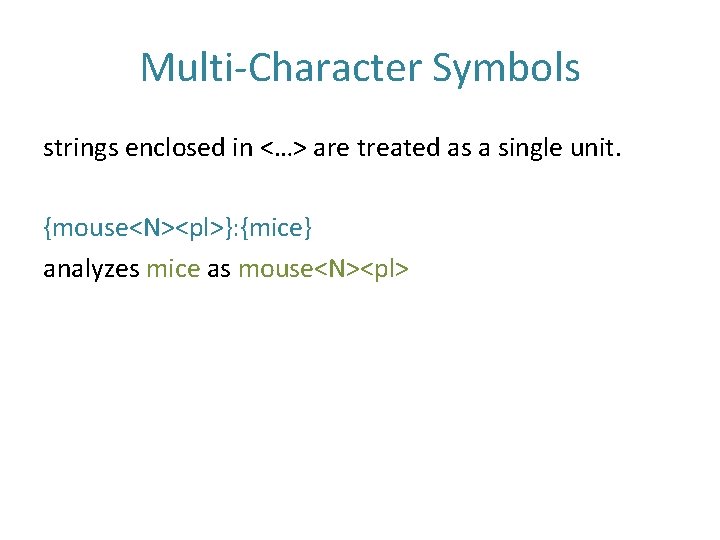
Multi-Character Symbols strings enclosed in <…> are treated as a single unit. {mouse<N><pl>}: {mice} analyzes mice as mouse<N><pl>
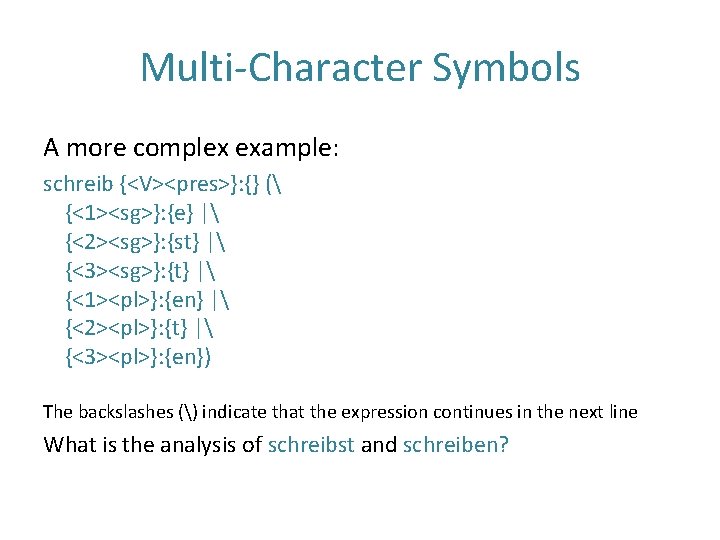
Multi-Character Symbols A more complex example: schreib {<V><pres>}: {} ( {<1><sg>}: {e} | {<2><sg>}: {st} | {<3><sg>}: {t} | {<1><pl>}: {en} | {<2><pl>}: {t} | {<3><pl>}: {en}) The backslashes () indicate that the expression continues in the next line What is the analysis of schreibst and schreiben?
Conclusion: Finite State Morphology • Talked about finite state morphology in a more formal way • Showed how to convert regular expressions to finite state automata • Talked about finite state transducers for computational morphology – Morphological analysis and generation
• Thank you for your attention
Appendix • Details of Conjunction of FSAs • Algorithms for Determinisation, Composition and Minimisation of FSAs
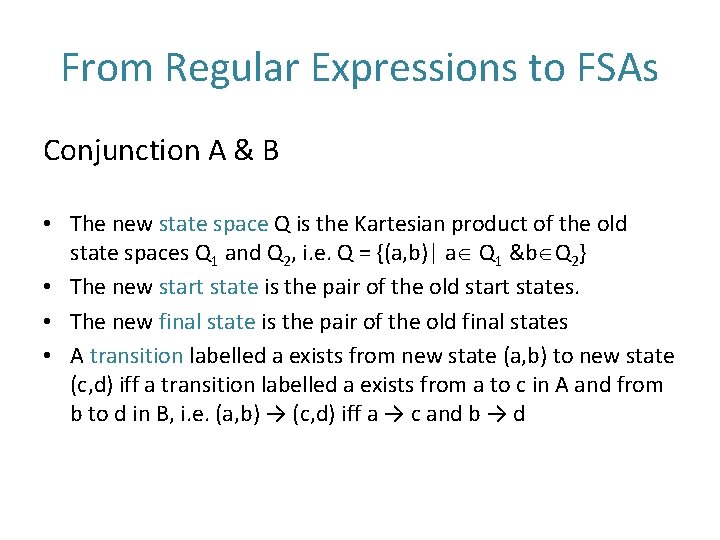
From Regular Expressions to FSAs Conjunction A & B • The new state space Q is the Kartesian product of the old state spaces Q 1 and Q 2, i. e. Q = {(a, b)| a Q 1 &b Q 2} • The new start state is the pair of the old start states. • The new final state is the pair of the old final states • A transition labelled a exists from new state (a, b) to new state (c, d) iff a transition labelled a exists from a to c in A and from b to d in B, i. e. (a, b) → (c, d) iff a → c and b → d
Determinisation of FSAs • The new state set is the powerset of the old state set (set of all subsets). • The new start state is the epsilon-closure of the old start state (i. e. the start state + all states reachable from it via epsilon transitions) • There is a transition from state q to r labelled a iff there is a transition labelled a from some old state a in q to some old state b in r. • The set of final states comprises all states q which contain an old final state a.
Composition of FSAs • First, make the two FSAs deterministic. • The new state set is then the Kartesian product of the two old state sets • The new start state is the pair consisting of the two old start states • There is a transition from state (a, b) to state (c, d) labelled x: z iff there is some transition labelled x: y from state a to state c and a transition labelled y: z from state b to state d • The final state set comprises all state pairs (a, b) where both a and b are old final states.
Minimisation of FSAs Minimisation of A a simple (but inefficient) minimisation algorithm 1. determinise 2. reverse 3. determinise 4. reverse