
Finite State Machines in Verilog CS 153 Spring
- Slides: 6
Finite State Machines in Verilog CS 153, Spring 2007 Ian G. Harris Department of Computer Science University of California Irvine
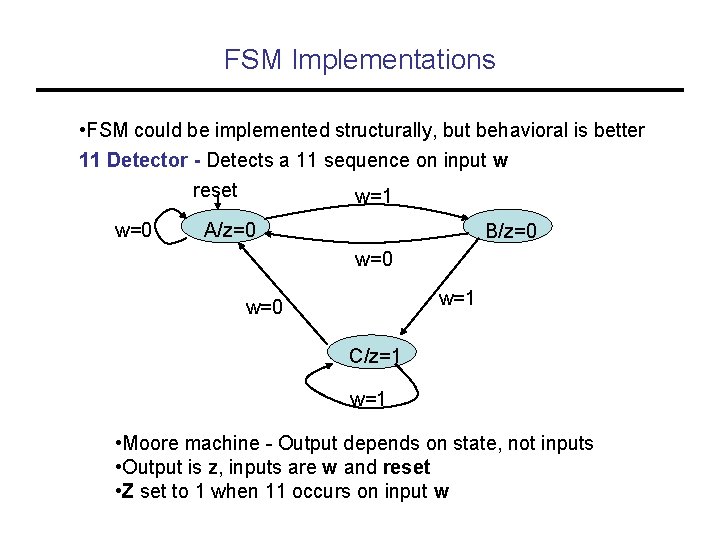
FSM Implementations • FSM could be implemented structurally, but behavioral is better 11 Detector - Detects a 11 sequence on input w reset w=1 w=0 A/z=0 B/z=0 w=1 w=0 C/z=1 w=1 • Moore machine - Output depends on state, not inputs • Output is z, inputs are w and reset • Z set to 1 when 11 occurs on input w
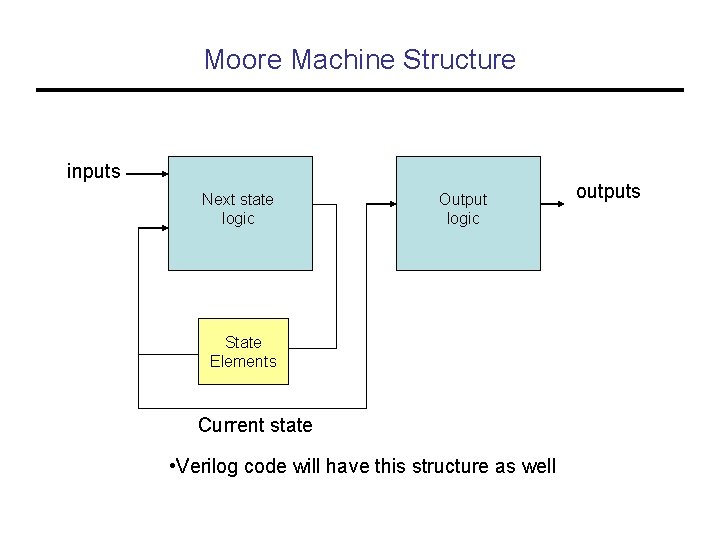
Moore Machine Structure inputs Next state logic Output logic State Elements Current state • Verilog code will have this structure as well outputs
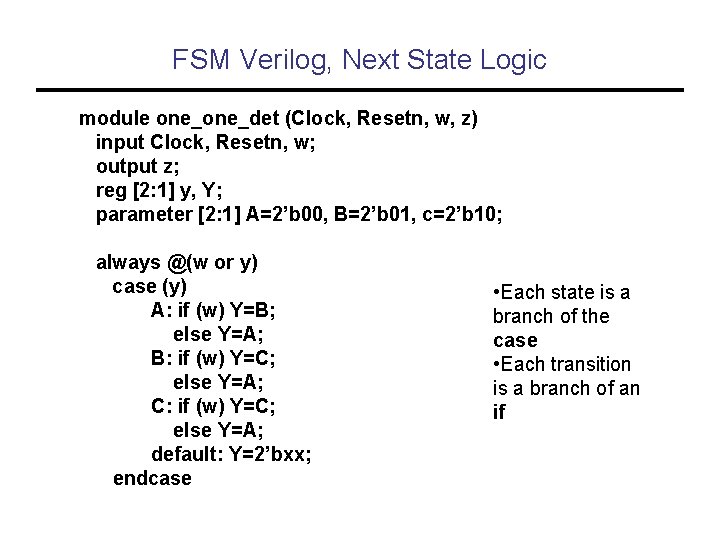
FSM Verilog, Next State Logic module one_det (Clock, Resetn, w, z) input Clock, Resetn, w; output z; reg [2: 1] y, Y; parameter [2: 1] A=2’b 00, B=2’b 01, c=2’b 10; always @(w or y) case (y) A: if (w) Y=B; else Y=A; B: if (w) Y=C; else Y=A; C: if (w) Y=C; else Y=A; default: Y=2’bxx; endcase • Each state is a branch of the case • Each transition is a branch of an if
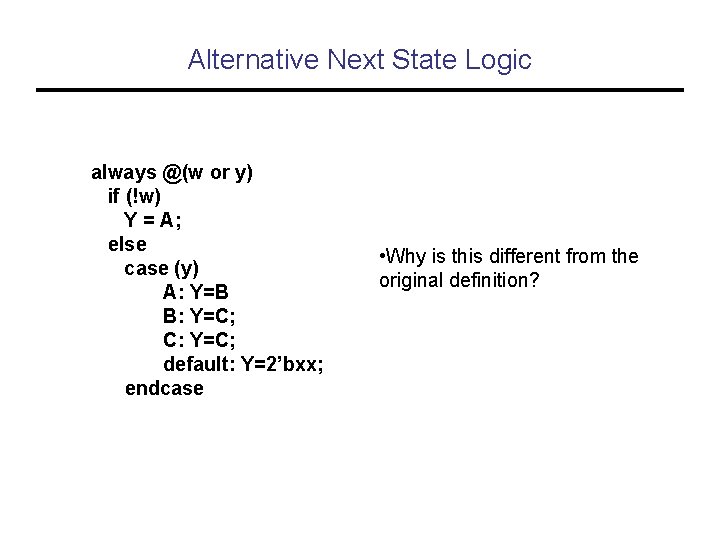
Alternative Next State Logic always @(w or y) if (!w) Y = A; else case (y) A: Y=B B: Y=C; C: Y=C; default: Y=2’bxx; endcase • Why is this different from the original definition?
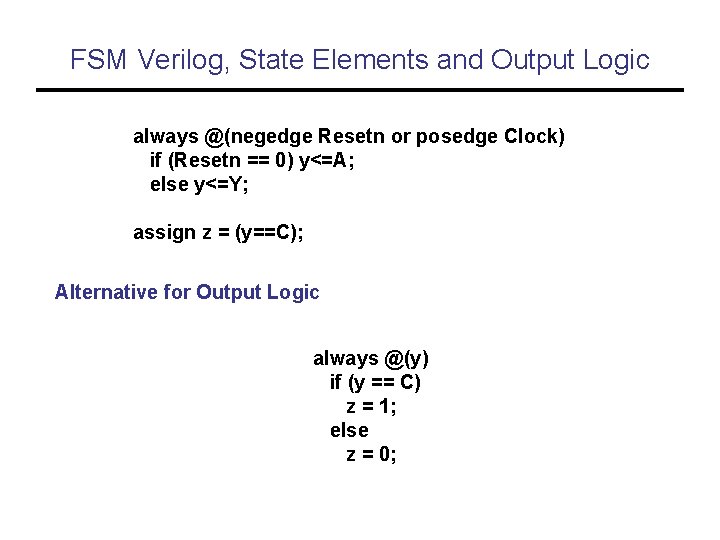
FSM Verilog, State Elements and Output Logic always @(negedge Resetn or posedge Clock) if (Resetn == 0) y<=A; else y<=Y; assign z = (y==C); Alternative for Output Logic always @(y) if (y == C) z = 1; else z = 0;