
Finite State Automata Code at http files me


- Slides: 104
Finite State Automata Code at: http: //files. me. com/jeffp k/9443 b 3
Definition A finite state automaton (FSA) is a machine that can be in one and only one of a finite set of states at a time. Transitions cause the FSA to move to a different state. Each state has a finite set of transitions that define what next states are possible. Transitions are triggered by events. Every transition has an associated event trigger. A transition may have one or more side-effects associated with its execution. These sideeffects are called actions. An FSA is also sometimes called a finite state machine (FSM)
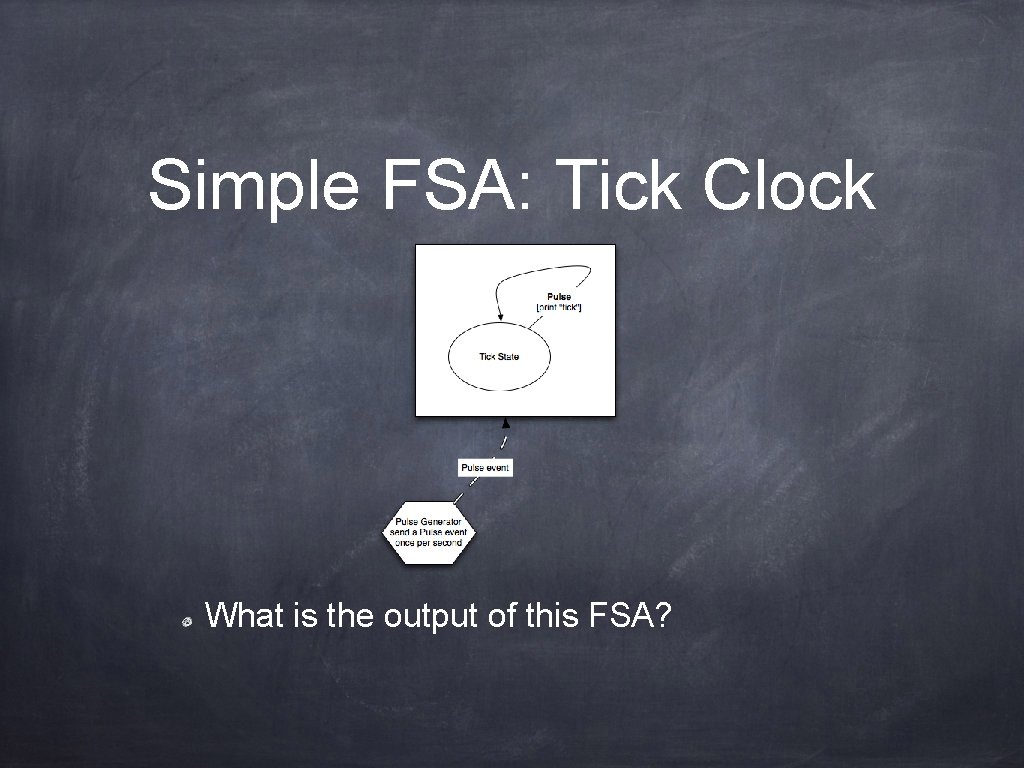
Simple FSA: Tick Clock What is the output of this FSA?
tick tick. . . Tick Clock Output
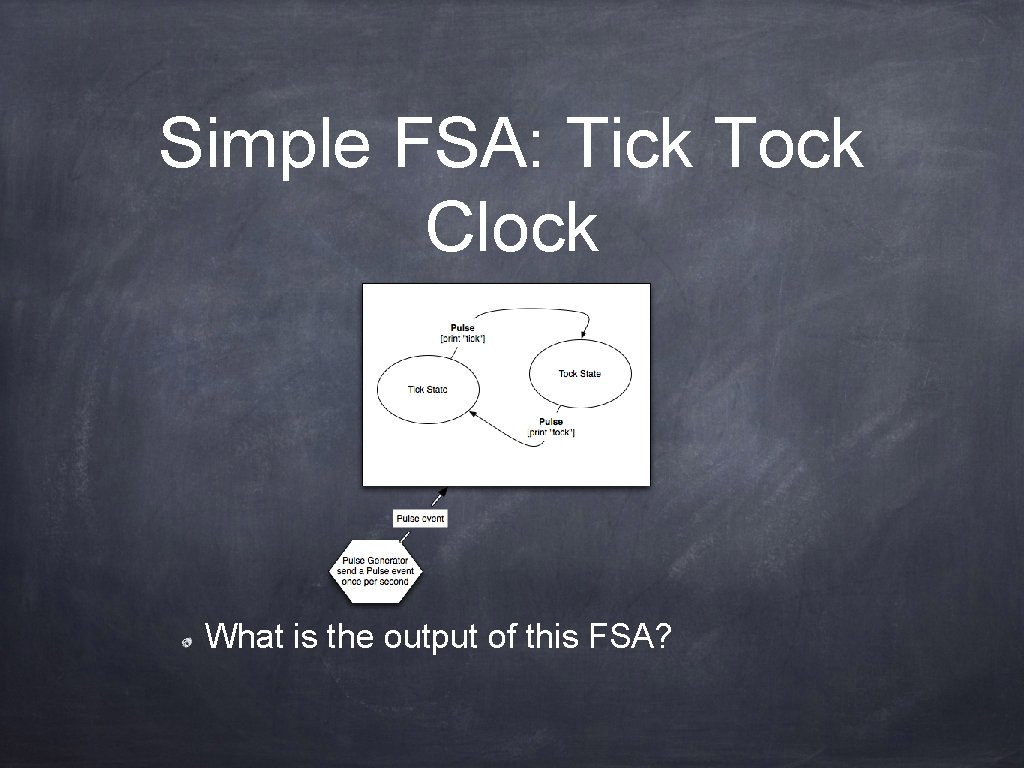
Simple FSA: Tick Tock Clock What is the output of this FSA?
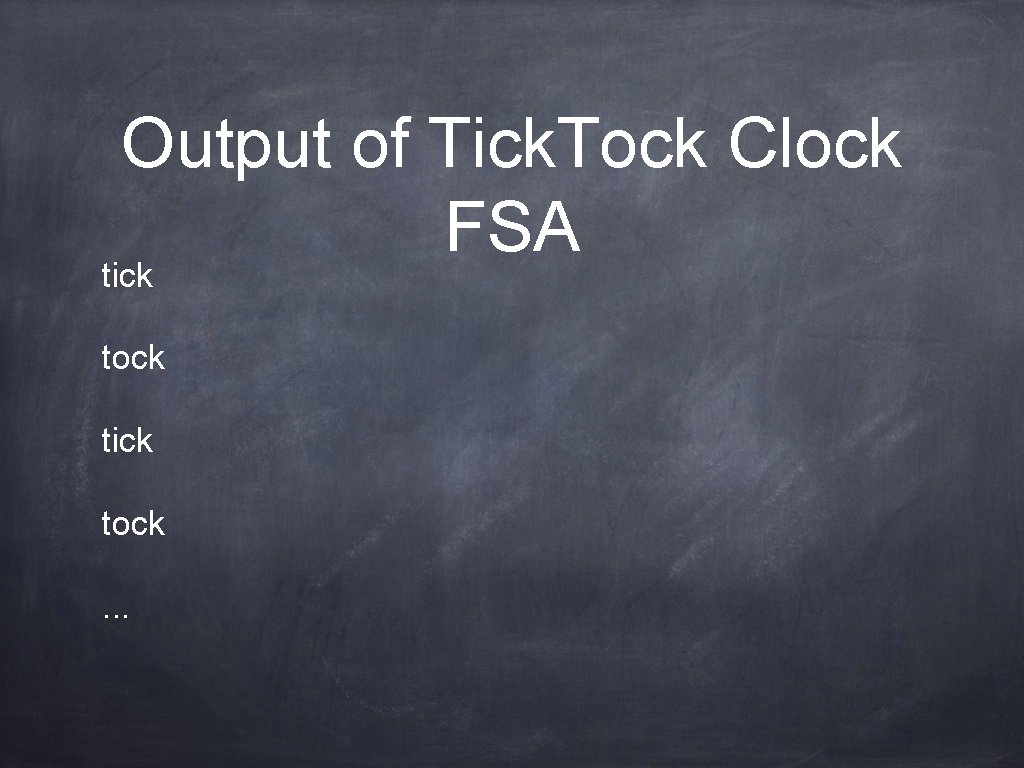
Output of Tick. Tock Clock FSA tick tock. . .
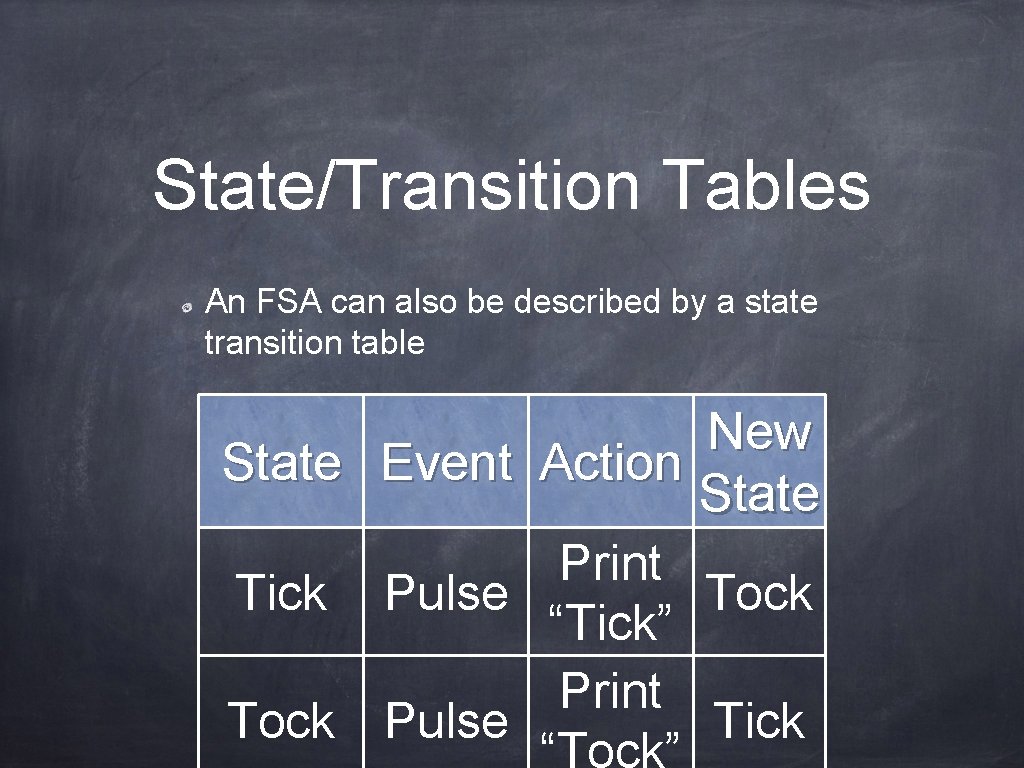
State/Transition Tables An FSA can also be described by a state transition table New State Event Action State Print Tick Pulse Tock “Tick” Print Tock Pulse Tick “Tock”
All common computers Based on something called a “j/k FSAs flip-flop. ” are very complex j/k flip-flop can be modeled as a fairly simple FSA j/k flip-flops are combined to create “gates”. Gates are combined to create computers. This kind of computer is called a von Neumann architecture machine.
FSAs in Games
In the beginning There was Zork. . http: //files. me. com/jeffpk/d 8 sb 6 n Java Zengine Source: http: //sourceforge. net/projects/zplet/
Adventure game 101 Adventure games are finite state automata Your current location is the state of the FSA Typed input is an event Transitions define the result of typed text and move you to a new location (state) Conditions gate some transitions
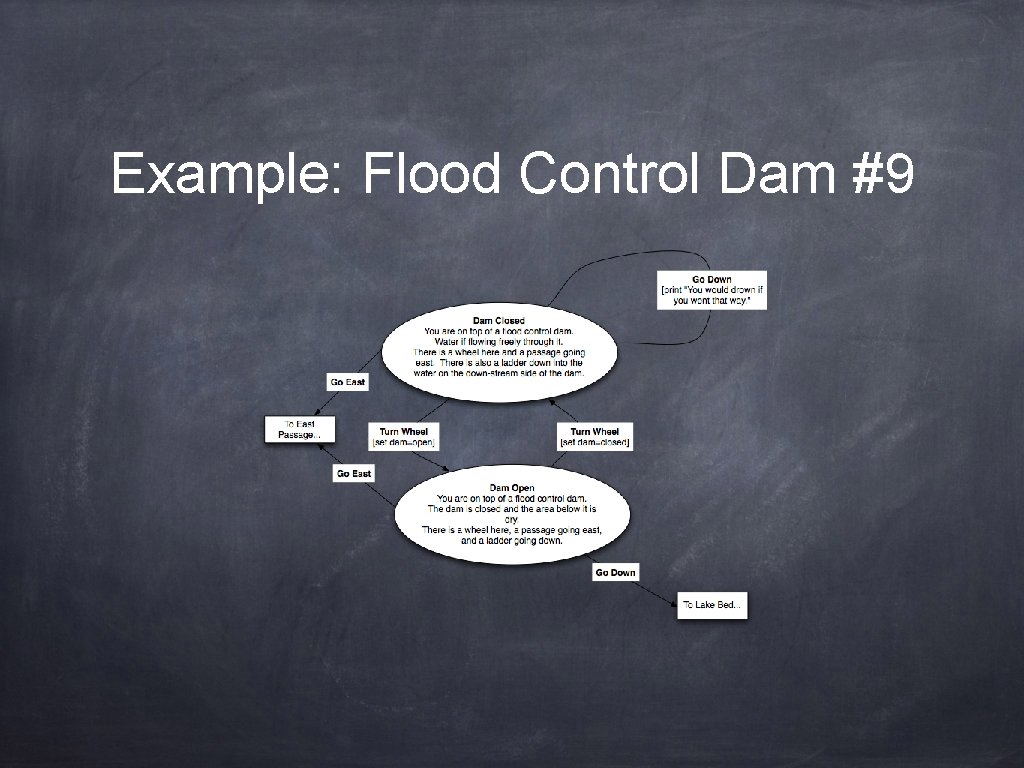
Example: Flood Control Dam #9
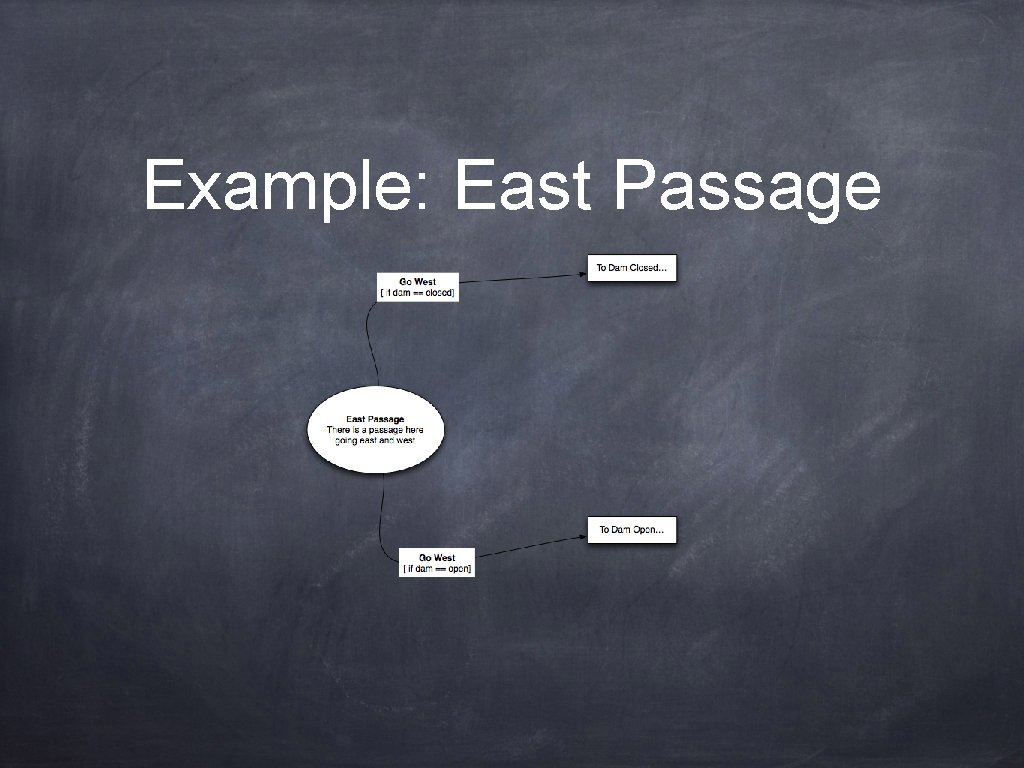
Example: East Passage
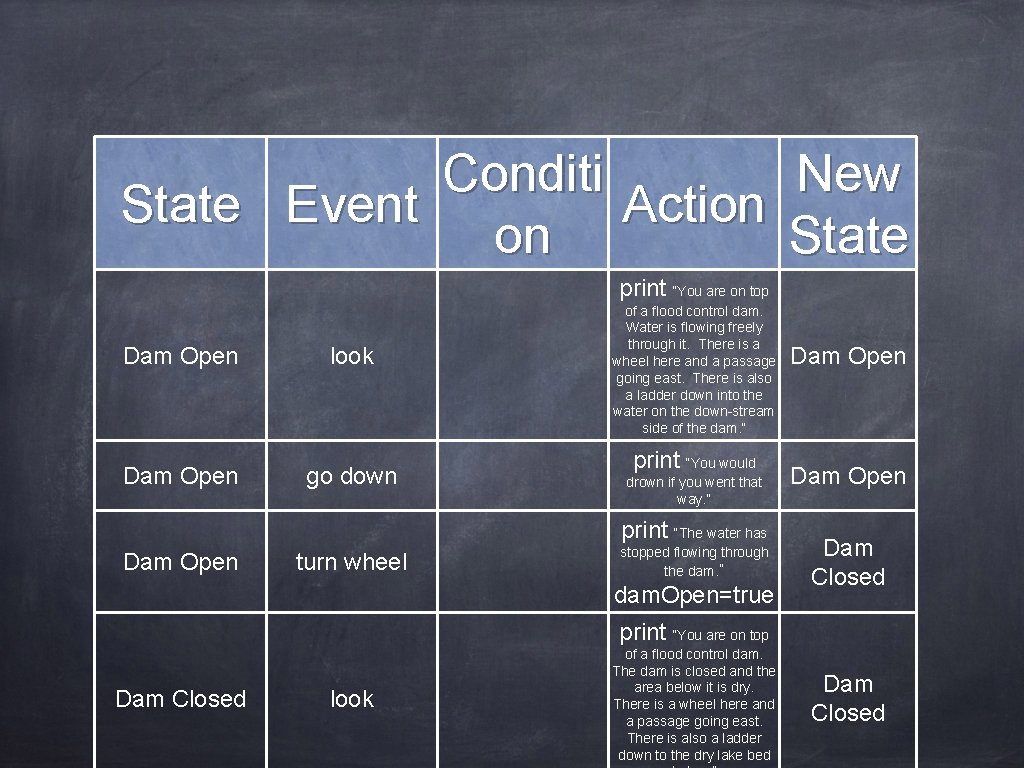
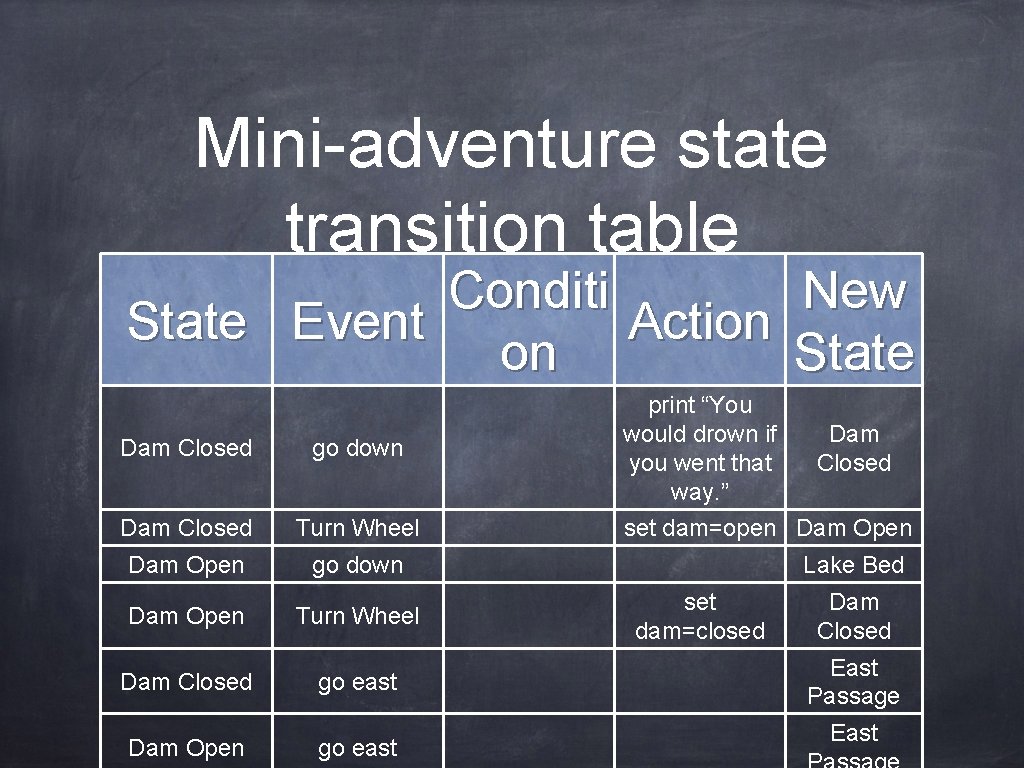
Conditi New State Event Action on State print “You are on top Dam Open look go down of a flood control dam. Water is flowing freely through it. There is a wheel here and a passage going east. There is also a ladder down into the water on the down-stream side of the dam. “ print “You would drown if you went that way. ” print “The water has Dam Open turn wheel stopped flowing through the dam. ” dam. Open=true Dam Open Dam Closed print “You are on top Dam Closed look of a flood control dam. The dam is closed and the area below it is dry. There is a wheel here and a passage going east. There is also a ladder down to the dry lake bed Dam Closed
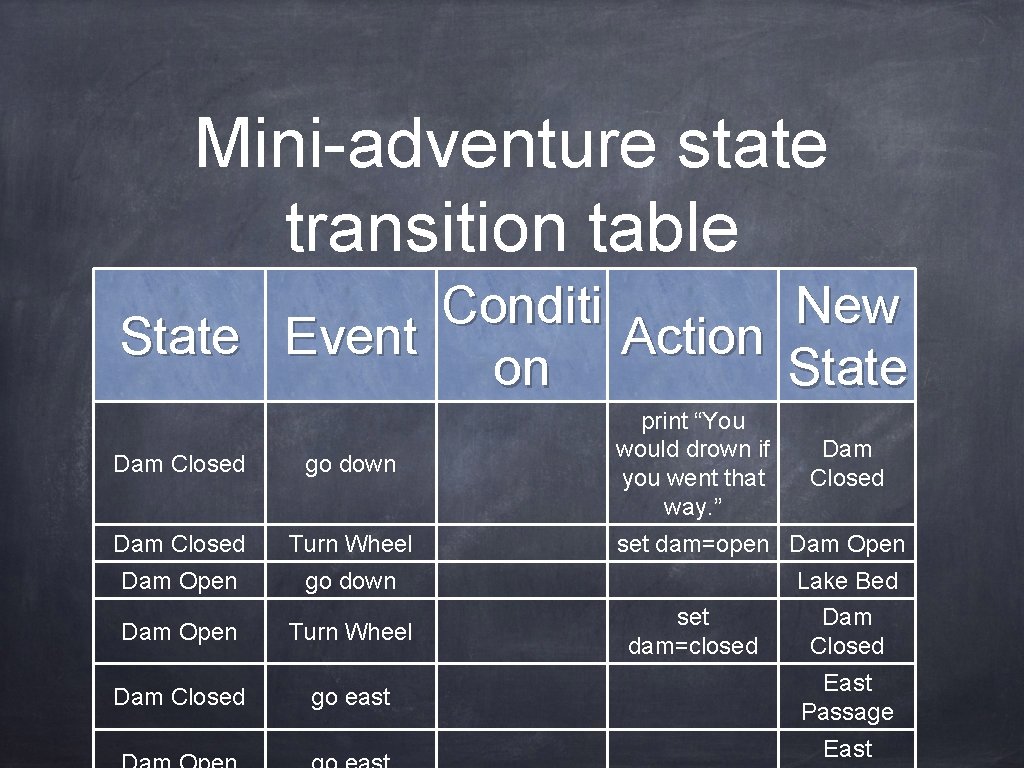
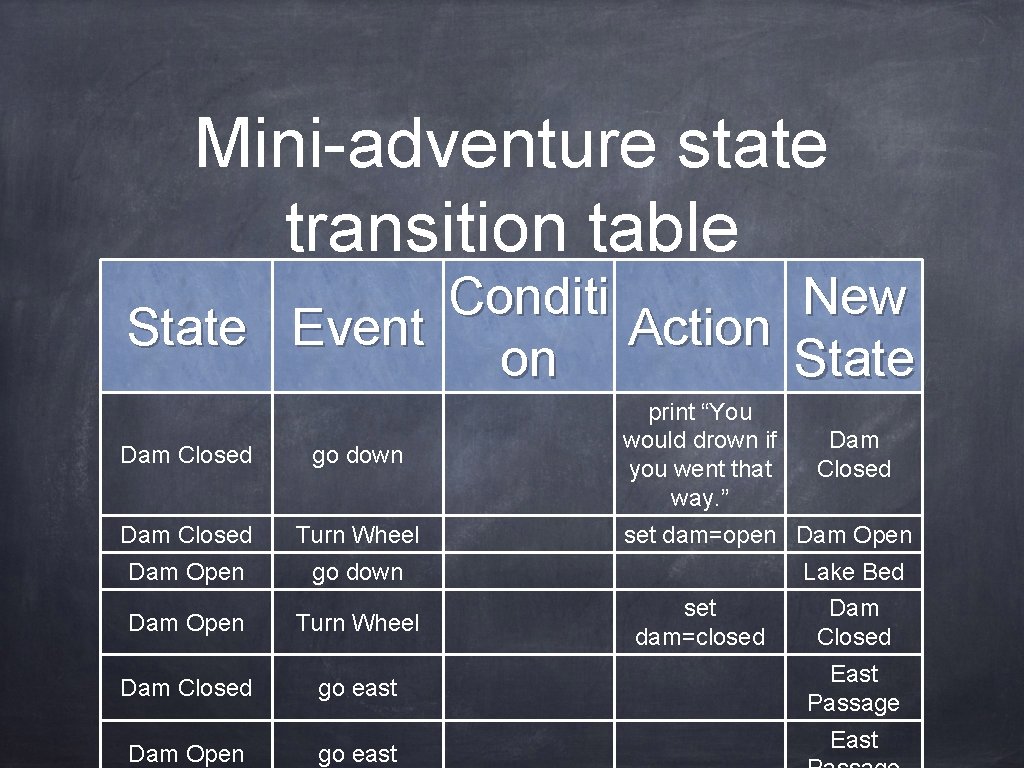
Mini-adventure state transition table Conditi New State Event Action on State Dam Closed go down Dam Closed Turn Wheel Dam Open go down Dam Open Turn Wheel Dam Closed go east print “You would drown if you went that way. ” Dam Closed set dam=open Dam Open Lake Bed set dam=closed Dam Closed East Passage East
What about look? “look” event should print the description How might we implement this?
A look event for every state Explosion of transitions Nx. M where N is the number of “global” events and M is the number of states There should be a better way. . .
Pervasive Transitions A transition that is defined for all states. Can represent with a wildcard in the table. . .
Mini-adventure state transition table Conditi New State Event Action on State Dam Closed go down Dam Closed Turn Wheel Dam Open go down Dam Open Turn Wheel Dam Closed Dam Open go east print “You would drown if you went that way. ” Dam Closed set dam=open Dam Open Lake Bed set dam=closed Dam Closed East Passage East
What else might a pervasive transition be used for?
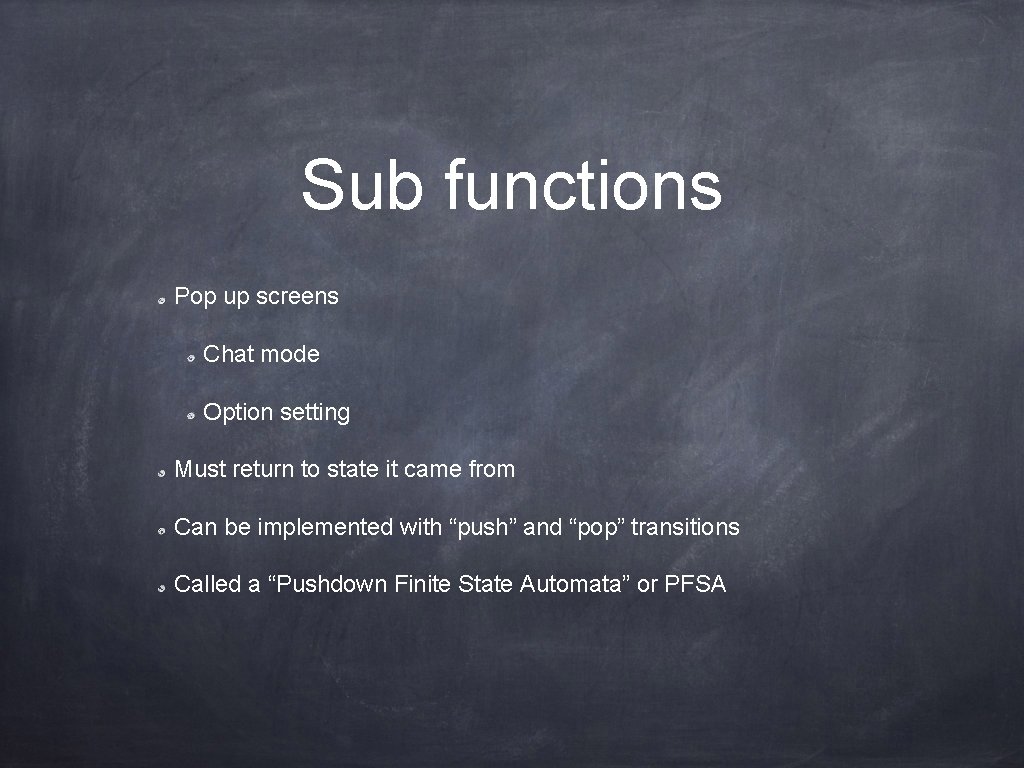
Sub functions Pop up screens Chat mode Option setting Must return to state it came from Can be implemented with “push” and “pop” transitions Called a “Pushdown Finite State Automata” or PFSA
Mini-adventure state transition table Conditi New State Event Action on State Dam Closed go down Dam Closed Turn Wheel Dam Open go down Dam Open Turn Wheel Dam Closed go east Dam Open go east print “You would drown if you went that way. ” Dam Closed set dam=open Dam Open Lake Bed set dam=closed Dam Closed East Passage East
FSA for AI
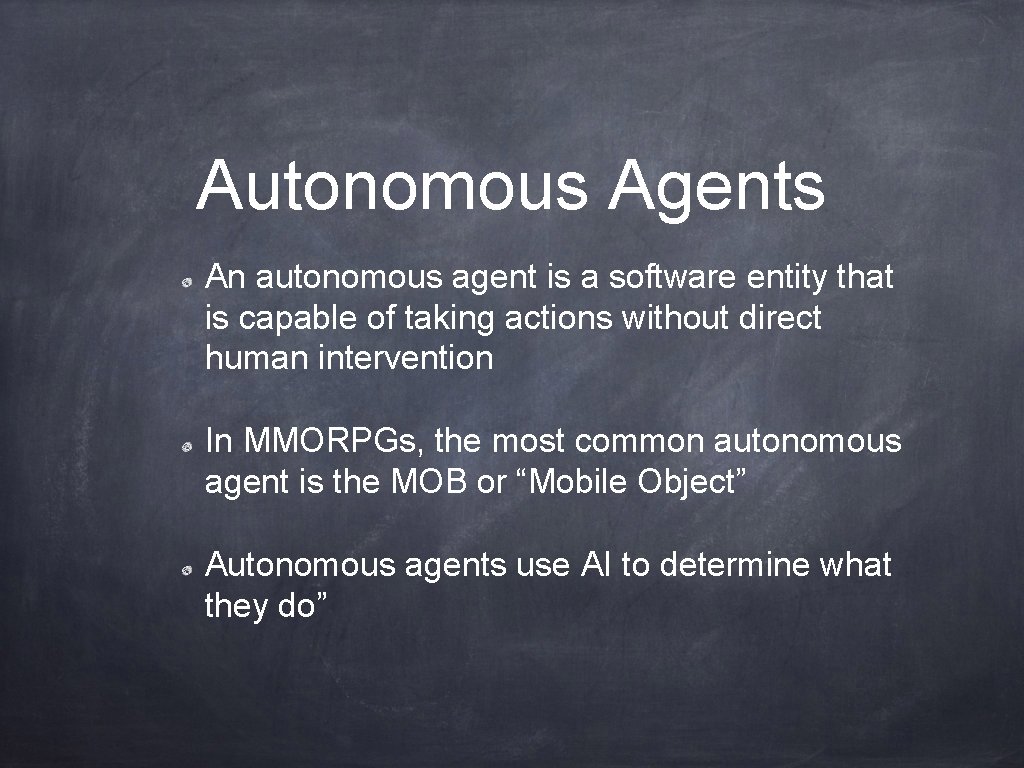
Autonomous Agents An autonomous agent is a software entity that is capable of taking actions without direct human intervention In MMORPGs, the most common autonomous agent is the MOB or “Mobile Object” Autonomous agents use AI to determine what they do”
FSA are Context Sensitive The result of an event is dependent on the external event and the internal state. FSA are good for modeling a mental state Because FSA states can be chained sequentially through events, they are also good for modeling processes.
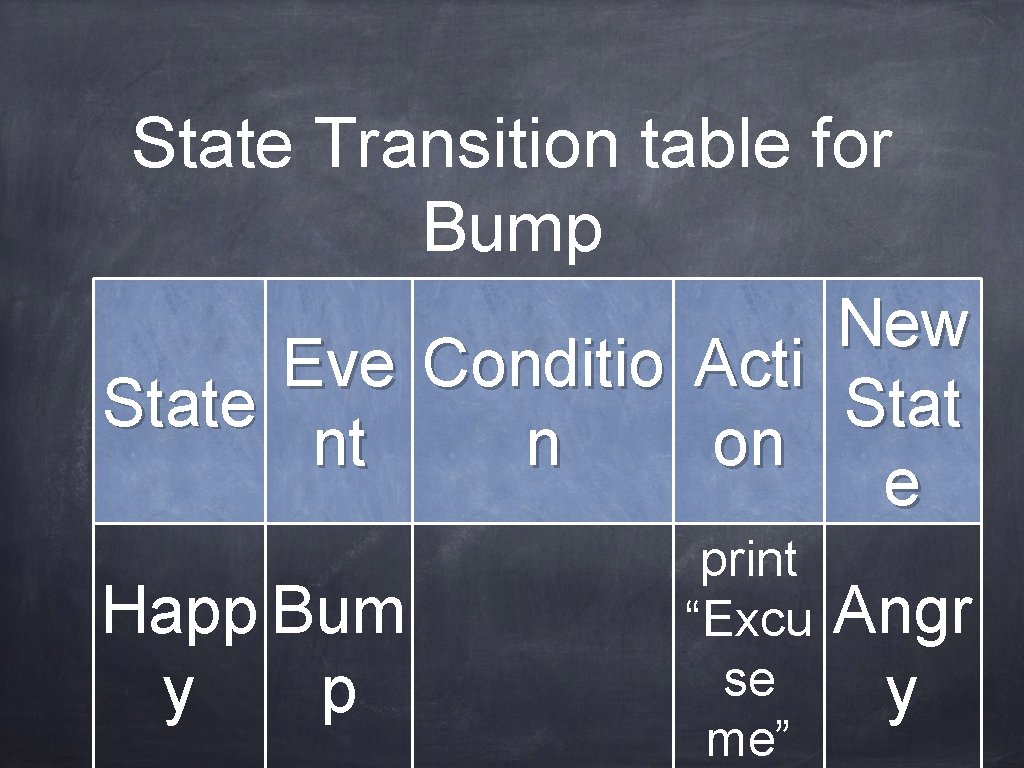
A simple AI If you bump me, how I react is dependent on my mood: If I’m happy, I say “excuse me” If I’m angry, I shove you back. I start out happy If I am bumped, I get angry Volunteer to draw the state transition diagram?
State Transition table for Bump New Eve Conditio Acti State Stat nt n on e Happ Bum y p print “Excu se me” Angr y
What is the eventual result of this AI?
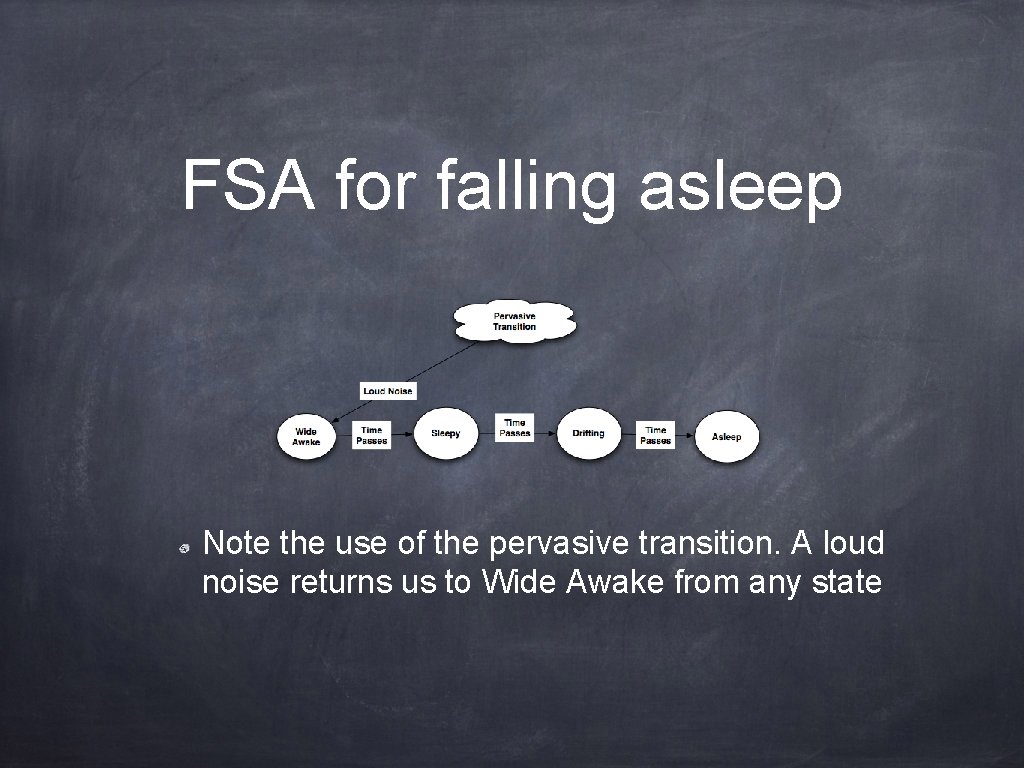
A process: Falling Asleep Unless I am a Narcoleptic, I don’t go from wide awake to fast asleep I go from wide awake to sleepy to drifting to full sleep We can model this process as a set of states in an FSA
FSA for falling asleep Note the use of the pervasive transition. A loud noise returns us to Wide Awake from any state
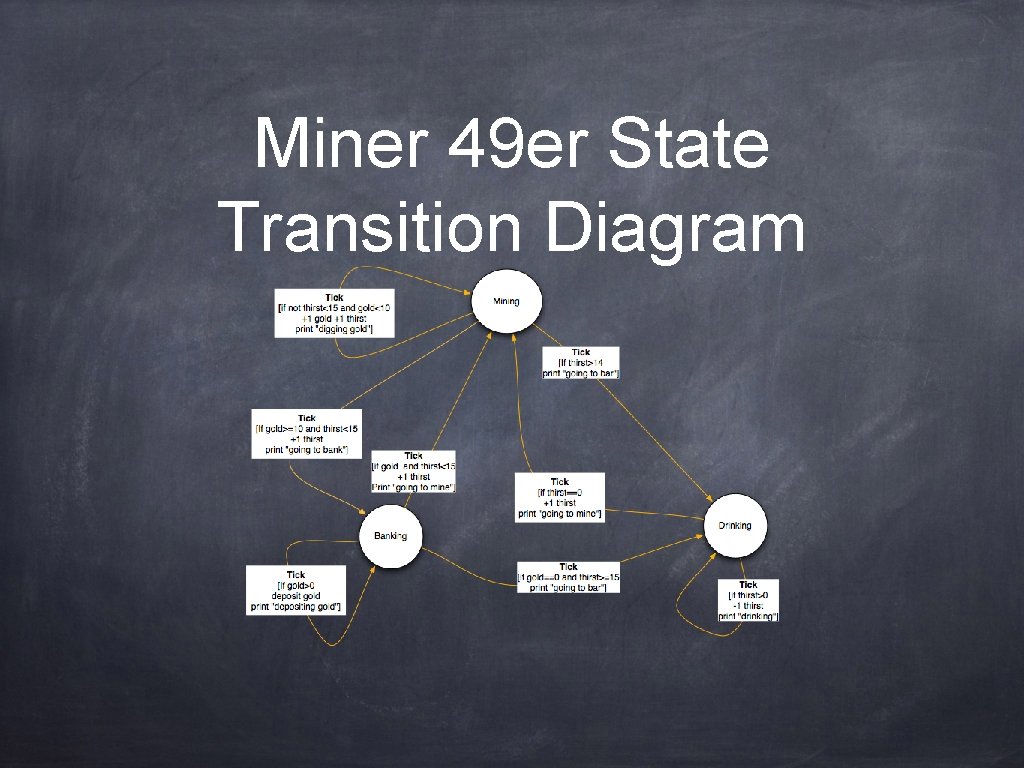
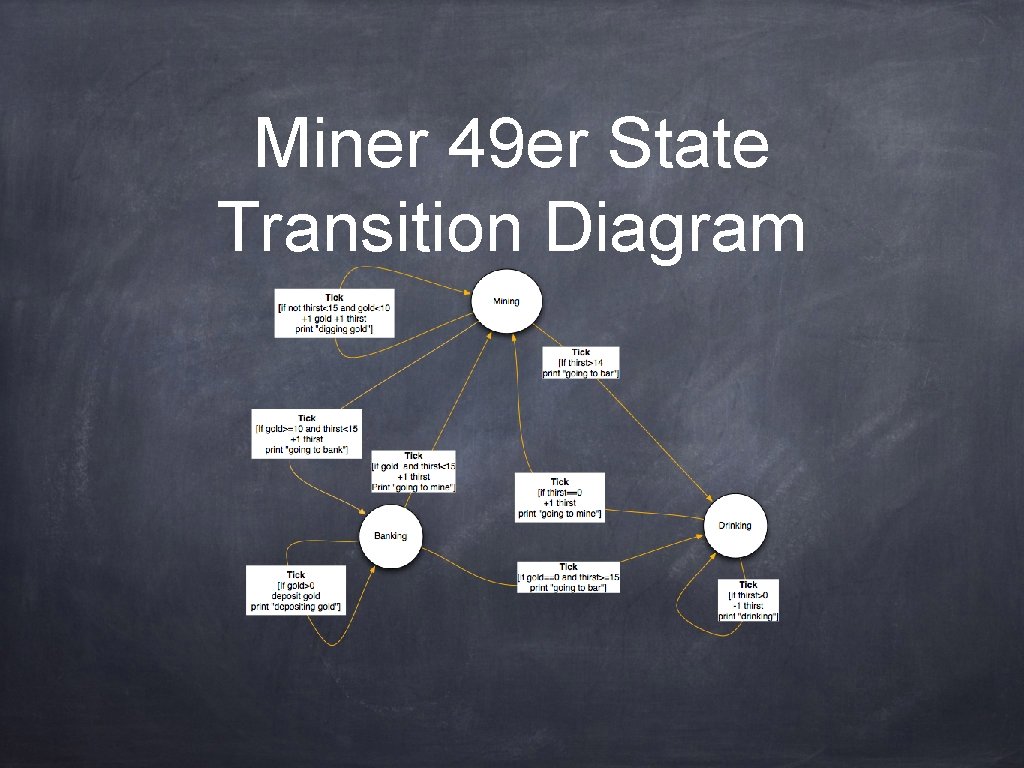
Miner 49 er is a simple textual simulation with an autonomous agent. The agent is a miner The miner is modeled with FSA The simulation plays out in game turns called “ticks”. The miner takes one action per tick. titicktick. referredto as a “tick”
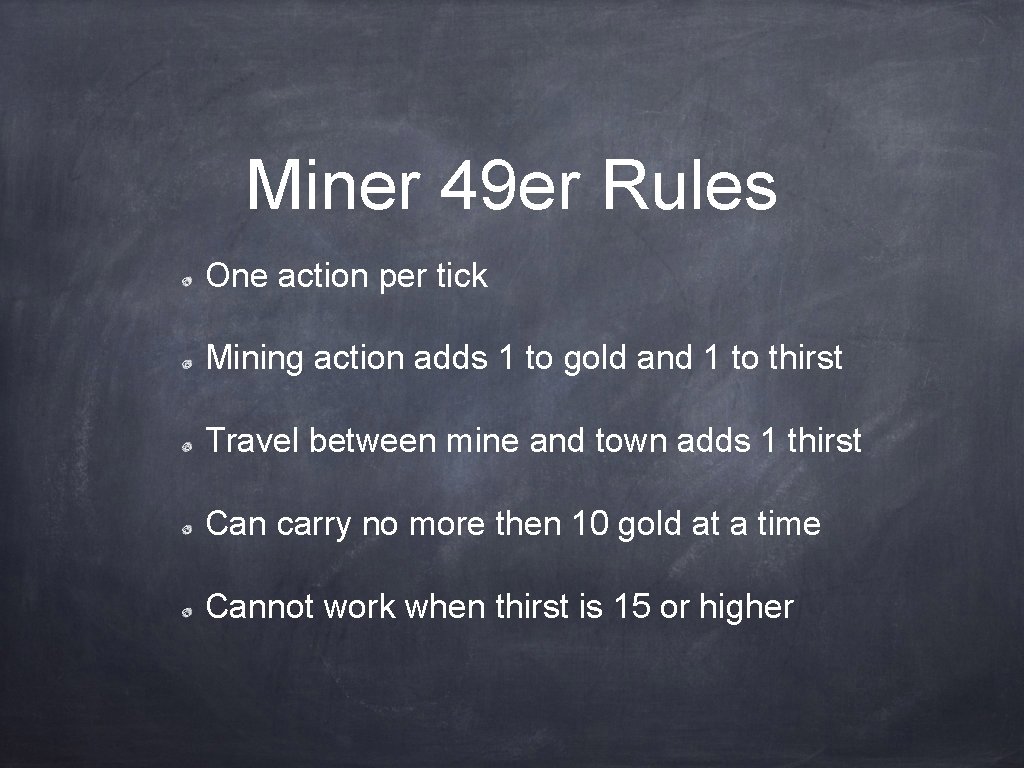
Miner 49 er Rules One action per tick Mining action adds 1 to gold and 1 to thirst Travel between mine and town adds 1 thirst Can carry no more then 10 gold at a time Cannot work when thirst is 15 or higher
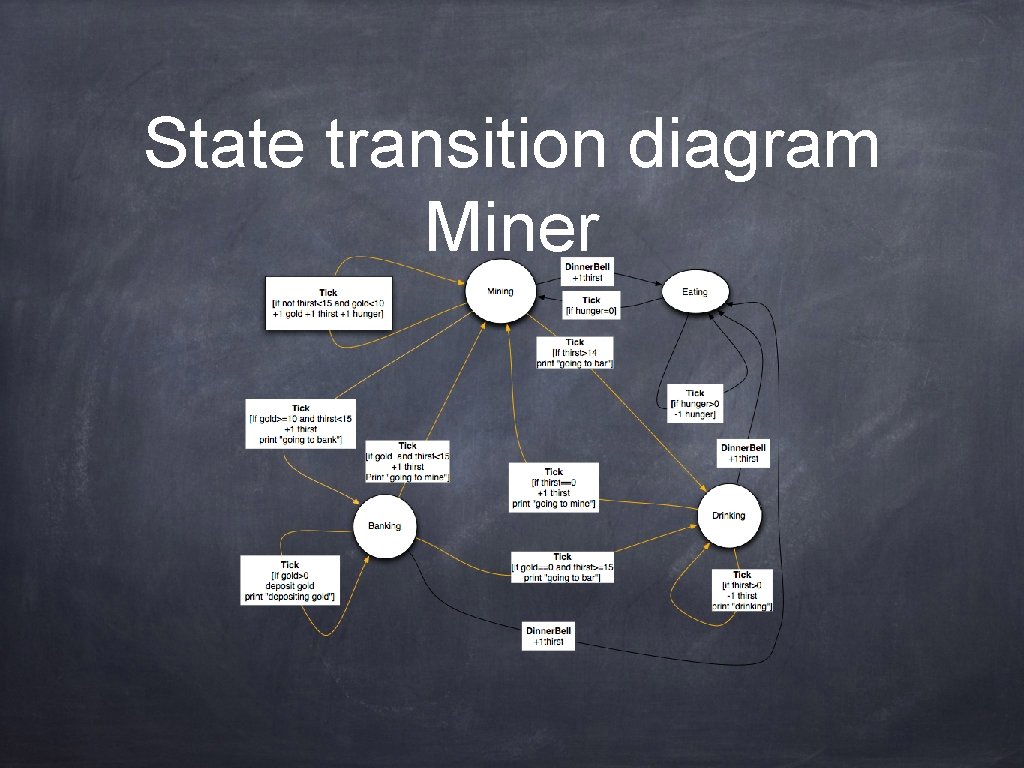
Miner 49 er State Transition Diagram
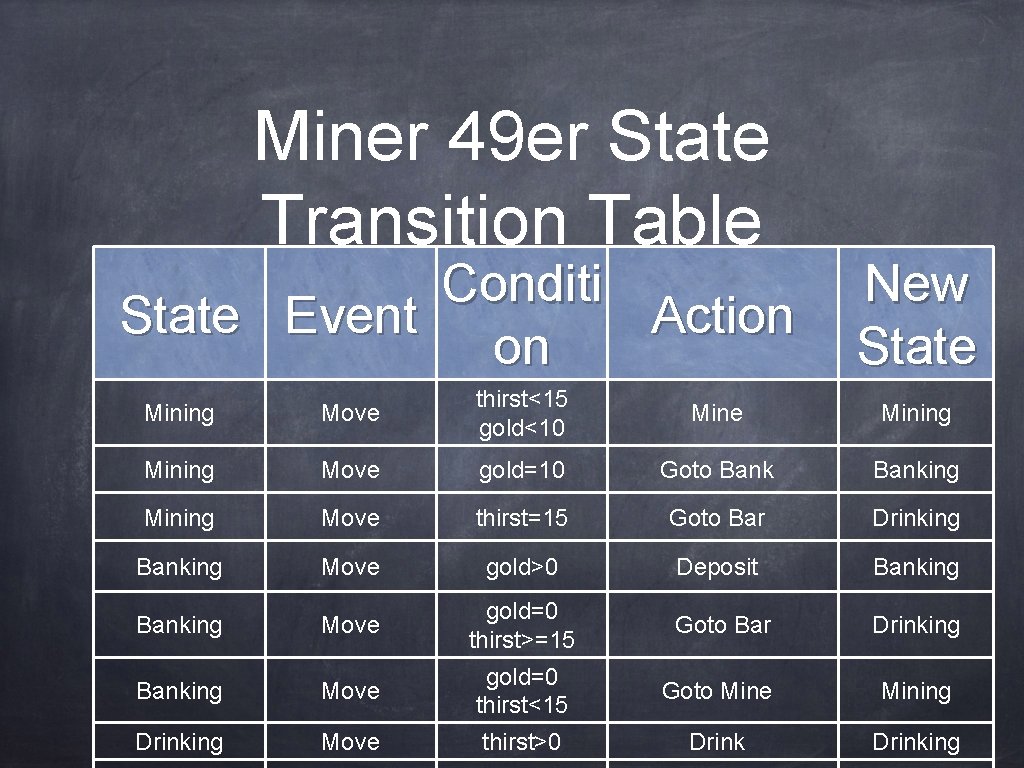
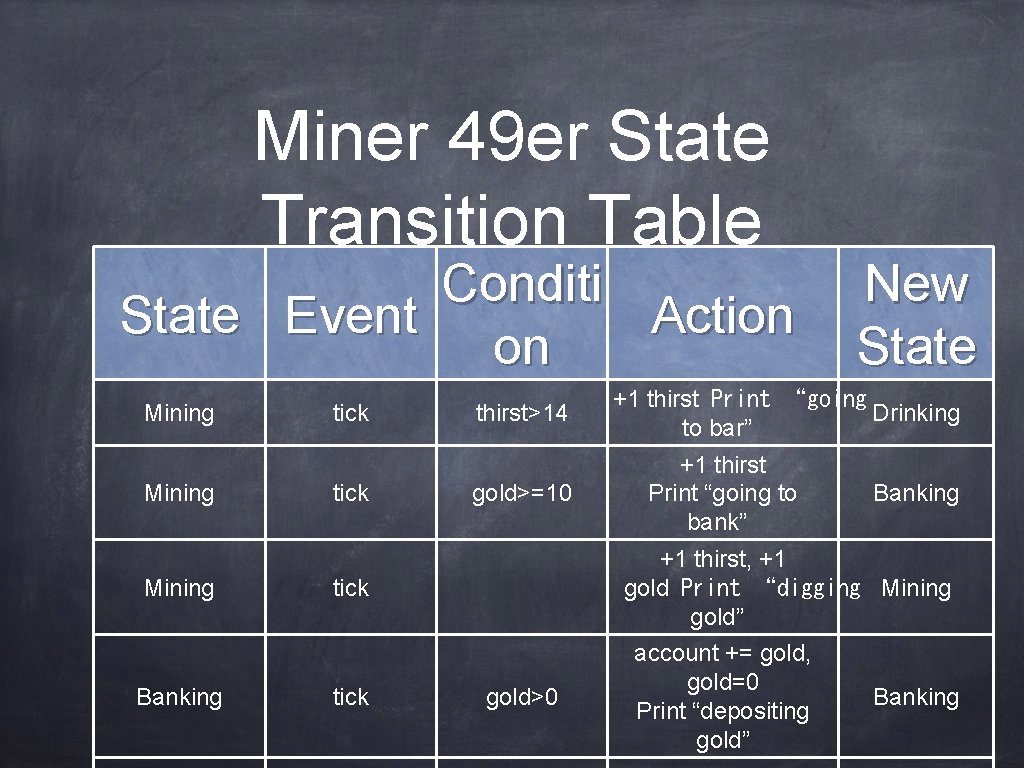
Miner 49 er State Transition Table Conditi State Event Action on New State Mining Move thirst<15 gold<10 Mining Move gold=10 Goto Banking Mining Move thirst=15 Goto Bar Drinking Banking Move gold>0 Deposit Banking Move gold=0 thirst>=15 Goto Bar Drinking Banking Move gold=0 thirst<15 Goto Mine Mining Drinking Move thirst>0 Drinking Mine Mining
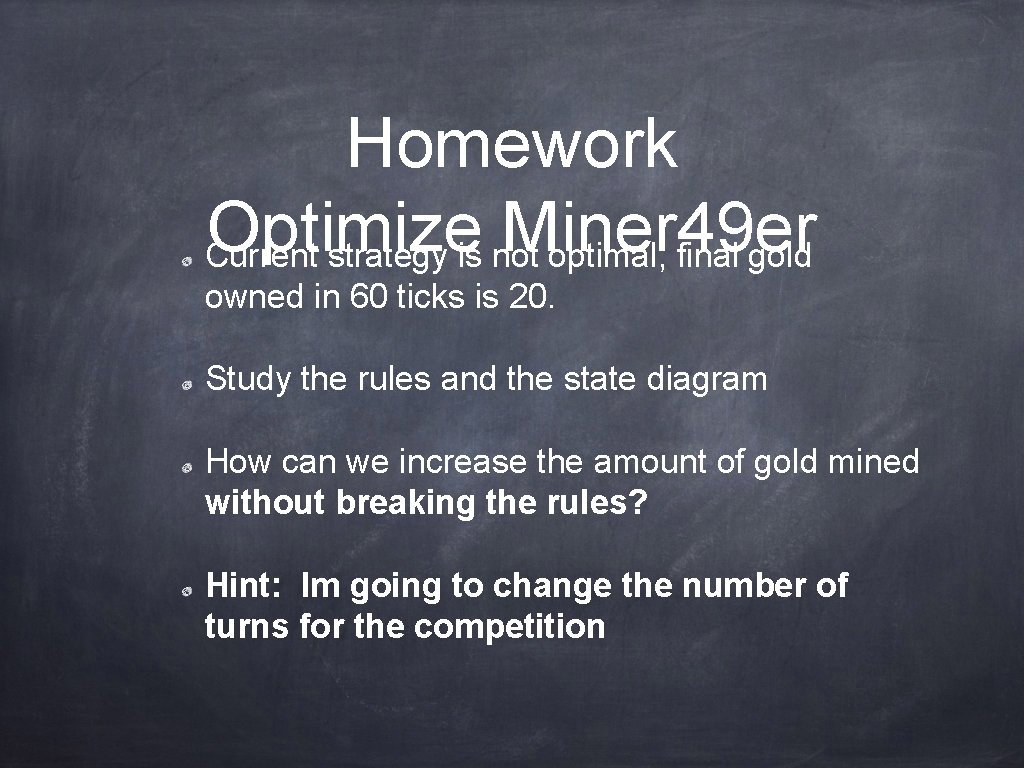
Homework Optimize Miner 49 er Current strategy is not optimal, final gold owned in 60 ticks is 20. Study the rules and the state diagram How can we increase the amount of gold mined without breaking the rules? Hint: Im going to change the number of turns for the competition
Lecture 2: The FSA Library and More Miner 49 er and Beyond
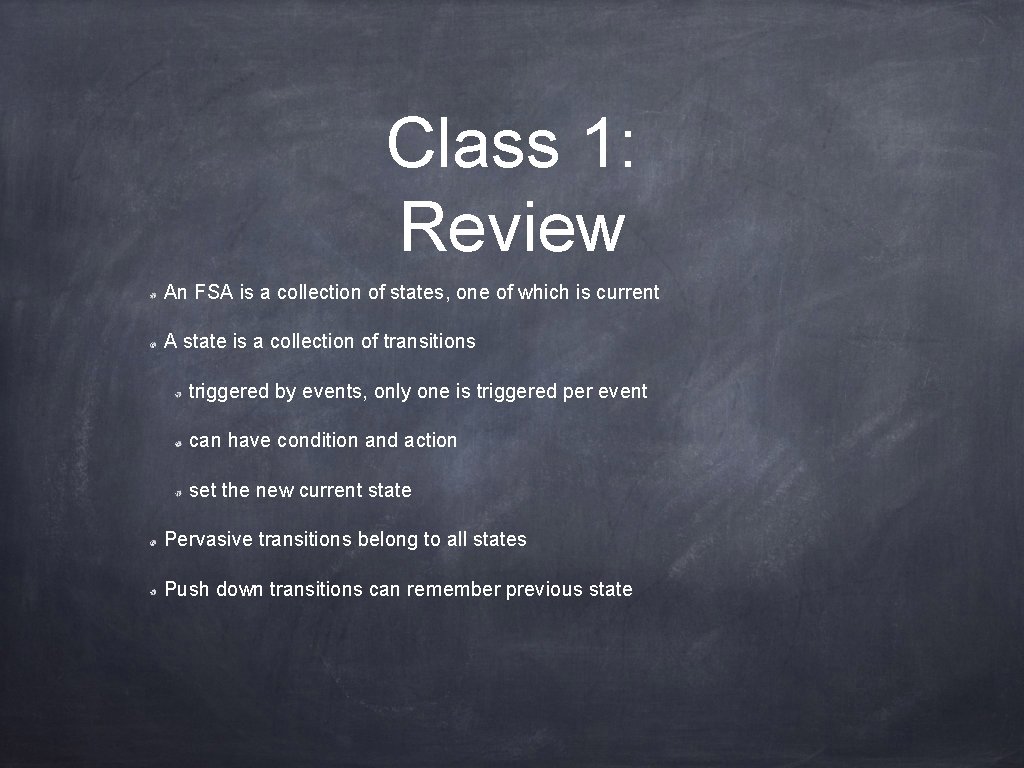
Class 1: Review An FSA is a collection of states, one of which is current A state is a collection of transitions triggered by events, only one is triggered per event can have condition and action set the new current state Pervasive transitions belong to all states Push down transitions can remember previous state
Miner 49 er State Transition Diagram
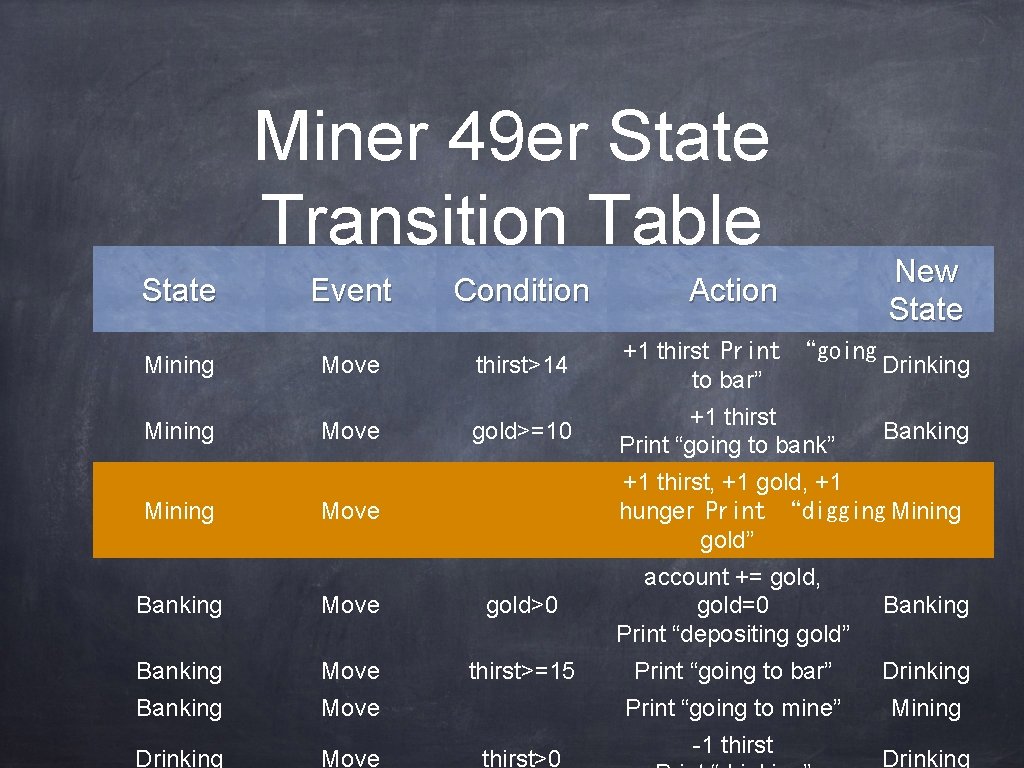
Miner 49 er State Transition Table Conditi State Event Action on Mining Banking tick thirst>14 gold>=10 +1 thirst Print “going Drinking to bar” +1 thirst Print “going to bank” Banking +1 thirst, +1 gold Print “digging Mining gold” tick New State gold>0 account += gold, gold=0 Print “depositing gold” Banking
The FSAImpl Class
The FSA Library Provides Finite State Automata framework Designed with interfaces eg FSA is an interface that defines the public calls on an FSA Implemented with classes called. . . Impl eg the class that implements the FSA interface is called FSAImpl Good paradigm: Design with interfaces, implement with classes.
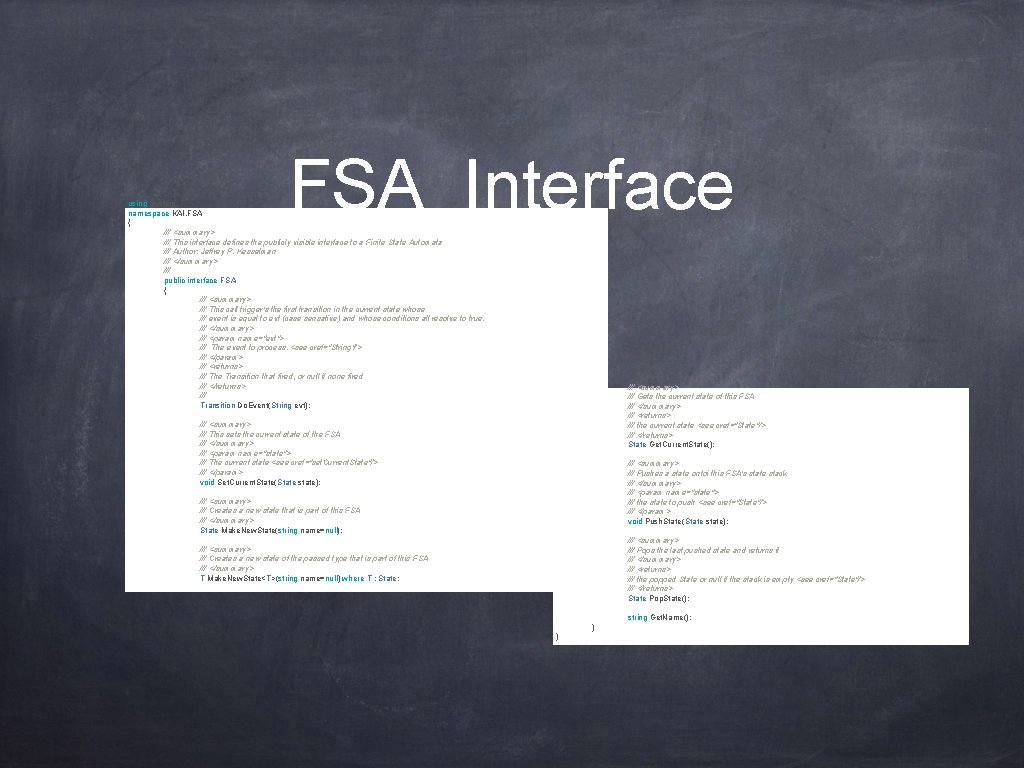
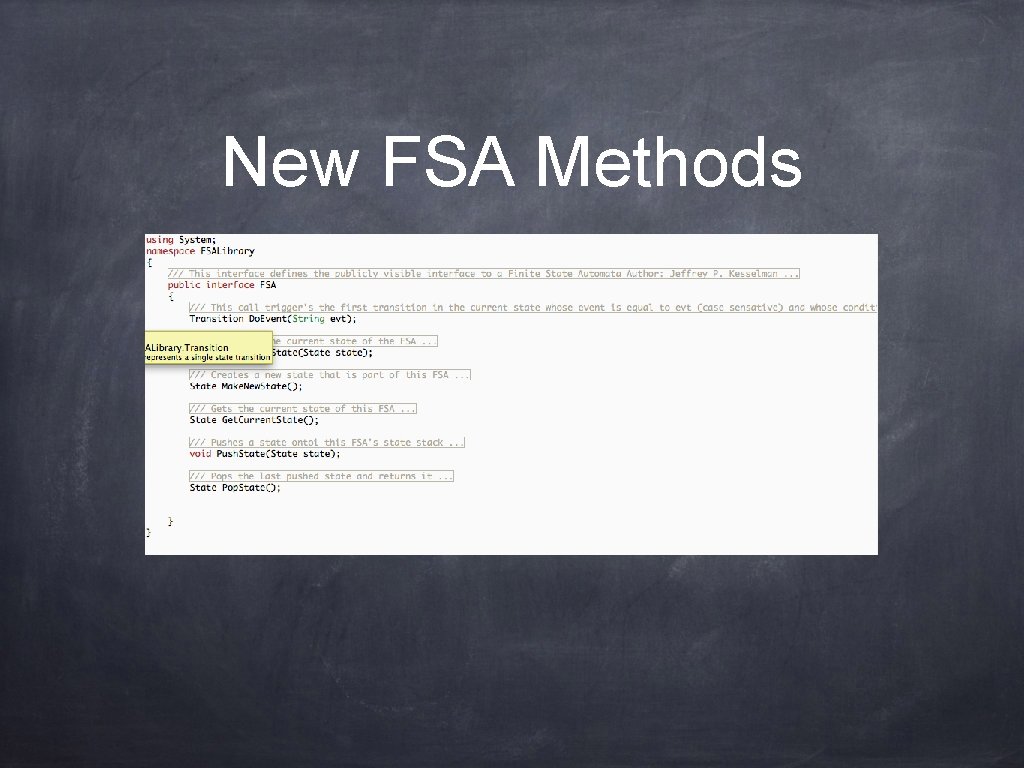
FSA Interface using System; namespace KAI. FSA { /// <summary> /// This interface defines the publicly visible interface to a Finite State Automata /// Author: Jeffrey P. Kesselman /// </summary> /// public interface FSA { /// <summary> /// This call trigger's the first transition in the current state whose /// event is equal to evt (case sensative) and whose conditions all resolve to true. /// </summary> /// <param name="evt"> /// The event to process. <see cref="String"/> /// </param> /// <returns> /// The Transition that fired, or null if none fired /// </returns> /// Transition Do. Event(String evt); /// <summary> /// Gets the current state of this FSA /// </summary> /// <returns> /// the current state <see cref="State"/> /// </returns> State Get. Current. State(); /// <summary> /// This sets the current state of the FSA /// </summary> /// <param name="state"> /// The current state <see cref="set. Current. State"/> /// </param> void Set. Current. State(State state); /// <summary> /// Pushes a state ontoi this FSA's state stack /// </summary> /// <param name="state"> /// the state to push <see cref="State"/> /// </param> void Push. State(State state); /// <summary> /// Creates a new state that is part of this FSA /// </summary> State Make. New. State(string name=null); /// <summary> /// Pops the last pushed state and returns it /// </summary> /// <returns> /// the popped State or null if the stack is empty <see cref="State"/> /// </returns> State Pop. State(); /// <summary> /// Creates a new state of the passed type that is part of this FSA /// </summary> T Make. New. State<T>(string name=null) where T : State; string Get. Name(); } }
Using the FSA Library: FSAImpl is the key class. To create an FSA, you instance FSAImpl or instance a subclass thereof. Miner. cs is a sub-class of FSAImpl
The FSA Library: Creating States The FSA starts out empty. You create states by calling the factory method FSA. make. New. State() This returns an object that implements the State interface This object represents one State of the particular FSA.
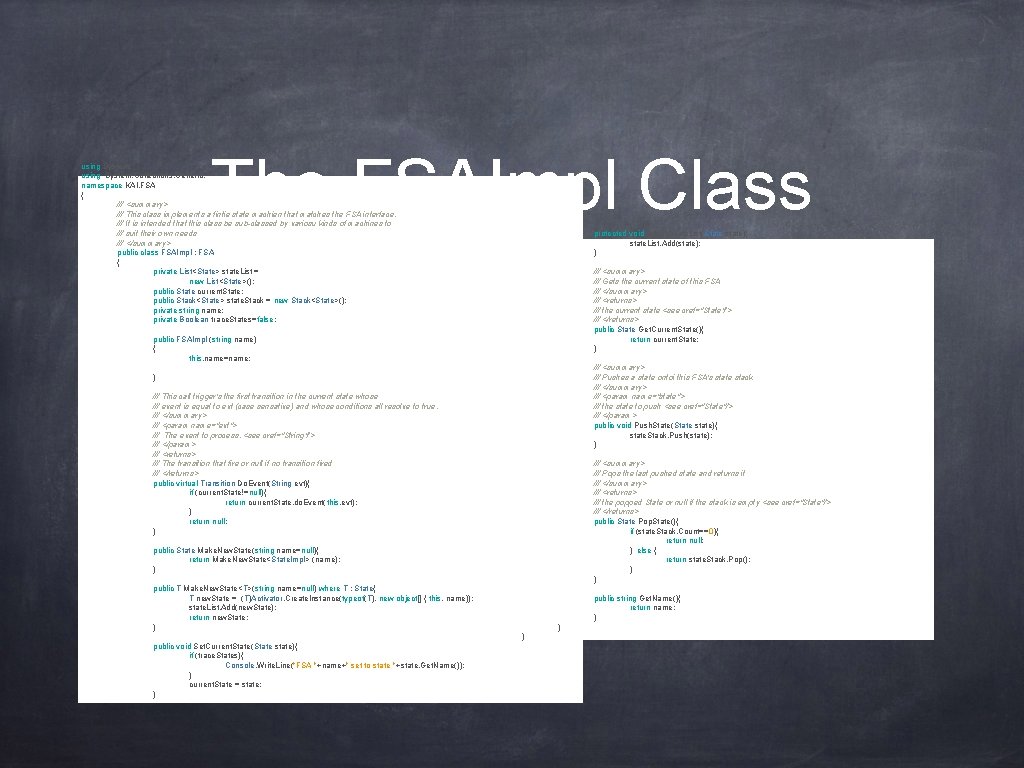
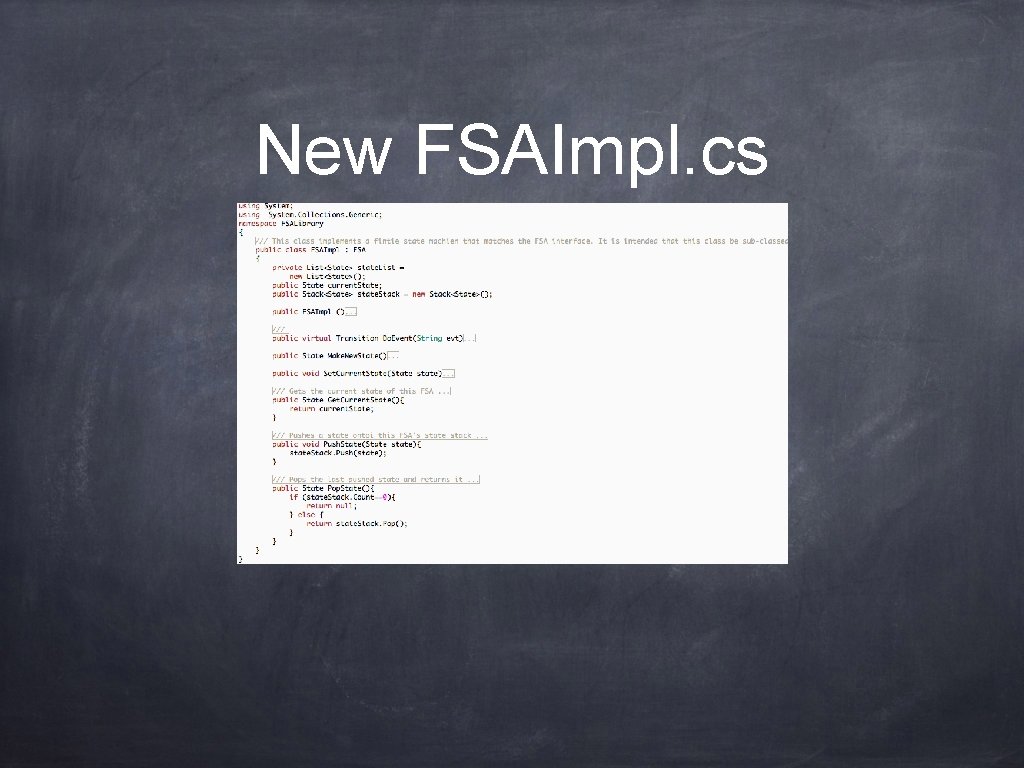
The FSAImpl Class using System; using System. Collections. Generic; namespace KAI. FSA { /// <summary> /// This class implements a fintie state machien that matches the FSA interface. /// It is intended that this class be sub-classed by variosu kinds of machines to /// suit their own needs /// </summary> public class FSAImpl : FSA { private List<State> state. List = new List<State>(); public State current. State; public Stack<State> state. Stack = new Stack<State>(); private string name; private Boolean trace. States=false; protected void Add. To. State. List(State state){ state. List. Add(state); } /// <summary> /// Gets the current state of this FSA /// </summary> /// <returns> /// the current state <see cref="State"/> /// </returns> public State Get. Current. State(){ return current. State; } public FSAImpl (string name) { this. name=name; /// <summary> /// Pushes a state ontoi this FSA's state stack /// </summary> /// <param name="state"> /// the state to push <see cref="State"/> /// </param> public void Push. State(State state){ state. Stack. Push(state); } } /// This call trigger's the first transition in the current state whose /// event is equal to evt (case sensative) and whose conditions all resolve to true. /// </summary> /// <param name="evt"> /// The event to process. <see cref="String"/> /// </param> /// <returns> /// The transition that fire or null if no transition fired /// </returns> public virtual Transition Do. Event(String evt){ if (current. State!=null){ return current. State. do. Event(this, evt); } return null; } /// <summary> /// Pops the last pushed state and returns it /// </summary> /// <returns> /// the popped State or null if the stack is empty <see cref="State"/> /// </returns> public State Pop. State(){ if (state. Stack. Count==0){ return null; } else { return state. Stack. Pop(); } } public State Make. New. State(string name=null){ return Make. New. State<State. Impl> (name); } public T Make. New. State<T>(string name=null) where T : State{ T new. State = (T)Activator. Create. Instance(typeof(T), new object[] { this, name}); state. List. Add(new. State); return new. State; } public string Get. Name(){ return name; } } } public void Set. Current. State(State state){ if (trace. States){ Console. Write. Line("FSA "+name+" set to state "+state. Get. Name()); } current. State = state; }
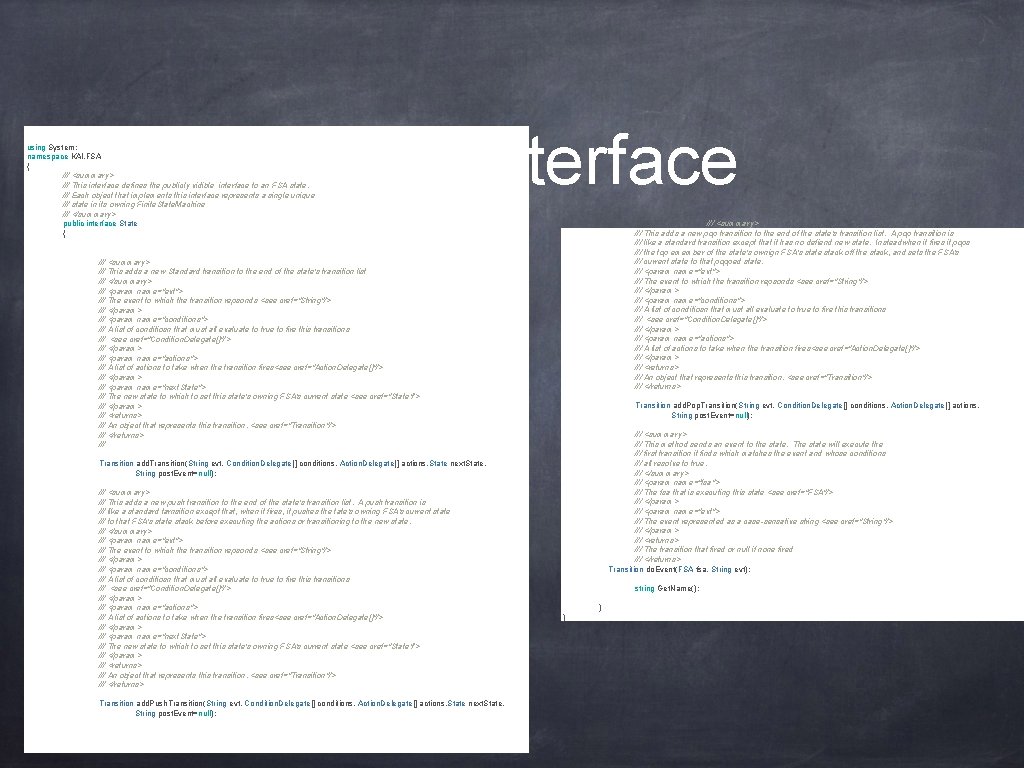
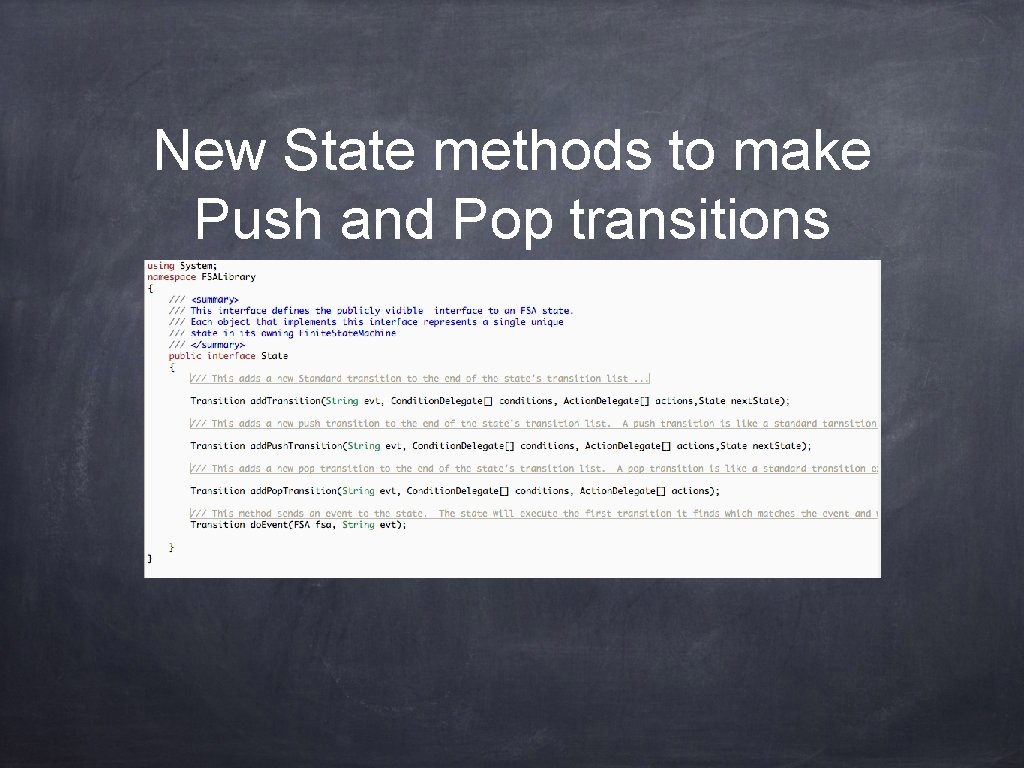
State Interface using System; namespace KAI. FSA { /// <summary> /// This interface defines the publicly vidible interface to an FSA state. /// Each object that implements this interface represents a single unique /// state in its owning Finite. State. Machine /// </summary> public interface State { /// <summary> /// This adds a new pop transition to the end of the state's transition list. A pop transition is /// like a standard transition except that it has no defiend new state. Insteadwhen it fires it pops /// the top emember of the state's ownign FSA's state stack off the stack, and sets the FSA's /// current state to that popped state. /// <param name="evt"> /// The event to which the transition repsonds <see cref="String"/> /// </param> /// <param name="conditions"> /// A list of conditiosn that must all evaluate to true to fire this transitions /// <see cref="Condition. Delegate[]"/> /// </param> /// <param name="actions"> /// A list of actions to take when the transition fires<see cref="Action. Delegate[]"/> /// </param> /// <returns> /// An object that represents this transition. <see cref="Transition"/> /// </returns> /// <summary> /// This adds a new Standard transition to the end of the state's transition list /// </summary> /// <param name="evt"> /// The event to which the transition repsonds <see cref="String"/> /// </param> /// <param name="conditions"> /// A list of conditiosn that must all evaluate to true to fire this transitions /// <see cref="Condition. Delegate[]"/> /// </param> /// <param name="actions"> /// A list of actions to take when the transition fires<see cref="Action. Delegate[]"/> /// </param> /// <param name="next. State"> /// The new state to which to set this state's owning FSA's current state <see cref="State"/> /// </param> /// <returns> /// An object that represents this transition. <see cref="Transition"/> /// </returns> /// Transition add. Pop. Transition(String evt, Condition. Delegate[] conditions, Action. Delegate[] actions, String post. Event=null); /// <summary> /// This method sends an event to the state. The state will execute the /// first transition it finds which matches the event and whose conditions /// all resolve to true. /// </summary> /// <param name="fsa"> /// The fsa that is executing this state <see cref="FSA"/> /// </param> /// <param name="evt"> /// The event represented as a case-sensative string <see cref="String"/> /// </param> /// <returns> /// The transition that fired or null if none fired /// </returns> Transition do. Event(FSA fsa, String evt); Transition add. Transition(String evt, Condition. Delegate[] conditions, Action. Delegate[] actions, State next. State, String post. Event=null); /// <summary> /// This adds a new push transition to the end of the state's transition list. A push transition is /// like a standard tarnsition except that, when it fires, it pushes the tate's owning FSA's current state /// to that FSA's state stack before executing the actions or transitioning to the new state. /// </summary> /// <param name="evt"> /// The event to which the transition repsonds <see cref="String"/> /// </param> /// <param name="conditions"> /// A list of conditiosn that must all evaluate to true to fire this transitions /// <see cref="Condition. Delegate[]"/> /// </param> /// <param name="actions"> /// A list of actions to take when the transition fires<see cref="Action. Delegate[]"/> /// </param> /// <param name="next. State"> /// The new state to which to set this state's owning FSA's current state <see cref="State"/> /// </param> /// <returns> /// An object that represents this transition. <see cref="Transition"/> /// </returns> Transition add. Push. Transition(String evt, Condition. Delegate[] conditions, Action. Delegate[] actions, State next. State, String post. Event=null); string Get. Name(); } }
The FSA Library: Adding Transitions are created by calling the State. add. Transition(. . . ) method add. Transition takes 4 parameters event string Condition. Delegate array Action. Delegate array new State to transition to Returns an object that implements the Transition interface
C# Delegates are like C function pointers or Java Method objects Unlike C or Java, C# Delegates contain both a method to invoke and the object to invoke it on Unlike C or Java, C# Delegates are typed
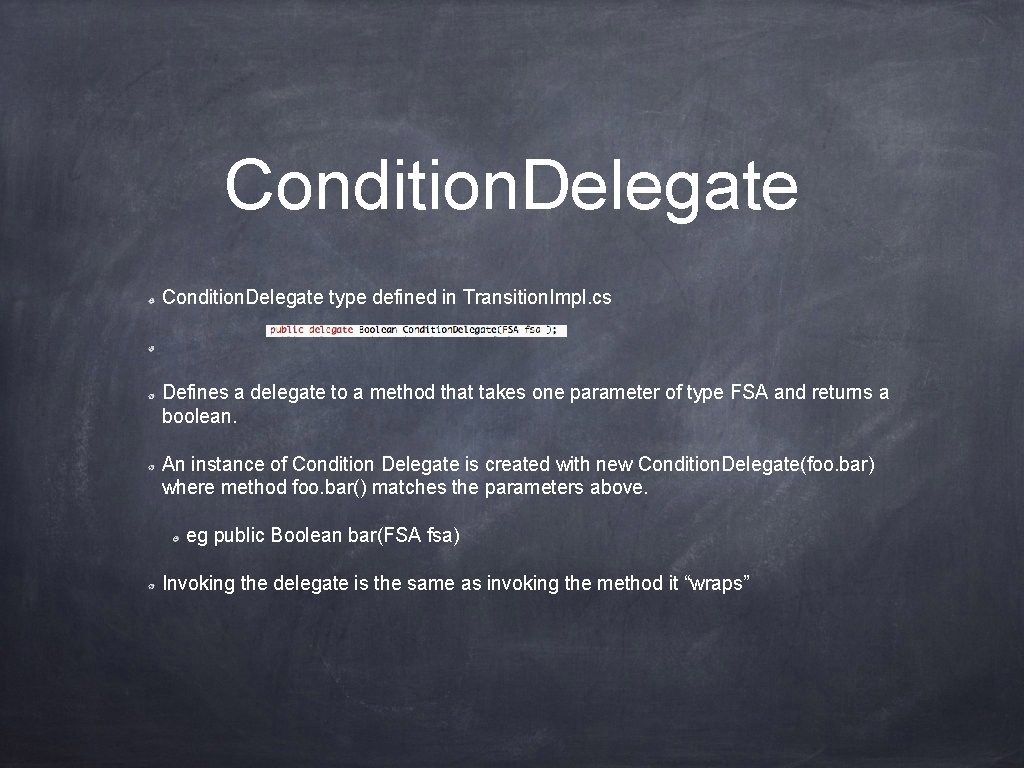
Condition. Delegate type defined in Transition. Impl. cs Defines a delegate to a method that takes one parameter of type FSA and returns a boolean. An instance of Condition Delegate is created with new Condition. Delegate(foo. bar) where method foo. bar() matches the parameters above. eg public Boolean bar(FSA fsa) Invoking the delegate is the same as invoking the method it “wraps”
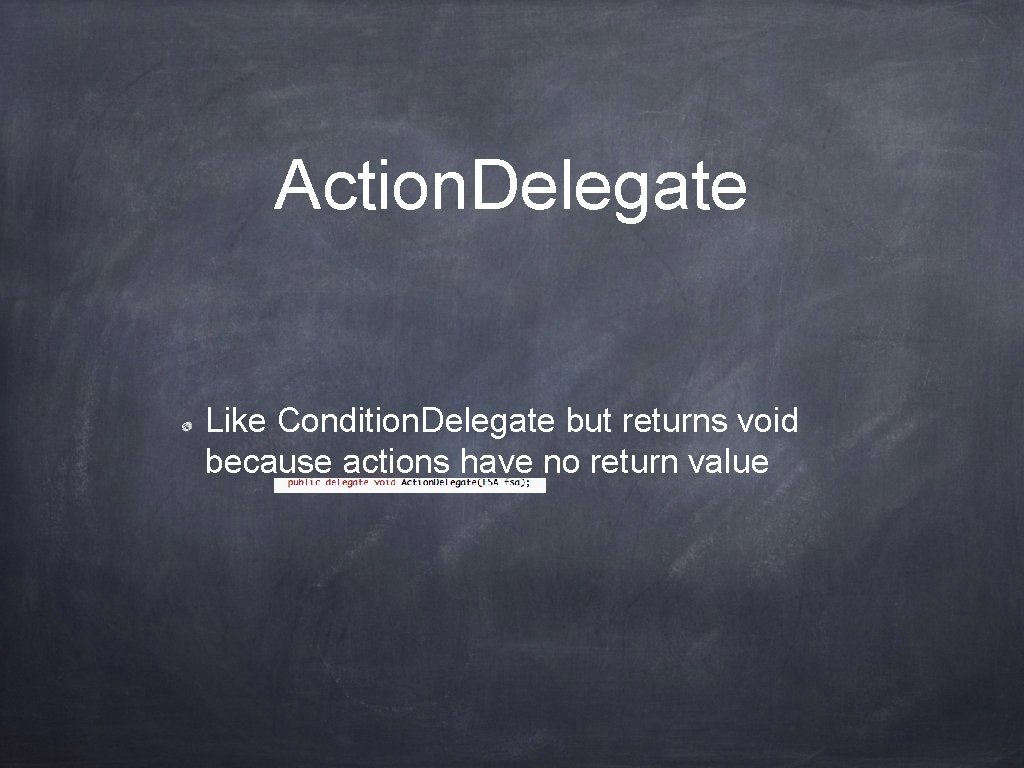
Action. Delegate Like Condition. Delegate but returns void because actions have no return value
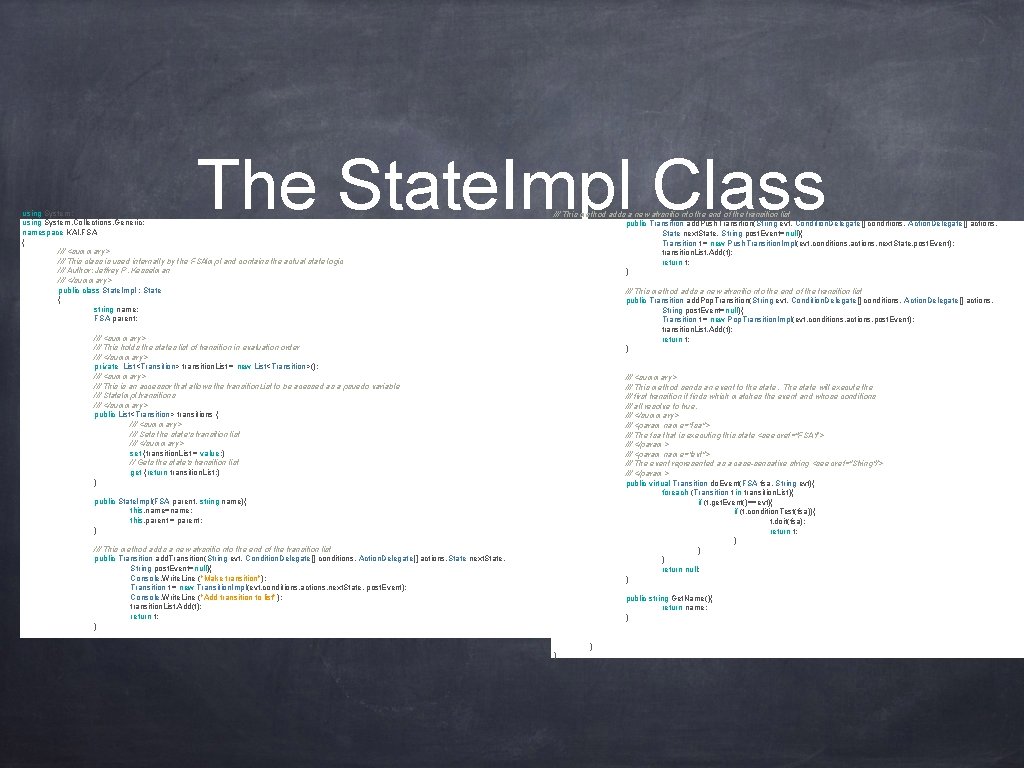
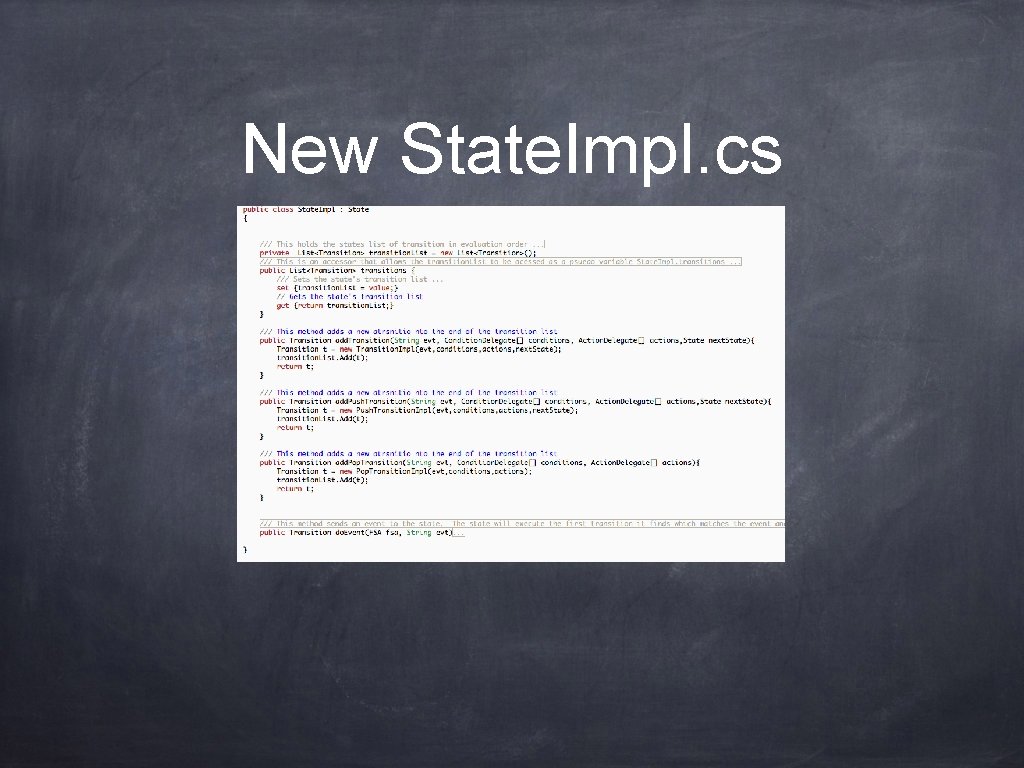
The State. Impl Class using System; using System. Collections. Generic; namespace KAI. FSA { /// <summary> /// This class is used internally by the FSAImpl and contains the actual state logic /// Author: Jeffrey P. Kesselman /// </summary> public class State. Impl : State { string name; FSA parent; /// This method adds a new atrsnitio nto the end of the transition list public Transition add. Push. Transition(String evt, Condition. Delegate[] conditions, Action. Delegate[] actions, State next. State, String post. Event=null){ Transition t = new Push. Transition. Impl(evt, conditions, actions, next. State, post. Event); transition. List. Add(t); return t; } /// This method adds a new atrsnitio nto the end of the transition list public Transition add. Pop. Transition(String evt, Condition. Delegate[] conditions, Action. Delegate[] actions, String post. Event=null){ Transition t = new Pop. Transition. Impl(evt, conditions, actions, post. Event); transition. List. Add(t); return t; } /// <summary> /// This holds the states list of transition in evaluation order /// </summary> private List<Transition> transition. List = new List<Transition>(); /// <summary> /// This is an accessor that allows the transition. List to be acessed as a psuedo variable /// State. Impl. transitions /// </summary> public List<Transition> transitions { /// <summary> /// Sets the state's transition list /// </summary> set {transition. List = value; } // Gets the state's transition list get {return transition. List; } } /// <summary> /// This method sends an event to the state. The state will execute the /// first transition it finds which matches the event and whose conditions /// all resolve to true. /// </summary> /// <param name="fsa"> /// The fsa that is executing this state <see cref="FSA"/> /// </param> /// <param name="evt"> /// The event represented as a case-sensative string <see cref="String"/> /// </param> public virtual Transition do. Event(FSA fsa, String evt){ foreach (Transition t in transition. List){ if (t. get. Event()==evt){ if (t. condition. Test(fsa)){ t. doit(fsa); return t; } } } return null; } public State. Impl(FSA parent, string name){ this. name=name; this. parent = parent; } /// This method adds a new atrsnitio nto the end of the transition list public Transition add. Transition(String evt, Condition. Delegate[] conditions, Action. Delegate[] actions, State next. State, String post. Event=null){ Console. Write. Line ("Make transition"); Transition t = new Transition. Impl(evt, conditions, actions, next. State, post. Event); Console. Write. Line ("Add transition to list"); transition. List. Add(t); return t; } public string Get. Name(){ return name; } } }
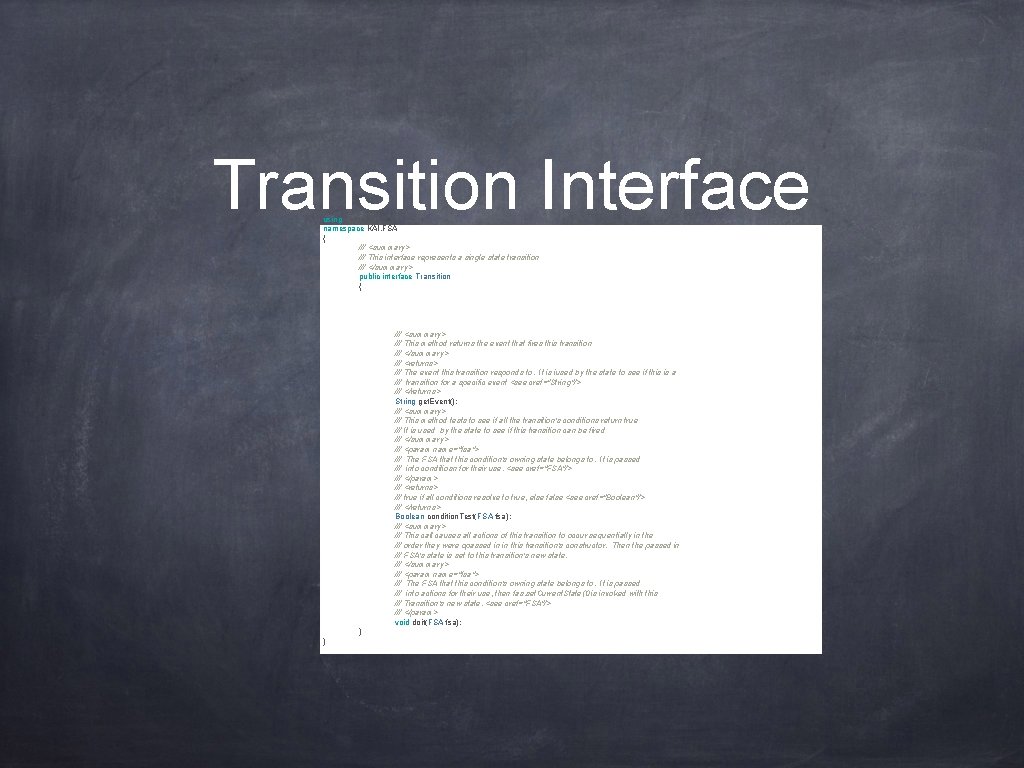
Transition Interface using System; namespace KAI. FSA { /// <summary> /// This interface represents a single state transition /// </summary> public interface Transition { /// <summary> /// This method returns the event that fires this transition /// </summary> /// <returns> /// The event this transition responds to. It is iused by the state to see if this is a /// transition for a specific event <see cref="String"/> /// </returns> String get. Event(); /// <summary> /// This method tests to see if all the transition's conditions return true /// It is used by the state to see if this transition can be fired /// </summary> /// <param name="fsa"> /// The FSA that this condition's owning state belongs to. It is passed /// into conditiosn for their use. <see cref="FSA"/> /// </param> /// <returns> /// true if all conditions resolve to true, else false <see cref="Boolean"/> /// </returns> Boolean condition. Test(FSA fsa); /// <summary> /// This call causes all actions of this transition to occur sequentially in the /// order they were opassed in in this transition's constructor. Then the passed in /// FSA's state is set to this transition's new state. /// </summary> /// <param name="fsa"> /// The FSA that this condition's owning state belongs to. It is passed /// into actions for their use, then fas. set. Current. State(0 is invoked with this /// Transition's new state. <see cref="FSA"/> /// </param> void doit(FSA fsa); } }
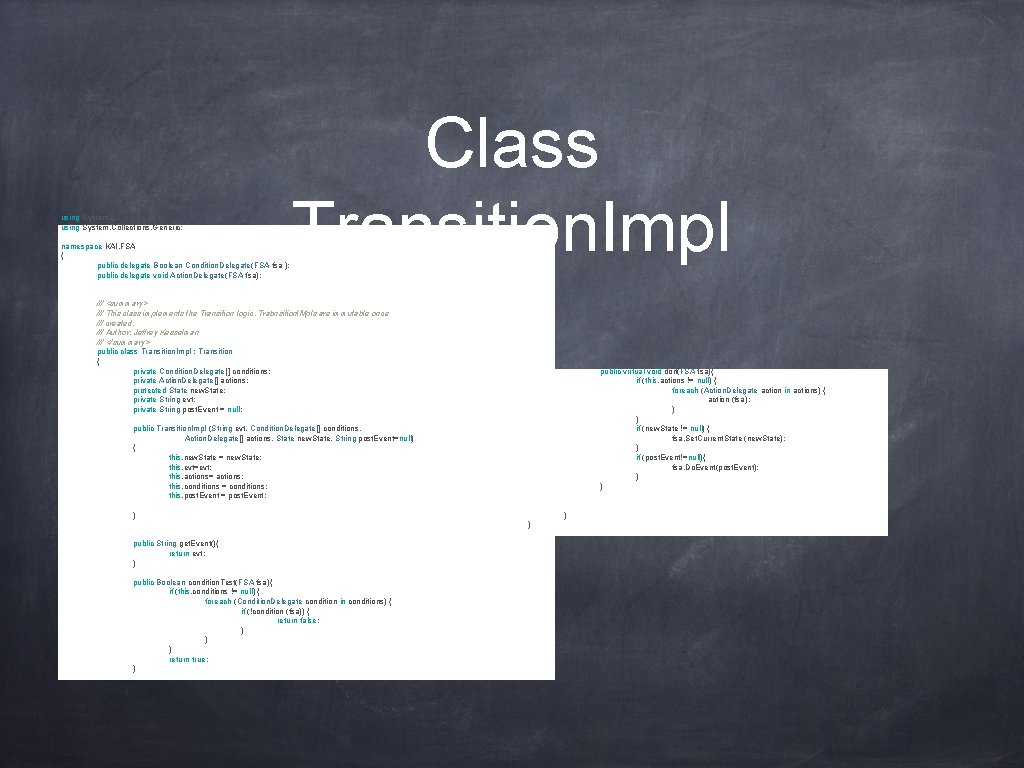
using System; using System. Collections. Generic; namespace KAI. FSA { public delegate Boolean Condition. Delegate(FSA fsa ); public delegate void Action. Delegate(FSA fsa); Class Transition. Impl /// <summary> /// This class implements the Transition logic. Trabnsition. IMpls are immutable once /// created. /// Author: Jeffrey Kesselman /// </summary> public class Transition. Impl : Transition { private Condition. Delegate[] conditions; private Action. Delegate[] actions; protected State new. State; private String evt; private String post. Event = null; public virtual void doit(FSA fsa){ if (this. actions != null) { foreach (Action. Delegate action in actions) { action (fsa); } } if (new. State != null) { fsa. Set. Current. State (new. State); } if (post. Event!=null){ fsa. Do. Event(post. Event); } } public Transition. Impl (String evt, Condition. Delegate[] conditions, Action. Delegate[] actions, State new. State, String post. Event=null) { this. new. State = new. State; this. evt=evt; this. actions= actions; this. conditions = conditions; this. post. Event = post. Event; } } } public String get. Event(){ return evt; } public Boolean condition. Test(FSA fsa){ if (this. conditions != null) { foreach (Condition. Delegate condition in conditions) { if (!condition (fsa)) { return false; } } } return true; }
Communication Between FSA Events can come from other GUI, game logic, or other FSA Example: Miner’s Wife
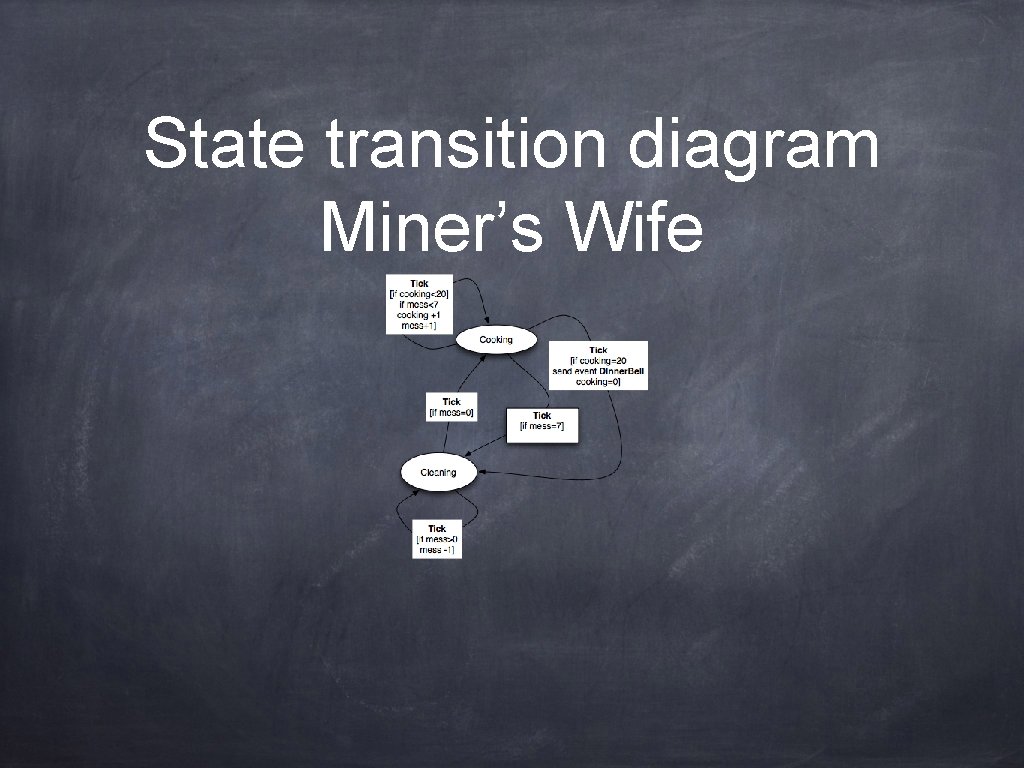
State transition diagram Miner’s Wife
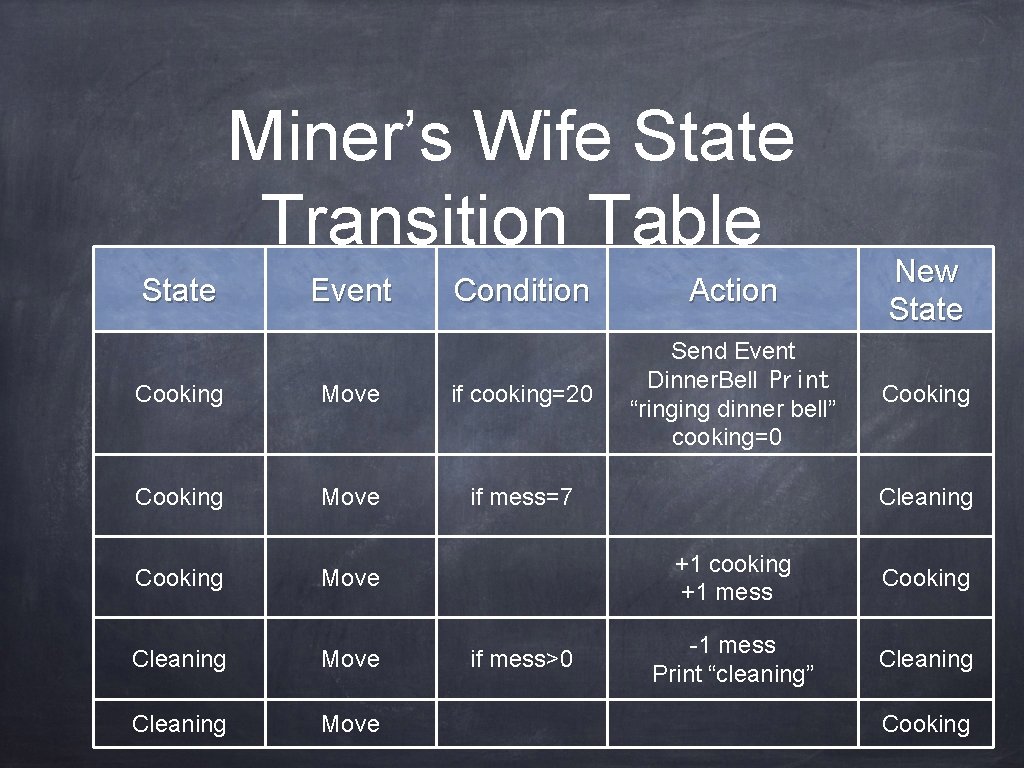
Volunteer to draw the State Transition Table.
Miner’s Wife State Transition Table State Event Condition Action New State Send Event Dinner. Bell Print “ringing dinner bell” cooking=0 Cooking Move if cooking=20 Cooking Move if mess=7 Cooking Move Cleaning Move if mess>0 Cleaning +1 cooking +1 mess Cooking -1 mess Print “cleaning” Cleaning Cooking
State transition diagram Miner
Anyone want to draw that?
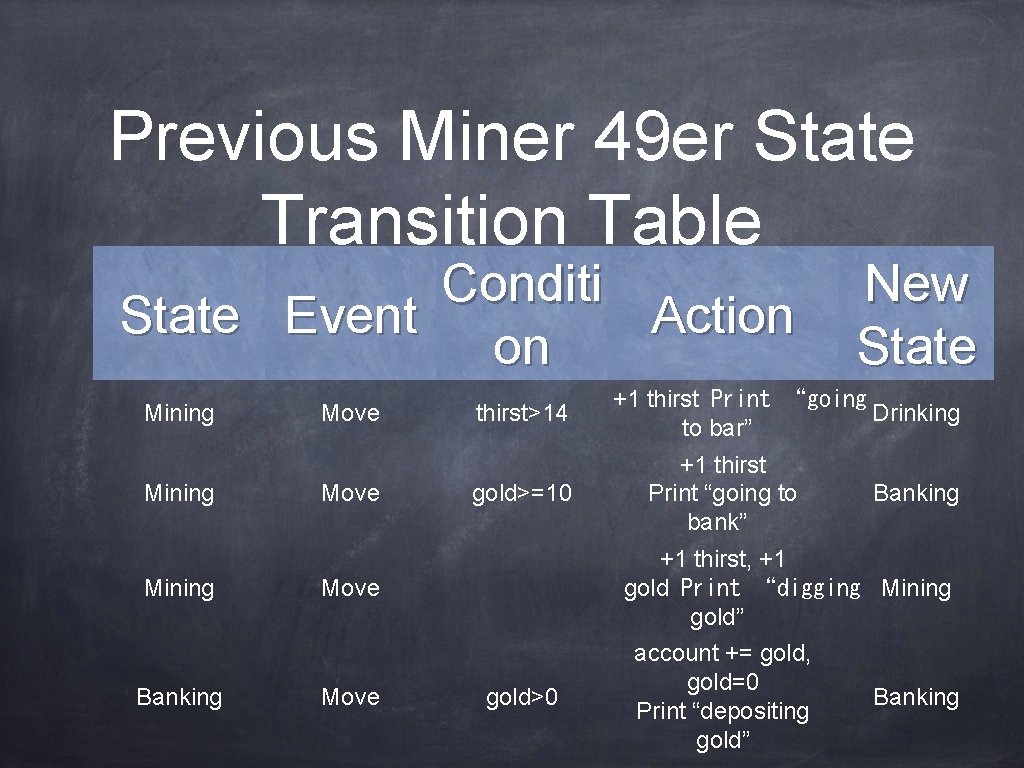
Previous Miner 49 er State Transition Table Conditi State Event Action on Mining Banking Move thirst>14 gold>=10 +1 thirst Print “going Drinking to bar” +1 thirst Print “going to bank” Banking +1 thirst, +1 gold Print “digging Mining gold” Move New State gold>0 account += gold, gold=0 Print “depositing gold” Banking
Miner 49 er State Transition Table State Event Condition Action New State Mining Move thirst>14 +1 thirst Print “going Drinking to bar” Mining Move gold>=10 +1 thirst Print “going to bank” Banking Move +1 thirst, +1 gold, +1 hunger Print “digging Mining gold” Banking Move gold>0 account += gold, gold=0 Print “depositing gold” Banking Move thirst>=15 Print “going to bar” Drinking Banking Move Print “going to mine” Mining Drinking Move Mining thirst>0 -1 thirst Drinking
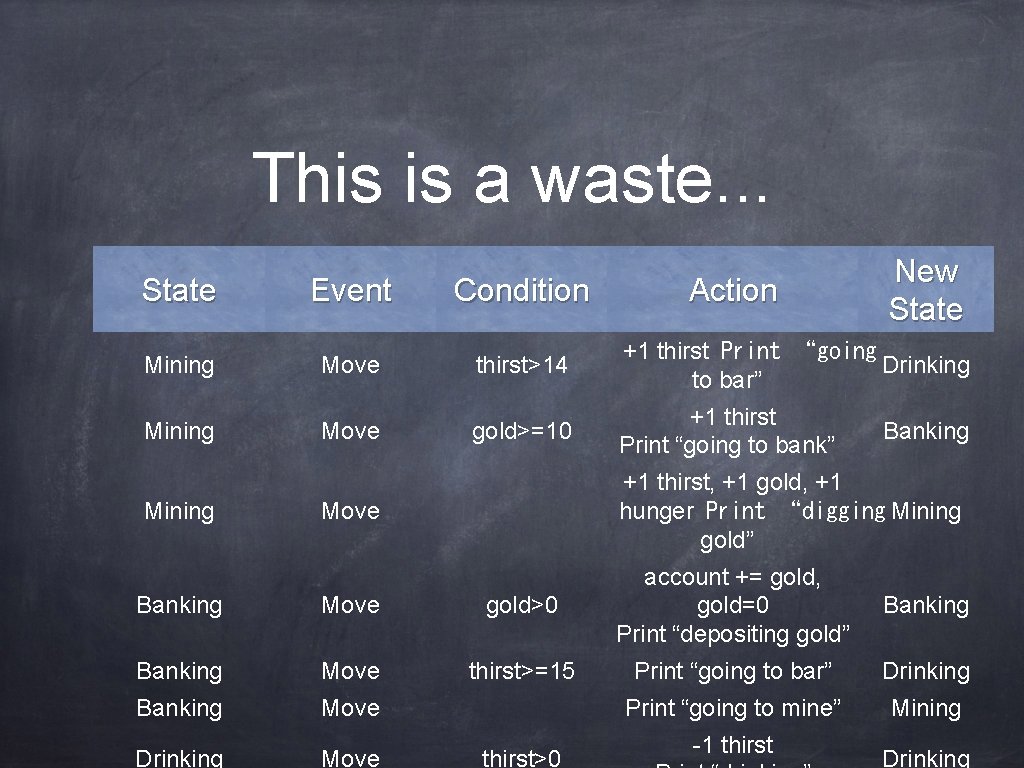
This is a waste. . . State Event Condition Action New State Mining Move thirst>14 +1 thirst Print “going Drinking to bar” Mining Move gold>=10 +1 thirst Print “going to bank” Banking Move +1 thirst, +1 gold, +1 hunger Print “digging Mining gold” Banking Move gold>0 account += gold, gold=0 Print “depositing gold” Banking Move thirst>=15 Print “going to bar” Drinking Banking Move Print “going to mine” Mining Drinking Move Mining thirst>0 -1 thirst Drinking
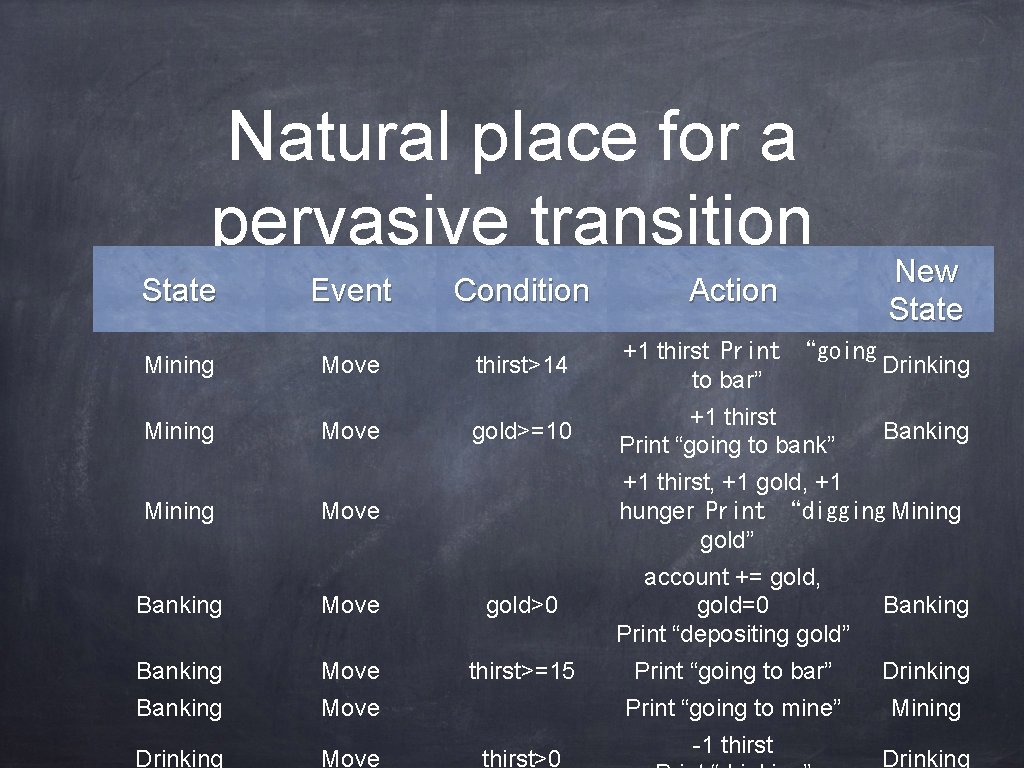
Natural place for a pervasive transition State Event Condition Action New State Mining Move thirst>14 +1 thirst Print “going Drinking to bar” Mining Move gold>=10 +1 thirst Print “going to bank” Banking Move +1 thirst, +1 gold, +1 hunger Print “digging Mining gold” Banking Move gold>0 account += gold, gold=0 Print “depositing gold” Banking Move thirst>=15 Print “going to bar” Drinking Banking Move Print “going to mine” Mining Drinking Move Mining thirst>0 -1 thirst Drinking
How do we send the Dinner. Bell event?
How do we send the Dinner. Bell event? Miner’s Wife holds reference to Miner call Miner. do. Event() private communication
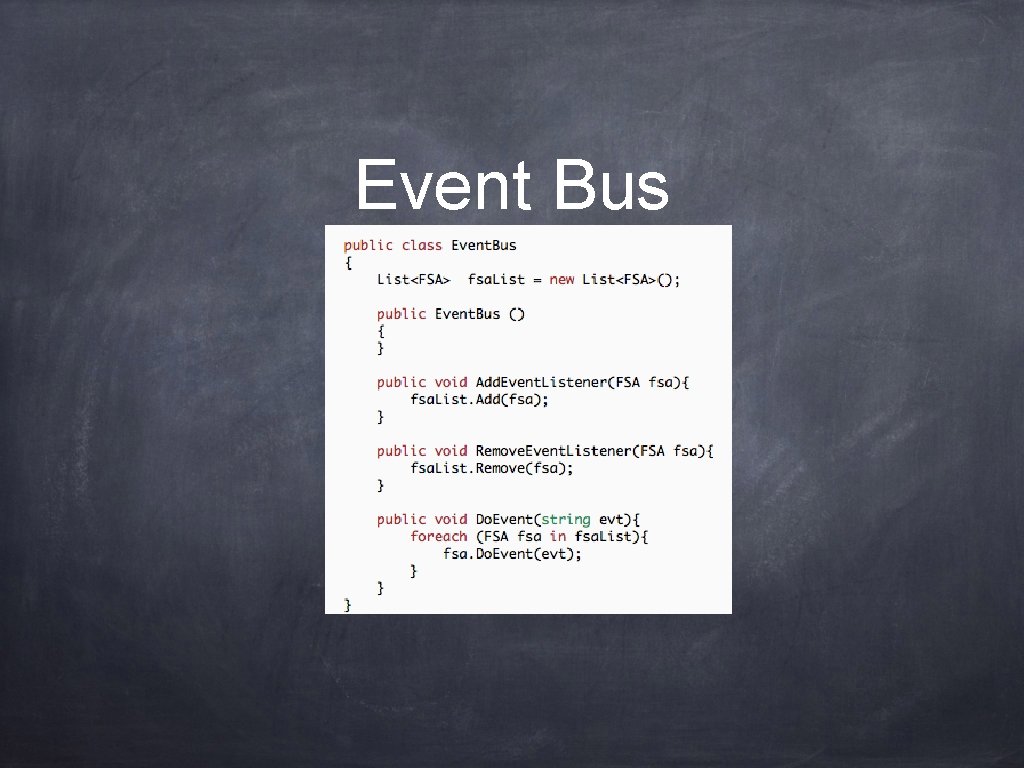
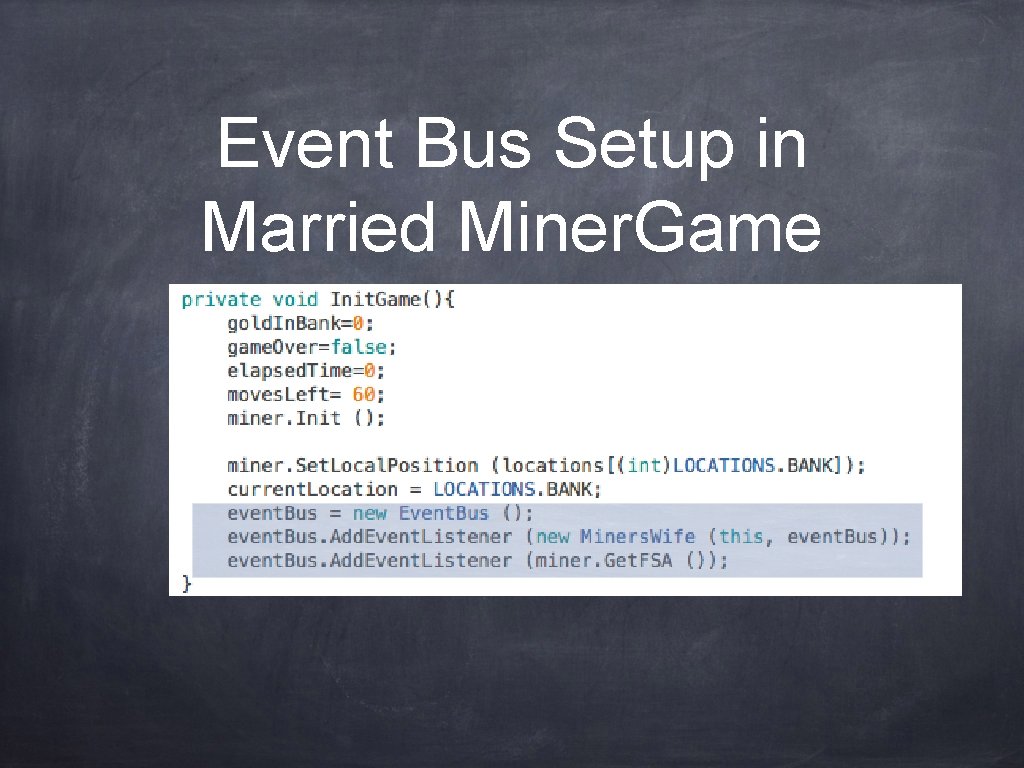
How do we send the event? Event Bus holds references to all FSA Miner’s Wife calls Event. Bus. send. Event() Bus calls all registered listeners Broadcast communication Can also be used for tick
Lets look at some code
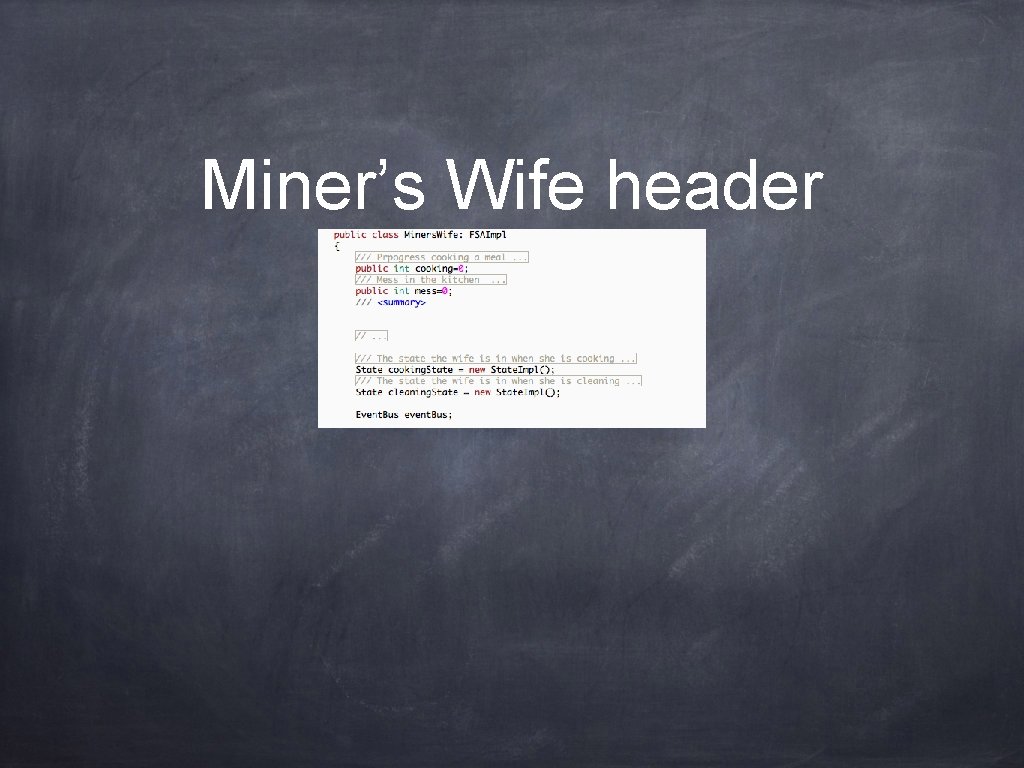
Miner’s Wife header
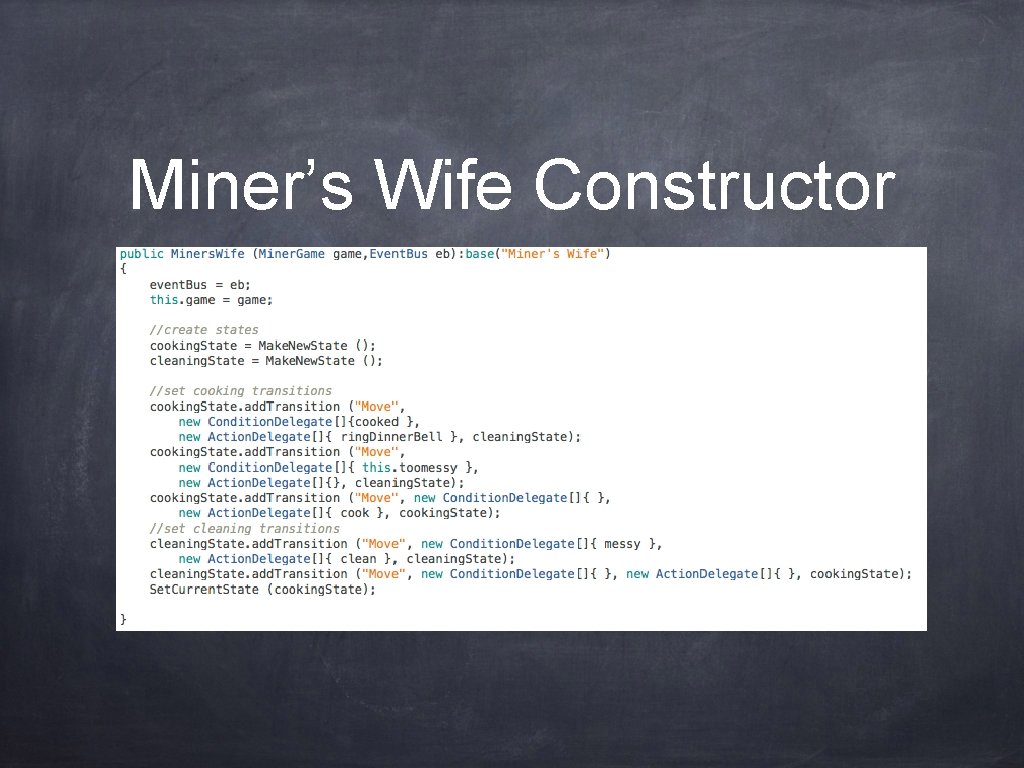
Miner’s Wife Constructor
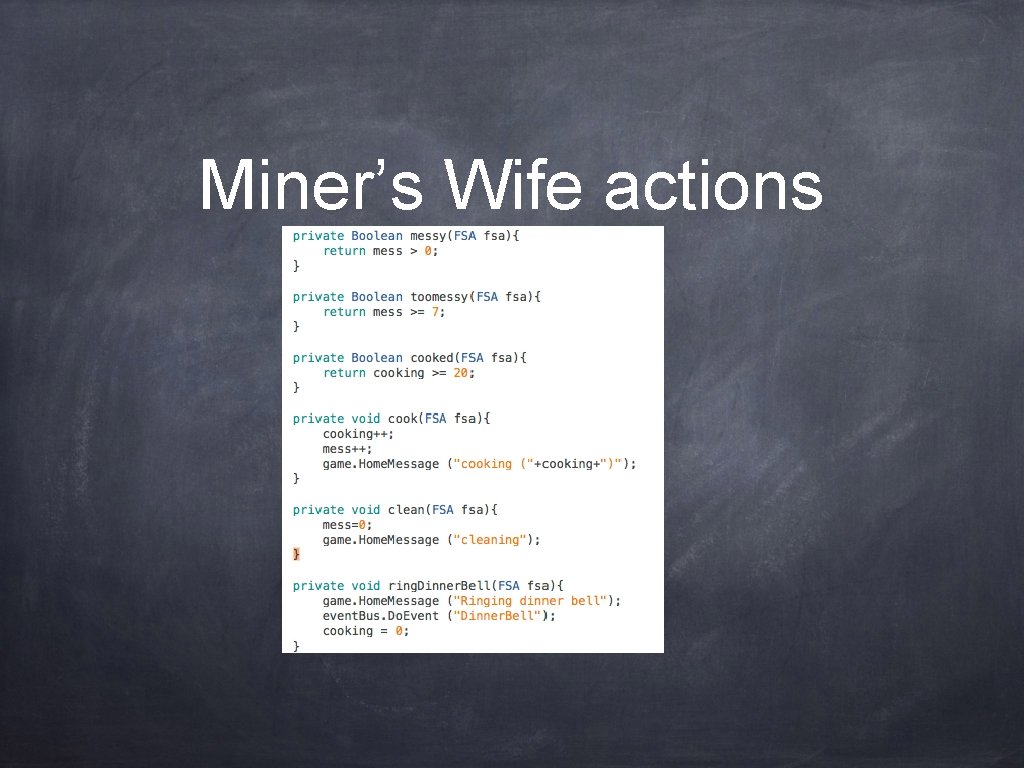
Miner’s Wife actions
Event Bus
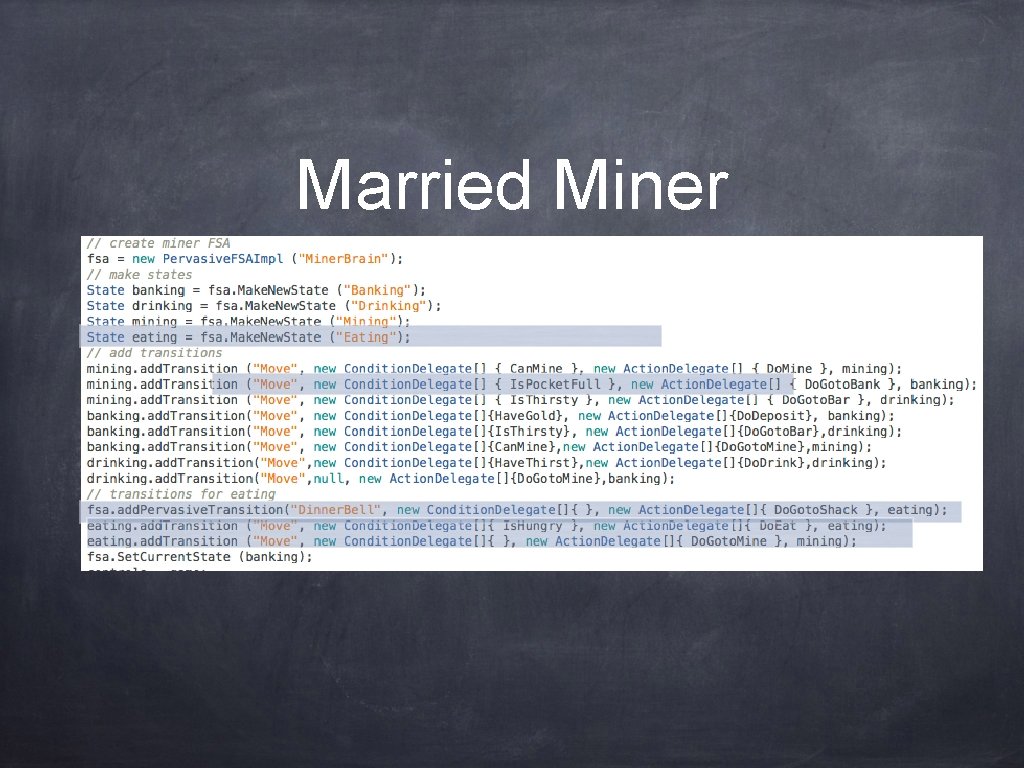
Married Miner
Event Bus Setup in Married Miner. Game
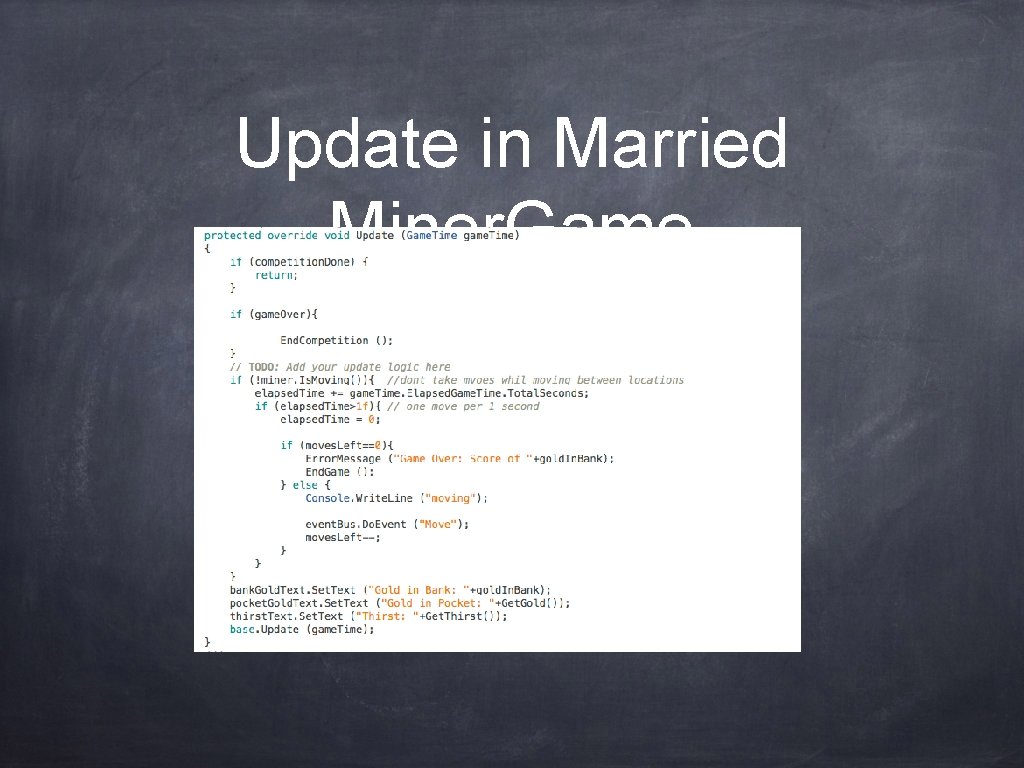
Update in Married Miner. Game
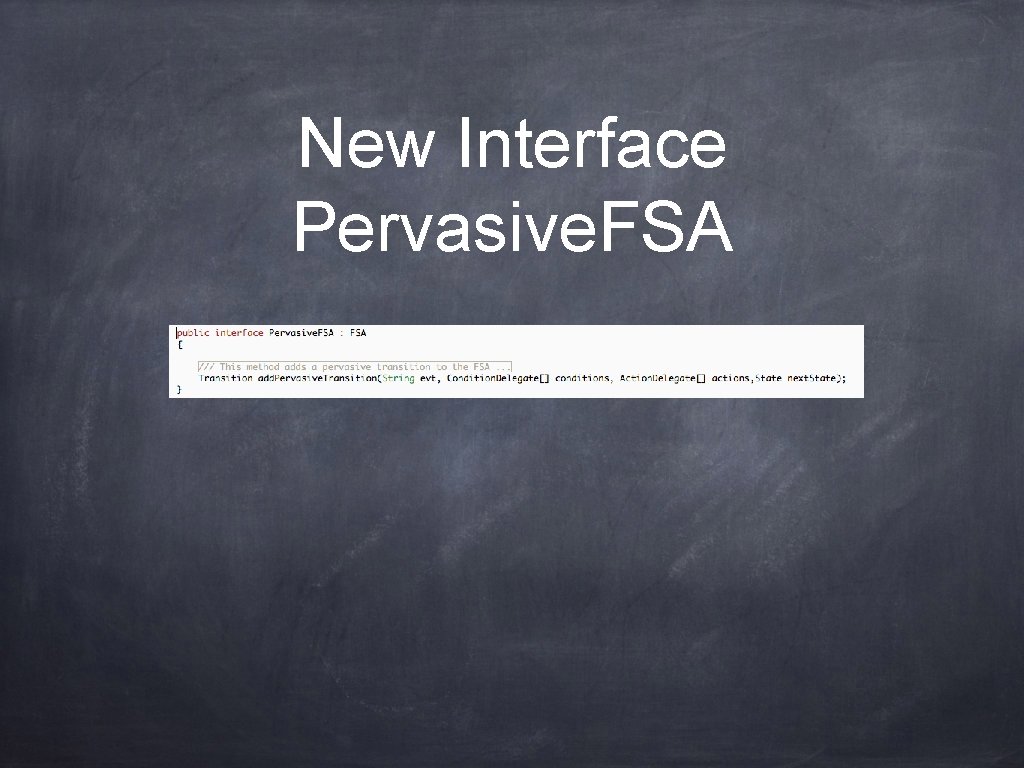
New Interface Pervasive. FSA
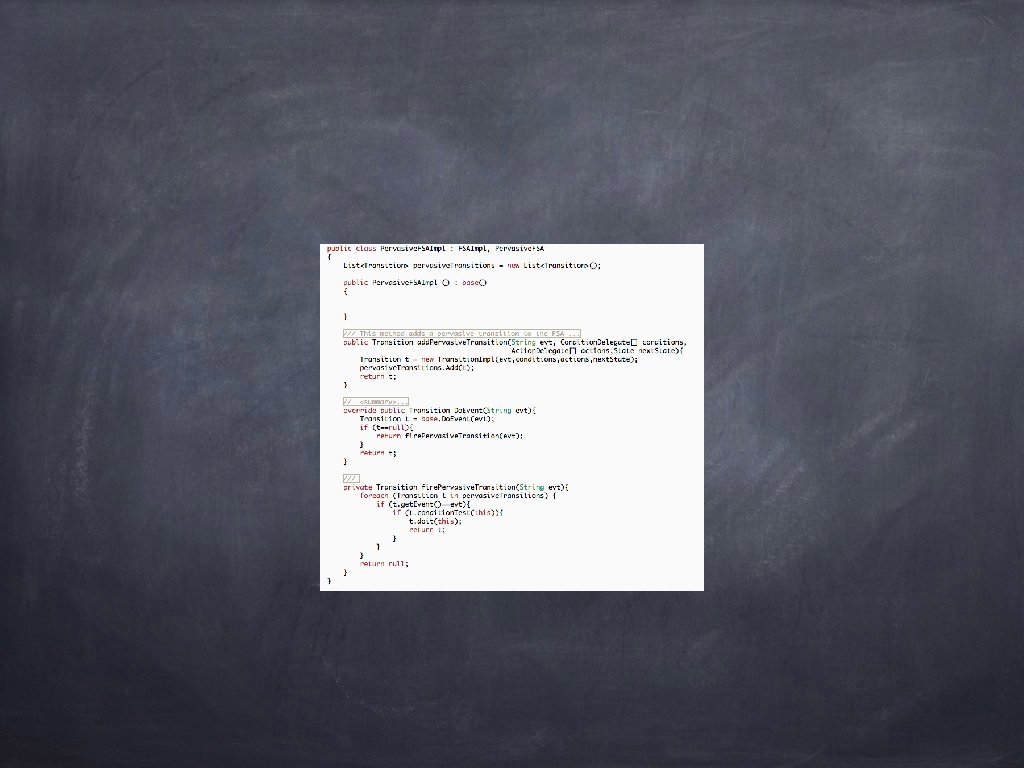
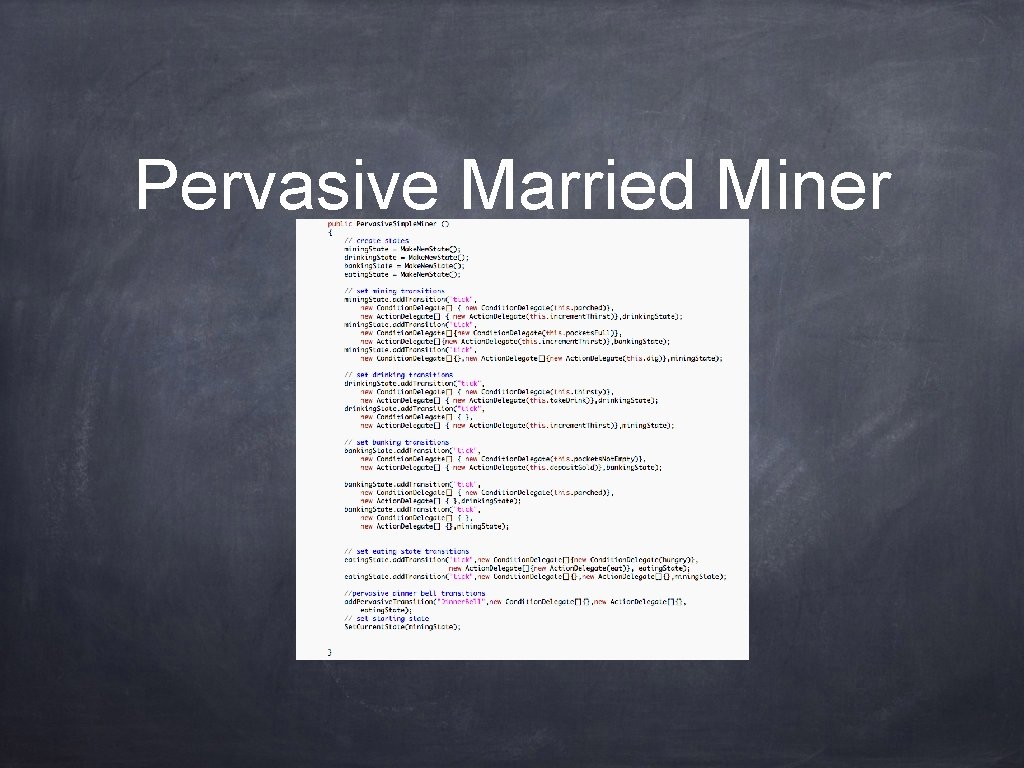
Pervasive Married Miner
Hirearchical State Machines In the real-world, state machines are often stacked A parent state machine can have, as its states, a set of state machines. When a parent state machine is sent an event, which ever child machine is the parent’s “current state” gets the event. If an event is not handled by the child state machine, it is “percolated” or “bubbled” up to the parent. Allows for more control and state re-use
Why Hierarchical FSA?
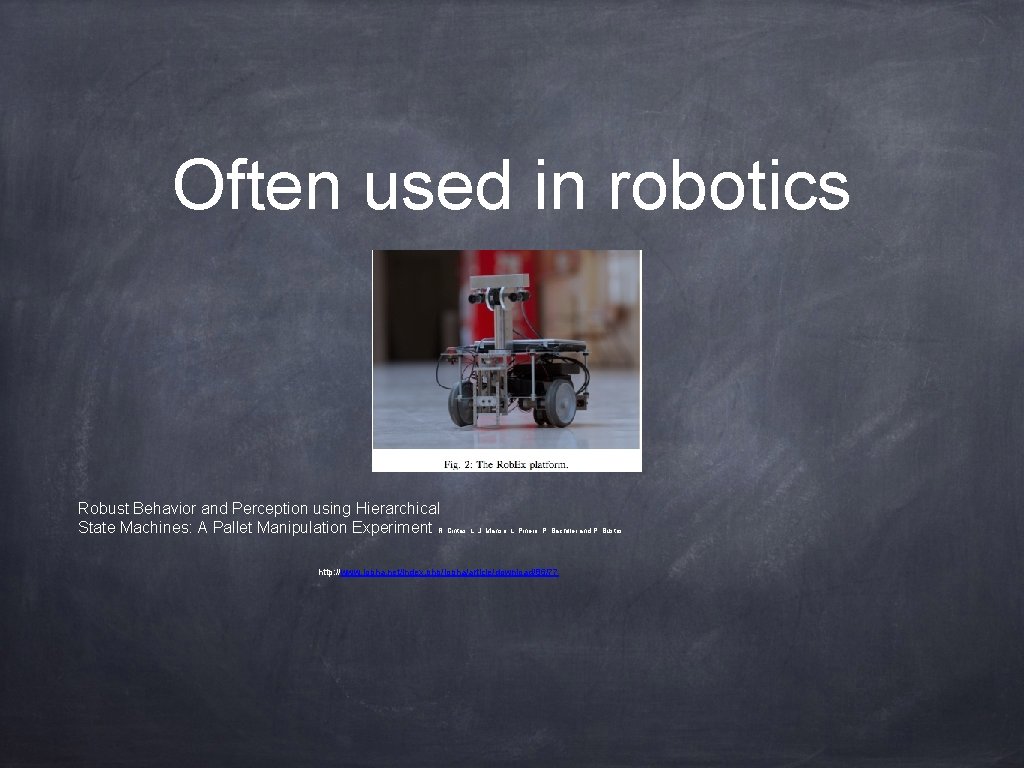
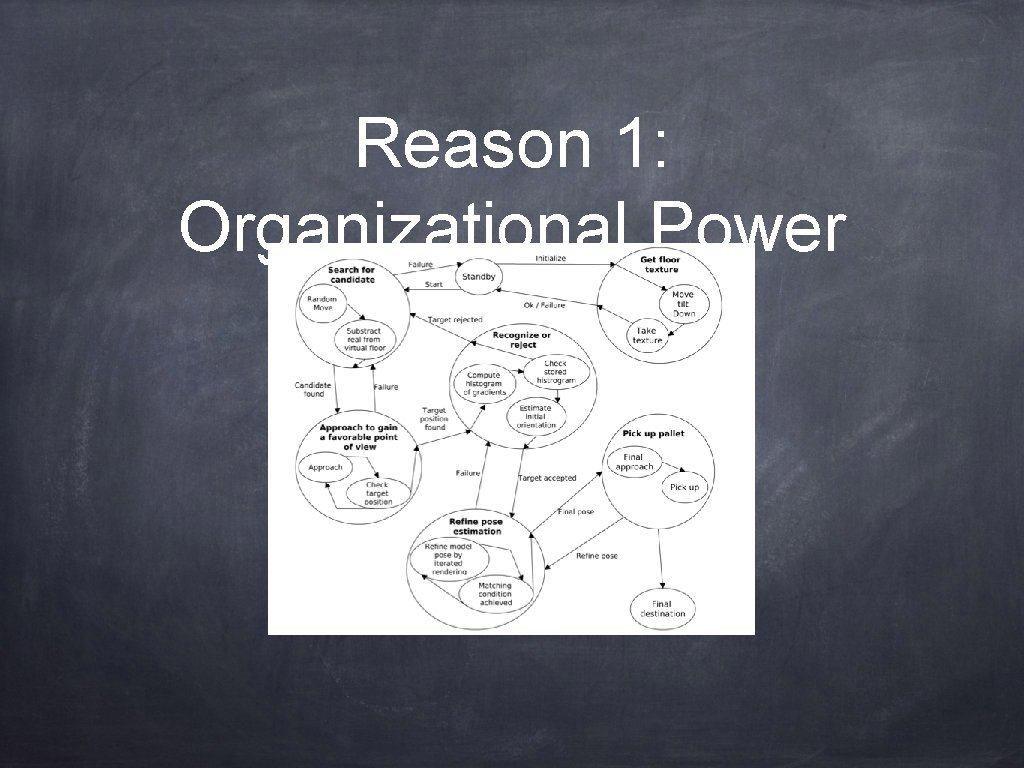
Often used in robotics Robust Behavior and Perception using Hierarchical State Machines: A Pallet Manipulation Experiment R. Cintas, L. J. Manso, L. Pinero, P. Bachiller and P. Bustos http: //www. jopha. net/index. php/jopha/article/download/86/77
Reason 1: Organizational Power
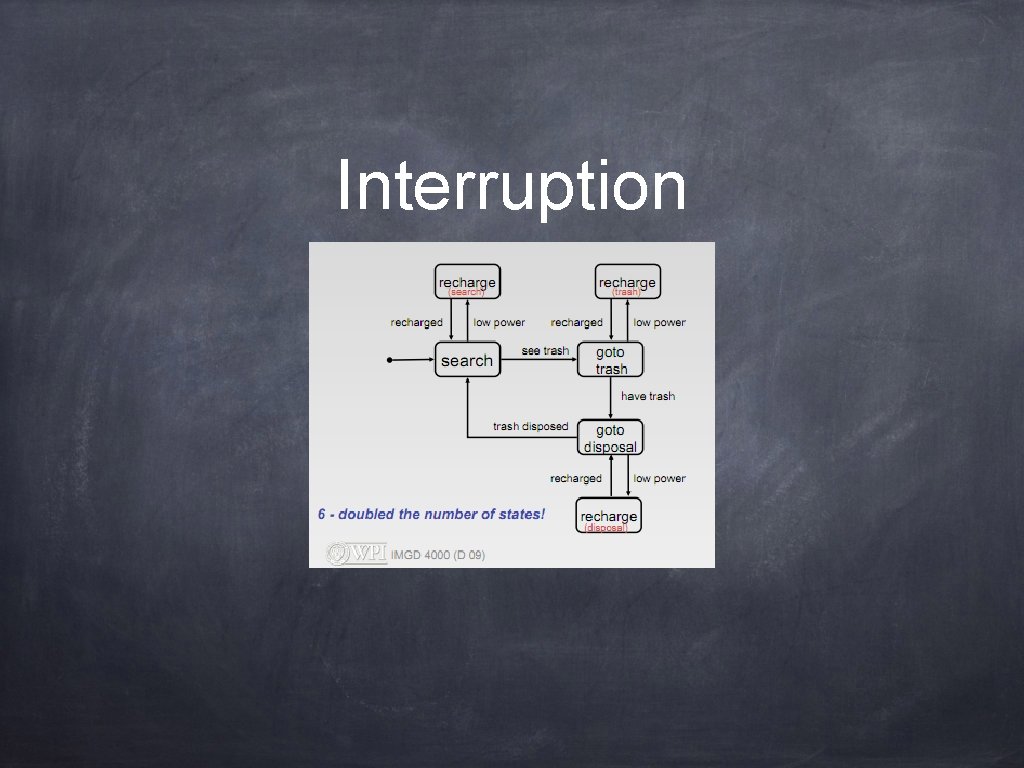
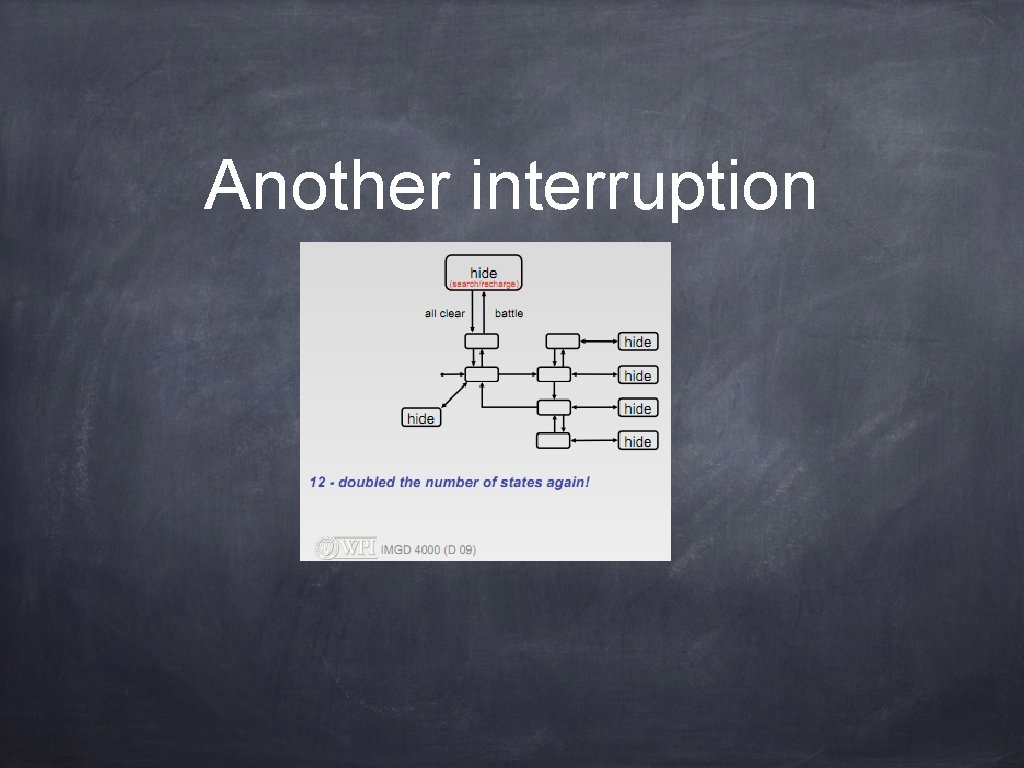
Reason 2: State Proliferation An adjunct to PFSA Each FSA remembers its current state independently
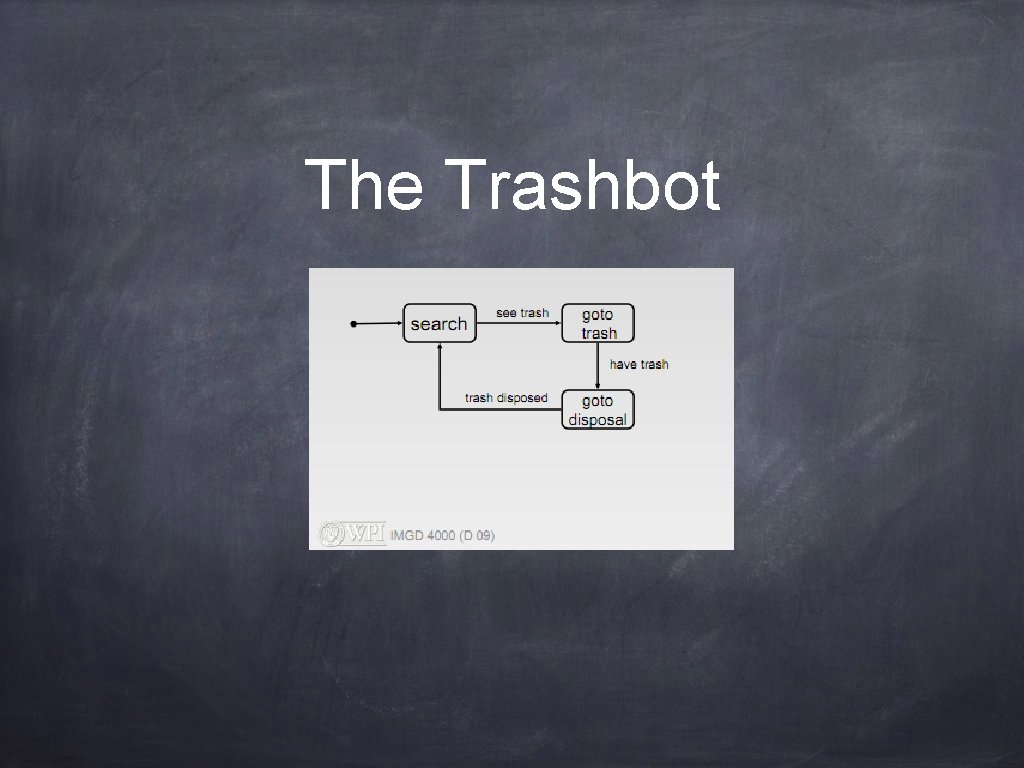
The Trashbot
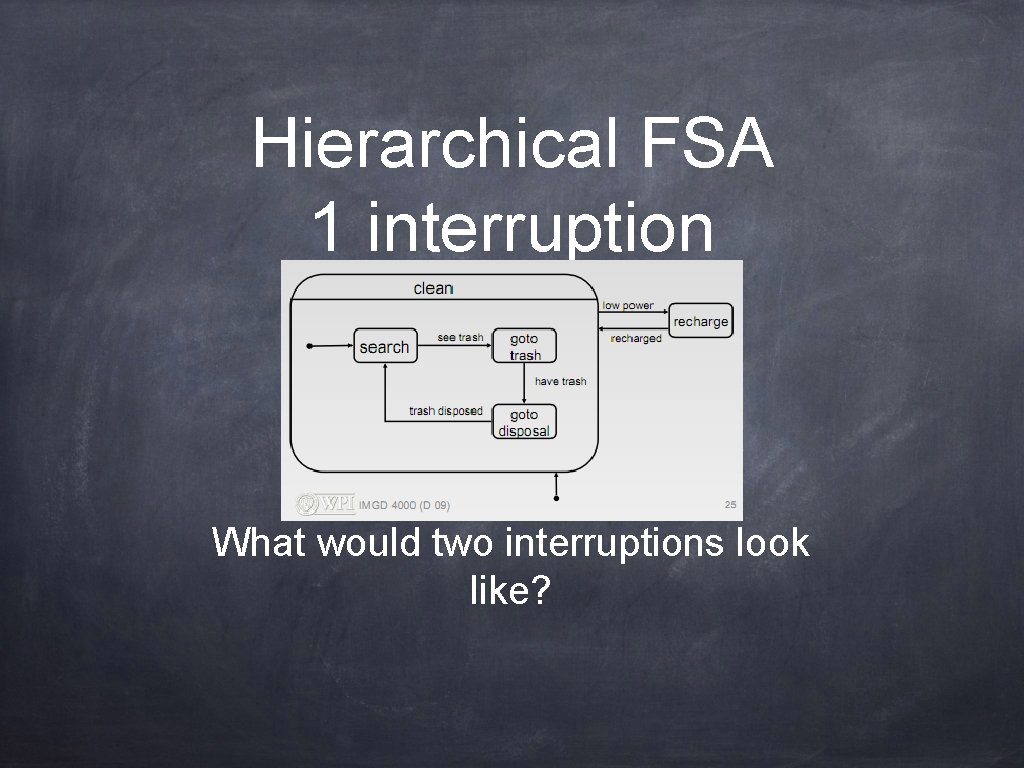
Interruption
Another interruption
Hierarchical FSA 1 interruption What would two interruptions look like?
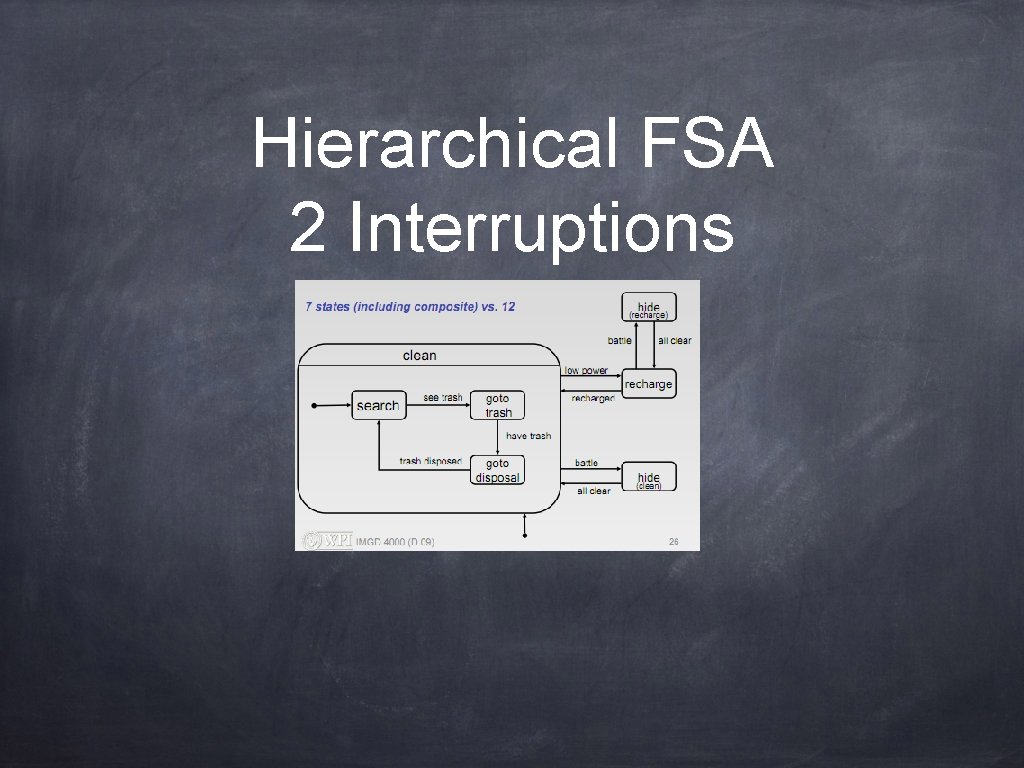
Hierarchical FSA 2 Interruptions
Lets build a Hierarchical Stationary FSA Guard Standing Guard Goes to Investigating state if he hears a noise Goes to Alarmed state if the alarm is triggered Investigating Triggers alarm Goes to Alarmed state Goes to triggered alarm Walks in direction of noise for distance D Goes to closest noise Returns to previous state if he sees nothing Attacks Goes to Alarm state if he sees anything if opponent defeated, go to next closest noise and attack Goes to Alarmed state if the alarm is triggered if no noise, go to standing guard Alarm state Goes to closest check point
Reason 3: State Reuse
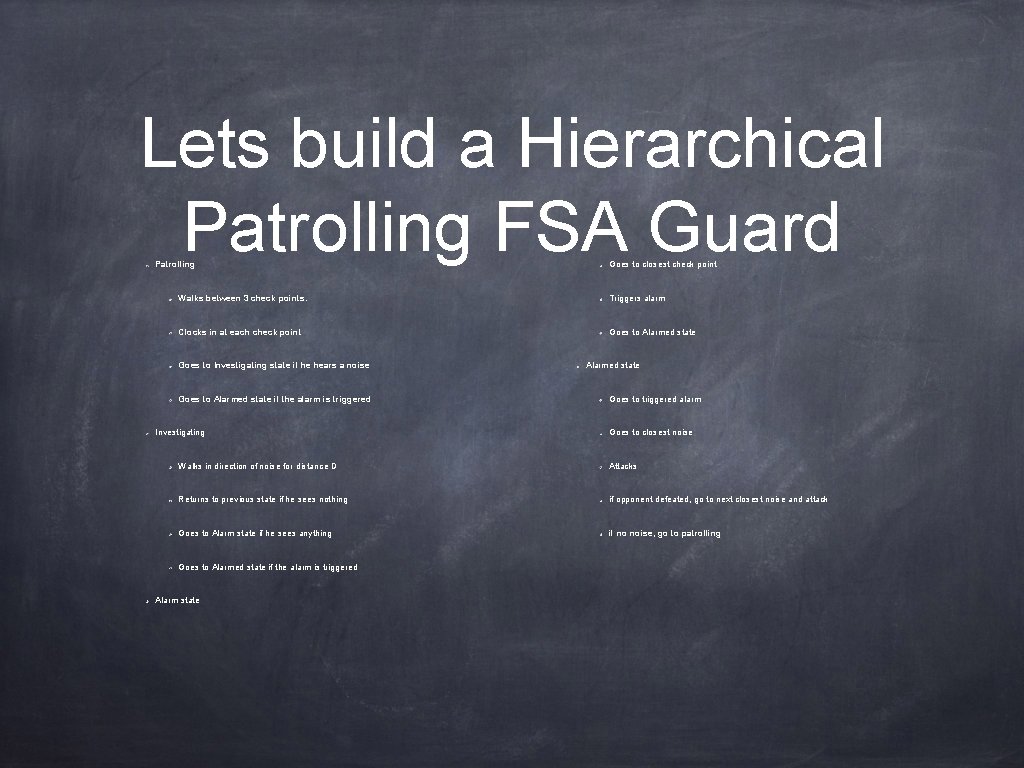
Lets build a Hierarchical Patrolling FSA Guard Patrolling Goes to closest check point Walks between 3 check points. Triggers alarm Clocks in at each check point Goes to Alarmed state Goes to Investigating state if he hears a noise Goes to Alarmed state if the alarm is triggered Investigating Alarmed state Goes to triggered alarm Goes to closest noise Walks in direction of noise for distance D Attacks Returns to previous state if he sees nothing if opponent defeated, go to next closest noise and attack Goes to Alarm state if he sees anything if no noise, go to patrolling Goes to Alarmed state if the alarm is triggered Alarm state
How could we improve state reuse?
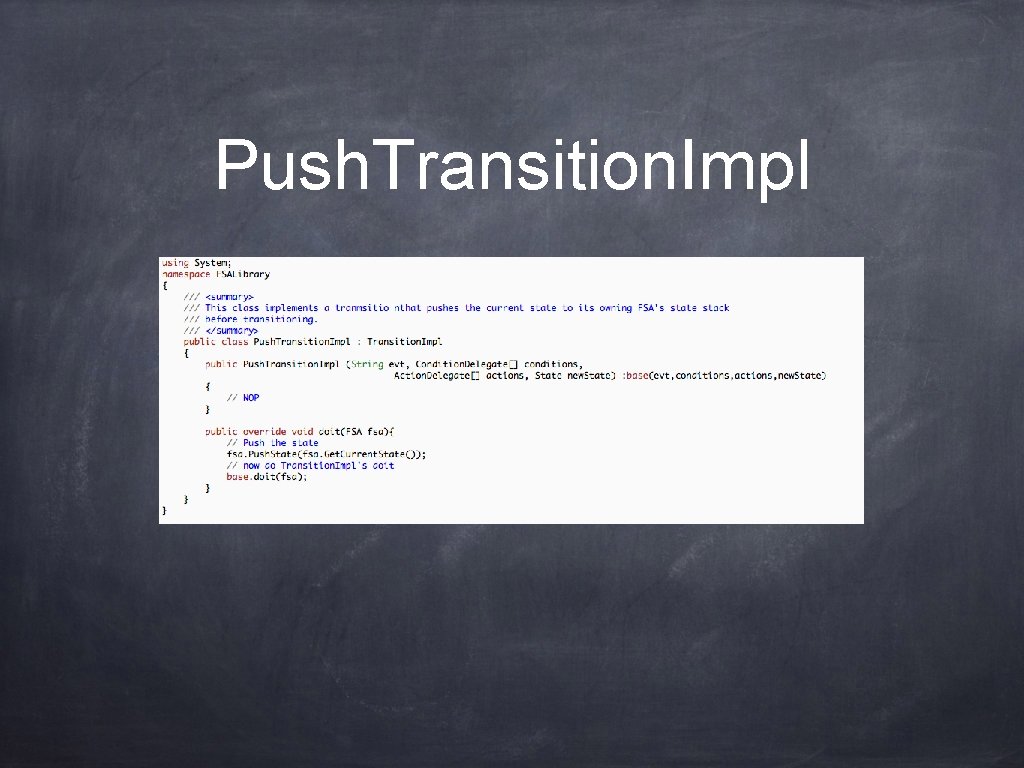
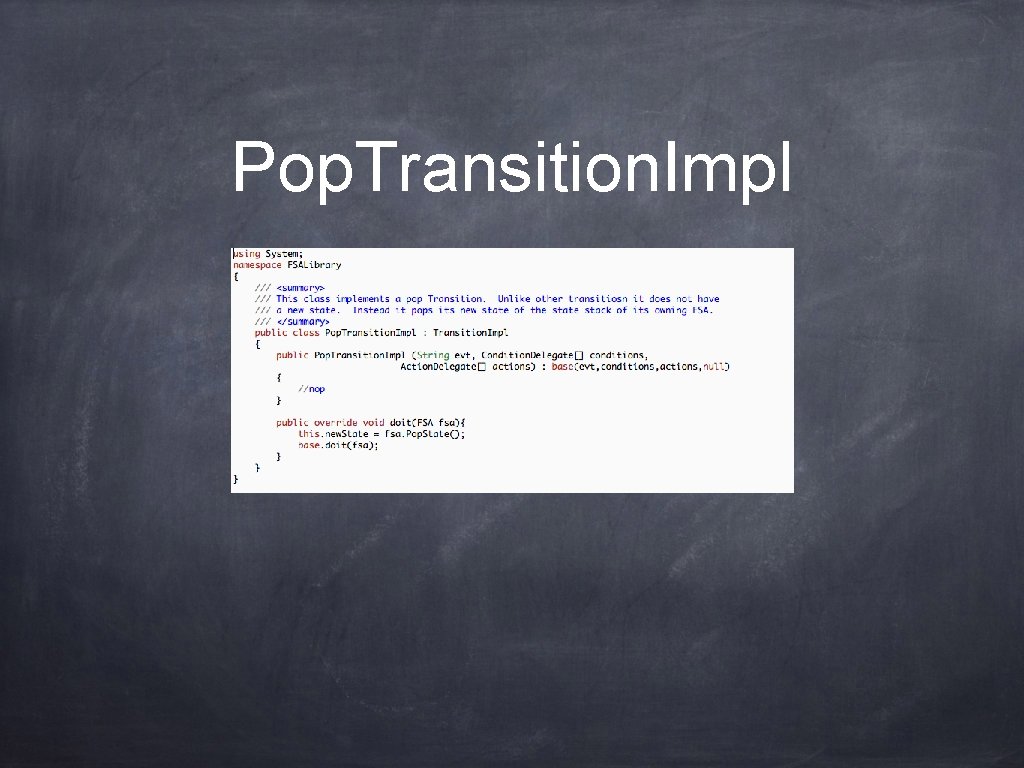
Adding Push/Pop to the FSA Two new kinds of Transitions Push. Transition. Impl Pop. Transition. Impl
Push. Transition. Impl
Pop. Transition. Impl
New State methods to make Push and Pop transitions
New State. Impl. cs
New FSA Methods
New FSAImpl. cs
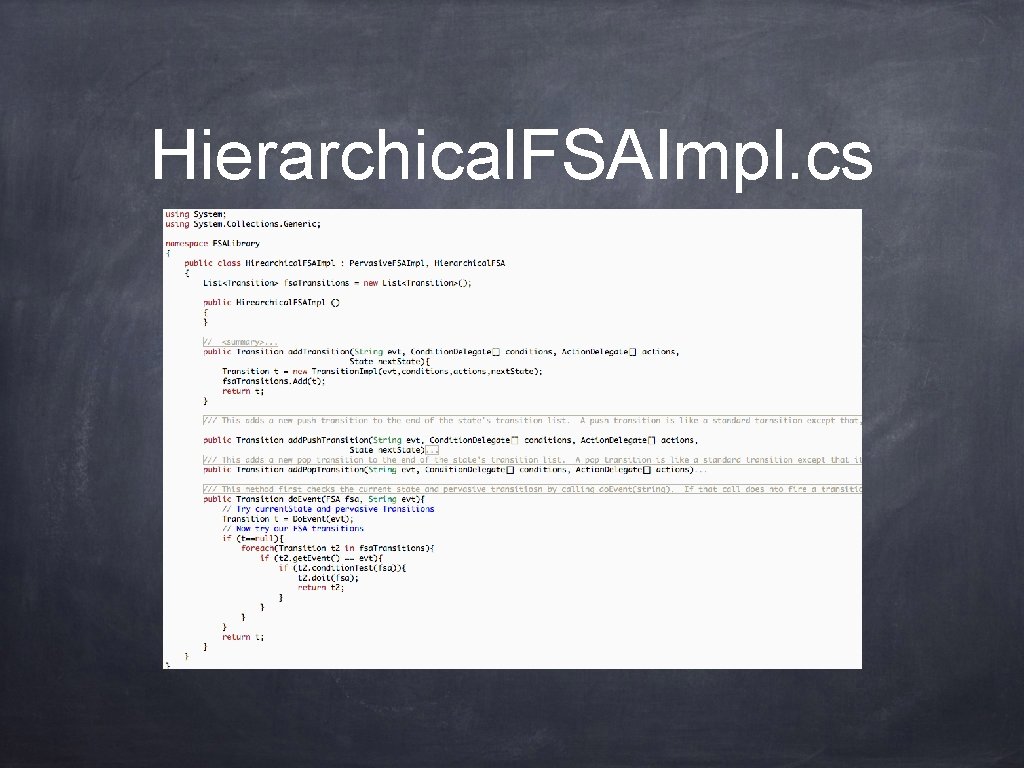
Hierarchical FSA Implementation What makes a Hierarchical. FSA different from our existing Pervasive. FSA?
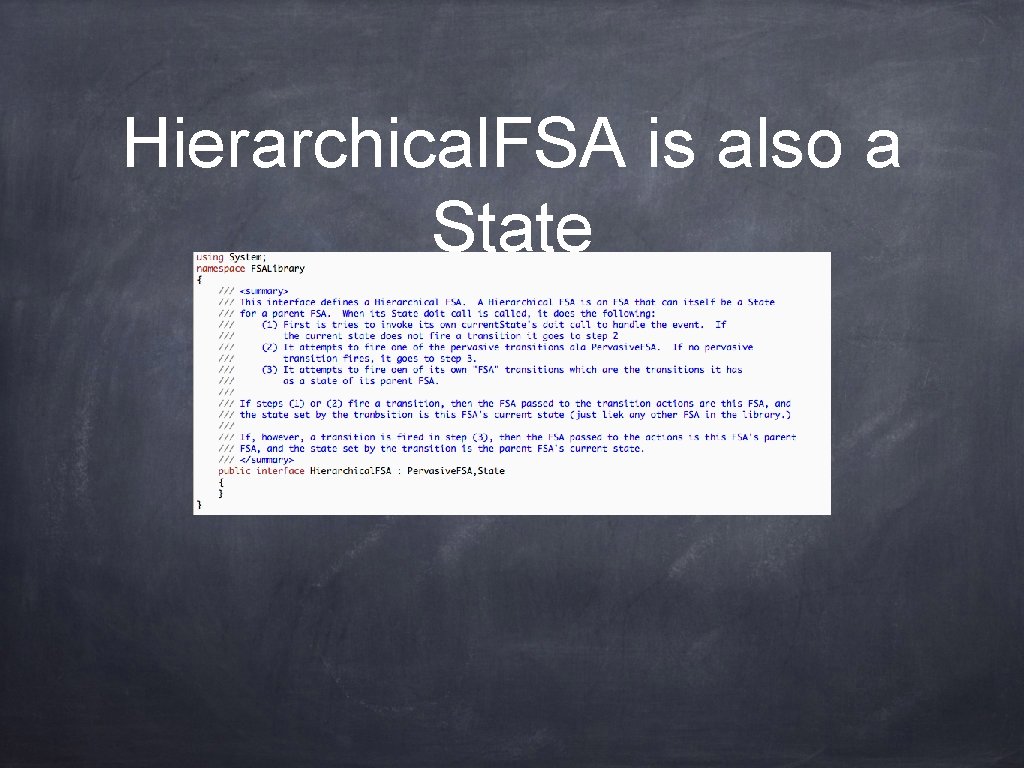
Hierarchical. FSA is also a State
Hierarchical. FSAImpl. cs
Implementation of Sneeker 32