
Finite State Automata are Limited Let us use
- Slides: 26
Finite State Automata are Limited Let us use (context-free) grammars!
Context Free Grammar for anbn S : : = - a grammar rule S : : = a S b - another grammar rule Example of a derivation S => a. Sb => a a. Sb b => aa a. Sb bb => aaabbb Parse tree: leaves give us the result
Context-Free Grammars G = (A, N, S, R) • A - terminals (alphabet for generated words w A*) • N - non-terminals – symbols with (recursive) definitions • Grammar rules in R are pairs (n, v), written n : : = v where n N is a non-terminal v (A U N)* - sequence of terminals and nonterminals A derivation in G starts from the starting symbol S • Each step replaces a non-terminal with one of its right hand sides
Parse Tree Given a grammar G = (A, N, S, R ), t is a parse tree of G iff t is a node-labelled tree with ordered children that satisfies: • root is labeled by S • leaves are labelled by elements of A • each non-leaf node is labelled by an element of N • for each non-leaf node labelled by n whose children left to right are labelled by p 1…p n, we have a rule (n: : = p 1…p n) R Yield of a parse tree t is the unique word in A* obtained by reading the leaves of t from left to right Language of a grammar G = words of all yields of parse trees of G L(G) = {yield(t) | is. Parse. Tree(G, t)} is. Parse. Tree - easy to check condition Harder: know if a word has a parse tree
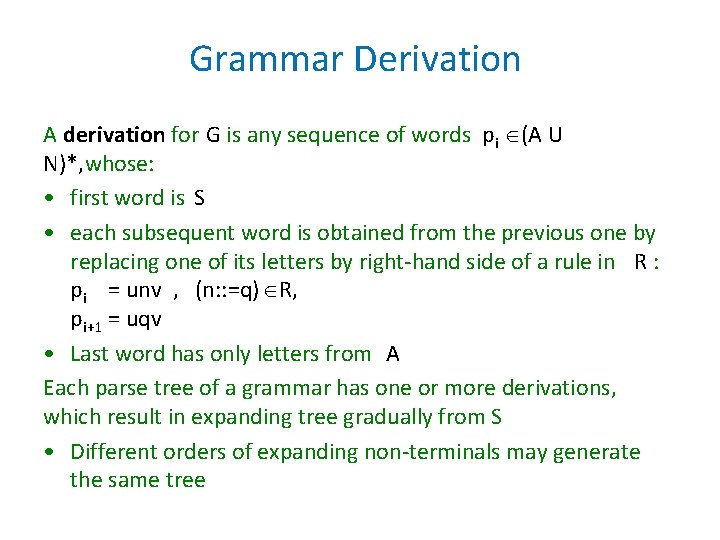
Grammar Derivation A derivation for G is any sequence of words pi (A U N)*, whose: • first word is S • each subsequent word is obtained from the previous one by replacing one of its letters by right-hand side of a rule in R : pi = unv , (n: : =q) R, pi+1 = uqv • Last word has only letters from A Each parse tree of a grammar has one or more derivations, which result in expanding tree gradually from S • Different orders of expanding non-terminals may generate the same tree
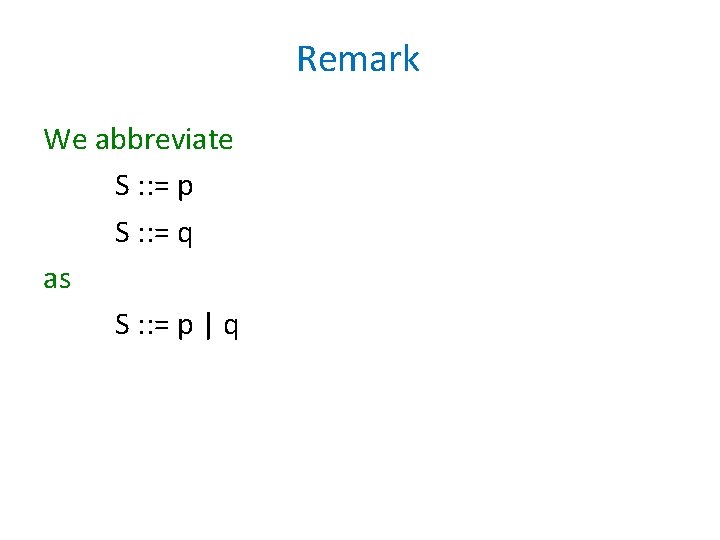
Remark We abbreviate S : : = p S : : = q as S : : = p | q
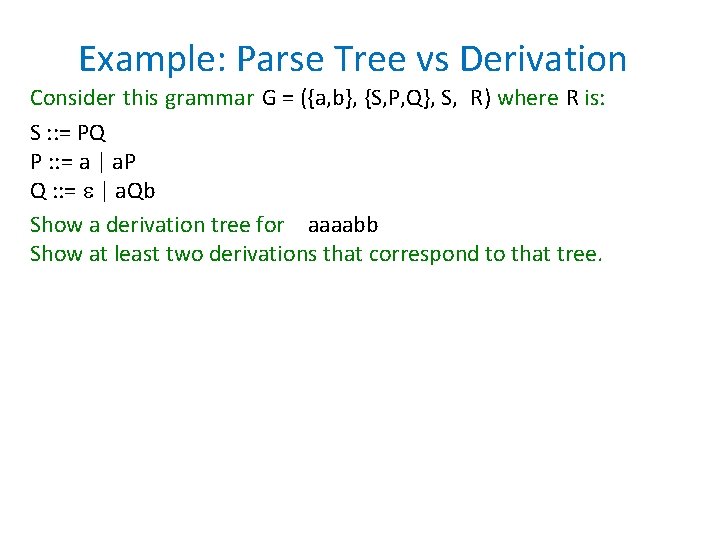
Example: Parse Tree vs Derivation Consider this grammar G = ({a, b}, {S, P, Q}, S, R) where R is: S : : = PQ P : : = a | a. P Q : : = | a. Qb Show a derivation tree for aaaabb Show at least two derivations that correspond to that tree.
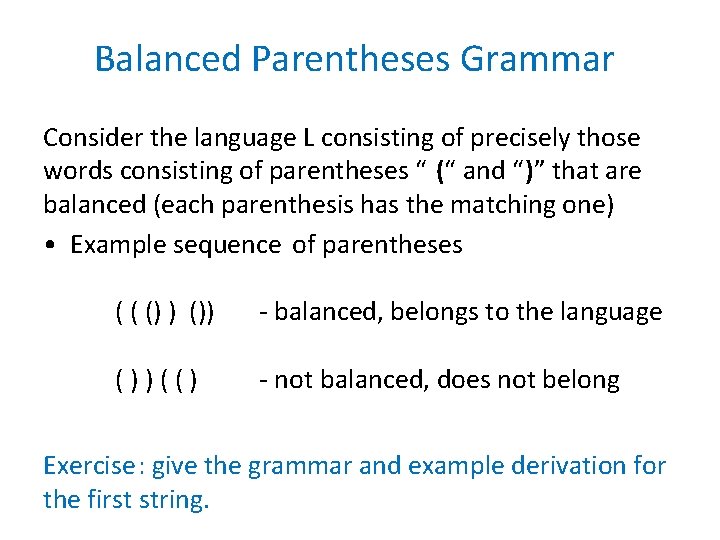
Balanced Parentheses Grammar Consider the language L consisting of precisely those words consisting of parentheses “ (“ and “)” that are balanced (each parenthesis has the matching one) • Example sequence of parentheses ( ( () ) ()) - balanced, belongs to the language ())(() - not balanced, does not belong Exercise: give the grammar and example derivation for the first string.
Balanced Parentheses Grammar
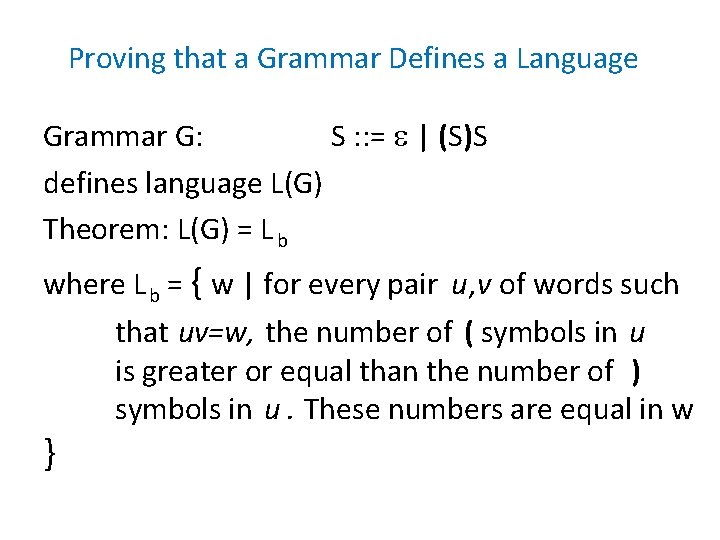
Proving that a Grammar Defines a Language Grammar G: S : : = | (S)S defines language L(G) Theorem: L(G) = L b where L b = { w | for every pair u, v of words such } that uv=w, the number of ( symbols in u is greater or equal than the number of ) symbols in u. These numbers are equal in w
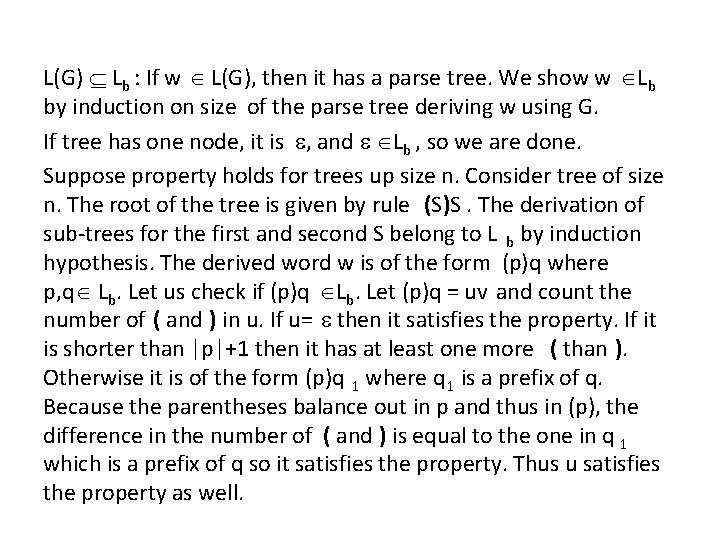
L(G) Lb : If w L(G), then it has a parse tree. We show w Lb by induction on size of the parse tree deriving w using G. If tree has one node, it is , and Lb , so we are done. Suppose property holds for trees up size n. Consider tree of size n. The root of the tree is given by rule (S)S. The derivation of sub-trees for the first and second S belong to L b by induction hypothesis. The derived word w is of the form (p)q where p, q Lb. Let us check if (p)q Lb. Let (p)q = uv and count the number of ( and ) in u. If u= then it satisfies the property. If it is shorter than |p|+1 then it has at least one more ( than ). Otherwise it is of the form (p)q 1 where q 1 is a prefix of q. Because the parentheses balance out in p and thus in (p), the difference in the number of ( and ) is equal to the one in q 1 which is a prefix of q so it satisfies the property. Thus u satisfies the property as well.
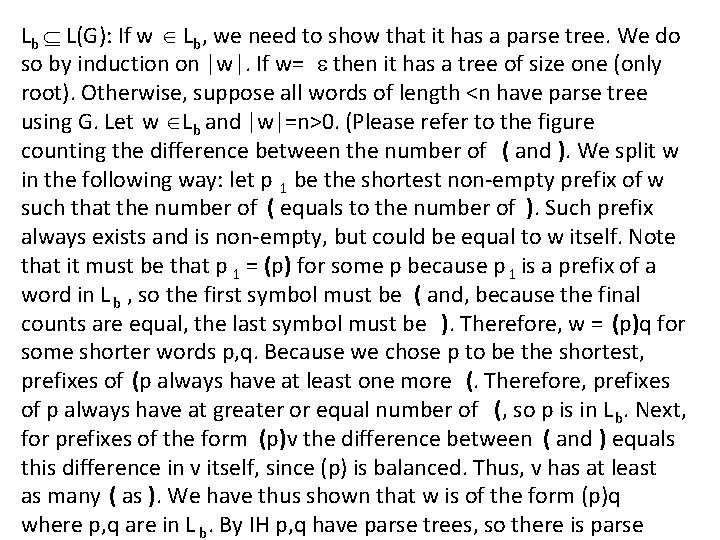
Lb L(G): If w Lb, we need to show that it has a parse tree. We do so by induction on |w|. If w= then it has a tree of size one (only root). Otherwise, suppose all words of length <n have parse tree using G. Let w Lb and |w|=n>0. (Please refer to the figure counting the difference between the number of ( and ). We split w in the following way: let p 1 be the shortest non-empty prefix of w such that the number of ( equals to the number of ). Such prefix always exists and is non-empty, but could be equal to w itself. Note that it must be that p 1 = (p) for some p because p 1 is a prefix of a word in L b , so the first symbol must be ( and, because the final counts are equal, the last symbol must be ). Therefore, w = (p)q for some shorter words p, q. Because we chose p to be the shortest, prefixes of (p always have at least one more (. Therefore, prefixes of p always have at greater or equal number of (, so p is in L b. Next, for prefixes of the form (p)v the difference between ( and ) equals this difference in v itself, since (p) is balanced. Thus, v has at least as many ( as ). We have thus shown that w is of the form (p)q where p, q are in L b. By IH p, q have parse trees, so there is parse
Exercise: Grammar Equivalence Show that each string that can be derived by grammar G 1 B : : = | ( B ) | B B can also be derived by grammar G 2 B : : = | ( B ) B and vice versa. In other words, L(G 1) = L(G 2) Remark: there is no algorithm to check for equivalence of arbitrary grammars. We must be clever.
Grammar Equivalence G 1: B : : = | ( B ) | B B G 2: B : : = | ( B ) B (Easy) Lemma: Each word in alphabet A={(, )} that can be derived by G 2 can also be derived by G 1. Proof. Consider a derivation of a word w from G 2. We construct a derivation of w in G 1 by showing one or more steps that produce the same effect. We have several cases depending on steps in G 2 derivation: u. Bv => uv replace by (same) u. Bv => uv u. Bv => u(B)Bv replace by u. Bv => u. BBv => u(B)Bv This constructs a valid derivation in G 1. Corollary: L(G 2) L(G 1) Lemma: L(G 1) Lb (words derived by G 1 are balanced parentheses). Proof: very similar to proof of L(G 2) Lb from before. Lemma: L b L(G 2) – this was one direction of proof that Lb = L(G 2) before. Corollary: L(G 2) = L(G 1) = L(Lb)
Regular Languages and Grammars Exercise: give grammar describing the same language as this regular expression: (a|b) (ab)*b*
Translating Regular Expression into a Grammar • Suppose we first allow regular expression operators * and | within grammars • Then R becomes simply S : : = R • Then give rules to remove *, | by introducing new non-terminal symbols
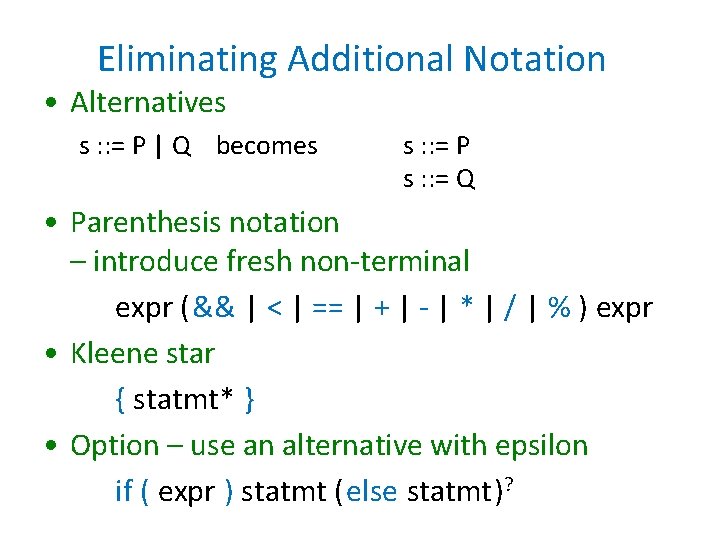
Eliminating Additional Notation • Alternatives s : : = P | Q becomes s : : = P s : : = Q • Parenthesis notation – introduce fresh non-terminal expr (&& | < | == | + | - | * | / | % ) expr • Kleene star { statmt* } • Option – use an alternative with epsilon if ( expr ) statmt (else statmt)?
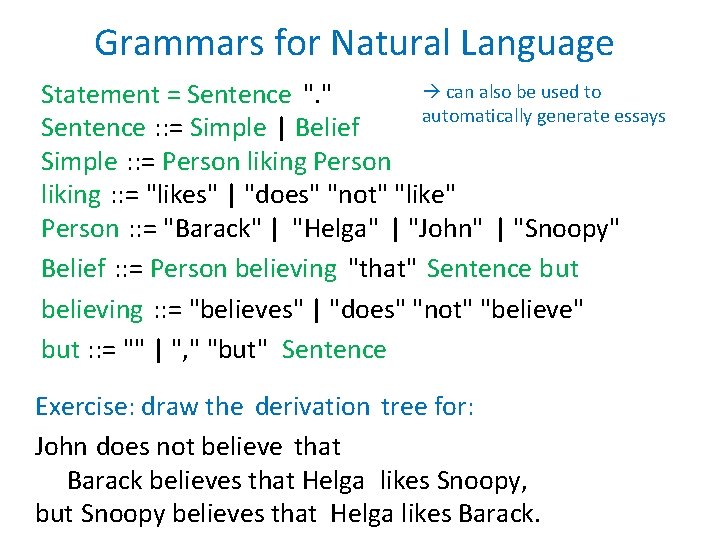
Grammars for Natural Language can also be used to Statement = Sentence ". " automatically generate essays Sentence : : = Simple | Belief Simple : : = Person liking : : = "likes" | "does" "not" "like" Person : : = "Barack" | "Helga" | "John" | "Snoopy" Belief : : = Person believing "that" Sentence but believing : : = "believes" | "does" "not" "believe" but : : = "" | ", " "but" Sentence Exercise: draw the derivation tree for: John does not believe that Barack believes that Helga likes Snoopy, but Snoopy believes that Helga likes Barack.
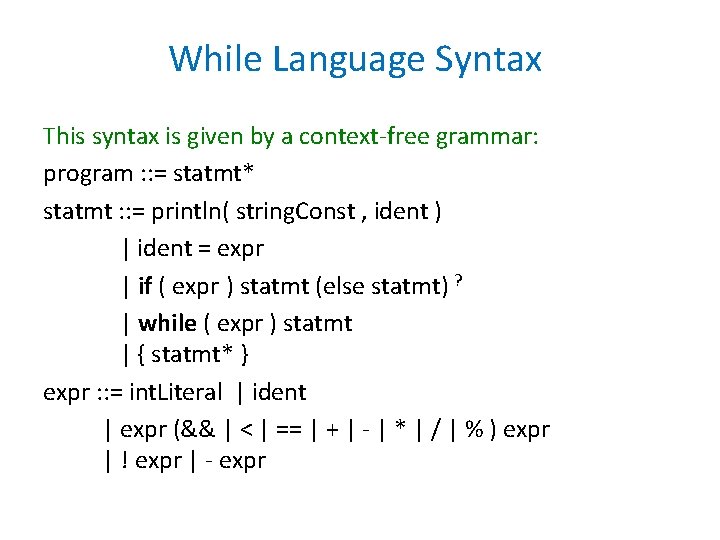
While Language Syntax This syntax is given by a context-free grammar: program : : = statmt* statmt : : = println( string. Const , ident ) | ident = expr | if ( expr ) statmt (else statmt) ? | while ( expr ) statmt | { statmt* } expr : : = int. Literal | ident | expr (&& | < | == | + | - | * | / | % ) expr | ! expr | - expr
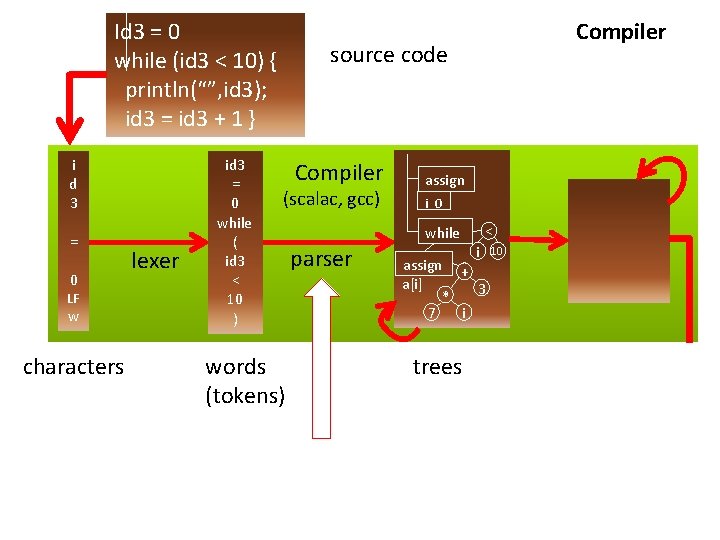
Id 3 = 0 while (id 3 < 10) { println(“”, id 3); id 3 = id 3 + 1 } i d 3 = 0 LF w characters lexer id 3 = 0 while ( id 3 < 10 ) Compiler source code Compiler (scalac, gcc) words (tokens) assign i 0 while parser < i assign + a[i] 3 * 7 i trees 10
Recursive Descent Parsing - Manually - weak, but useful parsing technique - to make it work, we might need to transform the grammar
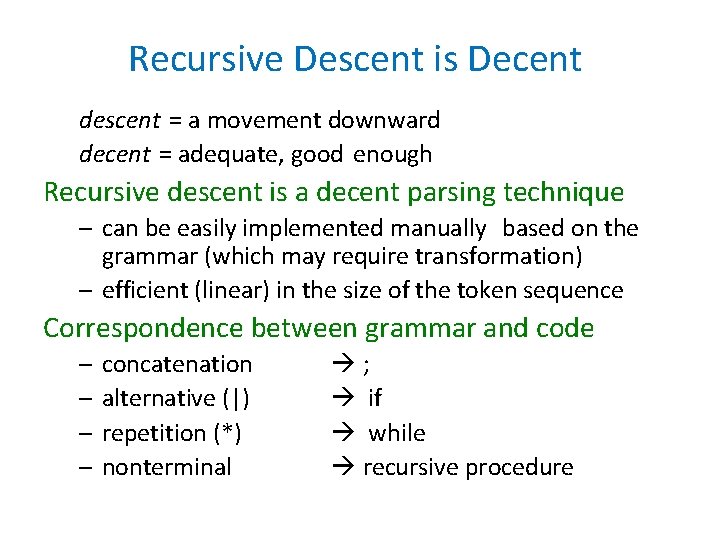
Recursive Descent is Decent descent = a movement downward decent = adequate, good enough Recursive descent is a decent parsing technique – can be easily implemented manually based on the grammar (which may require transformation) – efficient (linear) in the size of the token sequence Correspondence between grammar and code – – concatenation alternative (|) repetition (*) nonterminal ; if while recursive procedure
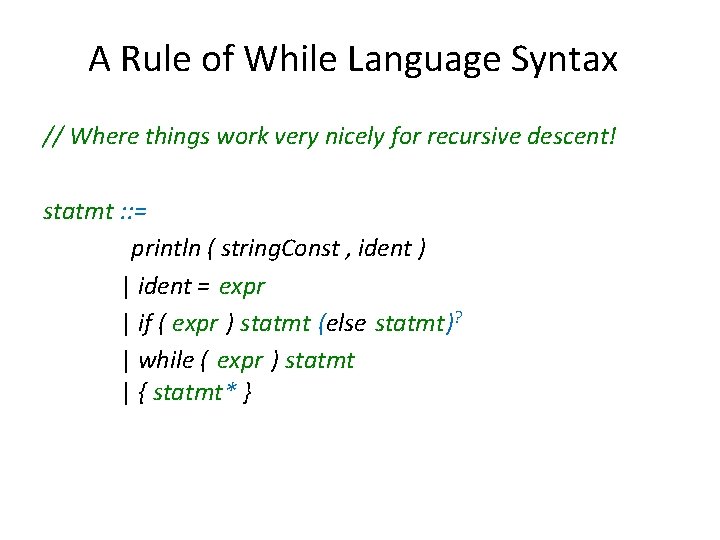
A Rule of While Language Syntax // Where things work very nicely for recursive descent! statmt : : = println ( string. Const , ident ) | ident = expr | if ( expr ) statmt (else statmt)? | while ( expr ) statmt | { statmt* }
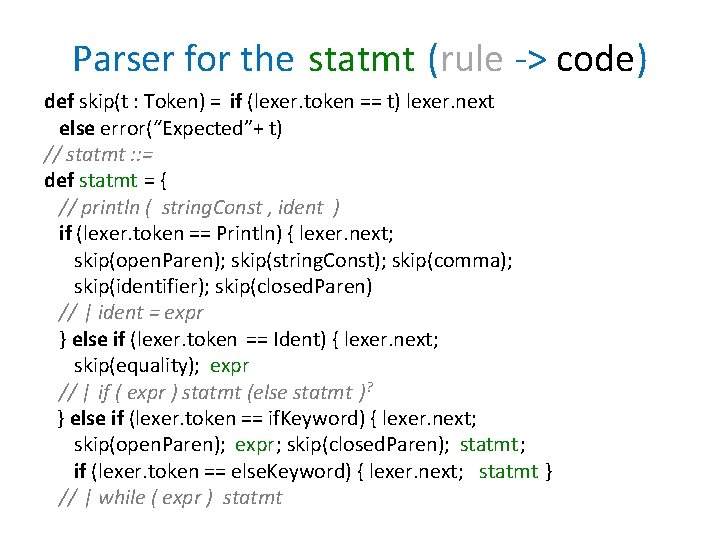
Parser for the statmt (rule -> code) def skip(t : Token) = if (lexer. token == t) lexer. next else error(“Expected”+ t) // statmt : : = def statmt = { // println ( string. Const , ident ) if (lexer. token == Println) { lexer. next; skip(open. Paren); skip(string. Const); skip(comma); skip(identifier); skip(closed. Paren) // | ident = expr } else if (lexer. token == Ident) { lexer. next; skip(equality); expr // | if ( expr ) statmt (else statmt )? } else if (lexer. token == if. Keyword) { lexer. next; skip(open. Paren); expr; skip(closed. Paren); statmt; if (lexer. token == else. Keyword) { lexer. next; statmt } // | while ( expr ) statmt
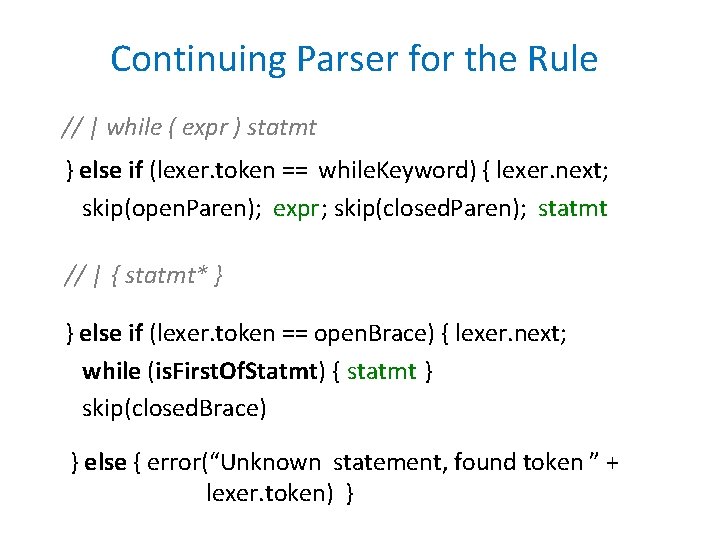
Continuing Parser for the Rule // | while ( expr ) statmt } else if (lexer. token == while. Keyword) { lexer. next; skip(open. Paren); expr; skip(closed. Paren); statmt // | { statmt* } } else if (lexer. token == open. Brace) { lexer. next; while (is. First. Of. Statmt) { statmt } skip(closed. Brace) } else { error(“Unknown statement, found token ” + lexer. token) }
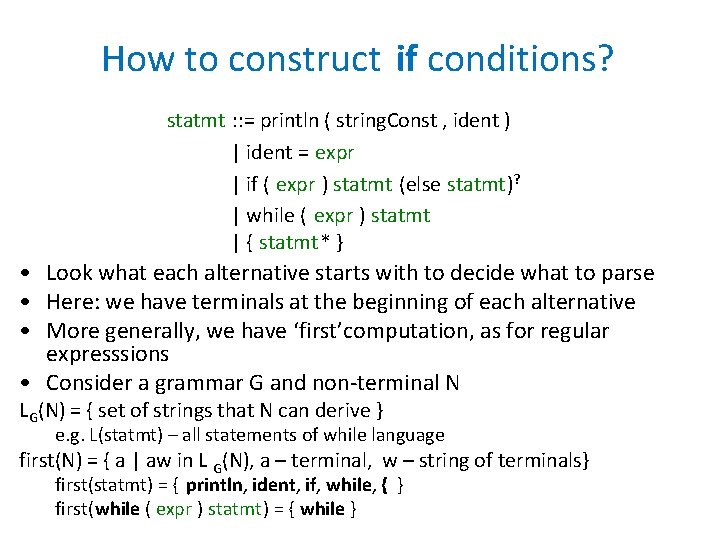
How to construct if conditions? statmt : : = println ( string. Const , ident ) | ident = expr | if ( expr ) statmt (else statmt)? | while ( expr ) statmt | { statmt* } • Look what each alternative starts with to decide what to parse • Here: we have terminals at the beginning of each alternative • More generally, we have ‘first’computation, as for regular expresssions • Consider a grammar G and non-terminal N LG(N) = { set of strings that N can derive } e. g. L(statmt) – all statements of while language first(N) = { a | aw in L G(N), a – terminal, w – string of terminals} first(statmt) = { println, ident, if, while, { } first(while ( expr ) statmt) = { while }