
Finite Elements 1 D acoustic wave equation Helmholtz
- Slides: 11
Finite Elements: 1 D acoustic wave equation Ø Helmholtz (wave) equation (time-dependent) Ø Regular grid Ø Irregular grid Ø Explicit time integration Ø Implicit time integraton Ø Numerical Examples Scope: Understand the basic concept of the finite element method applied to the 1 D acoustic wave equation. Finite element method 1
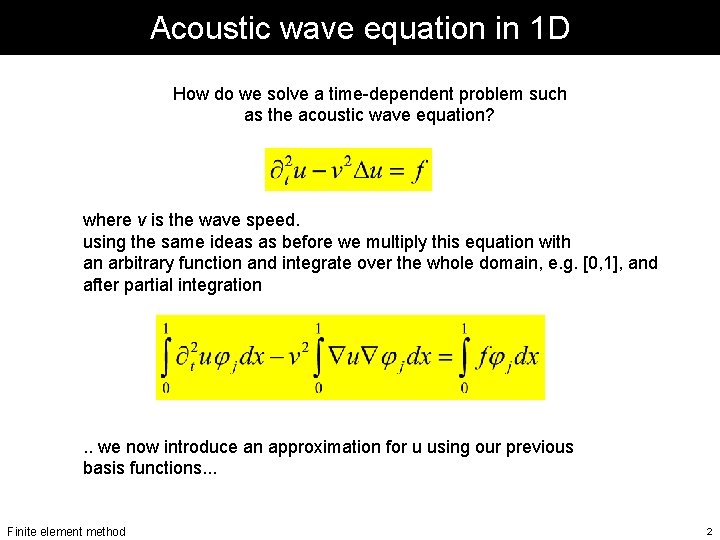
Acoustic wave equation in 1 D How do we solve a time-dependent problem such as the acoustic wave equation? where v is the wave speed. using the same ideas as before we multiply this equation with an arbitrary function and integrate over the whole domain, e. g. [0, 1], and after partial integration . . we now introduce an approximation for u using our previous basis functions. . . Finite element method 2
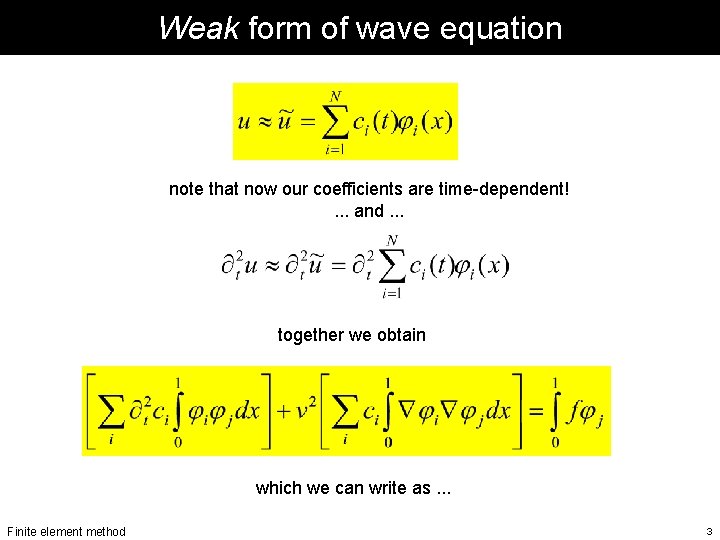
Weak form of wave equation note that now our coefficients are time-dependent!. . . and. . . together we obtain which we can write as. . . Finite element method 3
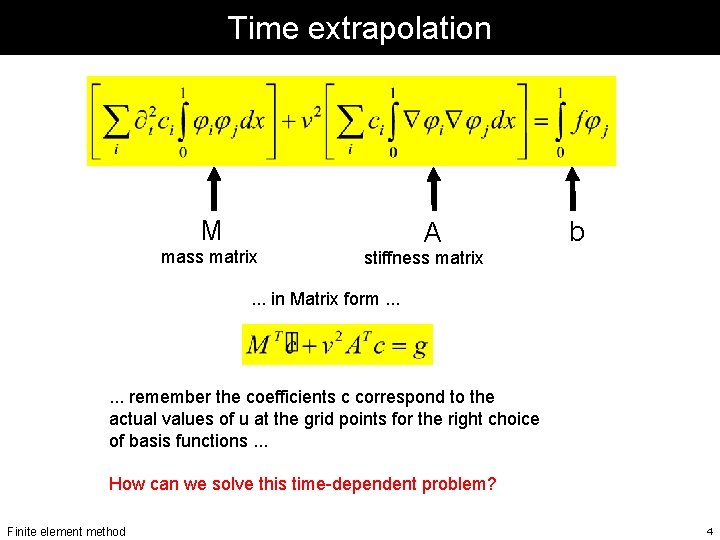
Time extrapolation M mass matrix A b stiffness matrix . . . in Matrix form. . . remember the coefficients c correspond to the actual values of u at the grid points for the right choice of basis functions. . . How can we solve this time-dependent problem? Finite element method 4
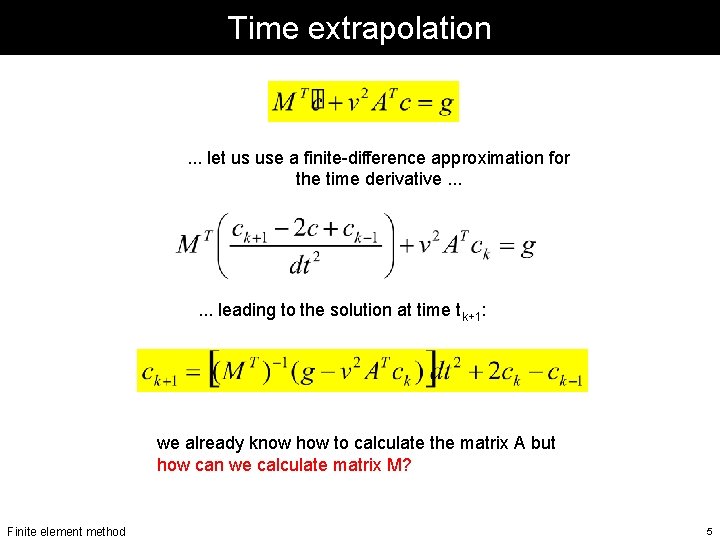
Time extrapolation . . . let us use a finite-difference approximation for the time derivative. . . leading to the solution at time tk+1: we already know how to calculate the matrix A but how can we calculate matrix M? Finite element method 5
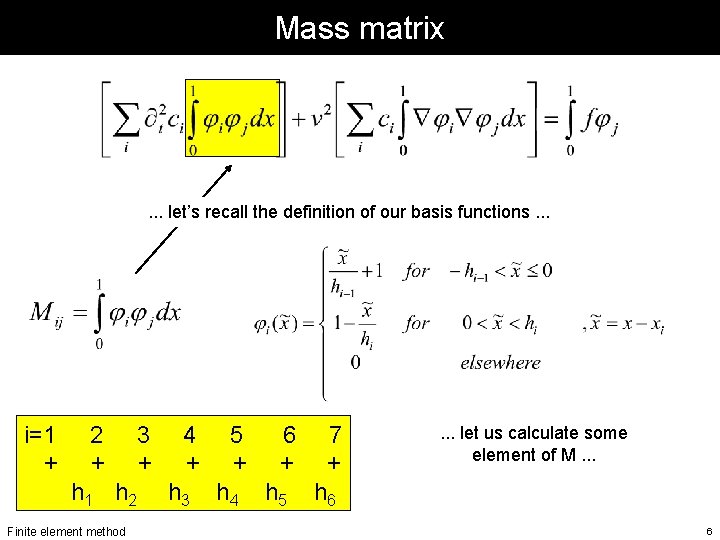
Mass matrix . . . let’s recall the definition of our basis functions. . . i=1 + 2 + 3 + h 1 h 2 Finite element method 4 + h 3 5 6 7 + + + h 4 h 5 h 6 . . . let us calculate some element of M. . . 6
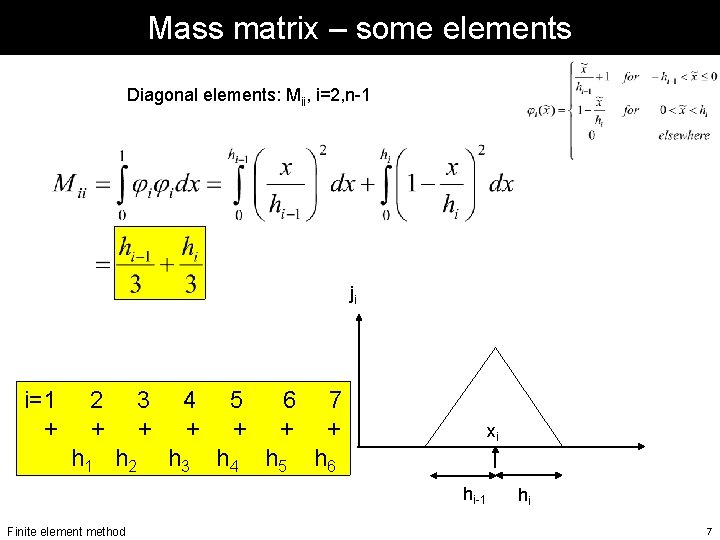
Mass matrix – some elements Diagonal elements: Mii, i=2, n-1 ji i=1 + 2 + 3 + h 1 h 2 4 + h 3 5 6 7 + + + h 4 h 5 h 6 xi hi-1 Finite element method hi 7
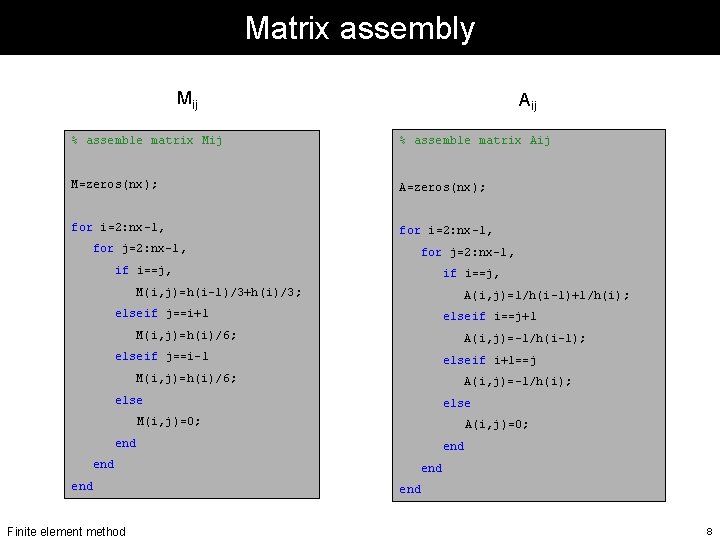
Matrix assembly Mij Aij % assemble matrix Mij % assemble matrix Aij M=zeros(nx); A=zeros(nx); for i=2: nx-1, for j=2: nx-1, if i==j, M(i, j)=h(i-1)/3+h(i)/3; A(i, j)=1/h(i-1)+1/h(i); elseif j==i+1 elseif i==j+1 M(i, j)=h(i)/6; A(i, j)=-1/h(i-1); elseif j==i-1 elseif i+1==j M(i, j)=h(i)/6; A(i, j)=-1/h(i); else M(i, j)=0; A(i, j)=0; end end Finite element method end 8
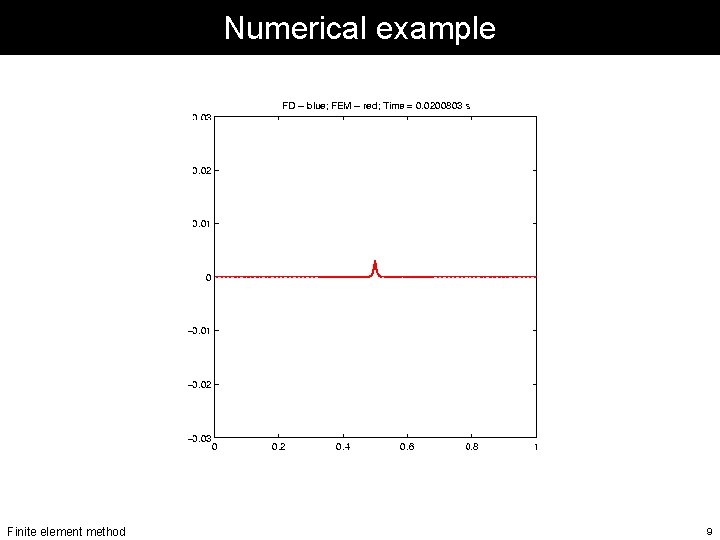
Numerical example Finite element method 9
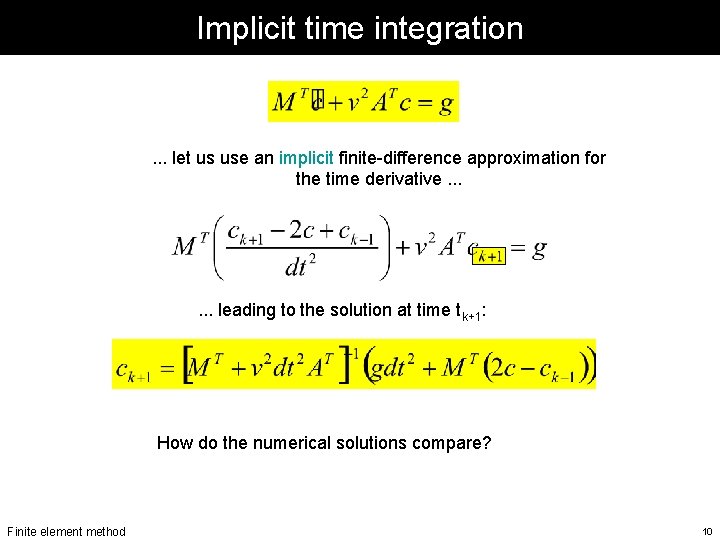
Implicit time integration . . . let us use an implicit finite-difference approximation for the time derivative. . . leading to the solution at time tk+1: How do the numerical solutions compare? Finite element method 10
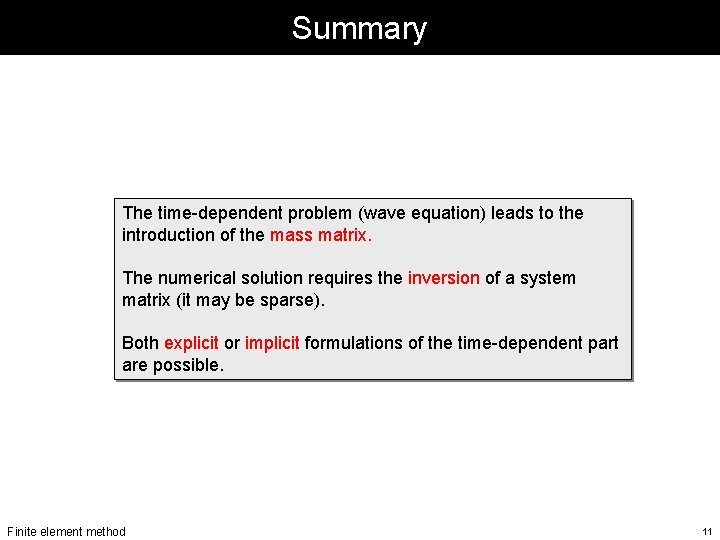
Summary The time-dependent problem (wave equation) leads to the introduction of the mass matrix. The numerical solution requires the inversion of a system matrix (it may be sparse). Both explicit or implicit formulations of the time-dependent part are possible. Finite element method 11