
FINITE ELEMENT METHODS ONE DIMENSIONAL BAR ELEMENT IN
FINITE ELEMENT METHODS ONE DIMENSIONAL BAR ELEMENT IN TWO DIMENSIONAL PLANE or PLANE TRUSS ELEMENT May – Aug 2012 Jagadish Dr. T. 1
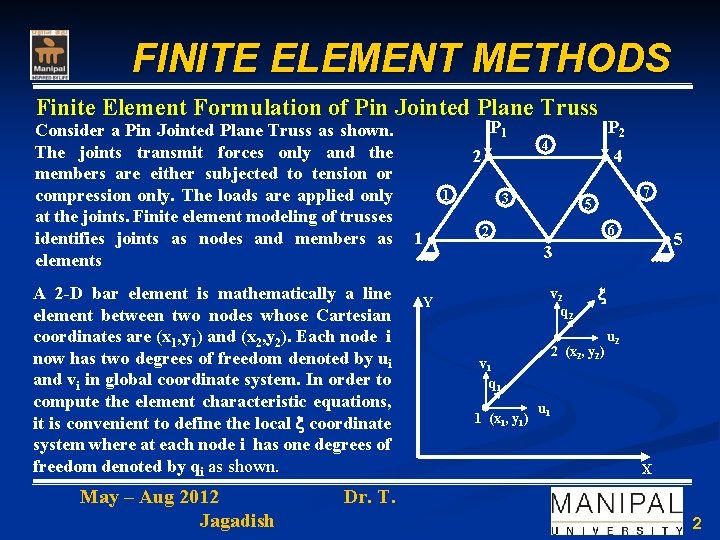
FINITE ELEMENT METHODS Finite Element Formulation of Pin Jointed Plane Truss Consider a Pin Jointed Plane Truss as shown. The joints transmit forces only and the members are either subjected to tension or compression only. The loads are applied only at the joints. Finite element modeling of trusses identifies joints as nodes and members as elements A 2 -D bar element is mathematically a line element between two nodes whose Cartesian coordinates are (x 1, y 1) and (x 2, y 2). Each node i now has two degrees of freedom denoted by ui and vi in global coordinate system. In order to compute the element characteristic equations, it is convenient to define the local x coordinate system where at each node i has one degrees of freedom denoted by qi as shown. May – Aug 2012 Jagadish P 1 2 1 1 4 P 2 4 3 7 5 6 2 5 3 v 2 q 2 Y 2 (x 2, y 2) v 1 q 1 1 (x 1, y 1) x u 2 u 1 X Dr. T. 2
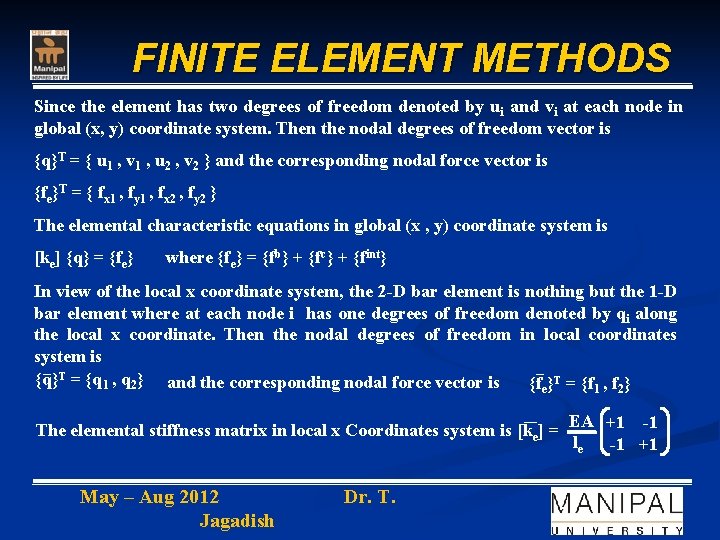
FINITE ELEMENT METHODS Since the element has two degrees of freedom denoted by ui and vi at each node in global (x, y) coordinate system. Then the nodal degrees of freedom vector is {q}T = { u 1 , v 1 , u 2 , v 2 } and the corresponding nodal force vector is {fe}T = { fx 1 , fy 1 , fx 2 , fy 2 } The elemental characteristic equations in global (x , y) coordinate system is [ke] {q} = {fe} where {fe} = {fb} + {fc} + {fint} In view of the local x coordinate system, the 2 -D bar element is nothing but the 1 -D bar element where at each node i has one degrees of freedom denoted by qi along the local x coordinate. Then the nodal degrees of freedom in local coordinates system is {q}T = {q 1 , q 2} and the corresponding nodal force vector is {fe}T = {f 1 , f 2} The elemental stiffness matrix in local x Coordinates system is [ke] = May – Aug 2012 Jagadish Dr. T. EA +1 -1 le -1 +1 3

FINITE ELEMENT METHODS Since the element has two degrees of freedom denoted by ui and vi at each node i in global (x, y) coordinate system and has one degree of freedom qi at each node i in local x coordinate system. Then we have The length of the element le = [(x 2 -x 1)2 +(y 2 -y 1)2] The direction cosines of the local x coordinate axis with the global (x, y) coordinate axis is ( y 2 - y 1 ) ( x 2 - x 1 ) m = cos( x, y ) = l = cos( x, x ) = le le Then the transformation of global nodal degree of freedom vector to local nodal degrees of freedom vector is given by q 1 = lu 1 + mv 1 q 2 = lu 2 + mv 2 u 1 q 1 l m 0 0 v 1 In matrix form we have = q 2 0 0 l m u 2 v 2 Which can be written as {q} = [L] {q} May – Aug 2012 Jagadish Dr. T. 4
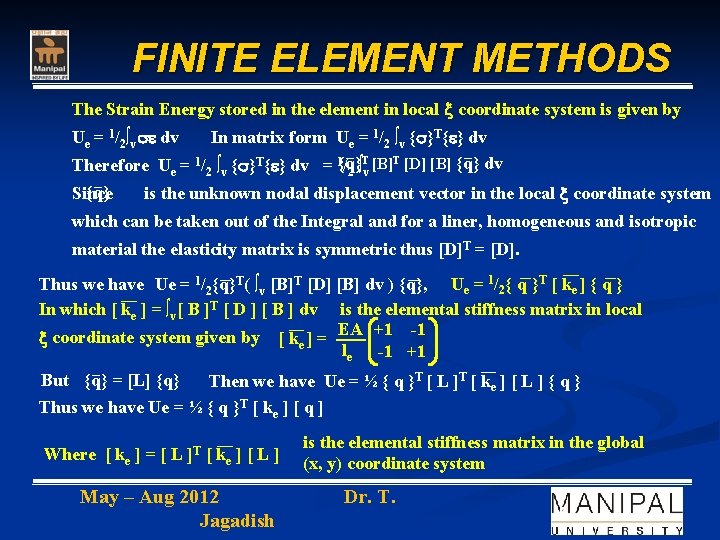
FINITE ELEMENT METHODS The Strain Energy stored in the element in local x coordinate system is given by Ue = 1/2∫vse dv In matrix form Ue = 1/2 ∫v {s}T{e} dv Therefore Ue = 1/2 ∫v {s}T{e} dv = 1{q} /2 ∫Tv [B]T [D] [B] {q} dv {q} Since is the unknown nodal displacement vector in the local x coordinate system which can be taken out of the Integral and for a liner, homogeneous and isotropic material the elasticity matrix is symmetric thus [D]T = [D]. Thus we have Ue = 1/2{q}T( ∫v [B]T [D] [B] dv ) {q}, Ue = 1/2{ q }T [ ke ] { q } In which [ ke ] = ∫v[ B ]T [ D ] [ B ] dv is the elemental stiffness matrix in local x coordinate system given by [ ke ] = EA +1 -1 le -1 +1 But {q} = [L] {q} Then we have Ue = ½ { q }T [ L ]T [ ke ] [ L ] { q } Thus we have Ue = ½ { q }T [ ke ] [ q ] Where [ ke ] = [ L ]T [ ke ] [ L ] May – Aug 2012 Jagadish is the elemental stiffness matrix in the global (x, y) coordinate system Dr. T. 5
![FINITE ELEMENT METHODS Since [ k e ] = [ L ] T [](http://slidetodoc.com/presentation_image_h2/ae4967299a30d8929e4b102b703a8469/image-6.jpg "FINITE ELEMENT METHODS Since [ k e ] = [ L ] T [")
FINITE ELEMENT METHODS Since [ k e ] = [ L ] T [ ke ] [ L ] l 0 m 0 EA +1 -1 l [ ke ] = le -1 +1 0 0 l 0 m EA [ ke ] = le l 2 lm -l 2 -lm m 2 -lm -m 2 -lm l 2 lm -m 2 lm m 2 m 0 0 l 0 m After multiplication we get [ke] is the elemental stiffness matrix in global (x , y) coordinate system Work Potential in the element in the local x coordinate system We = {q}T {fe} But {q} = [L] {q} We = {q}T [L]T {fe} Thus We = {q}T {fe} Where { fe } = [ L]T {fe} { fe } = l m 0 0 l m f 1 f 2 i. e. fx 1 fy 1 fx 2 fy 2 May – Aug 2012 Jagadish lf 1 mf 1 = lf 2 mf 2 is the elemental Nodal force vector in global (x , y) coordinate system Dr. T.
FINITE ELEMENT METHODS ONE DIMENSIONAL BAR ELEMENT IN THREE DIMENSIONAL SPACE or SPACE TRUSS ELEMENT May – Aug 2012 Jagadish Dr. T.
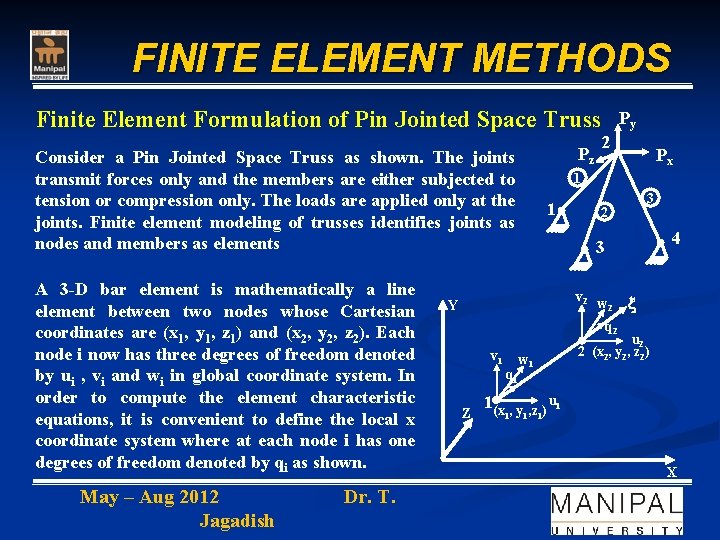
FINITE ELEMENT METHODS Finite Element Formulation of Pin Jointed Space Truss Pz Consider a Pin Jointed Space Truss as shown. The joints transmit forces only and the members are either subjected to tension or compression only. The loads are applied only at the joints. Finite element modeling of trusses identifies joints as nodes and members as elements A 3 -D bar element is mathematically a line element between two nodes whose Cartesian coordinates are (x 1, y 1, z 1) and (x 2, y 2, z 2). Each node i now has three degrees of freedom denoted by ui , vi and wi in global coordinate system. In order to compute the element characteristic equations, it is convenient to define the local x coordinate system where at each node i has one degrees of freedom denoted by qi as shown. May – Aug 2012 Jagadish Dr. T. Py 2 Px 1 1 3 2 4 3 v 2 w 2 Y x q 2 v 1 q 1 Z u 2 2 (x 2, y 2, z 2) w 1 1(x , y , z ) u 1 1 X
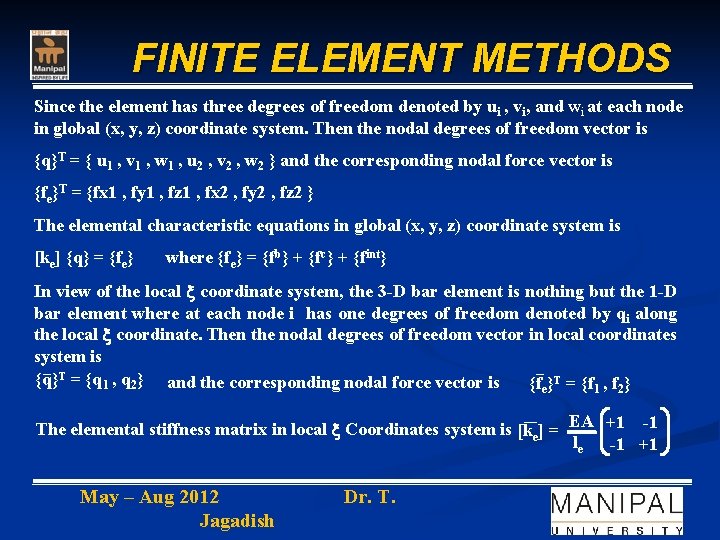
FINITE ELEMENT METHODS Since the element has three degrees of freedom denoted by ui , vi, and wi at each node in global (x, y, z) coordinate system. Then the nodal degrees of freedom vector is {q}T = { u 1 , v 1 , w 1 , u 2 , v 2 , w 2 } and the corresponding nodal force vector is {fe}T = {fx 1 , fy 1 , fz 1 , fx 2 , fy 2 , fz 2 } The elemental characteristic equations in global (x, y, z) coordinate system is [ke] {q} = {fe} where {fe} = {fb} + {fc} + {fint} In view of the local x coordinate system, the 3 -D bar element is nothing but the 1 -D bar element where at each node i has one degrees of freedom denoted by qi along the local x coordinate. Then the nodal degrees of freedom vector in local coordinates system is {q}T = {q 1 , q 2} and the corresponding nodal force vector is {fe}T = {f 1 , f 2} The elemental stiffness matrix in local x Coordinates system is [ke] = EA +1 -1 le -1 +1 May – Aug 2012 Jagadish Dr. T.

FINITE ELEMENT METHODS Since the element has three degrees of freedom denoted by ui , vi and wi at each node i in global (x, y, z) coordinate system and has one degree of freedom qi at each node i in local x coordinate system. Then we have The length of the element le = [(x 2 -x 1)2 +(y 2 -y 1)2 + (z 2 -z 1)2] The direction cosines of the local x coordinate axis with the global (x, y) coordinate axis is ( z 2 - z 1 ) ( x 2 - x 1 ) m = cos( x, y ) = ( y 2 - y 1 ) n = cos( x, z ) = l = cos( x, x ) = le le le Then the transformation of local nodal degree of freedom to global nodal degrees of freedom vector is given by q 1 = lu 1 + mv 1 + nw 1 u 1 q 2 = lu 2 + mv 2 v 1 q 1 l m n 0 0 0 w 1 In matrix form we have = q 2 u 2 0 0 0 l m n v 2 w 2 Which can be written as {q} = [L] {q} May – Aug 2012 Jagadish Dr. T.
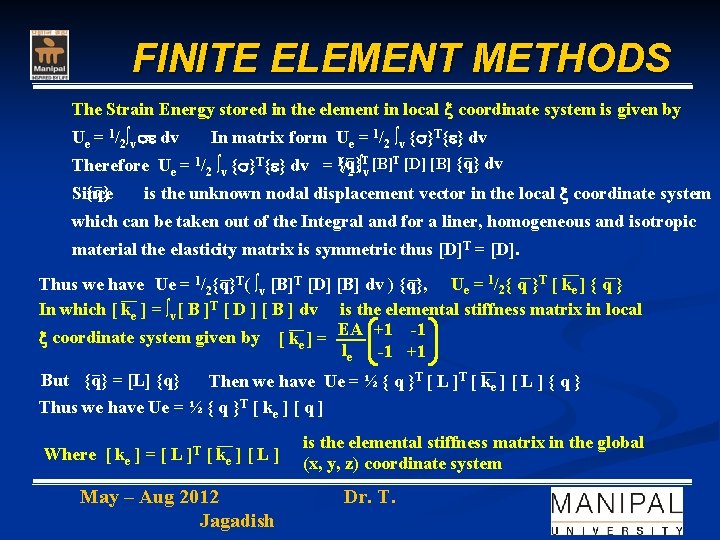
FINITE ELEMENT METHODS The Strain Energy stored in the element in local x coordinate system is given by Ue = 1/2∫vse dv In matrix form Ue = 1/2 ∫v {s}T{e} dv Therefore Ue = 1/2 ∫v {s}T{e} dv = 1{q} /2 ∫Tv [B]T [D] [B] {q} dv {q} Since is the unknown nodal displacement vector in the local x coordinate system which can be taken out of the Integral and for a liner, homogeneous and isotropic material the elasticity matrix is symmetric thus [D]T = [D]. Thus we have Ue = 1/2{q}T( ∫v [B]T [D] [B] dv ) {q}, Ue = 1/2{ q }T [ ke ] { q } In which [ ke ] = ∫v[ B ]T [ D ] [ B ] dv is the elemental stiffness matrix in local x coordinate system given by [ ke ] = EA +1 -1 le -1 +1 But {q} = [L] {q} Then we have Ue = ½ { q }T [ L ]T [ ke ] [ L ] { q } Thus we have Ue = ½ { q }T [ ke ] [ q ] Where [ ke ] = [ L ]T [ ke ] [ L ] May – Aug 2012 Jagadish is the elemental stiffness matrix in the global (x, y, z) coordinate system Dr. T.
![FINITE ELEMENT METHODS Since [ k e ] = [ L ] T [](http://slidetodoc.com/presentation_image_h2/ae4967299a30d8929e4b102b703a8469/image-12.jpg "FINITE ELEMENT METHODS Since [ k e ] = [ L ] T [")
FINITE ELEMENT METHODS Since [ k e ] = [ L ] T [ ke ] [ L ] l 0 m 0 n 0 EA +1 -1 l m n 0 0 0 After multiplication we get [ ke ] = 0 l le -1 +1 0 0 0 l m n 0 m 0 n l 2 lm ln -l 2 -lm -ln lm m 2 mn -lm -m 2 -mn ln mn n 2 -ln -mn -n 2 EA [ ke ] = -l 2 -lm -ln l 2 lm ln le -lm -m 2 -mn lm m 2 mn -ln -mn -n 2 ln mn n 2 [ke] is the elemental stiffness matrix in global (x , y, z) coordinate system May – Aug 2012 Jagadish Dr. T.
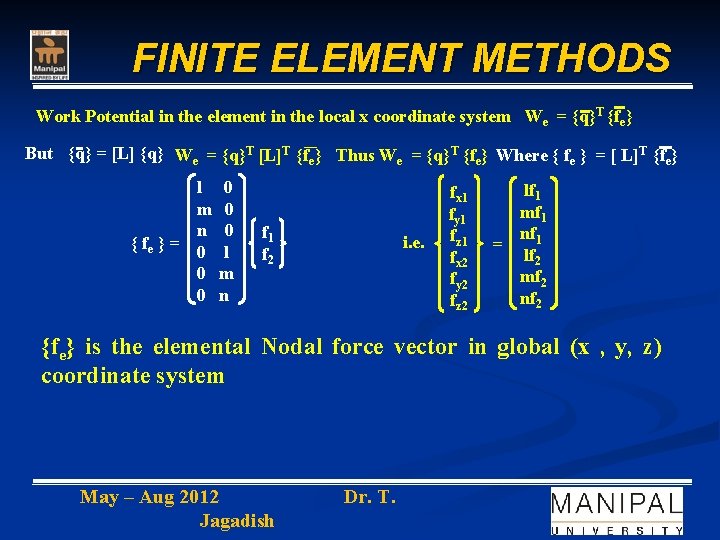
FINITE ELEMENT METHODS Work Potential in the element in the local x coordinate system We = {q}T {fe} But {q} = [L] {q} We = {q}T [L]T {fe} Thus We = {q}T {fe} Where { fe } = [ L]T {fe} l m n { fe } = 0 0 0 l m n f 1 f 2 i. e. fx 1 fy 1 fz 1 fx 2 fy 2 fz 2 lf 1 mf 1 nf 1 = lf 2 mf 2 nf 2 {fe} is the elemental Nodal force vector in global (x , y, z) coordinate system May – Aug 2012 Jagadish Dr. T.
FINITE ELEMENT METHODS May – Aug 2012 Jagadish Dr. T. 14
- Slides: 14