
Finite element Analysis study of PU based Acoustic
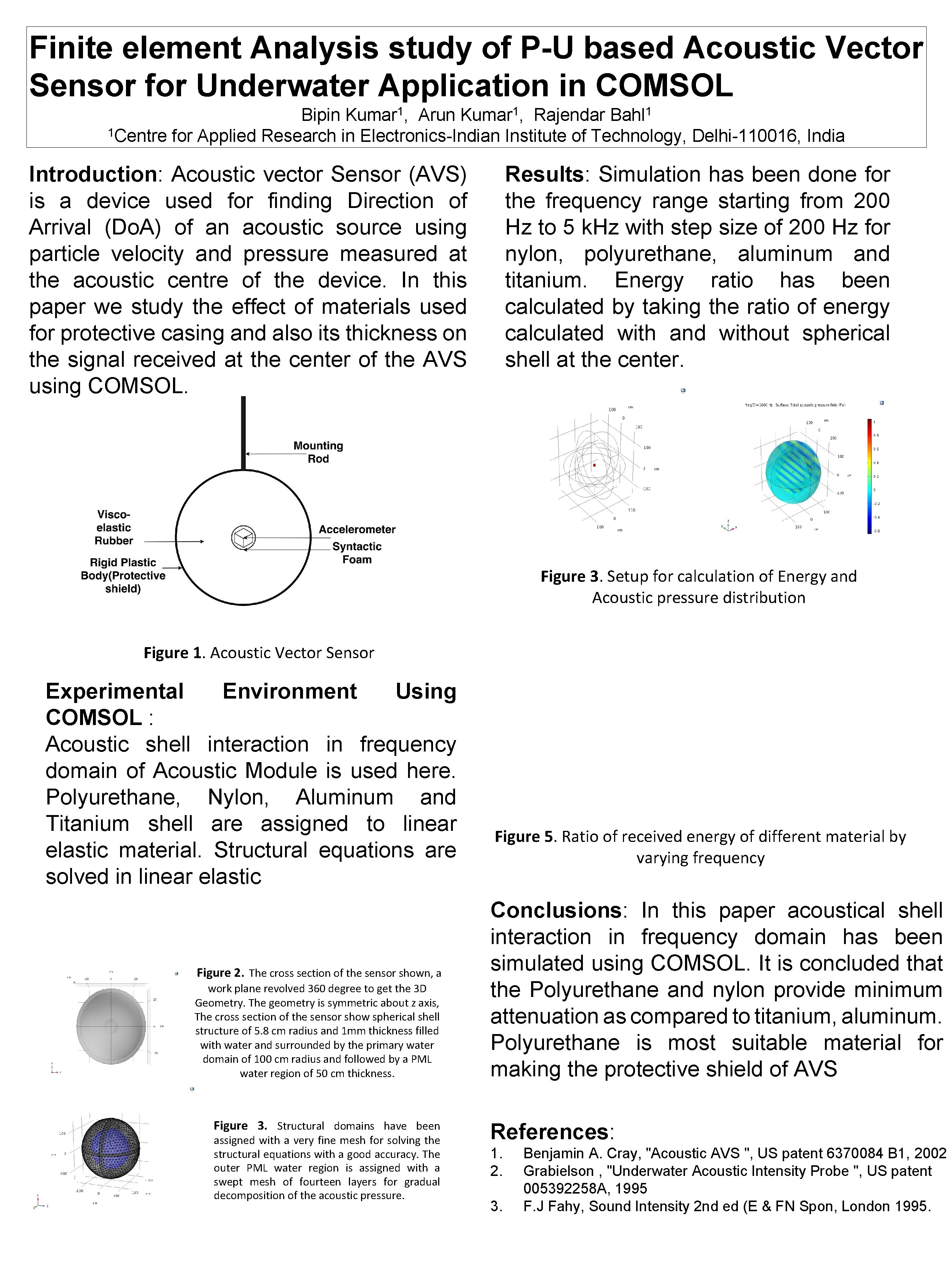
Finite element Analysis study of P-U based Acoustic Vector Sensor for Underwater Application in COMSOL 1 Kumar , Bipin Arun Rajendar 1 Centre for Applied Research in Electronics-Indian Institute of Technology, Delhi-110016, India Introduction: Acoustic vector Sensor (AVS) is a device used for finding Direction of Arrival (Do. A) of an acoustic source using particle velocity and pressure measured at the acoustic centre of the device. In this paper we study the effect of materials used for protective casing and also its thickness on the signal received at the center of the AVS using COMSOL. 1 Bahl Results: Simulation has been done for the frequency range starting from 200 Hz to 5 k. Hz with step size of 200 Hz for nylon, polyurethane, aluminum and titanium. Energy ratio has been calculated by taking the ratio of energy calculated with and without spherical shell at the center. Figure 3. Setup for calculation of Energy and Acoustic pressure distribution Figure 1. Acoustic Vector Sensor Experimental Environment Using COMSOL : Acoustic shell interaction in frequency domain of Acoustic Module is used here. Polyurethane, Nylon, Aluminum and Titanium shell are assigned to linear elastic material. Structural equations are solved in linear elastic Figure 2. The cross section of the sensor shown, a work plane revolved 360 degree to get the 3 D Geometry. The geometry is symmetric about z axis, The cross section of the sensor show spherical shell structure of 5. 8 cm radius and 1 mm thickness filled with water and surrounded by the primary water domain of 100 cm radius and followed by a PML water region of 50 cm thickness. Figure 3. Structural domains have been assigned with a very fine mesh for solving the structural equations with a good accuracy. The outer PML water region is assigned with a swept mesh of fourteen layers for gradual decomposition of the acoustic pressure. Figure 5. Ratio of received energy of different material by varying frequency Conclusions: In this paper acoustical shell interaction in frequency domain has been simulated using COMSOL. It is concluded that the Polyurethane and nylon provide minimum attenuation as compared to titanium, aluminum. Polyurethane is most suitable material for making the protective shield of AVS References: 1. 2. 3. Benjamin A. Cray, "Acoustic AVS ", US patent 6370084 B 1, 2002 Grabielson , "Underwater Acoustic Intensity Probe ", US patent 005392258 A, 1995 F. J Fahy, Sound Intensity 2 nd ed (E & FN Spon, London 1995.

Material E(GPa) v Nylon 1150 2 0. 4 Aluminum 2730 69 0. 33 Polyurethane 1030 0. 033 4 Titanium 4940 105 0. 33
- Slides: 2