
Finite Element Analysis Overview Introduction Aim Review the

- Slides: 10
Finite Element Analysis Overview
Introduction § Aim – Review the finite element meshes used by MPI § Why do it – MPI uses 3 mesh types all have § Advantage § Disadvantages – Understanding the mesh types and capability is critical for their proper application
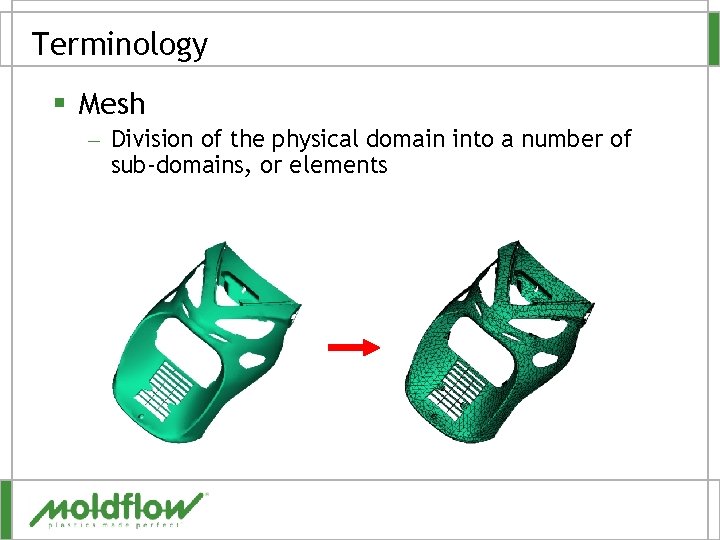
Terminology § Mesh – Division of the physical domain into a number of sub-domains, or elements
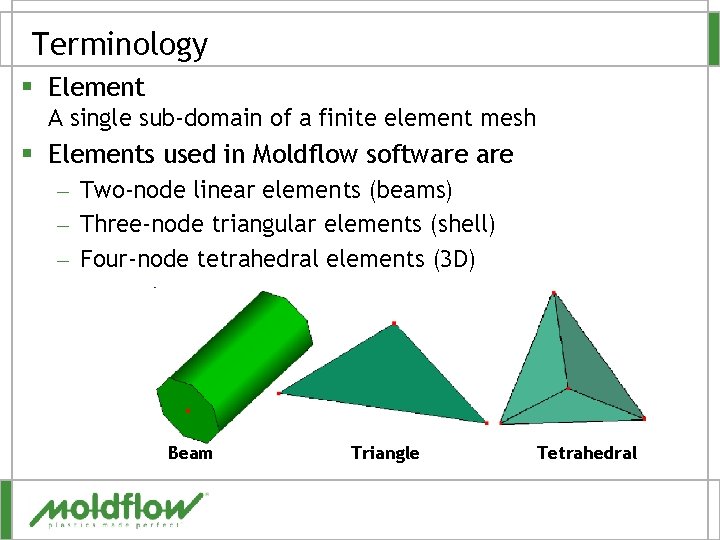
Terminology § Element A single sub-domain of a finite element mesh § Elements used in Moldflow software – Two-node linear elements (beams) – Three-node triangular elements (shell) – Four-node tetrahedral elements (3 D) Beam Triangle Tetrahedral
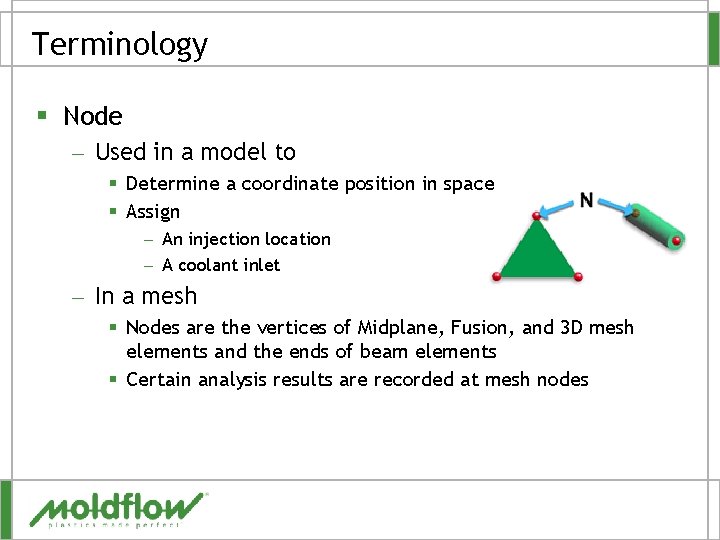
Terminology § Node – Used in a model to § Determine a coordinate position in space § Assign – An injection location – A coolant inlet – In a mesh § Nodes are the vertices of Midplane, Fusion, and 3 D mesh elements and the ends of beam elements § Certain analysis results are recorded at mesh nodes
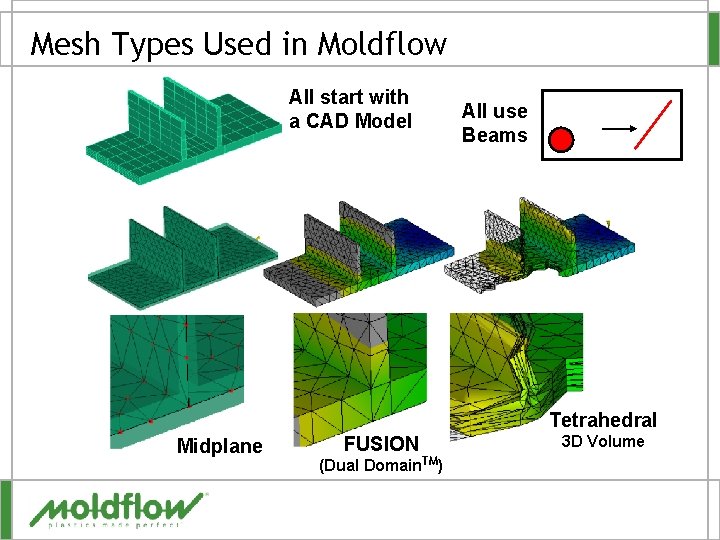
Mesh Types Used in Moldflow All start with a CAD Model All use Beams Tetrahedral Midplane FUSION (Dual Domain. TM) 3 D Volume
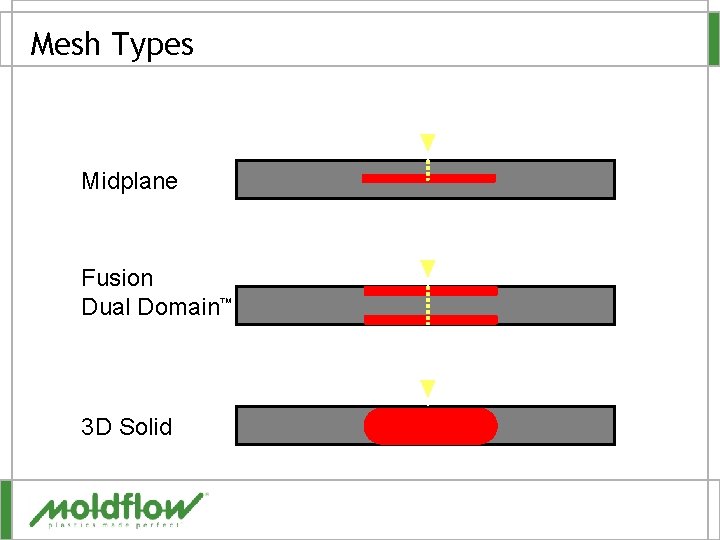
Mesh Types Midplane Fusion Dual Domain™ 3 D Solid
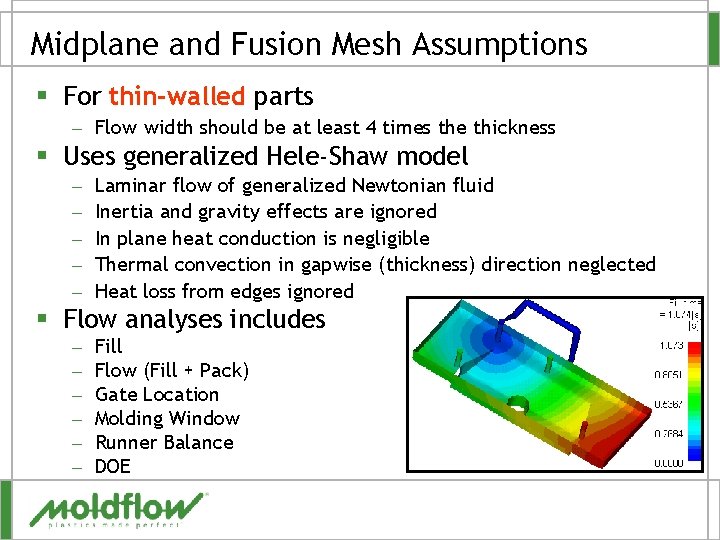
Midplane and Fusion Mesh Assumptions § For thin-walled parts – Flow width should be at least 4 times the thickness § Uses generalized Hele-Shaw model – – – Laminar flow of generalized Newtonian fluid Inertia and gravity effects are ignored In plane heat conduction is negligible Thermal convection in gapwise (thickness) direction neglected Heat loss from edges ignored § Flow analyses includes – – – Fill Flow (Fill + Pack) Gate Location Molding Window Runner Balance DOE
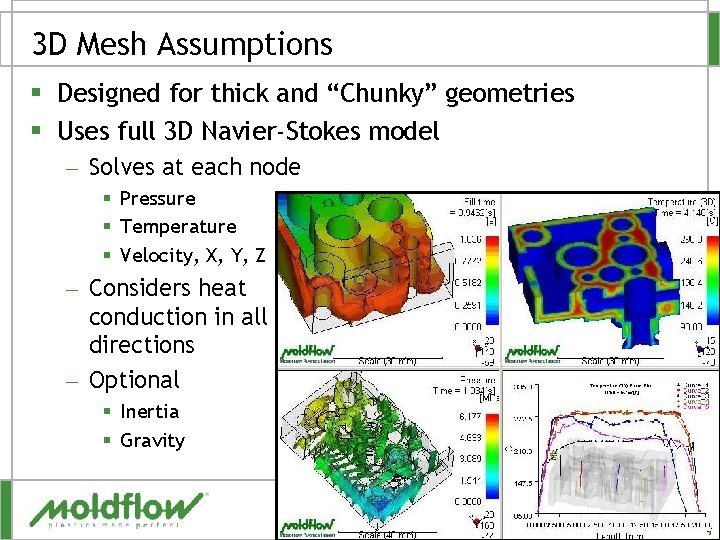
3 D Mesh Assumptions § Designed for thick and “Chunky” geometries § Uses full 3 D Navier-Stokes model – Solves at each node § Pressure § Temperature § Velocity, X, Y, Z – Considers heat conduction in all directions – Optional § Inertia § Gravity
QUESTIONS?