
Finite Difference Approximations Simple geophysical partial differential equations
- Slides: 27
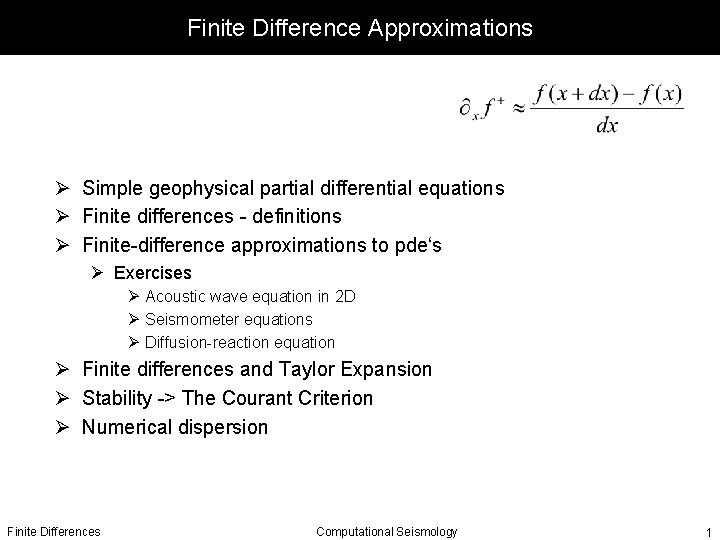
Finite Difference Approximations Ø Simple geophysical partial differential equations Ø Finite differences - definitions Ø Finite-difference approximations to pde‘s Ø Exercises Ø Acoustic wave equation in 2 D Ø Seismometer equations Ø Diffusion-reaction equation Ø Finite differences and Taylor Expansion Ø Stability -> The Courant Criterion Ø Numerical dispersion Finite Differences Computational Seismology 1
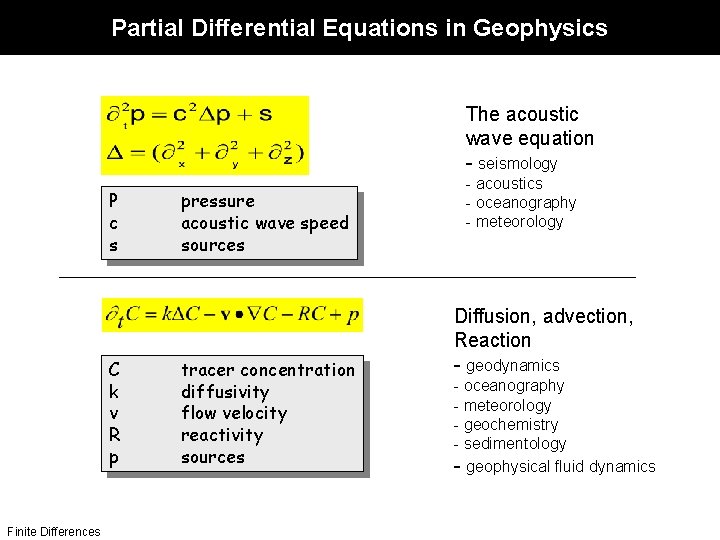
Partial Differential Equations in Geophysics The acoustic wave equation - seismology P c s C k v R p Finite Differences pressure acoustic wave speed sources tracer concentration diffusivity flow velocity reactivity sources - acoustics - oceanography - meteorology Diffusion, advection, Reaction - geodynamics - oceanography - meteorology - geochemistry - sedimentology - geophysical fluid dynamics
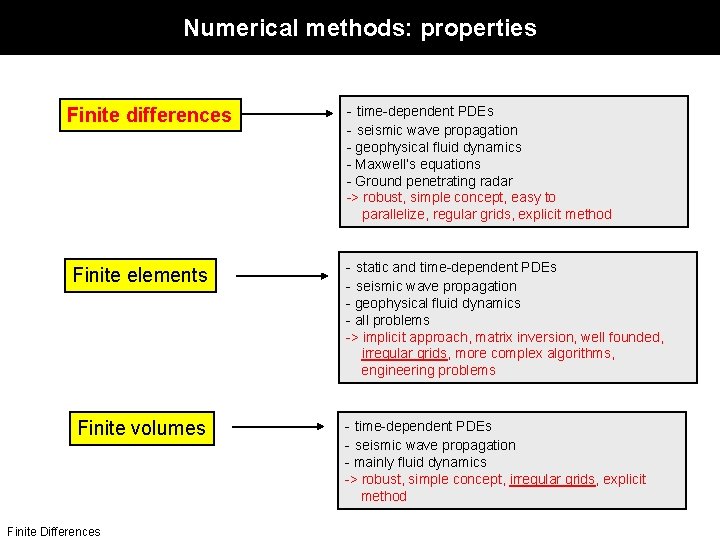
Numerical methods: properties Finite differences - time-dependent PDEs - seismic wave propagation - geophysical fluid dynamics - Maxwell’s equations - Ground penetrating radar -> robust, simple concept, easy to parallelize, regular grids, explicit method Finite elements - static and time-dependent PDEs - seismic wave propagation - geophysical fluid dynamics - all problems -> implicit approach, matrix inversion, well founded, irregular grids, more complex algorithms, engineering problems Finite volumes - time-dependent PDEs - seismic wave propagation - mainly fluid dynamics -> robust, simple concept, irregular grids, explicit method Finite Differences
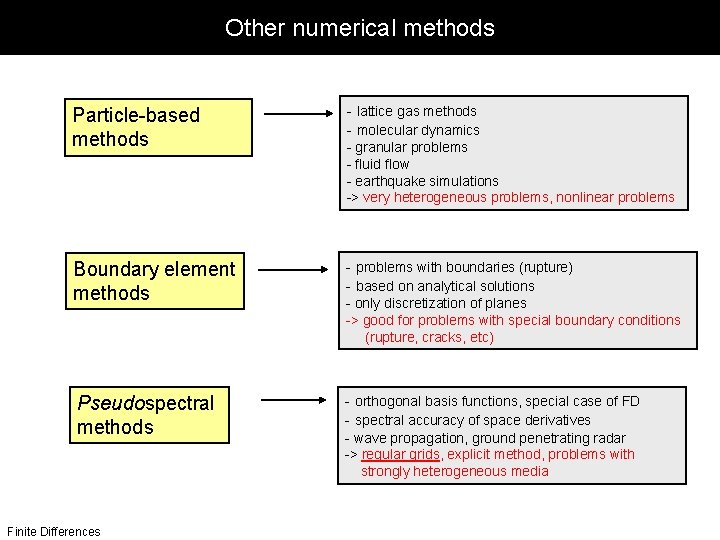
Other numerical methods Particle-based methods - lattice gas methods - molecular dynamics Boundary element methods - problems with boundaries (rupture) - based on analytical solutions Pseudospectral methods - orthogonal basis functions, special case of FD - spectral accuracy of space derivatives Finite Differences - granular problems - fluid flow - earthquake simulations -> very heterogeneous problems, nonlinear problems - only discretization of planes -> good for problems with special boundary conditions (rupture, cracks, etc) - wave propagation, ground penetrating radar -> regular grids, explicit method, problems with strongly heterogeneous media
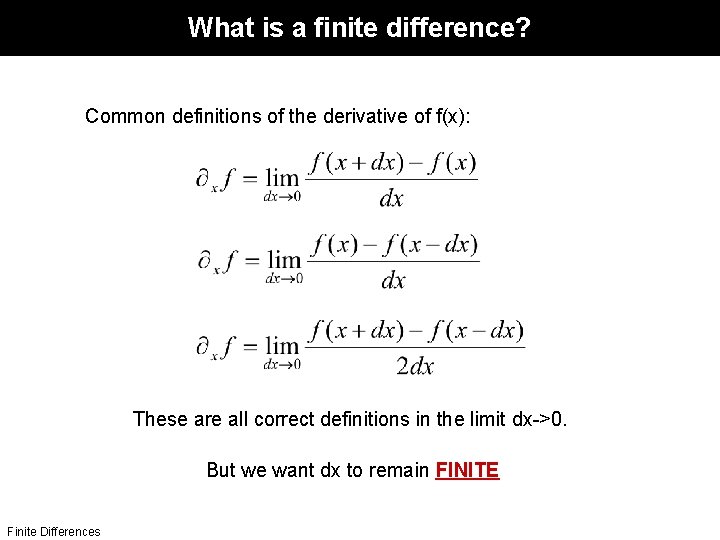
What is a finite difference? Common definitions of the derivative of f(x): These are all correct definitions in the limit dx->0. But we want dx to remain FINITE Finite Differences
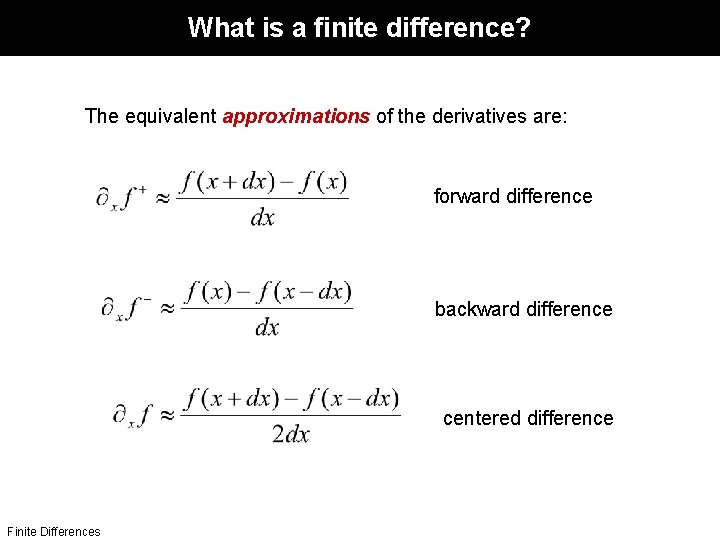
What is a finite difference? The equivalent approximations of the derivatives are: forward difference backward difference centered difference Finite Differences
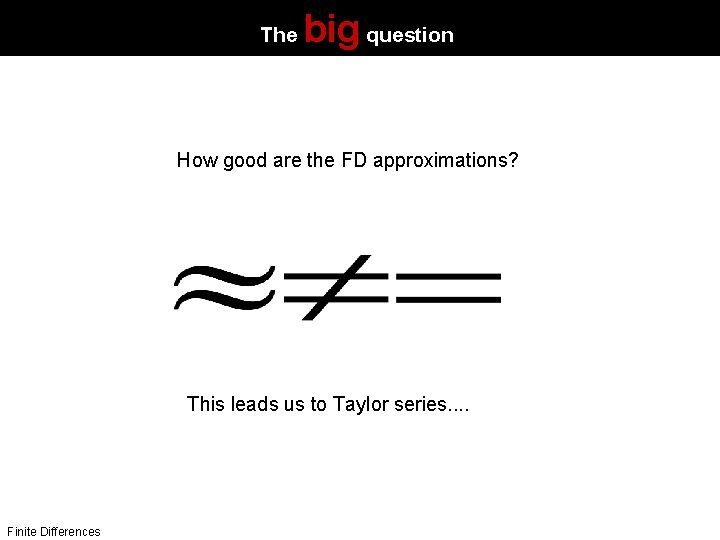
The big question: How good are the FD approximations? This leads us to Taylor series. . Finite Differences
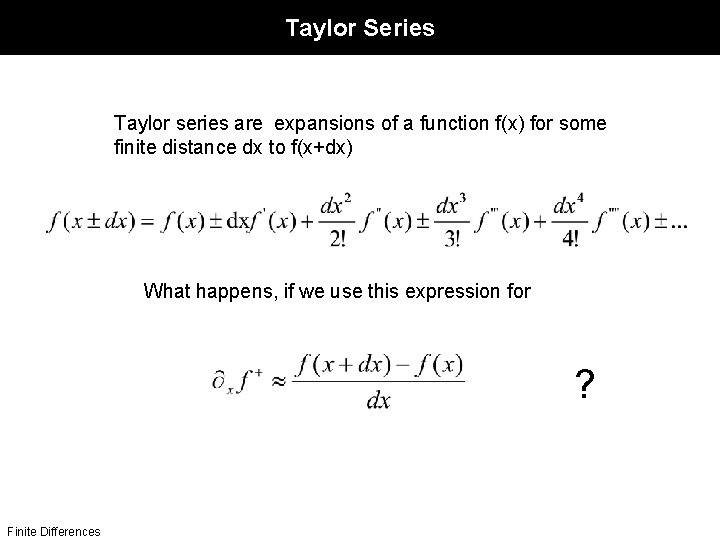
Taylor Series Taylor series are expansions of a function f(x) for some finite distance dx to f(x+dx) What happens, if we use this expression for ? Finite Differences
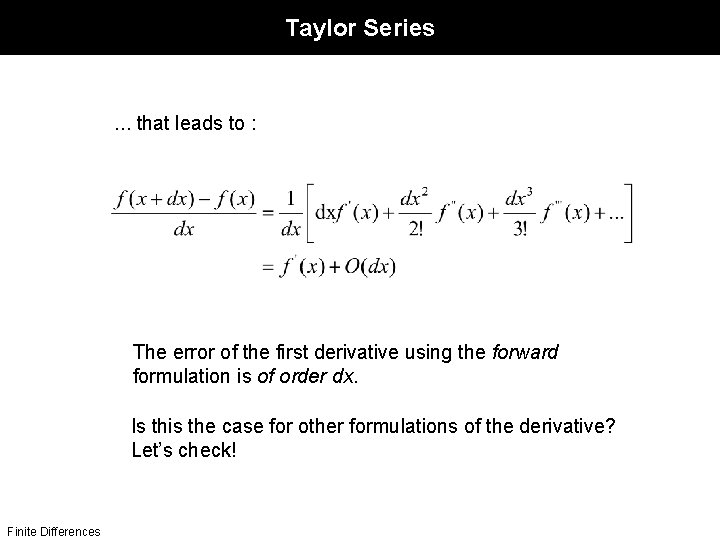
Taylor Series . . . that leads to : The error of the first derivative using the forward formulation is of order dx. Is this the case for other formulations of the derivative? Let’s check! Finite Differences
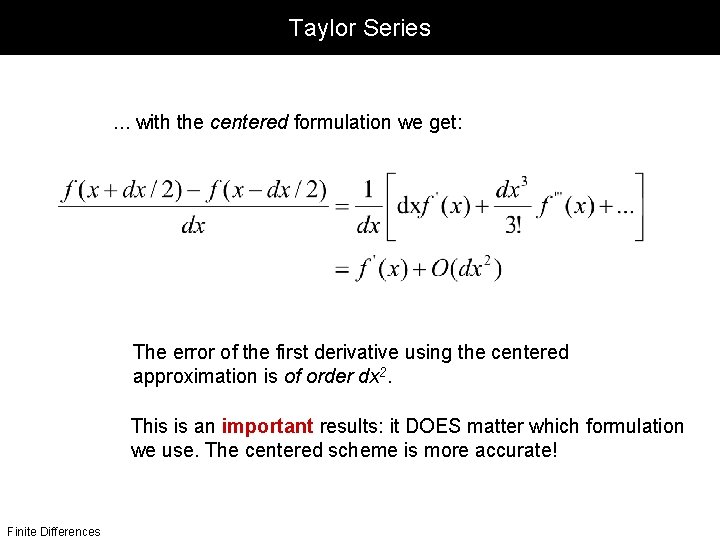
Taylor Series . . . with the centered formulation we get: The error of the first derivative using the centered approximation is of order dx 2. This is an important results: it DOES matter which formulation we use. The centered scheme is more accurate! Finite Differences
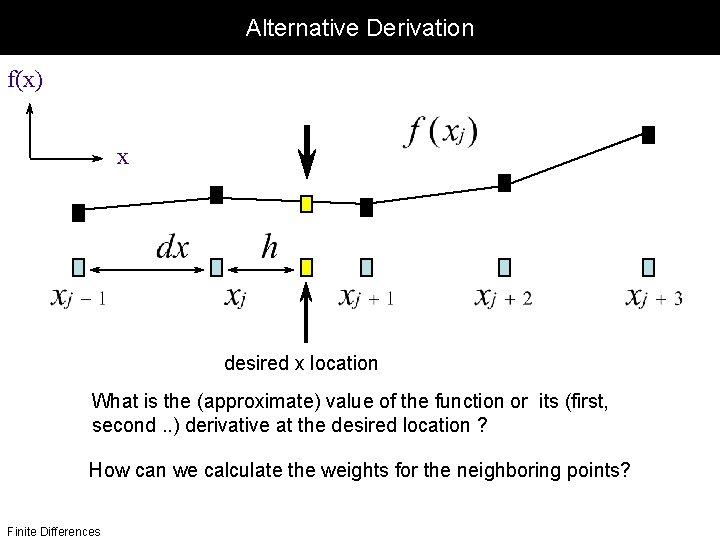
Alternative Derivation f(x) x desired x location What is the (approximate) value of the function or its (first, second. . ) derivative at the desired location ? How can we calculate the weights for the neighboring points? Finite Differences
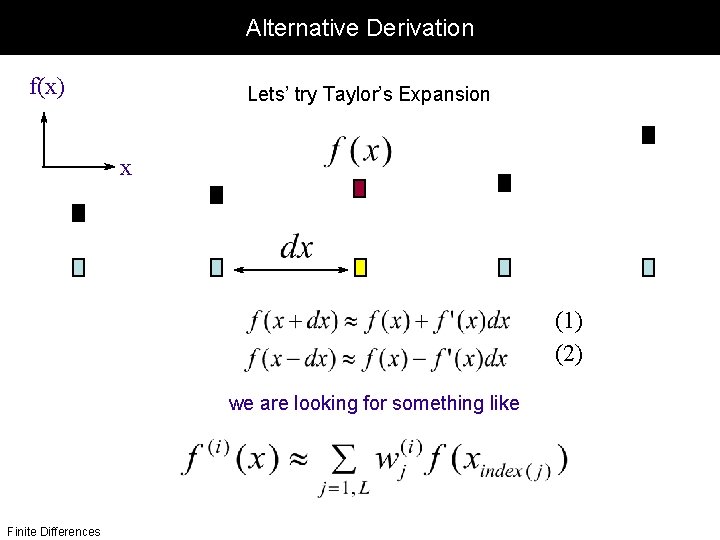
Alternative Derivation f(x) Lets’ try Taylor’s Expansion x (1) (2) we are looking for something like Finite Differences
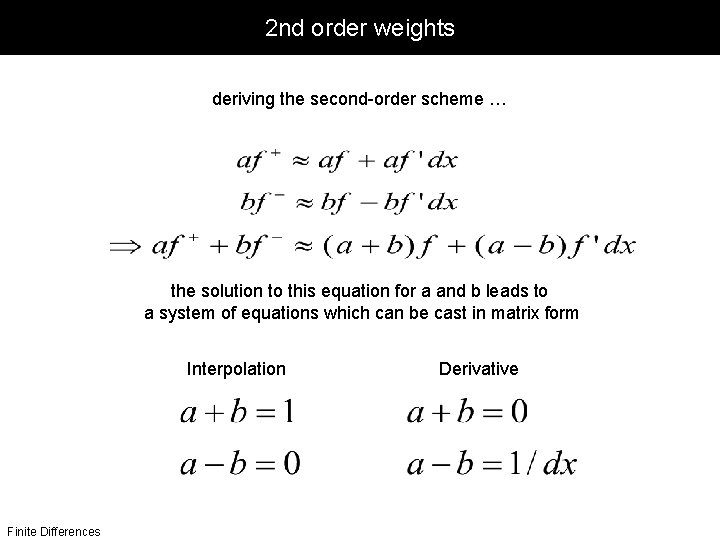
2 nd order weights deriving the second-order scheme … the solution to this equation for a and b leads to a system of equations which can be cast in matrix form Interpolation Finite Differences Derivative
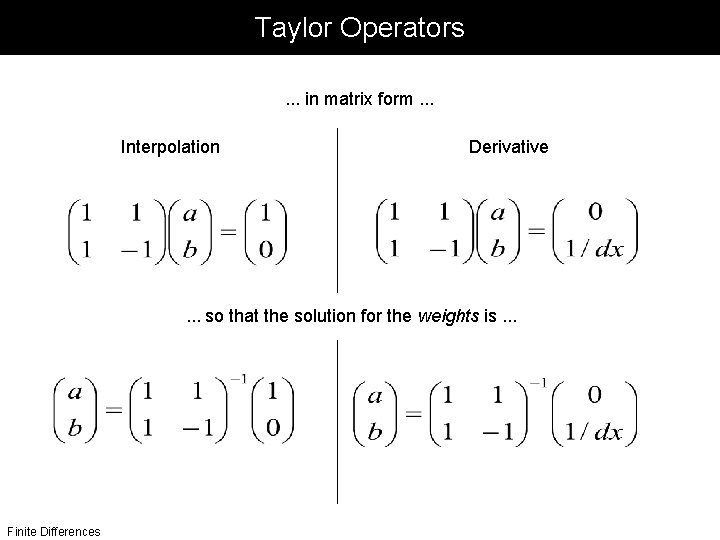
Taylor Operators. . . in matrix form. . . Interpolation Derivative . . . so that the solution for the weights is. . . Finite Differences
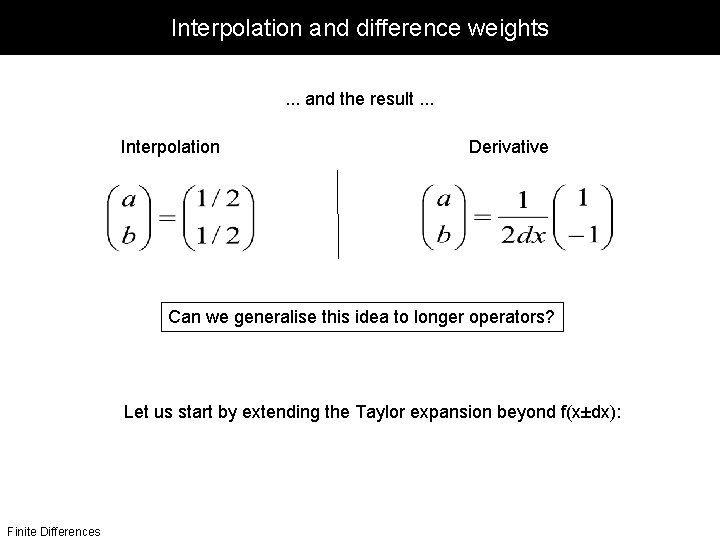
Interpolation and difference weights. . . and the result. . . Interpolation Derivative Can we generalise this idea to longer operators? Let us start by extending the Taylor expansion beyond f(x±dx): Finite Differences
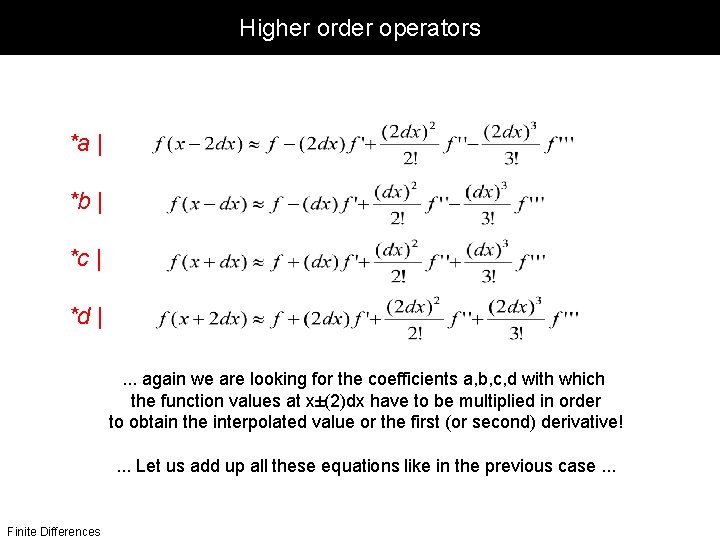
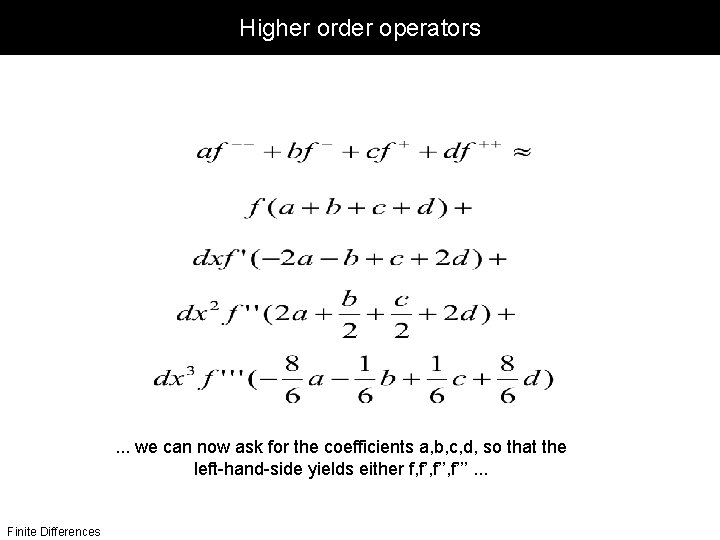
Higher order operators *a | *b | *c | *d |. . . again we are looking for the coefficients a, b, c, d with which the function values at x±(2)dx have to be multiplied in order to obtain the interpolated value or the first (or second) derivative!. . . Let us add up all these equations like in the previous case. . . Finite Differences
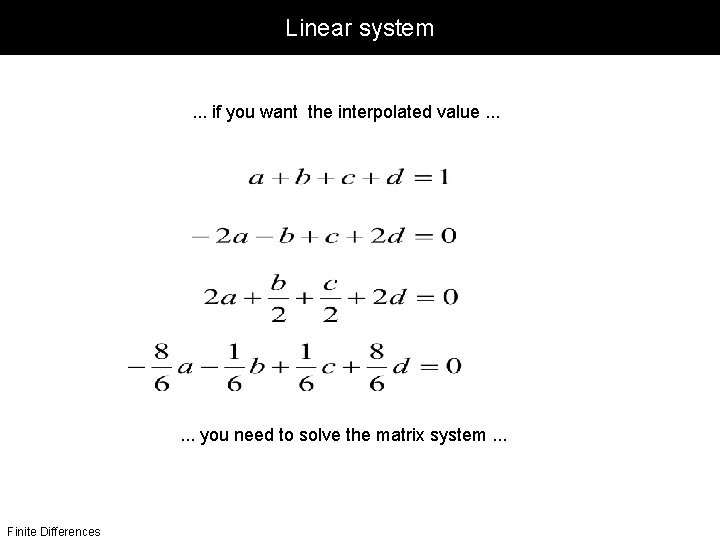
Higher order operators . . . we can now ask for the coefficients a, b, c, d, so that the left-hand-side yields either f, f’’, f’’’. . . Finite Differences
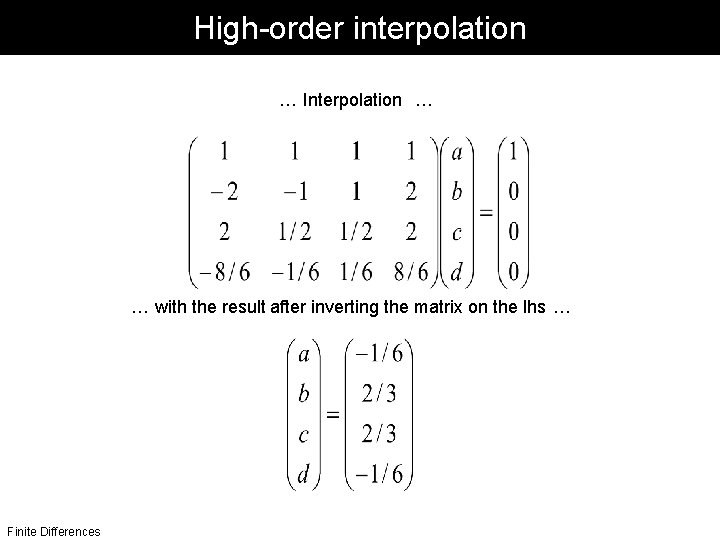
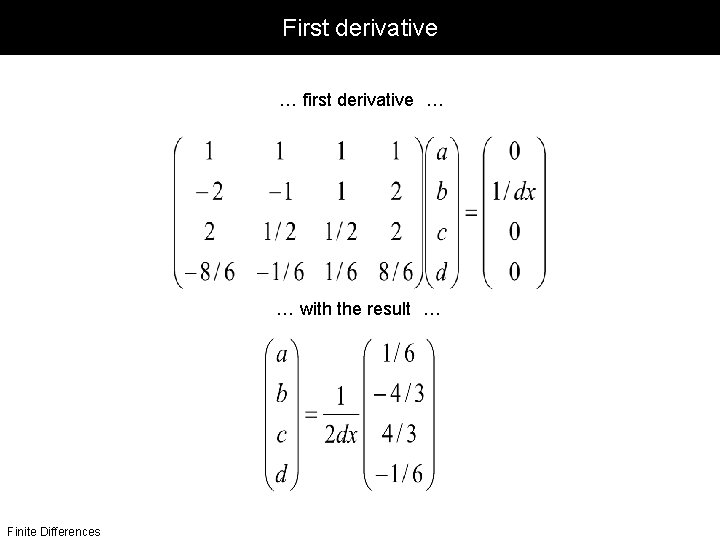
Linear system . . . if you want the interpolated value. . . you need to solve the matrix system. . . Finite Differences
High-order interpolation. . . Interpolation. . . with the result after inverting the matrix on the lhs. . . Finite Differences
First derivative. . . first derivative. . . with the result. . . Finite Differences
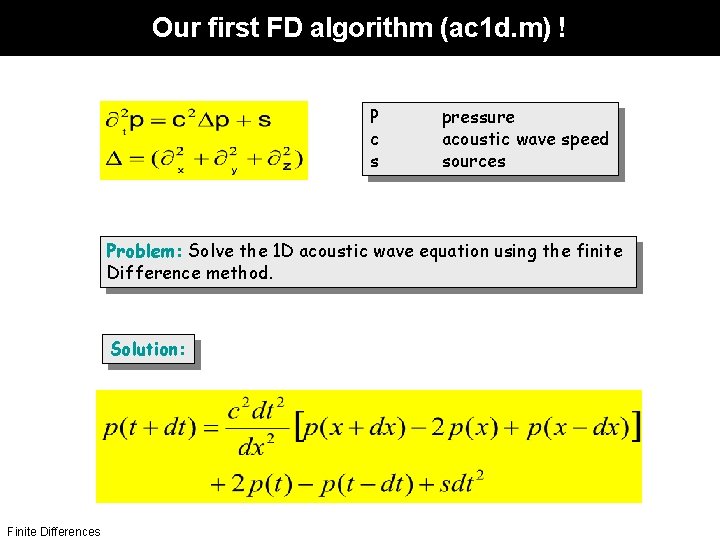
Our first FD algorithm (ac 1 d. m) ! P c s pressure acoustic wave speed sources Problem: Solve the 1 D acoustic wave equation using the finite Difference method. Solution: Finite Differences
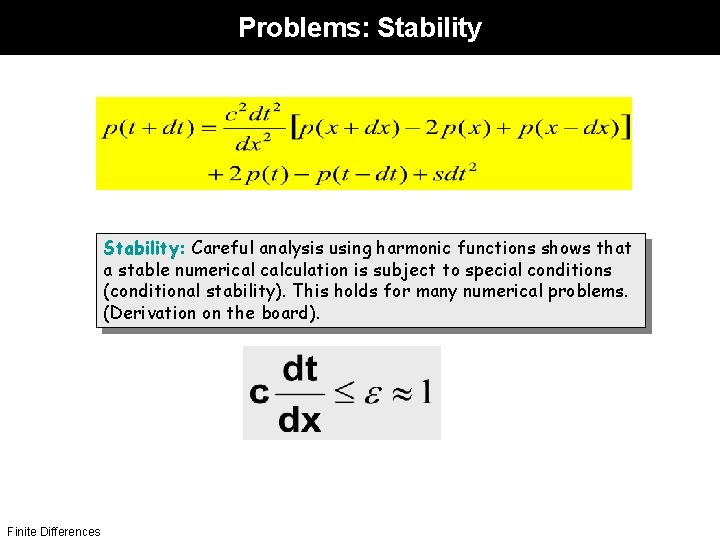
Problems: Stability: Careful analysis using harmonic functions shows that a stable numerical calculation is subject to special conditions (conditional stability). This holds for many numerical problems. (Derivation on the board). Finite Differences
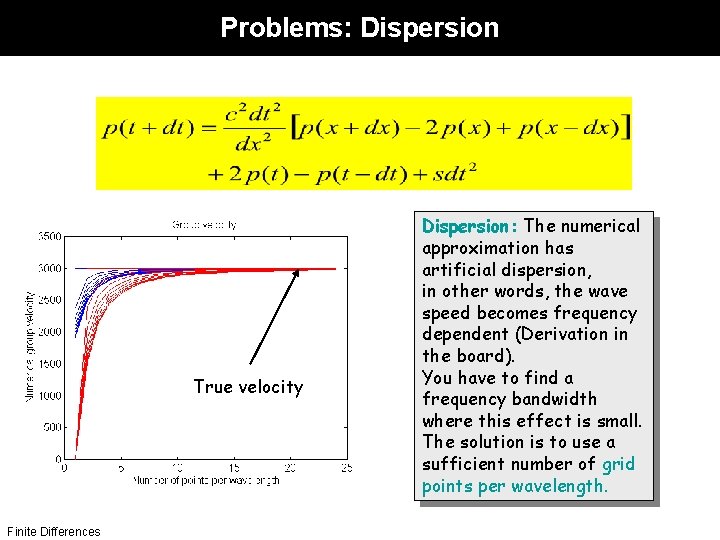
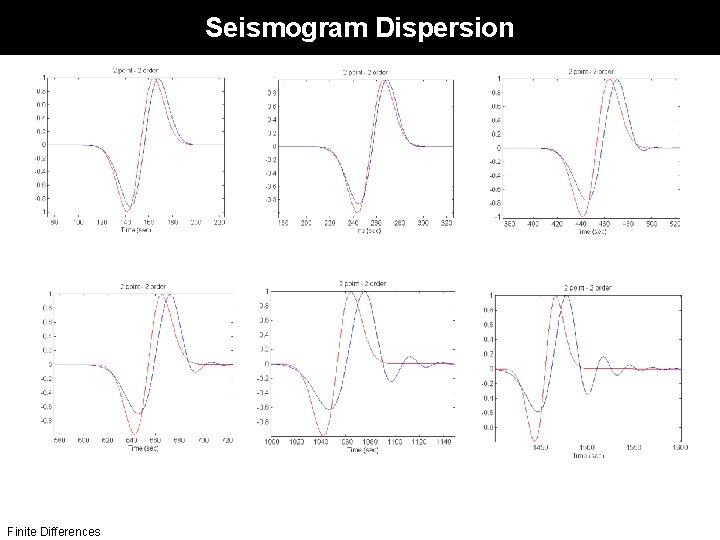
Problems: Dispersion True velocity Finite Differences Dispersion: The numerical approximation has artificial dispersion, in other words, the wave speed becomes frequency dependent (Derivation in the board). You have to find a frequency bandwidth where this effect is small. The solution is to use a sufficient number of grid points per wavelength.
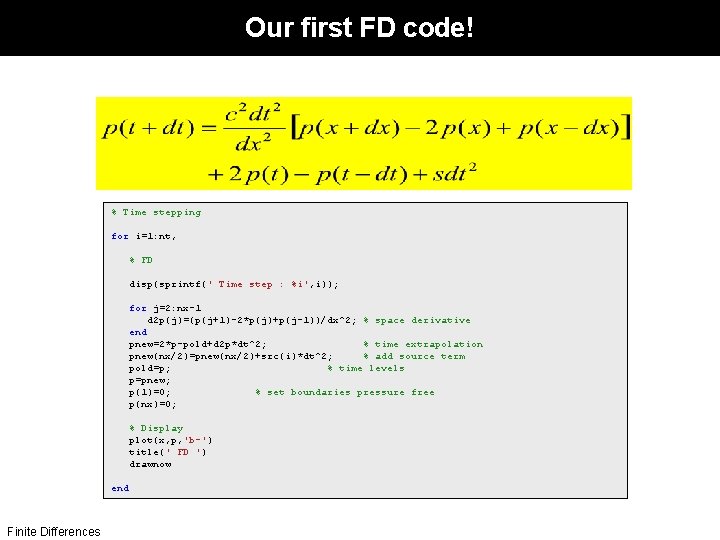
Our first FD code! % Time stepping for i=1: nt, % FD disp(sprintf(' Time step : %i', i)); for j=2: nx-1 d 2 p(j)=(p(j+1)-2*p(j)+p(j-1))/dx^2; % space derivative end pnew=2*p-pold+d 2 p*dt^2; % time extrapolation pnew(nx/2)=pnew(nx/2)+src(i)*dt^2; % add source term pold=p; % time levels p=pnew; p(1)=0; % set boundaries pressure free p(nx)=0; % Display plot(x, p, 'b-') title(' FD ') drawnow end Finite Differences
Snapshot Example Finite Differences
Seismogram Dispersion Finite Differences
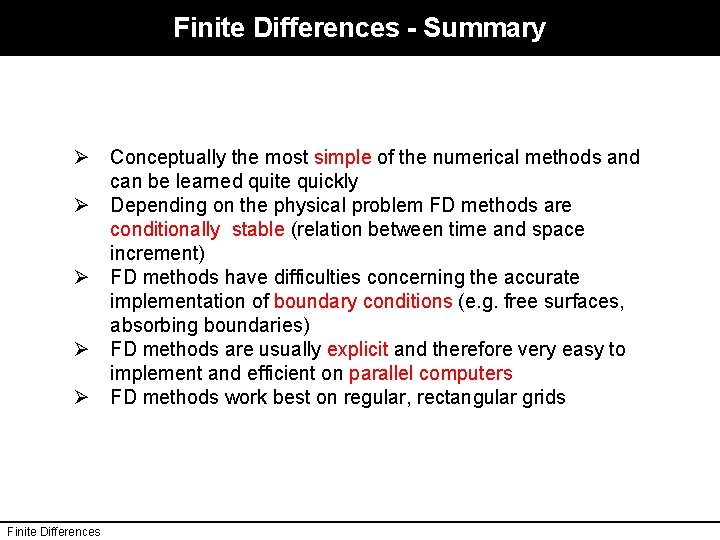
Finite Differences - Summary Ø Conceptually the most simple of the numerical methods and can be learned quite quickly Ø Depending on the physical problem FD methods are conditionally stable (relation between time and space increment) Ø FD methods have difficulties concerning the accurate implementation of boundary conditions (e. g. free surfaces, absorbing boundaries) Ø FD methods are usually explicit and therefore very easy to implement and efficient on parallel computers Ø FD methods work best on regular, rectangular grids Finite Differences