
Finite Clauses Types of Sentences Simple Compound Complex

- Slides: 28
Finite Clauses
Types of Sentences • • Simple Compound Complex
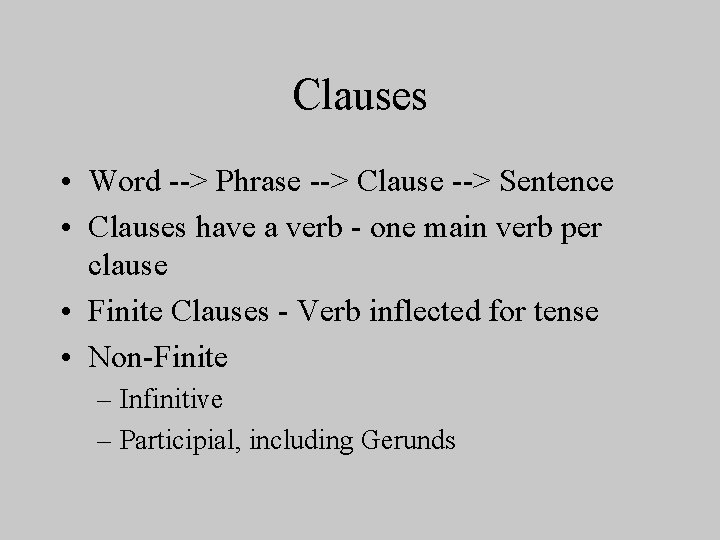
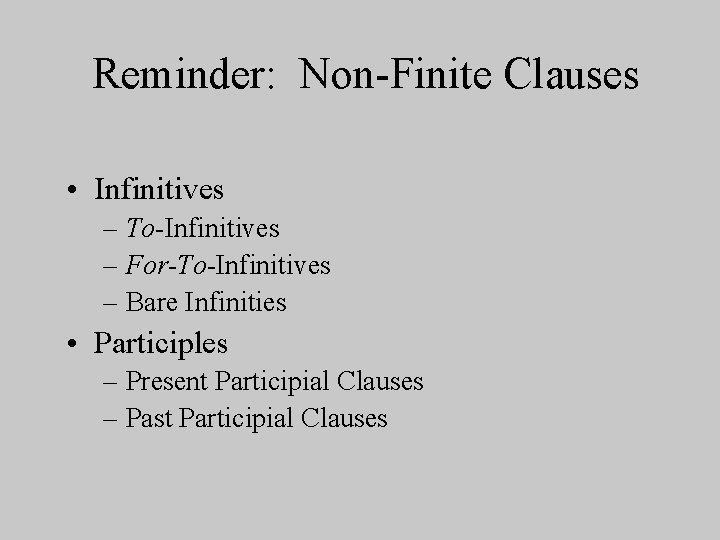
Clauses • Word --> Phrase --> Clause --> Sentence • Clauses have a verb - one main verb per clause • Finite Clauses - Verb inflected for tense • Non-Finite – Infinitive – Participial, including Gerunds
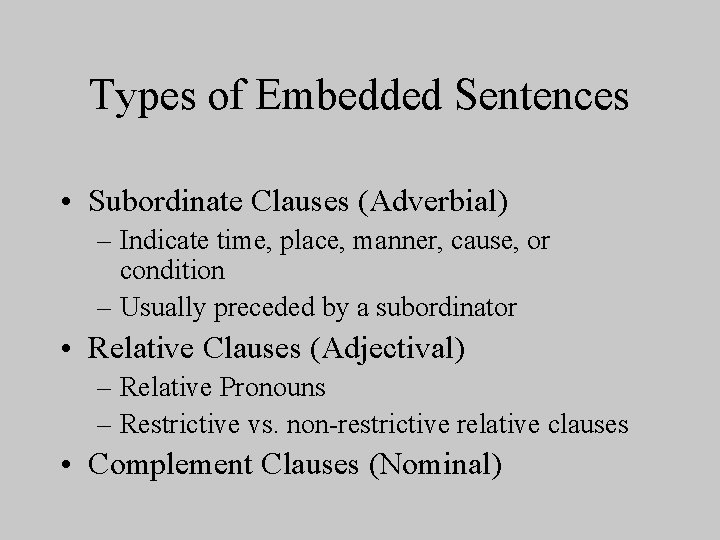
Types of Embedded Sentences • Subordinate Clauses (Adverbial) – Indicate time, place, manner, cause, or condition – Usually preceded by a subordinator • Relative Clauses (Adjectival) – Relative Pronouns – Restrictive vs. non-restrictive relative clauses • Complement Clauses (Nominal)
Complement Clauses • Appear as an NP • Can be the subject of the sentence [That you like bananas] is surprising. • Can be an object I know [that you like bananas. ] • Can be replaced by a pronoun (It is surprising; I know it. ) • That is a complementizer.
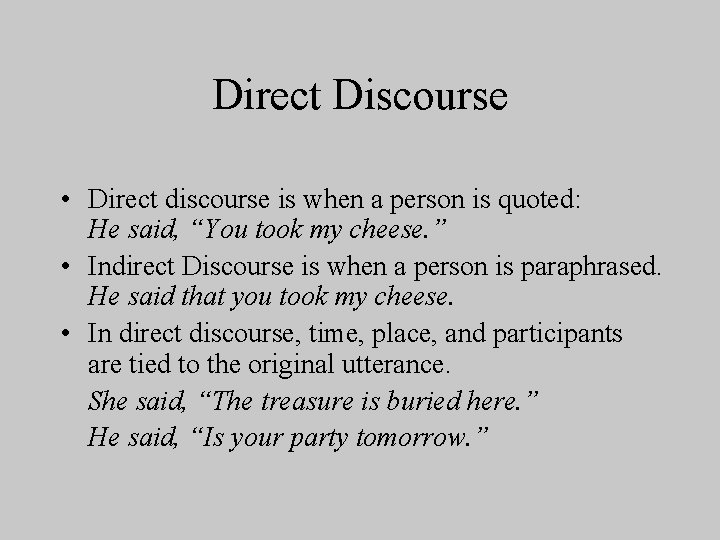
Direct Discourse • Direct discourse is when a person is quoted: He said, “You took my cheese. ” • Indirect Discourse is when a person is paraphrased. He said that you took my cheese. • In direct discourse, time, place, and participants are tied to the original utterance. She said, “The treasure is buried here. ” He said, “Is your party tomorrow. ”
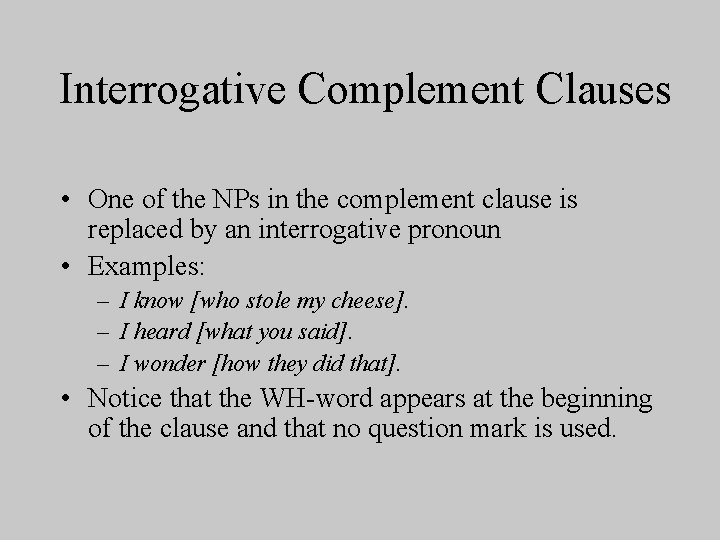
Interrogative Complement Clauses • One of the NPs in the complement clause is replaced by an interrogative pronoun • Examples: – I know [who stole my cheese]. – I heard [what you said]. – I wonder [how they did that]. • Notice that the WH-word appears at the beginning of the clause and that no question mark is used.
Non-Finite Clauses
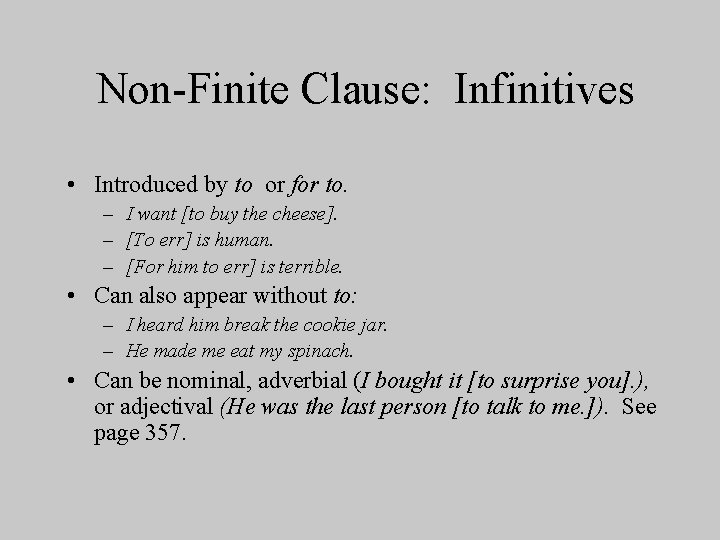
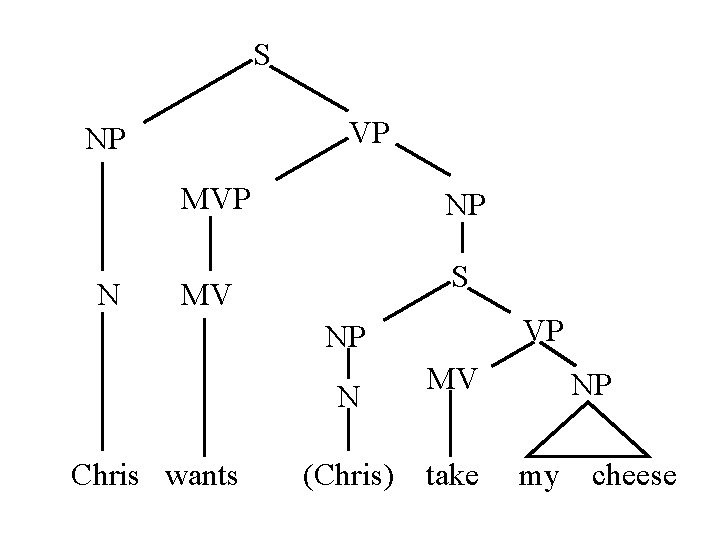
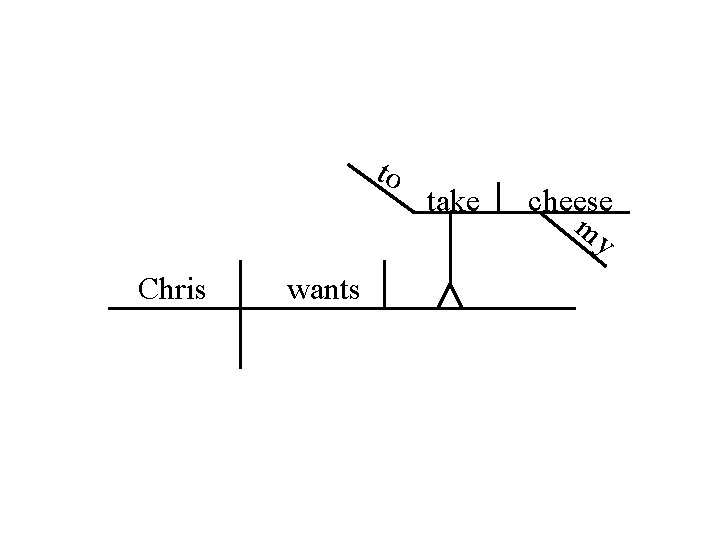
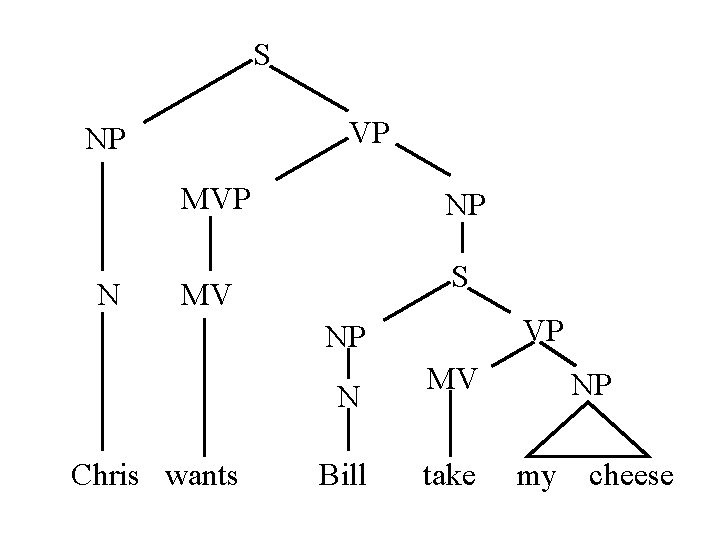
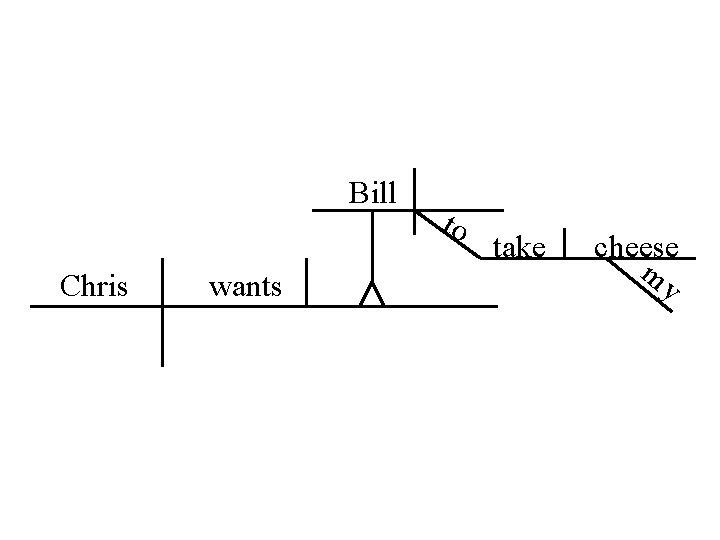
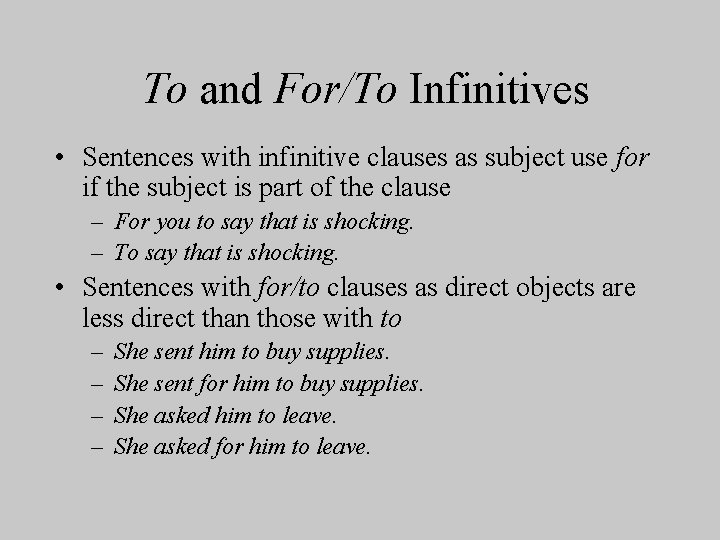
Non-Finite Clause: Infinitives • Introduced by to or for to. – I want [to buy the cheese]. – [To err] is human. – [For him to err] is terrible. • Can also appear without to: – I heard him break the cookie jar. – He made me eat my spinach. • Can be nominal, adverbial (I bought it [to surprise you]. ), or adjectival (He was the last person [to talk to me. ]). See page 357.
S VP NP MVP N NP S MV VP NP N Chris wants (Chris) MV take NP my cheese
to Chris wants take cheese my
S VP NP MVP N NP S MV VP NP N Chris wants Bill MV take NP my cheese
Bill Chris wants to take cheese my
To and For/To Infinitives • Sentences with infinitive clauses as subject use for if the subject is part of the clause – For you to say that is shocking. – To say that is shocking. • Sentences with for/to clauses as direct objects are less direct than those with to – – She sent him to buy supplies. She sent for him to buy supplies. She asked him to leave. She asked for him to leave.
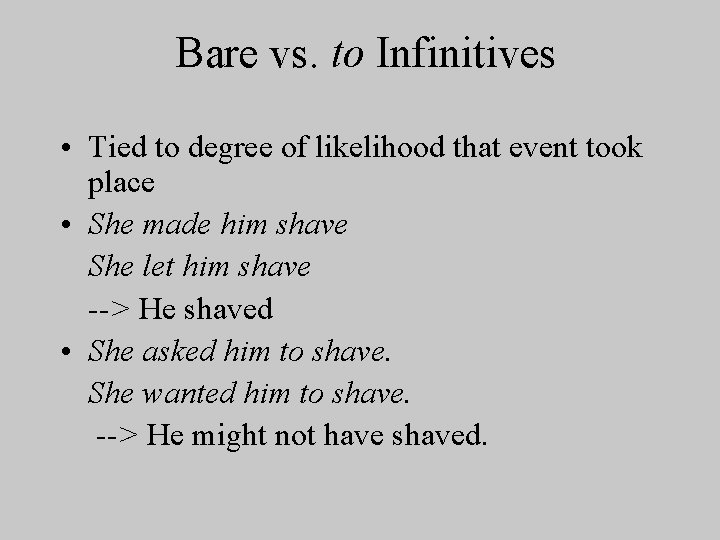
Bare vs. to Infinitives • Tied to degree of likelihood that event took place • She made him shave She let him shave --> He shaved • She asked him to shave. She wanted him to shave. --> He might not have shaved.
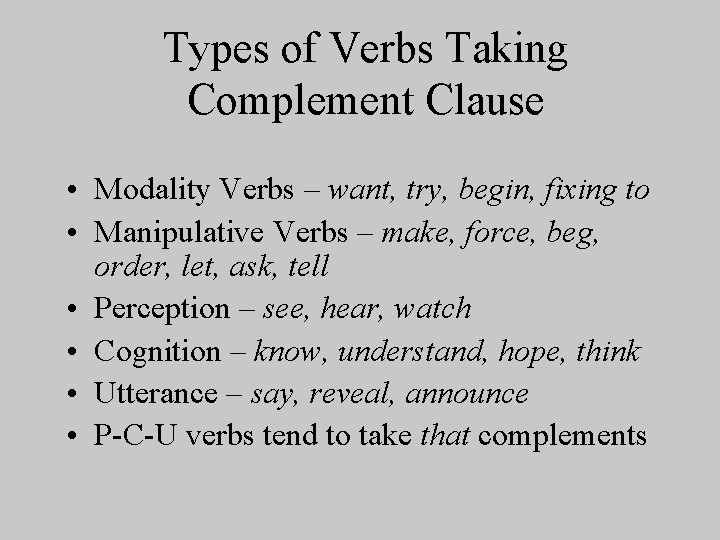
Types of Verbs Taking Complement Clause • Modality Verbs – want, try, begin, fixing to • Manipulative Verbs – make, force, beg, order, let, ask, tell • Perception – see, hear, watch • Cognition – know, understand, hope, think • Utterance – say, reveal, announce • P-C-U verbs tend to take that complements
Reminder: Non-Finite Clauses • Infinitives – To-Infinitives – For-To-Infinitives – Bare Infinities • Participles – Present Participial Clauses – Past Participial Clauses
Participial Clauses
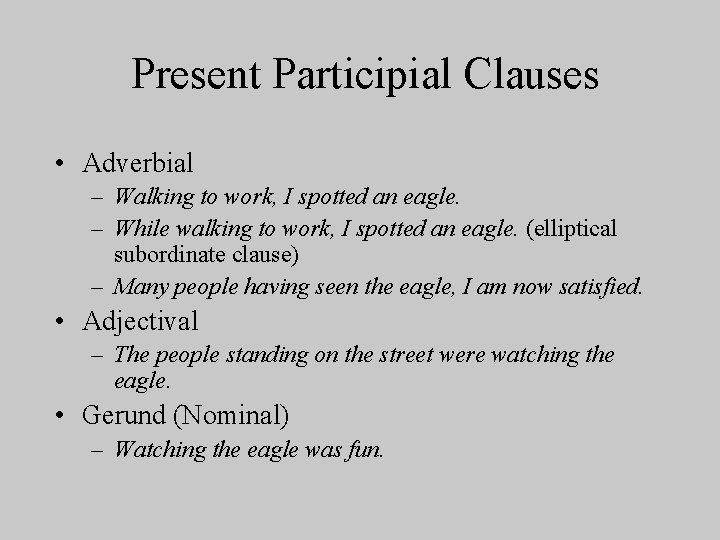
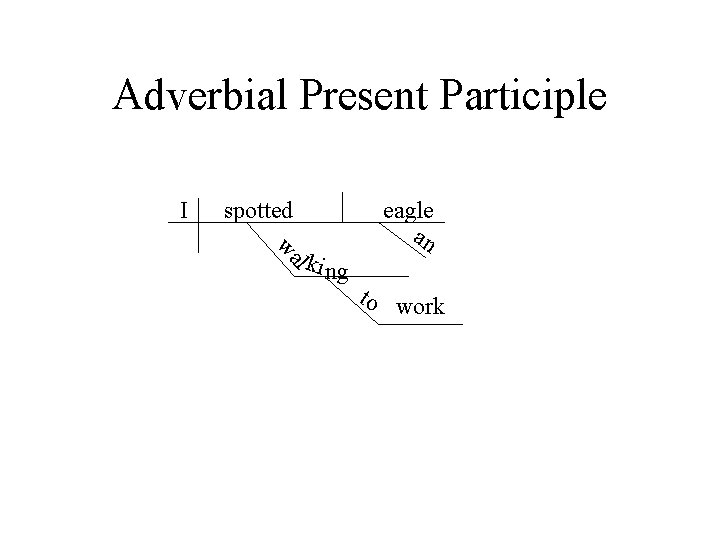
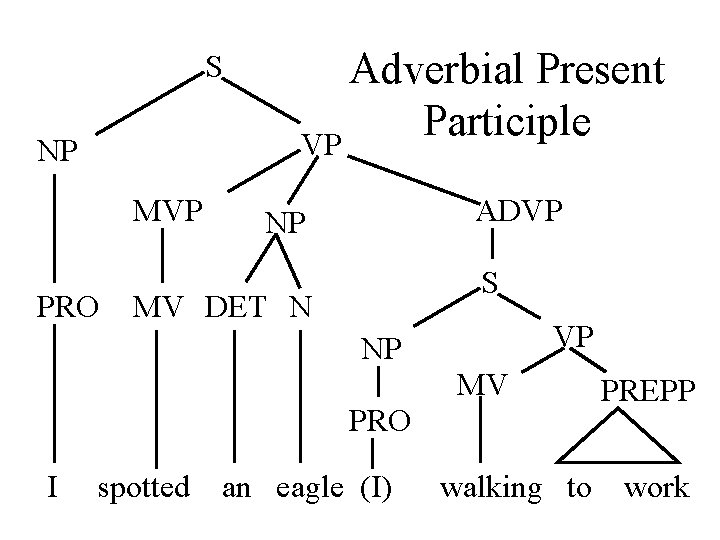
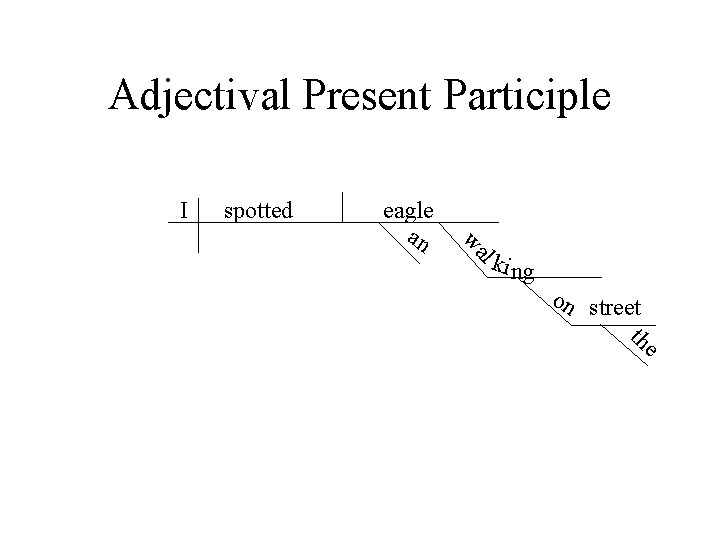
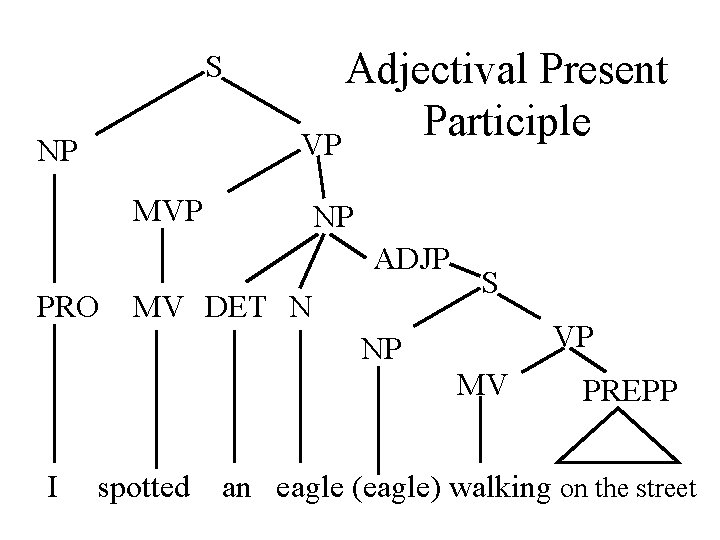
Present Participial Clauses • Adverbial – Walking to work, I spotted an eagle. – While walking to work, I spotted an eagle. (elliptical subordinate clause) – Many people having seen the eagle, I am now satisfied. • Adjectival – The people standing on the street were watching the eagle. • Gerund (Nominal) – Watching the eagle was fun.
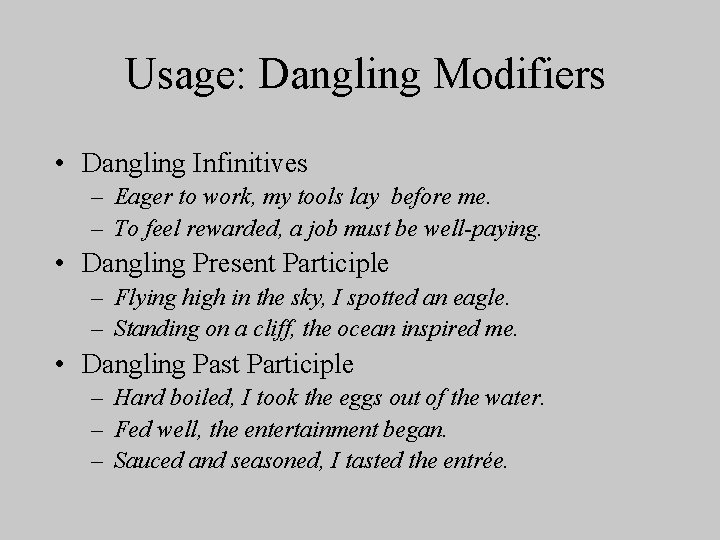
Usage: Dangling Modifiers • Dangling Infinitives – Eager to work, my tools lay before me. – To feel rewarded, a job must be well-paying. • Dangling Present Participle – Flying high in the sky, I spotted an eagle. – Standing on a cliff, the ocean inspired me. • Dangling Past Participle – Hard boiled, I took the eggs out of the water. – Fed well, the entertainment began. – Sauced and seasoned, I tasted the entrée.
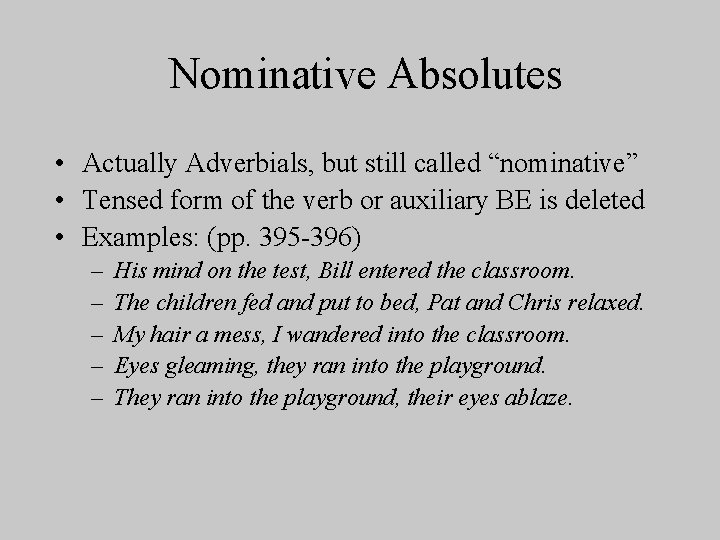
Nominative Absolutes • Actually Adverbials, but still called “nominative” • Tensed form of the verb or auxiliary BE is deleted • Examples: (pp. 395 -396) – – – His mind on the test, Bill entered the classroom. The children fed and put to bed, Pat and Chris relaxed. My hair a mess, I wandered into the classroom. Eyes gleaming, they ran into the playground. They ran into the playground, their eyes ablaze.
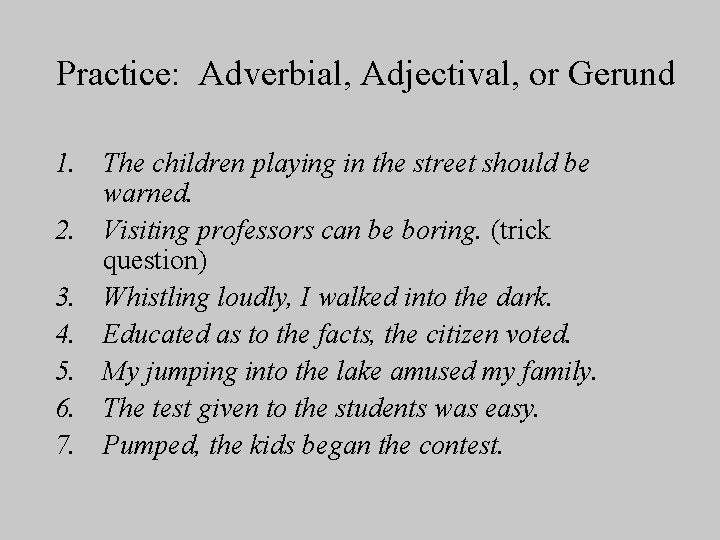
Practice: Adverbial, Adjectival, or Gerund 1. The children playing in the street should be warned. 2. Visiting professors can be boring. (trick question) 3. Whistling loudly, I walked into the dark. 4. Educated as to the facts, the citizen voted. 5. My jumping into the lake amused my family. 6. The test given to the students was easy. 7. Pumped, the kids began the contest.
Adverbial Present Participle I spotted wa l ki ng eagle an to work
S NP MVP PRO Adverbial Present Participle VP ADVP NP S MV DET N VP NP MV PRO I spotted an eagle (I) walking to PREPP work
Adjectival Present Participle I spotted wa eagle an l ki ng on street th e
S NP Adjectival Present Participle VP MVP NP ADJP PRO MV DET N S VP NP MV I spotted PREPP an eagle (eagle) walking on the street
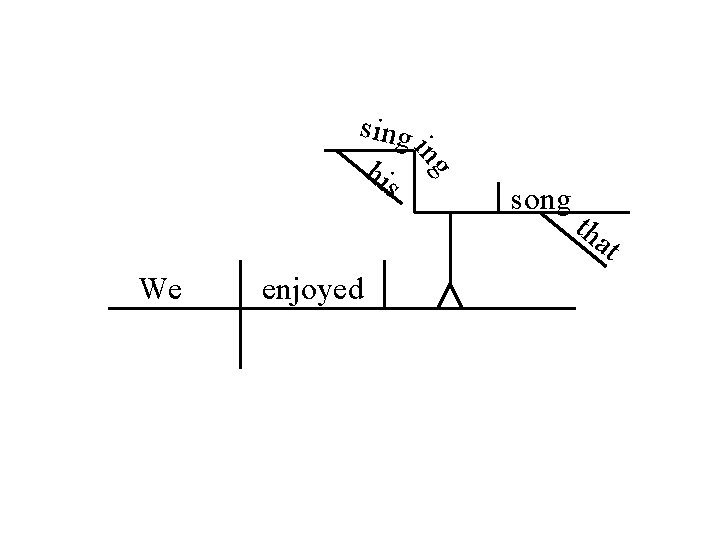
g in sing his song tha t We enjoyed
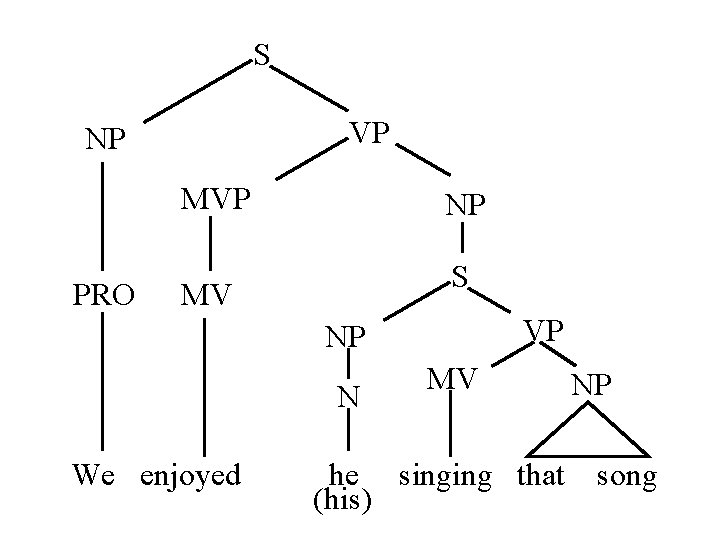
S VP NP MVP PRO NP S MV VP NP N We enjoyed MV he singing that (his) NP song