
Finite Automata FiniteState Automata FSA is a mathematical
- Slides: 18
Finite Automata
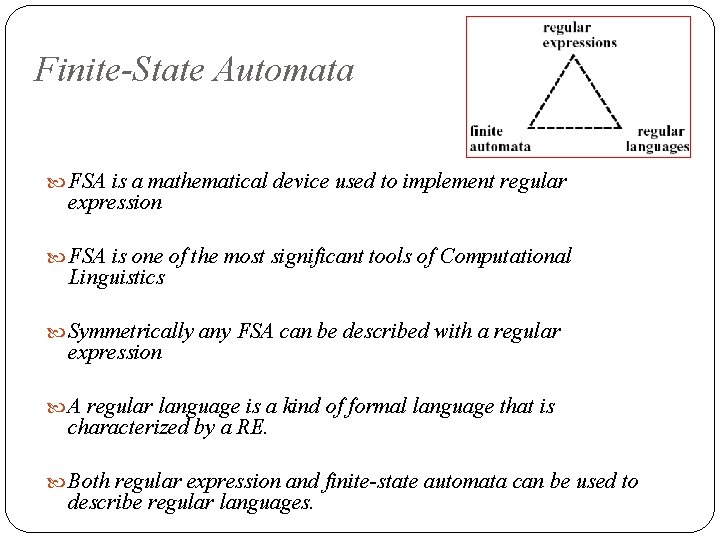
Finite-State Automata FSA is a mathematical device used to implement regular expression FSA is one of the most significant tools of Computational Linguistics Symmetrically any FSA can be described with a regular expression A regular language is a kind of formal language that is characterized by a RE. Both regular expression and finite-state automata can be used to 2 describe regular languages.
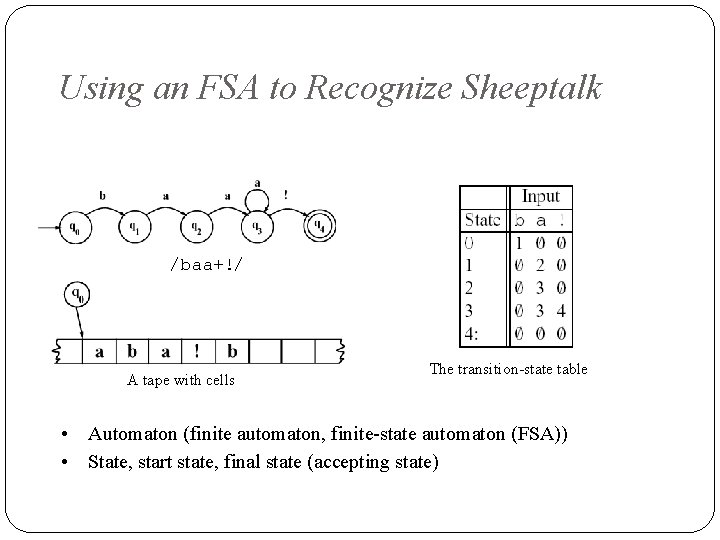
Using an FSA to Recognize Sheeptalk /baa+!/ A tape with cells The transition-state table • Automaton (finite automaton, finite-state automaton (FSA)) • State, start state, final state (accepting state) 3
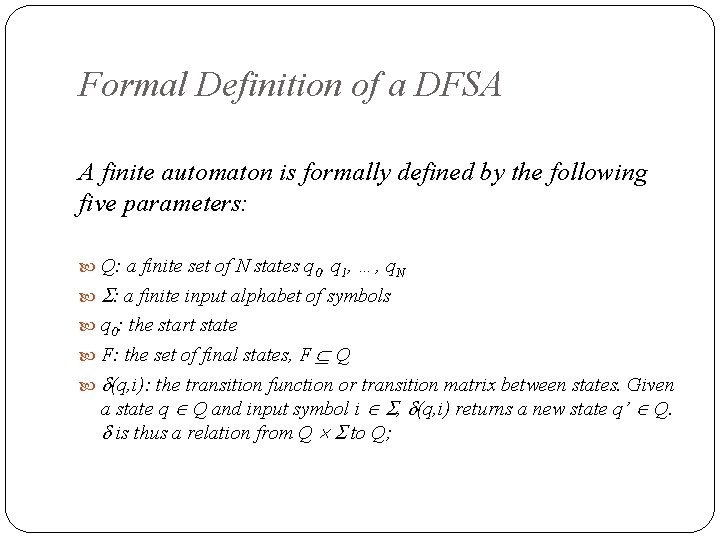
Formal Definition of a DFSA A finite automaton is formally defined by the following five parameters: Q: a finite set of N states q 0, q 1, …, q. N : a finite input alphabet of symbols q 0: the start state F: the set of final states, F Q (q, i): the transition function or transition matrix between states. Given a state q Q and input symbol i , (q, i) returns a new state q’ Q. is thus a relation from Q to Q; 4
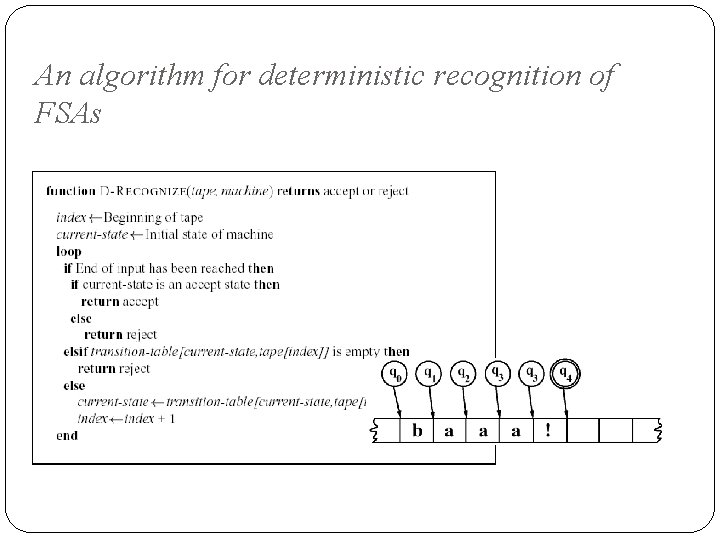
An algorithm for deterministic recognition of FSAs 5
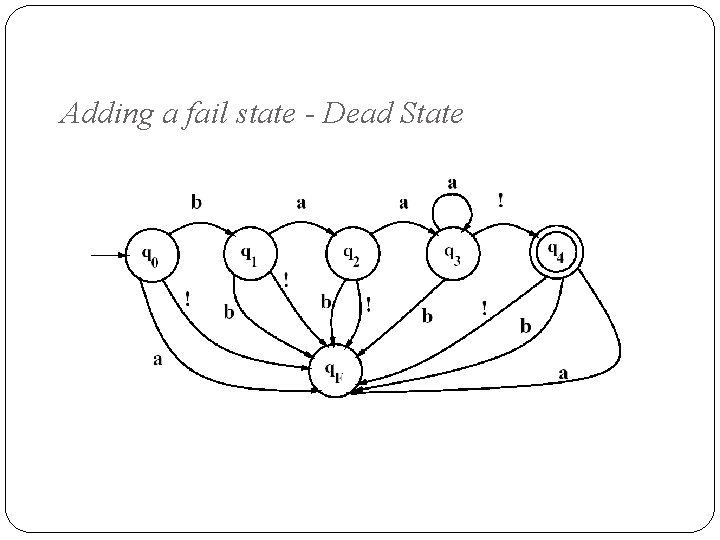
Adding a fail state - Dead State 6
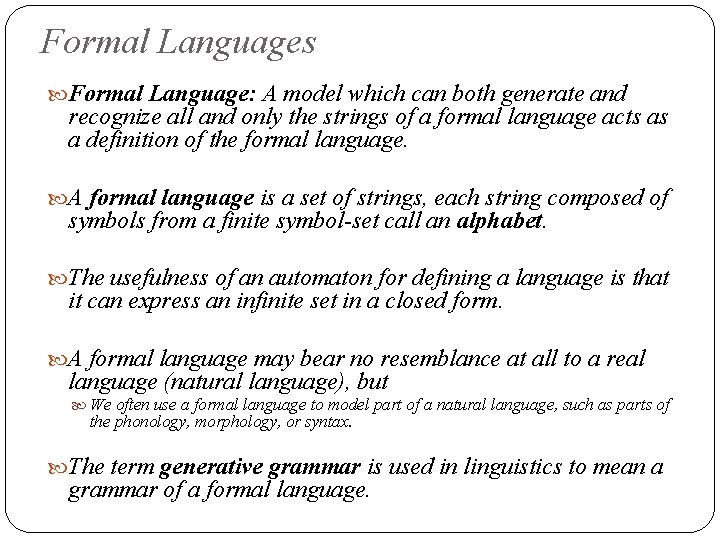
Formal Languages Formal Language: A model which can both generate and recognize all and only the strings of a formal language acts as a definition of the formal language. A formal language is a set of strings, each string composed of symbols from a finite symbol-set call an alphabet. The usefulness of an automaton for defining a language is that it can express an infinite set in a closed form. A formal language may bear no resemblance at all to a real language (natural language), but We often use a formal language to model part of a natural language, such as parts of the phonology, morphology, or syntax. The term generative grammar is used in linguistics to mean a 7 grammar of a formal language.
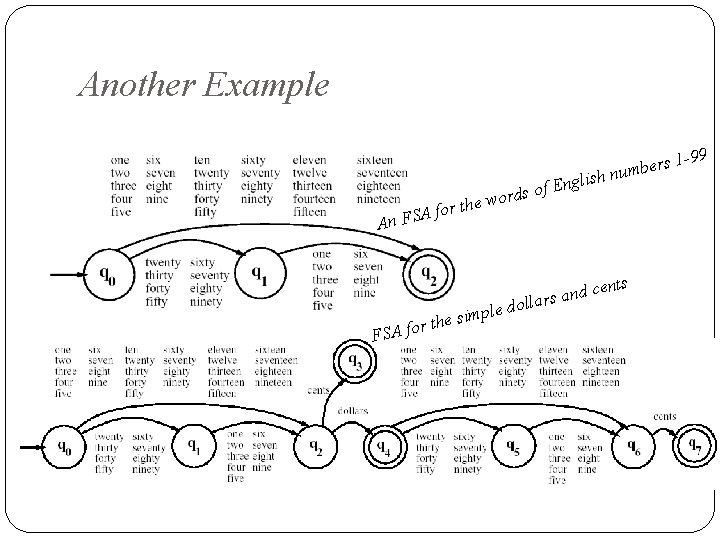
Another Example -99 rds wo e h t r A fo rs 1 e b m u lish n g n E f o An FS nts r the o f A S F 8 sim d ce n a s r a ll ple do
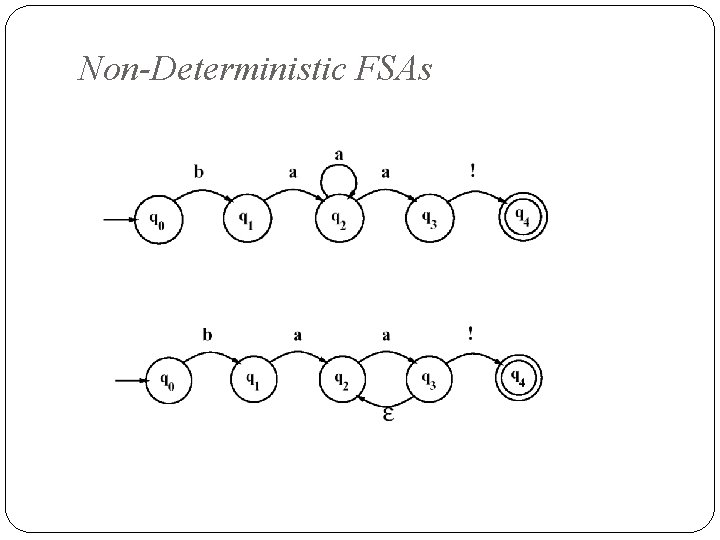
Non-Deterministic FSAs 9
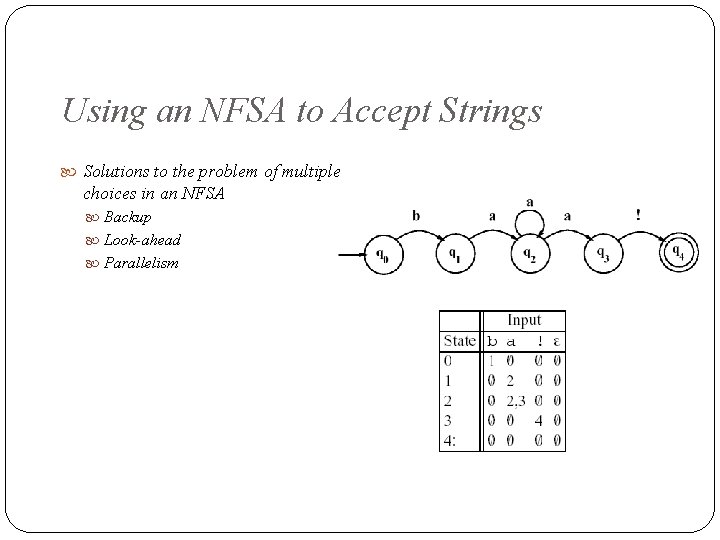
Using an NFSA to Accept Strings Solutions to the problem of multiple choices in an NFSA Backup Look-ahead Parallelism 10
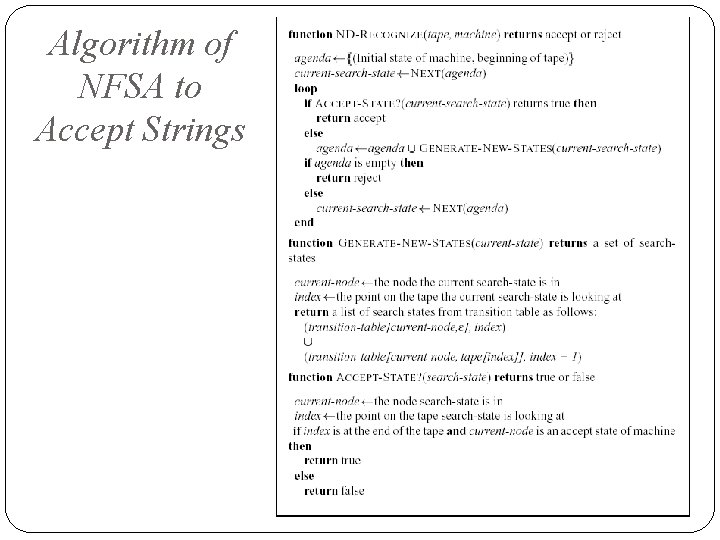
Algorithm of NFSA to Accept Strings 11
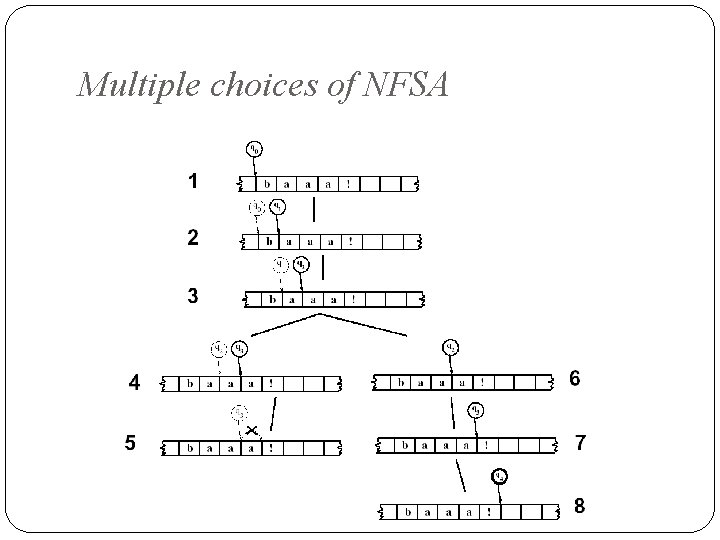
Multiple choices of NFSA 12
2. 2 Finite-State Automata Recognition as Search Algorithms such as ND-RECOGNIZE are known as state-space search Depth-first search or Last In First Out (LIFO) strategy Breadth-first search or First In First Out (FIFO) strategy More complex search techniques such as dynamic programming or A* 13
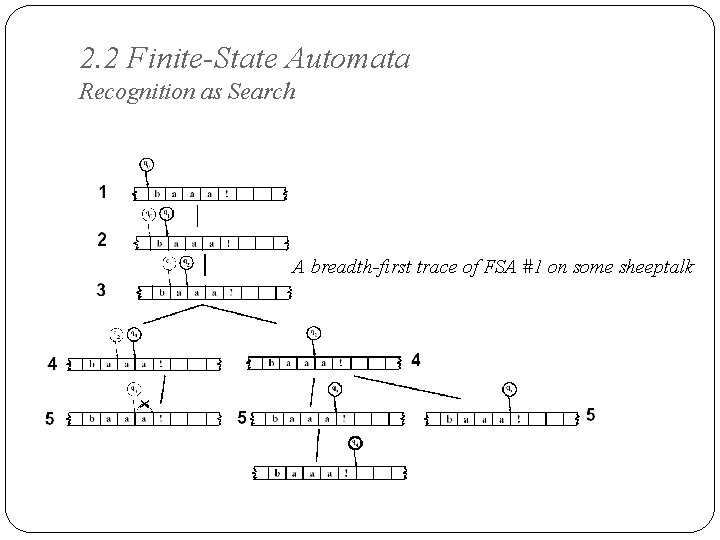
2. 2 Finite-State Automata Recognition as Search A breadth-first trace of FSA #1 on some sheeptalk 14
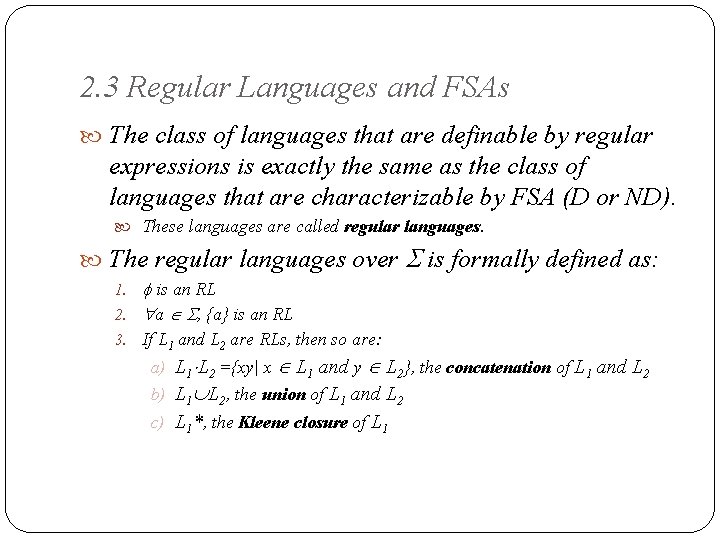
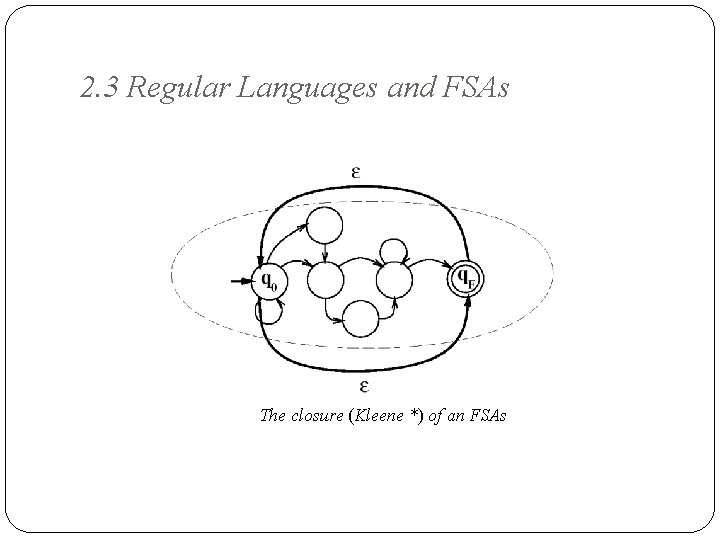
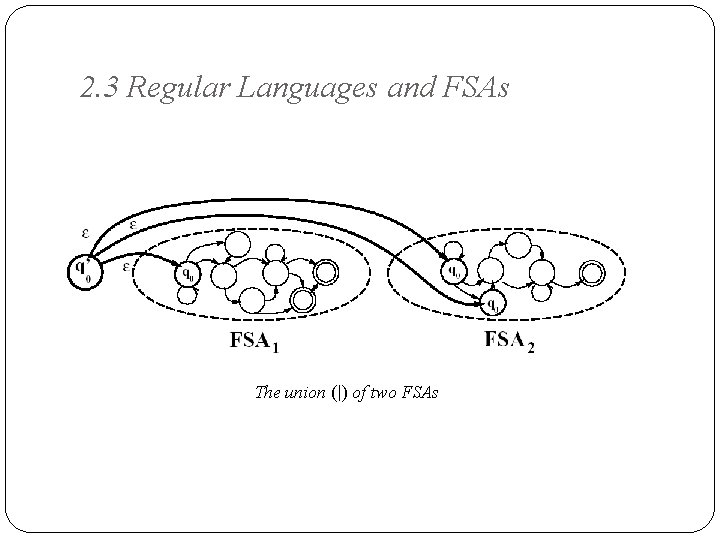
2. 3 Regular Languages and FSAs The class of languages that are definable by regular expressions is exactly the same as the class of languages that are characterizable by FSA (D or ND). These languages are called regular languages. The regular languages over is formally defined as: is an RL 2. a , {a} is an RL 1. 3. If L 1 and L 2 are RLs, then so are: a) L 1 L 2 ={xy| x L 1 and y L 2}, the concatenation of L 1 and L 2 b) L 1 L 2, the union of L 1 and L 2 c) L 1*, the Kleene closure of L 1 15
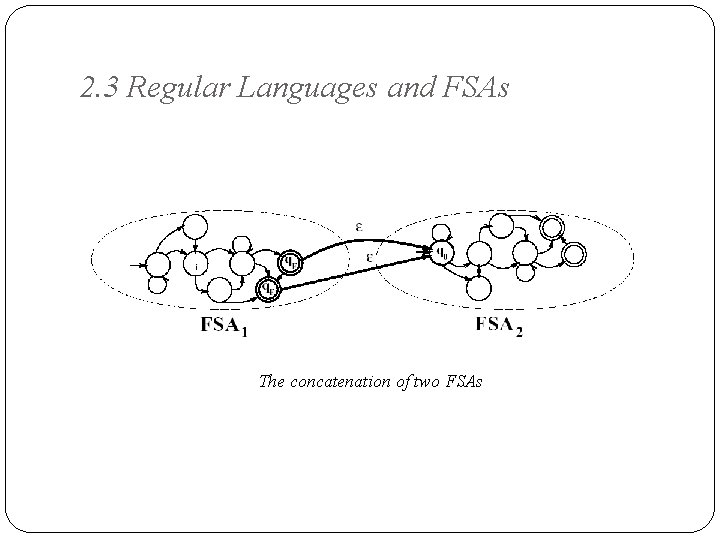
2. 3 Regular Languages and FSAs The concatenation of two FSAs 16
2. 3 Regular Languages and FSAs The closure (Kleene *) of an FSAs 17
2. 3 Regular Languages and FSAs The union (|) of two FSAs 18