
Finite and renewable resources Grade 1 3 4
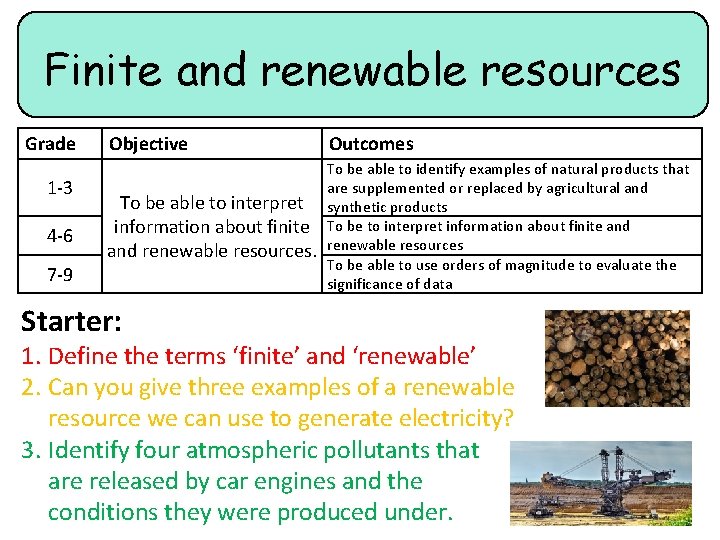
Finite and renewable resources Grade 1 -3 4 -6 7 -9 Objective Outcomes To be able to interpret information about finite and renewable resources. To be able to identify examples of natural products that are supplemented or replaced by agricultural and synthetic products To be to interpret information about finite and renewable resources To be able to use orders of magnitude to evaluate the significance of data Starter: 1. Define the terms ‘finite’ and ‘renewable’ 2. Can you give three examples of a renewable resource we can use to generate electricity? 3. Identify four atmospheric pollutants that are released by car engines and the conditions they were produced under.
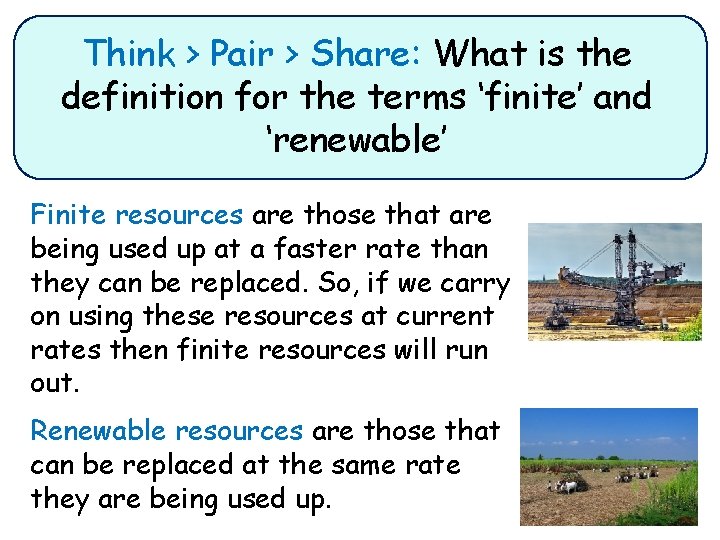
Think > Pair > Share: What is the definition for the terms ‘finite’ and ‘renewable’ Finite resources are those that are being used up at a faster rate than they can be replaced. So, if we carry on using these resources at current rates then finite resources will run out. Renewable resources are those that can be replaced at the same rate they are being used up.
Task: Watch the video and answer the following questions: https: //www. youtube. com/watch? v=1 UQn. UQR 0 t. To 1. Humans use many of the Earth’s resources, can you give four examples of how these resources are used? 2. Can you give two examples by which agricultural has helped us to use the Earth’s natural resources more sustainable? 3. Define the term ‘synthetic’ 4. Give two examples of a finite resource. 5. Give one example of a renewable resource. 6. What does the term ‘sustainable’ mean?
Self-assessment: 1. Humans use the Earth’s resources for warmth, shelter, food and transport. 2. Cotton, which is produced by a plant, is grown in sufficient quantities to meet the demands of the world. In addition, trees are grown for timber and fuel. 3. Synthetic means that it is a man-made material. 4. Two examples of finite resources are fossil fuels and metals. 5. One example of a renewable resource is wood. 6. Sustainability means that we meeting the needs of our generation without compromising the ability to meet the needs of future generations.

Finite resources The chemical industry uses natural resources as raw materials to make new products: • Crude oil is used to make polymers and petrochemicals • Crude oil is also used to produce fuels such as petrol, diesel and kerosene. • Metals ores are needed to extract metal • Limestone is used to make cement How quickly these finite resources may run out depends on several uncertain factors. In pairs, discuss what these factors might be.

We are unsure of the exact quantities of certain finite resources left on Earth. Are there areas on Earth, with a fresh supply of finite resources, that we are yet to discover? Uncertainties surrounding estimates of how long finite resources will last. The effect of recycling finite resources, in order to ensure that they last longer. The rate at which we are currently using finite resources may change in the future, this is hard to predict
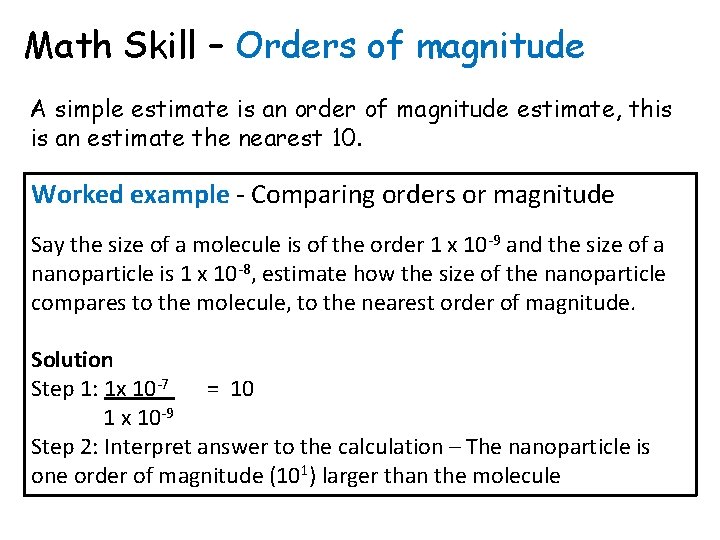
Math Skill – Orders of magnitude A simple estimate is an order of magnitude estimate, this is an estimate the nearest 10. Worked example - Comparing orders or magnitude Say the size of a molecule is of the order 1 x 10 -9 and the size of a nanoparticle is 1 x 10 -8, estimate how the size of the nanoparticle compares to the molecule, to the nearest order of magnitude. Solution Step 1: 1 x 10 -7 = 10 1 x 10 -9 Step 2: Interpret answer to the calculation – The nanoparticle is one order of magnitude (101) larger than the molecule
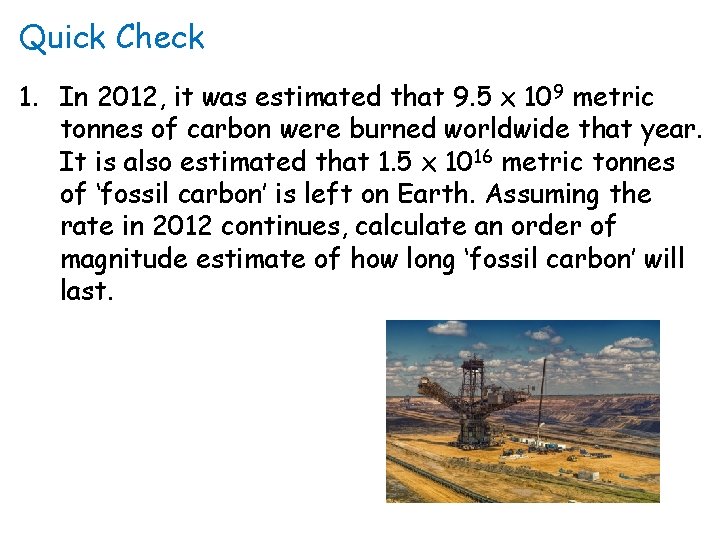
Quick Check 1. In 2012, it was estimated that 9. 5 x 10⁹ metric tonnes of carbon were burned worldwide that year. It is also estimated that 1. 5 x 10¹⁶ metric tonnes of ‘fossil carbon’ is left on Earth. Assuming the rate in 2012 continues, calculate an order of magnitude estimate of how long ‘fossil carbon’ will last.
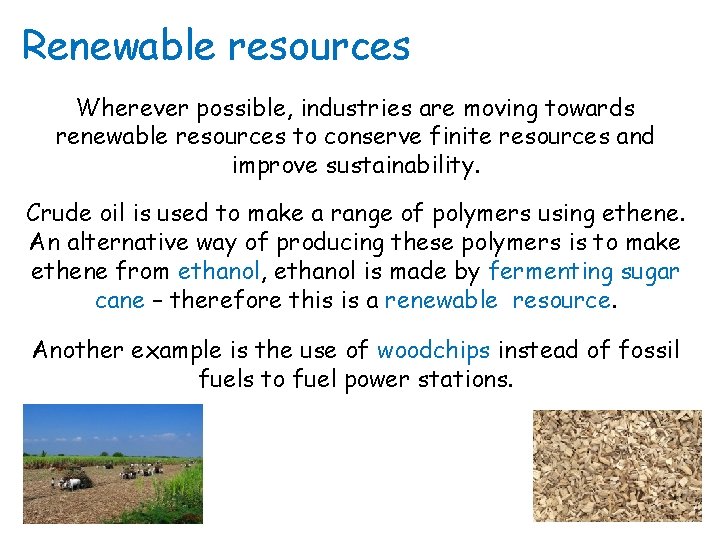
Renewable resources Wherever possible, industries are moving towards renewable resources to conserve finite resources and improve sustainability. Crude oil is used to make a range of polymers using ethene. An alternative way of producing these polymers is to make ethene from ethanol, ethanol is made by fermenting sugar cane – therefore this is a renewable resource. Another example is the use of woodchips instead of fossil fuels to fuel power stations.
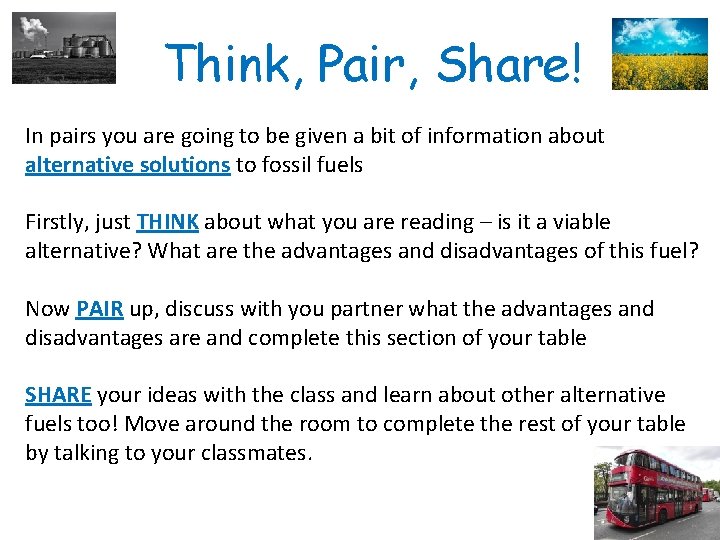
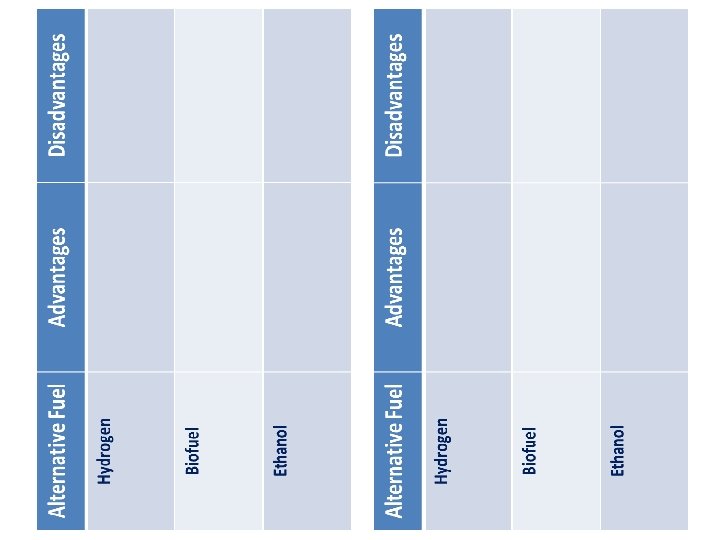
Think, Pair, Share! In pairs you are going to be given a bit of information about alternative solutions to fossil fuels Firstly, just THINK about what you are reading – is it a viable alternative? What are the advantages and disadvantages of this fuel? Now PAIR up, discuss with you partner what the advantages and disadvantages are and complete this section of your table SHARE your ideas with the class and learn about other alternative fuels too! Move around the room to complete the rest of your table by talking to your classmates.
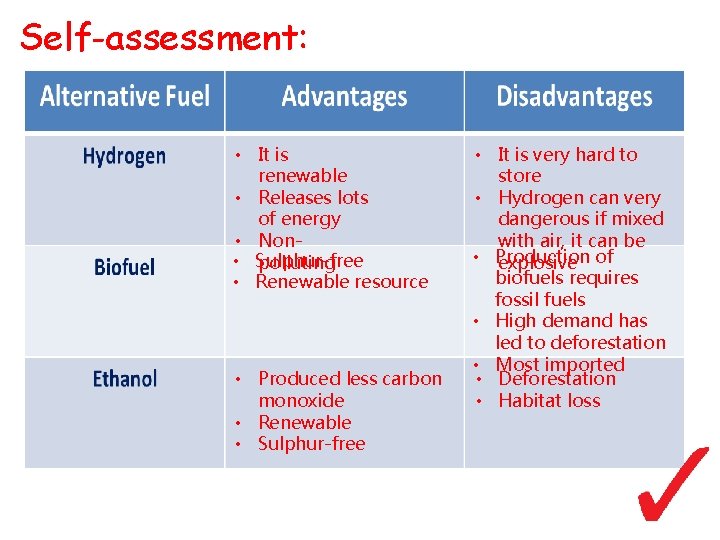
Self-assessment: • It is renewable • Releases lots of energy • Non • Sulphur-free polluting • Renewable resource • Produced less carbon monoxide • Renewable • Sulphur-free • It is very hard to store • Hydrogen can very dangerous if mixed with air, it can be • Production explosive of biofuels requires fossil fuels • High demand has led to deforestation • Most imported • Deforestation • Habitat loss
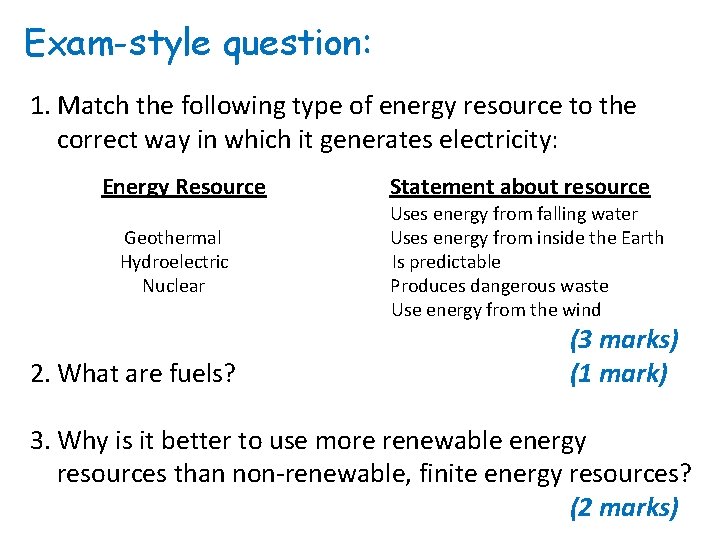
Exam-style question: 1. Match the following type of energy resource to the correct way in which it generates electricity: Energy Resource Geothermal Hydroelectric Nuclear 2. What are fuels? Statement about resource Uses energy from falling water Uses energy from inside the Earth Is predictable Produces dangerous waste Use energy from the wind (3 marks) (1 mark) 3. Why is it better to use more renewable energy resources than non-renewable, finite energy resources? (2 marks)
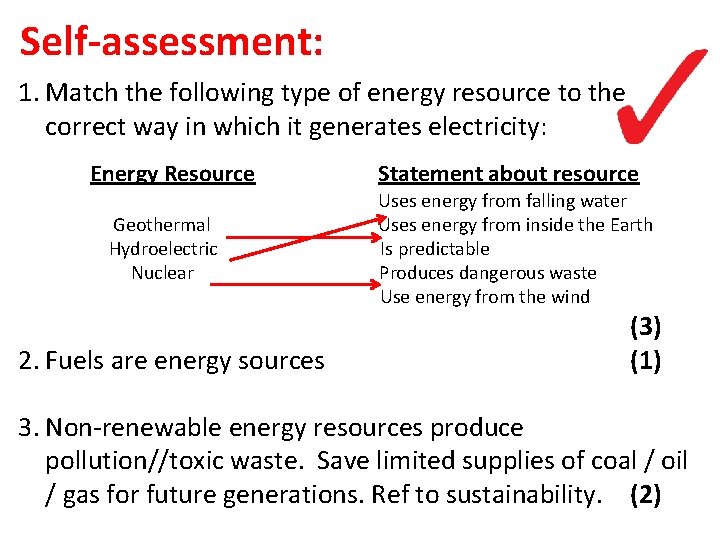
Self-assessment: 1. Match the following type of energy resource to the correct way in which it generates electricity: Energy Resource Geothermal Hydroelectric Nuclear 2. Fuels are energy sources Statement about resource Uses energy from falling water Uses energy from inside the Earth Is predictable Produces dangerous waste Use energy from the wind (3) (1) 3. Non-renewable energy resources produce pollution//toxic waste. Save limited supplies of coal / oil / gas for future generations. Ref to sustainability. (2)
Plenary ~ Complete one of the following sentences in your book: One thing I must remember from today’s lesson is… Before this lesson I already knew how to … Today I have learnt that … I still don’t understand ….
Resources
3. 4. 5. 6. 2. 1. Humans use many of the Earth’s resources, can you give four examples of how these resources are used? Can you give two examples by which agricultural has helped us to use the Earth’s natural resources more sustainable? Define the term ‘synthetic’ Give two examples of a finite resource. Give one example of a renewable resource. What does the term ‘sustainable’ mean?
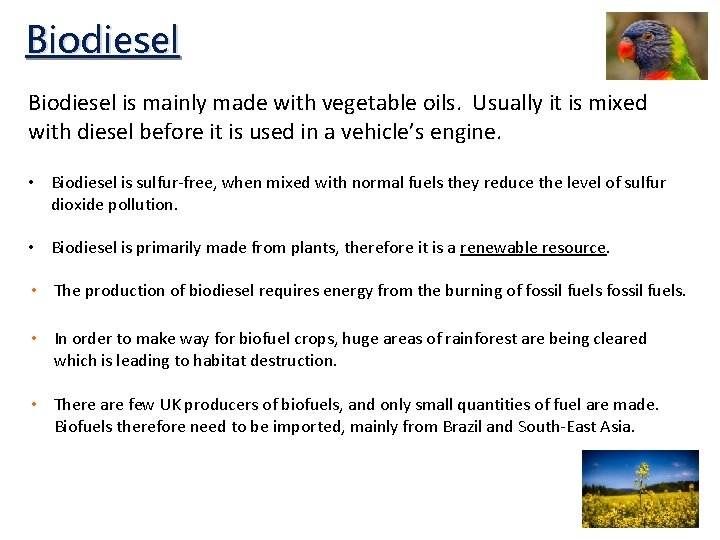
Biodiesel is mainly made with vegetable oils. Usually it is mixed with diesel before it is used in a vehicle’s engine. • Biodiesel is sulfur-free, when mixed with normal fuels they reduce the level of sulfur dioxide pollution. • Biodiesel is primarily made from plants, therefore it is a renewable resource. • The production of biodiesel requires energy from the burning of fossil fuels. • In order to make way for biofuel crops, huge areas of rainforest are being cleared which is leading to habitat destruction. • There are few UK producers of biofuels, and only small quantities of fuel are made. Biofuels therefore need to be imported, mainly from Brazil and South-East Asia.
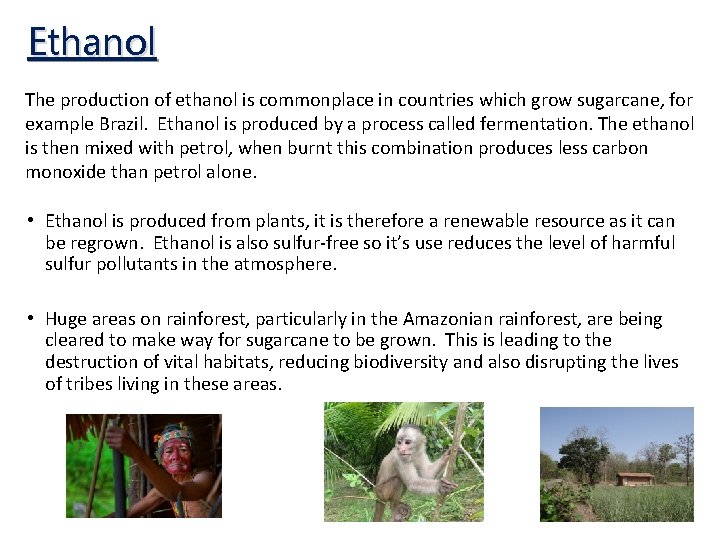
Ethanol The production of ethanol is commonplace in countries which grow sugarcane, for example Brazil. Ethanol is produced by a process called fermentation. The ethanol is then mixed with petrol, when burnt this combination produces less carbon monoxide than petrol alone. • Ethanol is produced from plants, it is therefore a renewable resource as it can be regrown. Ethanol is also sulfur-free so it’s use reduces the level of harmful sulfur pollutants in the atmosphere. • Huge areas on rainforest, particularly in the Amazonian rainforest, are being cleared to make way for sugarcane to be grown. This is leading to the destruction of vital habitats, reducing biodiversity and also disrupting the lives of tribes living in these areas.
Hydrogen, when burnt with pure oxygen, is a zero-emission fuel which can release huge amounts of energy. It is also ideal as it renewable. The only downside is that it cannot be used in normal engines. One way the energy from this reaction is currently being harnessed is in hydrogen fuel cells, which generate electricity to power electric vehicles. • Hydrogen can be very explosive. • Hydrogen is difficult to store, it needs to be kept cool and compressed to be stored as a gas • Only a small amount of hydrogen is needed to release a huge amount of energy • Hydrogen reacts with oxygen when burnt to release water vapour only – no harmful gases
- Slides: 20