
Finish Verification Condition Generation Simple Prover for FOL
- Slides: 44
Finish Verification Condition Generation Simple Prover for FOL CS 294 -8 Lecture 10 Prof. Necula CS 294 -8 Lecture 10 1
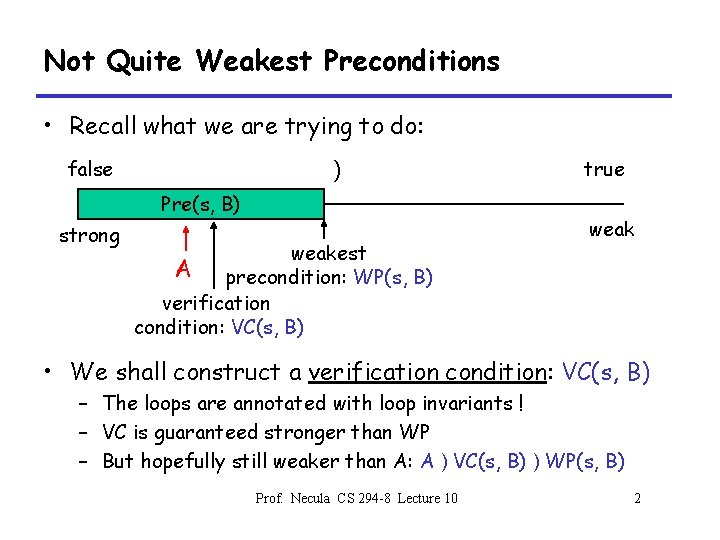
Not Quite Weakest Preconditions • Recall what we are trying to do: false ) Pre(s, B) strong weakest A precondition: WP(s, B) verification condition: VC(s, B) true weak • We shall construct a verification condition: VC(s, B) – The loops are annotated with loop invariants ! – VC is guaranteed stronger than WP – But hopefully still weaker than A: A ) VC(s, B) ) WP(s, B) Prof. Necula CS 294 -8 Lecture 10 2
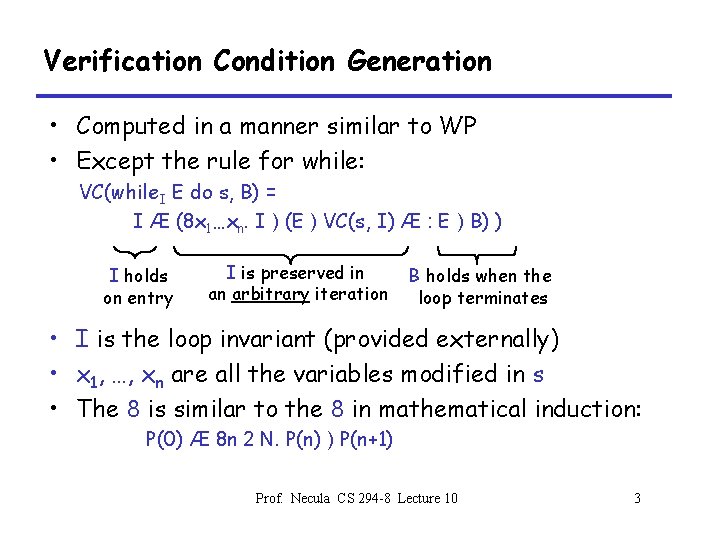
Verification Condition Generation • Computed in a manner similar to WP • Except the rule for while: VC(while. I E do s, B) = I Æ (8 x 1…xn. I ) (E ) VC(s, I) Æ : E ) B) ) I holds on entry I is preserved in an arbitrary iteration B holds when the loop terminates • I is the loop invariant (provided externally) • x 1, …, xn are all the variables modified in s • The 8 is similar to the 8 in mathematical induction: P(0) Æ 8 n 2 N. P(n) ) P(n+1) Prof. Necula CS 294 -8 Lecture 10 3
Forward Verification Condition Generation • Traditionally VC is computed backwards – Works well for structured code • But it can be computed in a forward direction – Works even for low-level languages (e. g. , assembly language) – Uses symbolic evaluation (important technique #2) – Has broad applications in program analysis • e. g. the PREfix tools works this way Prof. Necula CS 294 -8 Lecture 10 4
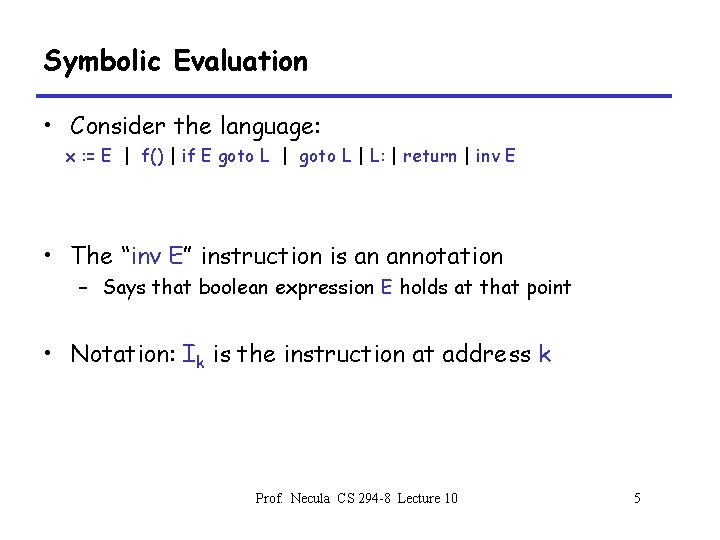
Symbolic Evaluation • Consider the language: x : = E | f() | if E goto L | L: | return | inv E • The “inv E” instruction is an annotation – Says that boolean expression E holds at that point • Notation: Ik is the instruction at address k Prof. Necula CS 294 -8 Lecture 10 5
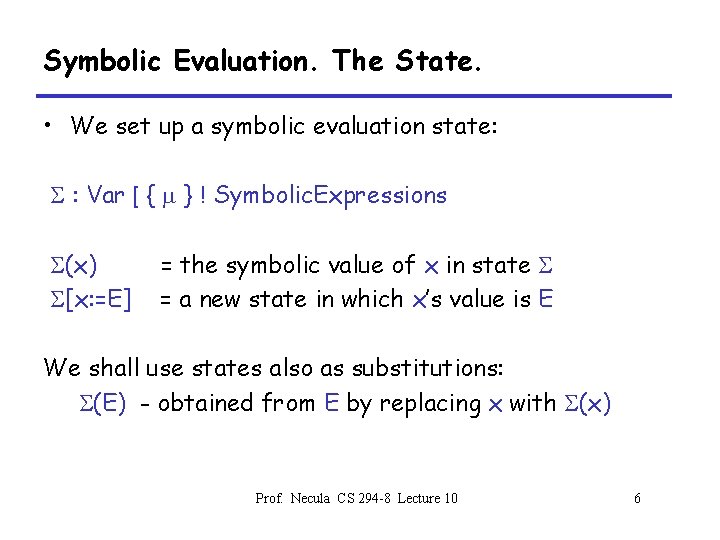
Symbolic Evaluation. The State. • We set up a symbolic evaluation state: S : Var [ { m } ! Symbolic. Expressions S(x) S[x: =E] = the symbolic value of x in state S = a new state in which x’s value is E We shall use states also as substitutions: S(E) - obtained from E by replacing x with S(x) Prof. Necula CS 294 -8 Lecture 10 6
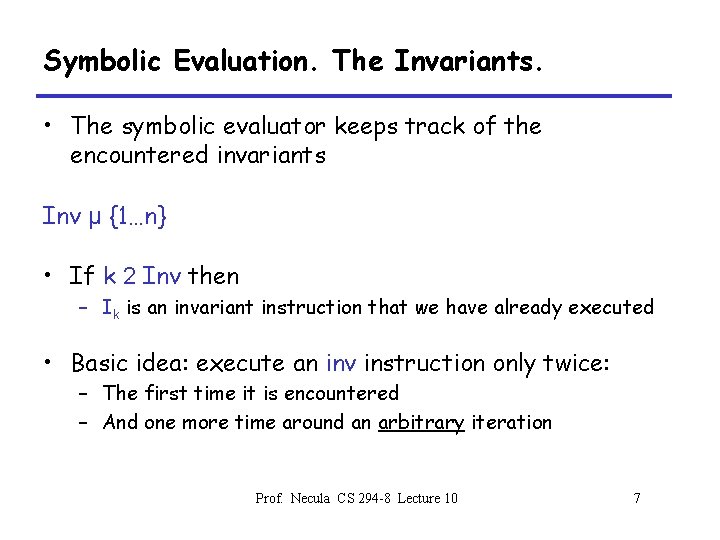
Symbolic Evaluation. The Invariants. • The symbolic evaluator keeps track of the encountered invariants Inv µ {1…n} • If k 2 Inv then – Ik is an invariant instruction that we have already executed • Basic idea: execute an inv instruction only twice: – The first time it is encountered – And one more time around an arbitrary iteration Prof. Necula CS 294 -8 Lecture 10 7
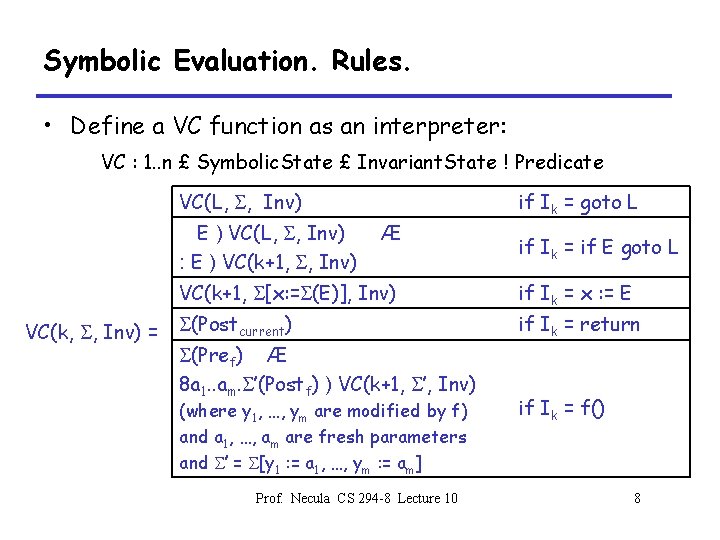
Symbolic Evaluation. Rules. • Define a VC function as an interpreter: VC : 1. . n £ Symbolic. State £ Invariant. State ! Predicate VC(L, S, Inv) E ) VC(L, S, Inv) : E ) VC(k+1, S, Inv) VC(k, S, Inv) = if Ik = goto L Æ if Ik = if E goto L VC(k+1, S[x: =S(E)], Inv) if Ik = x : = E S(Postcurrent) if Ik = return S(Pref) Æ 8 a 1. . am. S’(Postf) ) VC(k+1, S’, Inv) (where y 1, …, ym are modified by f) and a 1, …, am are fresh parameters and S’ = S[y 1 : = a 1, …, ym : = am] Prof. Necula CS 294 -8 Lecture 10 if Ik = f() 8
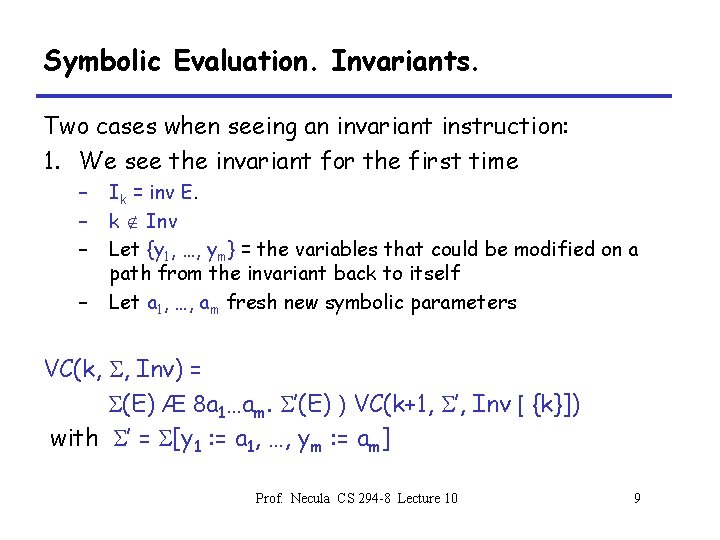
Symbolic Evaluation. Invariants. Two cases when seeing an invariant instruction: 1. We see the invariant for the first time – – Ik = inv E. k Ï Inv Let {y 1, …, ym} = the variables that could be modified on a path from the invariant back to itself Let a 1, …, am fresh new symbolic parameters VC(k, S, Inv) = S(E) Æ 8 a 1…am. S’(E) ) VC(k+1, S’, Inv [ {k}]) with S’ = S[y 1 : = a 1, …, ym : = am] Prof. Necula CS 294 -8 Lecture 10 9
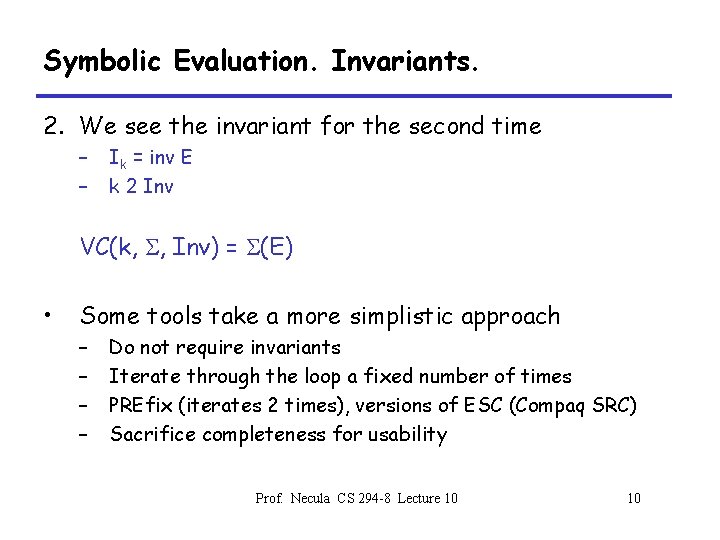
Symbolic Evaluation. Invariants. 2. We see the invariant for the second time – – Ik = inv E k 2 Inv VC(k, S, Inv) = S(E) • Some tools take a more simplistic approach – – Do not require invariants Iterate through the loop a fixed number of times PREfix (iterates 2 times), versions of ESC (Compaq SRC) Sacrifice completeness for usability Prof. Necula CS 294 -8 Lecture 10 10
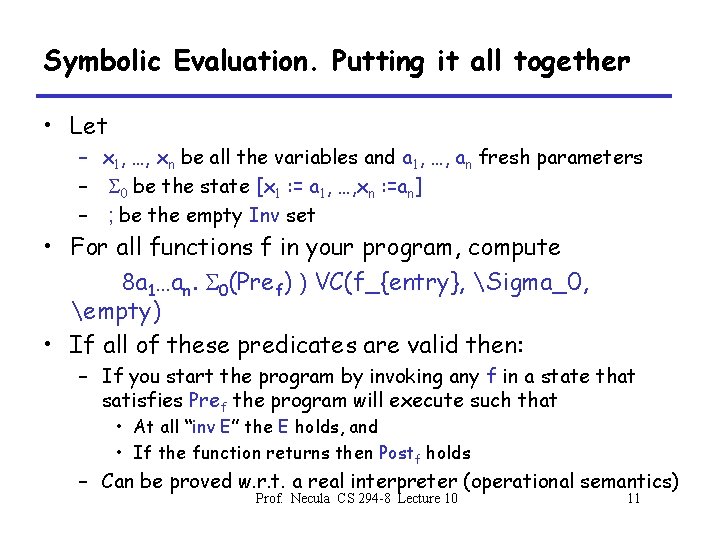
Symbolic Evaluation. Putting it all together • Let – x 1, …, xn be all the variables and a 1, …, an fresh parameters – S 0 be the state [x 1 : = a 1, …, xn : =an] – ; be the empty Inv set • For all functions f in your program, compute 8 a 1…an. S 0(Pref) ) VC(f_{entry}, Sigma_0, empty) • If all of these predicates are valid then: – If you start the program by invoking any f in a state that satisfies Pref the program will execute such that • At all “inv E” the E holds, and • If the function returns then Postf holds – Can be proved w. r. t. a real interpreter (operational semantics) Prof. Necula CS 294 -8 Lecture 10 11
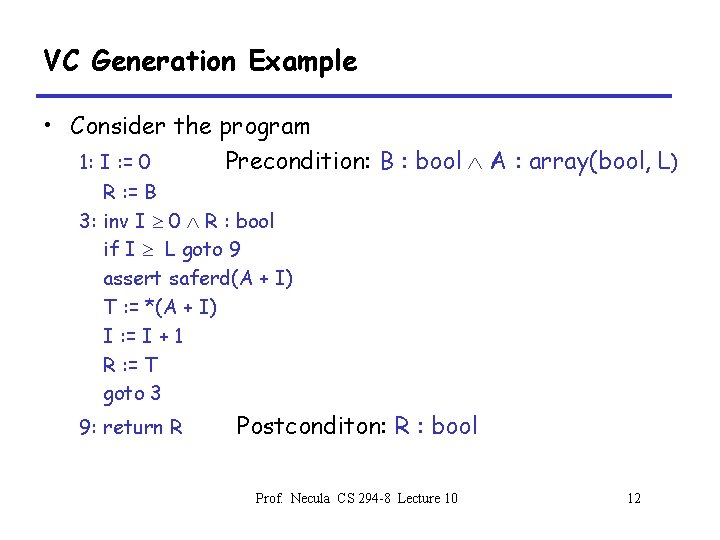
VC Generation Example • Consider the program 1: I : = 0 Precondition: B : bool A : array(bool, L) R : = B 3: inv I 0 R : bool if I L goto 9 assert saferd(A + I) T : = *(A + I) I : = I + 1 R : = T goto 3 9: return R Postconditon: R : bool Prof. Necula CS 294 -8 Lecture 10 12
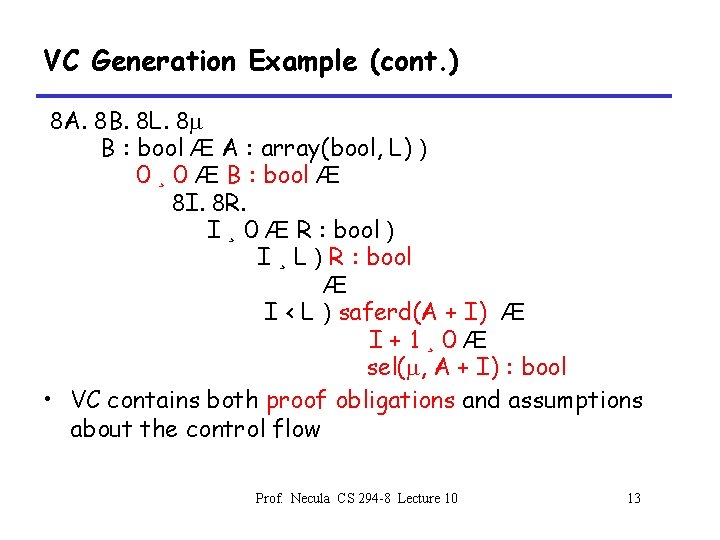
VC Generation Example (cont. ) 8 A. 8 B. 8 L. 8 m B : bool Æ A : array(bool, L) ) 0 ¸ 0 Æ B : bool Æ 8 I. 8 R. I ¸ 0 Æ R : bool ) I ¸ L ) R : bool Æ I < L ) saferd(A + I) Æ I+1¸ 0Æ sel(m, A + I) : bool • VC contains both proof obligations and assumptions about the control flow Prof. Necula CS 294 -8 Lecture 10 13
Review • We have defined weakest preconditions – Not always expressible • Then we defined verification conditions – Always expressible – Also preconditions but not weakest => loss of completeness • Next we have to prove the verification conditions • But first, we’ll examine some of their properties Prof. Necula CS 294 -8 Lecture 10 14
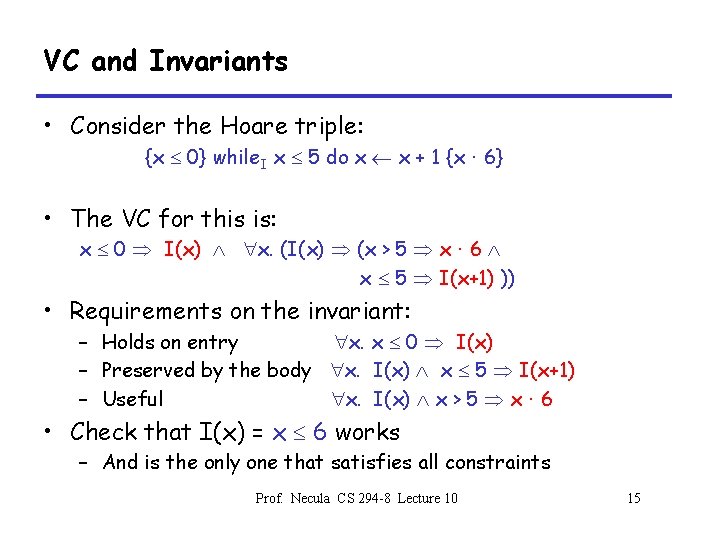
VC and Invariants • Consider the Hoare triple: {x 0} while. I x 5 do x x + 1 {x · 6} • The VC for this is: x 0 I(x) x. (I(x) (x > 5 x · 6 x 5 I(x+1) )) • Requirements on the invariant: – Holds on entry x. x 0 I(x) – Preserved by the body x. I(x) x 5 I(x+1) – Useful x. I(x) x > 5 x · 6 • Check that I(x) = x 6 works – And is the only one that satisfies all constraints Prof. Necula CS 294 -8 Lecture 10 15
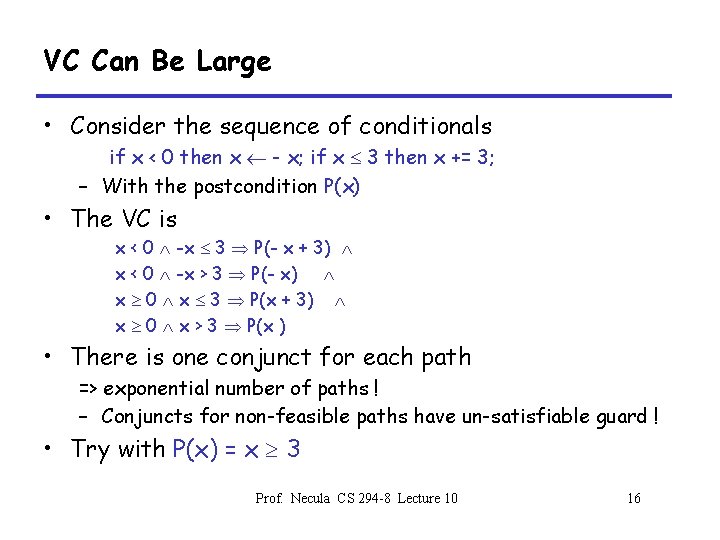
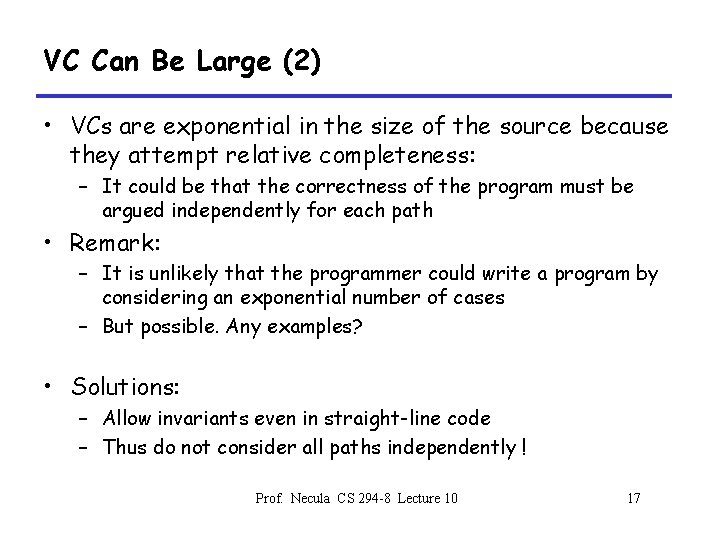
VC Can Be Large • Consider the sequence of conditionals if x < 0 then x - x; if x 3 then x += 3; – With the postcondition P(x) • The VC is x < 0 -x 3 P(- x + 3) x < 0 -x > 3 P(- x) x 0 x 3 P(x + 3) x 0 x > 3 P(x ) • There is one conjunct for each path => exponential number of paths ! – Conjuncts for non-feasible paths have un-satisfiable guard ! • Try with P(x) = x 3 Prof. Necula CS 294 -8 Lecture 10 16
VC Can Be Large (2) • VCs are exponential in the size of the source because they attempt relative completeness: – It could be that the correctness of the program must be argued independently for each path • Remark: – It is unlikely that the programmer could write a program by considering an exponential number of cases – But possible. Any examples? • Solutions: – Allow invariants even in straight-line code – Thus do not consider all paths independently ! Prof. Necula CS 294 -8 Lecture 10 17
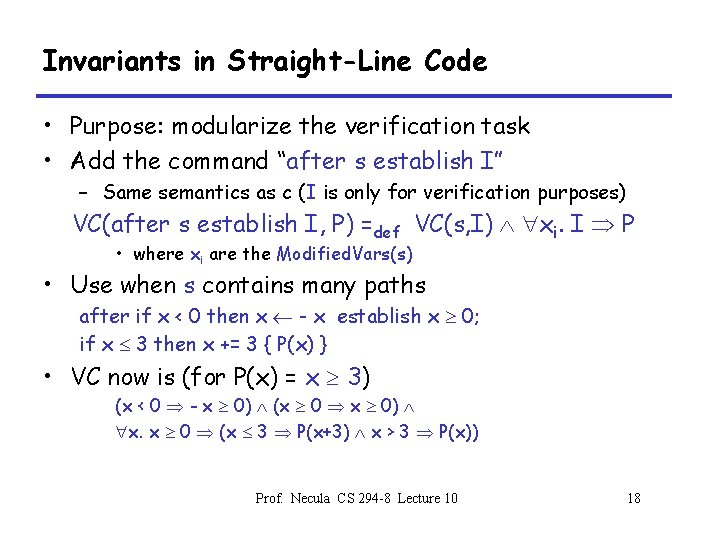
Invariants in Straight-Line Code • Purpose: modularize the verification task • Add the command “after s establish I” – Same semantics as c (I is only for verification purposes) VC(after s establish I, P) =def VC(s, I) xi. I P • where xi are the Modified. Vars(s) • Use when s contains many paths after if x < 0 then x - x establish x 0; if x 3 then x += 3 { P(x) } • VC now is (for P(x) = x 3) (x < 0 - x 0) (x 0 x 0) x. x 0 (x 3 P(x+3) x > 3 P(x)) Prof. Necula CS 294 -8 Lecture 10 18
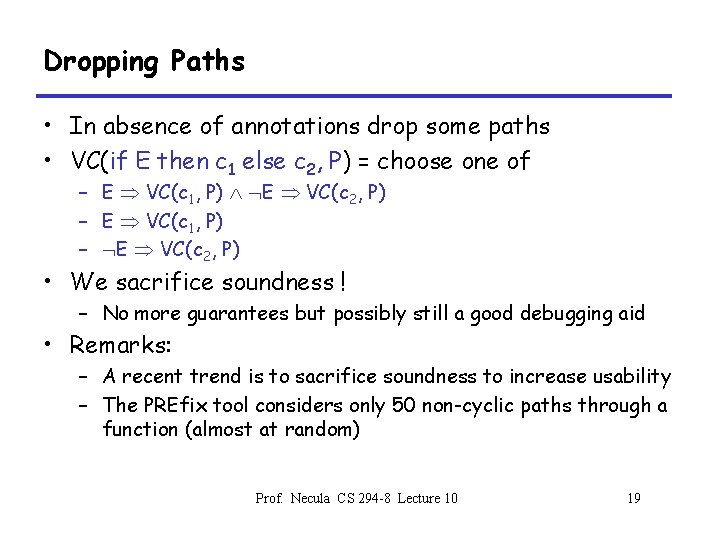
Dropping Paths • In absence of annotations drop some paths • VC(if E then c 1 else c 2, P) = choose one of – E VC(c 1, P) E VC(c 2, P) – E VC(c 1, P) – E VC(c 2, P) • We sacrifice soundness ! – No more guarantees but possibly still a good debugging aid • Remarks: – A recent trend is to sacrifice soundness to increase usability – The PREfix tool considers only 50 non-cyclic paths through a function (almost at random) Prof. Necula CS 294 -8 Lecture 10 19
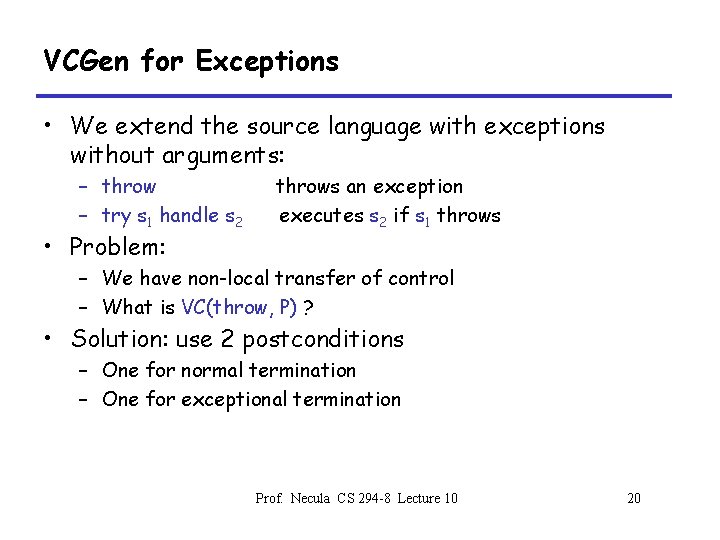
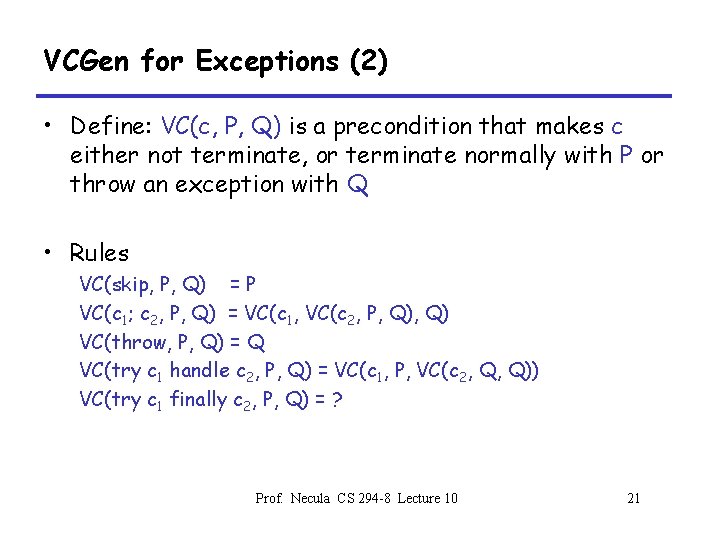
VCGen for Exceptions • We extend the source language with exceptions without arguments: – throw – try s 1 handle s 2 • Problem: throws an exception executes s 2 if s 1 throws – We have non-local transfer of control – What is VC(throw, P) ? • Solution: use 2 postconditions – One for normal termination – One for exceptional termination Prof. Necula CS 294 -8 Lecture 10 20
VCGen for Exceptions (2) • Define: VC(c, P, Q) is a precondition that makes c either not terminate, or terminate normally with P or throw an exception with Q • Rules VC(skip, P, Q) = P VC(c 1; c 2, P, Q) = VC(c 1, VC(c 2, P, Q) VC(throw, P, Q) = Q VC(try c 1 handle c 2, P, Q) = VC(c 1, P, VC(c 2, Q, Q)) VC(try c 1 finally c 2, P, Q) = ? Prof. Necula CS 294 -8 Lecture 10 21
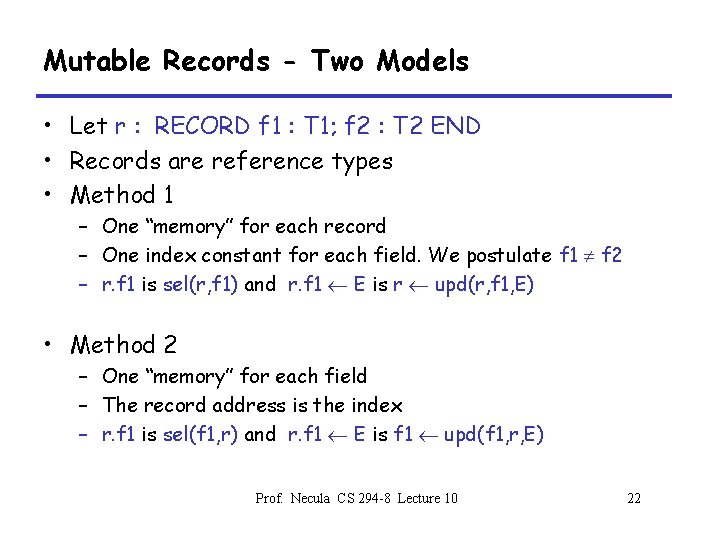
Mutable Records - Two Models • Let r : RECORD f 1 : T 1; f 2 : T 2 END • Records are reference types • Method 1 – One “memory” for each record – One index constant for each field. We postulate f 1 f 2 – r. f 1 is sel(r, f 1) and r. f 1 E is r upd(r, f 1, E) • Method 2 – One “memory” for each field – The record address is the index – r. f 1 is sel(f 1, r) and r. f 1 E is f 1 upd(f 1, r, E) Prof. Necula CS 294 -8 Lecture 10 22
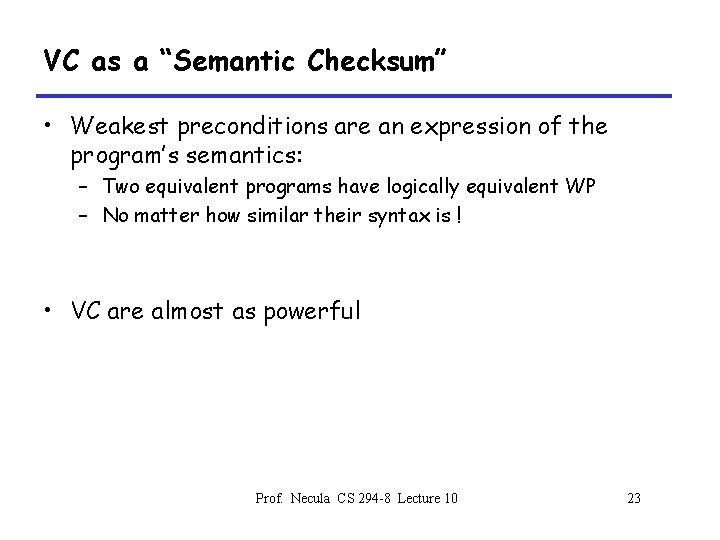
VC as a “Semantic Checksum” • Weakest preconditions are an expression of the program’s semantics: – Two equivalent programs have logically equivalent WP – No matter how similar their syntax is ! • VC are almost as powerful Prof. Necula CS 294 -8 Lecture 10 23
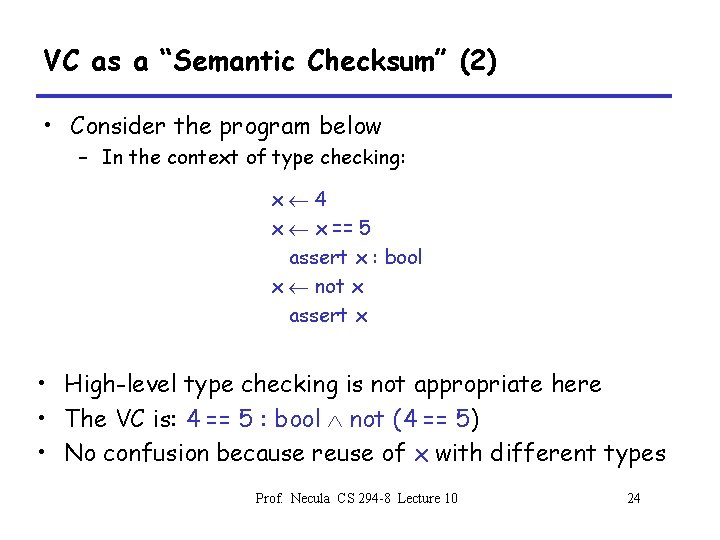
VC as a “Semantic Checksum” (2) • Consider the program below – In the context of type checking: x 4 x x == 5 assert x : bool x not x assert x • High-level type checking is not appropriate here • The VC is: 4 == 5 : bool not (4 == 5) • No confusion because reuse of x with different types Prof. Necula CS 294 -8 Lecture 10 24
Invariance of VC Across Optimizations • VC is so good at abstracting syntactic details that it is syntactically preserved by many common optimizations – Register allocation, instruction scheduling – Common-subexpression elimination, constant and copy prop. – Dead code elimination • We have identical VC whether or not an optimization has been performed – Preserves syntactic form, not just semantic meaning ! • This can be used to verify correctness of compiler optimizations (Translation Validation) Prof. Necula CS 294 -8 Lecture 10 25
VC Characterize a Safe Interpreter • Consider a fictitious “safe” interpreter – As it goes along it performs checks (e. g. saferd, valid. String) – Some of these would actually be hard to implement • The VC describes all of the checks to be performed – Along with their context (assumptions from conditionals) – Invariants and pre/postconditions are used to obtain a finite expression (through induction) • VC is valid ) interpreter never fails – We enforce same level of “correctness” – But better (static + more powerful checks) Prof. Necula CS 294 -8 Lecture 10 26
VC and Safe Interpreters • Essential components of VC’s: – Conjunction - sequencing of checks – Implications - capture flow information (context) – Universal quantification • To express checking for all input values • To aid in formulating induction – Literals - express the checks themselves • So far it looks that only a very small subset of firstorder logic suffices Prof. Necula CS 294 -8 Lecture 10 27
Review • Verification conditions – Capture the semantics of code + specifications – Language independent – Can be computed backward/forward on structured/unstructured code – Can be computed on high-level/low-level code Next: We start proving VC predicates Prof. Necula CS 294 -8 Lecture 10 28
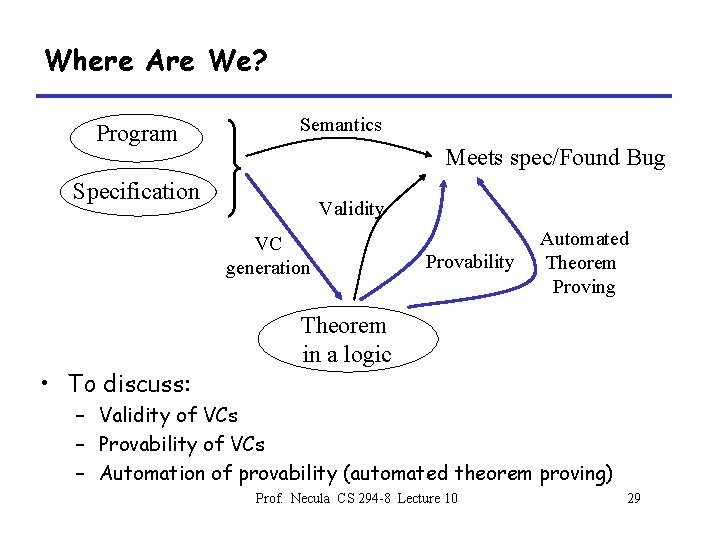
Where Are We? Program Semantics Meets spec/Found Bug Specification Validity VC generation • To discuss: Provability Automated Theorem Proving Theorem in a logic – Validity of VCs – Provability of VCs – Automation of provability (automated theorem proving) Prof. Necula CS 294 -8 Lecture 10 29
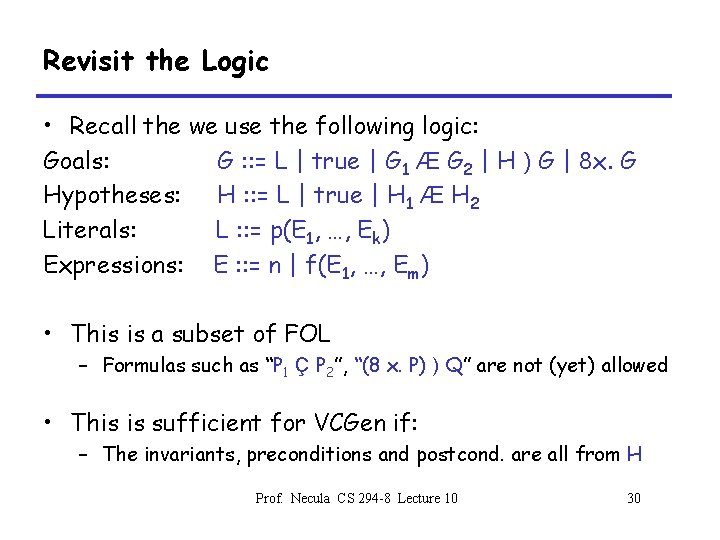
Revisit the Logic • Recall the we use the following logic: Goals: G : : = L | true | G 1 Æ G 2 | H ) G | 8 x. G Hypotheses: H : : = L | true | H 1 Æ H 2 Literals: L : : = p(E 1, …, Ek) Expressions: E : : = n | f(E 1, …, Em) • This is a subset of FOL – Formulas such as “P 1 Ç P 2”, “(8 x. P) ) Q” are not (yet) allowed • This is sufficient for VCGen if: – The invariants, preconditions and postcond. are all from H Prof. Necula CS 294 -8 Lecture 10 30
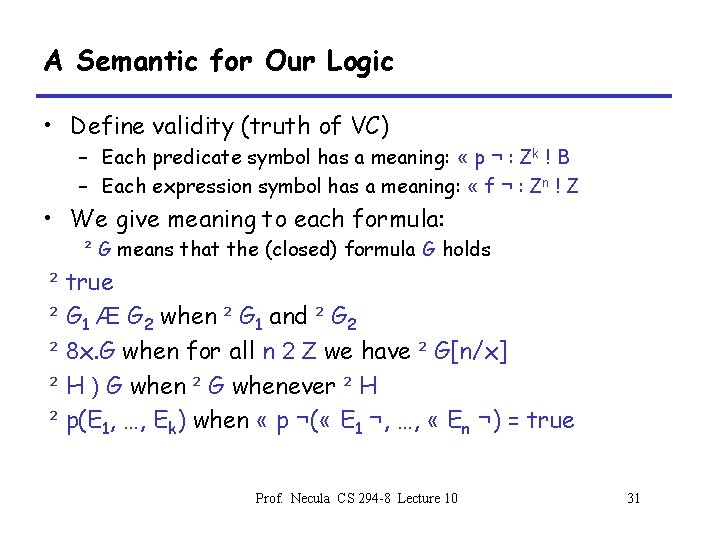
A Semantic for Our Logic • Define validity (truth of VC) – Each predicate symbol has a meaning: « p ¬ : Zk ! B – Each expression symbol has a meaning: « f ¬ : Zn ! Z • We give meaning to each formula: ² G means that the (closed) formula G holds ² true ² G 1 Æ G 2 when ² G 1 and ² G 2 ² 8 x. G when for all n 2 Z we have ² G[n/x] ² H ) G when ² G whenever ² H ² p(E 1, …, Ek) when « p ¬( « E 1 ¬, …, « En ¬) = true Prof. Necula CS 294 -8 Lecture 10 31
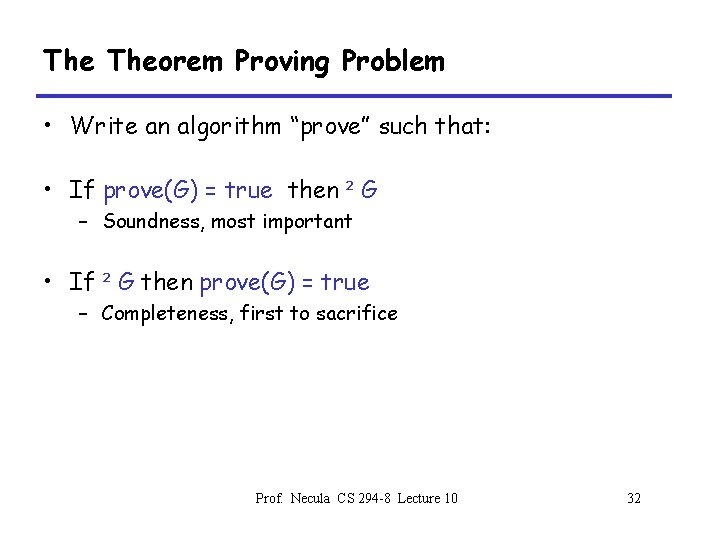
The Theorem Proving Problem • Write an algorithm “prove” such that: • If prove(G) = true then ² G – Soundness, most important • If ² G then prove(G) = true – Completeness, first to sacrifice Prof. Necula CS 294 -8 Lecture 10 32
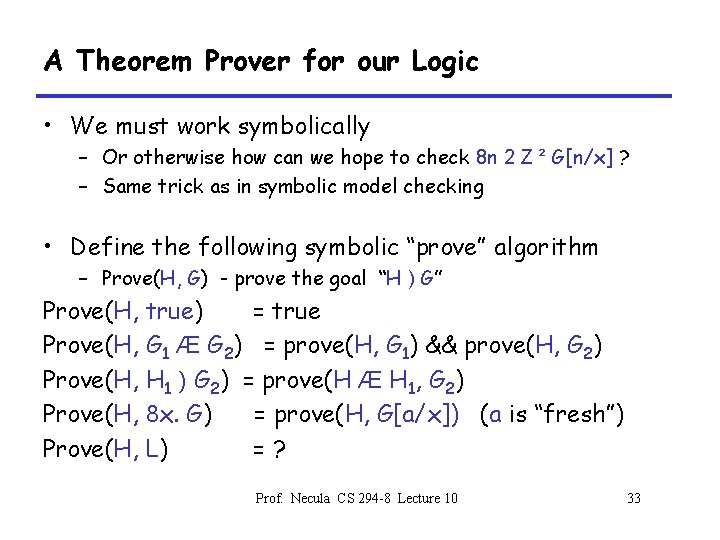
A Theorem Prover for our Logic • We must work symbolically – Or otherwise how can we hope to check 8 n 2 Z ² G[n/x] ? – Same trick as in symbolic model checking • Define the following symbolic “prove” algorithm – Prove(H, G) - prove the goal “H ) G” Prove(H, true) = true Prove(H, G 1 Æ G 2) = prove(H, G 1) && prove(H, G 2) Prove(H, H 1 ) G 2) = prove(H Æ H 1, G 2) Prove(H, 8 x. G) = prove(H, G[a/x]) (a is “fresh”) Prove(H, L) =? Prof. Necula CS 294 -8 Lecture 10 33
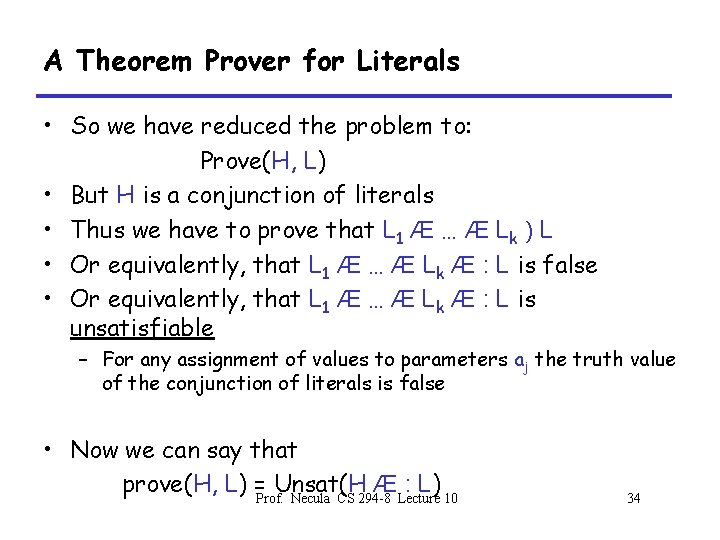
A Theorem Prover for Literals • So we have reduced the problem to: Prove(H, L) • But H is a conjunction of literals • Thus we have to prove that L 1 Æ … Æ Lk ) L • Or equivalently, that L 1 Æ … Æ Lk Æ : L is false • Or equivalently, that L 1 Æ … Æ Lk Æ : L is unsatisfiable – For any assignment of values to parameters aj the truth value of the conjunction of literals is false • Now we can say that prove(H, L) =Prof. Unsat(H Æ : L) Necula CS 294 -8 Lecture 10 34
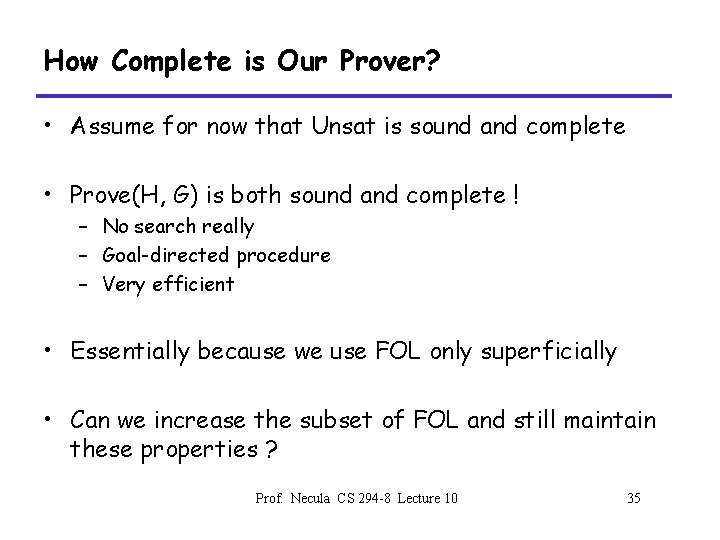
How Complete is Our Prover? • Assume for now that Unsat is sound and complete • Prove(H, G) is both sound and complete ! – No search really – Goal-directed procedure – Very efficient • Essentially because we use FOL only superficially • Can we increase the subset of FOL and still maintain these properties ? Prof. Necula CS 294 -8 Lecture 10 35
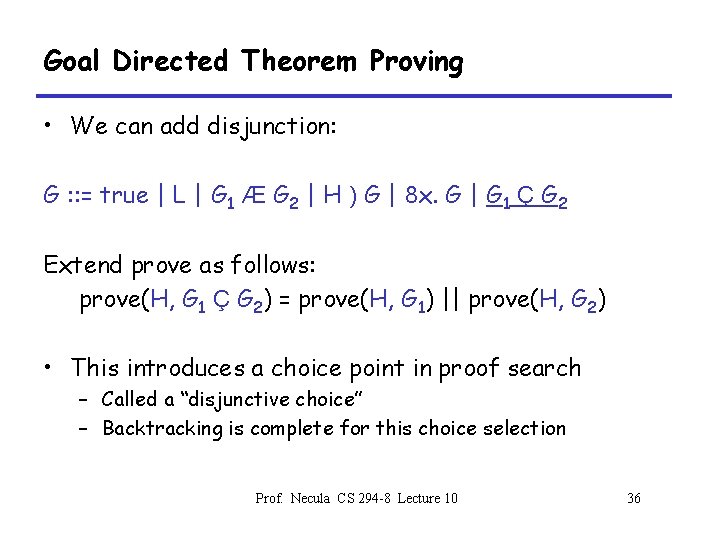
Goal Directed Theorem Proving • We can add disjunction: G : : = true | L | G 1 Æ G 2 | H ) G | 8 x. G | G 1 Ç G 2 Extend prove as follows: prove(H, G 1 Ç G 2) = prove(H, G 1) || prove(H, G 2) • This introduces a choice point in proof search – Called a “disjunctive choice” – Backtracking is complete for this choice selection Prof. Necula CS 294 -8 Lecture 10 36
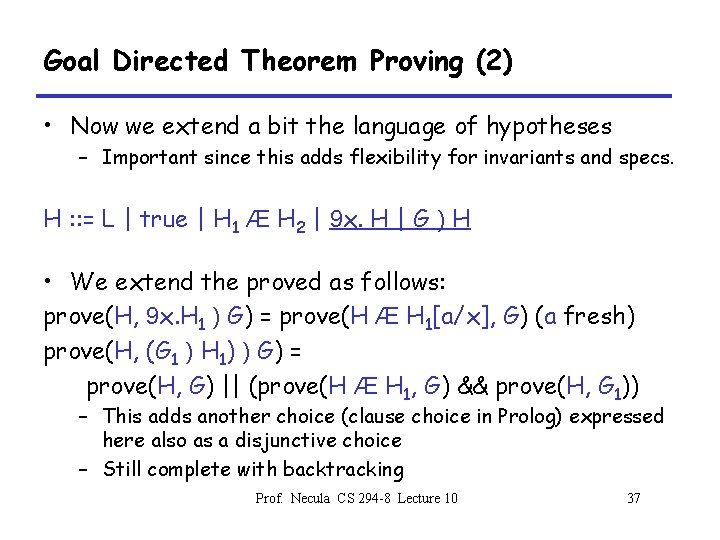
Goal Directed Theorem Proving (2) • Now we extend a bit the language of hypotheses – Important since this adds flexibility for invariants and specs. H : : = L | true | H 1 Æ H 2 | 9 x. H | G ) H • We extend the proved as follows: prove(H, 9 x. H 1 ) G) = prove(H Æ H 1[a/x], G) (a fresh) prove(H, (G 1 ) H 1) ) G) = prove(H, G) || (prove(H Æ H 1, G) && prove(H, G 1)) – This adds another choice (clause choice in Prolog) expressed here also as a disjunctive choice – Still complete with backtracking Prof. Necula CS 294 -8 Lecture 10 37
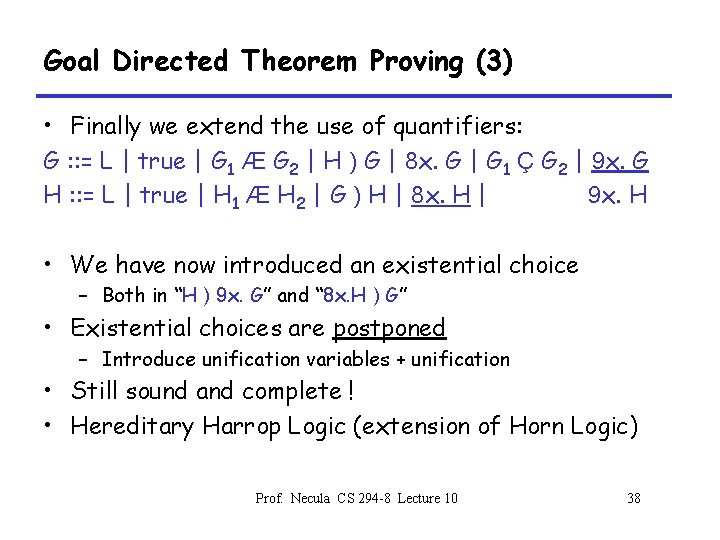
Goal Directed Theorem Proving (3) • Finally we extend the use of quantifiers: G : : = L | true | G 1 Æ G 2 | H ) G | 8 x. G | G 1 Ç G 2 | 9 x. G H : : = L | true | H 1 Æ H 2 | G ) H | 8 x. H | 9 x. H • We have now introduced an existential choice – Both in “H ) 9 x. G” and “ 8 x. H ) G” • Existential choices are postponed – Introduce unification variables + unification • Still sound and complete ! • Hereditary Harrop Logic (extension of Horn Logic) Prof. Necula CS 294 -8 Lecture 10 38
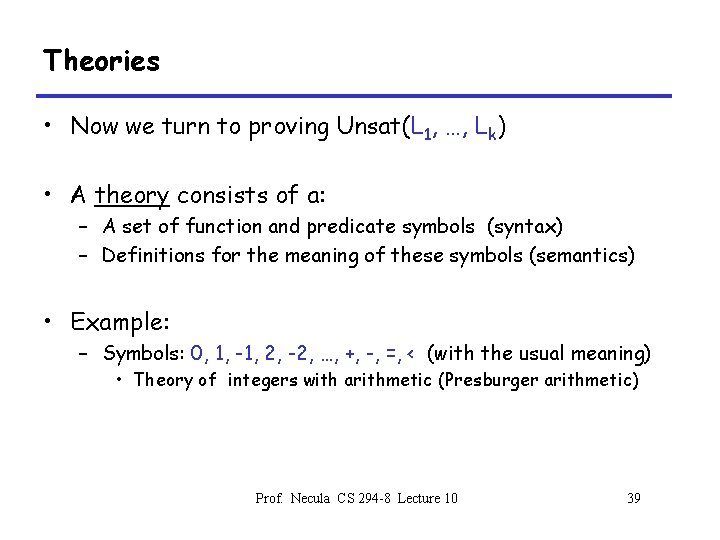
Theories • Now we turn to proving Unsat(L 1, …, Lk) • A theory consists of a: – A set of function and predicate symbols (syntax) – Definitions for the meaning of these symbols (semantics) • Example: – Symbols: 0, 1, -1, 2, -2, …, +, -, =, < (with the usual meaning) • Theory of integers with arithmetic (Presburger arithmetic) Prof. Necula CS 294 -8 Lecture 10 39
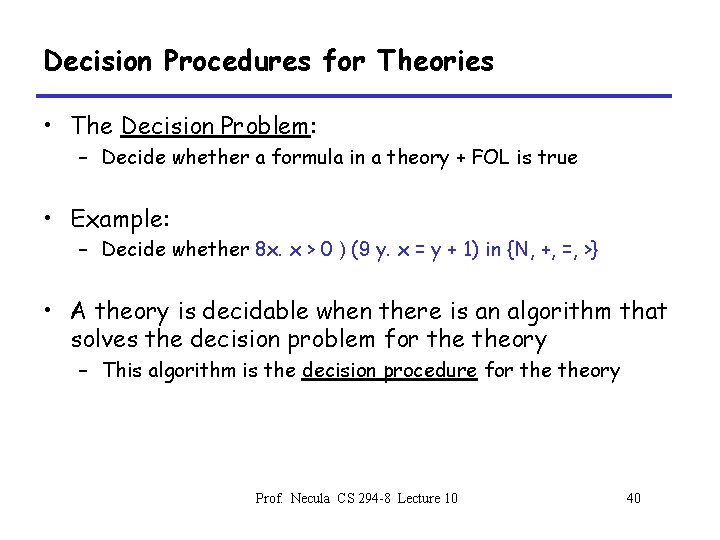
Decision Procedures for Theories • The Decision Problem: – Decide whether a formula in a theory + FOL is true • Example: – Decide whether 8 x. x > 0 ) (9 y. x = y + 1) in {N, +, =, >} • A theory is decidable when there is an algorithm that solves the decision problem for theory – This algorithm is the decision procedure for theory Prof. Necula CS 294 -8 Lecture 10 40
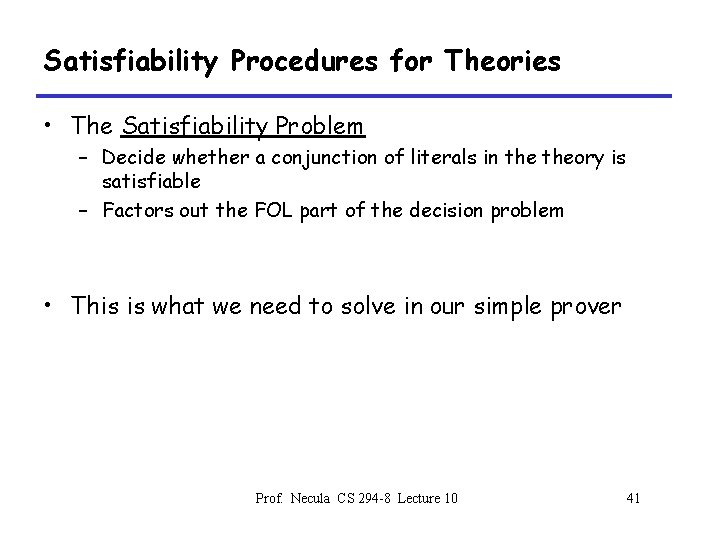
Satisfiability Procedures for Theories • The Satisfiability Problem – Decide whether a conjunction of literals in theory is satisfiable – Factors out the FOL part of the decision problem • This is what we need to solve in our simple prover Prof. Necula CS 294 -8 Lecture 10 41
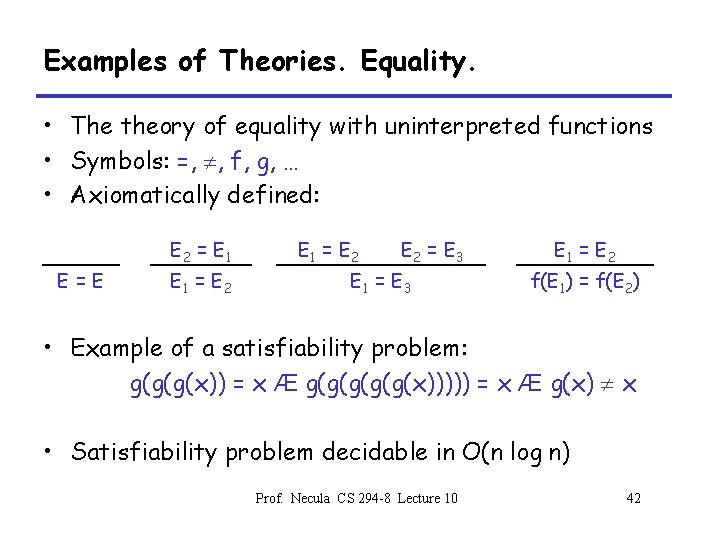
Examples of Theories. Equality. • The theory of equality with uninterpreted functions • Symbols: =, , f, g, … • Axiomatically defined: E 2 = E 1 E=E E 1 = E 2 E 2 = E 3 E 1 = E 2 f(E 1) = f(E 2) • Example of a satisfiability problem: g(g(g(x)) = x Æ g(g(g(x))))) = x Æ g(x) x • Satisfiability problem decidable in O(n log n) Prof. Necula CS 294 -8 Lecture 10 42
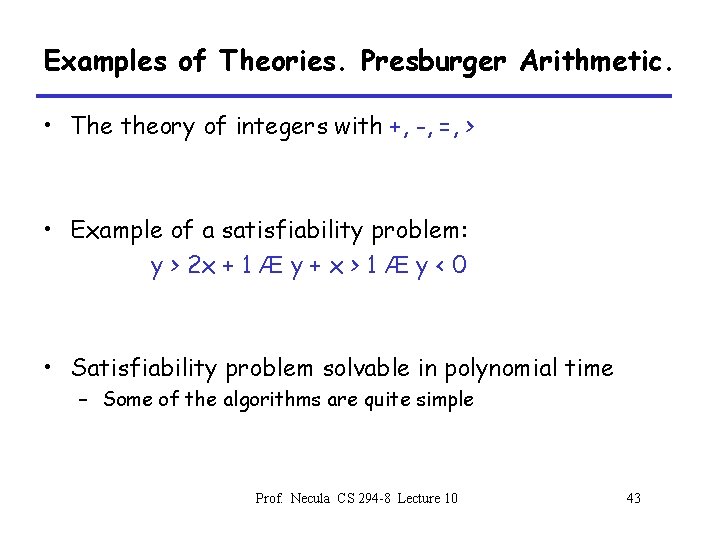
Examples of Theories. Presburger Arithmetic. • The theory of integers with +, -, =, > • Example of a satisfiability problem: y > 2 x + 1 Æ y + x > 1 Æ y < 0 • Satisfiability problem solvable in polynomial time – Some of the algorithms are quite simple Prof. Necula CS 294 -8 Lecture 10 43
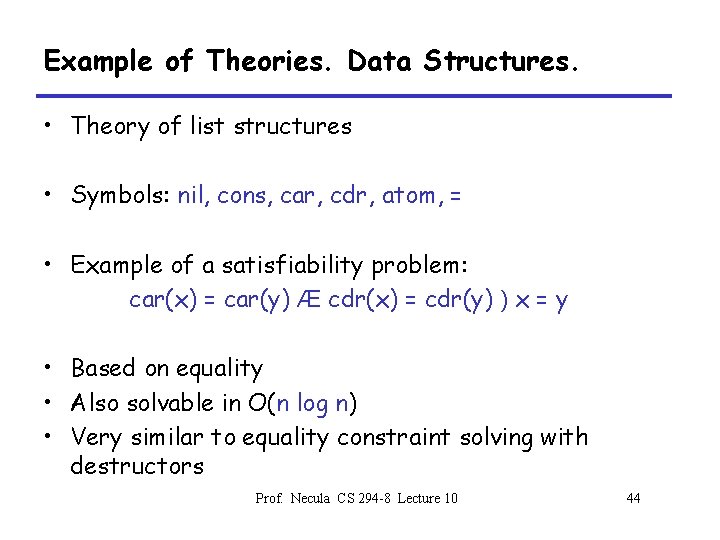
Example of Theories. Data Structures. • Theory of list structures • Symbols: nil, cons, car, cdr, atom, = • Example of a satisfiability problem: car(x) = car(y) Æ cdr(x) = cdr(y) ) x = y • Based on equality • Also solvable in O(n log n) • Very similar to equality constraint solving with destructors Prof. Necula CS 294 -8 Lecture 10 44