
Finish preclass Submit Learning Style Form Lecture starts
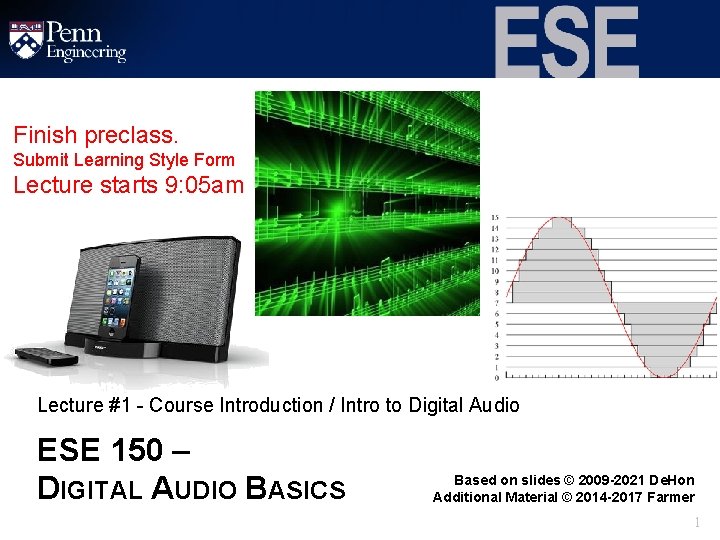
Finish preclass. Submit Learning Style Form Lecture starts 9: 05 am Lecture #1 - Course Introduction / Intro to Digital Audio ESE 150 – DIGITAL AUDIO BASICS Based on slides © 2009 -2021 De. Hon Additional Material © 2014 -2017 Farmer 1
LECTURE TOPICS � History & Motivation � � Overview of Class Schedule � � Computing and Digital Audio Big picture of our class goals Course Introduction / Goals of Class � Syllabus; Laboratory; Grading Course Content Overview PART 2 � Quick Week-by-week breakdown of class itself � Summary � 2
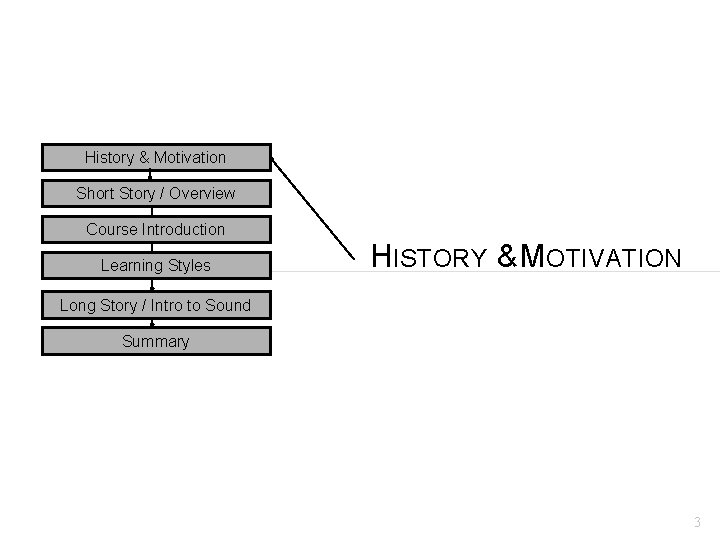
History & Motivation Short Story / Overview Course Introduction Learning Styles HISTORY & MOTIVATION Long Story / Intro to Sound Summary 3
POLL Believe I can assume you use a cell phone and GPS � How do you obtain music? [answer chat] � Communicate with friends outside of school? � � � Voice phone, e-mail, text message, facebook, skype? Where do you go to find answers? � Google, wikipedia 4

CHANGING WORLD https: //commons. wikimed ia. org/wiki/File: Moore%2 7 s_Law_Transistor_Coun t_1971 -2018. png � Moore’s Law: Every 18 months, size of transistor halved � Who cares? In same area, can fit twice as many transistors, twice the computing power! � Also, generally: if you make a transistor smaller, it gets a bit faster � � …up to a point… 5
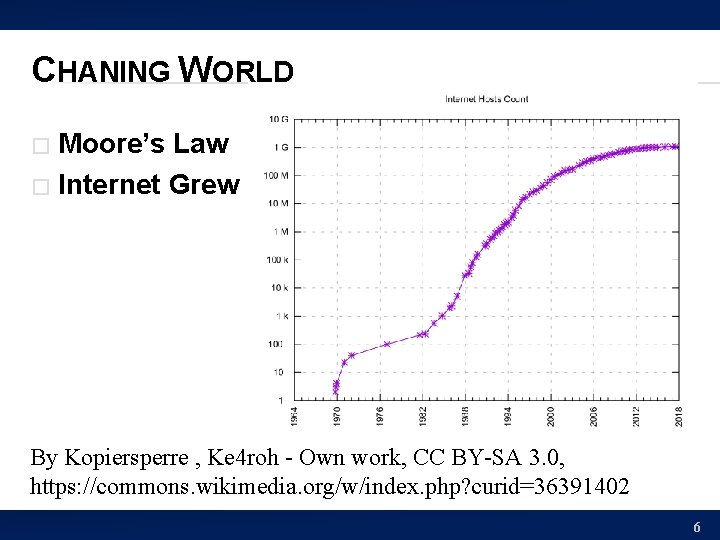
CHANING WORLD Moore’s Law � Internet Grew � By Kopiersperre , Ke 4 roh - Own work, CC BY-SA 3. 0, https: //commons. wikimedia. org/w/index. php? curid=36391402 6
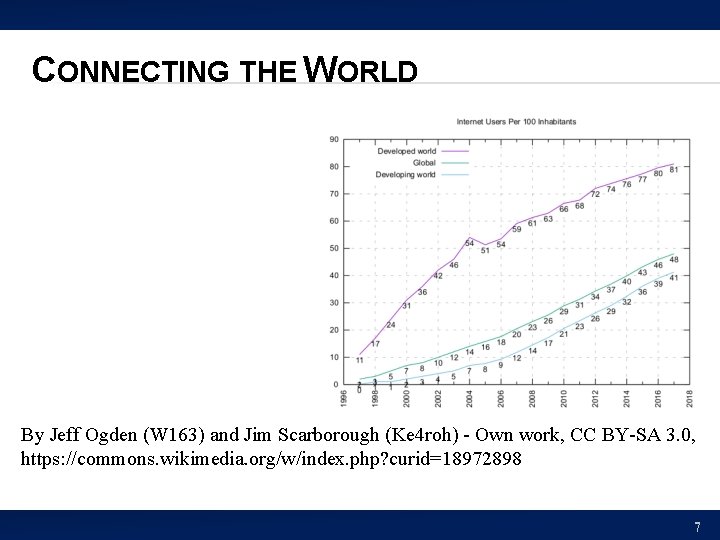
CONNECTING THE WORLD By Jeff Ogden (W 163) and Jim Scarborough (Ke 4 roh) - Own work, CC BY-SA 3. 0, https: //commons. wikimedia. org/w/index. php? curid=18972898 7
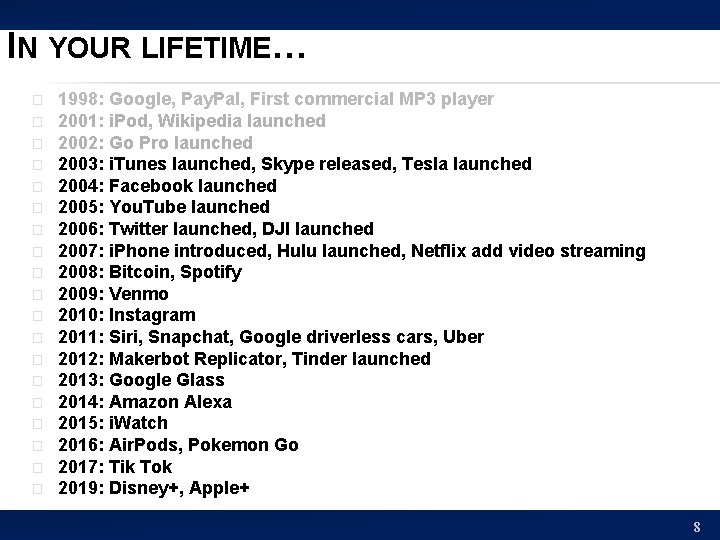
IN YOUR LIFETIME… � � � � � 1998: Google, Pay. Pal, First commercial MP 3 player 2001: i. Pod, Wikipedia launched 2002: Go Pro launched 2003: i. Tunes launched, Skype released, Tesla launched 2004: Facebook launched 2005: You. Tube launched 2006: Twitter launched, DJI launched 2007: i. Phone introduced, Hulu launched, Netflix add video streaming 2008: Bitcoin, Spotify 2009: Venmo 2010: Instagram 2011: Siri, Snapchat, Google driverless cars, Uber 2012: Makerbot Replicator, Tinder launched 2013: Google Glass 2014: Amazon Alexa 2015: i. Watch 2016: Air. Pods, Pokemon Go 2017: Tik Tok 2019: Disney+, Apple+ 8
COOL STUFF OF TODAY… � Today’s “must have” technology is: � � � Cell phones MP 3 players (Digital Audio Players) � � � � Internet enabled Digital cameras and video recorders (part of phones!) Realistic Video Games Integrated (e. g. i. Phone, i. Pad) DVRs (e. g. Ti. Vo) E-book readers (e. g. Kindle) 3 D printers (e. g. Makerbot) � � � computerized, networked, and based on digital media Circuit Scribe – draw actual circuits, electric ink! Replicator… Augmented Reality (e. g. Jedi Challenge, Pokemon-Go) � Holodeck… 9
WHAT MAKES US SAFER, LIVE LONGER? � Transportation Anti-lock brakes � Traction control � Blind-side assist � � Watch over Security cameras � Baby monitors � � Medical Devices Ultrasound � MRI � DNA sequencing � Pacemakers � 10
WHAT DO THESE THINGS INVOLVE? Computation � Communications � Hardware � Substantial software � � Products of Computer Engineers 11
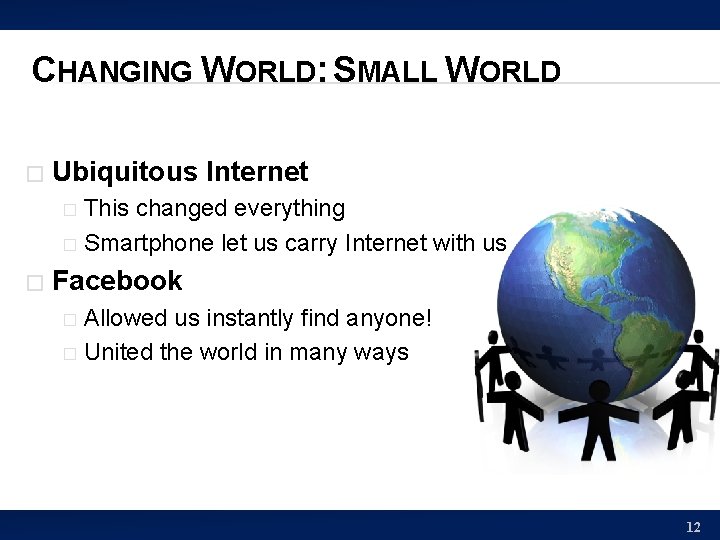
CHANGING WORLD: SMALL WORLD � Ubiquitous Internet This changed everything � Smartphone let us carry Internet with us � � Facebook Allowed us instantly find anyone! � United the world in many ways � 12
CHANGING WORLD: EASY SHARING Easy Instant sharing and storage � Photos, videos, writing � Web, Facebook, Youtube, Blogs � Backed up, Cloud � Accessible anywhere in the world � Indexed and searchable � Can carry it with you � 13
CHANGING WORLD: INSTANT GRATIFICATION � Search engines � � i. Tunes/Spotify � � Instant access to knowledge Instant access to music/casts/apps/video too Streaming video Instant access to video/news/visual information � Internet services/Netflix/Hulu/You. Tube/On-Demand/etc. � � Amazon. com � Instant access to nearly any product, ~drone delivery! 14
CHANGING WORLD: NEW WEALTH, NEW PLAYERS � Microsoft founded 1975 � � Apple founded 1976 � � � � � Just passed richest man… E-Bay 1995 Google, Netflix, Pay. Pal 1998 Tesla 2003 � � Highest valued company Oracle 1977 CISCO 1984 NVIDIA 1993 Amazon. com 1994 � � World’s richest man…for a while New richest man Facebook 2004 Twitter 2006 Bitcoin 2008 Venmo 2009 15
CONVERGENCE � Big Ideas and Advanced Technology Digitize Everything � Cheap Digital Processing � Cheap Storage � Cheap Digital Bandwidth � � Driven by Moore’s Law � Store and compute more bits per $$ 16
ENABLED BY VISIONARY ENGINEERS � Hard work, inspiration, and competition …would not have just happened � Certain applications/products tie many things together � � No one realized facebook/music would be “killer app” for smartphone revolution � Most inconceivable just prior � Compare how archaic the “future” looks in most movies just 20 years old What’s next? � How can we harness to make the world better? � 17
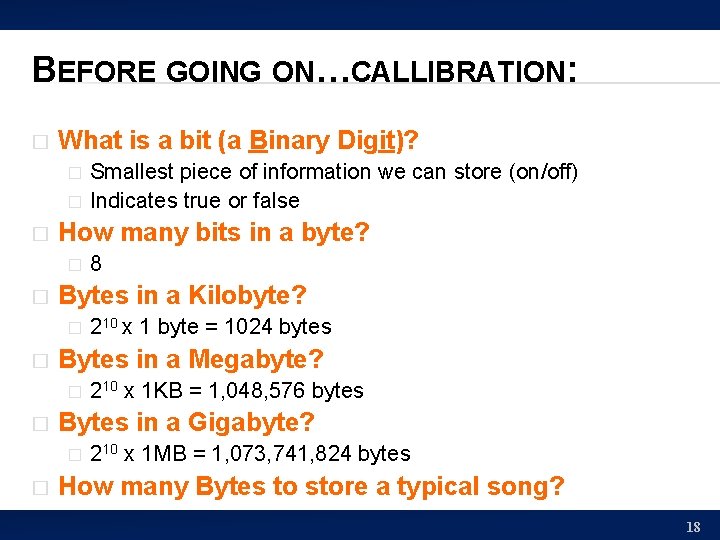
BEFORE GOING ON…CALLIBRATION: � What is a bit (a Binary Digit)? � � � How many bits in a byte? � � 210 x 1 KB = 1, 048, 576 bytes Bytes in a Gigabyte? � � 210 x 1 byte = 1024 bytes Bytes in a Megabyte? � � 8 Bytes in a Kilobyte? � � Smallest piece of information we can store (on/off) Indicates true or false 210 x 1 MB = 1, 073, 741, 824 bytes How many Bytes to store a typical song? 18
History & Motivation Short Story / Overview Course Introduction Learning Styles SHORT STORY Long Story / Intro to Sound Summary 19
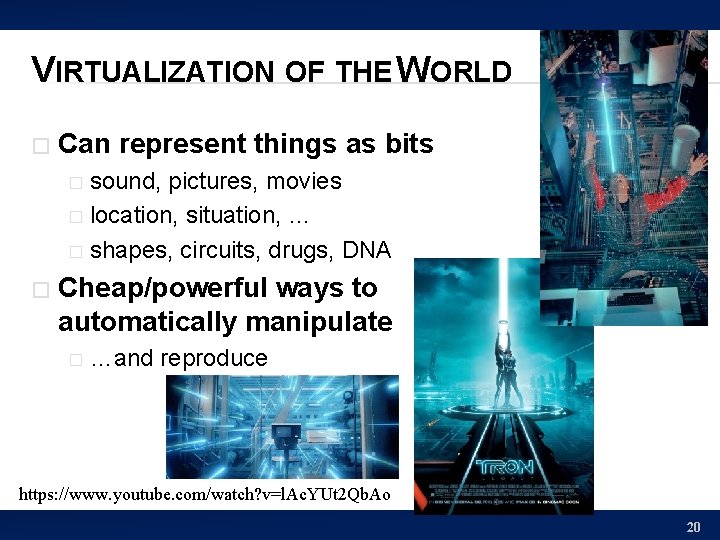
VIRTUALIZATION OF THE WORLD � Can represent things as bits sound, pictures, movies � location, situation, … � shapes, circuits, drugs, DNA � � Cheap/powerful ways to automatically manipulate � …and reproduce https: //www. youtube. com/watch? v=l. Ac. YUt 2 Qb. Ao 20
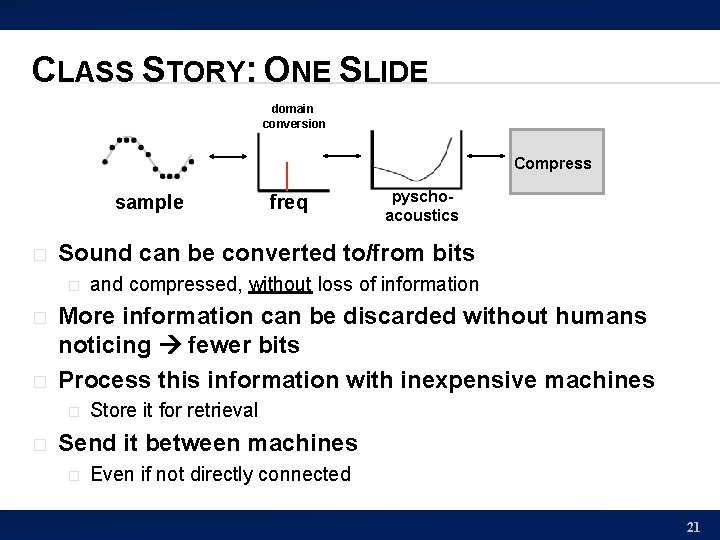
CLASS STORY: ONE SLIDE domain conversion Compress sample � � and compressed, without loss of information More information can be discarded without humans noticing fewer bits Process this information with inexpensive machines � � pyschoacoustics Sound can be converted to/from bits � � freq Store it for retrieval Send it between machines � Even if not directly connected 21
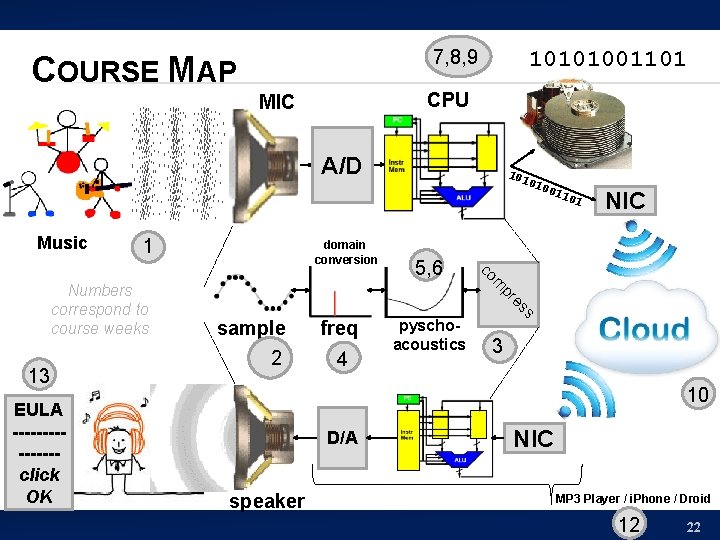
7, 8, 9 COURSE MAP 10101001101 CPU MIC A/D Music 1 EULA -------click OK freq 4 5, 6 pyschoacoustics 011 01 NIC s es pr 13 sample 2 010 m co Numbers correspond to course weeks domain conversion 101 3 10 D/A speaker NIC MP 3 Player / i. Phone / Droid 12 22
History & Motivation Short Story / Overview Course Introduction Learning Styles COURSE INTRODUCTION Long Story / Intro to Sound Summary 23
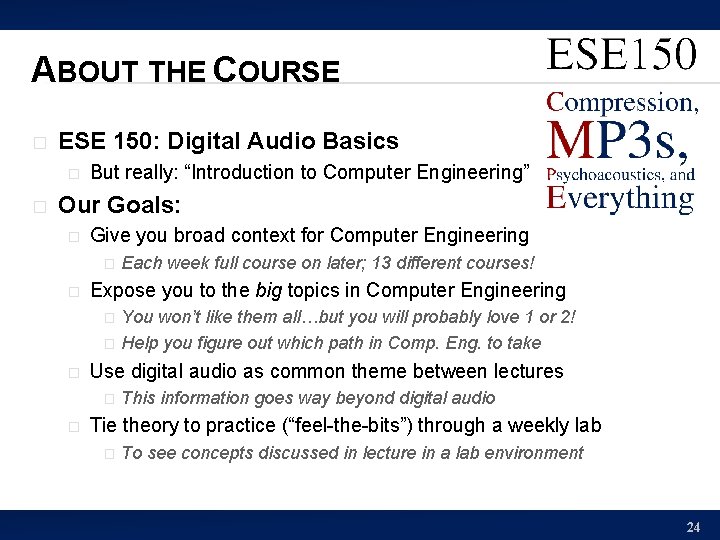
ABOUT THE COURSE � ESE 150: Digital Audio Basics � � But really: “Introduction to Computer Engineering” Our Goals: � Give you broad context for Computer Engineering � � Each week full course on later; 13 different courses! Expose you to the big topics in Computer Engineering You won’t like them all…but you will probably love 1 or 2! � Help you figure out which path in Comp. Eng. to take � � Use digital audio as common theme between lectures � � This information goes way beyond digital audio Tie theory to practice (“feel-the-bits”) through a weekly lab � To see concepts discussed in lecture in a lab environment 24
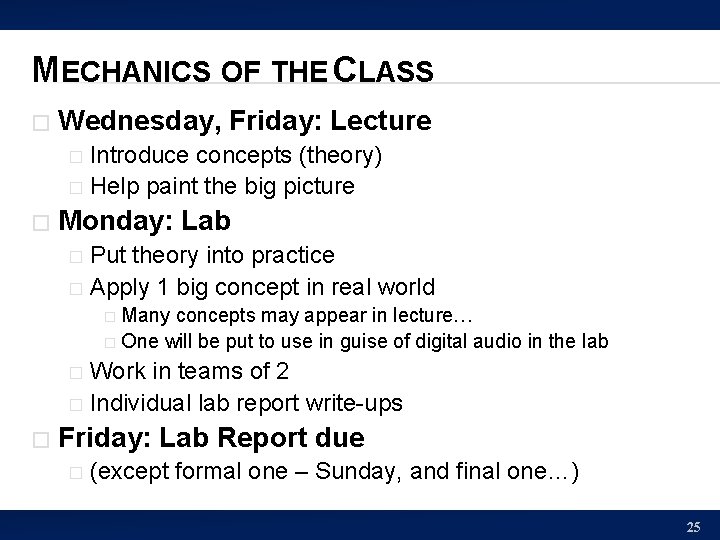
MECHANICS OF THE CLASS � Wednesday, Friday: Lecture Introduce concepts (theory) � Help paint the big picture � � Monday: Lab Put theory into practice � Apply 1 big concept in real world � � Many concepts may appear in lecture… � One will be put to use in guise of digital audio in the lab Work in teams of 2 � Individual lab report write-ups � � Friday: Lab Report due � (except formal one – Sunday, and final one…) 25
LECTURE TIMELINE Put preclass out previous day � 9: 05 am – actual start lecture � 9: 55 am – target end lecture � Recommend attend synchronous lecture recording � � If not, complete lecture quiz before next lecture 26
GRADING � 10% - Class Participation and Quizzes � � 50% - Weekly Lab Report Writeup � � � Warmup for final 15% - Final Exam � � Work in groups of 2 (we assign and mix up week-to-week) Labs have “prelab” work to do – counted as part of lab writeup Drop lowest score on attempted labs 20% - Formal Lab Report 5% - Midterm Exam � � Per lecture quiz: Based on lecture content Based on reading material, lecture material, lab work Read web page for policies � Not hard, but must show up, engage, do the work 27
COMPONENTS � Lecture slides online morning of lecture � � Big Idea – 1 p’er for every week Reading Preclass – available day before class � � Work through to get you thinking about the topic …and gives you some of the questions will ask in lecture Won’t be available later; stay up with class “Warm” Calls during synchronous recording � � Probably night before; post piazza Promote interaction/engagement Feedback forms � � Complete at end of lecture (or after watch) Help me tune lecture for class 28
CLASS GOALS Context and motivation for CMPE major � Appreciate how CMPE, EE, CSCI, SSE: � Work together � How they impact today’s world � � Start thinking like an engineer! 29
OUTCOMES � Able to conduct experiments � Psychoacoustic, network, hardware Able to optimize information encoding � Able to quantify quality vs. size tradeoffs in audio � Able to use oscilloscope, matlab, Arduino, FPGA � Able to write formal lab report � Understand role of Intellectual Property � Appreciate User Interface design � Understand technology enables new capabilities � 30
END PART 1 31
History & Motivation Short Story / Overview Course Introduction Learning Styles Long Story / Intro to Sound Summary LEARNING STYLES (INTERLUDE) 32
DIMENSIONS � Active (ACT) vs. Reflective (REF) � � Sensing (SEN) vs. Intuitive (INT) � � Facts and methods vs. abstractions and innovation Visual (VIS) vs. Verbal (VRB) � � Doing vs. thinking Pictures, diagrams vs. descriptions Sequential (SEQ) vs. Global (GLO) � Linear steps vs. context and connections See reading link on syllabus.
HOW DO PEOPLE COME OUT? Create Histogram � How I came out… � Count numbers by students: � � � Bin: 9+, 8 -4, 3 -1, 0, 1 -3, 4 -8, 9+ Histograms: Active/Reflective � Sensing/Intuitive � Visual/Verbal � Sequential/Global � 34
AWARE OF DIFFERENCES Differences among people � Differences between faculty and students? � � Claim college courses are biased toward: �Reflective, � This intuitive, verbal, sequential course: �Active, � Read sensing? , visual, global explanation �Being aware and how to cope useful for navigating all your courses at Penn
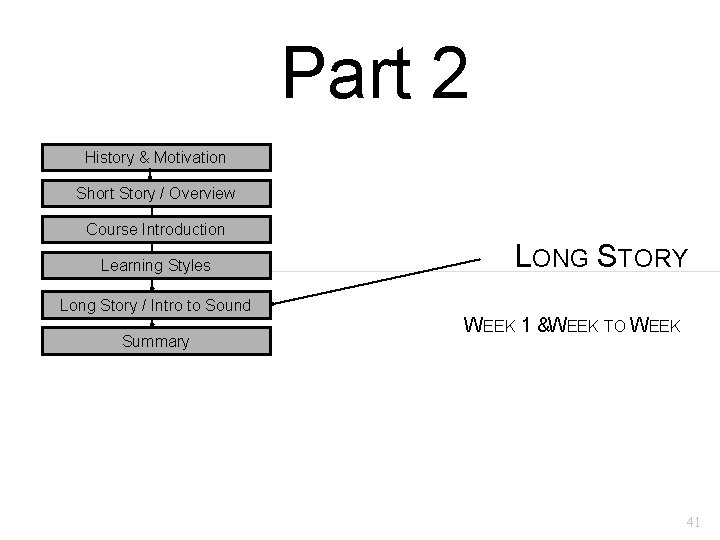
Part 2 History & Motivation Short Story / Overview Course Introduction Learning Styles Long Story / Intro to Sound Summary LONG STORY WEEK 1 &WEEK TO WEEK 41
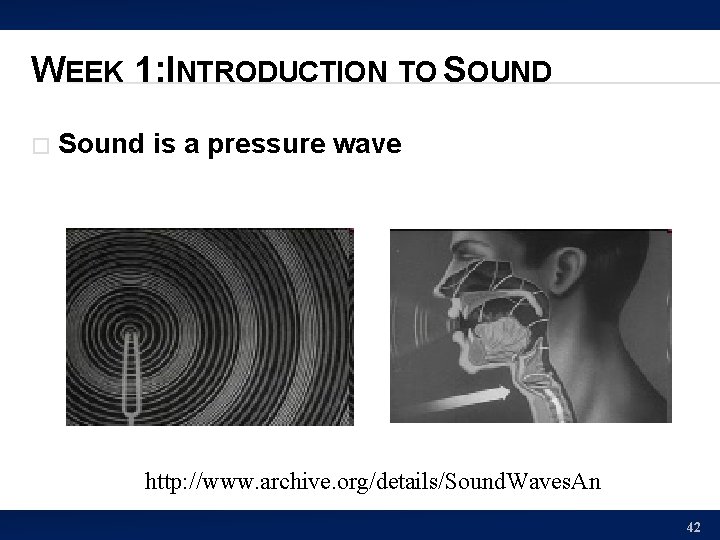
WEEK 1: INTRODUCTION TO SOUND � Sound is a pressure wave http: //www. archive. org/details/Sound. Waves. An 42
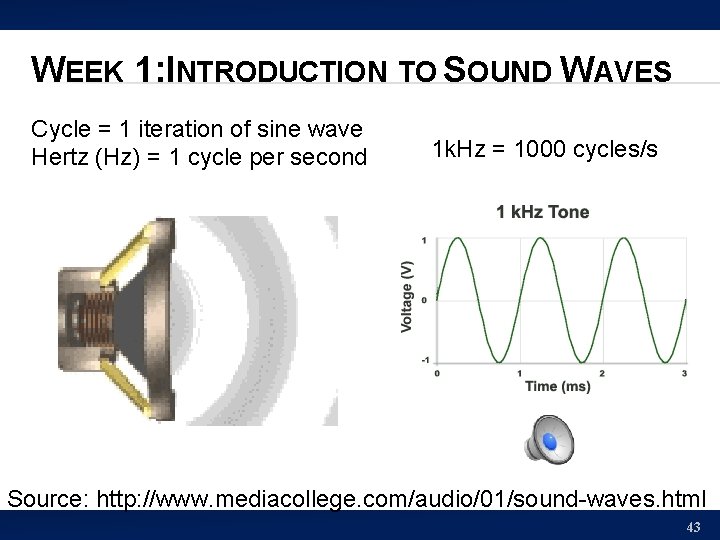
WEEK 1: INTRODUCTION TO SOUND WAVES Cycle = 1 iteration of sine wave Hertz (Hz) = 1 cycle per second 1 k. Hz = 1000 cycles/s Source: http: //www. mediacollege. com/audio/01/sound-waves. html 43
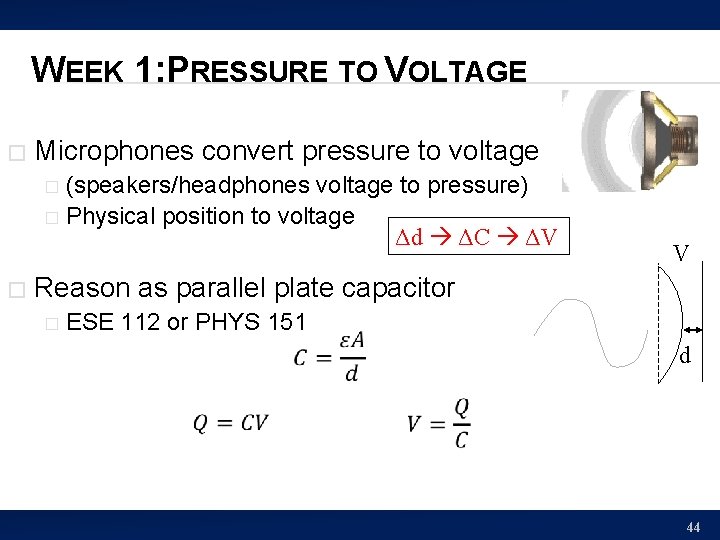
WEEK 1: PRESSURE TO VOLTAGE � Microphones convert pressure to voltage (speakers/headphones voltage to pressure) � Physical position to voltage Δd ΔC ΔV � � V Reason as parallel plate capacitor � ESE 112 or PHYS 151 d 44
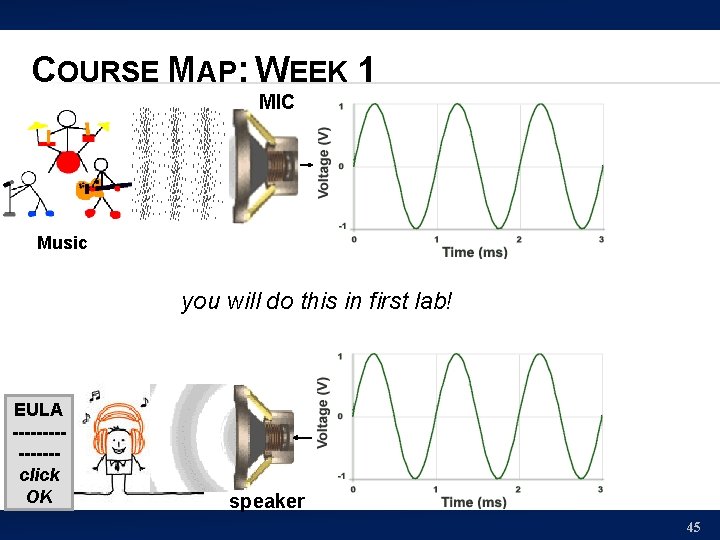
COURSE MAP: WEEK 1 MIC Music you will do this in first lab! EULA -------click OK speaker 45
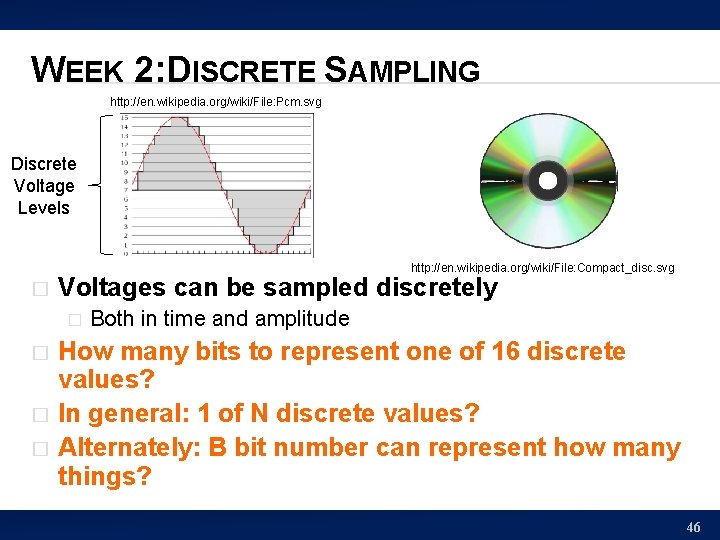
WEEK 2: DISCRETE SAMPLING http: //en. wikipedia. org/wiki/File: Pcm. svg Discrete Voltage Levels http: //en. wikipedia. org/wiki/File: Compact_disc. svg � Voltages can be sampled discretely � � Both in time and amplitude How many bits to represent one of 16 discrete values? In general: 1 of N discrete values? Alternately: B bit number can represent how many things? 46
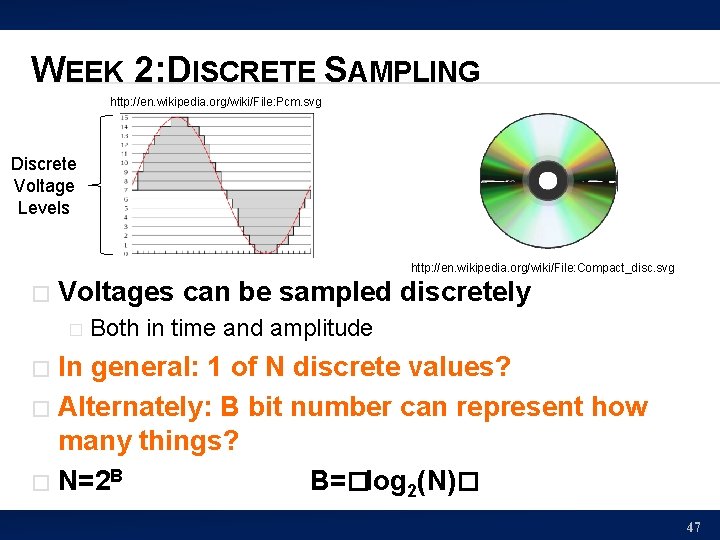
WEEK 2: DISCRETE SAMPLING http: //en. wikipedia. org/wiki/File: Pcm. svg Discrete Voltage Levels http: //en. wikipedia. org/wiki/File: Compact_disc. svg � Voltages can be sampled discretely � Both in time and amplitude In general: 1 of N discrete values? � Alternately: B bit number can represent how many things? � N=2 B B=�log 2(N)� � 47
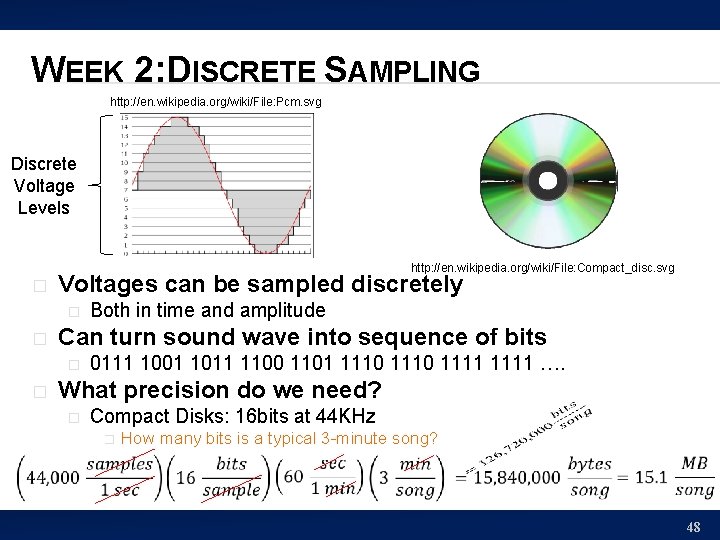
WEEK 2: DISCRETE SAMPLING http: //en. wikipedia. org/wiki/File: Pcm. svg Discrete Voltage Levels http: //en. wikipedia. org/wiki/File: Compact_disc. svg � Voltages can be sampled discretely � � Can turn sound wave into sequence of bits � � Both in time and amplitude 0111 1001 1011 1100 1101 1110 1111 …. What precision do we need? � Compact Disks: 16 bits at 44 KHz � How many bits is a typical 3 -minute song? 48
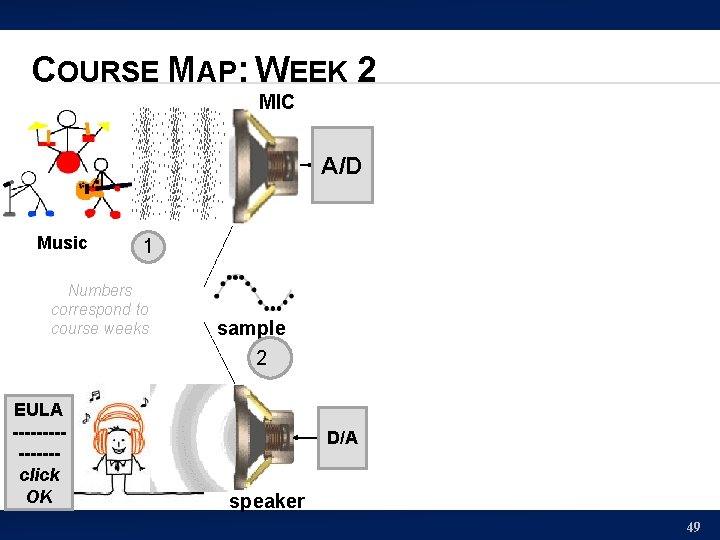
COURSE MAP: WEEK 2 MIC A/D Music 1 Numbers correspond to course weeks EULA -------click OK sample 2 D/A speaker 49
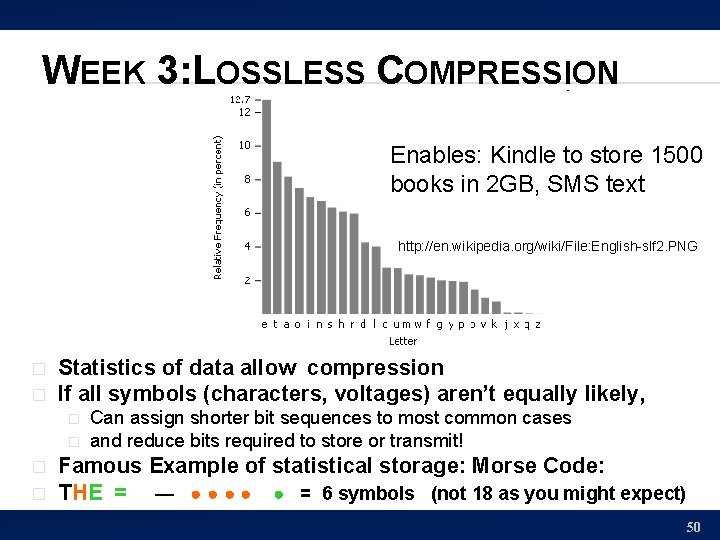
WEEK 3: LOSSLESS COMPRESSION Enables: Kindle to store 1500 books in 2 GB, SMS text http: //en. wikipedia. org/wiki/File: English-slf 2. PNG � � Statistics of data allow compression If all symbols (characters, voltages) aren’t equally likely, � � Can assign shorter bit sequences to most common cases and reduce bits required to store or transmit! Famous Example of statistical storage: Morse Code: THE = — ● ● ● = 6 symbols (not 18 as you might expect) 50
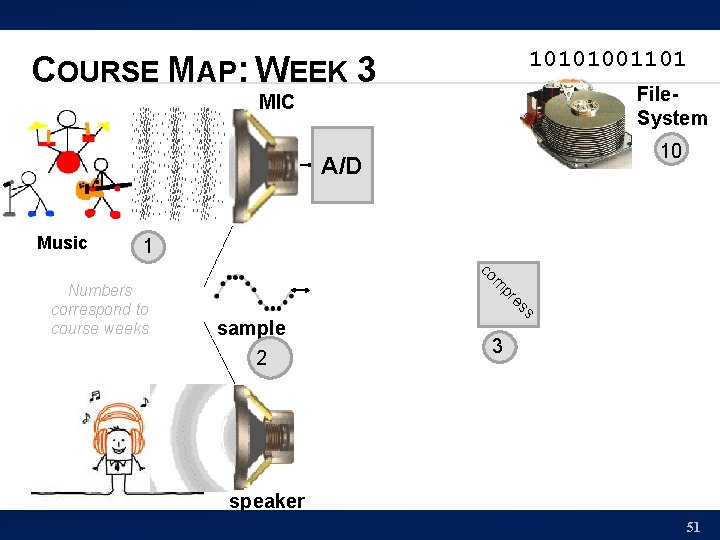
10101001101 COURSE MAP: WEEK 3 File. System MIC 10 A/D Music 1 sample 2 s es pr m co Numbers correspond to course weeks 3 speaker 51
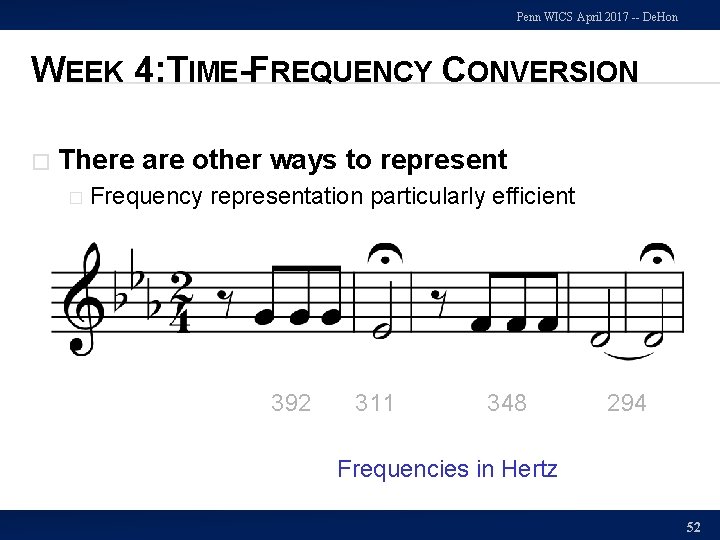
Penn WICS April 2017 -- De. Hon WEEK 4: TIME-FREQUENCY CONVERSION � There are other ways to represent � Frequency representation particularly efficient 392 311 348 294 Frequencies in Hertz 52
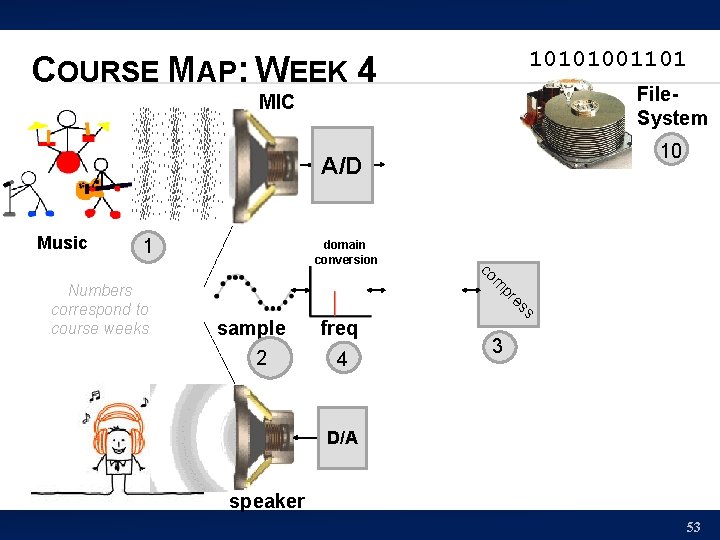
10101001101 COURSE MAP: WEEK 4 File. System MIC 10 A/D Music 1 sample 2 freq 4 s es pr m co Numbers correspond to course weeks domain conversion 3 D/A speaker 53
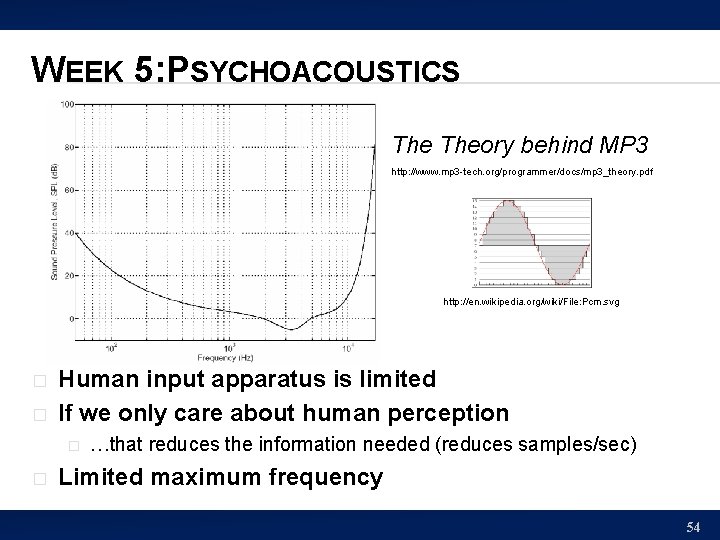
WEEK 5: PSYCHOACOUSTICS Theory behind MP 3 http: //www. mp 3 -tech. org/programmer/docs/mp 3_theory. pdf http: //en. wikipedia. org/wiki/File: Pcm. svg � � Human input apparatus is limited If we only care about human perception � � …that reduces the information needed (reduces samples/sec) Limited maximum frequency 54
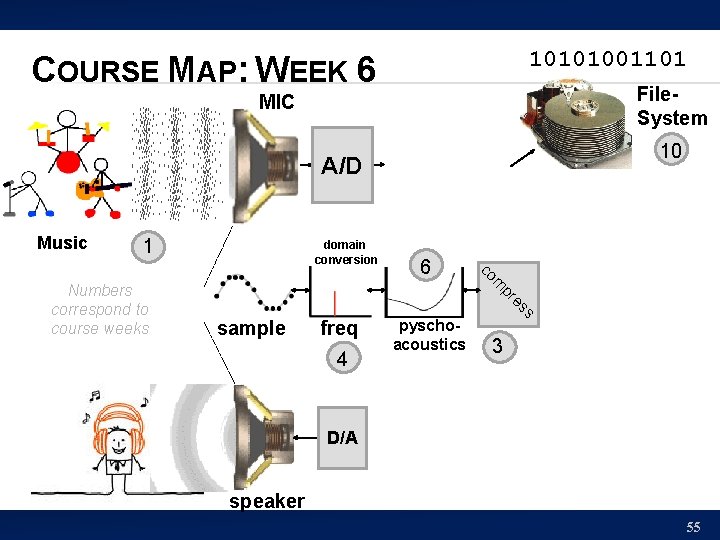
10101001101 COURSE MAP: WEEK 6 File. System MIC 10 A/D Music 1 freq 4 pyschoacoustics s es pr sample 6 m co Numbers correspond to course weeks domain conversion 3 D/A speaker 55
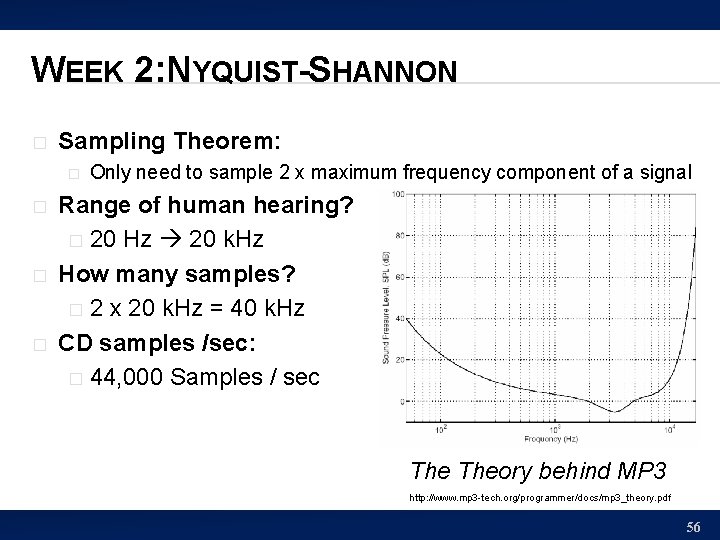
WEEK 2: NYQUIST-SHANNON � Sampling Theorem: � � Only need to sample 2 x maximum frequency component of a signal Range of human hearing? � 20 Hz 20 k. Hz How many samples? � 2 x 20 k. Hz = 40 k. Hz CD samples /sec: � 44, 000 Samples / sec Theory behind MP 3 http: //www. mp 3 -tech. org/programmer/docs/mp 3_theory. pdf 56
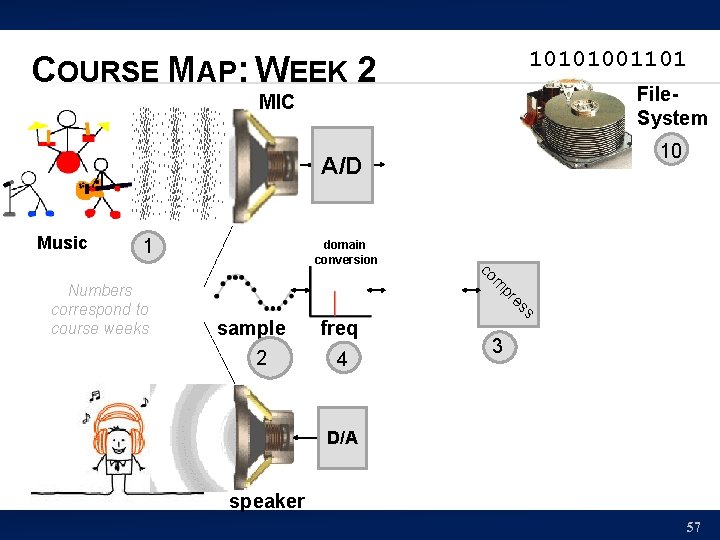
10101001101 COURSE MAP: WEEK 2 File. System MIC 10 A/D Music 1 sample 2 freq 4 s es pr m co Numbers correspond to course weeks domain conversion 3 D/A speaker 57
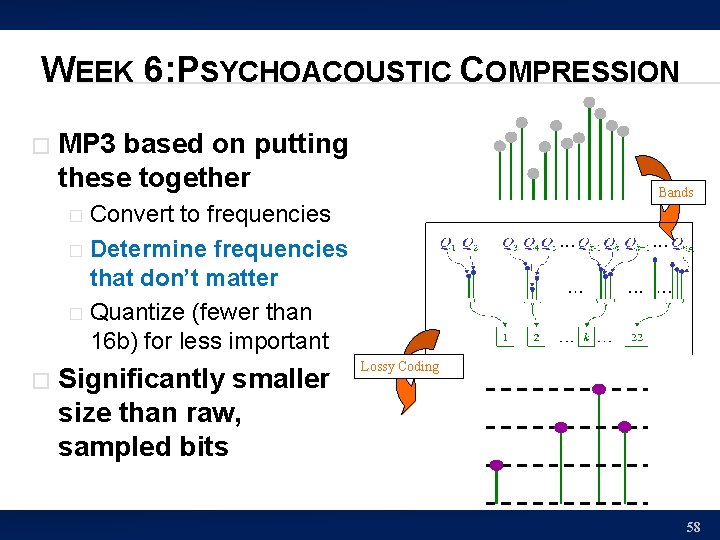
WEEK 6: PSYCHOACOUSTIC COMPRESSION � MP 3 based on putting these together Bands Convert to frequencies � Determine frequencies that don’t matter � Quantize (fewer than 16 b) for less important � � Significantly smaller size than raw, sampled bits Lossy Coding 58
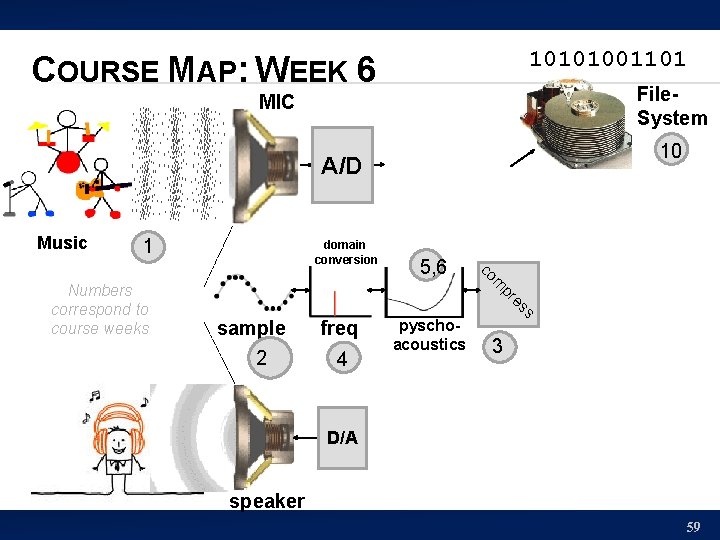
10101001101 COURSE MAP: WEEK 6 File. System MIC 10 A/D Music 1 freq 4 pyschoacoustics s es pr sample 2 5, 6 m co Numbers correspond to course weeks domain conversion 3 D/A speaker 59
WEEK 7: HARDWARE � CPUs: We’ll look at their operation and architecture � How fast does your laptop or cell phone run? � Modern chips run 100 MHz to 4 GHz � � only need one multiplier, adder Reuse hardware it in time 60
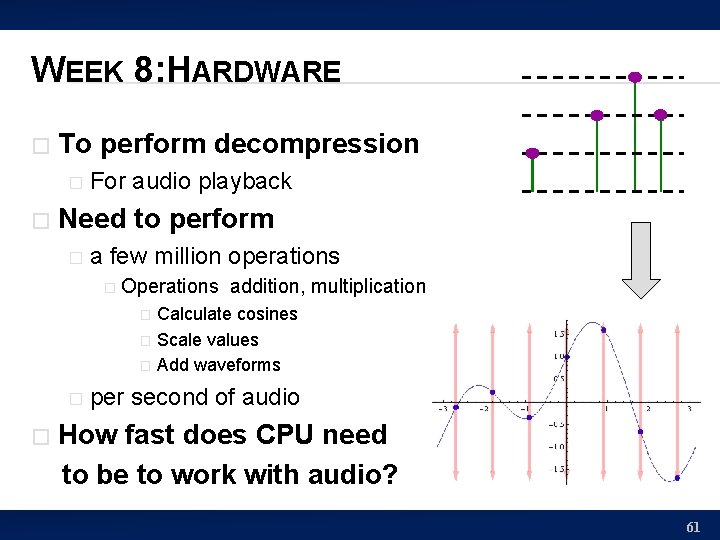
WEEK 8: HARDWARE � To perform decompression � � For audio playback Need to perform � a few million operations � Operations addition, multiplication Calculate cosines � Scale values � Add waveforms � � � per second of audio How fast does CPU need to be to work with audio? 61
WEEK 8: P I OD PROCESSOR � Early based on Portal. Player series Two ARM 7 TDMI cores � 80 MHz each � � Current use ARM 7 or ARM 8 62
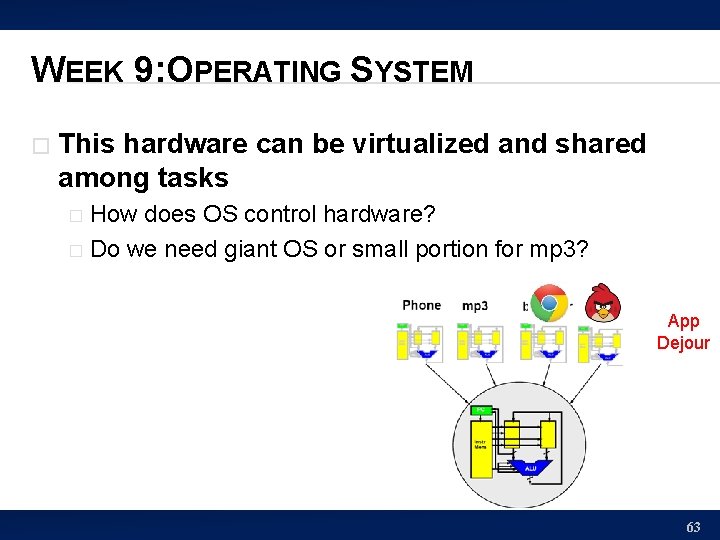
WEEK 9: OPERATING SYSTEM � This hardware can be virtualized and shared among tasks How does OS control hardware? � Do we need giant OS or small portion for mp 3? � App Dejour 63
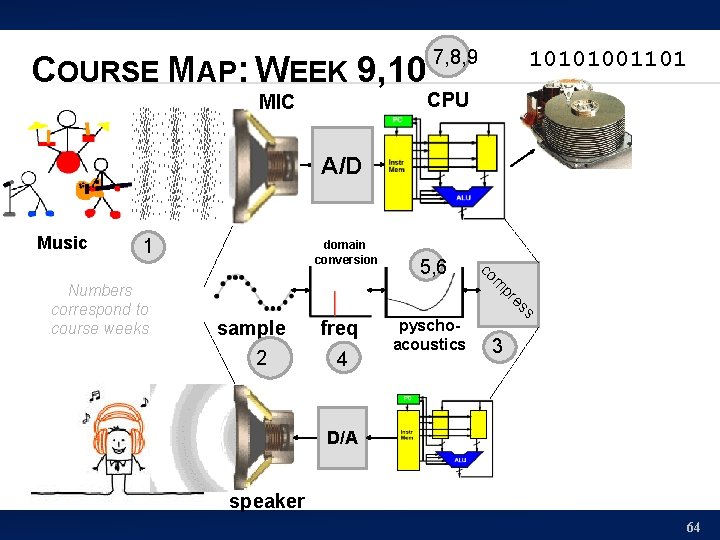
COURSE MAP: WEEK 9, 10 7, 8, 9 10101001101 CPU MIC A/D Music 1 freq 4 pyschoacoustics s es pr sample 2 5, 6 m co Numbers correspond to course weeks domain conversion 3 D/A speaker 64
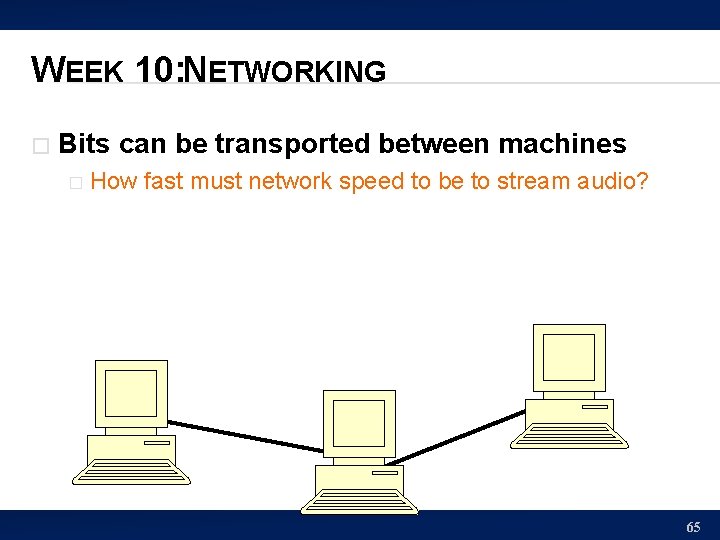
WEEK 10: NETWORKING � Bits can be transported between machines � How fast must network speed to be to stream audio? 65
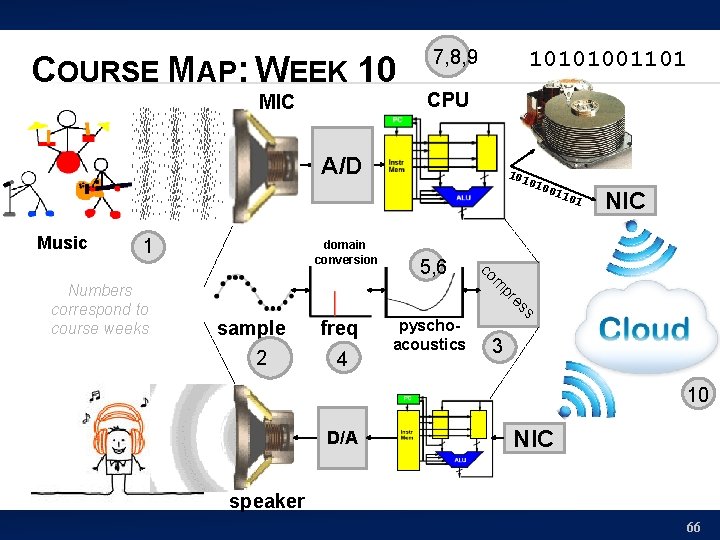
COURSE MAP: WEEK 10 MIC 7, 8, 9 10101001101 CPU A/D Music 1 freq 4 5, 6 pyschoacoustics 011 01 NIC s es pr sample 2 010 m co Numbers correspond to course weeks domain conversion 101 3 10 D/A NIC speaker 66
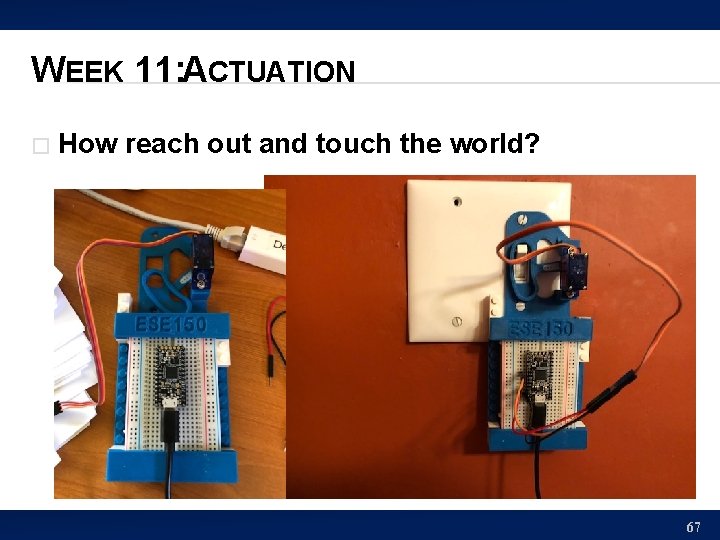
WEEK 11: ACTUATION � How reach out and touch the world? 67
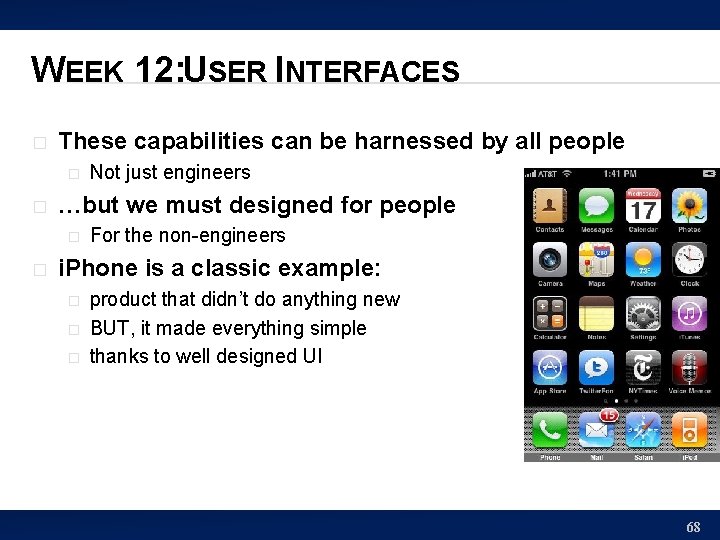
WEEK 12: USER INTERFACES � These capabilities can be harnessed by all people � � …but we must designed for people � � Not just engineers For the non-engineers i. Phone is a classic example: � � � product that didn’t do anything new BUT, it made everything simple thanks to well designed UI 68
WEEK 13: INTELLECTUAL PROPERTY Who own’s the bits? � What is the law? � Why should you care (as engineers)? � How is the world changing? � 69
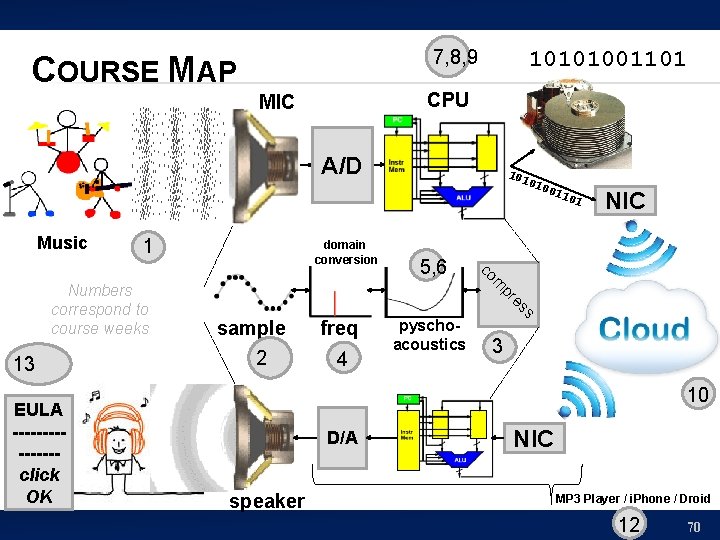
7, 8, 9 COURSE MAP 10101001101 CPU MIC A/D Music 1 EULA -------click OK freq 4 5, 6 pyschoacoustics 011 01 NIC s es pr 13 sample 2 010 m co Numbers correspond to course weeks domain conversion 101 3 10 D/A speaker NIC MP 3 Player / i. Phone / Droid 12 70
71
History & Motivation Short Story / Overview Course Introduction Learning Styles SUMMARY Long Story / Intro to Sound Summary 72
THIS COURSE � Always trying to improve: � Attempts to explain a great deal of Computer Engineering � Without � going to far in depth Lecture/Lab � Intent is to tie them together well � Inevitably, the tie won’t always be obvious � Help us, help you (and future students): � The more feedback you provide, the better we can make this course � If a tie isn’t obvious, let us help make the connection stronger � We want you to love Comp Engineering as much as we do � One form: daily feedback forms (link on syllabus) 73
CHANGING WORLD � Automated computation changed world � � Faster than we imagined World being digitized and refitted for computerized control and mediation People-to-people, people-to-machines � Infrastructure from bricks/concrete/steel to networking/computers/software � � Enabling new engineering � Computerization at center Exciting and dangerous � Computer Engineering at center � 74
PARTING THOUGHT � From 1 st computer to PCs in 30 years � � From first PCs to i. Phone next 30 years � � Apple 1976 i. Phone 2007 What will next 30 years hold? � � Eniac 1946 Apple 1976 Beginning of your career What will you imagine, create, enable? Complete: Lab Pickup Time Poll, Today’s Feedback. 75
- Slides: 70