
Finish Markov Decision Processes Last Class Computer Science
![Example MDP: Sequence of actions Can the sequence [Up, Right, Right ] take the](https://slidetodoc.com/presentation_image_h2/0ff54b08ef29d1d81f272a3eb57e1d09/image-27.jpg "Example MDP: Sequence of actions Can the sequence [Up, Right, Right ] take the")
- Slides: 27
Finish Markov Decision Processes Last Class Computer Science cpsc 322, Lecture 37 (Textbook Chpt 9. 5) April, 8, 2009 CPSC 322, Lecture 37 Slide 1
Lecture Overview • Recap: MDPs and More on MDP Example • Optimal Policies • Some Examples • Course Conclusions CPSC 322, Lecture 37 Slide 2
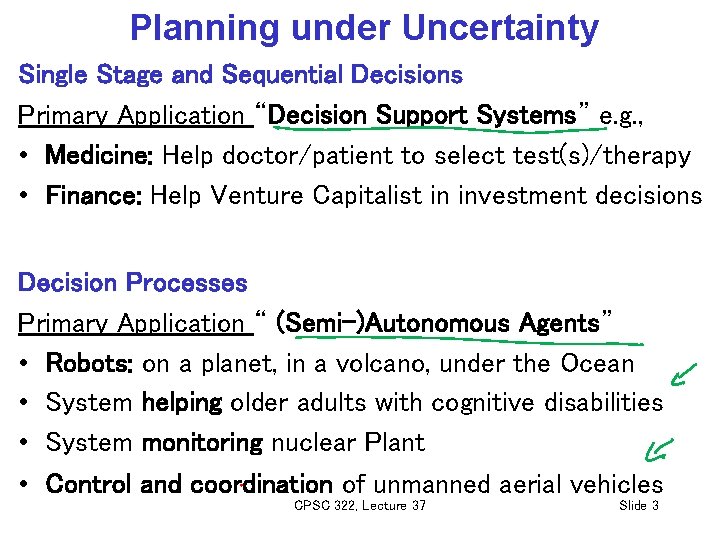
Planning under Uncertainty Single Stage and Sequential Decisions Primary Application “Decision Support Systems” e. g. , • Medicine: Help doctor/patient to select test(s)/therapy • Finance: Help Venture Capitalist in investment decisions Decision Processes Primary Application “ (Semi-)Autonomous Agents” • Robots: on a planet, in a volcano, under the Ocean • System helping older adults with cognitive disabilities • System monitoring nuclear Plant • Control and coordination of unmanned aerial vehicles CPSC 322, Lecture 37 Slide 3
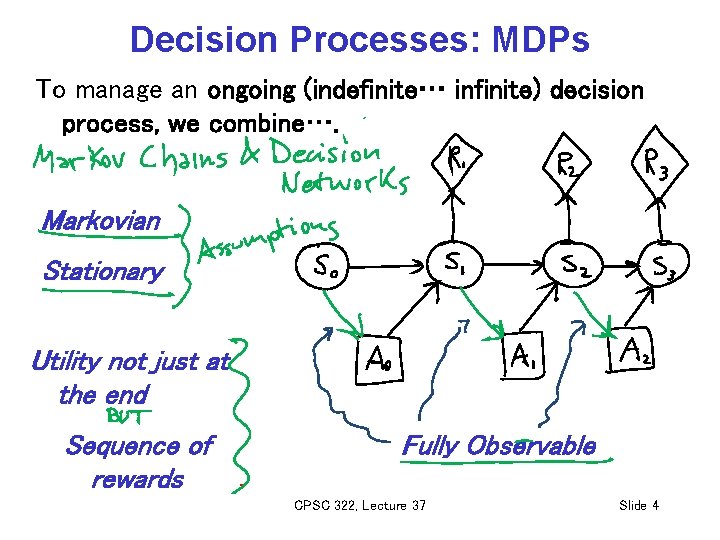
Decision Processes: MDPs To manage an ongoing (indefinite… infinite) decision process, we combine…. Markovian Stationary Utility not just at the end Sequence of rewards Fully Observable CPSC 322, Lecture 37 Slide 4
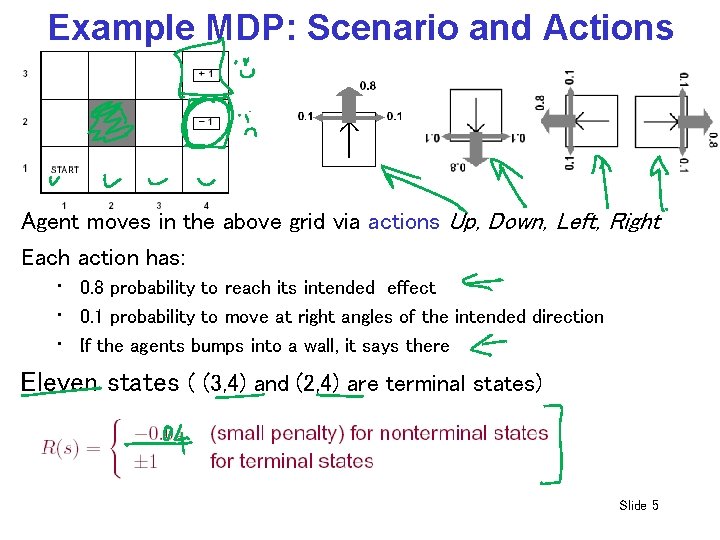
Example MDP: Scenario and Actions Agent moves in the above grid via actions Up, Down, Left, Right Each action has: • 0. 8 probability to reach its intended effect • 0. 1 probability to move at right angles of the intended direction • If the agents bumps into a wall, it says there Eleven states ( (3, 4) and (2, 4) are terminal states) CPSC 322, Lecture 37 Slide 5
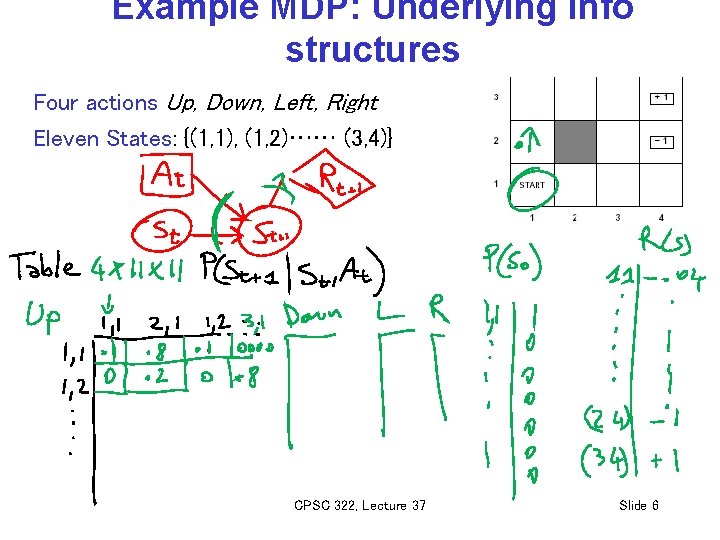
Example MDP: Underlying info structures Four actions Up, Down, Left, Right Eleven States: {(1, 1), (1, 2)…… (3, 4)} CPSC 322, Lecture 37 Slide 6
Lecture Overview • Recap: MDPs and More on MDP Example • Optimal Policies • Some Examples • Course Conclusions CPSC 322, Lecture 37 Slide 7
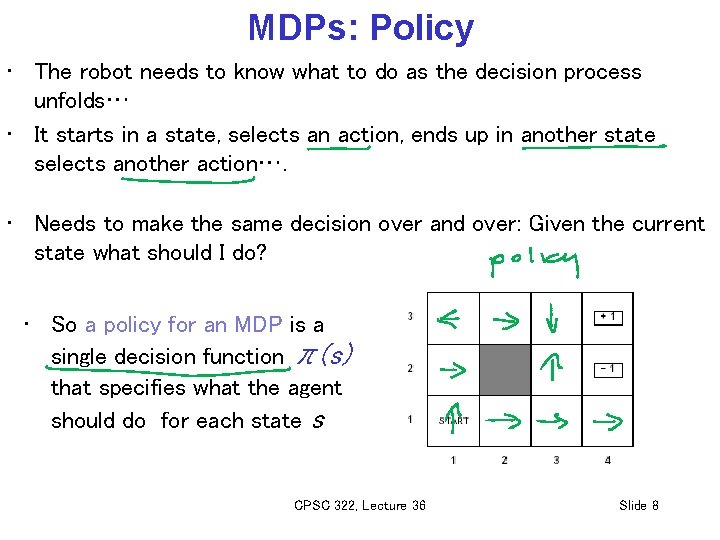
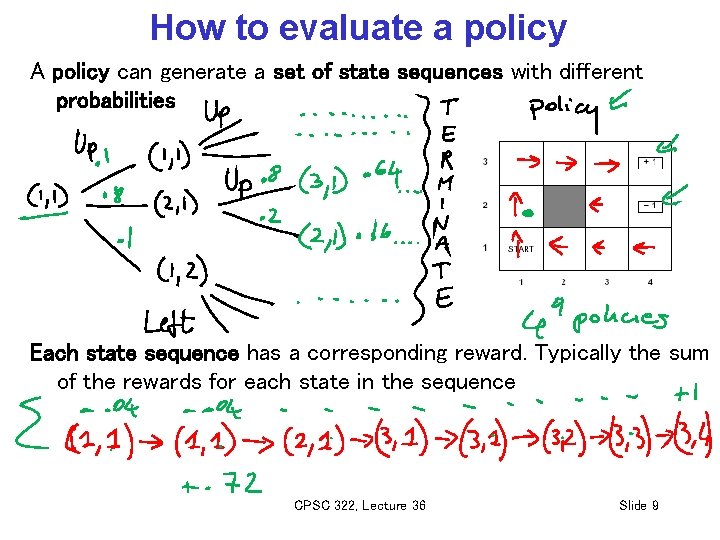
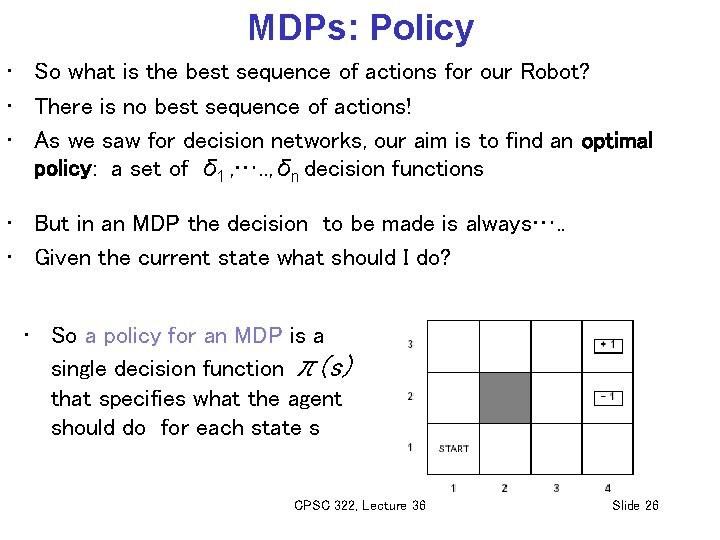
MDPs: Policy • The robot needs to know what to do as the decision process unfolds… • It starts in a state, selects an action, ends up in another state selects another action…. • Needs to make the same decision over and over: Given the current state what should I do? • So a policy for an MDP is a single decision function π(s) that specifies what the agent should do for each state s CPSC 322, Lecture 36 Slide 8
How to evaluate a policy A policy can generate a set of state sequences with different probabilities Each state sequence has a corresponding reward. Typically the sum of the rewards for each state in the sequence CPSC 322, Lecture 36 Slide 9
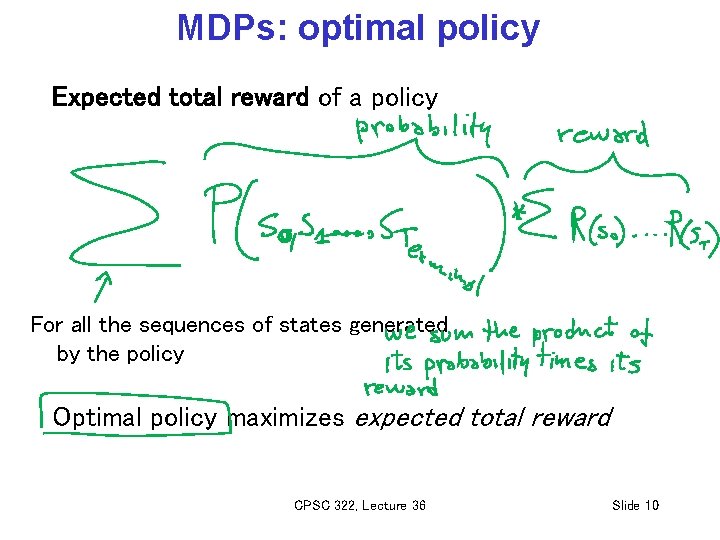
MDPs: optimal policy Expected total reward of a policy For all the sequences of states generated by the policy Optimal policy maximizes expected total reward CPSC 322, Lecture 36 Slide 10
Lecture Overview • Recap: MDPs and More on MDP Example • Optimal Policies • Some Examples • Course Conclusions CPSC 322, Lecture 37 Slide 11
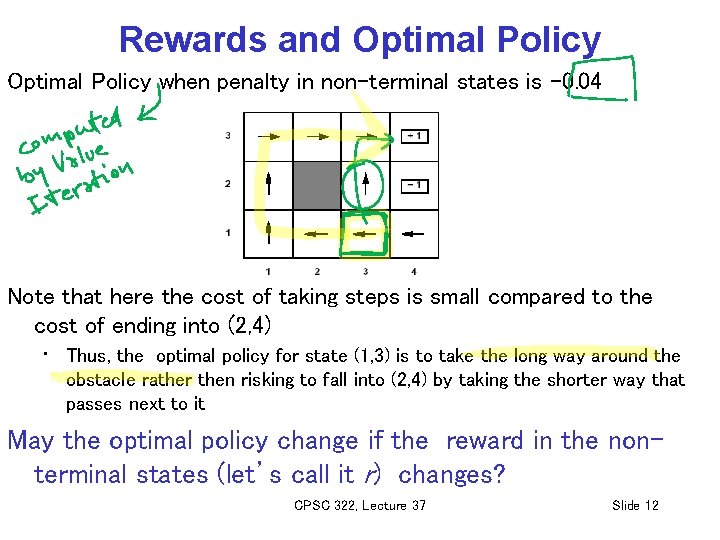
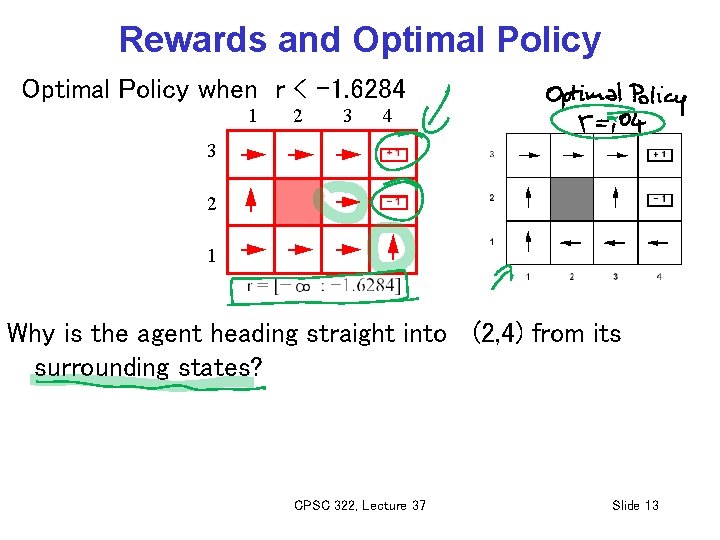
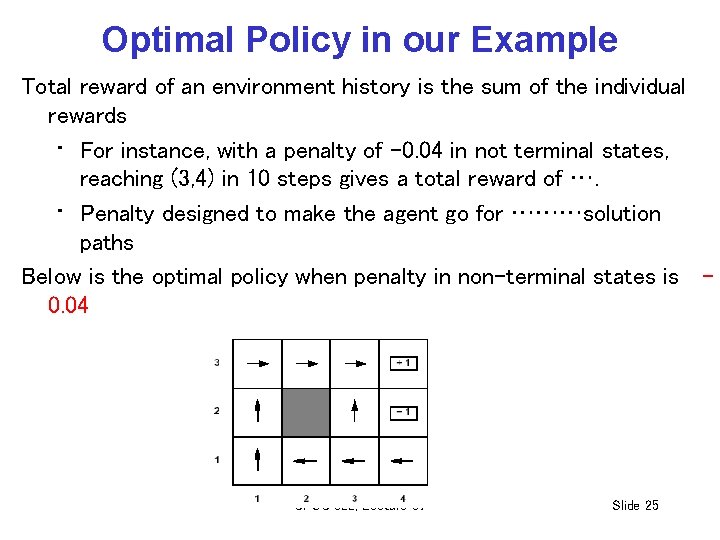
Rewards and Optimal Policy when penalty in non-terminal states is -0. 04 Note that here the cost of taking steps is small compared to the cost of ending into (2, 4) • Thus, the optimal policy for state (1, 3) is to take the long way around the obstacle rather then risking to fall into (2, 4) by taking the shorter way that passes next to it May the optimal policy change if the reward in the nonterminal states (let’s call it r) changes? CPSC 322, Lecture 37 Slide 12
Rewards and Optimal Policy when r < -1. 6284 1 2 3 4 3 2 1 Why is the agent heading straight into (2, 4) from its surrounding states? CPSC 322, Lecture 37 Slide 13
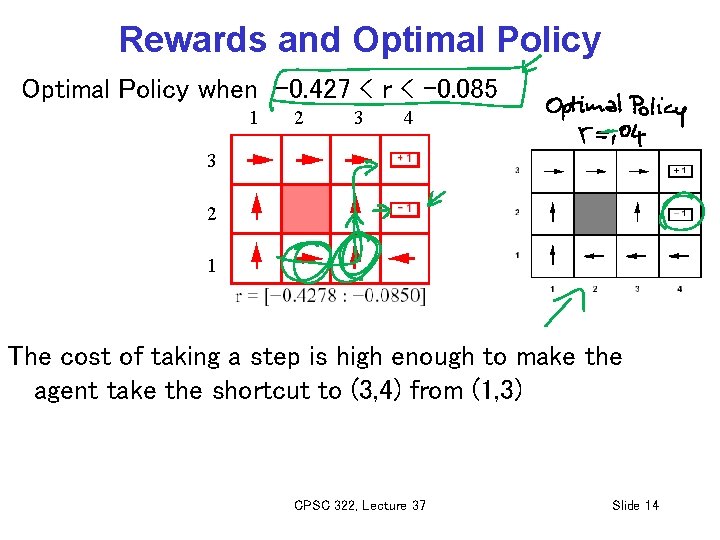
Rewards and Optimal Policy when -0. 427 < r < -0. 085 1 2 3 4 3 2 1 The cost of taking a step is high enough to make the agent take the shortcut to (3, 4) from (1, 3) CPSC 322, Lecture 37 Slide 14
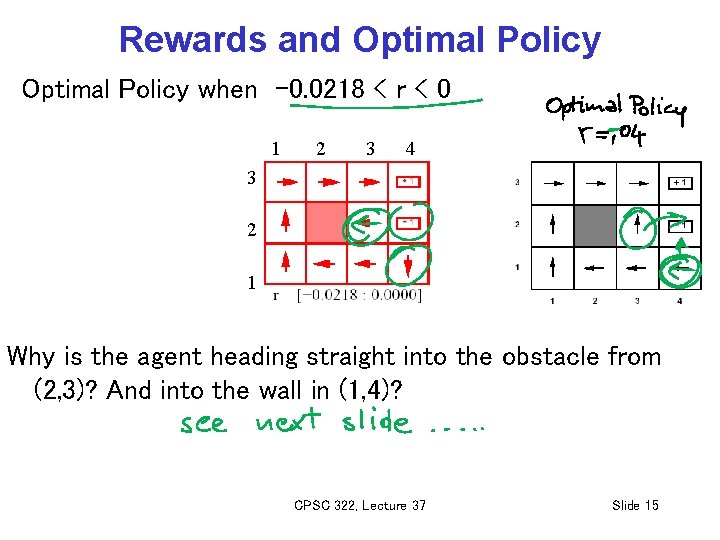
Rewards and Optimal Policy when -0. 0218 < r < 0 1 2 3 4 3 2 1 Why is the agent heading straight into the obstacle from (2, 3)? And into the wall in (1, 4)? CPSC 322, Lecture 37 Slide 15
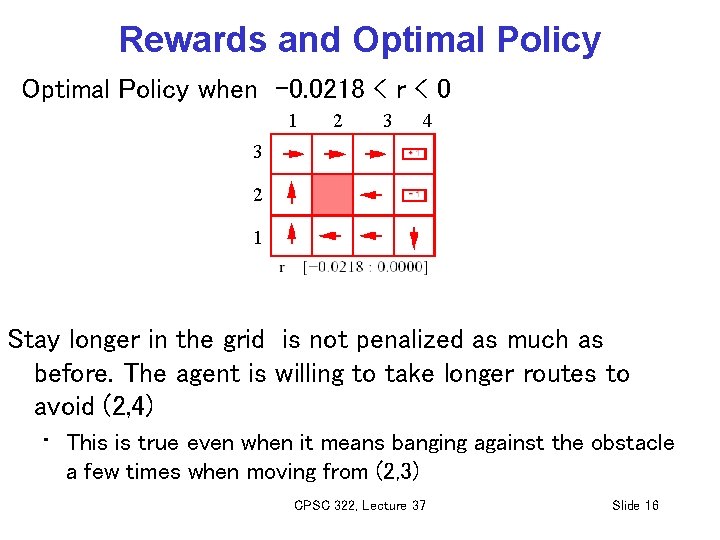
Rewards and Optimal Policy when -0. 0218 < r < 0 1 2 3 4 3 2 1 Stay longer in the grid is not penalized as much as before. The agent is willing to take longer routes to avoid (2, 4) • This is true even when it means banging against the obstacle a few times when moving from (2, 3) CPSC 322, Lecture 37 Slide 16
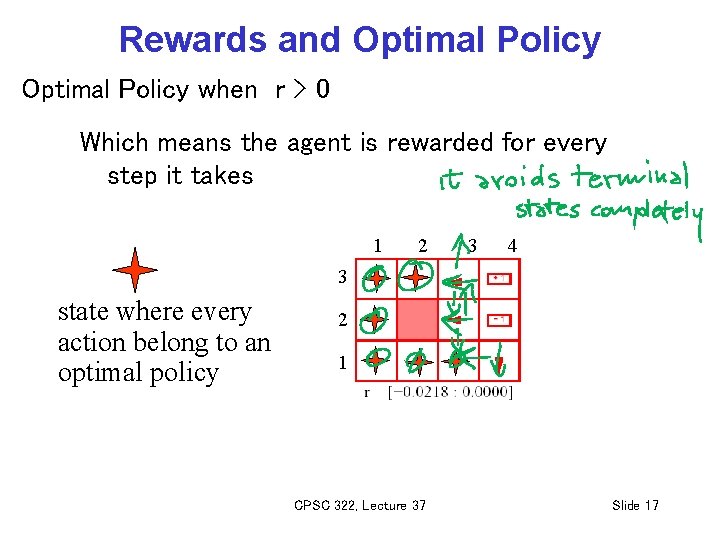
Rewards and Optimal Policy when r > 0 Which means the agent is rewarded for every step it takes 1 2 3 4 3 state where every action belong to an optimal policy 2 1 CPSC 322, Lecture 37 Slide 17
Learning Goals for Monday’s and today’s class You can: • Effectively represent indefinite/infinite decision processes • Compute the probability of a sequence of actions in a Markov Decision Process (MDP) • Define the computation of the expected total reward of a policy for an MDP • Explain influence of rewards on optimal policy CPSC 322, Lecture 36 Slide 18
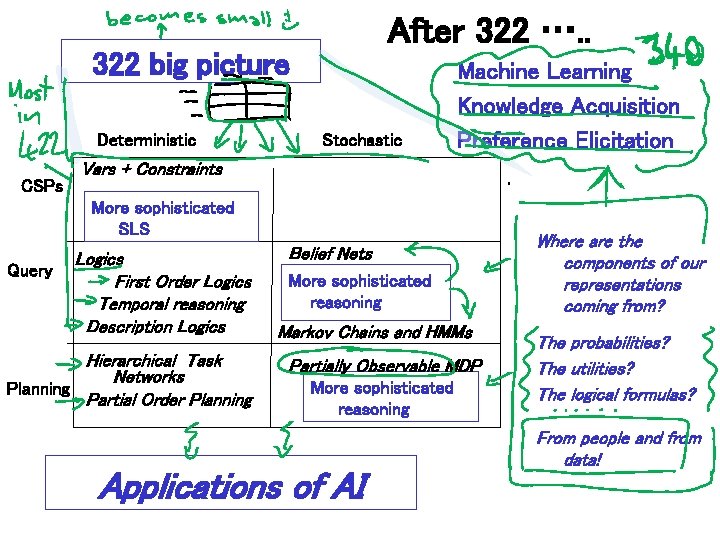
After 322 …. . 322 big picture Deterministic CSPs Stochastic Machine Learning Knowledge Acquisition Preference Elicitation Vars + Constraints More sophisticated SLS Query Logics First Order Logics Temporal reasoning Description Logics Hierarchical Task Networks Planning Partial Order Planning Belief Nets More sophisticated reasoning Markov Chains and HMMs Partially Observable MDP More sophisticated reasoning Applications of AI Where are the components of our representations coming from? The probabilities? The utilities? The logical formulas? From people and from data!
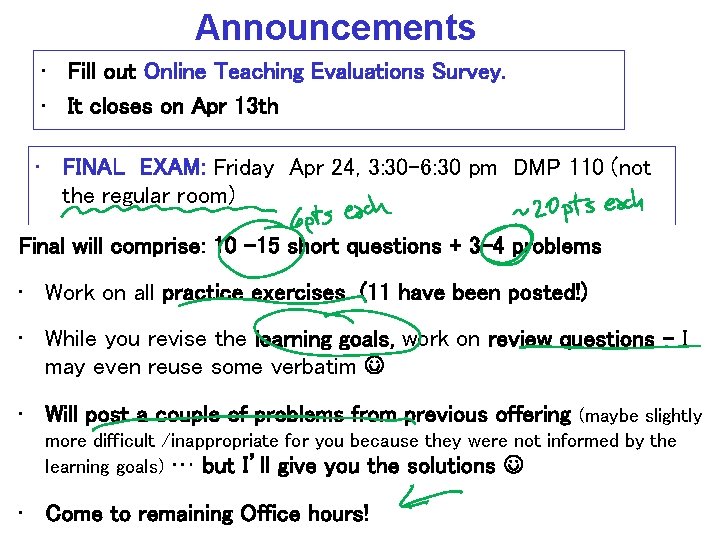
Announcements • Fill out Online Teaching Evaluations Survey. • It closes on Apr 13 th • FINAL EXAM: Friday Apr 24, 3: 30 -6: 30 pm DMP 110 (not the regular room) Final will comprise: 10 -15 short questions + 3 -4 problems • Work on all practice exercises (11 have been posted!) • While you revise the learning goals, work on review questions - I may even reuse some verbatim • Will post a couple of problems from previous offering (maybe slightly more difficult /inappropriate for you because they were not informed by the learning goals) … but I’ll give you the solutions 322, Lecture 37 • Come to remaining Office. CPSC hours! Slide 20
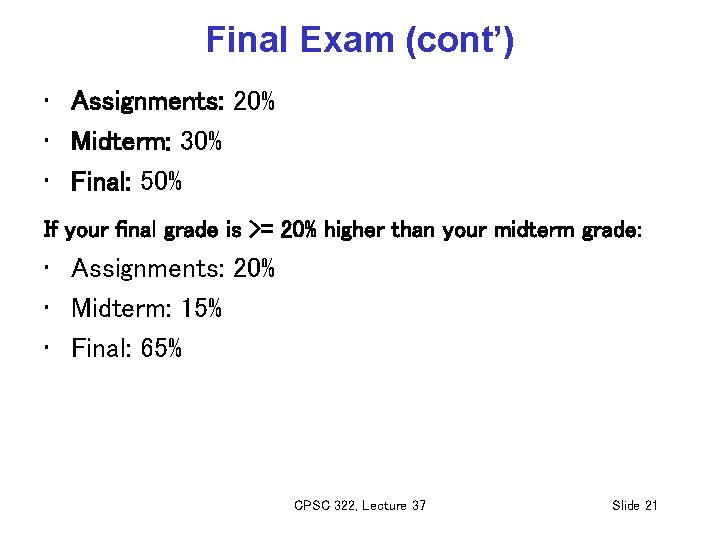
Final Exam (cont’) • Assignments: 20% • Midterm: 30% • Final: 50% If your final grade is >= 20% higher than your midterm grade: • Assignments: 20% • Midterm: 15% • Final: 65% CPSC 322, Lecture 37 Slide 21
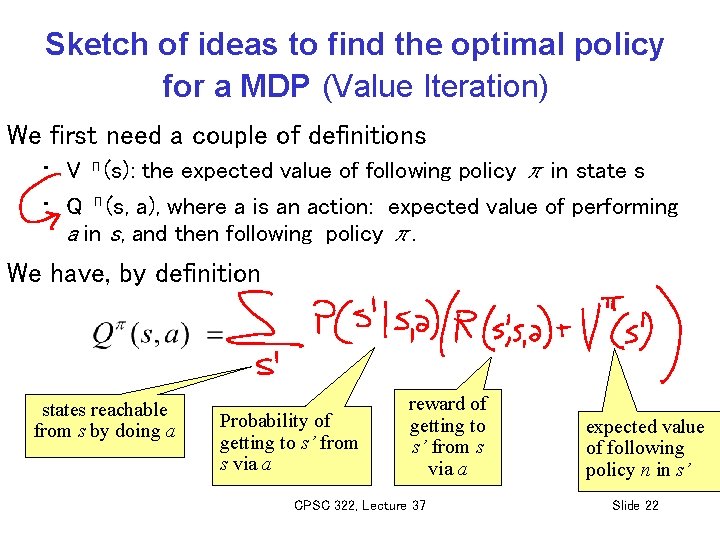
Sketch of ideas to find the optimal policy for a MDP (Value Iteration) We first need a couple of definitions • V п(s): the expected value of following policy π in state s • Q п(s, a), where a is an action: expected value of performing a in s, and then following policy π. We have, by definition states reachable from s by doing a Probability of getting to s’ from s via a reward of getting to s’ from s via a CPSC 322, Lecture 37 expected value of following policy п in s’ Slide 22
322 Conclusions Artificial Intelligence has become a huge field. After taking this course you should have achieved a reasonable understanding of the basic principles and techniques… But there is much more… 422 Advanced AI 340 Machine Learning 425 Machine Vision Grad courses: Natural Language Processing, Intelligent User Interfaces, Multi-Agents Systems, Machine Learning, Vision CPSC 322, Lecture 37 Slide 23
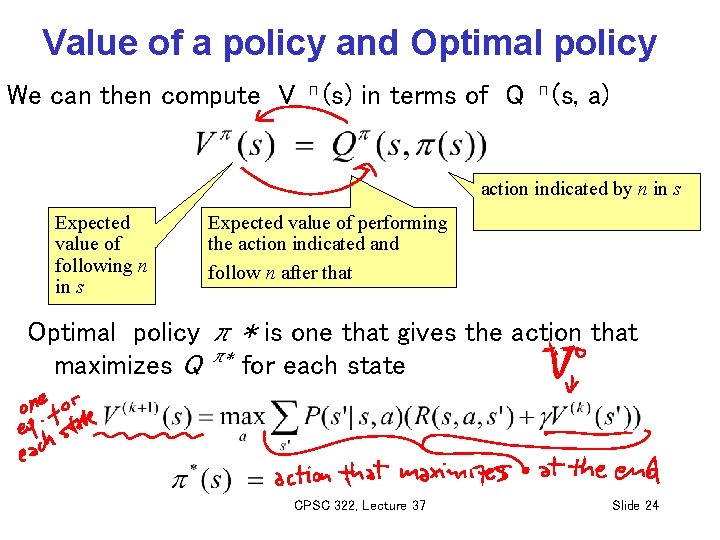
Value of a policy and Optimal policy We can then compute V п(s) in terms of Q п(s, a) action indicated by п in s Expected value of following п in s Expected value of performing the action indicated and follow п after that Optimal policy π * is one that gives the action that maximizes Q π* for each state CPSC 322, Lecture 37 Slide 24
Optimal Policy in our Example Total reward of an environment history is the sum of the individual rewards • For instance, with a penalty of -0. 04 in not terminal states, reaching (3, 4) in 10 steps gives a total reward of …. • Penalty designed to make the agent go for ………solution paths Below is the optimal policy when penalty in non-terminal states is 0. 04 CPSC 322, Lecture 37 Slide 25
MDPs: Policy • So what is the best sequence of actions for our Robot? • There is no best sequence of actions! • As we saw for decision networks, our aim is to find an optimal policy: a set of δ 1 , …. . , δn decision functions • But in an MDP the decision to be made is always…. . • Given the current state what should I do? • So a policy for an MDP is a single decision function π(s) that specifies what the agent should do for each state s CPSC 322, Lecture 36 Slide 26
Example MDP: Sequence of actions Can the sequence [Up, Right, Right ] take the agent in terminal state (3, 4)? Can the sequence reach “the goal” in any other way? CPSC 322, Lecture 36 Slide 27