
Fingerprints in Sunlight Deborah Scherrer Stanford University Solar
Fingerprints in Sunlight Deborah Scherrer Stanford University Solar Center 1
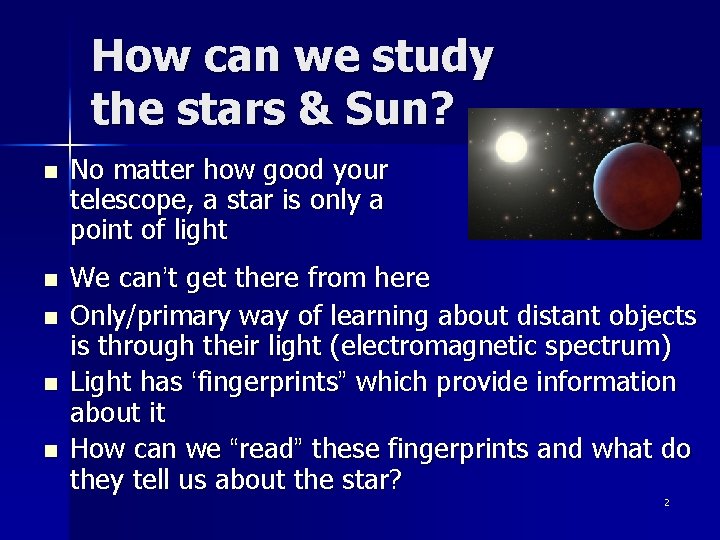
How can we study the stars & Sun? n No matter how good your telescope, a star is only a point of light n We can’t get there from here Only/primary way of learning about distant objects is through their light (electromagnetic spectrum) Light has ‘fingerprints” which provide information about it How can we “read” these fingerprints and what do they tell us about the star? n n n 2
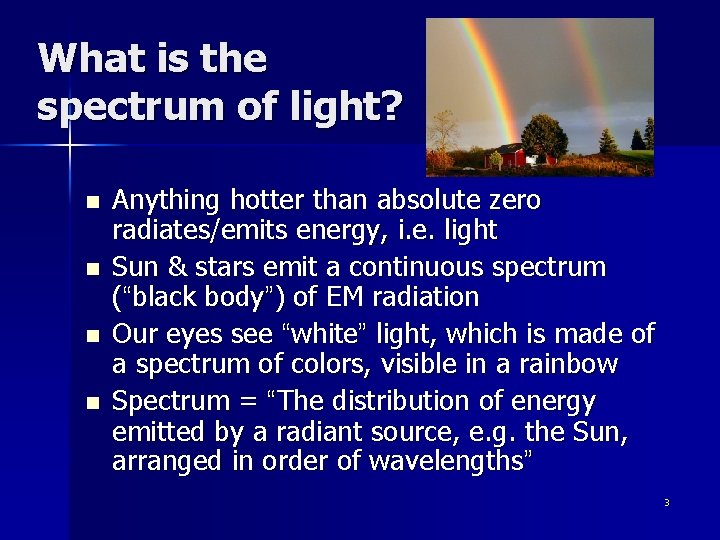
What is the spectrum of light? n n Anything hotter than absolute zero radiates/emits energy, i. e. light Sun & stars emit a continuous spectrum (“black body”) of EM radiation Our eyes see “white” light, which is made of a spectrum of colors, visible in a rainbow Spectrum = “The distribution of energy emitted by a radiant source, e. g. the Sun, arranged in order of wavelengths” 3
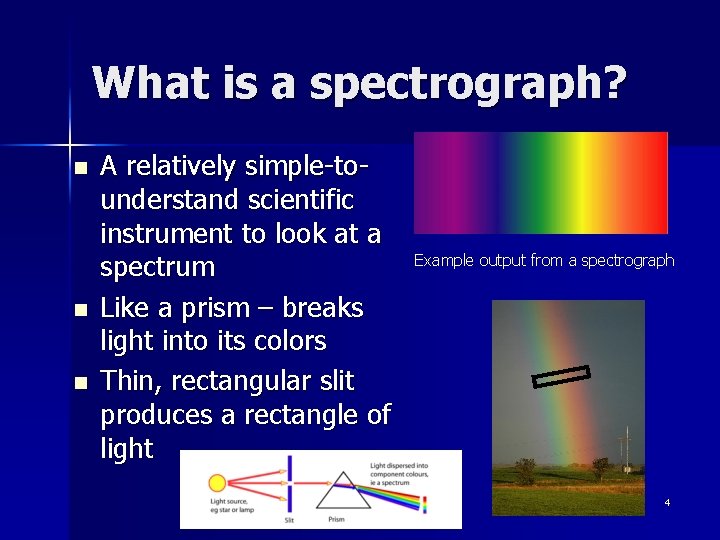
What is a spectrograph? n n n A relatively simple-tounderstand scientific instrument to look at a spectrum Like a prism – breaks light into its colors Thin, rectangular slit produces a rectangle of light Example output from a spectrograph 4
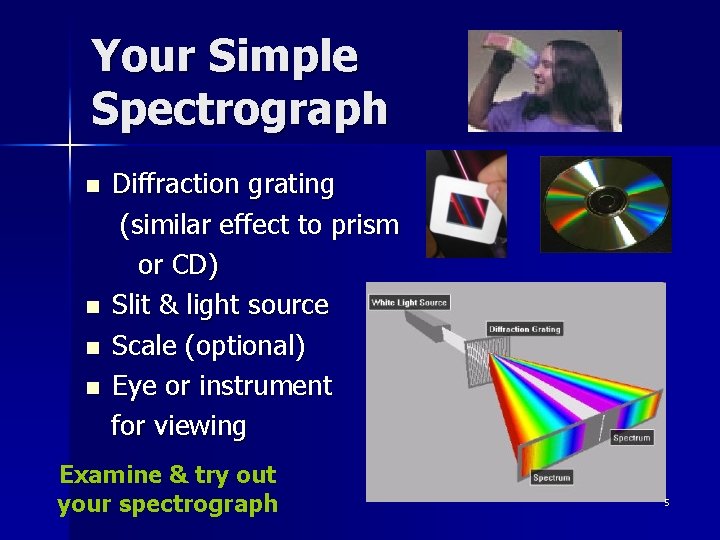
Your Simple Spectrograph n n Diffraction grating (similar effect to prism or CD) Slit & light source Scale (optional) Eye or instrument for viewing Examine & try out your spectrograph 5

Most astronomy is done with spectrographs! Your spectrograph Stanford Solar Center NASA’s Solar Dynamics Observatory (SDO) Spacecraft Student spectrograph & gas lamp NASA’s IRIS Mission Home-made spectrograph attached to telescope Hubble’s Cosmic Origins Spectrograph 6
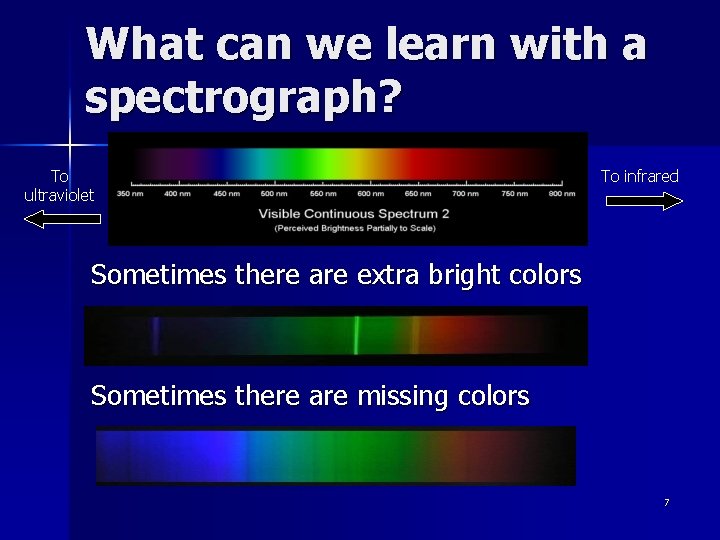
What can we learn with a spectrograph? To ultraviolet To infrared Sometimes there are extra bright colors Sometimes there are missing colors 7
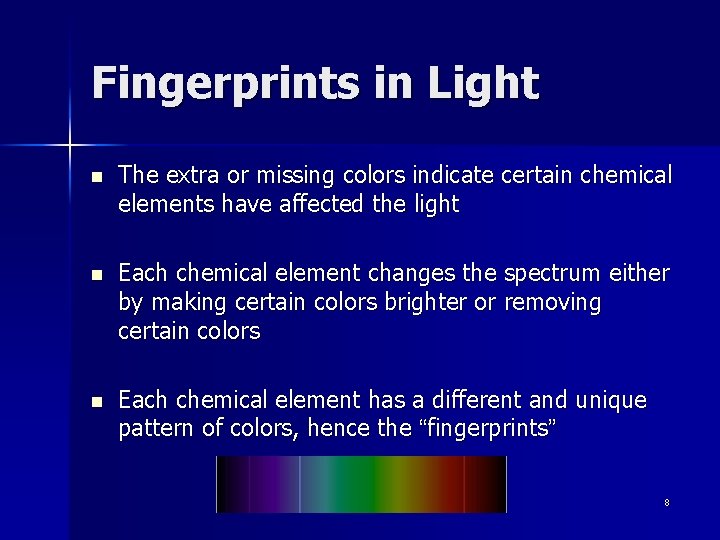
Fingerprints in Light n The extra or missing colors indicate certain chemical elements have affected the light n Each chemical element changes the spectrum either by making certain colors brighter or removing certain colors n Each chemical element has a different and unique pattern of colors, hence the “fingerprints” 8
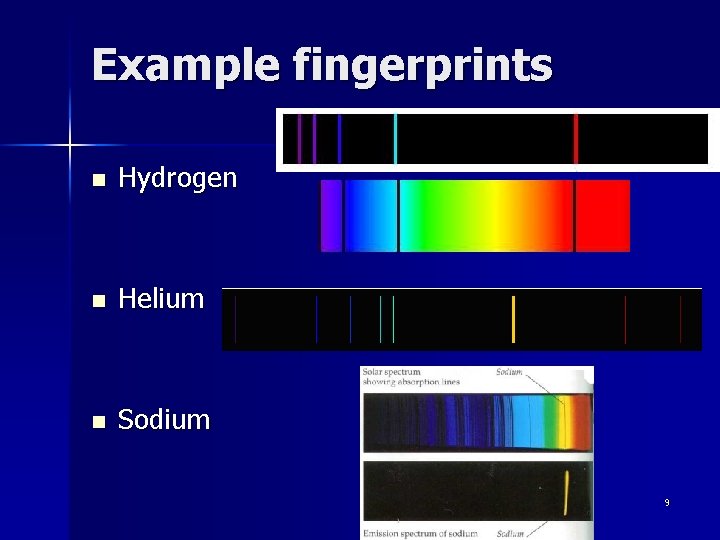
Example fingerprints n Hydrogen n Helium n Sodium 9
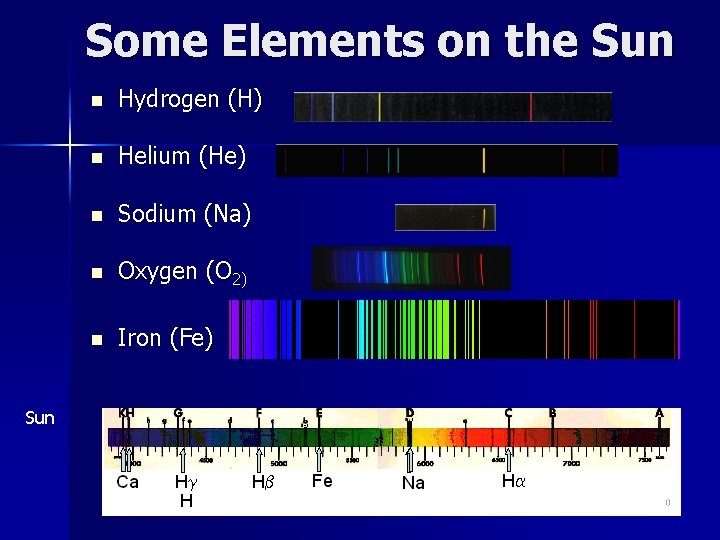
Some Elements on the Sun n Hydrogen (H) n Helium (He) n Sodium (Na) n Oxygen (O 2) n Iron (Fe) Sun 10
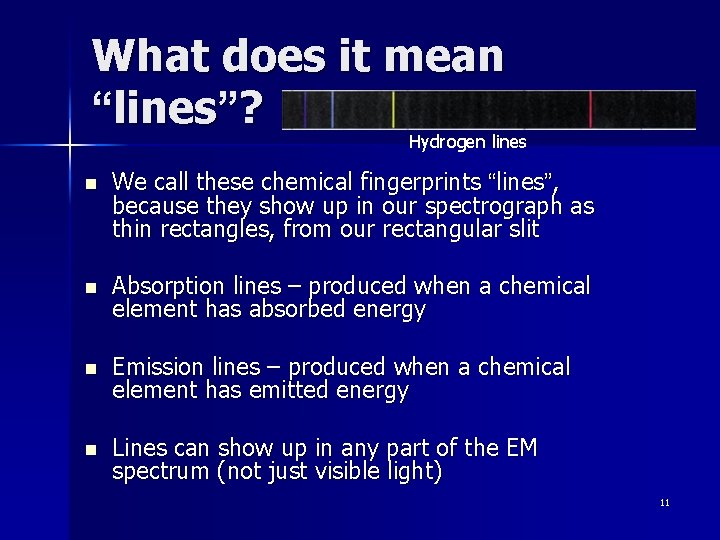
What does it mean “lines”? Hydrogen lines n We call these chemical fingerprints “lines”, because they show up in our spectrograph as thin rectangles, from our rectangular slit n Absorption lines – produced when a chemical element has absorbed energy n Emission lines – produced when a chemical element has emitted energy n Lines can show up in any part of the EM spectrum (not just visible light) 11

Let’s try an example n Point your spectrograph to an incandescent light or sunlight n Next, point your spectrograph to a fluorescent light bulb n What do you see? Especially notice the bright green line 12
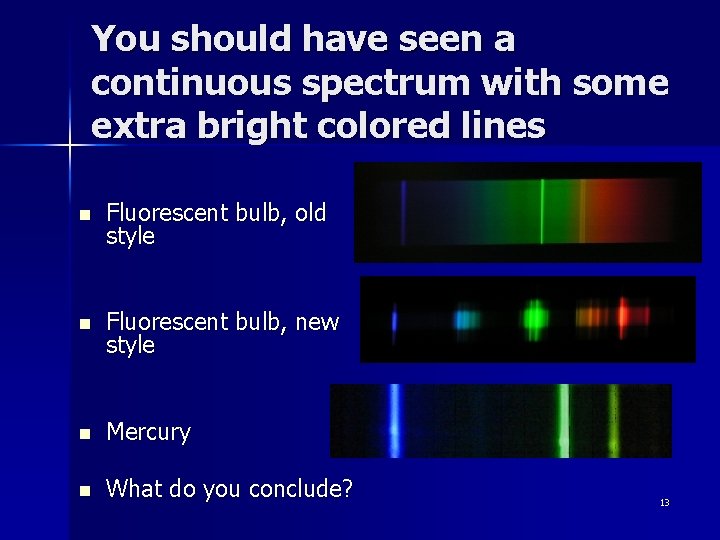
You should have seen a continuous spectrum with some extra bright colored lines n Fluorescent bulb, old style n Fluorescent bulb, new style n Mercury n What do you conclude? 13
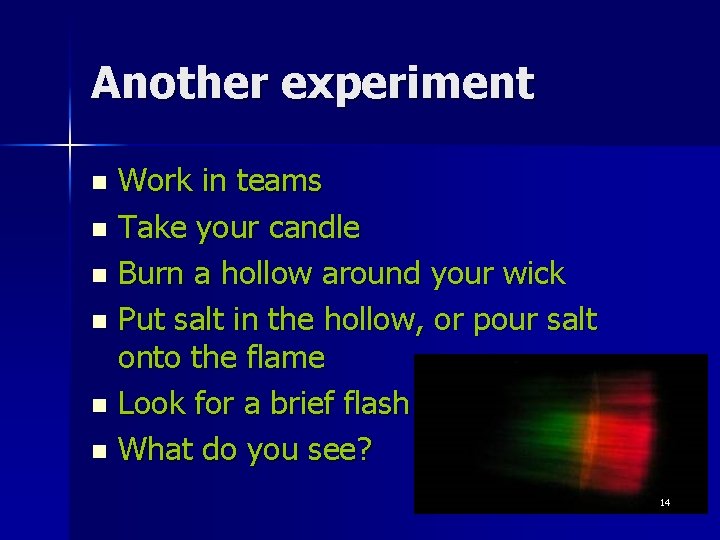
Another experiment Work in teams n Take your candle n Burn a hollow around your wick n Put salt in the hollow, or pour salt onto the flame n Look for a brief flash n What do you see? n 14
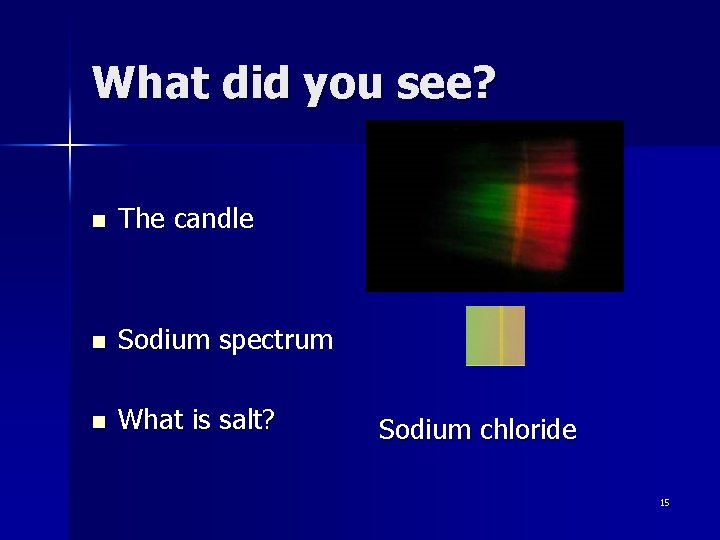
What did you see? n The candle n Sodium spectrum n What is salt? Sodium chloride 15
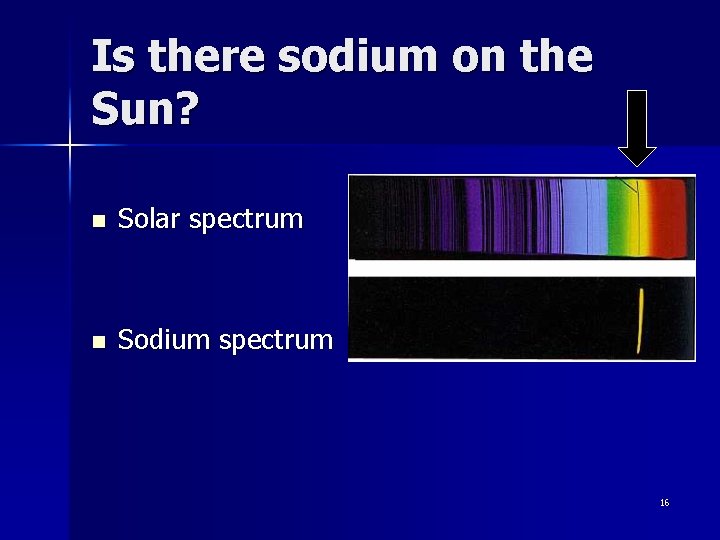
Is there sodium on the Sun? n Solar spectrum n Sodium spectrum 16
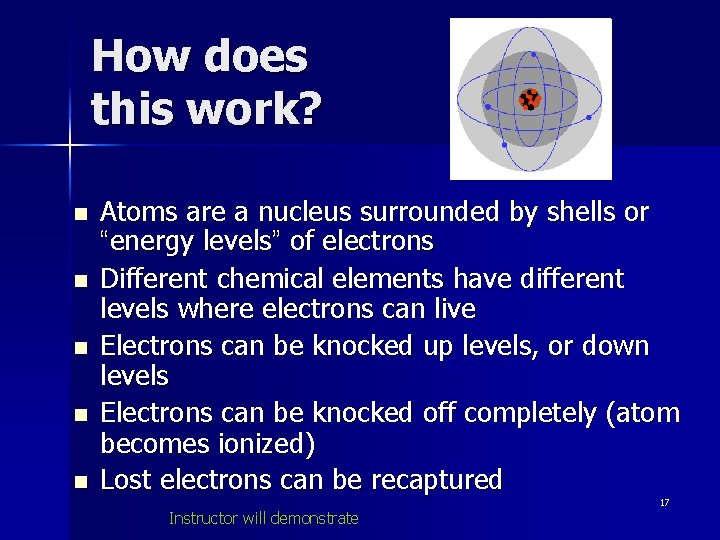
How does this work? n n n Atoms are a nucleus surrounded by shells or “energy levels” of electrons Different chemical elements have different levels where electrons can live Electrons can be knocked up levels, or down levels Electrons can be knocked off completely (atom becomes ionized) Lost electrons can be recaptured Instructor will demonstrate 17
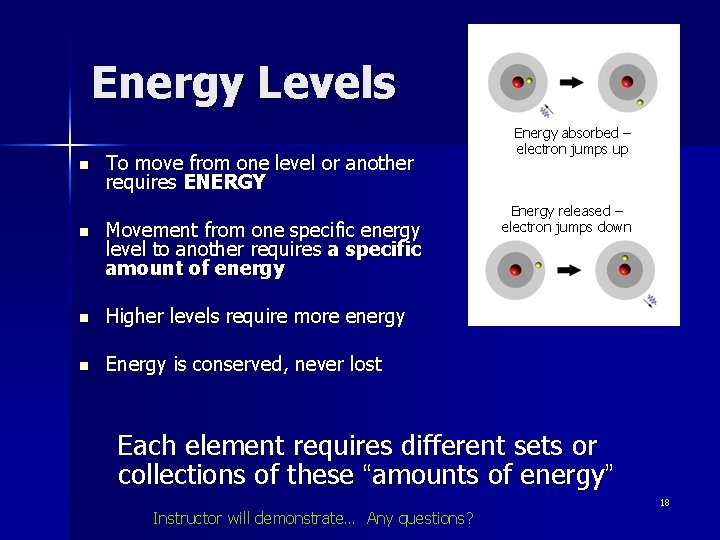
Energy Levels n To move from one level or another requires ENERGY n Movement from one specific energy level to another requires a specific amount of energy n Higher levels require more energy n Energy is conserved, never lost Energy absorbed – electron jumps up Energy released – electron jumps down Each element requires different sets or collections of these “amounts of energy” Instructor will demonstrate… Any questions? 18
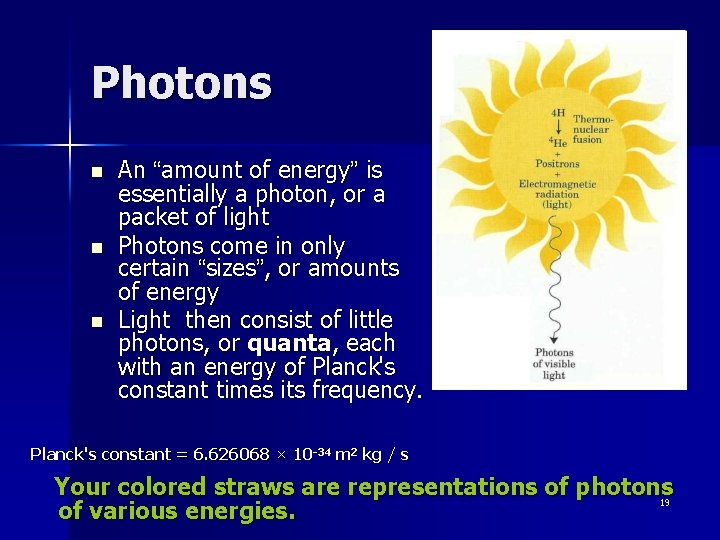
Photons n n n An “amount of energy” is essentially a photon, or a packet of light Photons come in only certain “sizes”, or amounts of energy Light then consist of little photons, or quanta, each with an energy of Planck's constant times its frequency. Planck's constant = 6. 626068 × 10 -34 m 2 kg / s Your colored straws are representations of photons 19 of various energies.
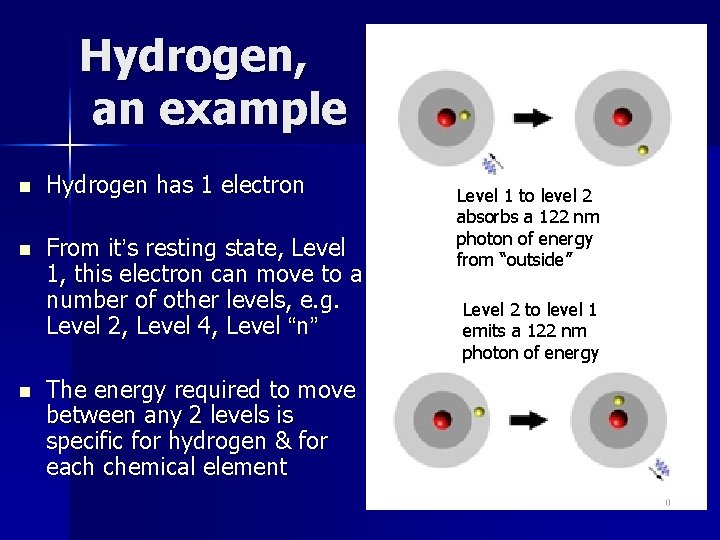
Hydrogen, an example n Hydrogen has 1 electron n From it’s resting state, Level 1, this electron can move to a number of other levels, e. g. Level 2, Level 4, Level “n” n Level 1 to level 2 absorbs a 122 nm photon of energy from “outside” Level 2 to level 1 emits a 122 nm photon of energy The energy required to move between any 2 levels is specific for hydrogen & for each chemical element 20
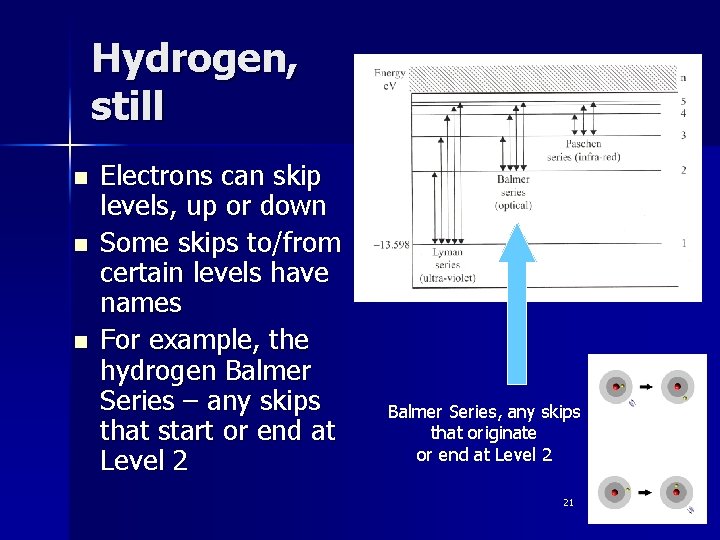
Hydrogen, still n n n Electrons can skip levels, up or down Some skips to/from certain levels have names For example, the hydrogen Balmer Series – any skips that start or end at Level 2 Balmer Series, any skips that originate or end at Level 2 21
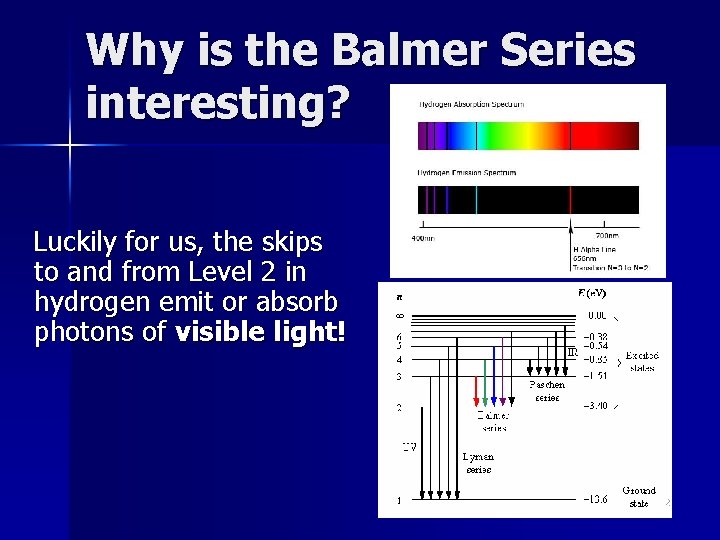
Why is the Balmer Series interesting? Luckily for us, the skips to and from Level 2 in hydrogen emit or absorb photons of visible light! 22
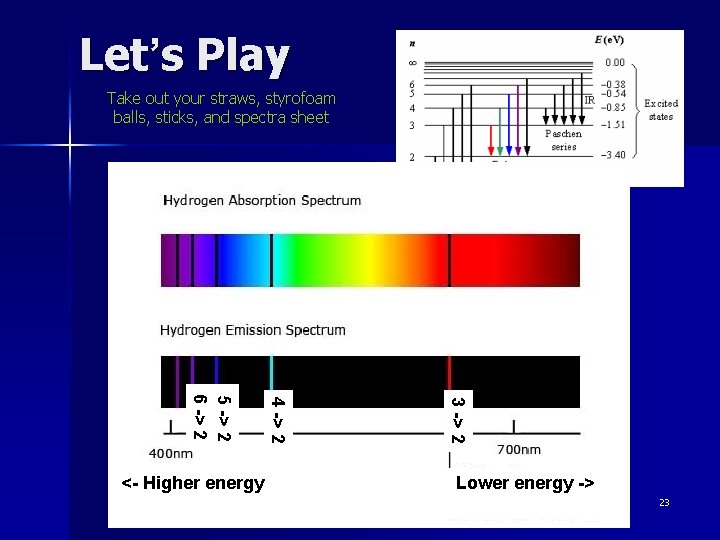
Let’s Play Take out your straws, styrofoam balls, sticks, and spectra sheet 3 -> 2 4 -> 2 5 -> 2 6 -> 2 <- Higher energy Lower energy -> 23
Questions on any of these concepts? n Next I’ll quickly explain what is an Halpha solar telescope. These are the most common form of amateur solar telescopes. 24
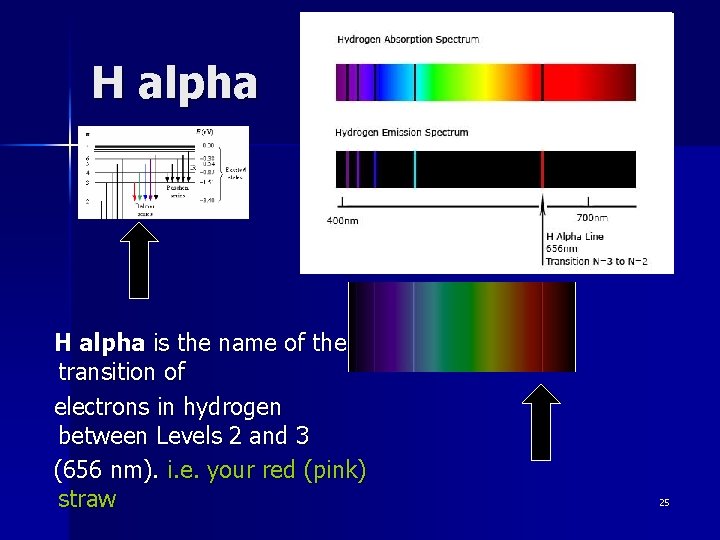
H alpha is the name of the transition of electrons in hydrogen between Levels 2 and 3 (656 nm). i. e. your red (pink) straw 25
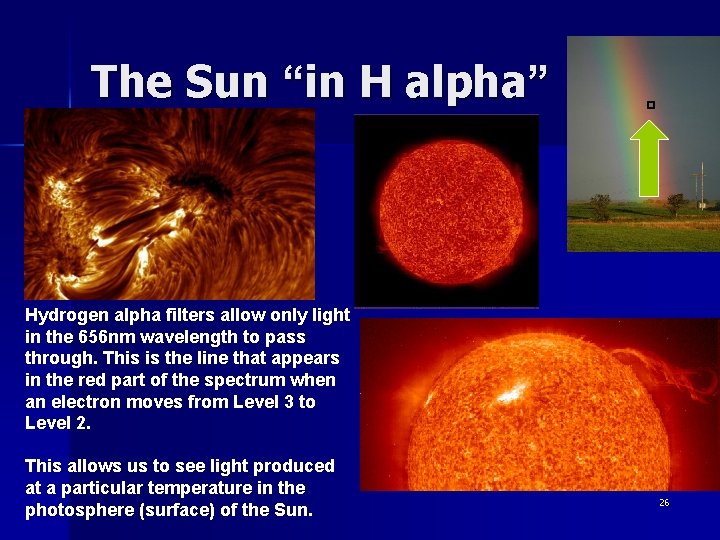
The Sun “in H alpha” Hydrogen alpha filters allow only light in the 656 nm wavelength to pass through. This is the line that appears in the red part of the spectrum when an electron moves from Level 3 to Level 2. This allows us to see light produced at a particular temperature in the photosphere (surface) of the Sun. 26
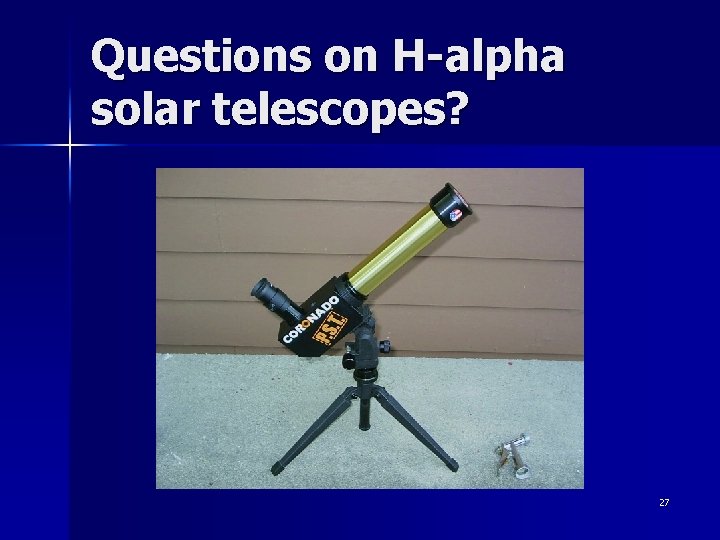
Questions on H-alpha solar telescopes? 27
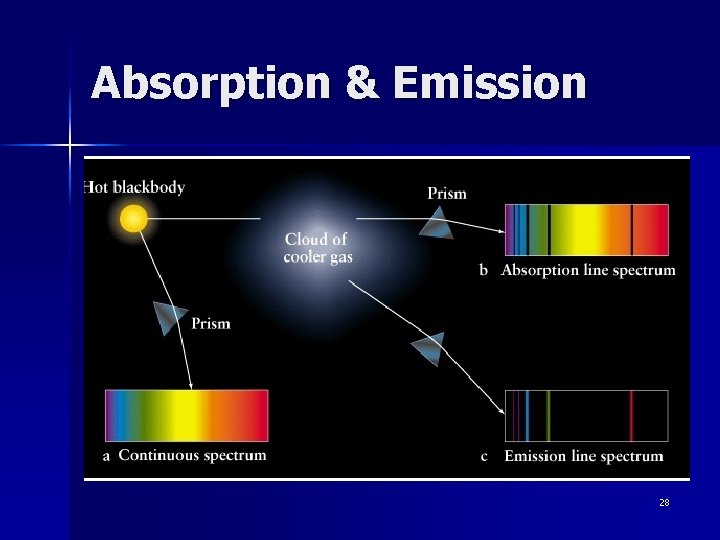
Absorption & Emission 28
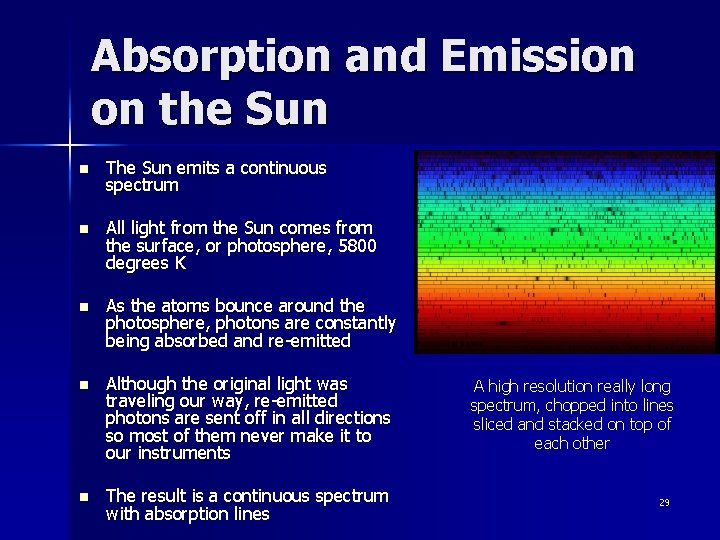
Absorption and Emission on the Sun n The Sun emits a continuous spectrum n All light from the Sun comes from the surface, or photosphere, 5800 degrees K n As the atoms bounce around the photosphere, photons are constantly being absorbed and re-emitted n Although the original light was traveling our way, re-emitted photons are sent off in all directions so most of them never make it to our instruments n The result is a continuous spectrum with absorption lines A high resolution really long spectrum, chopped into lines sliced and stacked on top of each other 29
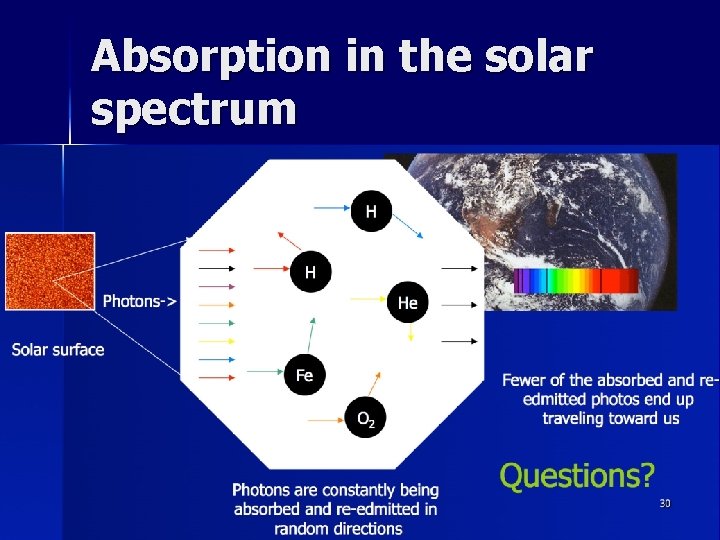
Absorption in the solar spectrum
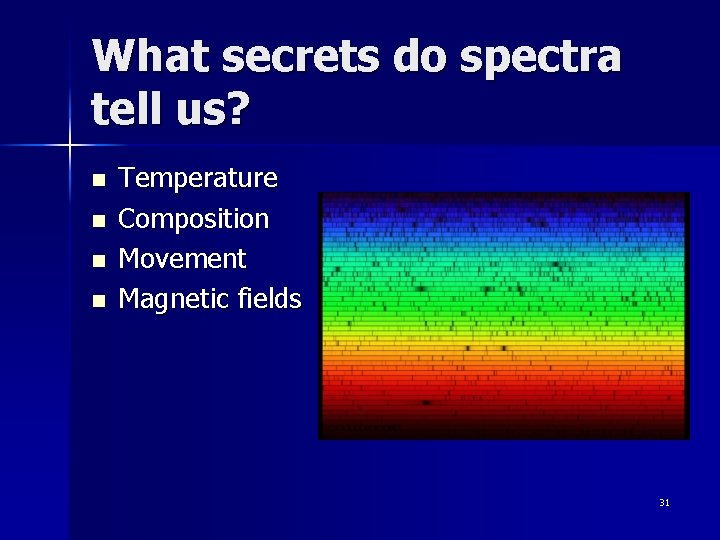
What secrets do spectra tell us? n n Temperature Composition Movement Magnetic fields 31
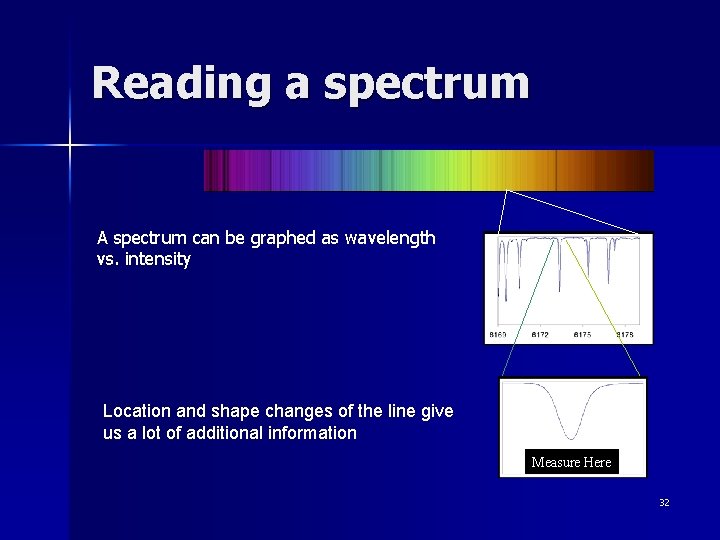
Reading a spectrum A spectrum can be graphed as wavelength vs. intensity Location and shape changes of the line give us a lot of additional information Measure Here 32
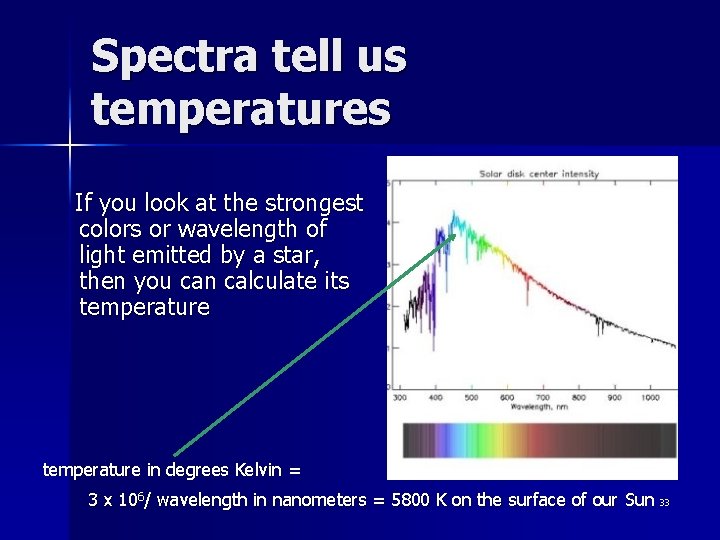
Spectra tell us temperatures If you look at the strongest colors or wavelength of light emitted by a star, then you can calculate its temperature in degrees Kelvin = 3 x 10⁶/ wavelength in nanometers = 5800 K on the surface of our Sun 33
Spectra tell us about composition Am emission or absorption line means a specific chemical element has been involved with the light you are seeing n Careful, though. The element could be from the source, or from an intervening plasma or gas cloud n 34
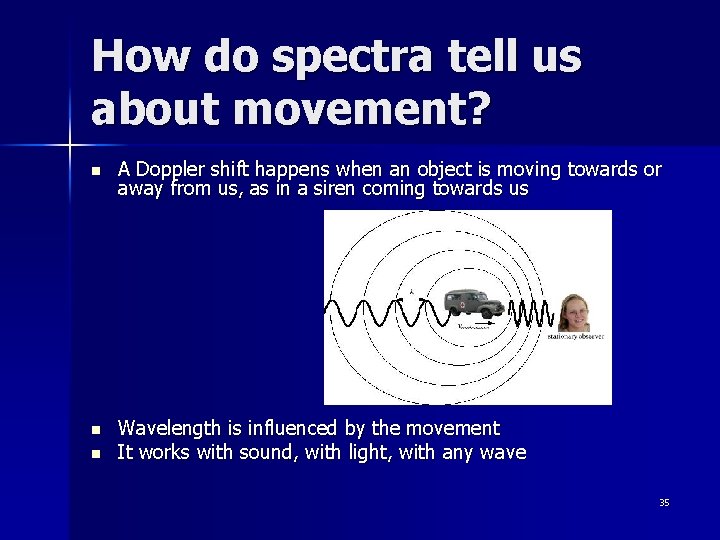
How do spectra tell us about movement? n A Doppler shift happens when an object is moving towards or away from us, as in a siren coming towards us n Wavelength is influenced by the movement It works with sound, with light, with any wave n 35
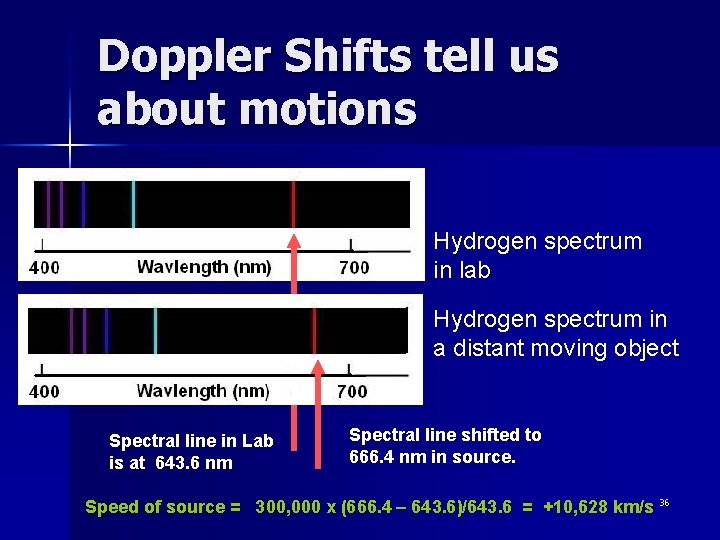
Doppler Shifts tell us about motions Hydrogen spectrum in lab Hydrogen spectrum in a distant moving object Spectral line in Lab is at 643. 6 nm Spectral line shifted to 666. 4 nm in source. Speed of source = 300, 000 x (666. 4 – 643. 6)/643. 6 = +10, 628 km/s 36
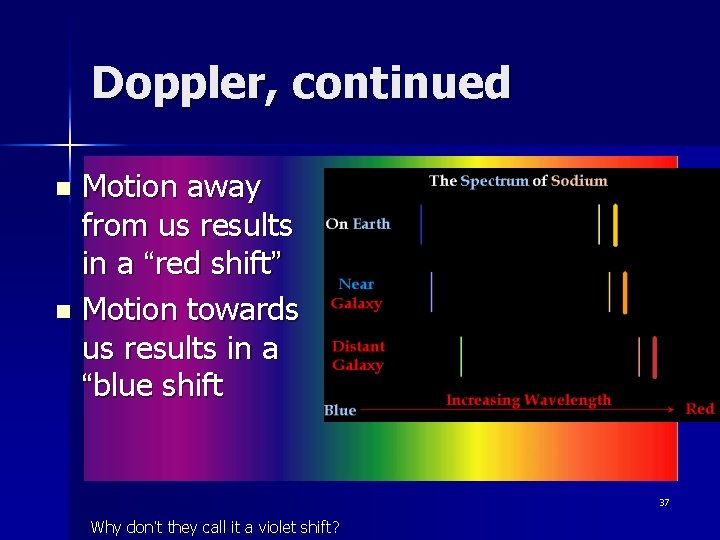
Doppler, continued Motion away from us results in a “red shift” n Motion towards us results in a “blue shift n 37 Why don’t they call it a violet shift?
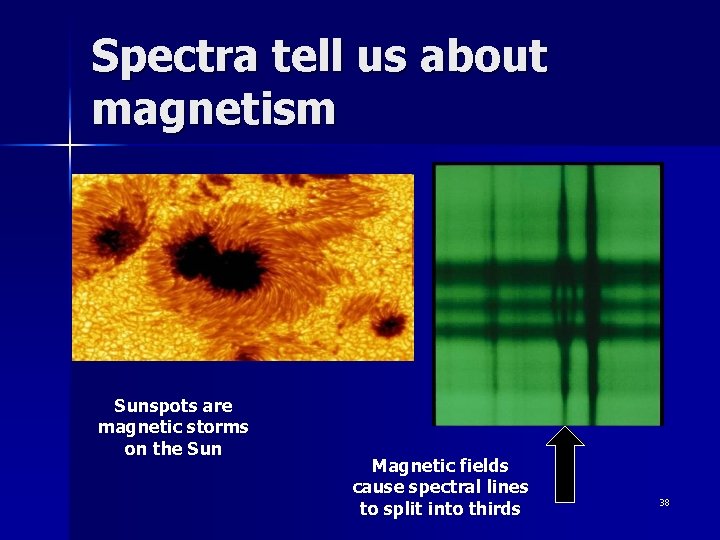
Spectra tell us about magnetism Sunspots are magnetic storms on the Sun Magnetic fields cause spectral lines to split into thirds 38
NASA’s Solar Dynamics Observatory (SDO) n n Launched Feb 2010 3 instruments, primary of which is Helioseismic Magnetic Imager (HMI) HMI is from the Solar Observatories team at Stanford – my group! HMI works similarly to a spectroscope 39

NASA’s IRIS Mission IRIS is a spectrograph! Scientists from our group at Stanford and from Lockheed work on IRIS! 40
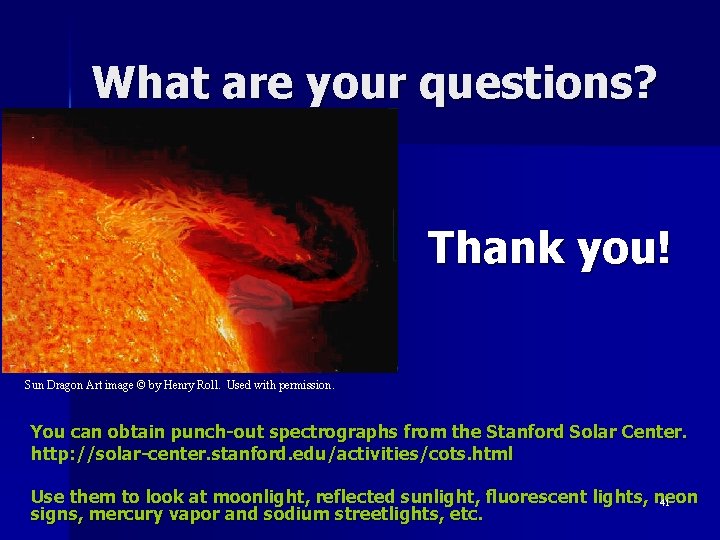
What are your questions? Thank you! Sun Dragon Art image © by Henry Roll. Used with permission. You can obtain punch-out spectrographs from the Stanford Solar Center. http: //solar-center. stanford. edu/activities/cots. html Use them to look at moonlight, reflected sunlight, fluorescent lights, neon 41 signs, mercury vapor and sodium streetlights, etc.
- Slides: 41