
Fingerprints History Describing and Processing http www lanl
Fingerprints: History, Describing and Processing http: //www. lanl. gov/news/albums/chemistry/fingerprint. jpg Mrs. Schultz

Stella Nickell 1986, Seattle, Washington
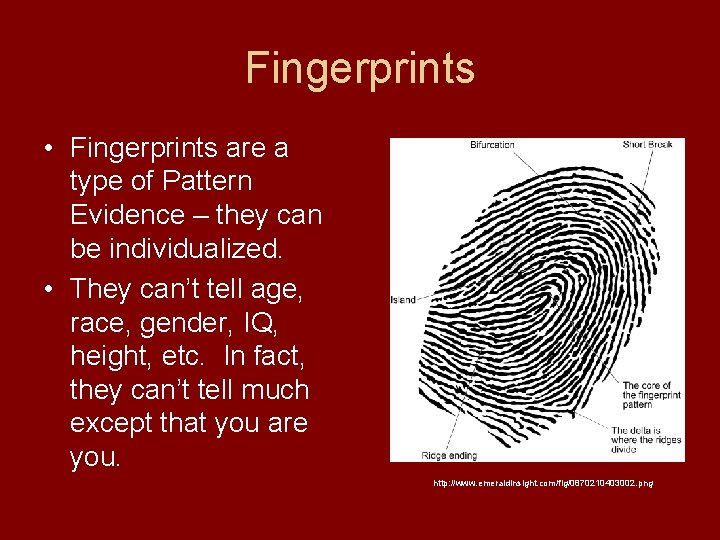
Fingerprints • Fingerprints are a type of Pattern Evidence – they can be individualized. • They can’t tell age, race, gender, IQ, height, etc. In fact, they can’t tell much except that you are you. http: //www. emeraldinsight. com/fig/0870210403002. png

Your fingerprints are…. • The impression of your friction ridges (the raised lines) found on the inner surface of your fingers, palms, or soles of your feet. They arise from your integumentary system (your skin). Your friction ridges help you grasp and hold on to things. http: //vignette 4. wikia. nocookie. net/itlaw/images/f/f 7/Fingerprints 00 a. j pg/revision/latest? cb=20100910000720
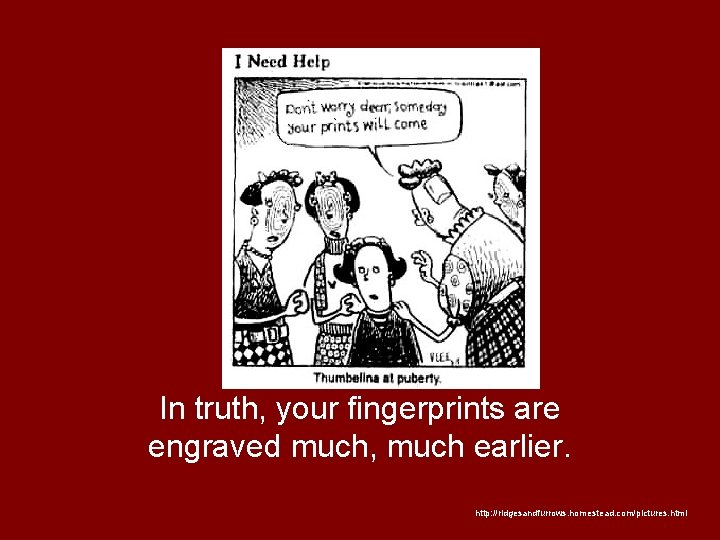
In truth, your fingerprints are engraved much, much earlier. http: //ridgesandfurrows. homestead. com/pictures. html
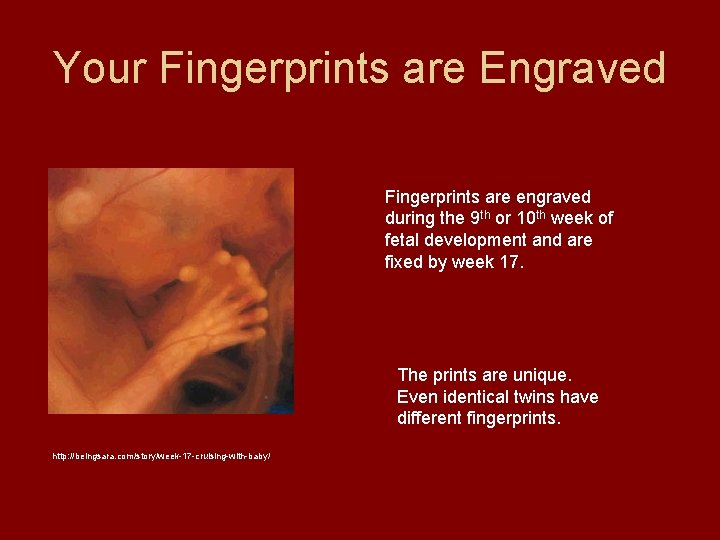
Your Fingerprints are Engraved Fingerprints are engraved during the 9 th or 10 th week of fetal development and are fixed by week 17. The prints are unique. Even identical twins have different fingerprints. http: //beingsara. com/story/week-17 -cruising-with-baby/
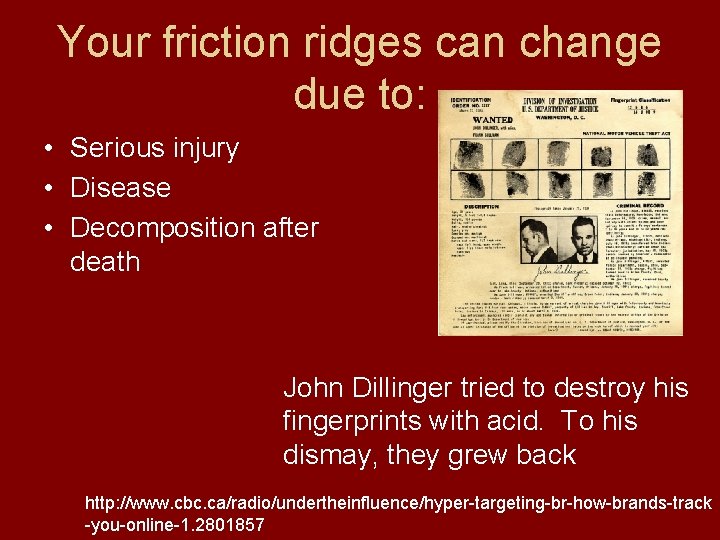
Your friction ridges can change due to: • Serious injury • Disease • Decomposition after death John Dillinger tried to destroy his fingerprints with acid. To his dismay, they grew back http: //www. cbc. ca/radio/undertheinfluence/hyper-targeting-br-how-brands-track -you-online-1. 2801857
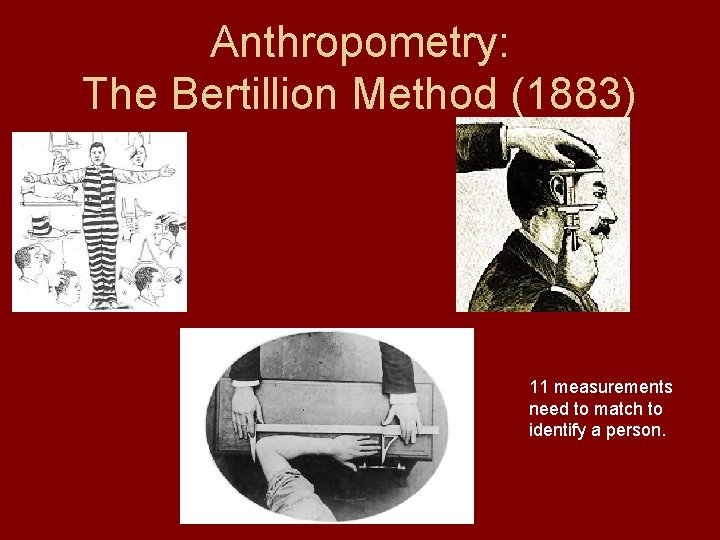
Anthropometry: The Bertillion Method (1883) 11 measurements need to match to identify a person.
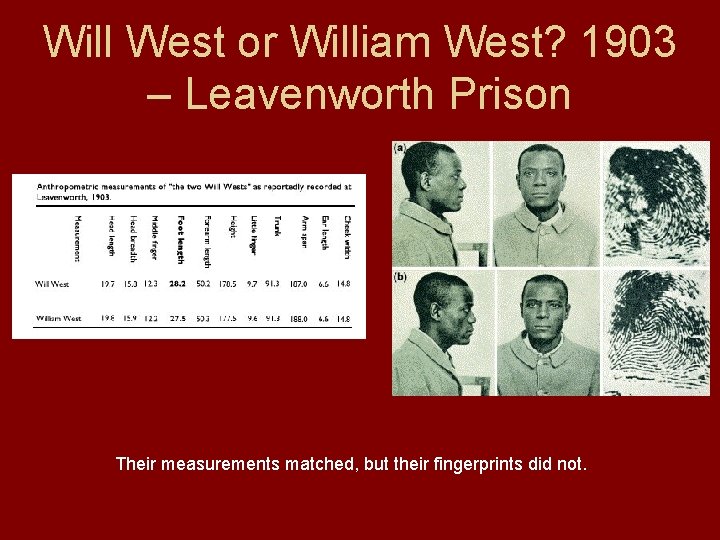
Will West or William West? 1903 – Leavenworth Prison Their measurements matched, but their fingerprints did not.
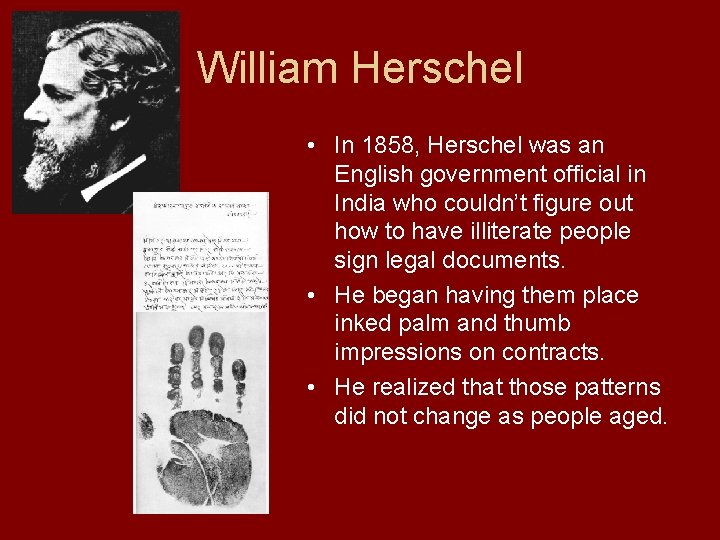
William Herschel • In 1858, Herschel was an English government official in India who couldn’t figure out how to have illiterate people sign legal documents. • He began having them place inked palm and thumb impressions on contracts. • He realized that those patterns did not change as people aged.
Henry Faulds • Faulds went on to show that even if a person suffers a superficial injury, their fingerprint pattern remains the same. • Faulds developed terms used today to describe fingerprints, such as loops and whorls.
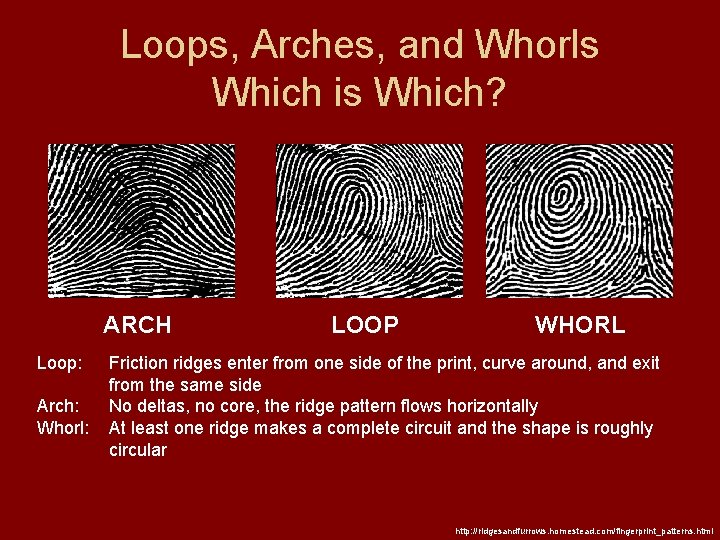
Loops, Arches, and Whorls Which is Which? ARCH Loop: Arch: Whorl: LOOP WHORL Friction ridges enter from one side of the print, curve around, and exit from the same side No deltas, no core, the ridge pattern flows horizontally At least one ridge makes a complete circuit and the shape is roughly circular http: //ridgesandfurrows. homestead. com/fingerprint_patterns. html
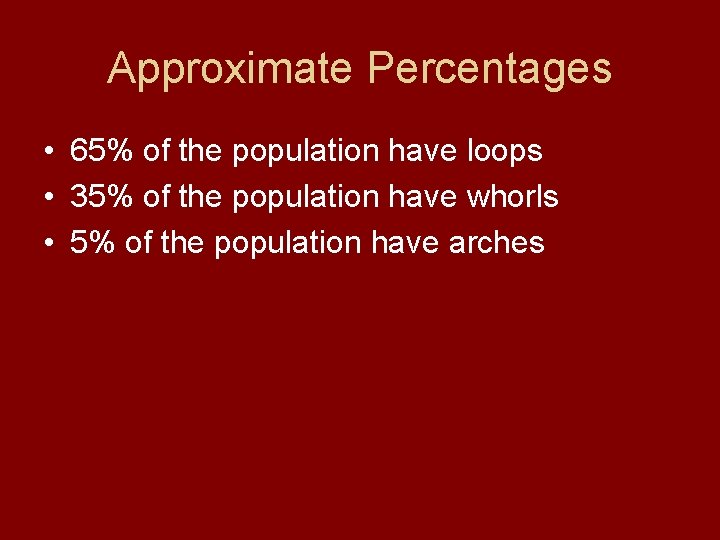
Approximate Percentages • 65% of the population have loops • 35% of the population have whorls • 5% of the population have arches

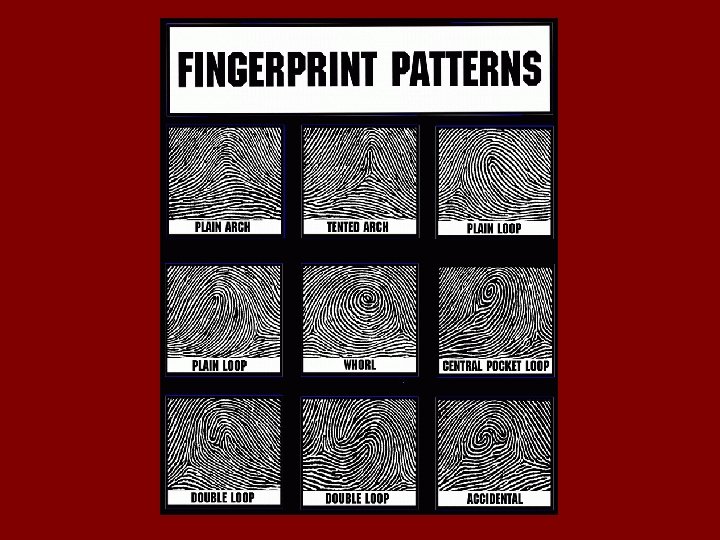
Of course, it gets more confusing… Which is Which? TENTED ARCH Composite: Tented arch: Twinned loop: TWINNED LOOP COMPOSITE Two or more separate patterns One upthrusting ridge that bisects superior arches at 90 degrees angles, more or less Two loop formations, separate and apart http: //ridgesandfurrows. homestead. com/fingerprint_patterns. html
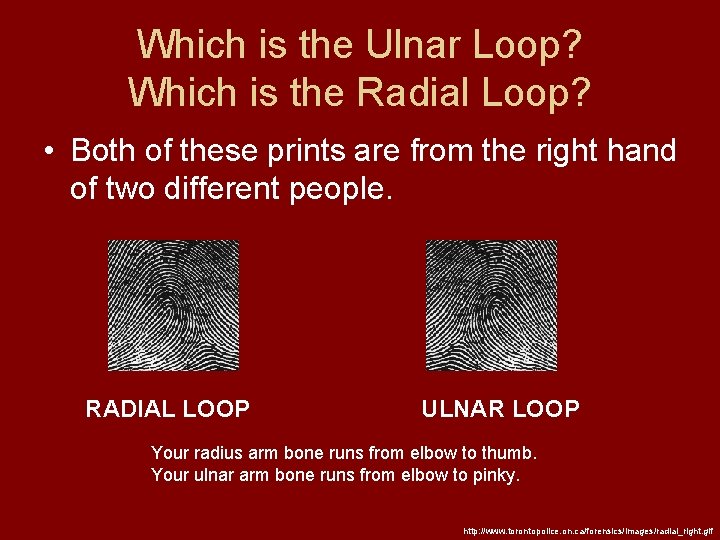
Which is the Ulnar Loop? Which is the Radial Loop? • Both of these prints are from the right hand of two different people. RADIAL LOOP ULNAR LOOP Your radius arm bone runs from elbow to thumb. Your ulnar arm bone runs from elbow to pinky. http: //www. torontopolice. on. ca/forensics/images/radial_right. gif
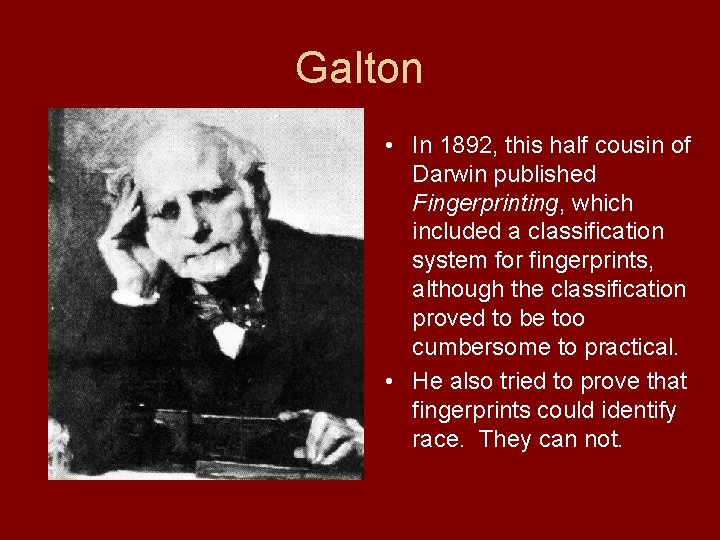
Galton • In 1892, this half cousin of Darwin published Fingerprinting, which included a classification system for fingerprints, although the classification proved to be too cumbersome to practical. • He also tried to prove that fingerprints could identify race. They can not.
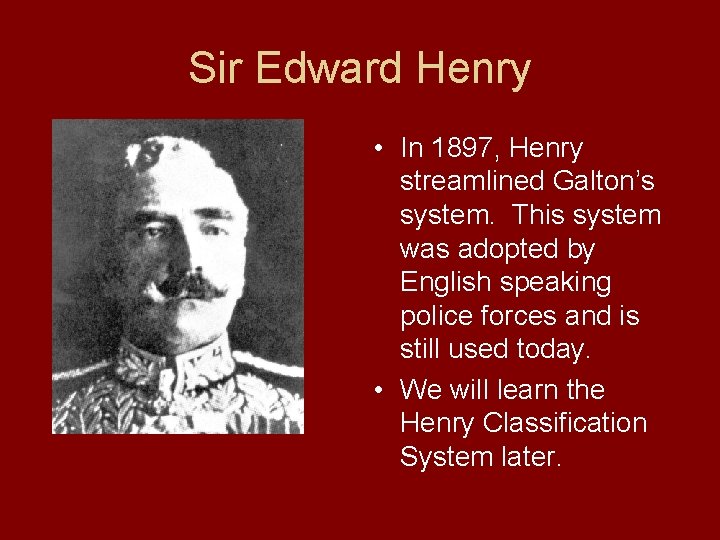
Sir Edward Henry • In 1897, Henry streamlined Galton’s system. This system was adopted by English speaking police forces and is still used today. • We will learn the Henry Classification System later.
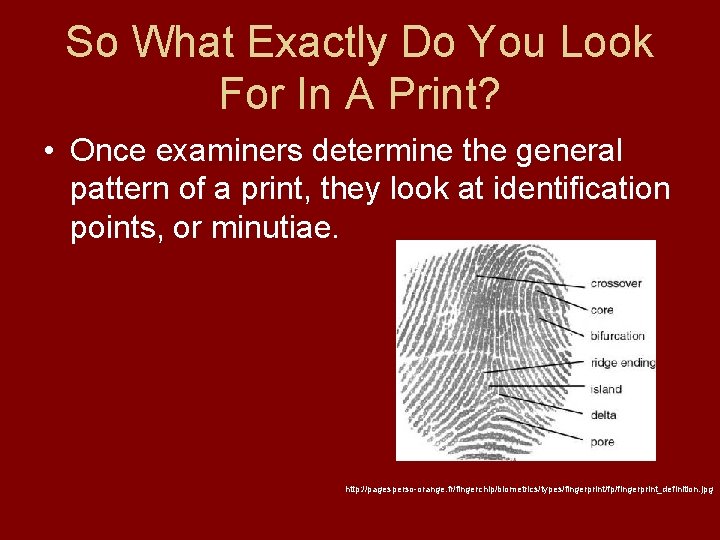
So What Exactly Do You Look For In A Print? • Once examiners determine the general pattern of a print, they look at identification points, or minutiae. http: //pagesperso-orange. fr/fingerchip/biometrics/types/fingerprint/fp/fingerprint_definition. jpg
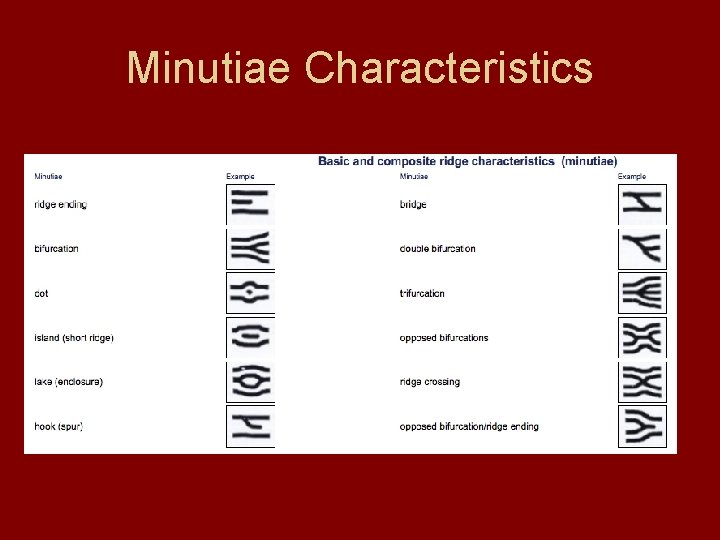
Minutiae Characteristics
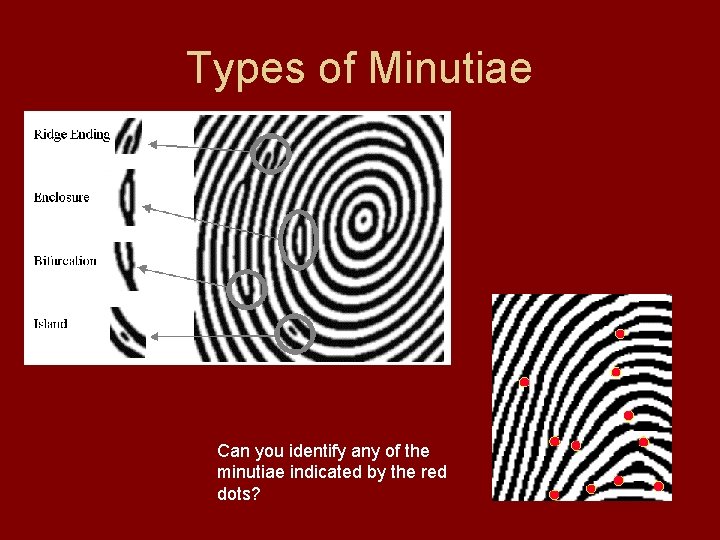
Types of Minutiae Can you identify any of the minutiae indicated by the red dots?
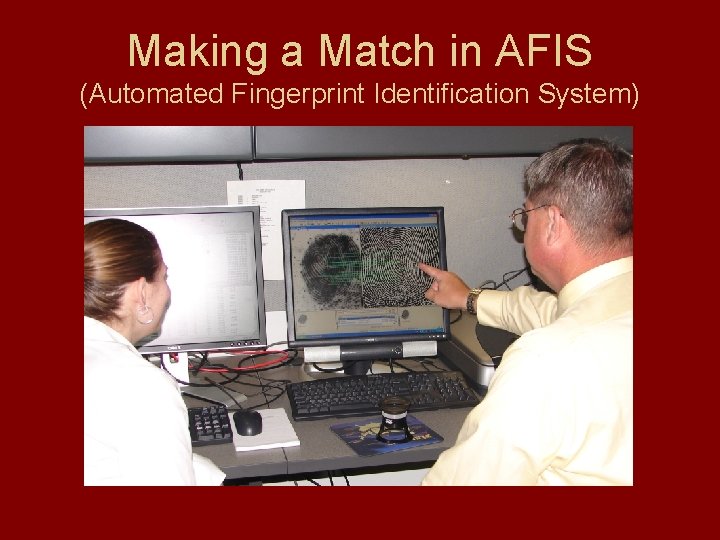
Making a Match in AFIS (Automated Fingerprint Identification System)
Friction Ridge Characteristics • Locard determined if 12 friction ridge characteristics match in two prints, the prints came from the same source. – The amount varies from 8 to 16 depending on who you ask.
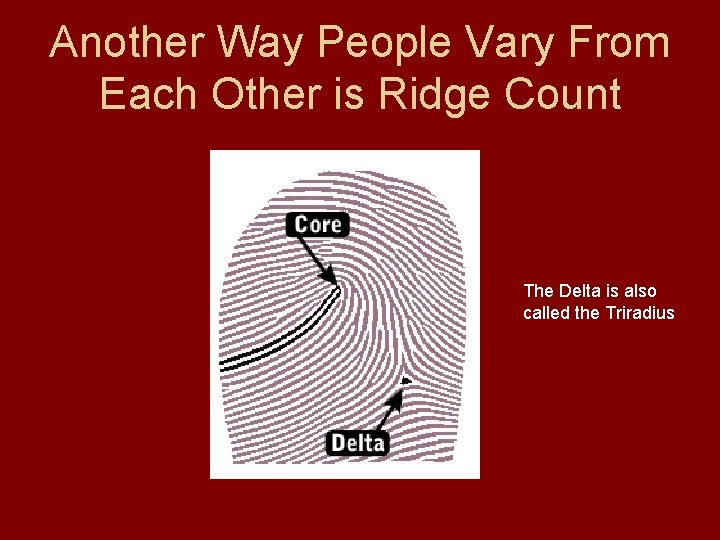
Another Way People Vary From Each Other is Ridge Count The Delta is also called the Triradius
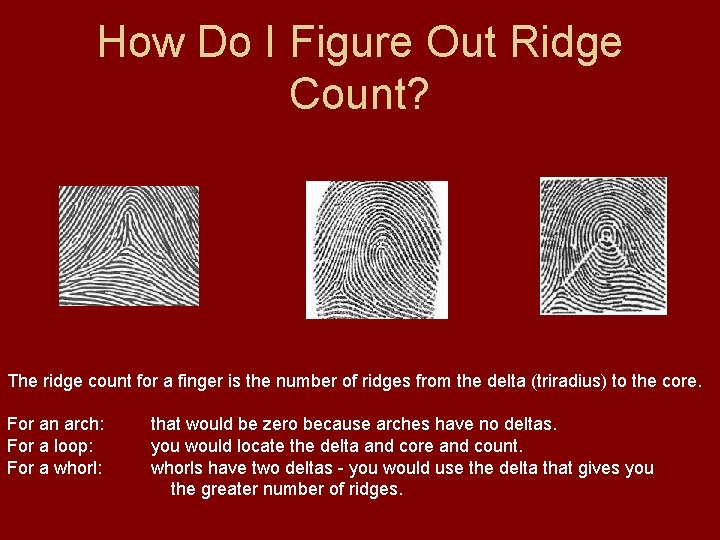
How Do I Figure Out Ridge Count? The ridge count for a finger is the number of ridges from the delta (triradius) to the core. For an arch: For a loop: For a whorl: that would be zero because arches have no deltas. you would locate the delta and core and count. whorls have two deltas - you would use the delta that gives you the greater number of ridges.
Now It’s Your Turn • You will make a 10 print card, identifying patterns, minutiae and ridge counts. • Go to today’s folder. Open “Fingerprint Patterns and Ridge Counts”. Read the background and follow the lab directions.
Developing Fingerprints • Latent fingerprints are friction ridge impressions not visible to the naked eye and are caused by transfer of body perspiration or oils to an object. • Patent fingerprints/Visible fingerprints are visible to the naked eye and may form from a bloody hand leaving a print on a surface. • Plastic fingerprints are impressions left on the surface of a soft material, such as clay or wet paint.
You and your eccrine glands • Eccrine glands are sweat glands. Eccrine sweat is 99% water and 1% salts, oils and proteins. The sweat that leaks out of the pores in your ridges leaves behind an invisible fingerprint.
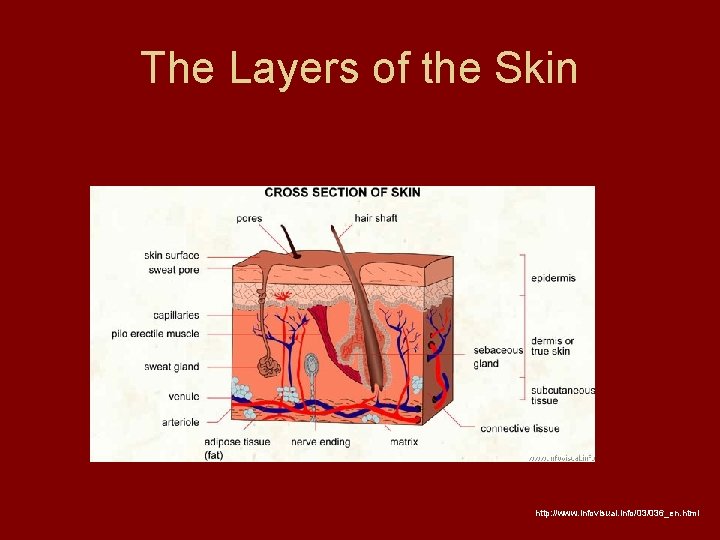
The Layers of the Skin http: //www. infovisual. info/03/036_en. html
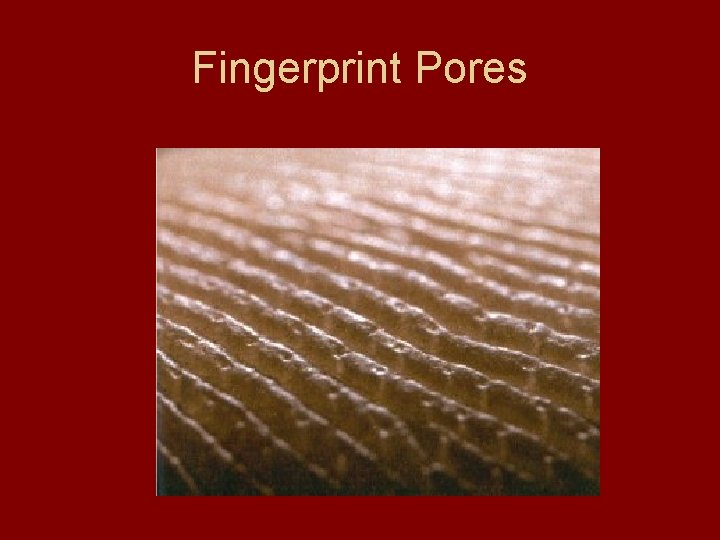
Fingerprint Pores
Latent Fingerprints • Fingerprint powders should be used on hard, nonabsorbent surfaces such as mirror, tile, glass, and painted wood. – Powders may be black, gray, or fluorescent and you use the one that provides the most contrast.
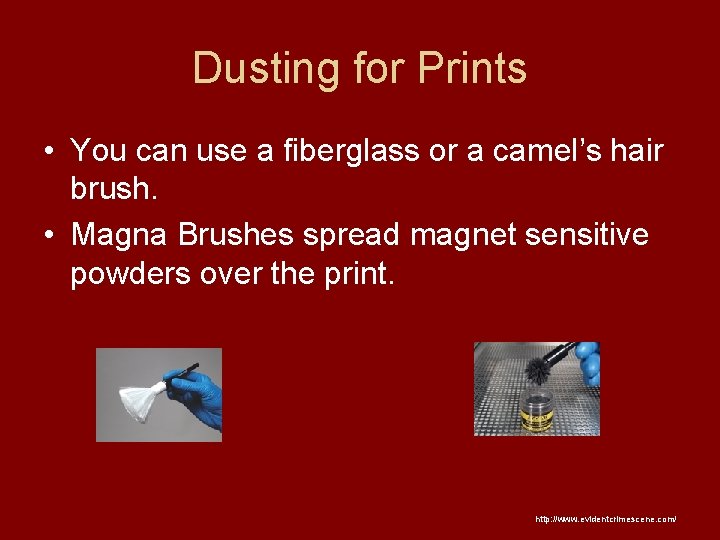
Dusting for Prints • You can use a fiberglass or a camel’s hair brush. • Magna Brushes spread magnet sensitive powders over the print. http: //www. evidentcrimescene. com/
Recovering Prints from Soft/Porous Surfaces • Chemical treatments must be used in this order - Iodine Fuming - Ninhydrin - Silver Nitrate - Super Glue fuming Why do you think the order is important? Each technique gets more destructive as you go.

Iodine Fuming • The object containing the print is placed in a chamber with iodine crystals. The temperature is increased until the iodine sublimes (goes from solid to vapor). • Iodine vapors react with body oils in the latent prints, making them visible. • The print will fade, so a picture must be taken immediately. • Iodine is reacting with fat.
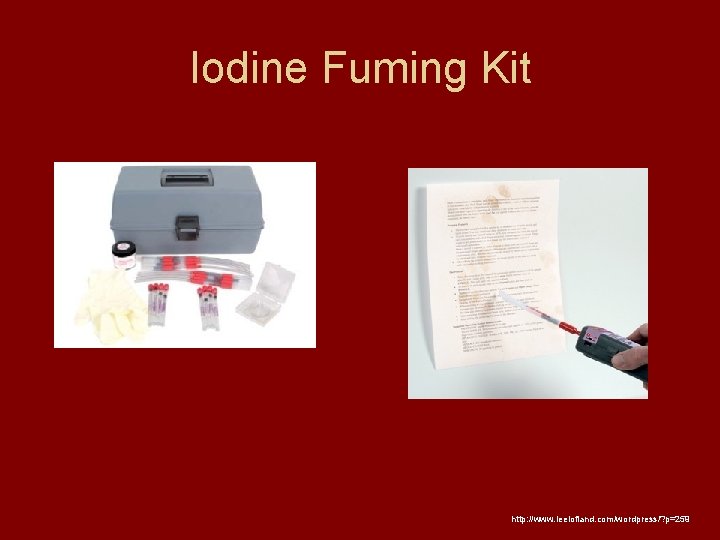
Iodine Fuming Kit http: //www. leelofland. com/wordpress/? p=259
Ninhydrin • Ninhydrin powder is dissolved and sprayed onto the latent print. • Prints appear within an hour or two. • Ninhydrin can be used to develop 40 year old prints from paper. • Ninhydrin is reacting with amino acids from perspiration. • Note that Ninhydrin cause ink to run.
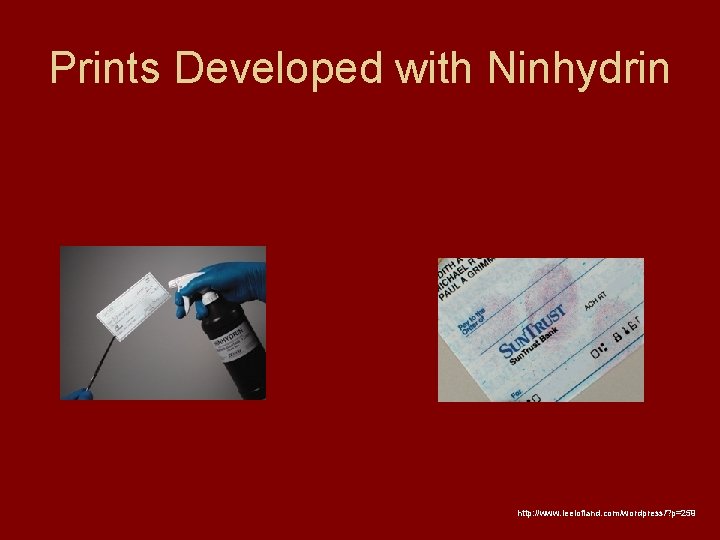
Prints Developed with Ninhydrin http: //www. leelofland. com/wordpress/? p=259
Silver Nitrate • Silver nitrate can be used if iodine fuming and ninhydrin fail to uncover prints. However, it will wash away fatty oils and proteins. • Silver nitrate is brushed onto the suspected object. • When the object is exposed to UV light, the print appears. • The color change results when silver nitrate reacts with salt on the print.
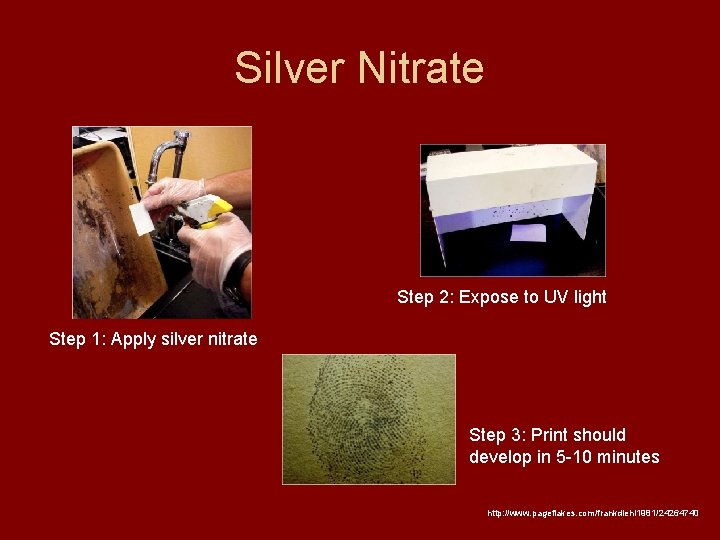
Silver Nitrate Step 2: Expose to UV light Step 1: Apply silver nitrate Step 3: Print should develop in 5 -10 minutes http: //www. pageflakes. com/frankdiehl 1981/24264740

Superglue Fuming Cabinet http: //www. airscienceuk. com/images/superglue-chamber-02. jpg
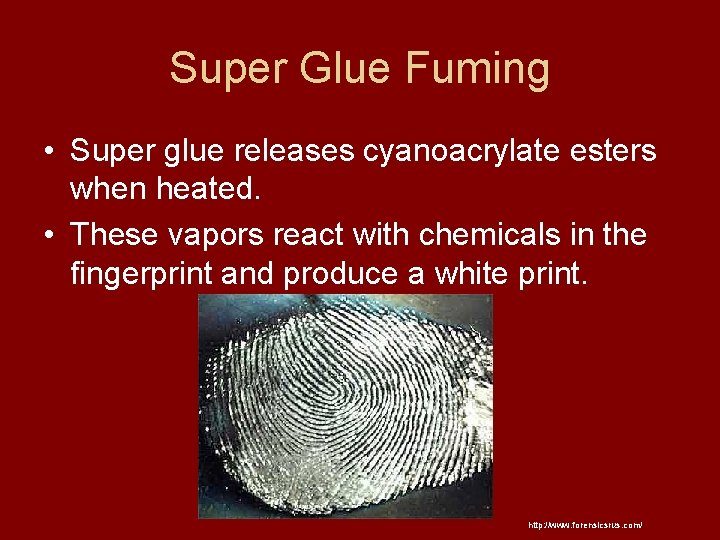
Super Glue Fuming • Super glue releases cyanoacrylate esters when heated. • These vapors react with chemicals in the fingerprint and produce a white print. http: //www. forensicsrus. com/
- Slides: 41