
Fingerprints GAVS 13 Fingerprints SFS 2 Students will

- Slides: 52
Fingerprints GAVS 13 Fingerprints
SFS 2. Students will use various scientific techniques to analyze physical and trace evidence. a. Identify and utilize appropriate techniques used to lift and evaluate readable, latent, plastic and visible fingerprints.
Learning Targets: I can 1. Explain why fingerprints are unique to each individual. 2. Describe how fingerprints are classified and stored in AFIS. 3. Demonstrate how fingerprints are collected and stored.
Introduction to Fingerprints • Dactylography – the study of fingerprints as a means of identification. • Fingerprints are a reproduction of friction skin ridges found on the palm side of fingers and thumbs. – Friction skin ridges are also found on the soles of feet and toes and can also be used for identification • Fingerprints are left behind due to sweat, oils, and dirt found on our hands • Fingerprints can be found on almost every surface creating evidence littering • Fingerprints are considered individual evidence and may provide the key to solving a case. • Fingerprints are more unique than DNA! No 2 people have ever been found to have the same fingerprints, whereas DNA can be shared between identical twins.
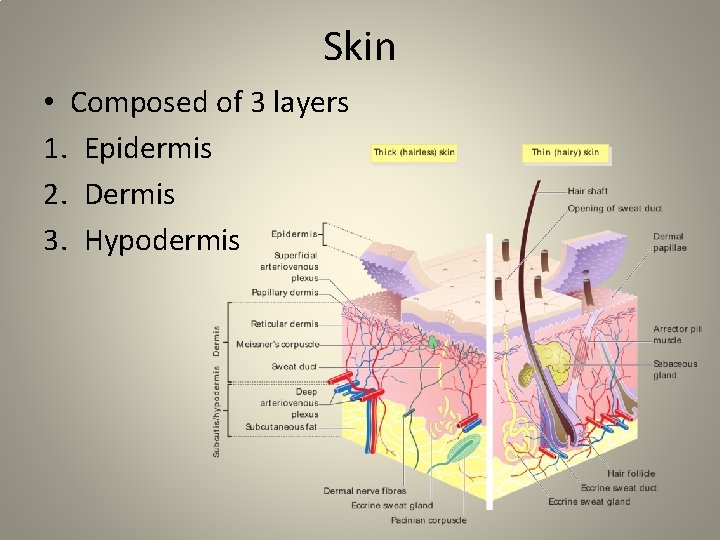
Skin • Composed of 3 layers 1. Epidermis 2. Dermis 3. Hypodermis
Skin (cont. ) – Epidermis – composed of ridge and grove features. Each ridge is dotted with sweat pores. • Fingerprints left behind are composed of any fluid from the Eccrine, Apocrine, or Sebaceous glands. – The Eccrine Sweat Glands are located in the palms and soles of feet and secrete a liquid that is 99% water and 1% chlorides, metal ions, and amino acids – The Apocrine Sweat Gland is found in hair follicles and secrete cytoplasm and nuclear materials, ionic iron, proteins, carbohydrates and cholesterol. – The Sebaceous Glands are found in places where hair grows and secrete an oily substance known as sebum. Sebum includes fatty acids, glycerides, alcohols and hydrocarbons. – Dermis • The epidermal layer is anchored to the dermis by the dermal papillae, small hills of dermis that project into the epidermis. – At the surface of the skin in hands and feet, they appear as the ridges commonly known as fingerprints. – This pattern remains the same throughout a person’s life. – Hypodermis – innermost layer containing fat deposits that give the body its contours and energy reserves.
DNA vs. Fingerprints as Evidence • Georgia, 2008 • A woman was murdered after a carjacking • Investigators found a cigarette at the crime scene with DNA matching a man identified as Donald Smith. • When interrogated, Donald Smith denied involvement. When police showed him a video of the carjacking, Donald said it was actually his identical twin brother, Ronald. • The family confirmed the man in the video was the twin brother, Ronald. • Police found a fingerprint in the car and were able to link it to Ronald, but not Donald. • When confronted with DNA, video, and a matching fingerprint, Ronald Smith confessed to the crime. • Without the fingerprint, Donald would have been mistakenly convicted for a crime he did not commit. http: //www. cbsnews. com/news/identical-dna-murder-has-georgia-police-seeing-double-whichtwin-did-it/
Fingerprint Formation • The dermal papillae are formed during fetal development. • As the dermal papillae layer grows, areas collapse as a a result of amniotic fluid pressure on the developing skin. • Although they share identical DNA, fingerprints form separately on each twin as a result of differing pressures of amniotic fluid while in the womb.
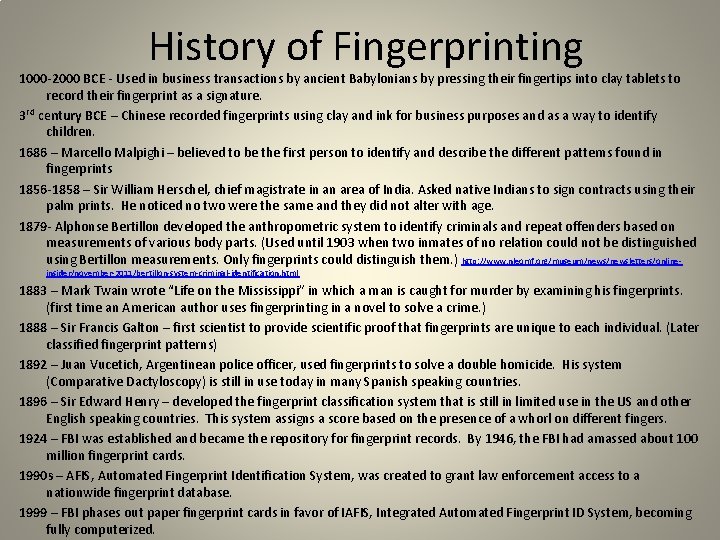
History of Fingerprinting 1000 -2000 BCE - Used in business transactions by ancient Babylonians by pressing their fingertips into clay tablets to record their fingerprint as a signature. 3 rd century BCE – Chinese recorded fingerprints using clay and ink for business purposes and as a way to identify children. 1686 – Marcello Malpighi – believed to be the first person to identify and describe the different patterns found in fingerprints 1856 -1858 – Sir William Herschel, chief magistrate in an area of India. Asked native Indians to sign contracts using their palm prints. He noticed no two were the same and they did not alter with age. 1879 - Alphonse Bertillon developed the anthropometric system to identify criminals and repeat offenders based on measurements of various body parts. (Used until 1903 when two inmates of no relation could not be distinguished using Bertillon measurements. Only fingerprints could distinguish them. ) http: //www. nleomf. org/museum/newsletters/onlineinsider/november-2011/bertillon-system-criminal-identification. html 1883 – Mark Twain wrote “Life on the Mississippi” in which a man is caught for murder by examining his fingerprints. (first time an American author uses fingerprinting in a novel to solve a crime. ) 1888 – Sir Francis Galton – first scientist to provide scientific proof that fingerprints are unique to each individual. (Later classified fingerprint patterns) 1892 – Juan Vucetich, Argentinean police officer, used fingerprints to solve a double homicide. His system (Comparative Dactyloscopy) is still in use today in many Spanish speaking countries. 1896 – Sir Edward Henry – developed the fingerprint classification system that is still in limited use in the US and other English speaking countries. This system assigns a score based on the presence of a whorl on different fingers. 1924 – FBI was established and became the repository for fingerprint records. By 1946, the FBI had amassed about 100 million fingerprint cards. 1990 s – AFIS, Automated Fingerprint Identification System, was created to grant law enforcement access to a nationwide fingerprint database. 1999 – FBI phases out paper fingerprint cards in favor of IAFIS, Integrated Automated Fingerprint ID System, becoming fully computerized.
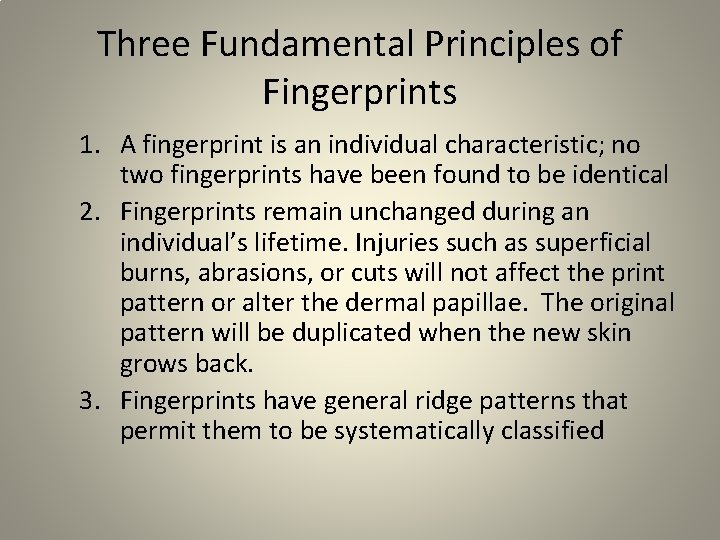
Three Fundamental Principles of Fingerprints 1. A fingerprint is an individual characteristic; no two fingerprints have been found to be identical 2. Fingerprints remain unchanged during an individual’s lifetime. Injuries such as superficial burns, abrasions, or cuts will not affect the print pattern or alter the dermal papillae. The original pattern will be duplicated when the new skin grows back. 3. Fingerprints have general ridge patterns that permit them to be systematically classified
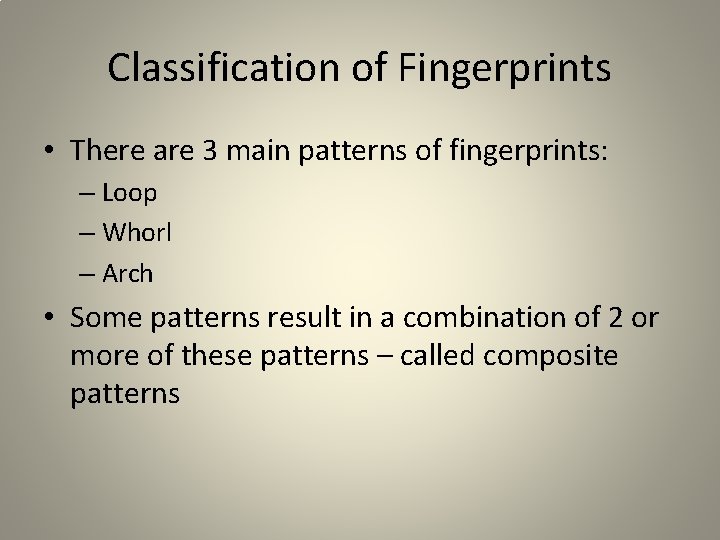
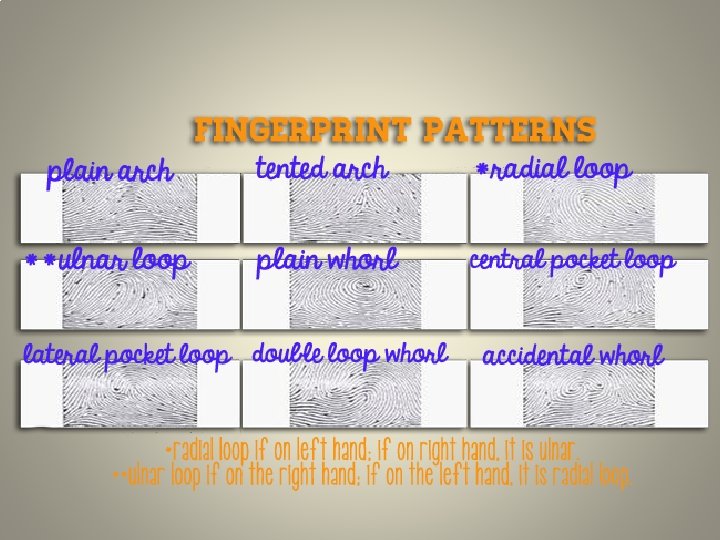
Classification of Fingerprints • There are 3 main patterns of fingerprints: – Loop – Whorl – Arch • Some patterns result in a combination of 2 or more of these patterns – called composite patterns
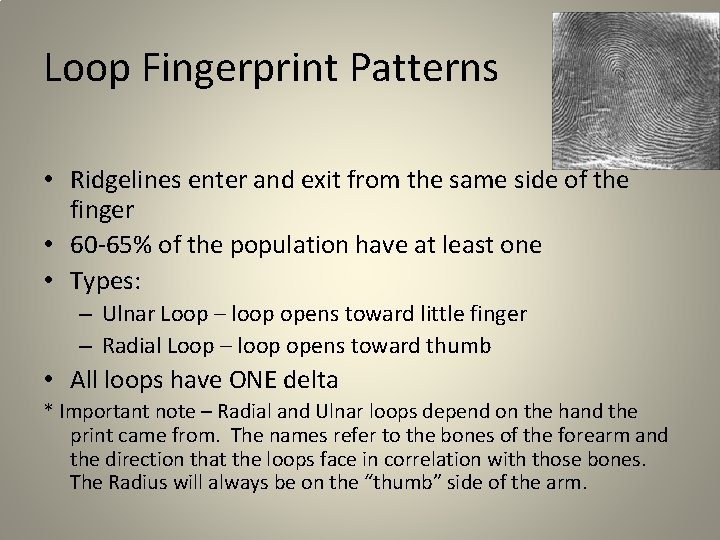
Loop Fingerprint Patterns • Ridgelines enter and exit from the same side of the finger • 60 -65% of the population have at least one • Types: – Ulnar Loop – loop opens toward little finger – Radial Loop – loop opens toward thumb • All loops have ONE delta * Important note – Radial and Ulnar loops depend on the hand the print came from. The names refer to the bones of the forearm and the direction that the loops face in correlation with those bones. The Radius will always be on the “thumb” side of the arm.
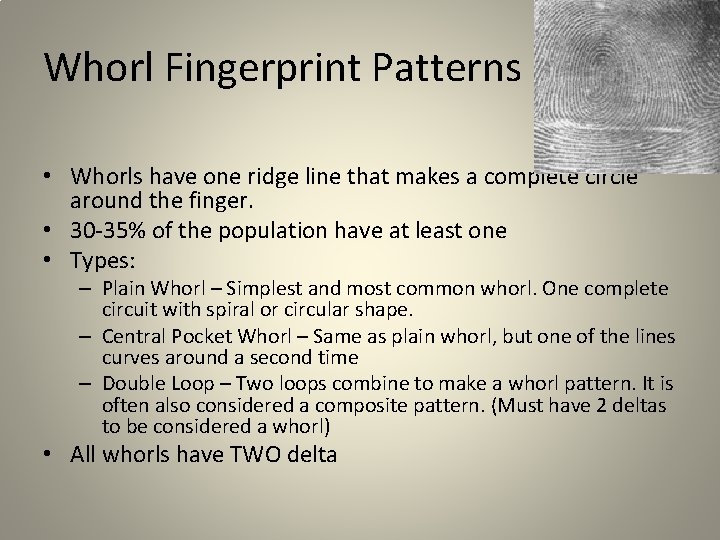
Whorl Fingerprint Patterns • Whorls have one ridge line that makes a complete circle around the finger. • 30 -35% of the population have at least one • Types: – Plain Whorl – Simplest and most common whorl. One complete circuit with spiral or circular shape. – Central Pocket Whorl – Same as plain whorl, but one of the lines curves around a second time – Double Loop – Two loops combine to make a whorl pattern. It is often also considered a composite pattern. (Must have 2 deltas to be considered a whorl) • All whorls have TWO delta
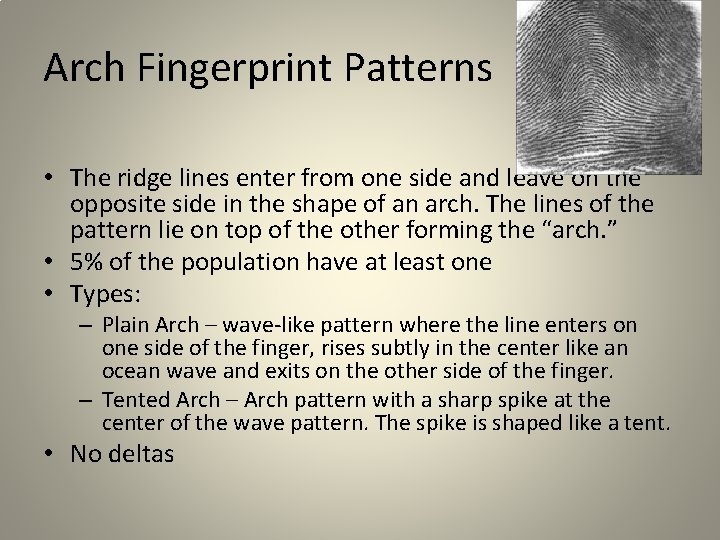
Arch Fingerprint Patterns • The ridge lines enter from one side and leave on the opposite side in the shape of an arch. The lines of the pattern lie on top of the other forming the “arch. ” • 5% of the population have at least one • Types: – Plain Arch – wave-like pattern where the line enters on one side of the finger, rises subtly in the center like an ocean wave and exits on the other side of the finger. – Tented Arch – Arch pattern with a sharp spike at the center of the wave pattern. The spike is shaped like a tent. • No deltas
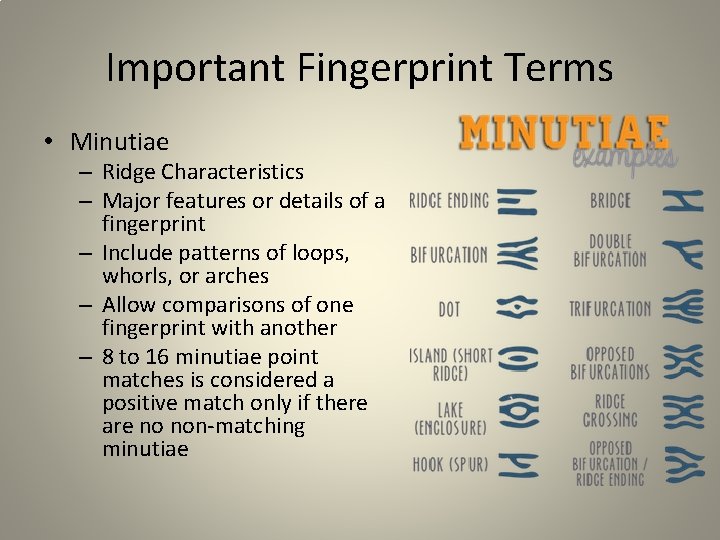
Important Fingerprint Terms • Minutiae – Ridge Characteristics – Major features or details of a fingerprint – Include patterns of loops, whorls, or arches – Allow comparisons of one fingerprint with another – 8 to 16 minutiae point matches is considered a positive match only if there are no non-matching minutiae
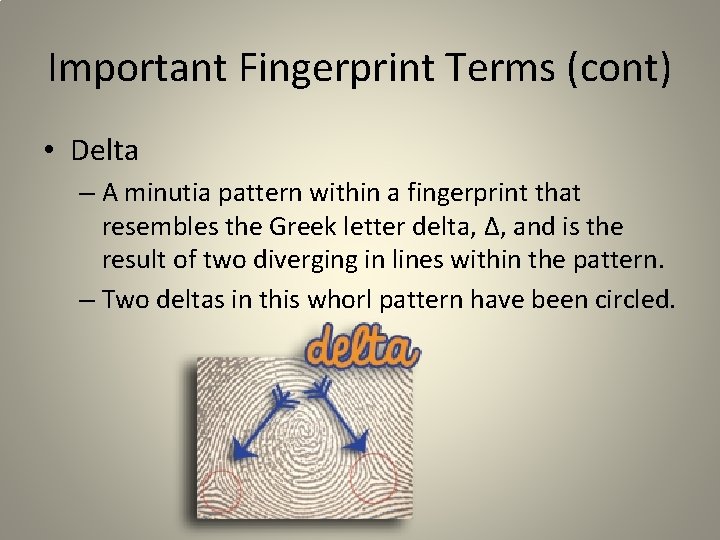
Important Fingerprint Terms (cont) • Delta – A minutia pattern within a fingerprint that resembles the Greek letter delta, Δ, and is the result of two diverging in lines within the pattern. – Two deltas in this whorl pattern have been circled.
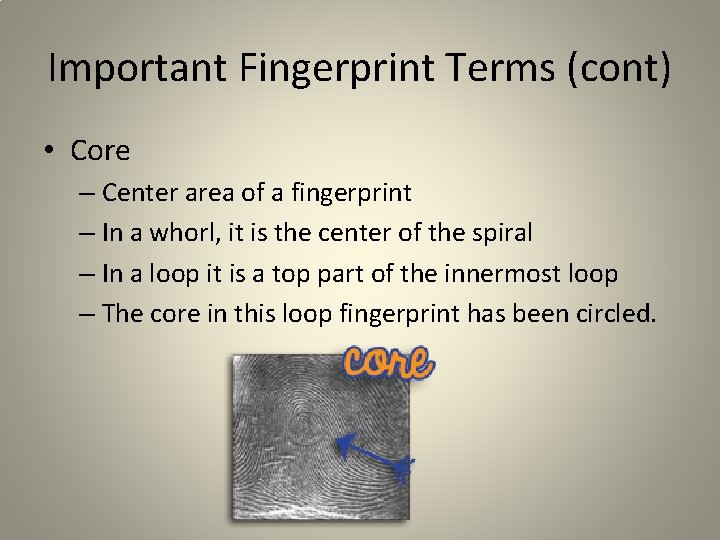
Important Fingerprint Terms (cont) • Core – Center area of a fingerprint – In a whorl, it is the center of the spiral – In a loop it is a top part of the innermost loop – The core in this loop fingerprint has been circled.
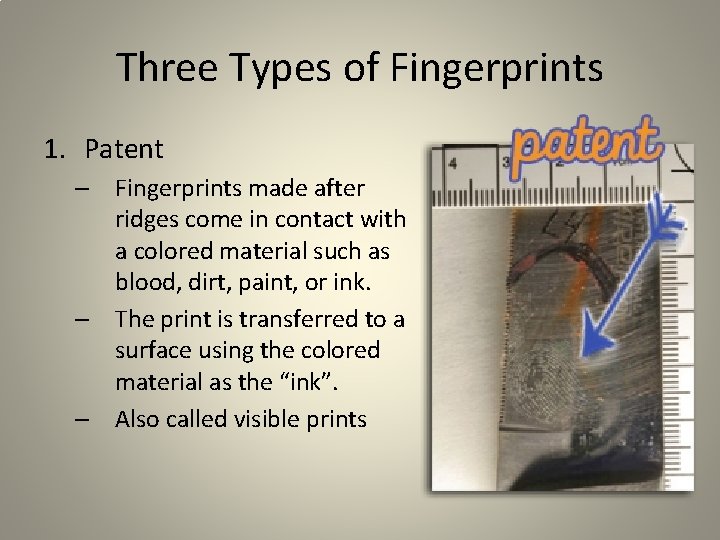
Three Types of Fingerprints 1. Patent – Fingerprints made after ridges come in contact with a colored material such as blood, dirt, paint, or ink. – The print is transferred to a surface using the colored material as the “ink”. – Also called visible prints
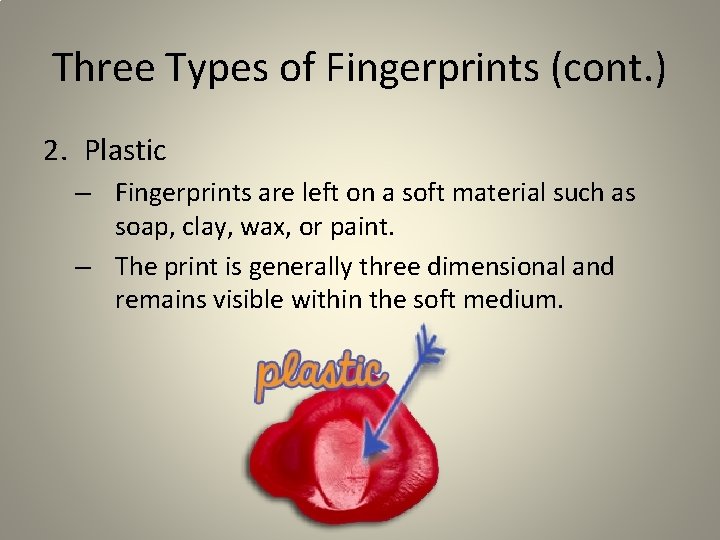
Three Types of Fingerprints (cont. ) 2. Plastic – Fingerprints are left on a soft material such as soap, clay, wax, or paint. – The print is generally three dimensional and remains visible within the soft medium.
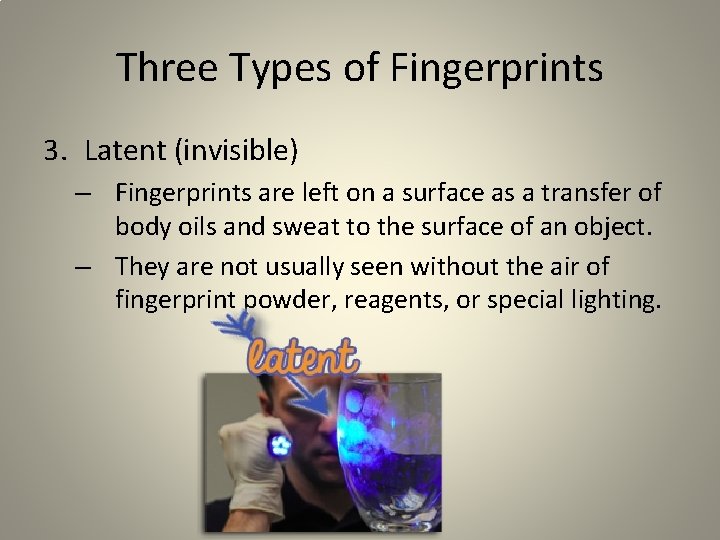
Three Types of Fingerprints 3. Latent (invisible) – Fingerprints are left on a surface as a transfer of body oils and sweat to the surface of an object. – They are not usually seen without the air of fingerprint powder, reagents, or special lighting.
Fingerprint Lab
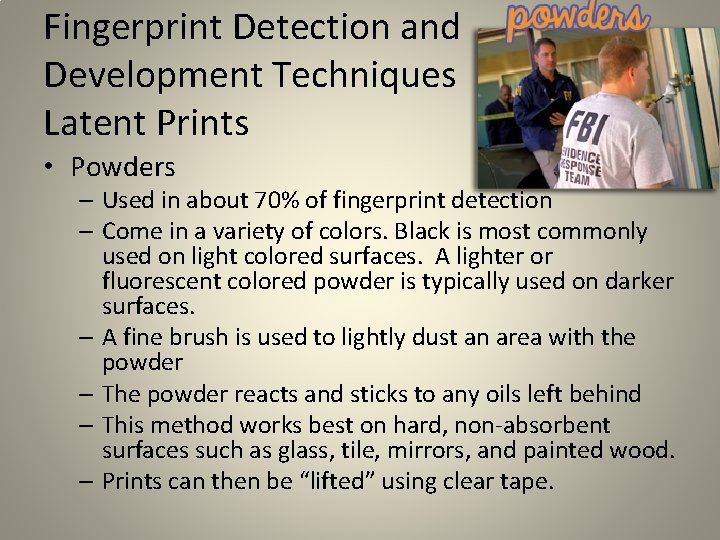
Fingerprint Detection and Development Techniques Latent Prints • Powders – Used in about 70% of fingerprint detection – Come in a variety of colors. Black is most commonly used on light colored surfaces. A lighter or fluorescent colored powder is typically used on darker surfaces. – A fine brush is used to lightly dust an area with the powder – The powder reacts and sticks to any oils left behind – This method works best on hard, non-absorbent surfaces such as glass, tile, mirrors, and painted wood. – Prints can then be “lifted” using clear tape.
Fingerprint Detection and Development Techniques (cont) Latent Prints • Cyanoacrylate Vapor – Commonly referred to as super glue fuming – Used on plastics, metals, glass, and skin of cadavers. – The object with the suspected fingerprint is placed into a fuming chamber with a small amount of cyanoacrylate – The cyanoacrylate is heated to release a vapor – The vapor adheres to the oil left behind by the fingers as they touched the object – Once dried, the print appears white or light colored and three-dimensional and observable with the naked eye. – This method is often successful when other attempts to obtain a latent print have been unsuccessful.
Fingerprint Detection and Development Techniques (cont) Latent Prints • Ninhydrin – Used to develop latent prints on paper, tissue, or clothing – Object is sprayed, dipped, or “painted” with ninhydrin and left to dry for about 24 hours before the print becomes visible. – The developed print with be purple due to a reaction of the Ninhydrin to amino acids and salts in the sweat and oil left behind on the paper. – Once Ninhydrin prints develop the characteristic purple color, they can be photographed for documentation.
Fingerprint Detection and Development Techniques (cont) Latent Prints • Silver Nitrate – For a fingerpirnt present on wood or Styrofoam – When exposed to ultraviolet (UV) light, silver nitrate reacts with the salt in sweat to form a black/brown compound. – The print will have a brown appearance when visualized under UV light. – Best used on porous surfaces, like paper or drywall.
Fingerprint Detection and Development Techniques (cont) Latent Prints • Iodine Fuming – Iodine crystals are heated and through sublimation turn from solid to vapor (gas) without entering into a liquid phase. – The vapor adheres to the fingerprint and makes it visible in a characteristic brown colored print. – This method will develop a latent print left on paper, cardboard, or unpainted surface – The print will only be visible for a short period of time, so it must be photographed quickly.
Fingerprint Detection and Development Techniques (cont) Latent Prints • Alternate Light Source – Latent fingerprints can be located and visualized using UV light or special fluorescent lighting. – Once visualized with alternate lighting, they are photographed and further processed such as dusting with power.
Fingerprint Detection and Development Techniques (cont) Patent Prints • Photography – All patent prints are visible and are therefore photographed and documented visually as thoroughly as possible. • Amido Black – Bloody fingerprints found on a body are usually enhanced with Amido Black. – This stain reacts with any protein it encounters – Enhances a bloody fingerprint on a body for better documentation and further analysis
Fingerprint Detection and Development Techniques (cont) Plastic Prints • Photography – Because they are visible, plastic prints are generally photographed and collected for submission to the crime lab for further analysis when possible.
Fingerprint Analysis Process: ACE-V • Specific order of processes to analyze fingerprints. A – Analysis – • If a print is incomplete, too faint or does not display enough minutiae points to compare to another fingerprint, it is dismissed as unsuitable • If found to be suitable for comparison, it is documented with the most significant minutiae, as well as any scars or other markings which can help to identify the print.
Fingerprint Analysis Process: ACE-V C – Comparison • A print from a person of interest, person from the crime scene or victim is compared to known prints to verify any matching sets. • The examiner will look for matching minutiae points or other identifying characteristics • Today, patterns are compared using FBI’s IAFIS database.
Fingerprint Analysis Process: ACE-V E – Evaluation • The examiner decides if the prints match, do not match, or are inconclusive. • A print may be inconclusive for any of several reasons – Poor quality print – Incomplete print without enough minutiae points
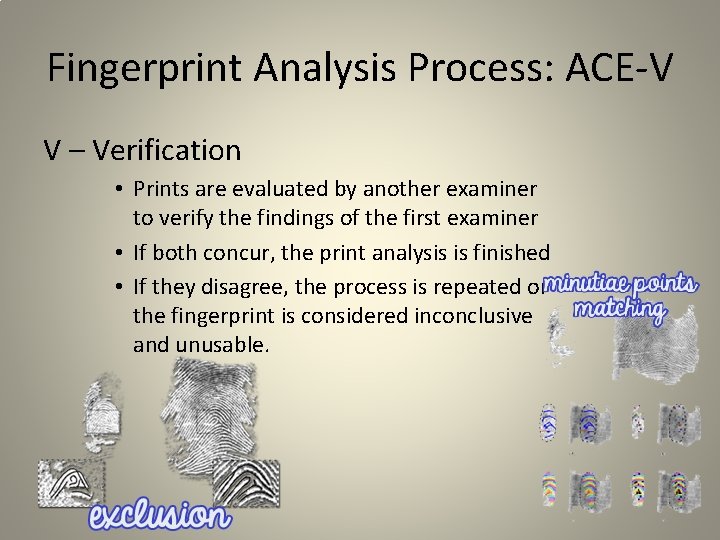
Fingerprint Analysis Process: ACE-V V – Verification • Prints are evaluated by another examiner to verify the findings of the first examiner • If both concur, the print analysis is finished • If they disagree, the process is repeated or the fingerprint is considered inconclusive and unusable.
Case Study: Shirley Mc. Kie • https: //www. theguardian. com/uk/2006/apr/1 8/ukcrime. features 11 • In 1997, a smudged print from one of PC Shirley Mc. Kie's thumbs was found at a murder scene in Kilmarnock. When she denied it was hers, no one believed her - after all, fingerprints don't lie. Then the truth emerged - it wasn't her print after all.
Fingerprint Portfolio A burglary occurred in an area home while the homeowners were at work. You have been called in as a fingerprint expert to try to find all latent, patent and plastic fingerprints, as well as to analyze any fingerprints that you find. You will also be preparing your testimony as an expert witness on fingerprinting. Complete the following fingerprint report as part of the case file and court preparation. You may consult this fingerprinting manual if needed:
Digital Imaging for Fingerprint Evidence • Integrated Automated Fingerprint Identification System (IAFIS) – What is it? – National computerized database of known fingerprints that allows fingerprints found at a crime scene or of a person of interest to be compared. – With the fingerprints, the database also includes criminal history information about convicted persons, mug shots, information about tattoos or distinguishing marks, physical characteristics, and aliases. – Houses information of 70 million convicted persons, 34 million civilians, and 73, 000 known or suspected international terrorists – Generally takes, on average 27 minutes, to get possible matches from the database. – Animated description of IAFIS: https: //vimeo. com/10455543
Digital Imaging for Fingerprint Evidence (cont) • How IAFIS works – Once a fingerprint is uploaded, the computer systems will search for similar prints in the database – The computer will print a list of close matches that a trained fingerprint examiner will use to ultimately determine a final match as outlined by ACE-V
Fingerprint Review • Order the following steps in Fingerprint Analysis: – Compare a print from a person of interest or crime scene to a known print – Verify that the prints are a match with a 2 nd examiner – Evaluate prints to determine if they represent a match – Analyze the print for comparison qualities
Fingerprint Review ANSWER • Order the following steps in Fingerprint Analysis: – Analyze the print for comparison qualities – Compare a print from a person of interest or crime scene to a known print – Evaluate prints to determine if they represent a match – Verify that the prints are a match with a 2 nd examiner
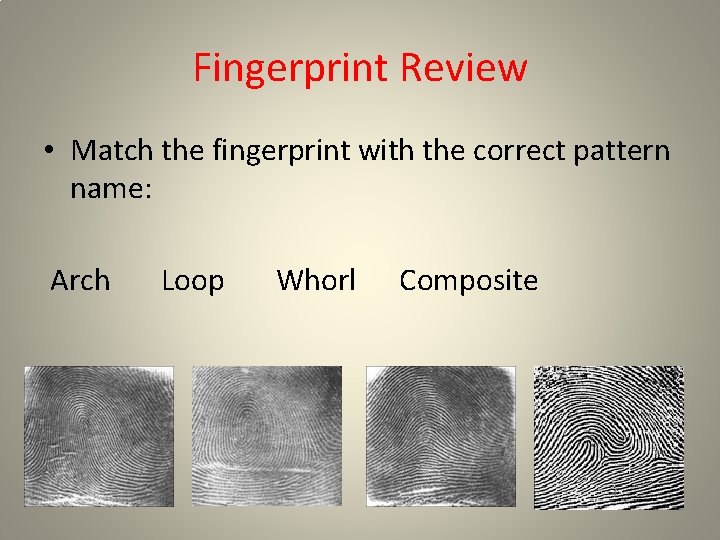
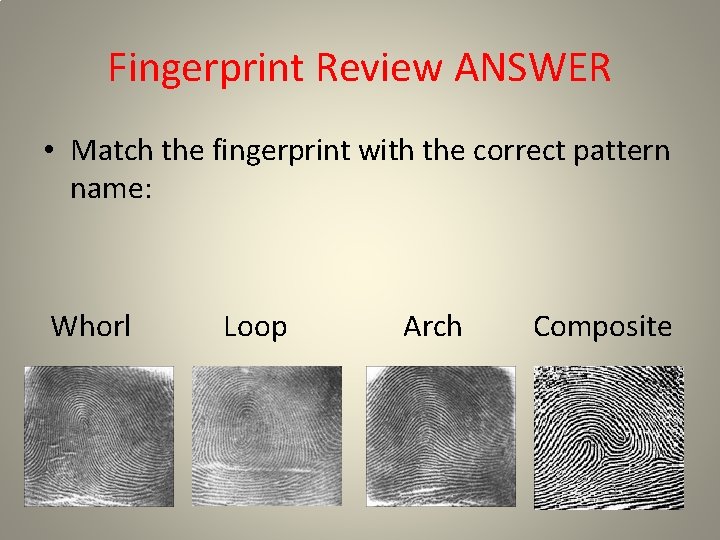
Fingerprint Review • Match the fingerprint with the correct pattern name: Arch Loop Whorl Composite
Fingerprint Review ANSWER • Match the fingerprint with the correct pattern name: Whorl Loop Arch Composite
Fingerprint Review • Choose the correct fingerprint types: 1. Invisible, caused by sweat and oil from skin. 2. Visible prints made by contact with a colored material that is transferred to a new surface. 3. Fingerprints that are left in a soft material.
Fingerprint Review ANSWER • Choose the correct fingerprint types: 1. Invisible, caused by sweat and oil from skin. Latent Prints 2. Visible prints made by contact with a colored material that is transferred to a new surface. Patent Prints 3. Fingerprints that are left in a soft material. Plastic Prints
Fingerprint Review • Choose the correct fingerprint type : 1. Fingerprint powder is the most common type of fingerprint developer used on these types of prints at a crime scene. 2. A bloody handprint on a wall. 3. A fingerprint in silly putty.
Fingerprint Review ANSWER • Choose the correct fingerprint type: 1. Fingerprint powder is the most common type of fingerprint developer used on these types of prints at a crime scene. Latent 2. A bloody handprint on a wall. Patent 3. A fingerprint in silly putty. Plastic
Fingerprint Review • Choose the correct fingerprint type: 1. Cyanoacrylate fuming is a common method for this type of fingerprint. 2. Greasy fingerprint on a doorknob. 3. A fingerprint in a wax seal.
Fingerprint Review ANSWER • Choose the correct fingerprint type: 1. Cyanoacrylate fuming is a common method for this type of fingerprint. Latent 2. Greasy fingerprint on a doorknob. Patent 3. A fingerprint in a wax seal. Plastic
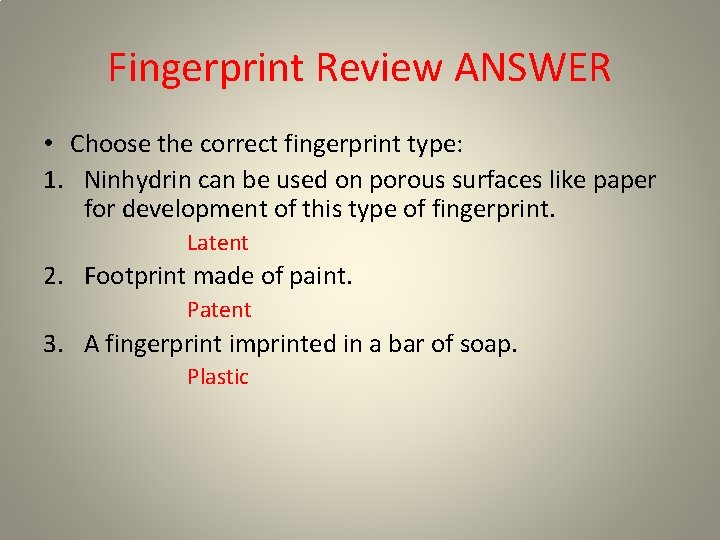
Fingerprint Review • Choose the correct fingerprint type: 1. Ninhydrin can be used on porous surfaces like paper for development of this type of fingerprint. 2. Footprint made of paint. 3. A fingerprint imprinted in a bar of soap.
Fingerprint Review ANSWER • Choose the correct fingerprint type: 1. Ninhydrin can be used on porous surfaces like paper for development of this type of fingerprint. Latent 2. Footprint made of paint. Patent 3. A fingerprint imprinted in a bar of soap. Plastic
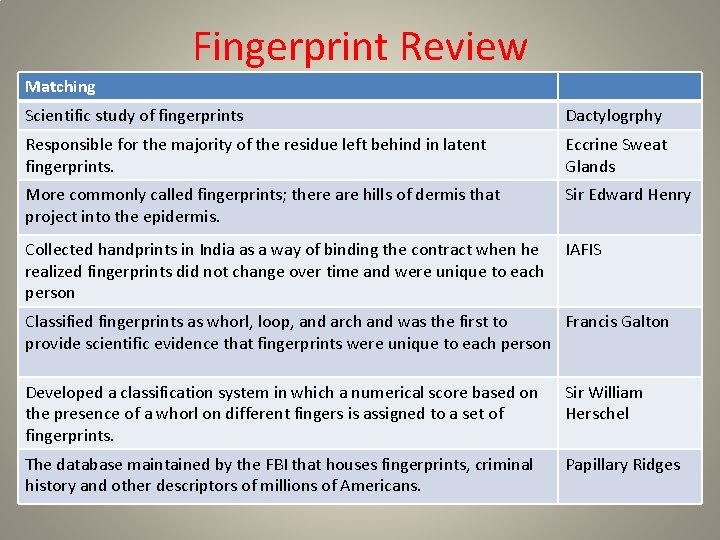
Fingerprint Review Matching Scientific study of fingerprints Dactylogrphy Responsible for the majority of the residue left behind in latent fingerprints. Eccrine Sweat Glands More commonly called fingerprints; there are hills of dermis that project into the epidermis. Sir Edward Henry Collected handprints in India as a way of binding the contract when he realized fingerprints did not change over time and were unique to each person IAFIS Classified fingerprints as whorl, loop, and arch and was the first to Francis Galton provide scientific evidence that fingerprints were unique to each person Developed a classification system in which a numerical score based on the presence of a whorl on different fingers is assigned to a set of fingerprints. Sir William Herschel The database maintained by the FBI that houses fingerprints, criminal history and other descriptors of millions of Americans. Papillary Ridges
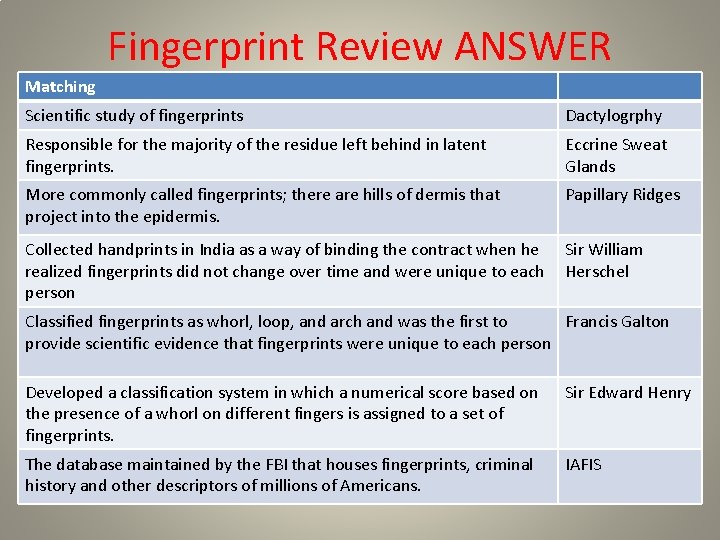
Fingerprint Review ANSWER Matching Scientific study of fingerprints Dactylogrphy Responsible for the majority of the residue left behind in latent fingerprints. Eccrine Sweat Glands More commonly called fingerprints; there are hills of dermis that project into the epidermis. Papillary Ridges Collected handprints in India as a way of binding the contract when he realized fingerprints did not change over time and were unique to each person Sir William Herschel Classified fingerprints as whorl, loop, and arch and was the first to Francis Galton provide scientific evidence that fingerprints were unique to each person Developed a classification system in which a numerical score based on the presence of a whorl on different fingers is assigned to a set of fingerprints. Sir Edward Henry The database maintained by the FBI that houses fingerprints, criminal history and other descriptors of millions of Americans. IAFIS