
Fingerprints dactylograms CHS Forensics Topics History Fundamental Principles

- Slides: 43
Fingerprints dactylograms CHS Forensics
Topics • History • Fundamental Principles • Automated fingerprint Identification System (AFIS) • Methods of detection • Preservation • Digital imaging c
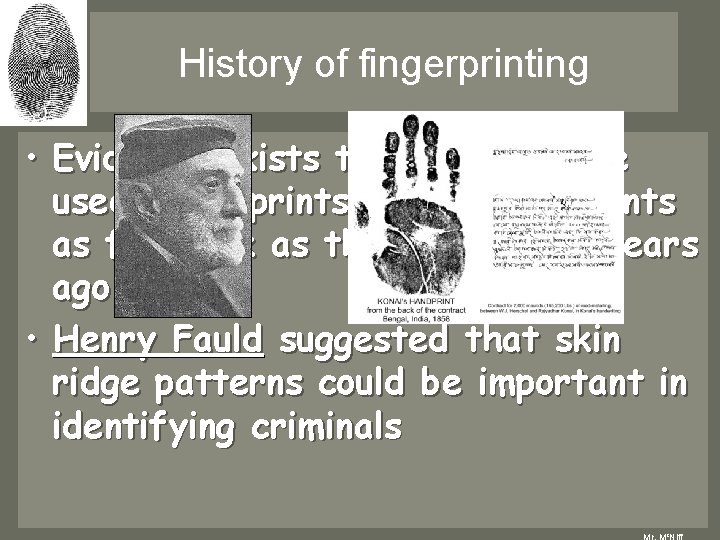
History of fingerprinting • Evidence exists that the Chinese used fingerprints to sign documents as far back as three thousand years ago. • Henry Fauld suggested that skin ridge patterns could be important in identifying criminals c
History cont. • Fauld described an incident about a thief who left his fingerprints on a white washed wall. • He compared this print with some suspects, he found they were all very different. • A few days later another suspect whose prints matched the ones on the wall, when confronted with the evidence, he confessed. c
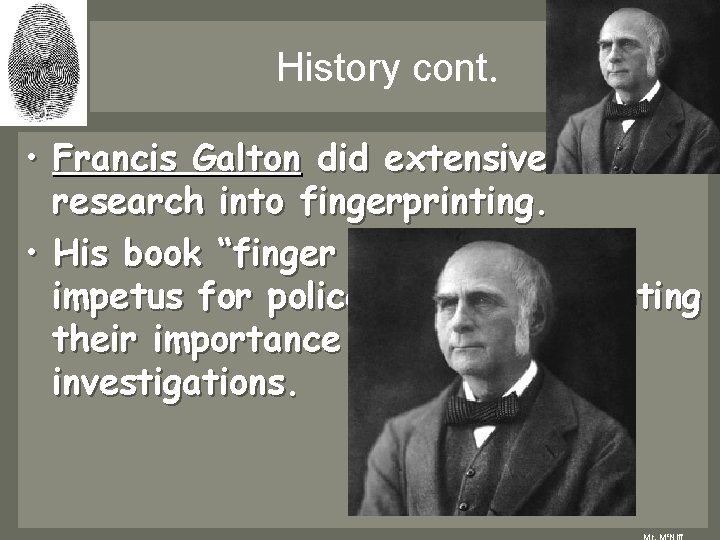
History cont. • Francis Galton did extensive research into fingerprinting. • His book “finger prints” was the impetus for police agencies accepting their importance in criminal investigations. c
History cont. • When the police took the Bertolion measurements for Will West, they matched exactly those taken previously from a different prisoner William West. Police seemed to know the reason for this: Will West was lying. He was the earlier William West, who had changed his name in order to save himself for the harsh punishments meted out to recidivists. • No amount of pleadings would have had any effect on the police, had they not discovered that William West was already in prison at that time! c
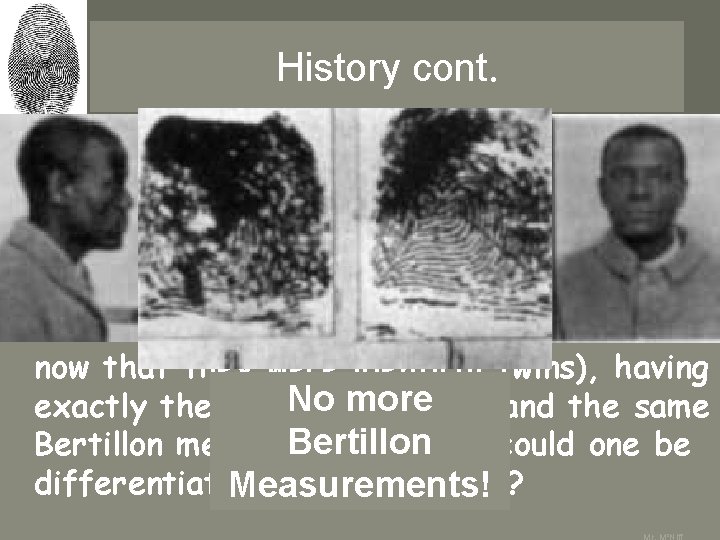
History cont. • And when the two were brought together, everyone was amazed. They looked exactly alike. Here was the strangest case in the history of identification - two people apparently unrelated (they denied being related, although it has been established now that they were identical twins), having more exactly the same. No appearance and the same Bertillon. How could one be Bertillon measurements. differentiated from the other? Measurements! c
Topics • History • Fundamental Principles • Automated fingerprint Identification System (AFIS) • Methods of detection • Preservation • Digital imaging c
Fundamental Principles • First Principle- A fingerprint is an individual characteristic • Second Principle- Fingerprints will remain unchanged for a lifetime • Third Principle- Fingerprints have general characteristics that allow them to be classified. c
First principle • A fingerprint is an individual characteristic, & therefore no two are alike • Galton calculated that there are 64 -billion different possible fingerprints. • This is supported by both research and that over the past 90 years no two fingerprints have been identical. c
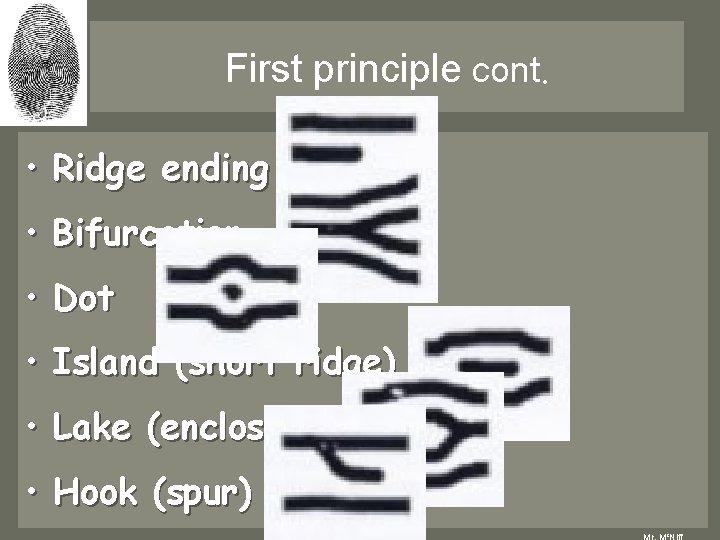
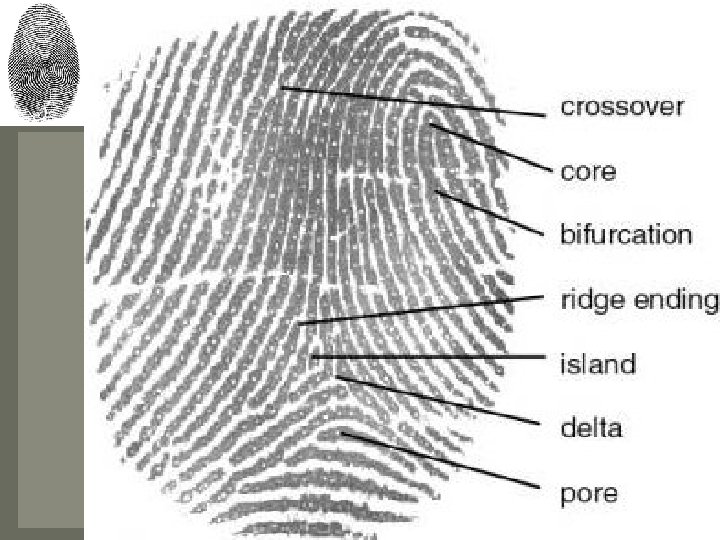
First principle cont. • The individuality of a finger print is not determined by its general shape or pattern but by a careful study of its ridge characteristics A. K. A. minutiae c
First principle cont. • Ridge ending • Bifurcation • Dot • Island (short ridge) • Lake (enclosure) • Hook (spur) c
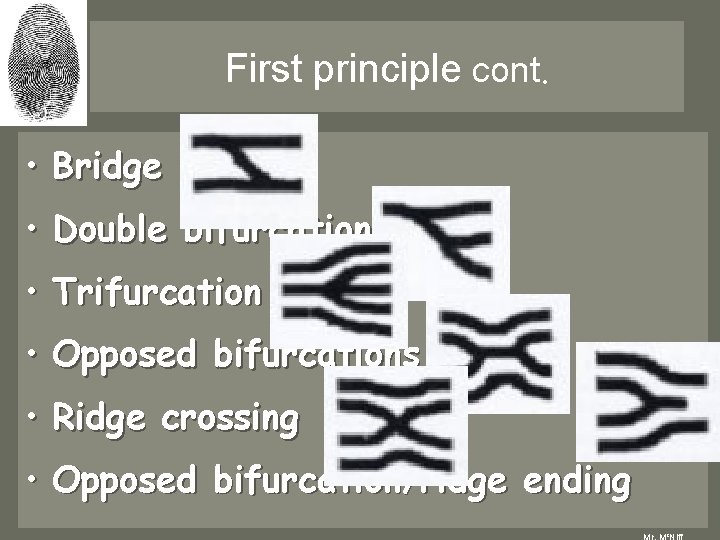
First principle cont. • Bridge • Double bifurcation • Trifurcation • Opposed bifurcations • Ridge crossing • Opposed bifurcation/ridge ending c
First principle cont. c
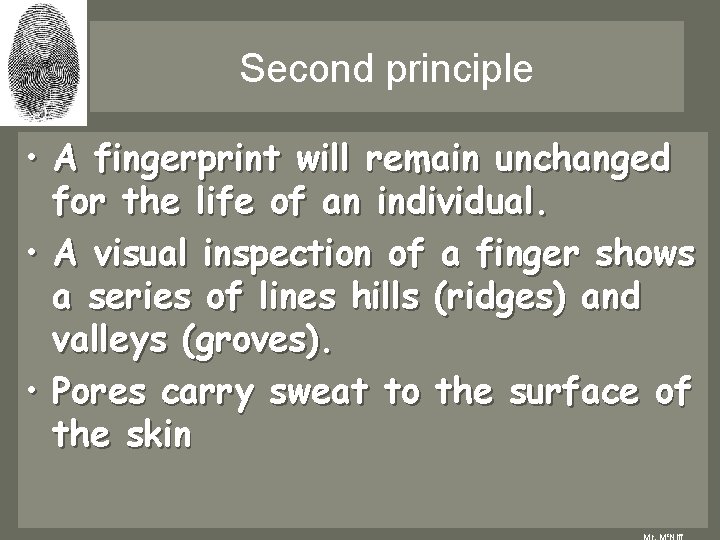
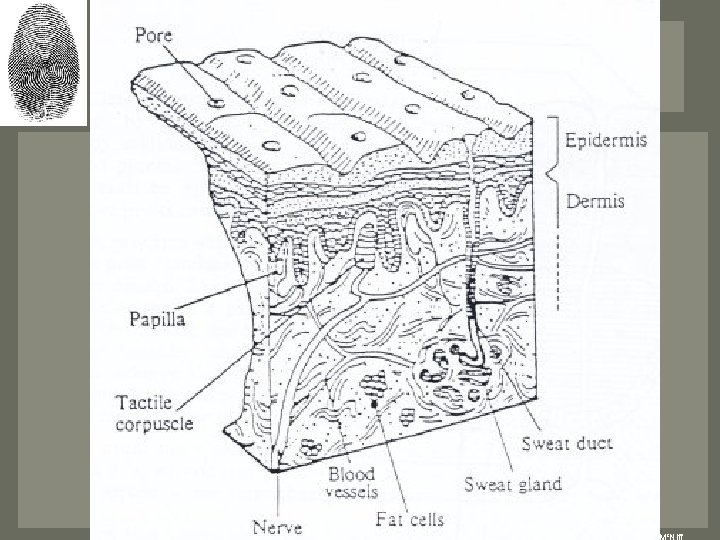
Second principle • A fingerprint will remain unchanged for the life of an individual. • A visual inspection of a finger shows a series of lines hills (ridges) and valleys (groves). • Pores carry sweat to the surface of the skin c
c
Second principle cont. • Once the finger touches a surface the oils and sweat on the finger are transferred to the surface. • They are invisible to the naked eye and are called Latent Fingerprints. • The only way to alter fingerprints is by deep scarring. c
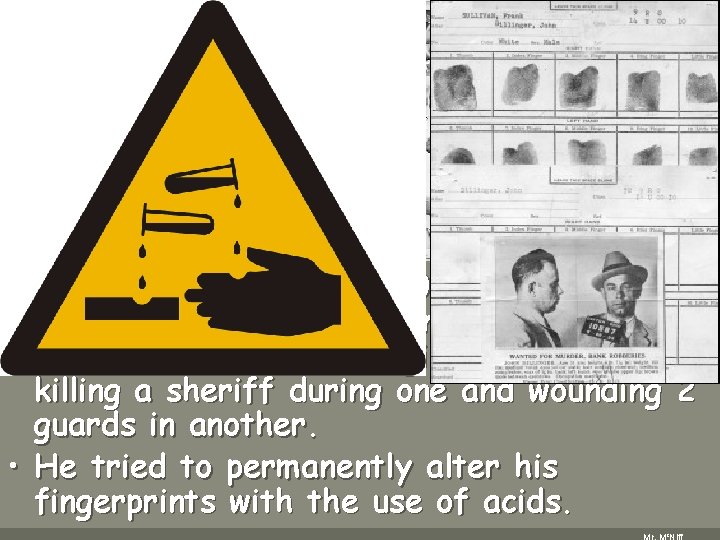
Second principle cont. • John Dillinger, a notorious and vicious thief. Terrorized the Midwest during the great depression. • He and his gang killed 10 men & wounding 7 others, robbing banks and police arsenals, and staging 3 jail breaks killing a sheriff during one and wounding 2 guards in another. • He tried to permanently alter his fingerprints with the use of acids. c
Third Principle • Fingerprints have general ridge patterns that permit them to be systematically classified. • All fingerprints are divided into three main patterns – Loops – Whorls – Arches c
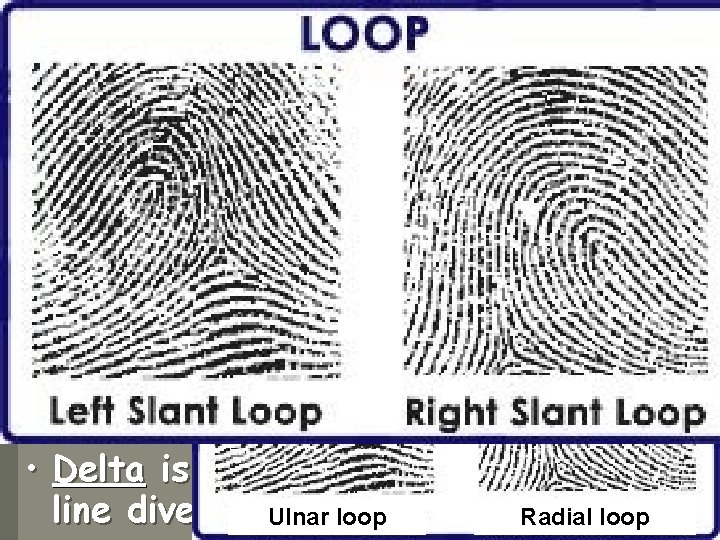
Third Principle cont • Loops- 65 % of the worlds population displays this type of pattern • If the loop opens toward the little finger it is called an Ulnar Loop • If the loop opens toward the thumb it is called a Radial Loop • Delta is the ridge nearest the type line divergence Ulnar loop Radial loop c
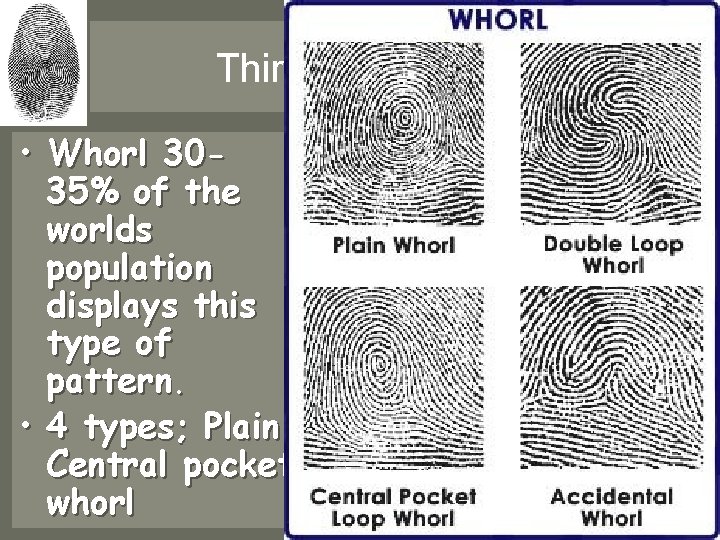
Third Principle cont • Whorl 3035% of the worlds population displays this type of pattern. • 4 types; Plain whorl, Double whorl, Central pocket loop whorl, Accidental whorl c
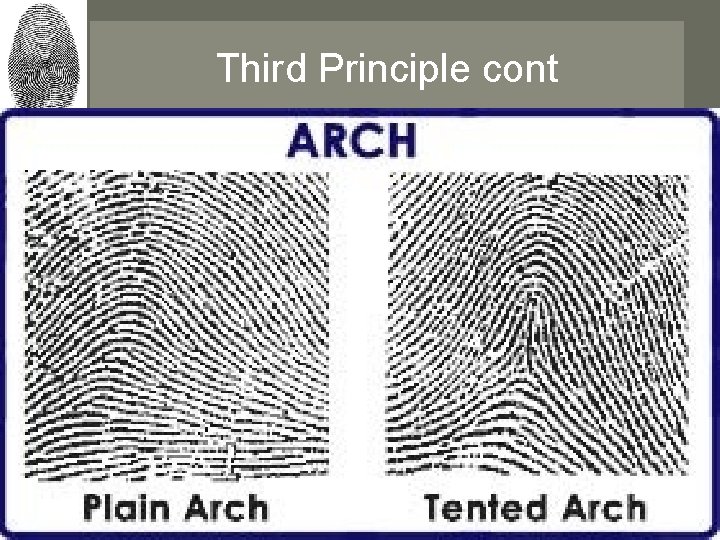
Third Principle cont • Arches 5% of the worlds population displays this type of pattern. • Arches have no Deltas c
Topics • History • Fundamental Principles • Automated fingerprint Identification System (AFIS) • Methods of detection • Preservation • Digital imaging c
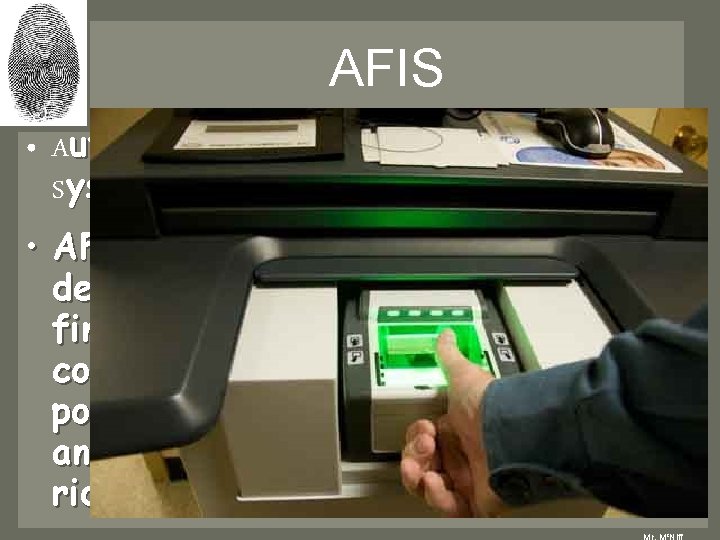
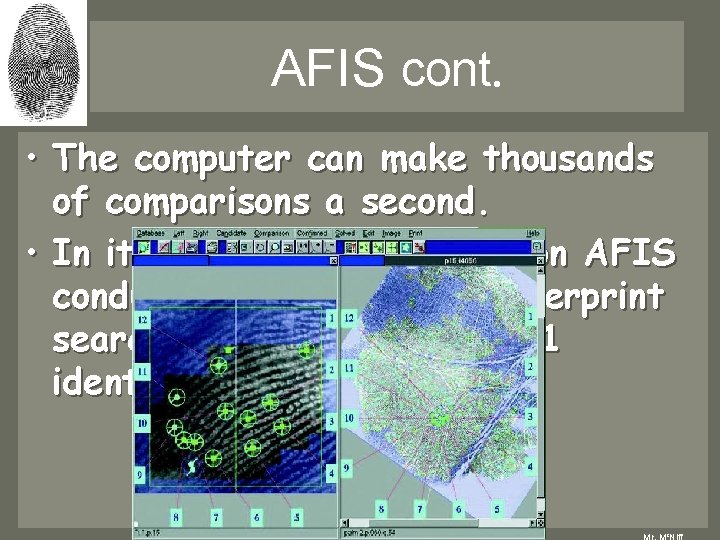
AFIS • Automated Fingerprint Identification System. • AFIS uses automatic scanning devices that convert the image of a fingerprint into digital minutiae that contain data showing ridged at their points of termination (ridge endings) and the branching of ridges into two ridges (bifurcations) c
AFIS cont. • The computer can make thousands of comparisons a second. • In its first year of operation AFIS conducted 5, 514 latent fingerprint searches and achieved 1, 001 identifications. c
Topics • History • Fundamental Principles • Automated fingerprint Identification System (AFIS) • Methods of detection • Preservation • Digital imaging c
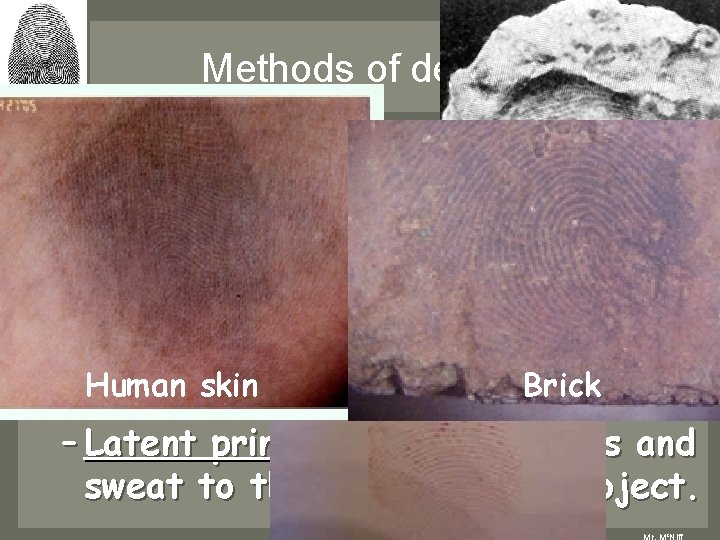
Methods of detection • Three kinds of crime scene prints – Visible prints- are made by fingers contacting a colored surface such as blood or paint. – Plastic prints- prints left on soft Human skinsuch as wax or Brick materials putty. – Latent prints- transfer of oils and sweat to the surface of an object. c
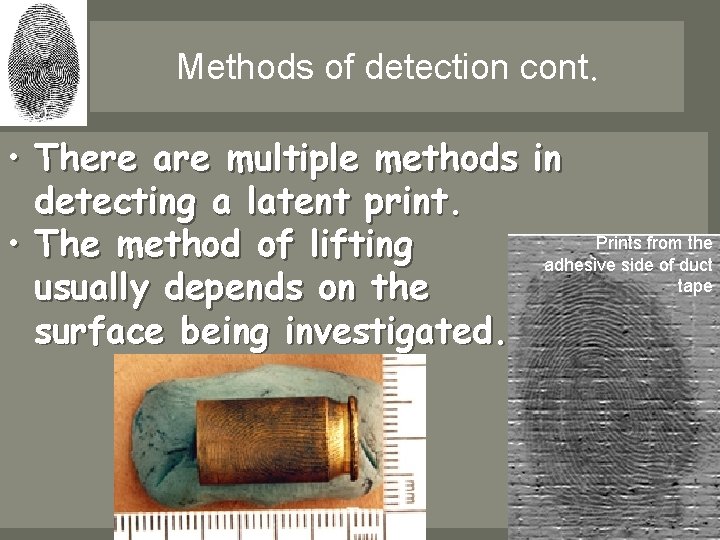
Methods of detection cont. • There are multiple methods in detecting a latent print. Prints from the • The method of lifting adhesive side of duct tape usually depends on the surface being investigated. c
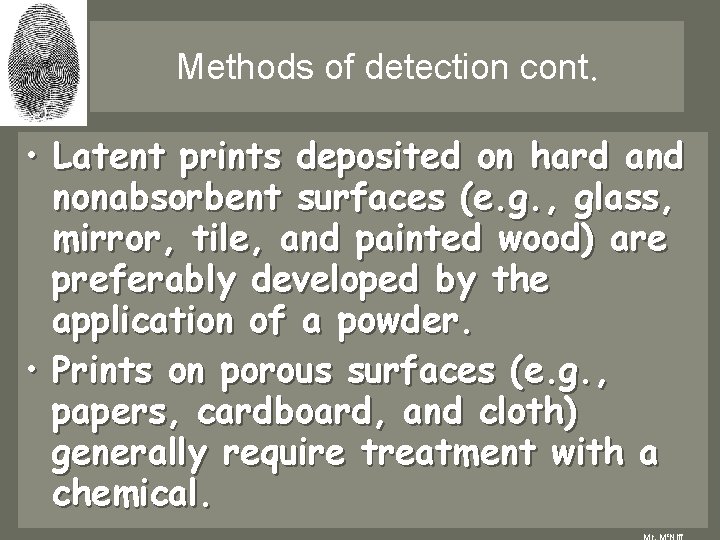
Methods of detection cont. • Latent prints deposited on hard and nonabsorbent surfaces (e. g. , glass, mirror, tile, and painted wood) are preferably developed by the application of a powder. • Prints on porous surfaces (e. g. , papers, cardboard, and cloth) generally require treatment with a chemical. c
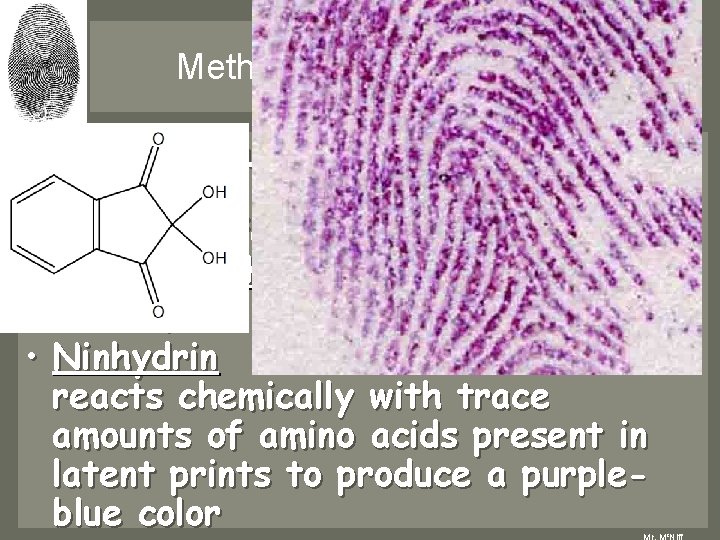
Methods of detection cont. • Examiners use various chemical methods to visualize latent prints on porous surfaces, such as iodine fuming, ninhydrin, and Physical Developer. • Ninhydrin reacts chemically with trace amounts of amino acids present in latent prints to produce a purpleblue color c
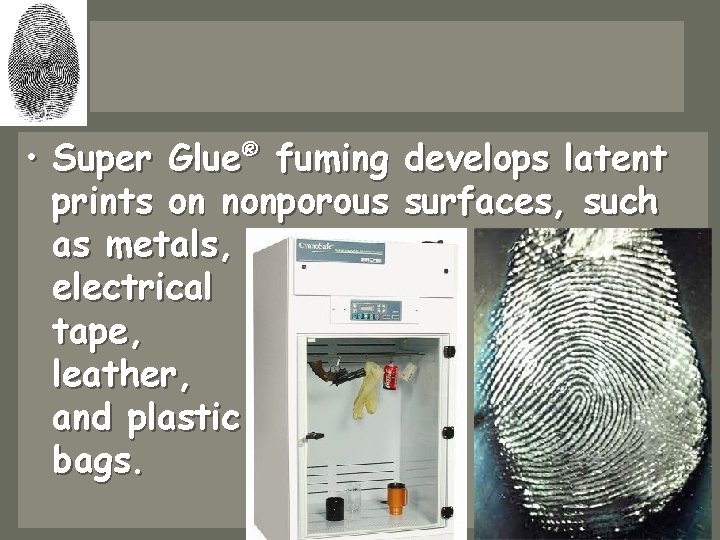
• Super Glue® fuming develops latent prints on nonporous surfaces, such as metals, electrical tape, leather, and plastic bags. c
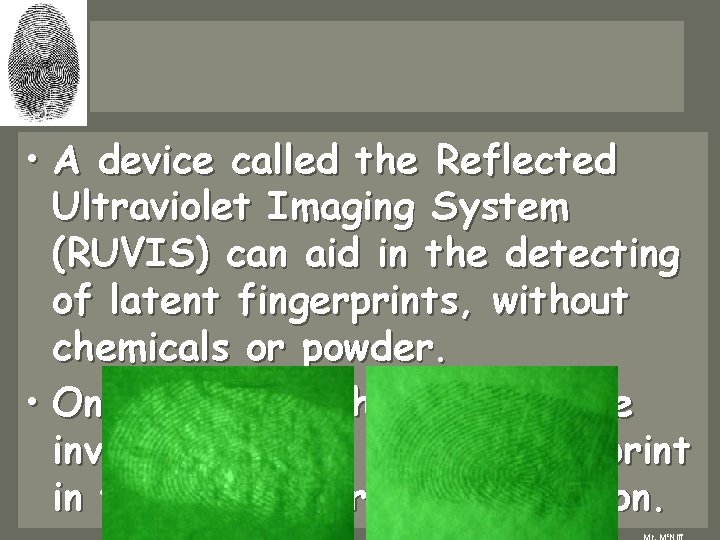
• A device called the Reflected Ultraviolet Imaging System (RUVIS) can aid in the detecting of latent fingerprints, without chemicals or powder. • Once located, the crime scene investigator can develop the print in the most appropriate fashion. c
Topics • History • Fundamental Principles • Automated fingerprint Identification System (AFIS) • Methods of detection • Preservation • Digital imaging c
Preservation • Visualized latent print • Permanently preserved – Future comparison – Possible use as court evidence • Photograph must be taken – Before any attempts at preservation c
Preservation • small object: preserve in its entirety. • large immovable objects – developed with a powder – “lift” with a broad adhesive tape. – tape placed on properly labeled card – good background contrast with the powder c
Topics • History • Fundamental Principles • Automated fingerprint Identification System (AFIS) • Methods of detection • Preservation • Digital imaging c
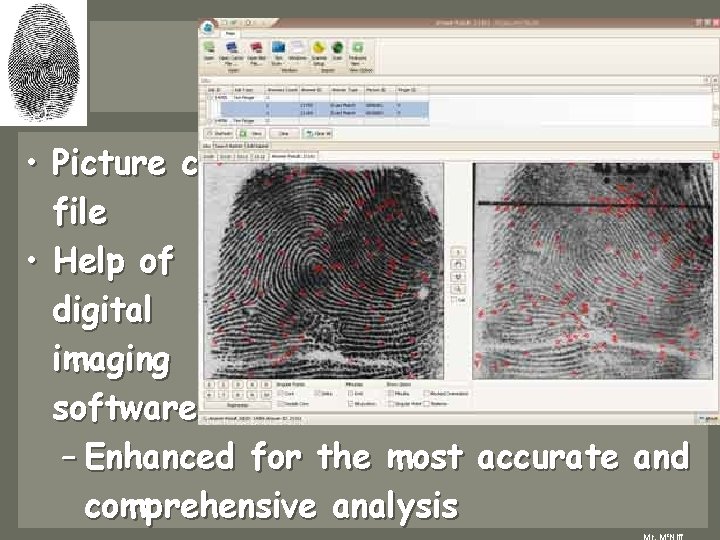
Digital imaging • Picture converted into digital computer file • Help of digital imaging software – Enhanced for the most accurate and comprehensive analysis c
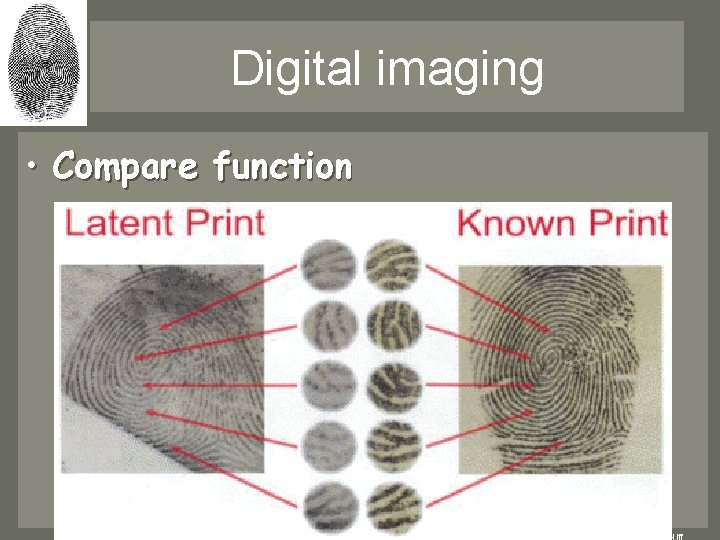
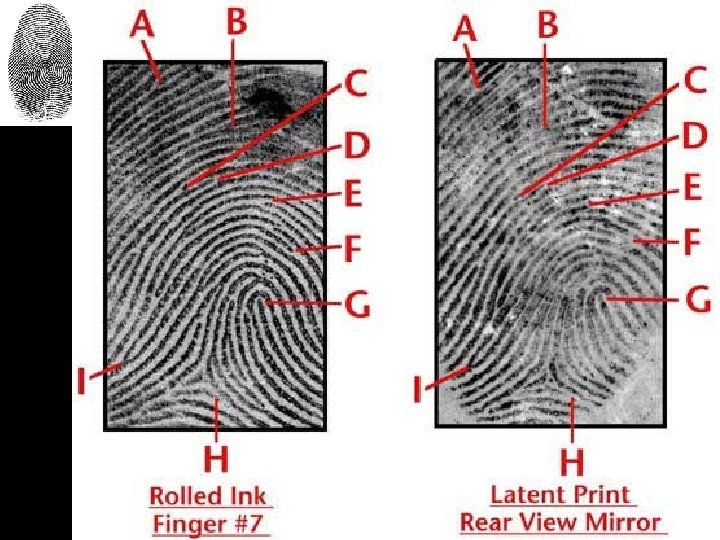
Digital imaging • Compare function – Two images side by side – Allows the examiner to chart the common features on both images simultaneously c
c
Topics • History • Fundamental Principles • Automated fingerprint Identification System (AFIS) • Methods of detection • Preservation • Digital imaging c
Pictures • Slide 3 • Slide 4 • Slide 6 • • • – – http: //newsimg. bbc. co. uk/media/images/40518000/jpg/_40518115_henryfaulds 203300. jpg http: //twistedphysics. typepad. com/cocktail_party_physics/images/hershcel_konai_contract. jpg – http: //www. bbc. co. uk/radio 4/science/media/MW_Galton. jpg – http: //www. geradts. com/anil/ij/vol_002_no_002/reviews/pb/page 002. html Slide 11 - 13 – http: //shs. westport. k 12. ct. us/forensics/04 -fingerprints/handout. htm Slide 17 – http: //www. dallasnews. com/sharedcontent/dws/img/v 3/08 -07 -2005. NT_07 dillinger. GT 41 LGHED. 1. jpg – https: //www. msu. edu/~muell 132/Famous_files/image 003. jpg – http: //www. shingleberrysigns. com/design_icon/warning%208%20 acid%20 corrosive. gif – http: //jp. pima. gov/Pages/history/images/jdbksh. jpg Slide 19 - 21 – http: //express. howstuffworks. com/fingerprint. htm Slide 23 – http: //media. northjersey. com/images/screen_1119_ai_tif_. jpg Slide 24 – http: //www. printquest-afis. com/index. 3. jpg Slide 26 – http: //www. forensicmag. com/Assets/images/articles 0805/MVC-010 F-10_cast. jpg – http: //4. bp. blogspot. com/_6 crr. W 2 JJSKE/Sp 1 ne 5 h 54 UI/AAAAACs/d. K_i. Zl 243 QI/s 1600 -h/Plastic+Print. jpg Slide 27 – http: //www. focossforensics. com/html/fingerprints. html Slide 29 – http: //www. ok. gov/osbi/images/ninhydrin%20 print. jpg Slide 36 – http: //www. behinco. com/Images/other/Newpic/4. jpg Slide 37 – http: //dupageforensics. org/images/fingerprint%20 comparison. gif Slide 38 – http: //www. rcmp-grc. gc. ca/ns/images/fingerprintcompare. jpg c
refrences • Saferstein, Richard. Criminalistics an introduction to forensic science. Upper Saddle River, N. J: Prentice Hall, 2004. Print. Slides 11 -12 – http: //shs. westport. k 12. ct. us/forensics/04 -fingerprints/handout. htm http: //www. fbi. gov/libref/historic/famcases/dillinger. htm. • • c