
Fingerprinting Performance Objectives Refer to the POST Goal
Fingerprinting
Performance Objectives • Refer to the POST Goal and Objectives
Definition of Fingerprint. The impression or mark left by the underside of the tips of the fingers or thumbs. The impression is formed by a pattern of ridges on the skin surface. This pattern is unique for each individual and therefore can serve as a means of identification. Retrieved from www. dictionary. com ; 11/5/2016 @1: 49 PM
Why do we do it? It is the oldest and generally considered one of the most reliable means of identifying a person. Each person finger prints are unique to them.
Classification • Classification of fingerprints involves giving each recorded fingerprint on a ten print fingerprint card a proper classification with a corresponding subclassification or ridge count, and then using those classifications for each print in a classification formula. • Two methods of classification; NCIC and Henry
Three Type of Fingerprint Patterns • Loop • Whorl • Arch
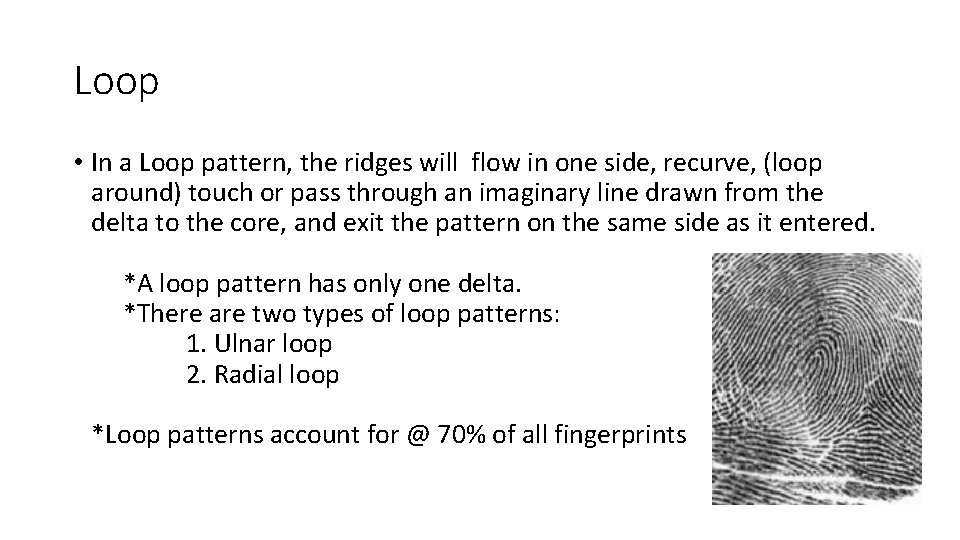
Loop • In a Loop pattern, the ridges will flow in one side, recurve, (loop around) touch or pass through an imaginary line drawn from the delta to the core, and exit the pattern on the same side as it entered. *A loop pattern has only one delta. *There are two types of loop patterns: 1. Ulnar loop 2. Radial loop *Loop patterns account for @ 70% of all fingerprints
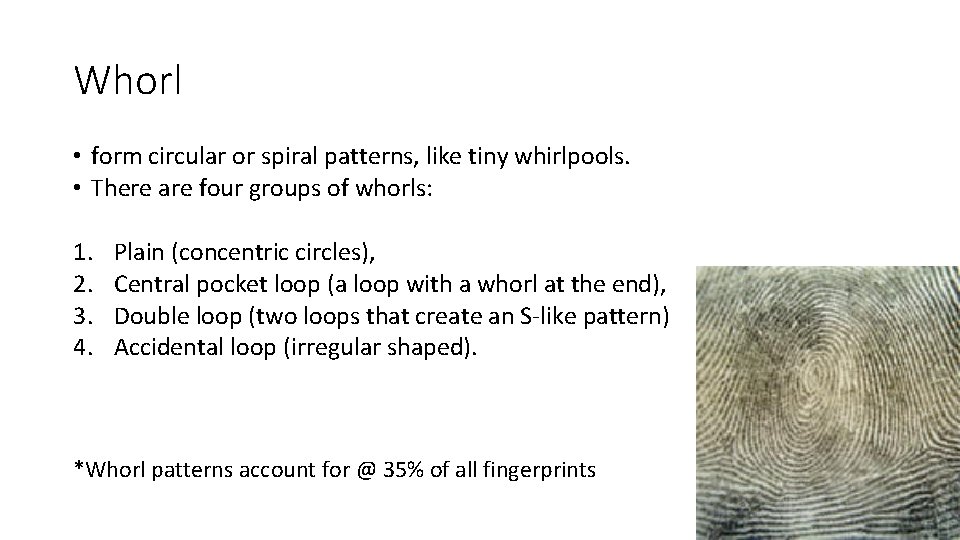
Whorl • form circular or spiral patterns, like tiny whirlpools. • There are four groups of whorls: 1. 2. 3. 4. Plain (concentric circles), Central pocket loop (a loop with a whorl at the end), Double loop (two loops that create an S-like pattern) Accidental loop (irregular shaped). *Whorl patterns account for @ 35% of all fingerprints
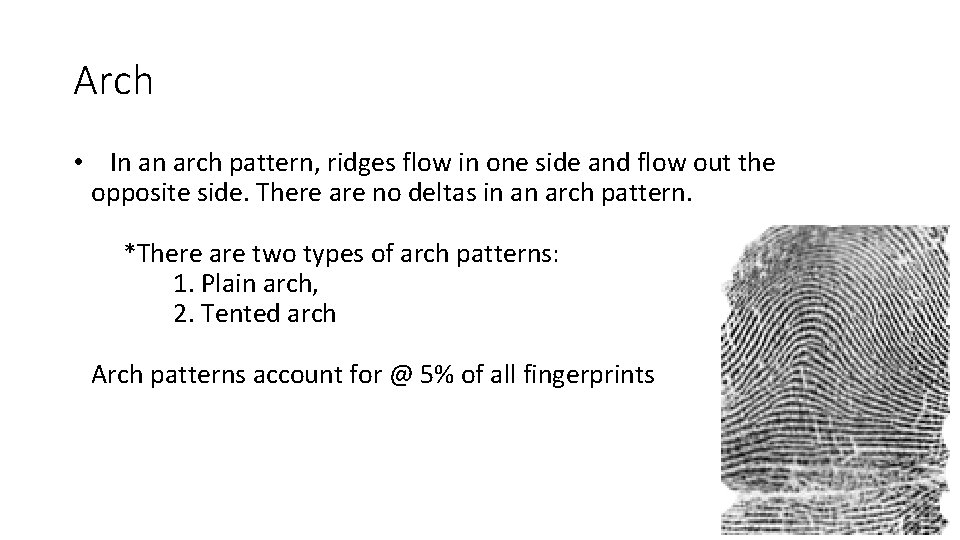
Arch • In an arch pattern, ridges flow in one side and flow out the opposite side. There are no deltas in an arch pattern. *There are two types of arch patterns: 1. Plain arch, 2. Tented arch Arch patterns account for @ 5% of all fingerprints
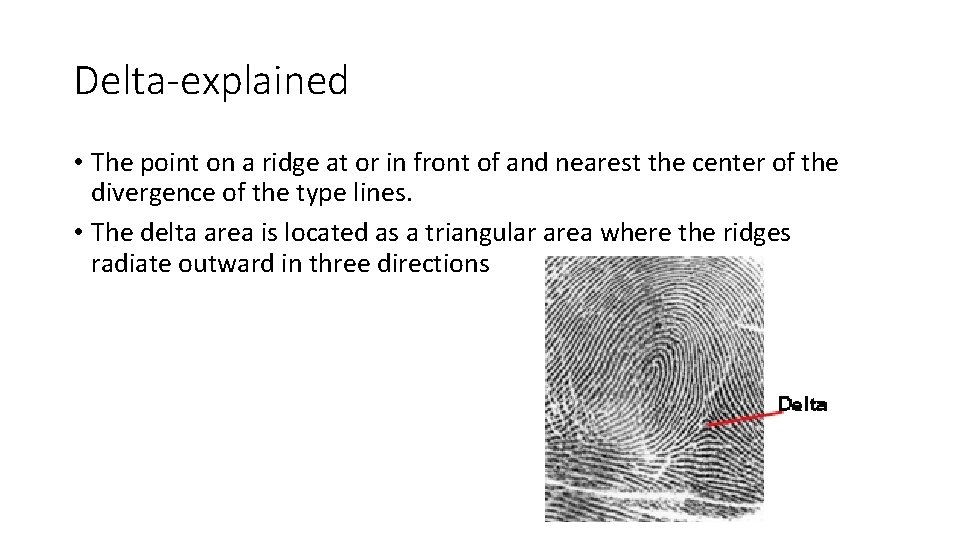
Delta-explained • The point on a ridge at or in front of and nearest the center of the divergence of the type lines. • The delta area is located as a triangular area where the ridges radiate outward in three directions
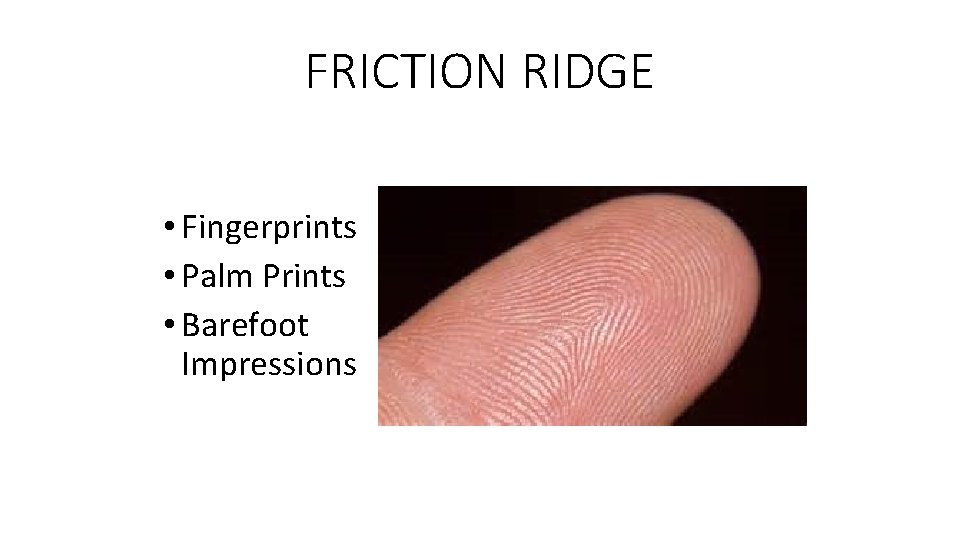
FRICTION RIDGE • Fingerprints • Palm Prints • Barefoot Impressions
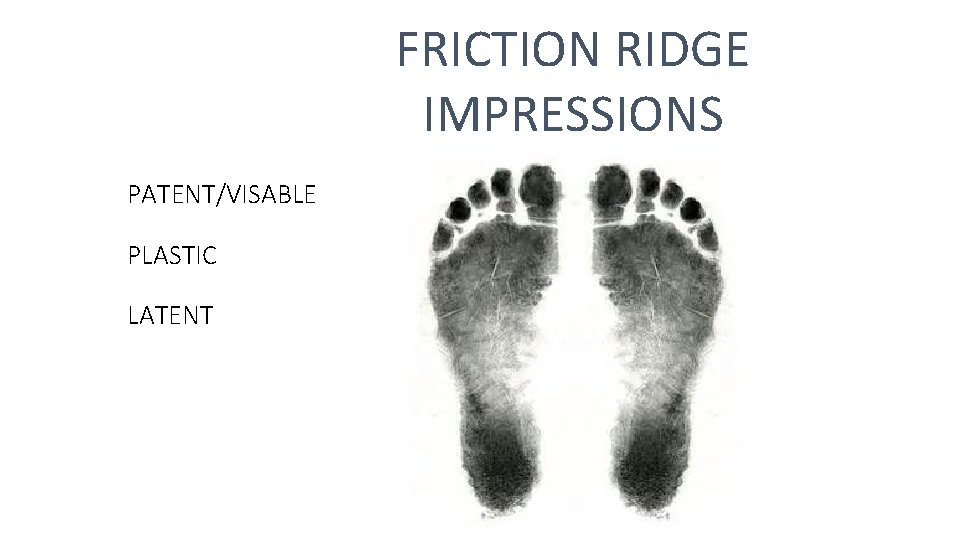
FRICTION RIDGE IMPRESSIONS PATENT/VISABLE PLASTIC LATENT
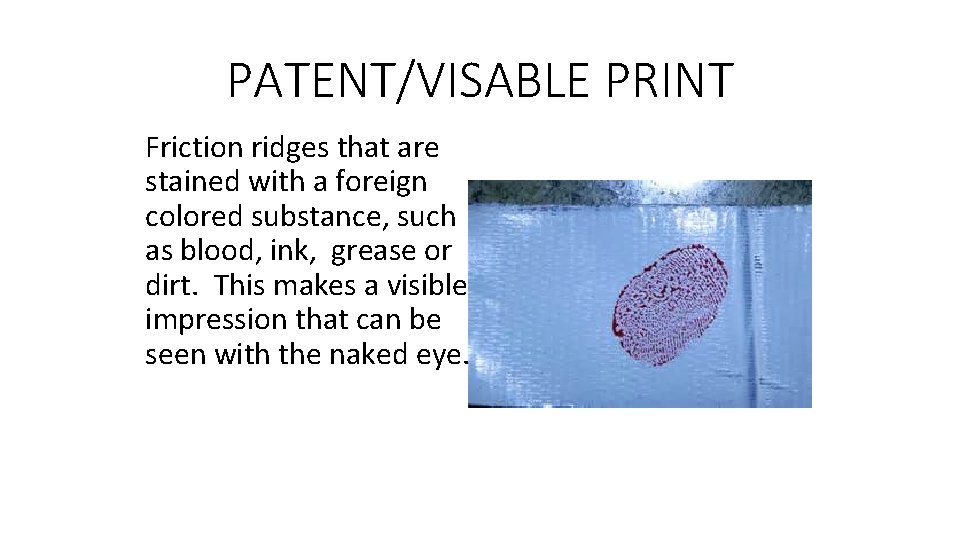
PATENT/VISABLE PRINT Friction ridges that are stained with a foreign colored substance, such as blood, ink, grease or dirt. This makes a visible impression that can be seen with the naked eye.
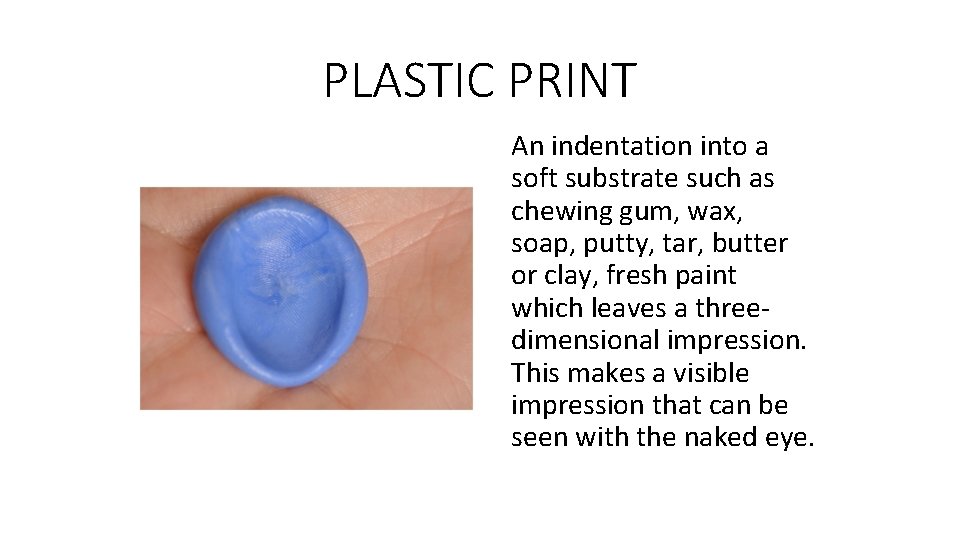
PLASTIC PRINT An indentation into a soft substrate such as chewing gum, wax, soap, putty, tar, butter or clay, fresh paint which leaves a threedimensional impression. This makes a visible impression that can be seen with the naked eye.
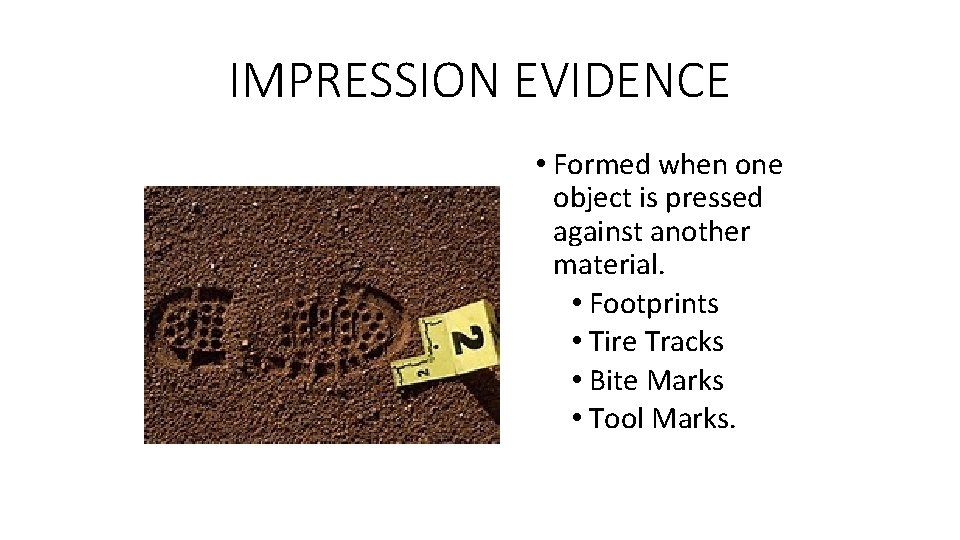
IMPRESSION EVIDENCE • Formed when one object is pressed against another material. • Footprints • Tire Tracks • Bite Marks • Tool Marks.
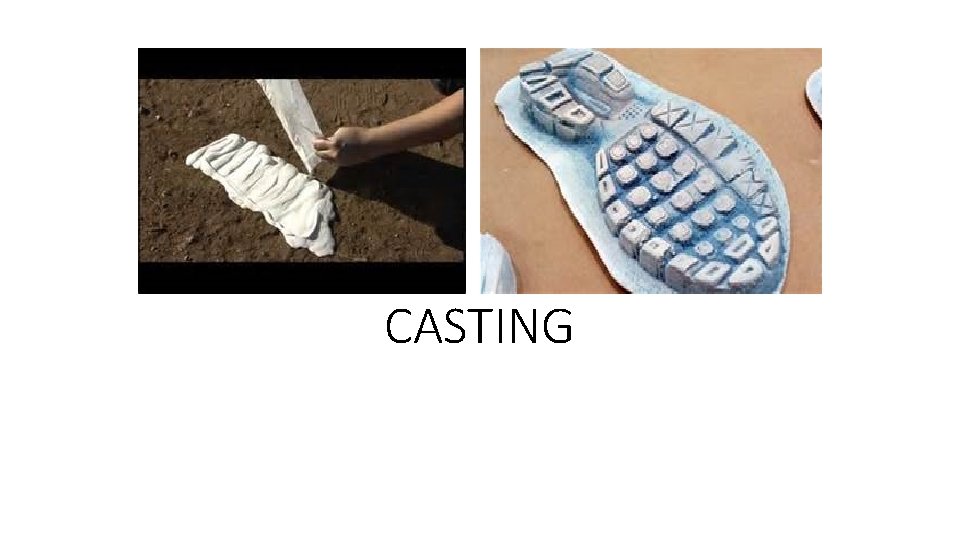
CASTING
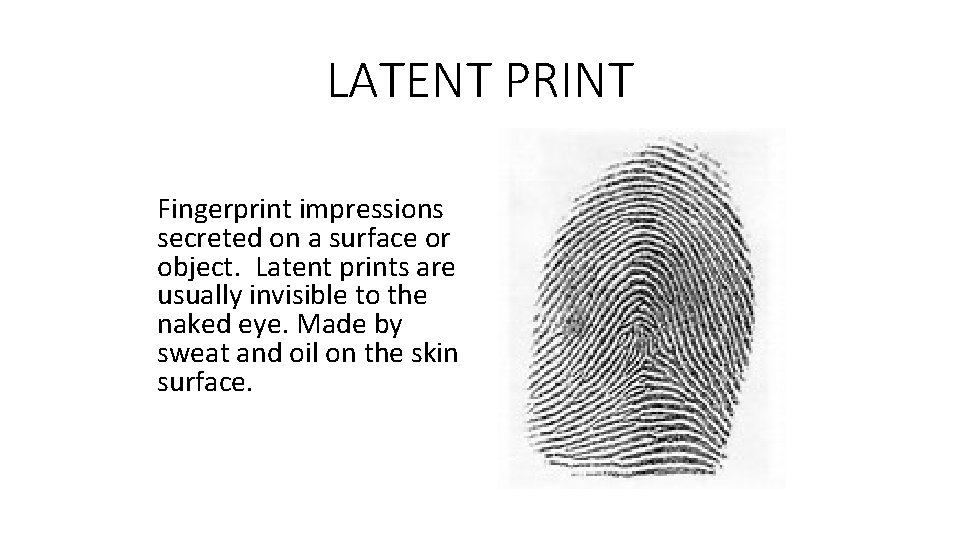
LATENT PRINT Fingerprint impressions secreted on a surface or object. Latent prints are usually invisible to the naked eye. Made by sweat and oil on the skin surface.
DEVELOPING FINGERPRINTS • Nonporous Surfaces • Glass • Marble • Metal • Plastic • Finished Wood • Light • Powder • Superglue Fuming • Porous Surfaces • Fabric • Paper • Un-Finished Wood • Iodine Fuming • Silver Nitrate • Ninhydrin
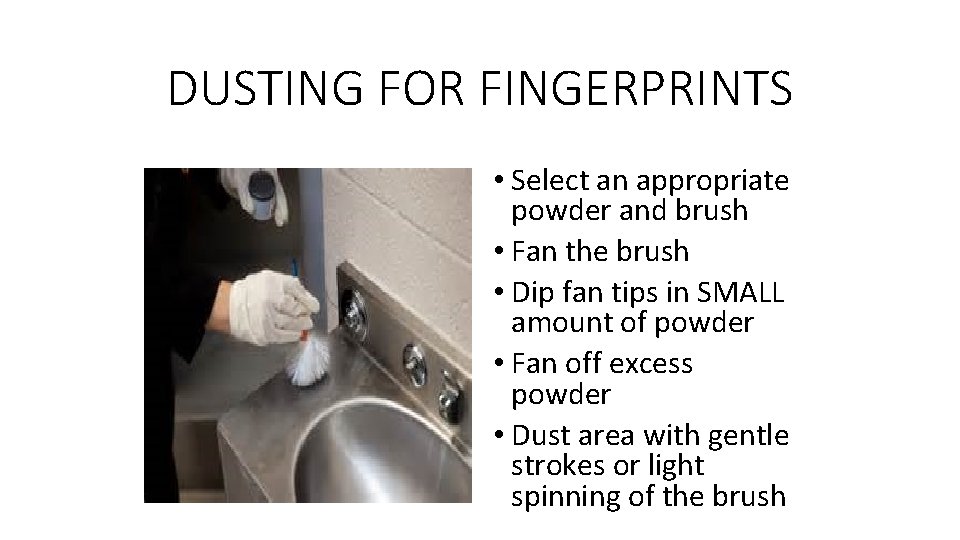
DUSTING FOR FINGERPRINTS • Select an appropriate powder and brush • Fan the brush • Dip fan tips in SMALL amount of powder • Fan off excess powder • Dust area with gentle strokes or light spinning of the brush
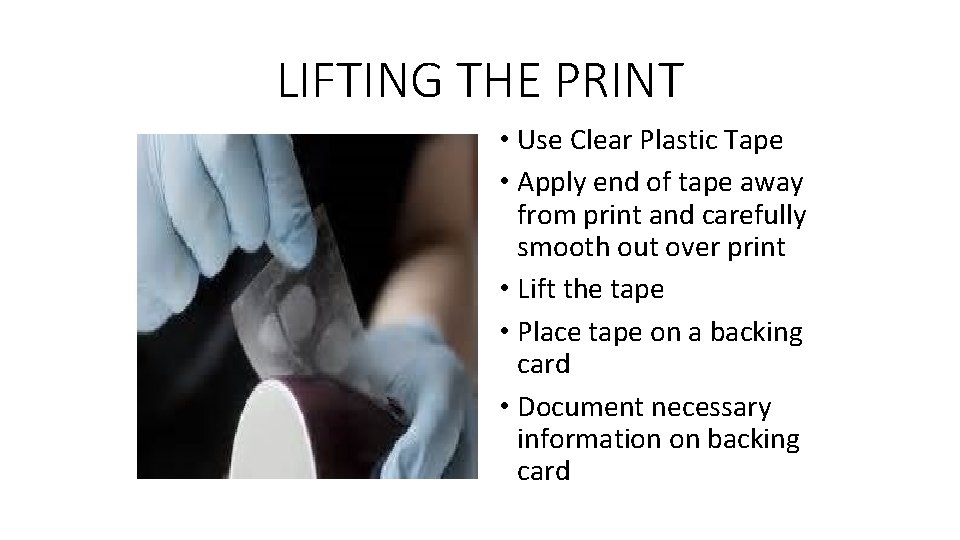
LIFTING THE PRINT • Use Clear Plastic Tape • Apply end of tape away from print and carefully smooth out over print • Lift the tape • Place tape on a backing card • Document necessary information on backing card
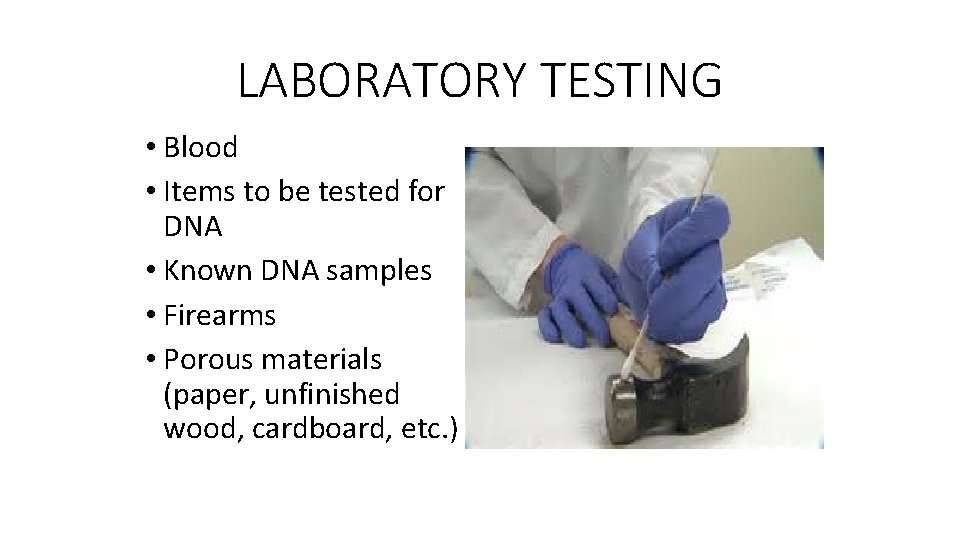
LABORATORY TESTING • Blood • Items to be tested for DNA • Known DNA samples • Firearms • Porous materials (paper, unfinished wood, cardboard, etc. )
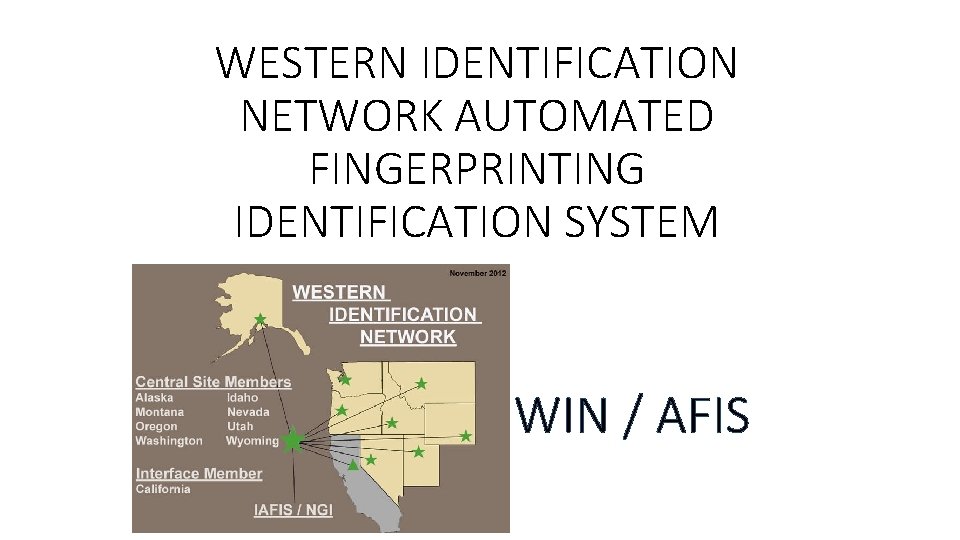
WESTERN IDENTIFICATION NETWORK AUTOMATED FINGERPRINTING IDENTIFICATION SYSTEM WIN / AFIS
National Crime Information Center • Computerized Index of Documented Criminal Justice Information • Over 20 Files of Information • Available 24 hours a day 365 days a year
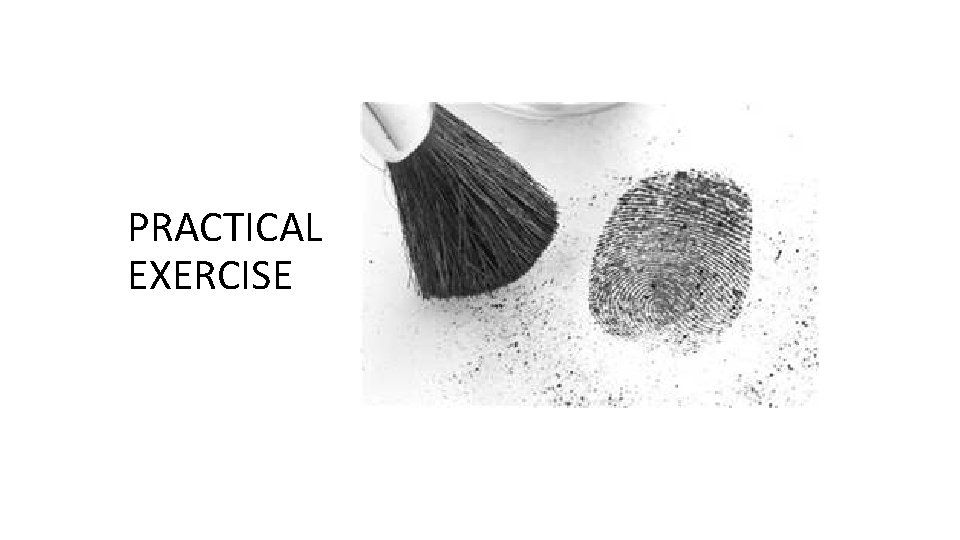
PRACTICAL EXERCISE
ROLLING FINGERPRINTS
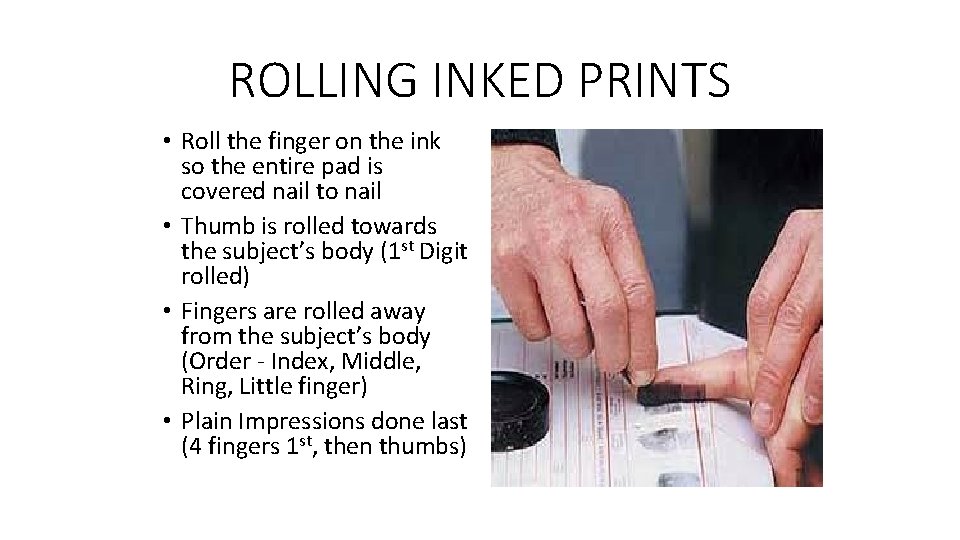
ROLLING INKED PRINTS • Roll the finger on the ink so the entire pad is covered nail to nail • Thumb is rolled towards the subject’s body (1 st Digit rolled) • Fingers are rolled away from the subject’s body (Order - Index, Middle, Ring, Little finger) • Plain Impressions done last (4 fingers 1 st, then thumbs)
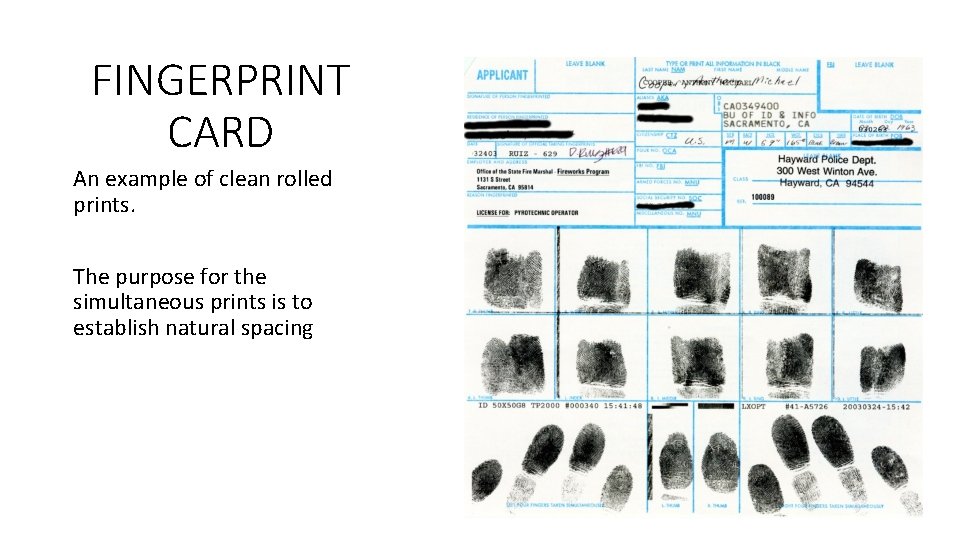
FINGERPRINT CARD An example of clean rolled prints. The purpose for the simultaneous prints is to establish natural spacing
SPECIAL CIRCUMSTANCES • Deformed or Missing Fingers • Fully Amputated • Tip-Amputated • Extra Finger • Scarred Fingers • Worn Fingerprints
REASONS FOR REJECTION • Finger was not fully rolled • Allowing the fingers to slip or twist • Use of improper inks • Failure to clean the subject’s fingers • Failure to keep equipment clean • Use of too much or too little ink • Recording fingerprints impressions within the wrong blocks on the print card

PRACTICAL EXERCISE

QUESTIONS
- Slides: 31