
Finescale remote sensing of fuels consumption fire spread
- Slides: 1
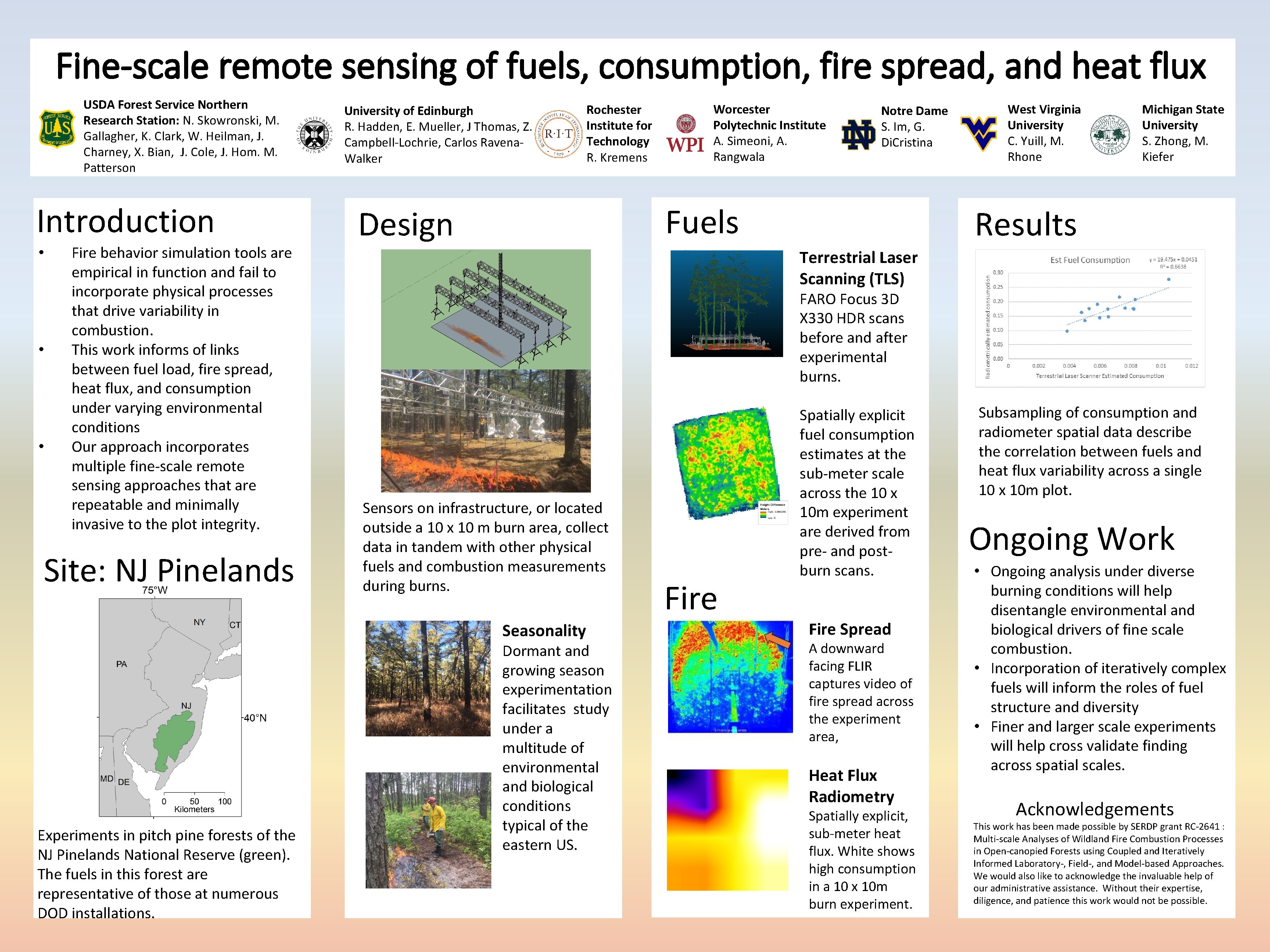
Fine-scale remote sensing of fuels, consumption, fire spread, and heat flux USDA Forest Service Northern Research Station: N. Skowronski, M. Gallagher, K. Clark, W. Heilman, J. Charney, X. Bian, J. Cole, J. Hom. M. Patterson Introduction • • • Fire behavior simulation tools are empirical in function and fail to incorporate physical processes that drive variability in combustion. This work informs of links between fuel load, fire spread, heat flux, and consumption under varying environmental conditions Our approach incorporates multiple fine-scale remote sensing approaches that are repeatable and minimally invasive to the plot integrity. Site: NJ Pinelands University of Edinburgh R. Hadden, E. Mueller, J Thomas, Z. Campbell-Lochrie, Carlos Ravena. Walker Worcester Polytechnic Institute A. Simeoni, A. Rangwala Notre Dame S. Im, G. Di. Cristina Fuels Design West Virginia University C. Yuill, M. Rhone Michigan State University S. Zhong, M. Kiefer Results Terrestrial Laser Scanning (TLS) FARO Focus 3 D X 330 HDR scans before and after experimental burns. Sensors on infrastructure, or located outside a 10 x 10 m burn area, collect data in tandem with other physical fuels and combustion measurements during burns. Seasonality Experiments in pitch pine forests of the NJ Pinelands National Reserve (green). The fuels in this forest are representative of those at numerous DOD installations. Rochester Institute for Technology R. Kremens Dormant and growing season experimentation facilitates study under a multitude of environmental and biological conditions typical of the eastern US. Fire Spatially explicit fuel consumption estimates at the sub-meter scale across the 10 x 10 m experiment are derived from pre- and postburn scans. Fire Spread A downward facing FLIR captures video of fire spread across the experiment area, Heat Flux Radiometry Spatially explicit, sub-meter heat flux. White shows high consumption in a 10 x 10 m burn experiment. Subsampling of consumption and radiometer spatial data describe the correlation between fuels and heat flux variability across a single 10 x 10 m plot. Ongoing analysis under diverse burning conditions will help Ongoing Work disentangle • Ongoing analysis under diverse burning conditions will help environmental and disentangle environmental and biological drivers of fine of scalefine combustion. scale combustion. • Incorporation of iteratively complex fuels will inform the roles of fuel structure and diversity • Finer and larger scale experiments will help cross validate finding across spatial scales. Acknowledgements This work has been made possible by SERDP grant RC-2641 : Multi-scale Analyses of Wildland Fire Combustion Processes in Open-canopied Forests using Coupled and Iteratively Informed Laboratory-, Field-, and Model-based Approaches. We would also like to acknowledge the invaluable help of our administrative assistance. Without their expertise, diligence, and patience this work would not be possible.