
Finegrained synchronization lock free programming Lecture 18 Parallel
- Slides: 48
Fine-grained synchronization & lock -free programming Lecture 18: Parallel Computer Architecture and Programming CMU 15 -418/15 -618, Spring 2019
Today’s Topics ▪ Fine-grained Synchronization ▪ Fine-grained Locking ▪ Lock-free Programming CMU 15 -418/618, Spring 2019
Locking Problem ▪ Locks can be big and expensive - How many atomic operations does one - lock require? How much data requires one lock? CMU 15 -418/618, Spring 2019
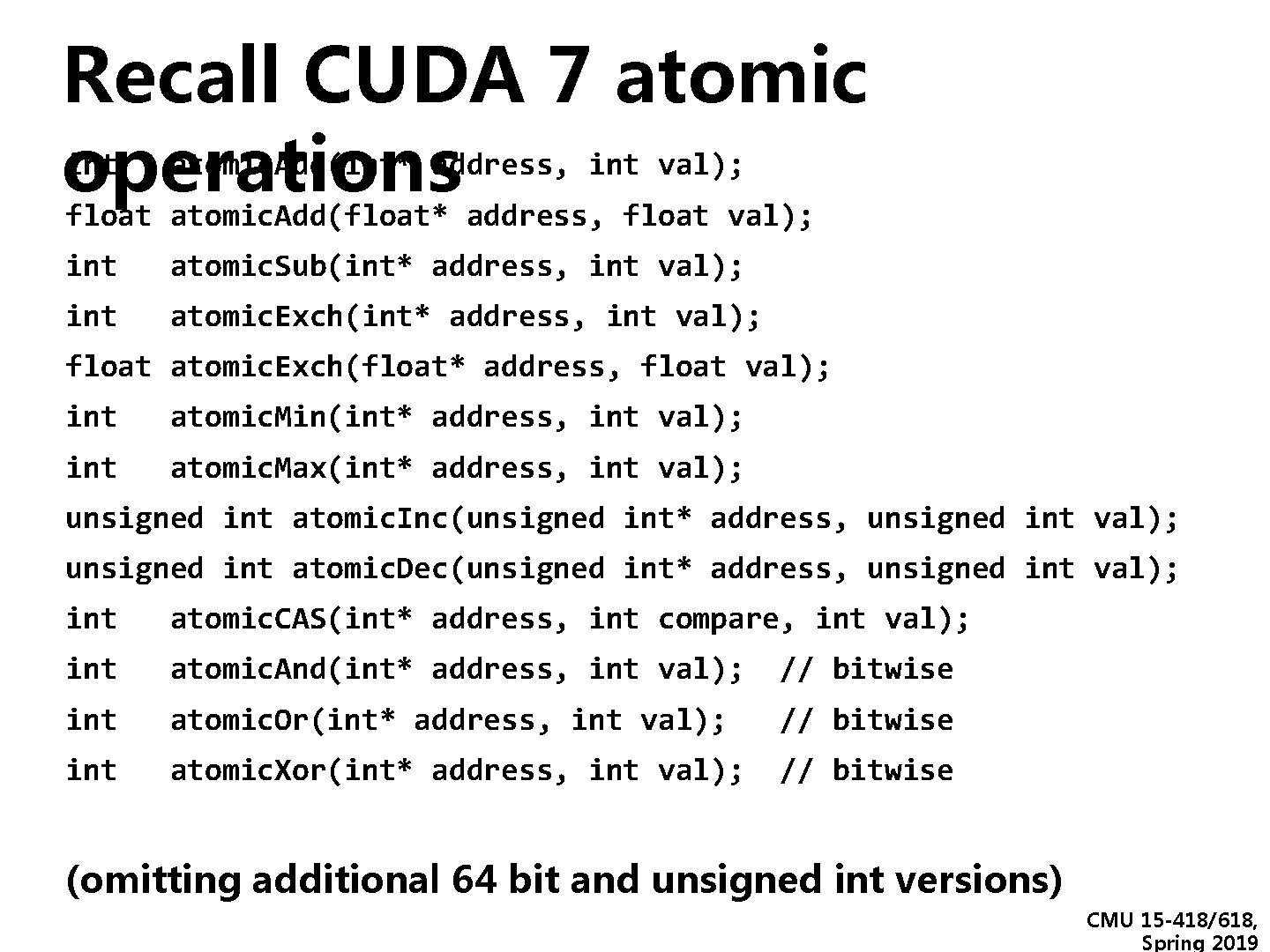
Recall CUDA 7 atomic int atomic. Add(int* address, int val); operations float atomic. Add(float* address, float val); int atomic. Sub(int* address, int val); int atomic. Exch(int* address, int val); float atomic. Exch(float* address, float val); int atomic. Min(int* address, int val); int atomic. Max(int* address, int val); unsigned int atomic. Inc(unsigned int* address, unsigned int val); unsigned int atomic. Dec(unsigned int* address, unsigned int val); int atomic. CAS(int* address, int compare, int val); int atomic. And(int* address, int val); // bitwise int atomic. Or(int* address, int val); // bitwise int atomic. Xor(int* address, int val); // bitwise (omitting additional 64 bit and unsigned int versions) CMU 15 -418/618, Spring 2019
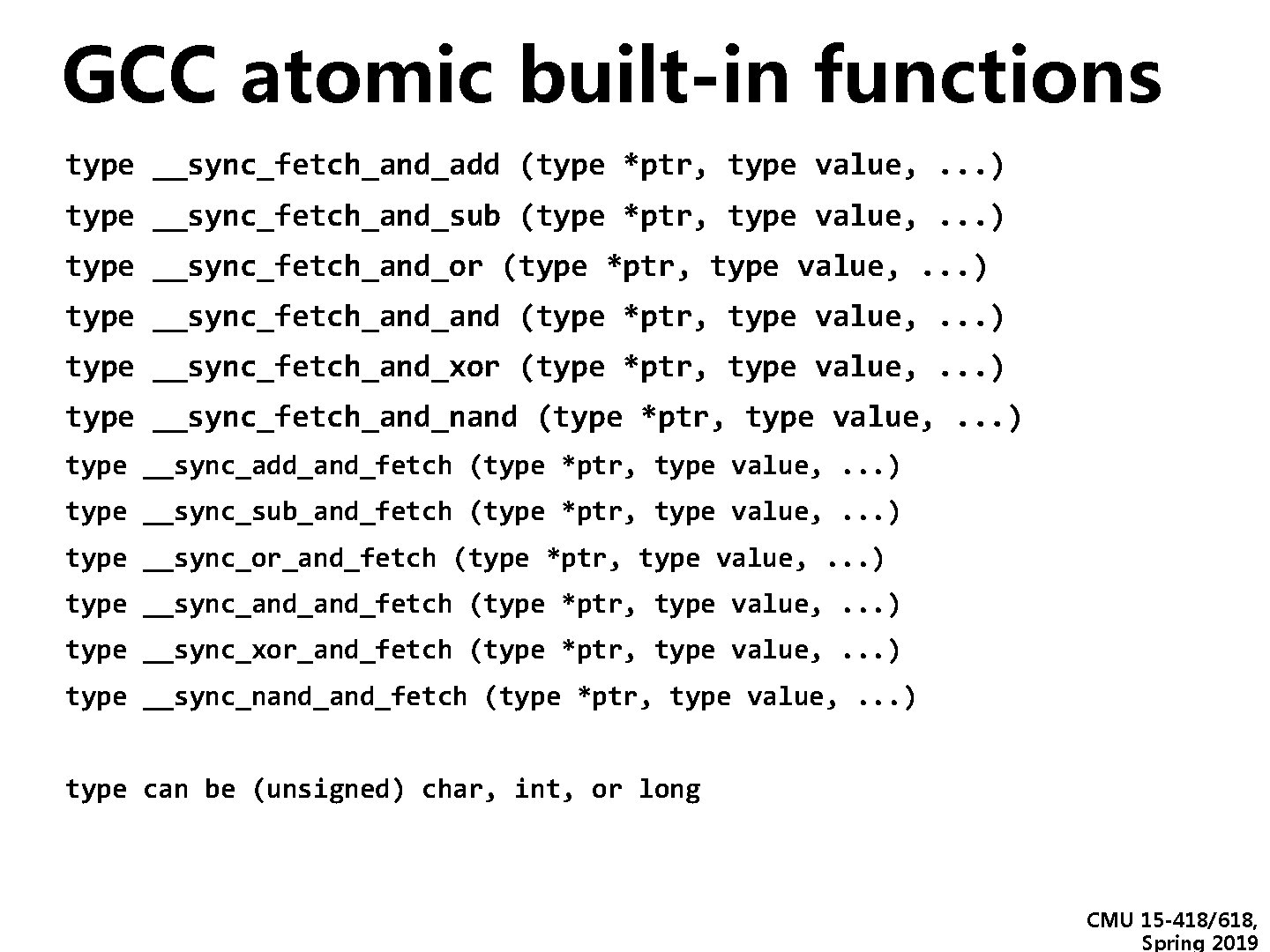
GCC atomic built-in functions type __sync_fetch_and_add (type *ptr, type value, . . . ) type __sync_fetch_and_sub (type *ptr, type value, . . . ) type __sync_fetch_and_or (type *ptr, type value, . . . ) type __sync_fetch_and_xor (type *ptr, type value, . . . ) type __sync_fetch_and_nand (type *ptr, type value, . . . ) type __sync_add_and_fetch (type *ptr, type value, . . . ) type __sync_sub_and_fetch (type *ptr, type value, . . . ) type __sync_or_and_fetch (type *ptr, type value, . . . ) type __sync_and_fetch (type *ptr, type value, . . . ) type __sync_xor_and_fetch (type *ptr, type value, . . . ) type __sync_nand_fetch (type *ptr, type value, . . . ) type can be (unsigned) char, int, or long CMU 15 -418/618, Spring 2019
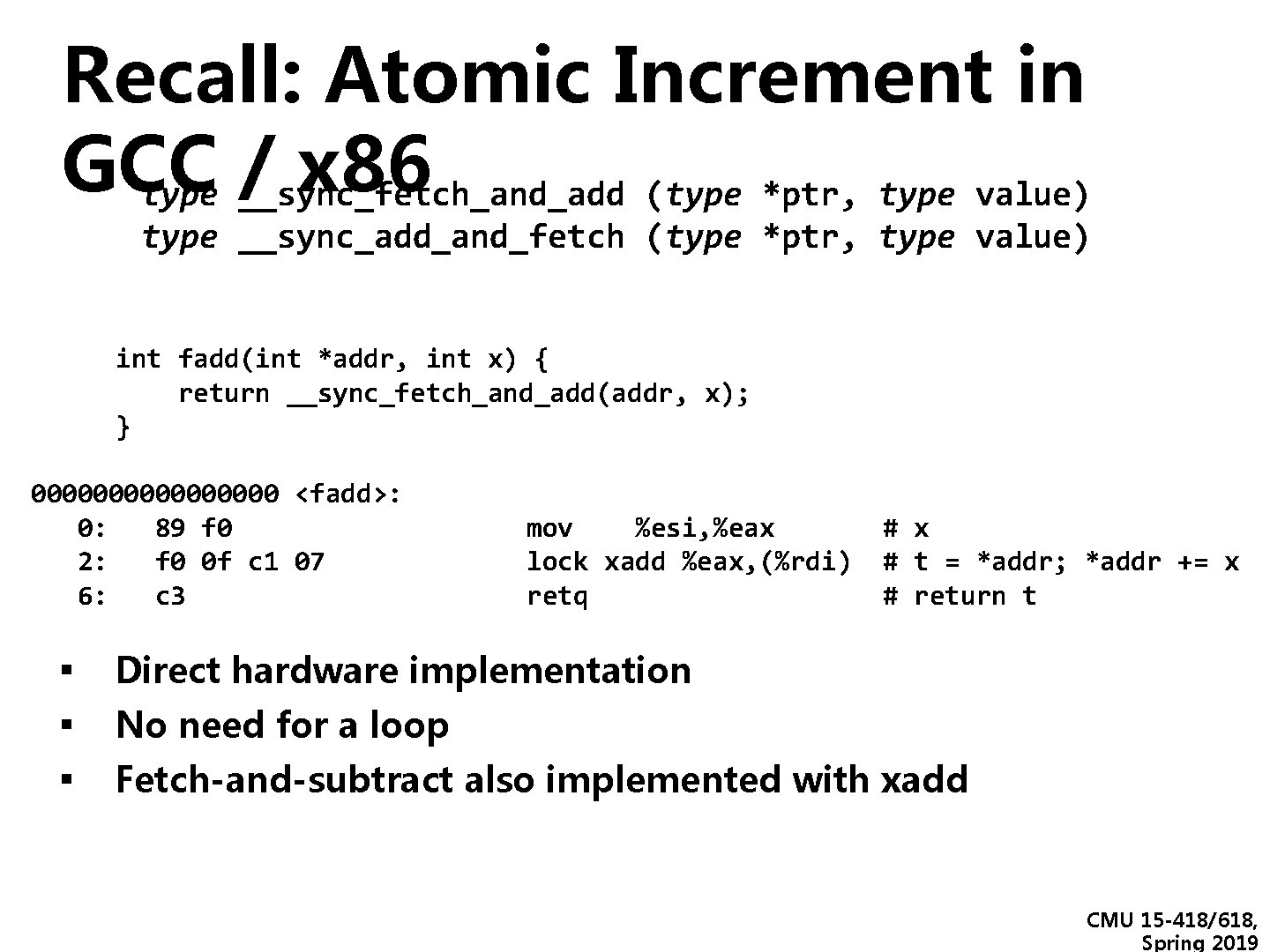
Recall: Atomic Increment in GCC / x 86 type __sync_fetch_and_add (type *ptr, type value) type __sync_add_and_fetch (type *ptr, type value) int fadd(int *addr, int x) { return __sync_fetch_and_add(addr, x); } 00000000 <fadd>: 0: 89 f 0 2: f 0 0 f c 1 07 6: c 3 mov %esi, %eax lock xadd %eax, (%rdi) retq # x # t = *addr; *addr += x # return t ▪ Direct hardware implementation ▪ No need for a loop ▪ Fetch-and-subtract also implemented with xadd CMU 15 -418/618, Spring 2019
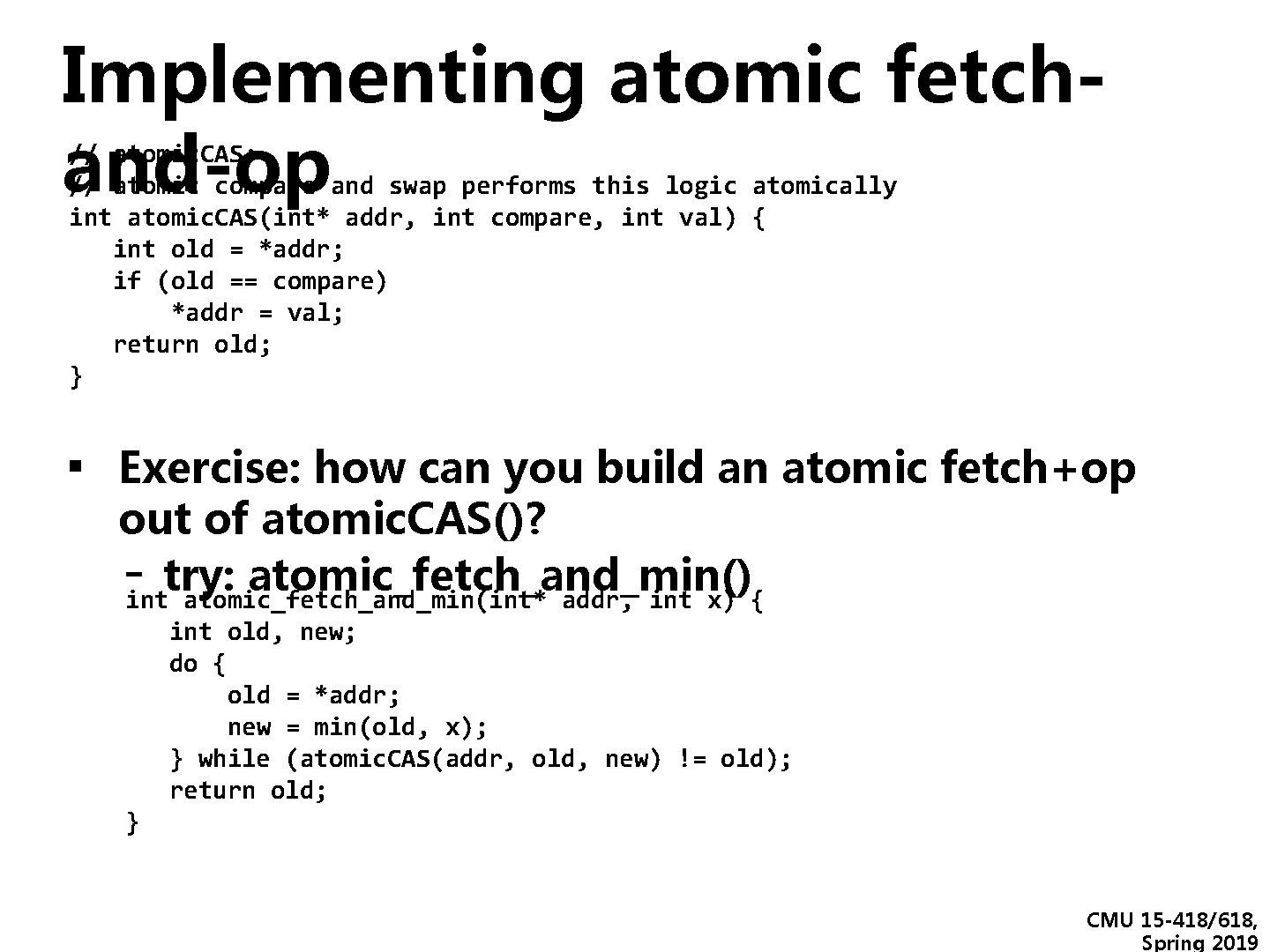
Implementing atomic fetchand-op // atomic. CAS: // atomic compare and swap performs this logic atomically int atomic. CAS(int* addr, int compare, int val) { int old = *addr; if (old == compare) *addr = val; return old; } ▪ Exercise: how can you build an atomic fetch+op out of atomic. CAS()? -inttry: atomic_fetch_and_min() atomic_fetch_and_min(int* addr, int x) { int old, new; do { old = *addr; new = min(old, x); } while (atomic. CAS(addr, old, new) != old); return old; } CMU 15 -418/618, Spring 2019
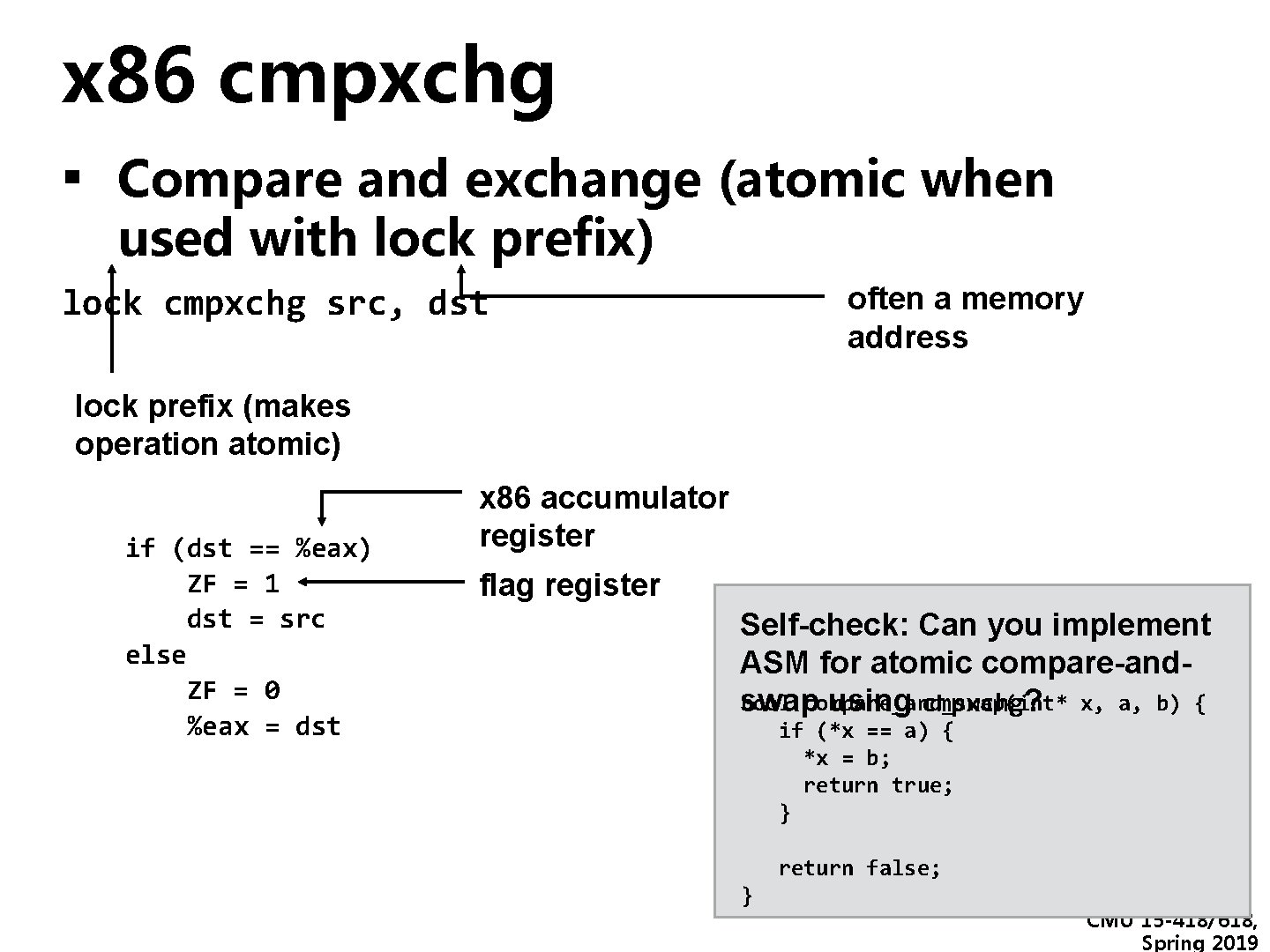
x 86 cmpxchg ▪ Compare and exchange (atomic when used with lock prefix) lock cmpxchg src, dst often a memory address lock prefix (makes operation atomic) if (dst == %eax) ZF = 1 dst = src else ZF = 0 %eax = dst x 86 accumulator register flag register Self-check: Can you implement ASM for atomic compare-andbool compare_and_swap(int* swap using cmpxchg? x, a, b) { if (*x == a) { *x = b; return true; } return false; } CMU 15 -418/618, Spring 2019
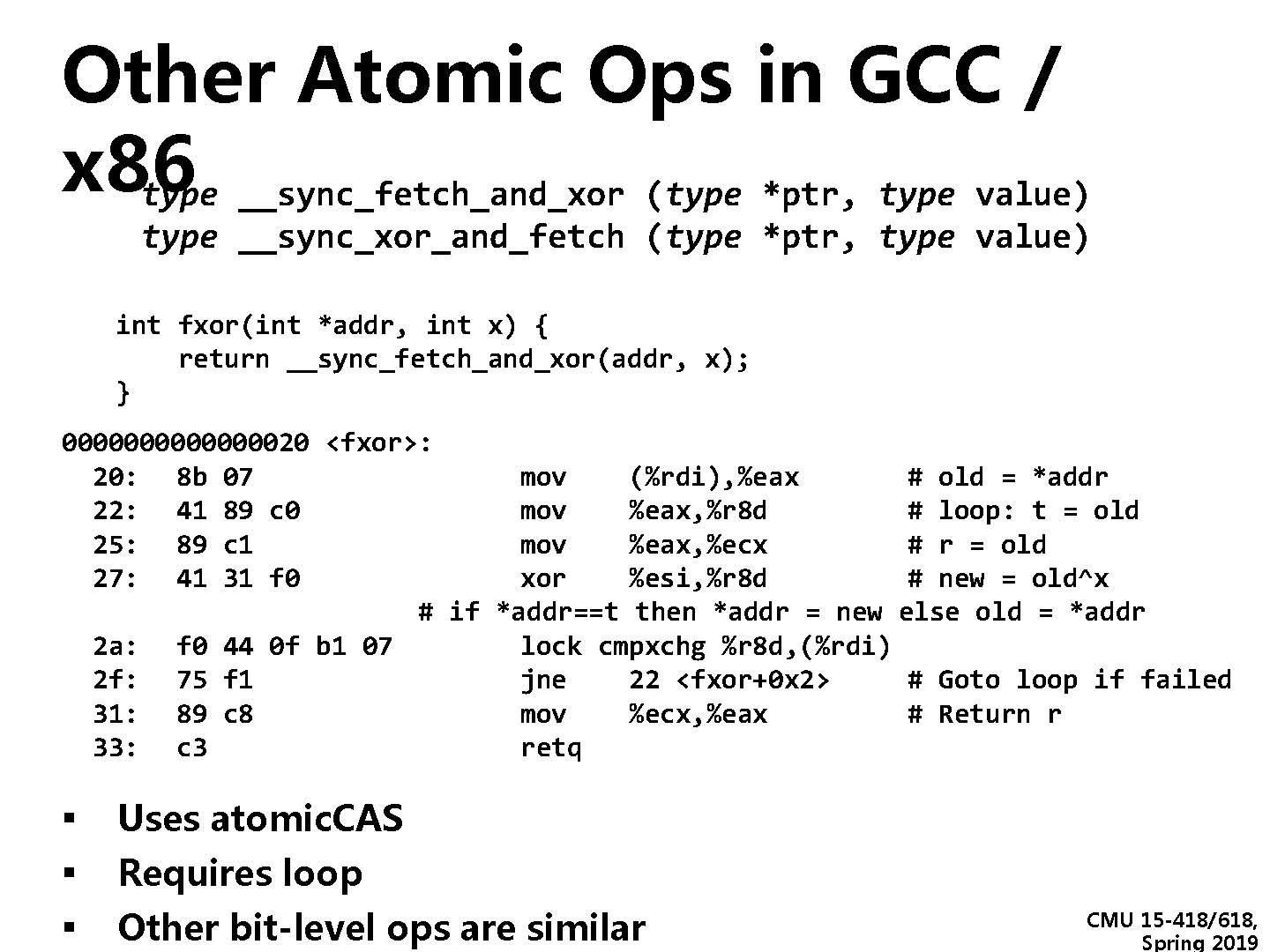
Other Atomic Ops in GCC / x 86 type __sync_fetch_and_xor (type *ptr, type value) type __sync_xor_and_fetch (type *ptr, type value) int fxor(int *addr, int x) { return __sync_fetch_and_xor(addr, x); } 000000020 <fxor>: 20: 8 b 07 mov (%rdi), %eax # old = *addr 22: 41 89 c 0 mov %eax, %r 8 d # loop: t = old 25: 89 c 1 mov %eax, %ecx # r = old 27: 41 31 f 0 xor %esi, %r 8 d # new = old^x # if *addr==t then *addr = new else old = *addr 2 a: f 0 44 0 f b 1 07 lock cmpxchg %r 8 d, (%rdi) 2 f: 75 f 1 jne 22 <fxor+0 x 2> # Goto loop if failed 31: 89 c 8 mov %ecx, %eax # Return r 33: c 3 retq ▪ Uses atomic. CAS ▪ Requires loop ▪ Other bit-level ops are similar CMU 15 -418/618, Spring 2019
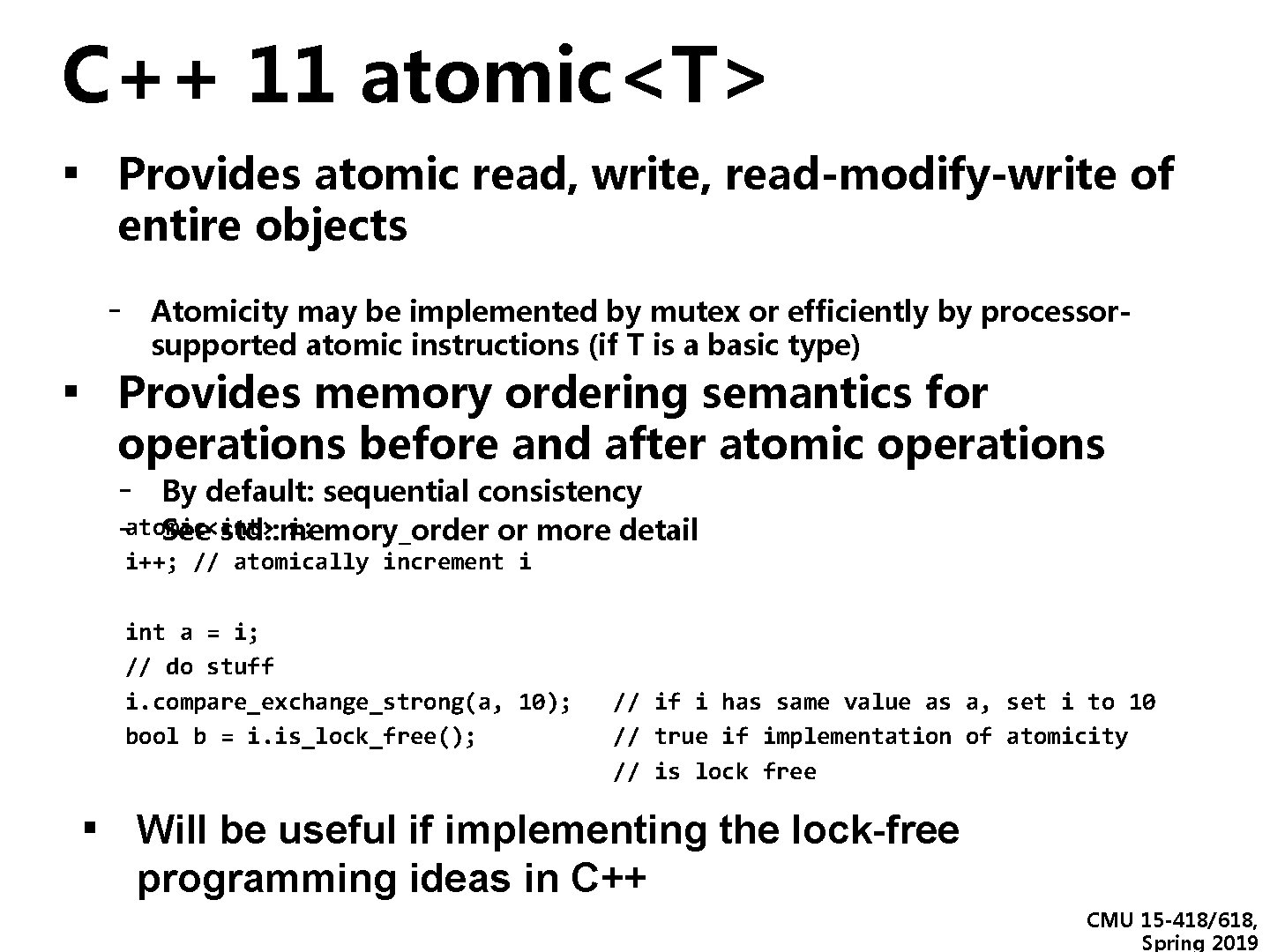
C++ 11 atomic<T> ▪ Provides atomic read, write, read-modify-write of entire objects - Atomicity may be implemented by mutex or efficiently by processorsupported atomic instructions (if T is a basic type) ▪ Provides memory ordering semantics for operations before and after atomic operations - By default: sequential consistency i; -atomic<int> See std: : memory_order or more detail i++; // atomically increment i int a = i; // do stuff i. compare_exchange_strong(a, 10); bool b = i. is_lock_free(); // if i has same value as a, set i to 10 // true if implementation of atomicity // is lock free ▪ Will be useful if implementing the lock-free programming ideas in C++ CMU 15 -418/618, Spring 2019
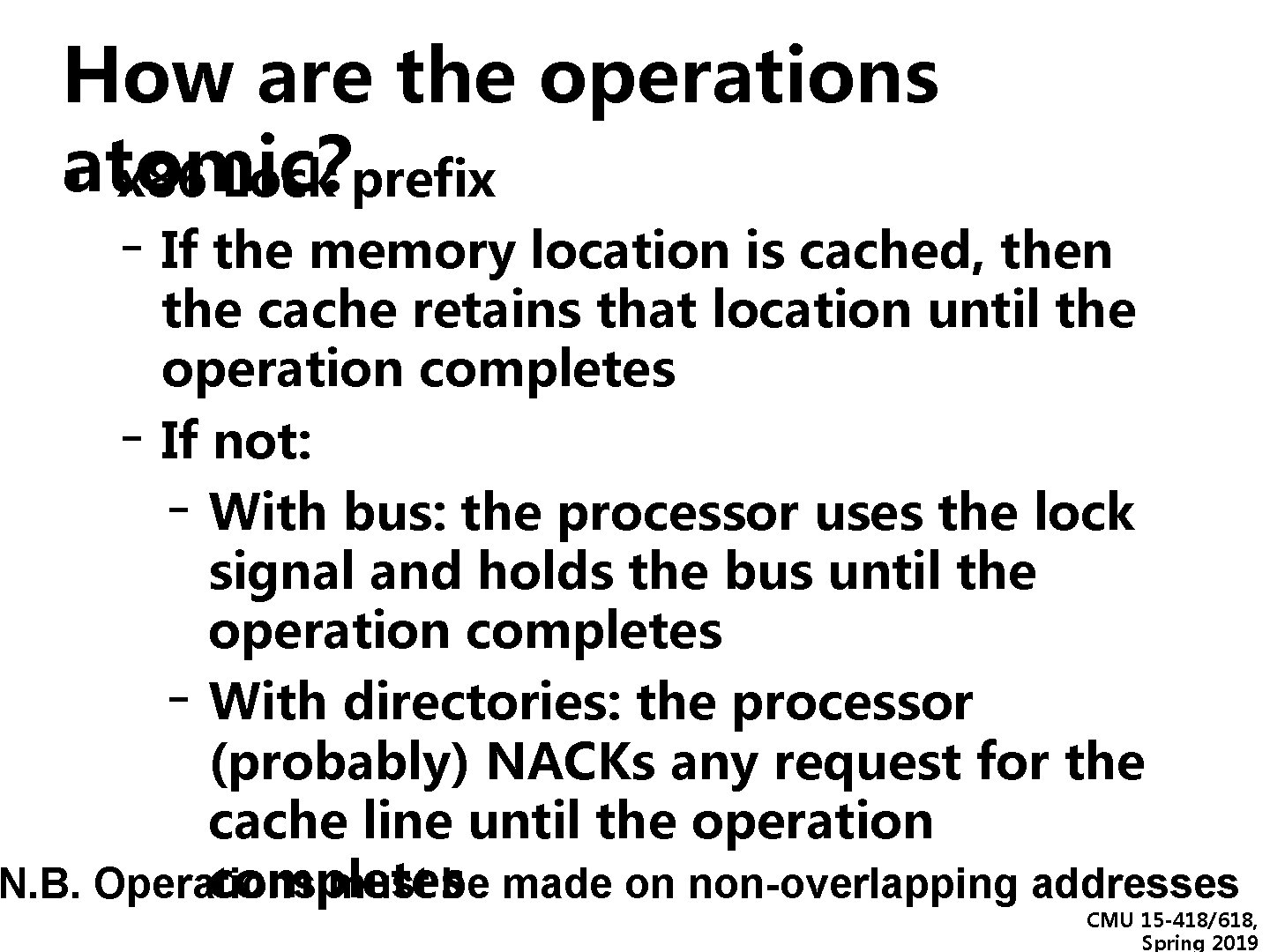
How are the operations atomic? ▪ x 86 Lock prefix - If the memory location is cached, then the cache retains that location until the operation completes - If not: - With bus: the processor uses the lock signal and holds the bus until the operation completes - With directories: the processor (probably) NACKs any request for the cache line until the operation completes N. B. Operations must be made on non-overlapping addresses CMU 15 -418/618, Spring 2019
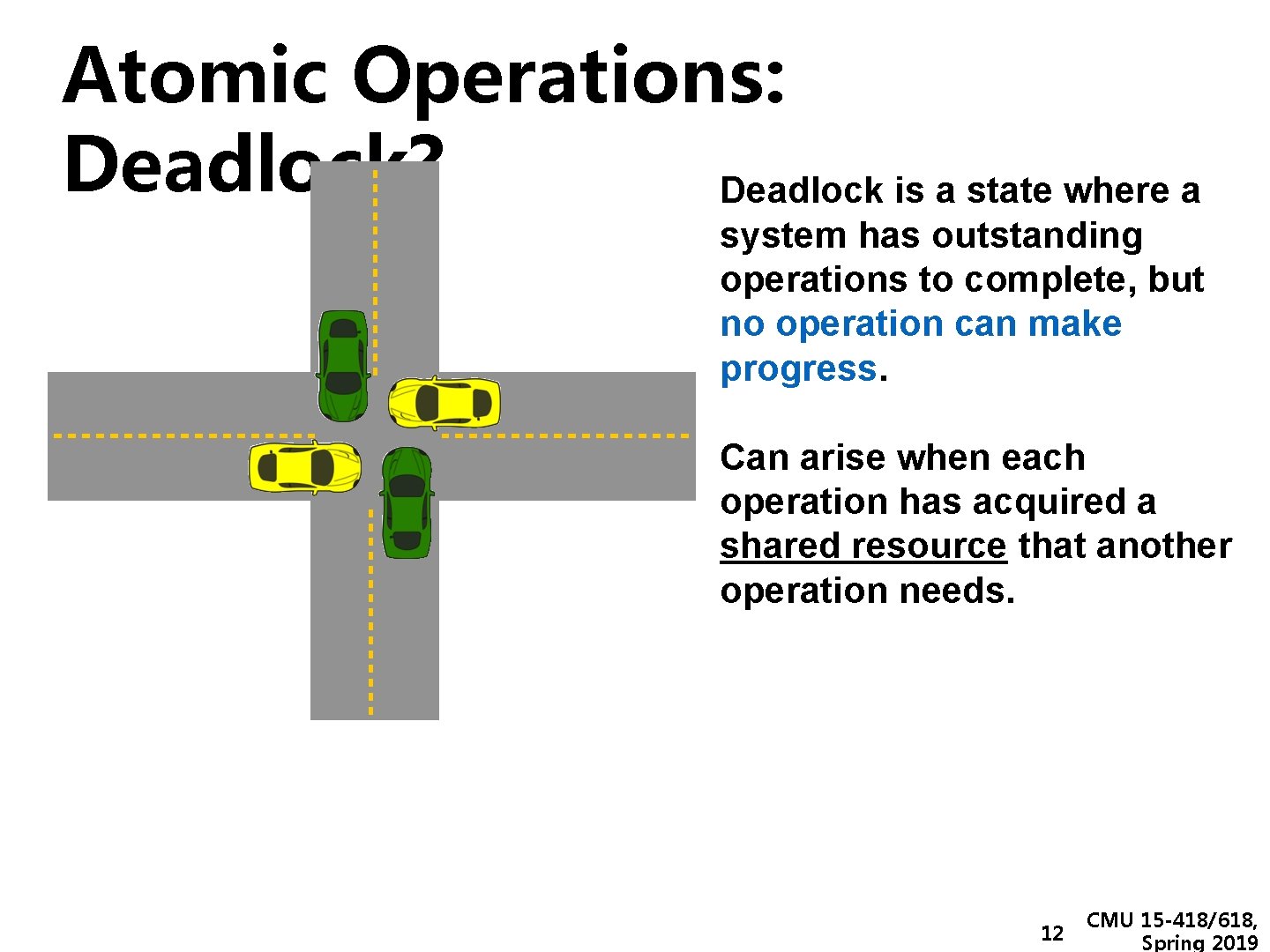
Atomic Operations: Deadlock? Deadlock is a state where a system has outstanding operations to complete, but no operation can make progress. Can arise when each operation has acquired a shared resource that another operation needs. 12 CMU 15 -418/618, Spring 2019
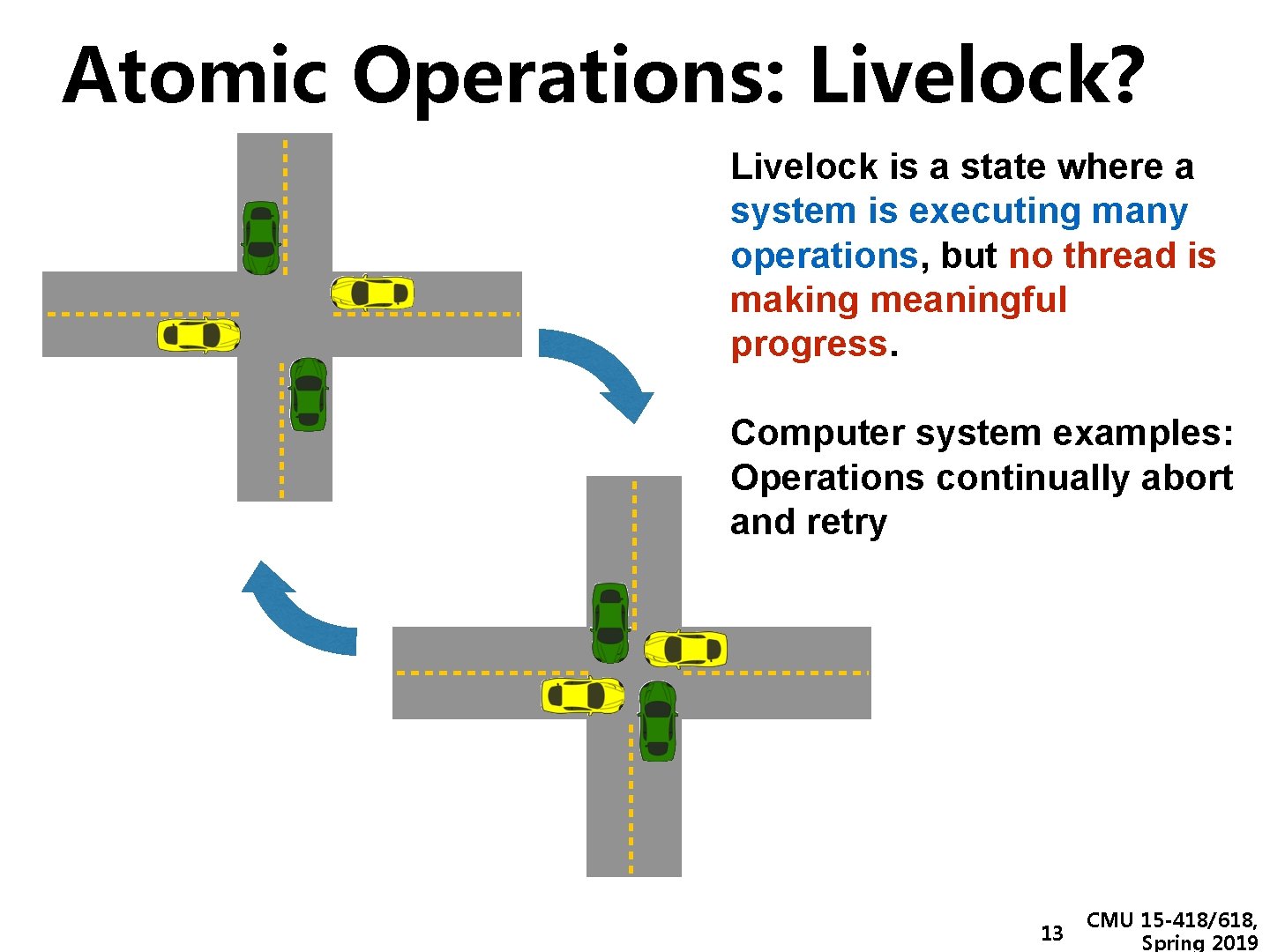
Atomic Operations: Livelock? Livelock is a state where a system is executing many operations, but no thread is making meaningful progress. Computer system examples: Operations continually abort and retry 13 CMU 15 -418/618, Spring 2019
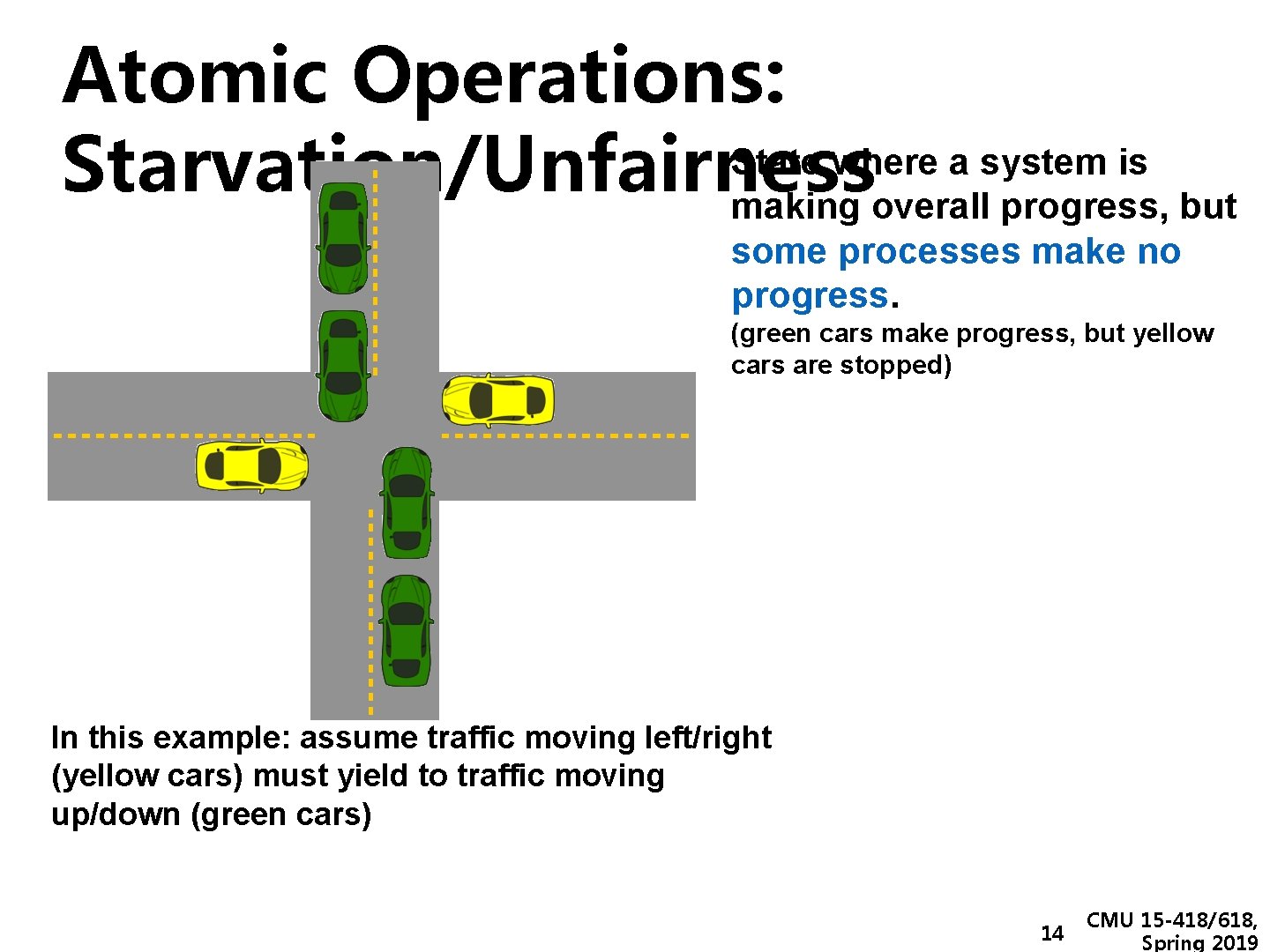
Atomic Operations: State where a system is Starvation/Unfairness making overall progress, but some processes make no progress. (green cars make progress, but yellow cars are stopped) In this example: assume traffic moving left/right (yellow cars) must yield to traffic moving up/down (green cars) 14 CMU 15 -418/618, Spring 2019
Locking more than one location ▪ Data structures are often larger than a single memory location - How can an entire data structure be protected? E. g. 15213 Proxylab cache CMU 15 -418/618, Spring 2019
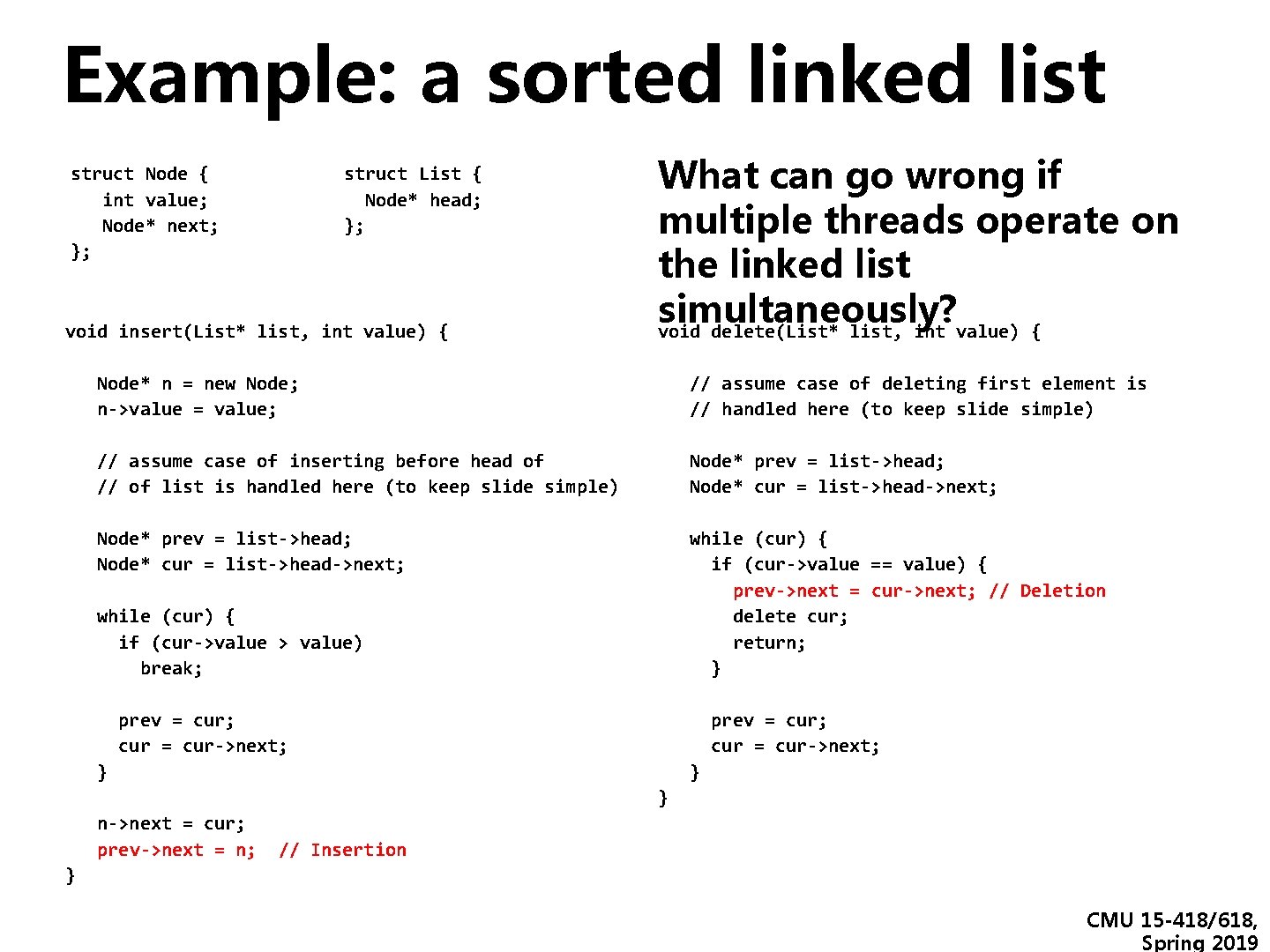
Example: a sorted linked list struct Node { int value; Node* next; }; struct List { Node* head; }; void insert(List* list, int value) { What can go wrong if multiple threads operate on the linked list simultaneously? void delete(List* list, int value) { Node* n = new Node; n->value = value; // assume case of deleting first element is // handled here (to keep slide simple) // assume case of inserting before head of // of list is handled here (to keep slide simple) Node* prev = list->head; Node* cur = list->head->next; while (cur) { if (cur->value == value) { prev->next = cur->next; // Deletion delete cur; return; } while (cur) { if (cur->value > value) break; prev = cur; cur = cur->next; } } } n->next = cur; prev->next = n; // Insertion } CMU 15 -418/618, Spring 2019
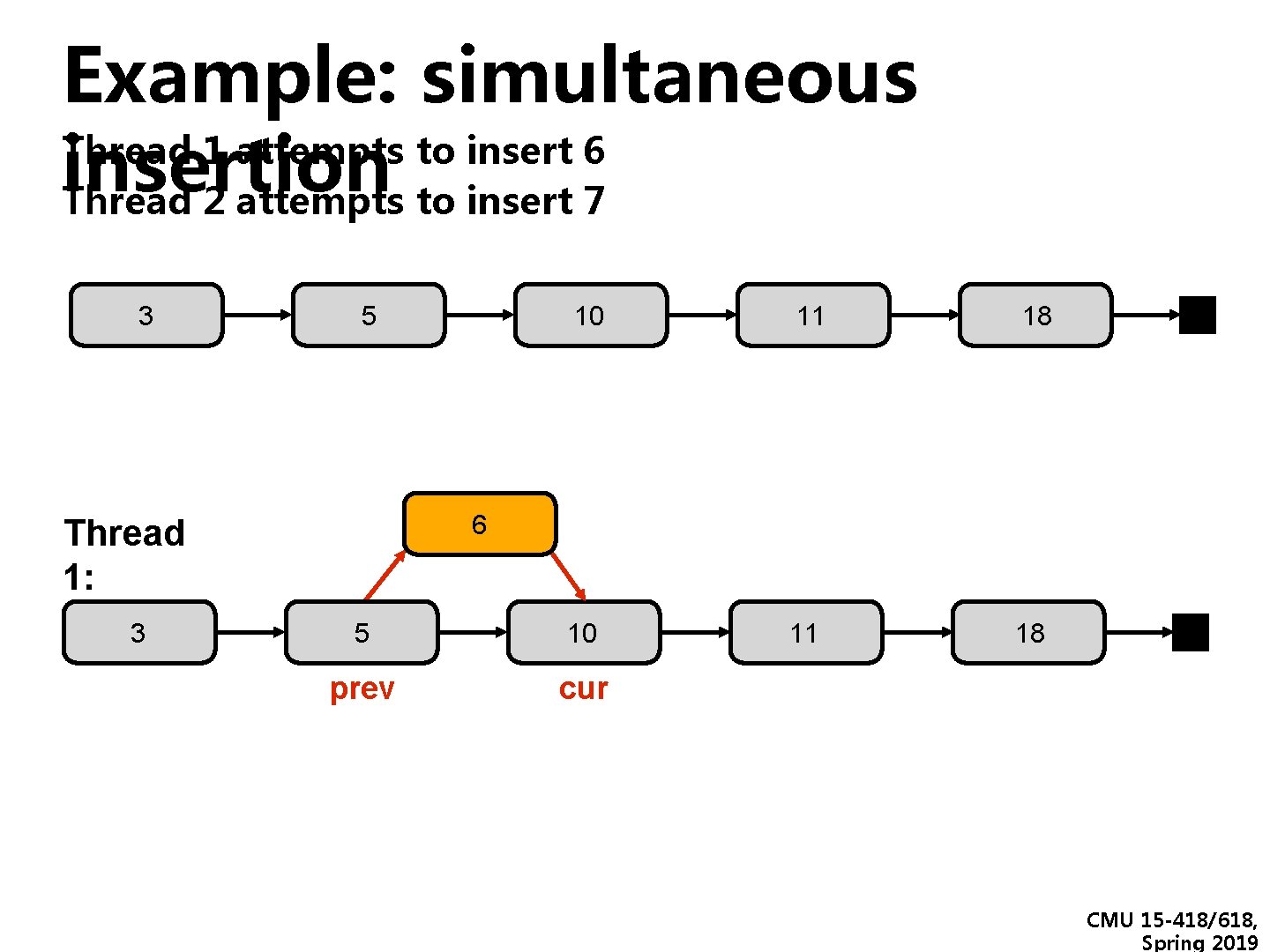
Example: simultaneous Thread 1 attempts to insert 6 insertion Thread 2 attempts to insert 7 3 5 10 11 18 prev cur 6 Thread 1: 3 CMU 15 -418/618, Spring 2019
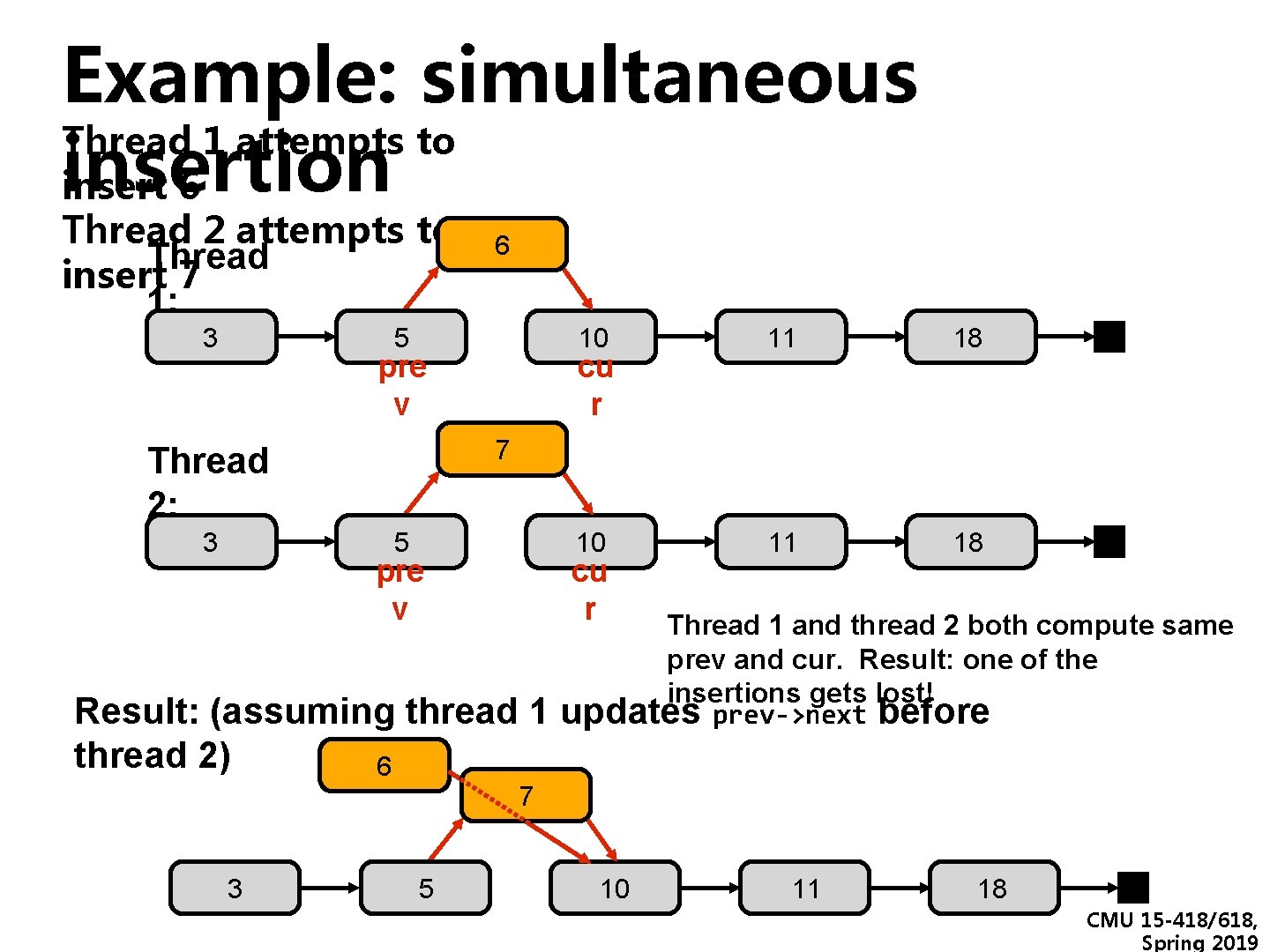
Example: simultaneous Thread 1 attempts to insertion insert 6 Thread 2 attempts to Thread insert 7 1: 3 6 5 pre v 11 18 10 11 18 cu r 7 Thread 2: 3 10 5 pre v cu r Result: (assuming thread 1 thread 2) 6 Thread 1 and thread 2 both compute same prev and cur. Result: one of the insertions gets lost! updates prev->next before 7 3 5 10 11 18 CMU 15 -418/618, Spring 2019
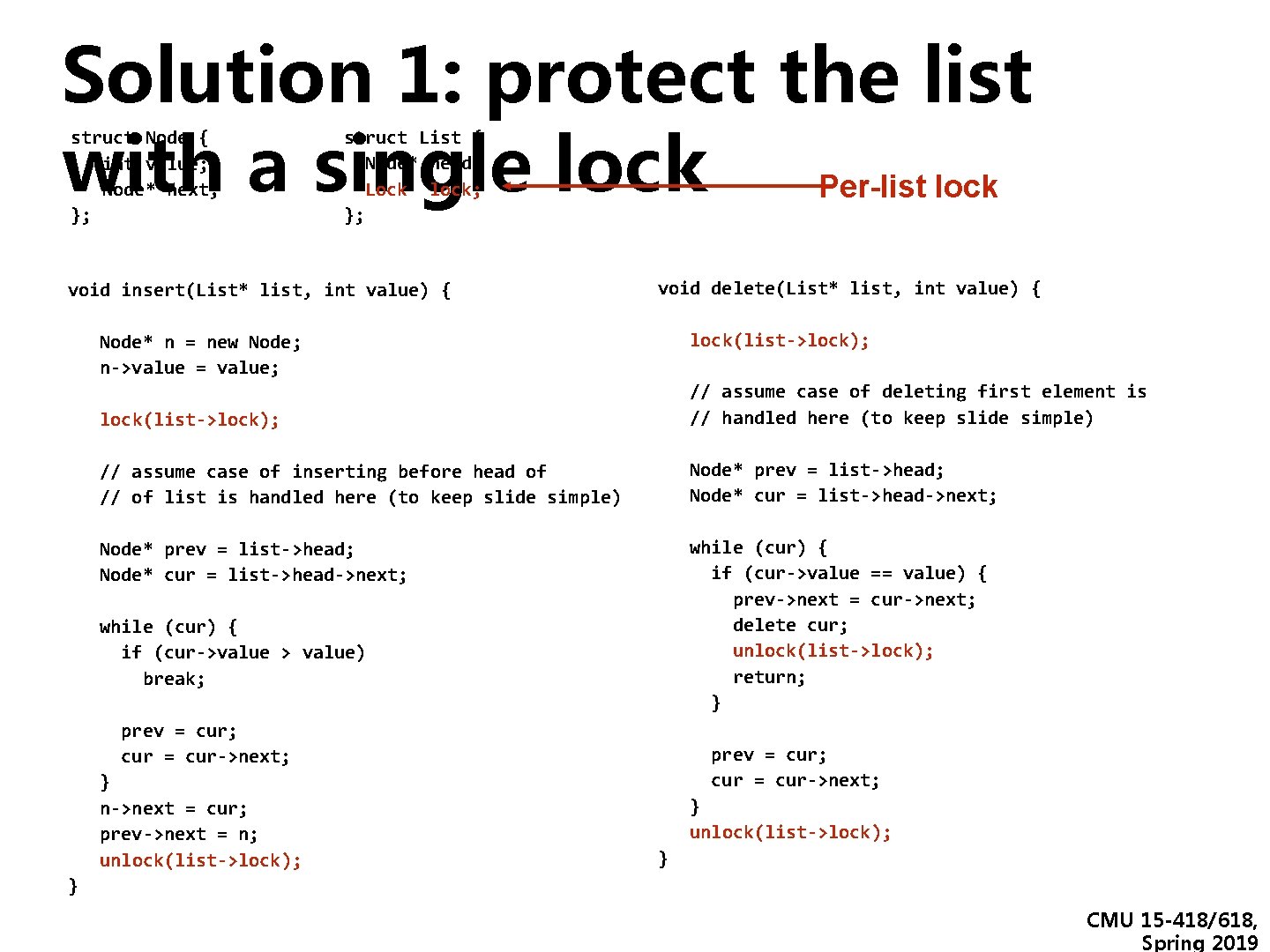
Solution 1: protect the list with a single lock Per-list lock struct Node { int value; Node* next; }; struct List { Node* head; Lock lock; }; void insert(List* list, int value) { void delete(List* list, int value) { lock(list->lock); Node* n = new Node; n->value = value; lock(list->lock); // assume case of deleting first element is // handled here (to keep slide simple) // assume case of inserting before head of // of list is handled here (to keep slide simple) Node* prev = list->head; Node* cur = list->head->next; while (cur) { if (cur->value == value) { prev->next = cur->next; delete cur; unlock(list->lock); return; } while (cur) { if (cur->value > value) break; prev = cur; cur = cur->next; } n->next = cur; prev->next = n; unlock(list->lock); prev = cur; cur = cur->next; } unlock(list->lock); } } CMU 15 -418/618, Spring 2019
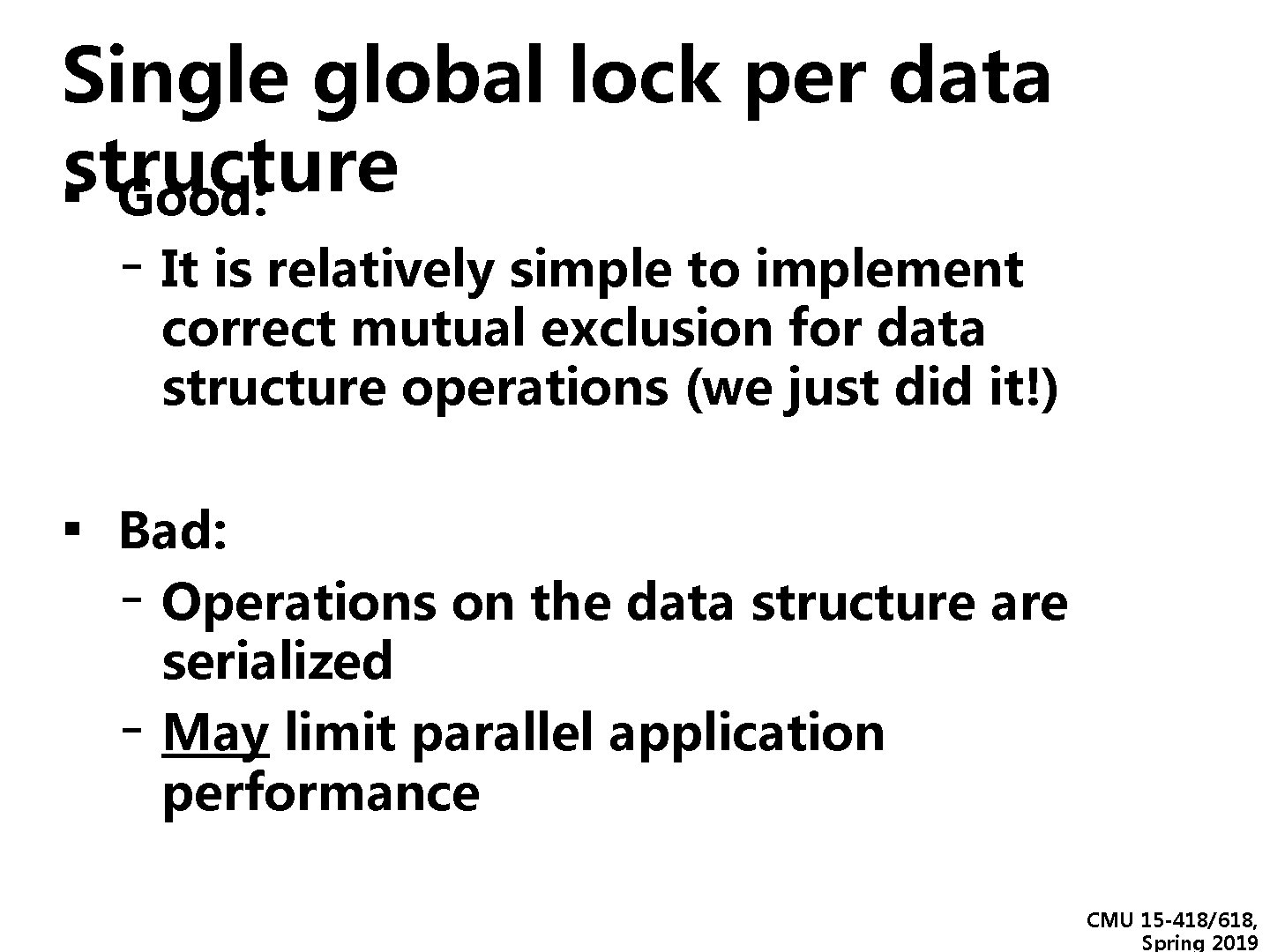
Single global lock per data structure ▪ Good: - It is relatively simple to implement correct mutual exclusion for data structure operations (we just did it!) ▪ Bad: - Operations on the data structure are - serialized May limit parallel application performance CMU 15 -418/618, Spring 2019
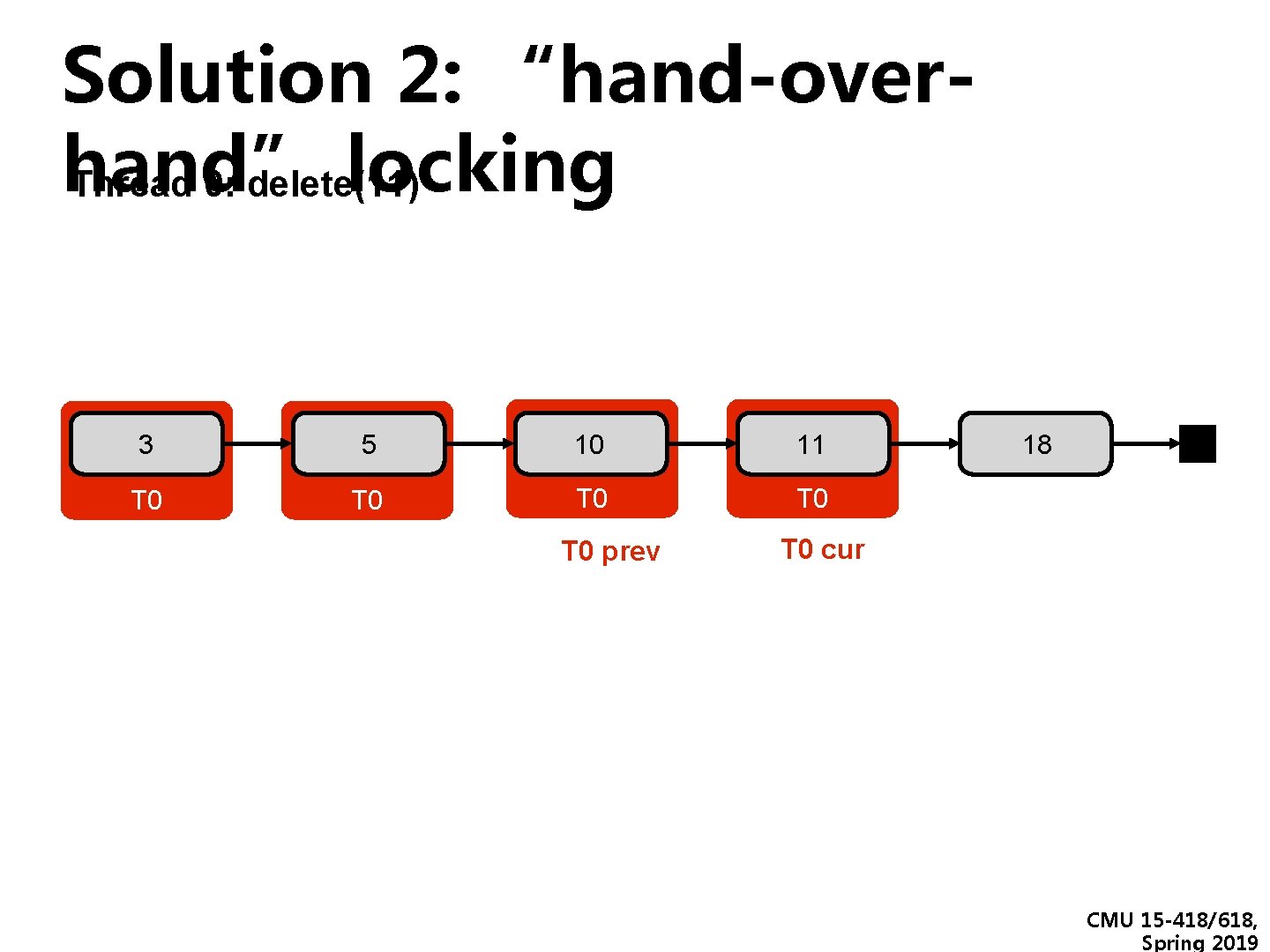
Solution 2: “hand-overhand” locking Thread 0: delete(11) 3 5 10 11 T 0 T 0 T 0 prev 18 T 0 cur CMU 15 -418/618, Spring 2019
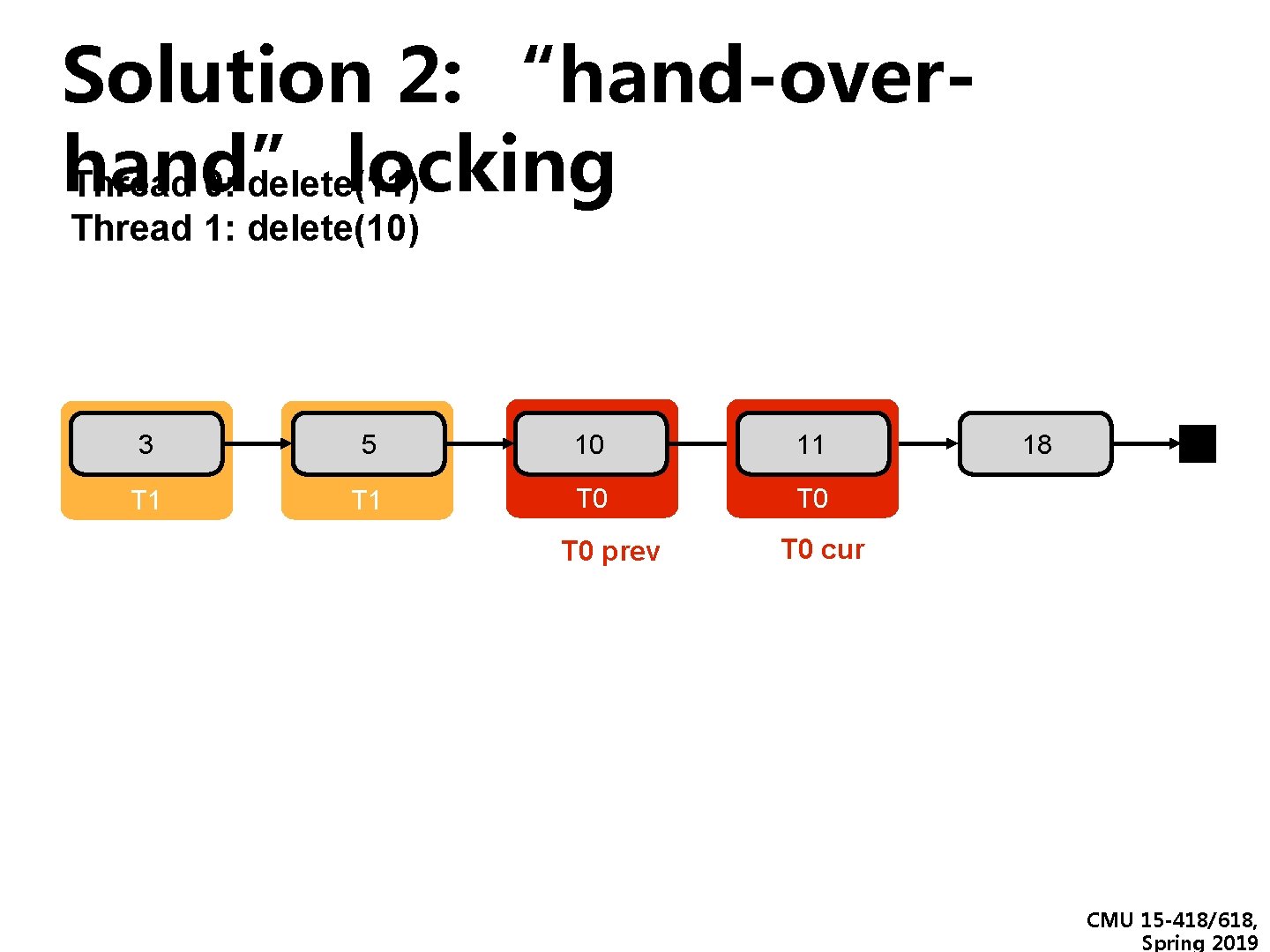
Solution 2: “hand-overhand” locking Thread 0: delete(11) Thread 1: delete(10) 3 5 10 11 T 1 T 0 T 0 prev 18 T 0 cur CMU 15 -418/618, Spring 2019
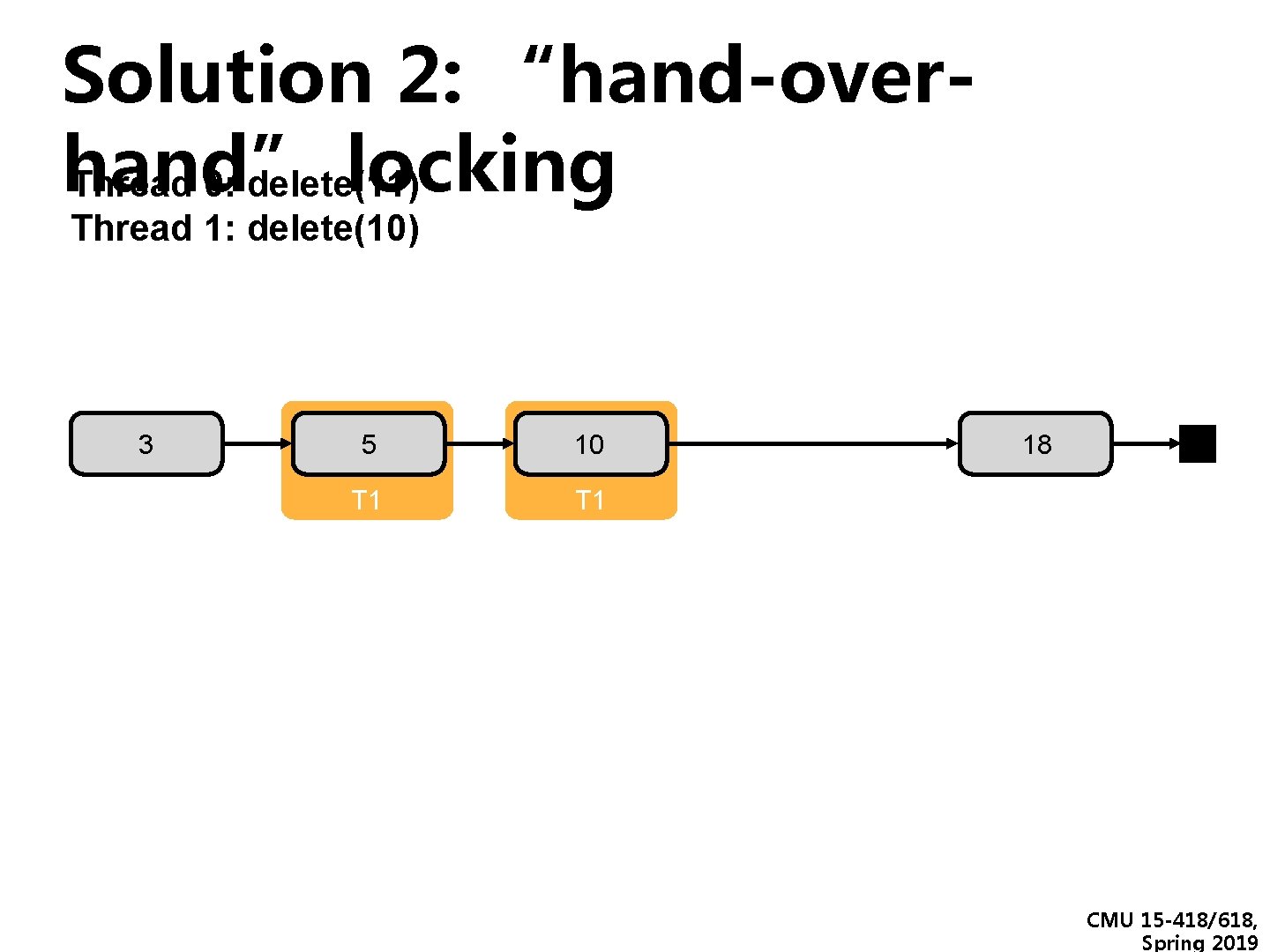
Solution 2: “hand-overhand” locking Thread 0: delete(11) Thread 1: delete(10) 3 5 10 T 1 18 CMU 15 -418/618, Spring 2019
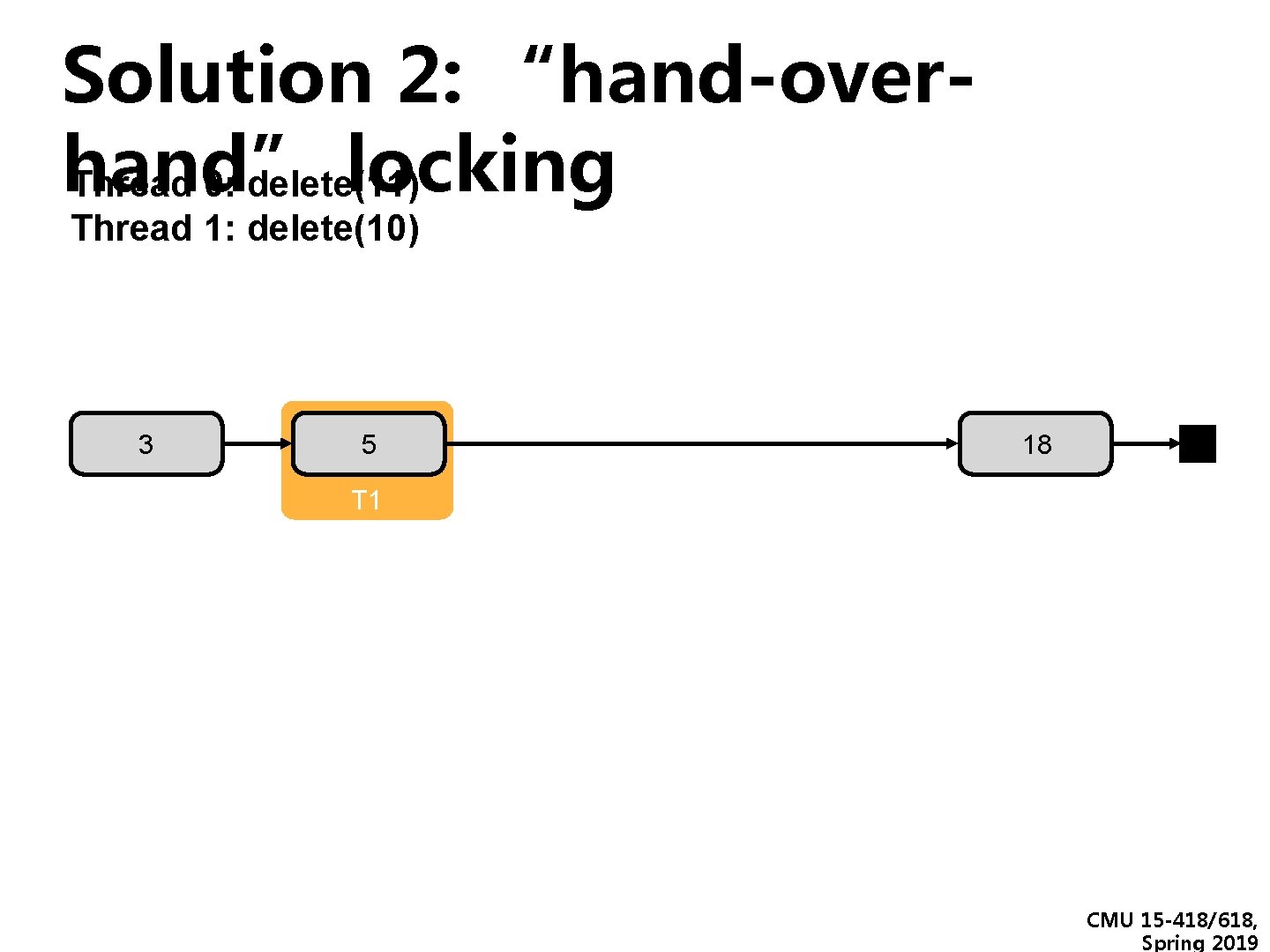
Solution 2: “hand-overhand” locking Thread 0: delete(11) Thread 1: delete(10) 3 5 18 T 1 CMU 15 -418/618, Spring 2019
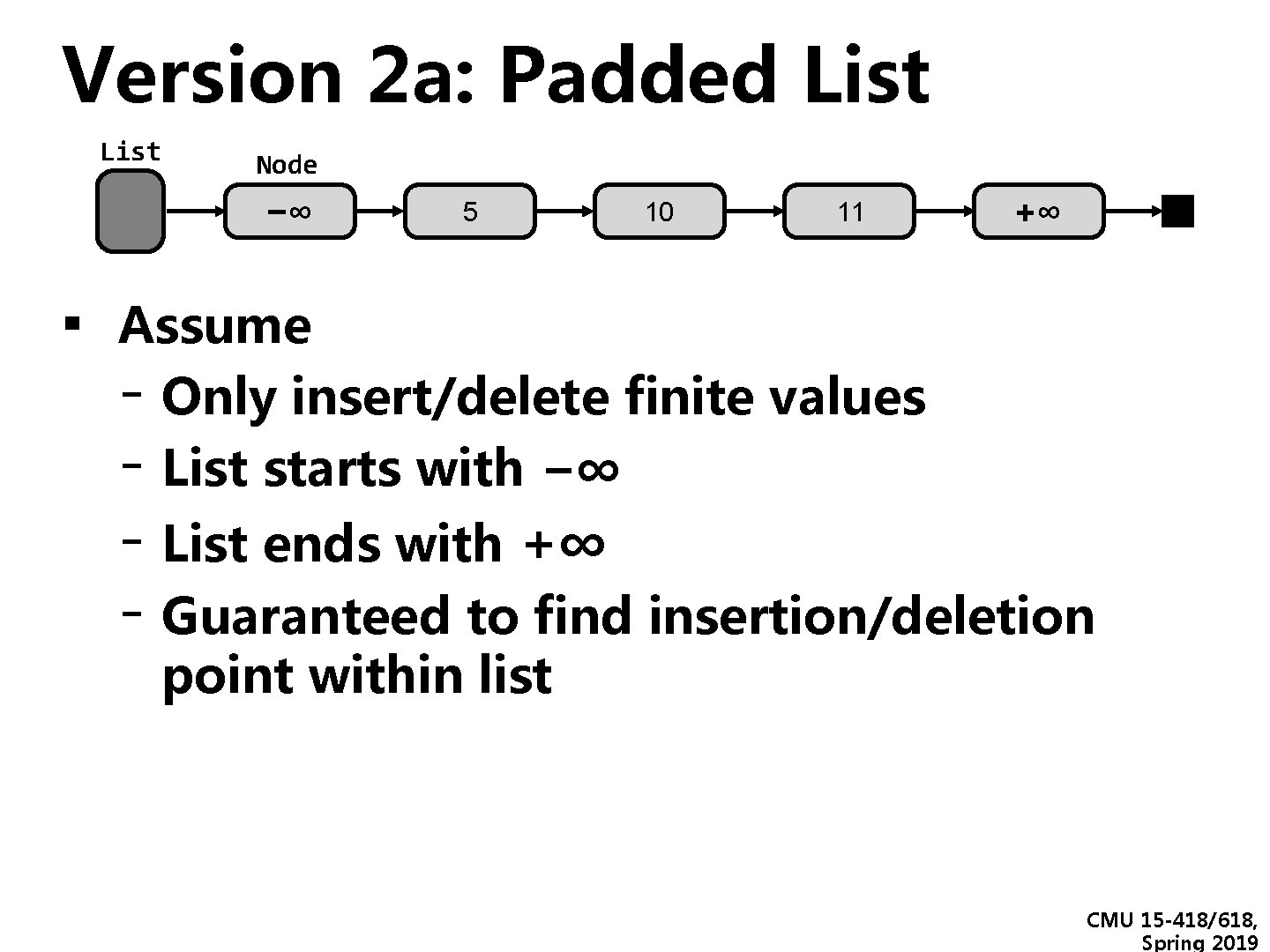
Version 2 a: Padded List Node −∞ 5 10 11 +∞ ▪ Assume - Only insert/delete finite values - List starts with −∞ - List ends with +∞ - Guaranteed to find insertion/deletion point within list CMU 15 -418/618, Spring 2019
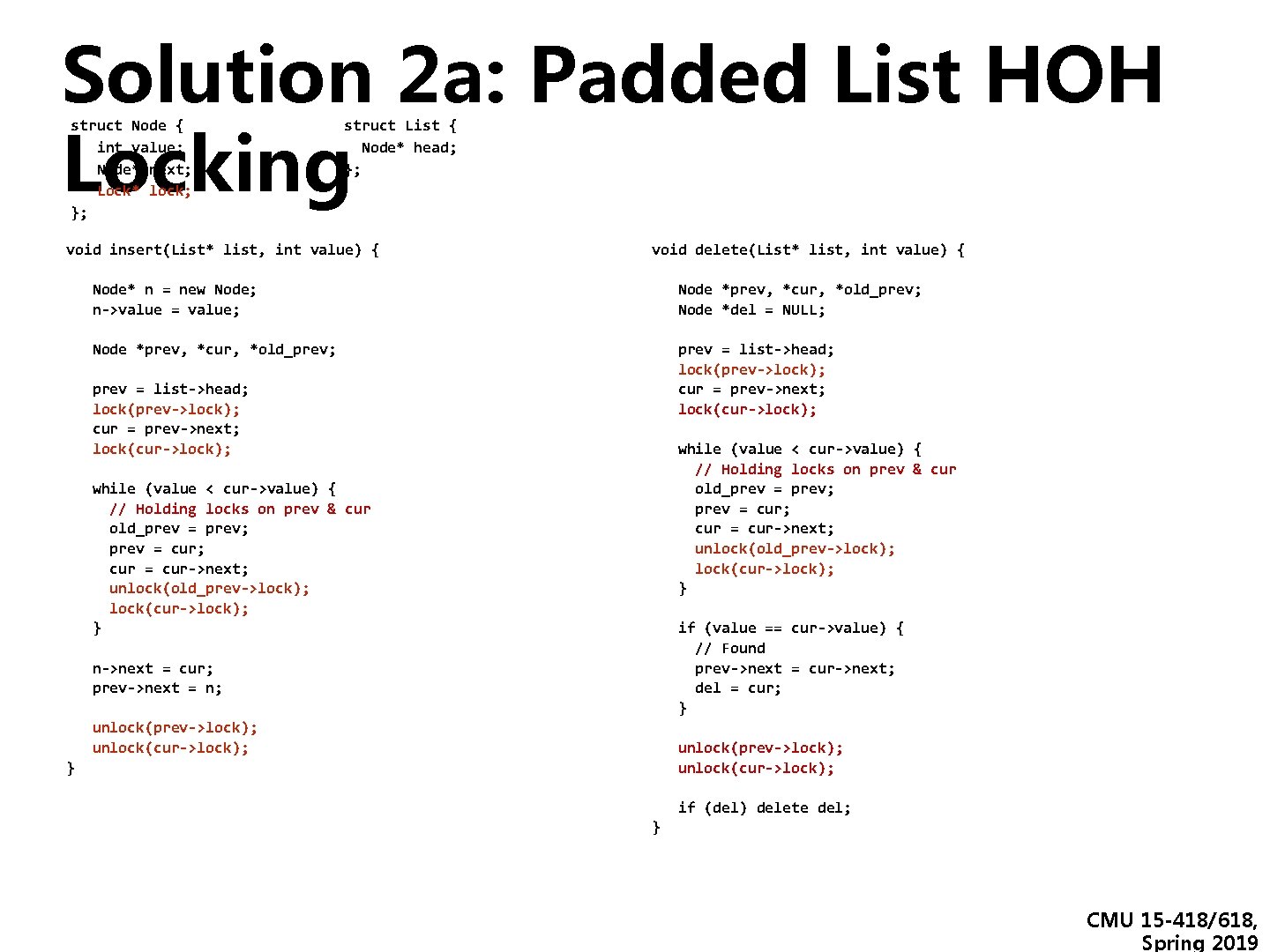
Solution 2 a: Padded List HOH Locking struct Node { int value; Node* next; Lock* lock; }; struct List { Node* head; }; void insert(List* list, int value) { void delete(List* list, int value) { Node* n = new Node; n->value = value; Node *prev, *cur, *old_prev; Node *del = NULL; Node *prev, *cur, *old_prev; prev = list->head; lock(prev->lock); cur = prev->next; lock(cur->lock); while (value < cur->value) { // Holding locks on prev & cur old_prev = prev; prev = cur; cur = cur->next; unlock(old_prev->lock); lock(cur->lock); } if (value == cur->value) { // Found prev->next = cur->next; del = cur; } n->next = cur; prev->next = n; unlock(prev->lock); unlock(cur->lock); } if (del) delete del; } CMU 15 -418/618, Spring 2019
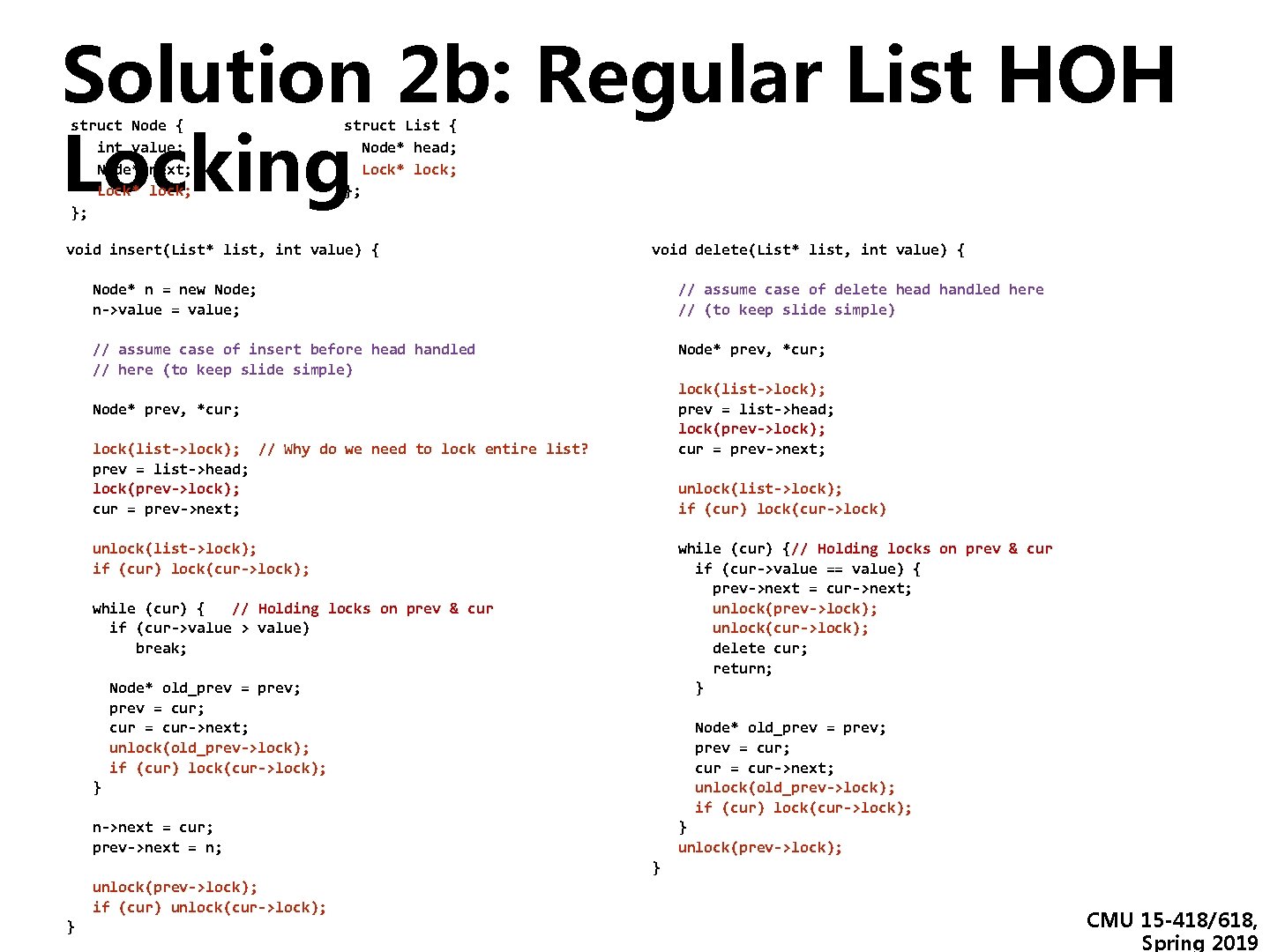
Solution 2 b: Regular List HOH Locking struct Node { int value; Node* next; Lock* lock; }; struct List { Node* head; Lock* lock; }; void insert(List* list, int value) { void delete(List* list, int value) { Node* n = new Node; n->value = value; // assume case of delete head handled here // (to keep slide simple) // assume case of insert before head handled // here (to keep slide simple) Node* prev, *cur; lock(list->lock); prev = list->head; lock(prev->lock); cur = prev->next; Node* prev, *cur; lock(list->lock); // Why do we need to lock entire list? prev = list->head; lock(prev->lock); cur = prev->next; unlock(list->lock); if (cur) lock(cur->lock); while (cur) {// Holding locks on prev & cur if (cur->value == value) { prev->next = cur->next; unlock(prev->lock); unlock(cur->lock); delete cur; return; } while (cur) { // Holding locks on prev & cur if (cur->value > value) break; Node* old_prev = prev; prev = cur; cur = cur->next; unlock(old_prev->lock); if (cur) lock(cur->lock); } n->next = cur; prev->next = n; } unlock(prev->lock); if (cur) unlock(cur->lock); } CMU 15 -418/618, Spring 2019
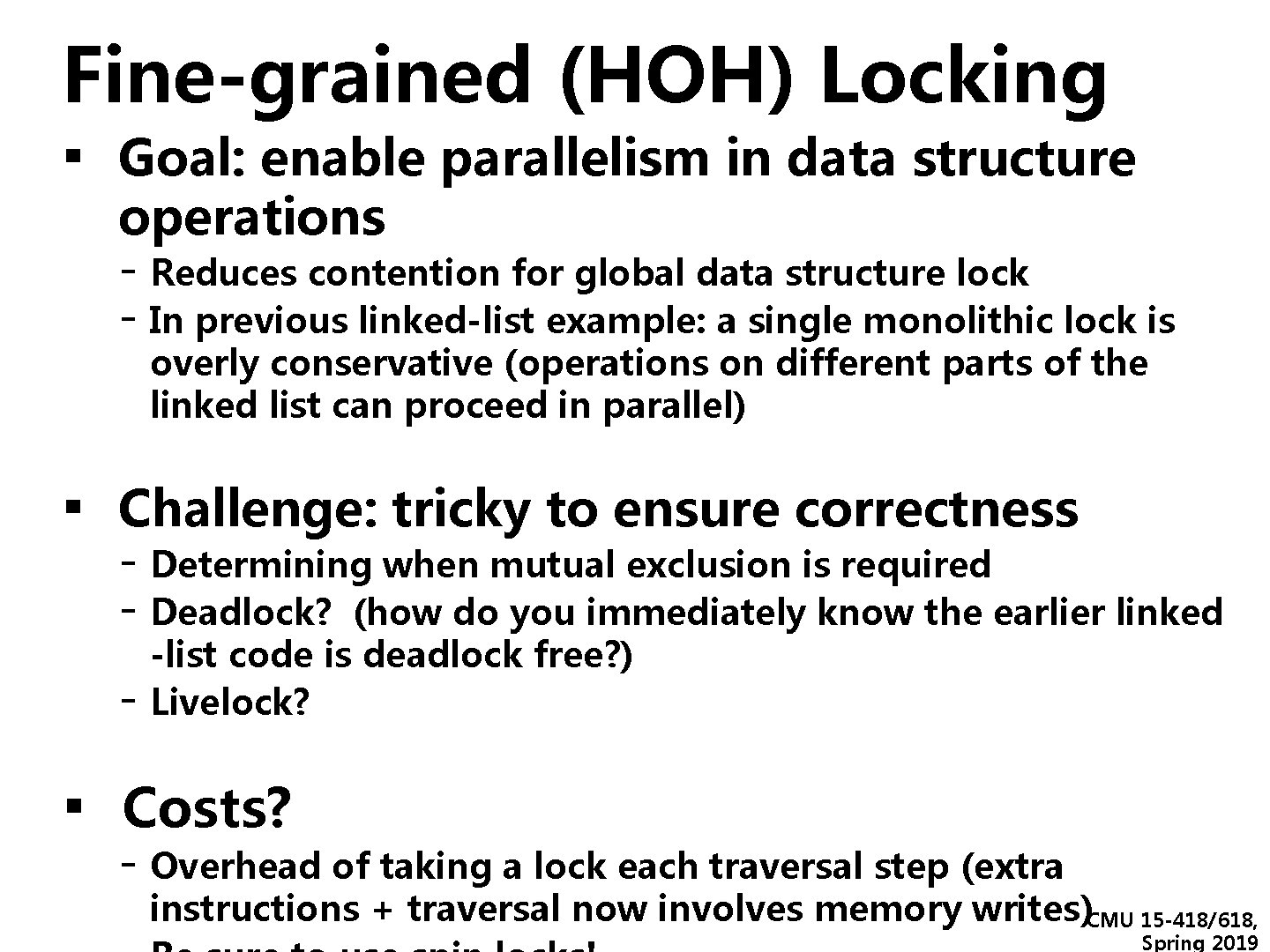
Fine-grained (HOH) Locking ▪ Goal: enable parallelism in data structure operations - Reduces contention for global data structure lock - In previous linked-list example: a single monolithic lock is overly conservative (operations on different parts of the linked list can proceed in parallel) ▪ Challenge: tricky to ensure correctness - Determining when mutual exclusion is required - Deadlock? (how do you immediately know the earlier linked - -list code is deadlock free? ) Livelock? ▪ Costs? - Overhead of taking a lock each traversal step (extra instructions + traversal now involves memory writes)CMU 15 -418/618, Spring 2019
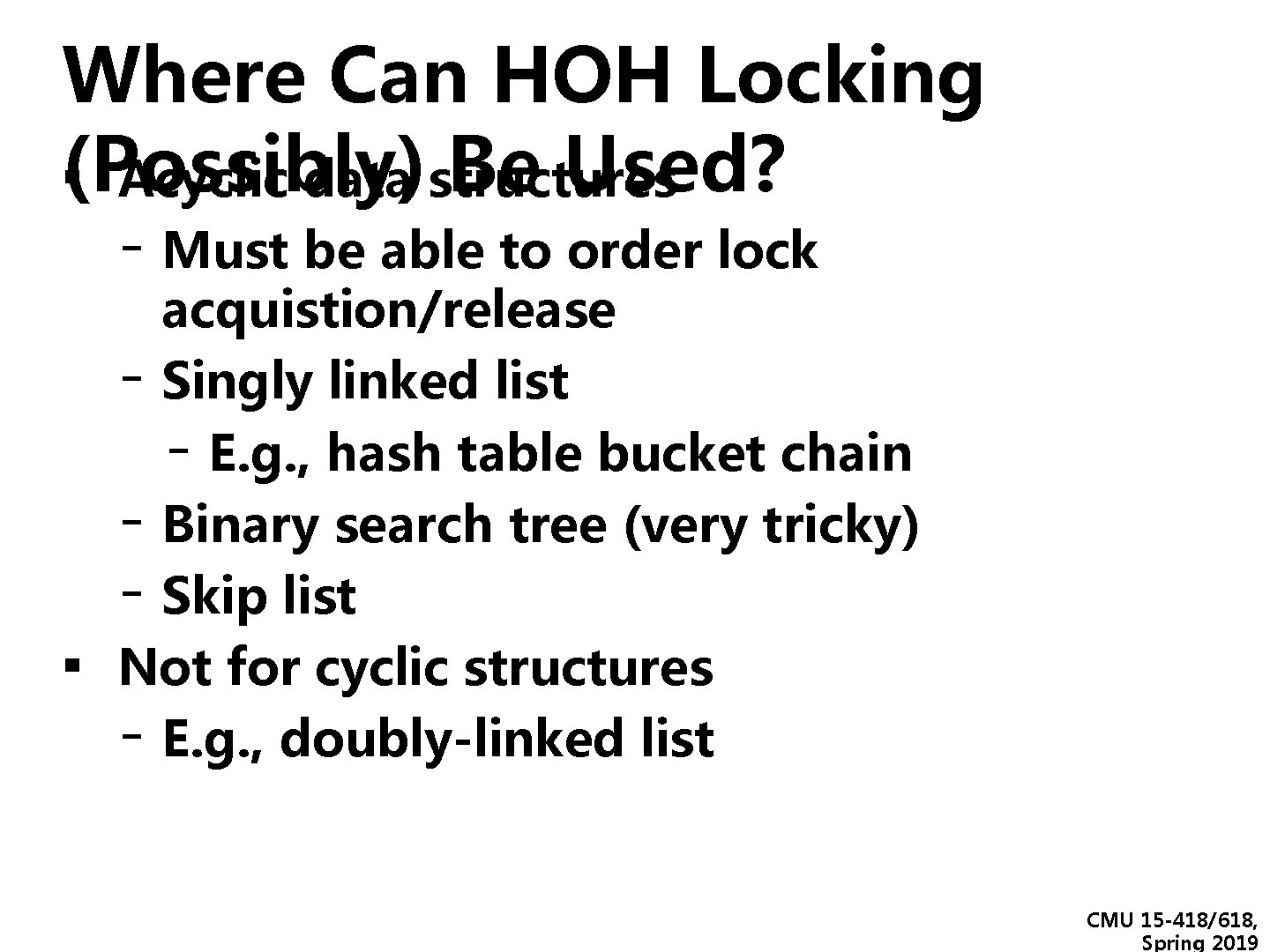
Where Can HOH Locking (Possibly) Be Used? ▪ Acyclic data structures - Must be able to order lock ▪ acquistion/release - Singly linked list - E. g. , hash table bucket chain - Binary search tree (very tricky) - Skip list Not for cyclic structures - E. g. , doubly-linked list CMU 15 -418/618, Spring 2019
Lock-free data structures CMU 15 -418/618, Spring 2019
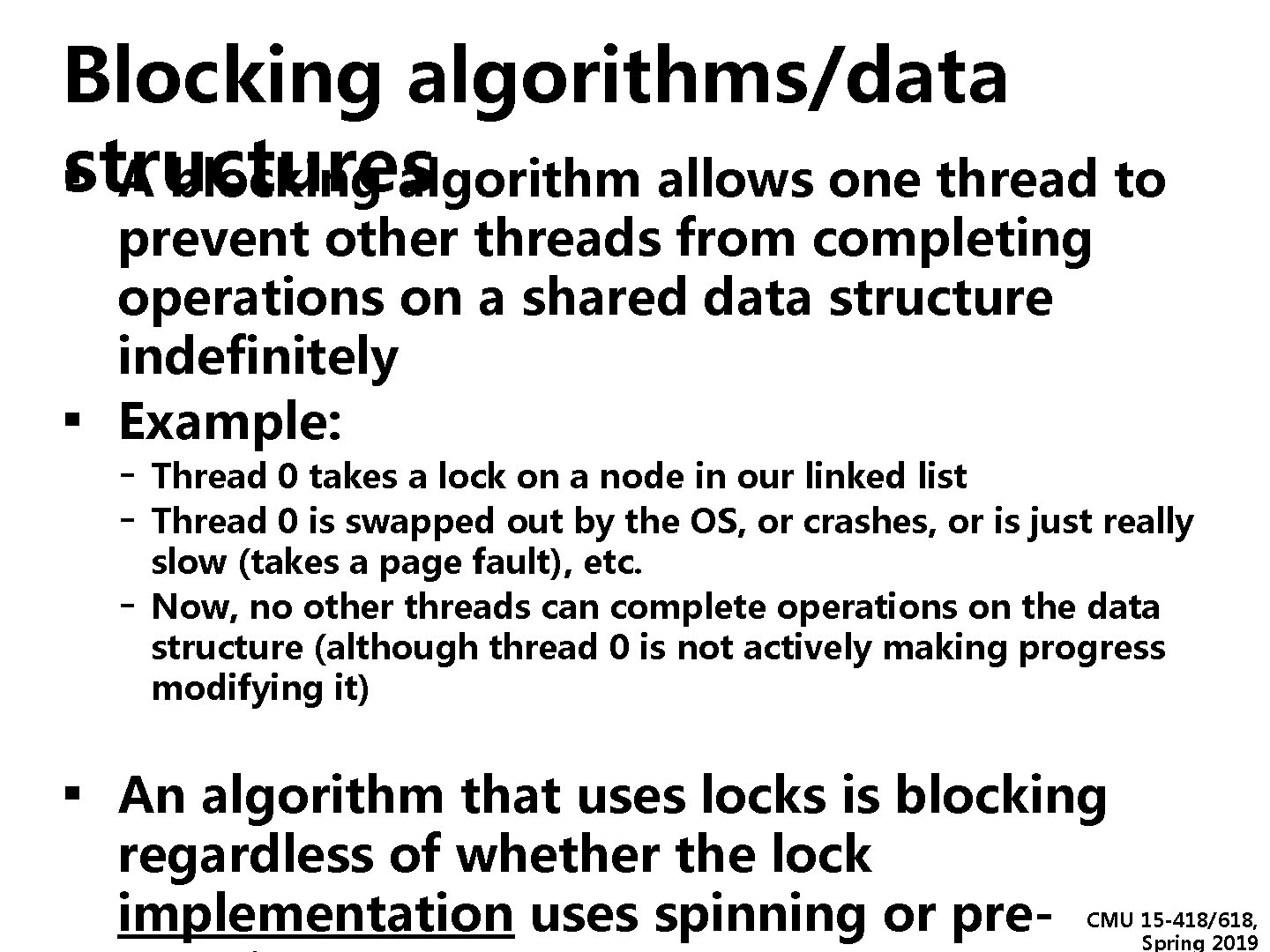
Blocking algorithms/data structures ▪ A blocking algorithm allows one thread to ▪ prevent other threads from completing operations on a shared data structure indefinitely Example: - Thread 0 takes a lock on a node in our linked list Thread 0 is swapped out by the OS, or crashes, or is just really slow (takes a page fault), etc. Now, no other threads can complete operations on the data structure (although thread 0 is not actively making progress modifying it) ▪ An algorithm that uses locks is blocking regardless of whether the lock implementation uses spinning or pre- CMU 15 -418/618, Spring 2019
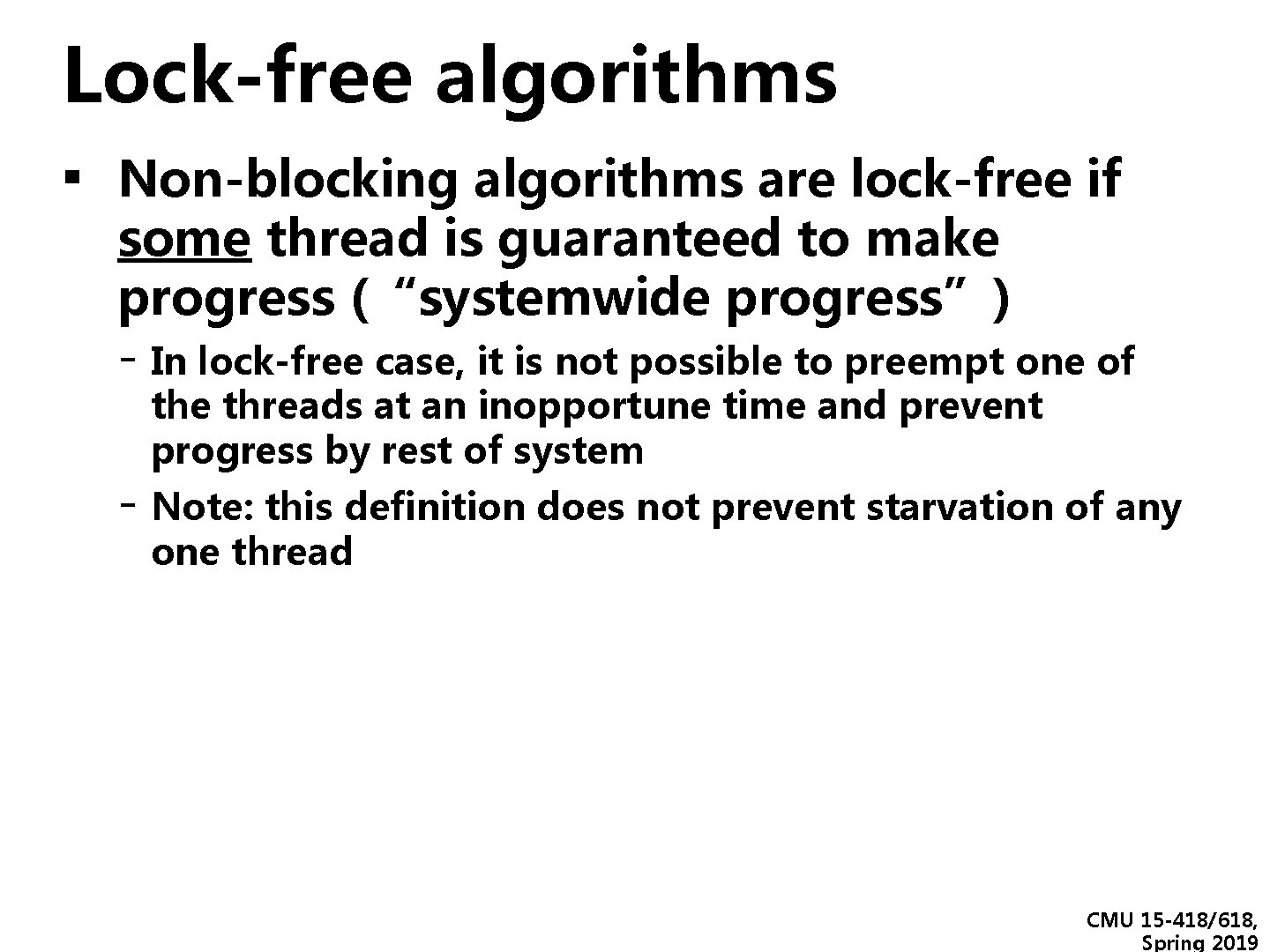
Lock-free algorithms ▪ Non-blocking algorithms are lock-free if some thread is guaranteed to make progress (“systemwide progress”) - In lock-free case, it is not possible to preempt one of the threads at an inopportune time and prevent progress by rest of system - Note: this definition does not prevent starvation of any one thread CMU 15 -418/618, Spring 2019
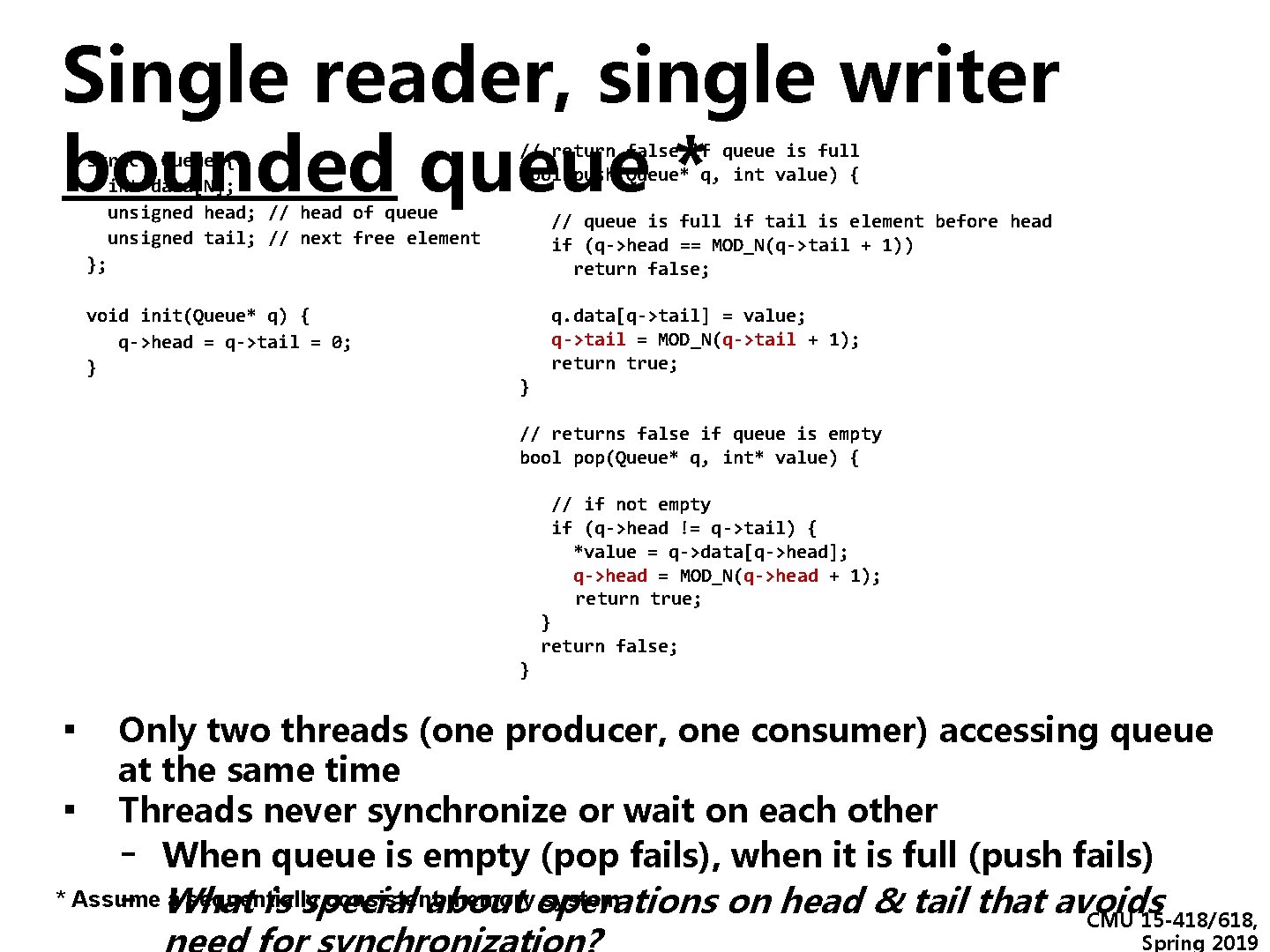
Single reader, single writer bounded queue * struct Queue { int data[N]; unsigned head; // head of queue unsigned tail; // next free element }; void init(Queue* q) { q->head = q->tail = 0; } // return false if queue is full bool push(Queue* q, int value) { // queue is full if tail is element before head if (q->head == MOD_N(q->tail + 1)) return false; q. data[q->tail] = value; q->tail = MOD_N(q->tail + 1); return true; } // returns false if queue is empty bool pop(Queue* q, int* value) { // if not empty if (q->head != q->tail) { *value = q->data[q->head]; q->head = MOD_N(q->head + 1); return true; } return false; } ▪ ▪ Only two threads (one producer, one consumer) accessing queue at the same time Threads never synchronize or wait on each other - When queue is empty (pop fails), when it is full (push fails) - * Assume What a sequentially consistent memoryoperations system is special about on head & tail that avoids CMU 15 -418/618, Spring 2019
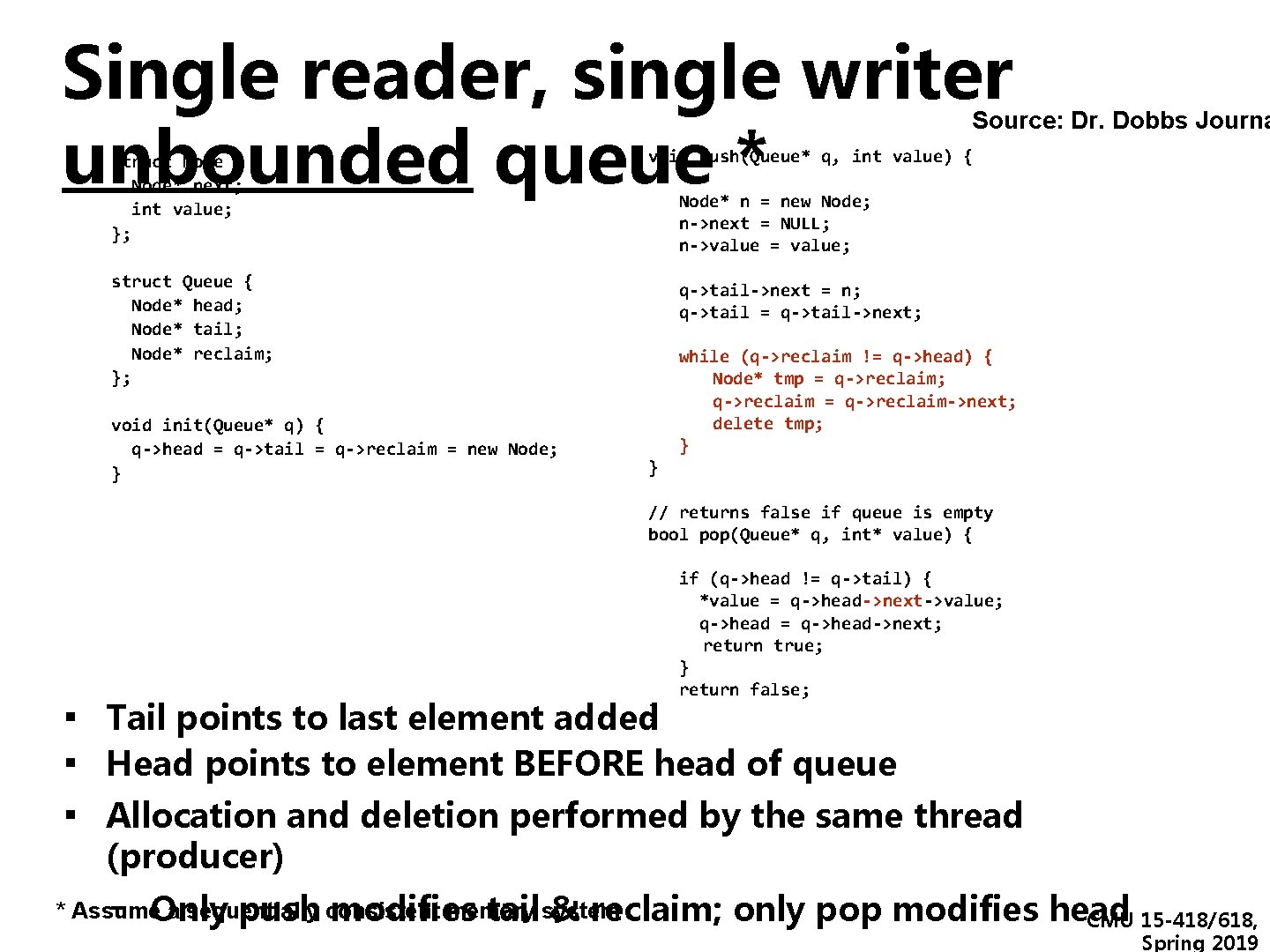
Single reader, single writer unbounded queue * Source: Dr. Dobbs Journa struct Node { Node* next; int value; }; void push(Queue* q, int value) { Node* n = new Node; n->next = NULL; n->value = value; struct Queue { Node* head; Node* tail; Node* reclaim; }; void init(Queue* q) { q->head = q->tail = q->reclaim = new Node; } q->tail->next = n; q->tail = q->tail->next; while (q->reclaim != q->head) { Node* tmp = q->reclaim; q->reclaim = q->reclaim->next; delete tmp; } } // returns false if queue is empty bool pop(Queue* q, int* value) { if (q->head != q->tail) { *value = q->head->next->value; q->head = q->head->next; return true; } return false; ▪ Tail points to last element added ▪ Head points to element BEFORE head of queue ▪ Allocation and deletion performed by the same thread } (producer) - * Assume. Only a sequentially memory push consistent modifies tail system & reclaim; only pop modifies head CMU 15 -418/618, Spring 2019
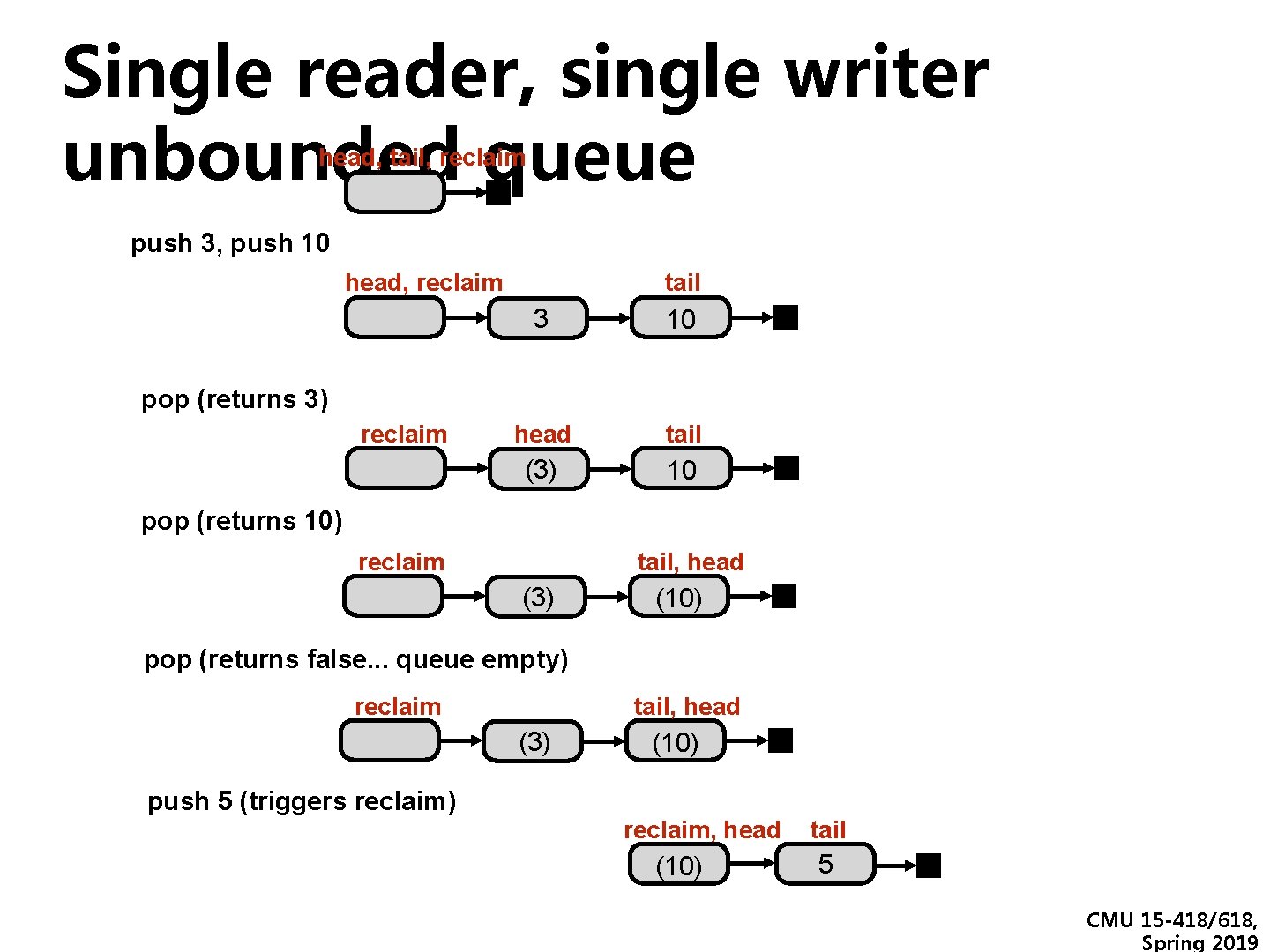
Single reader, single writer unbounded queue head, tail, reclaim push 3, push 10 head, reclaim tail 3 10 head tail (3) 10 pop (returns 3) reclaim pop (returns 10) reclaim tail, head (3) (10) pop (returns false. . . queue empty) reclaim tail, head (3) (10) push 5 (triggers reclaim) reclaim, head (10) tail 5 CMU 15 -418/618, Spring 2019
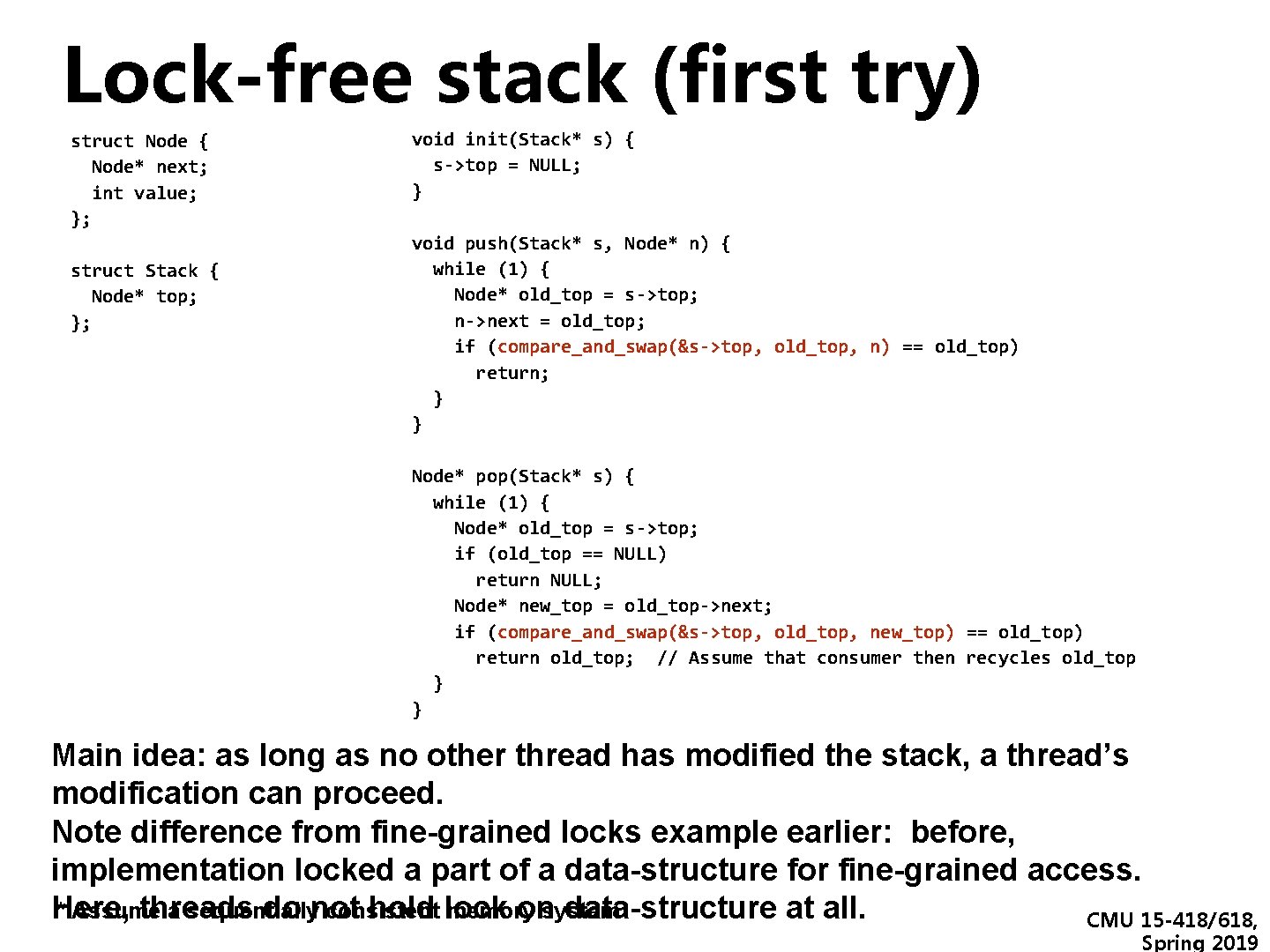
Lock-free stack (first try) struct Node { Node* next; int value; }; struct Stack { Node* top; }; void init(Stack* s) { s->top = NULL; } void push(Stack* s, Node* n) { while (1) { Node* old_top = s->top; n->next = old_top; if (compare_and_swap(&s->top, old_top, n) == old_top) return; } } Node* pop(Stack* s) { while (1) { Node* old_top = s->top; if (old_top == NULL) return NULL; Node* new_top = old_top->next; if (compare_and_swap(&s->top, old_top, new_top) == old_top) return old_top; // Assume that consumer then recycles old_top } } Main idea: as long as no other thread has modified the stack, a thread’s modification can proceed. Note difference from fine-grained locks example earlier: before, implementation locked a part of a data-structure for fine-grained access. Here, threads do not hold lock onsystem data-structure at all. * Assume a sequentially consistent memory CMU 15 -418/618, Spring 2019
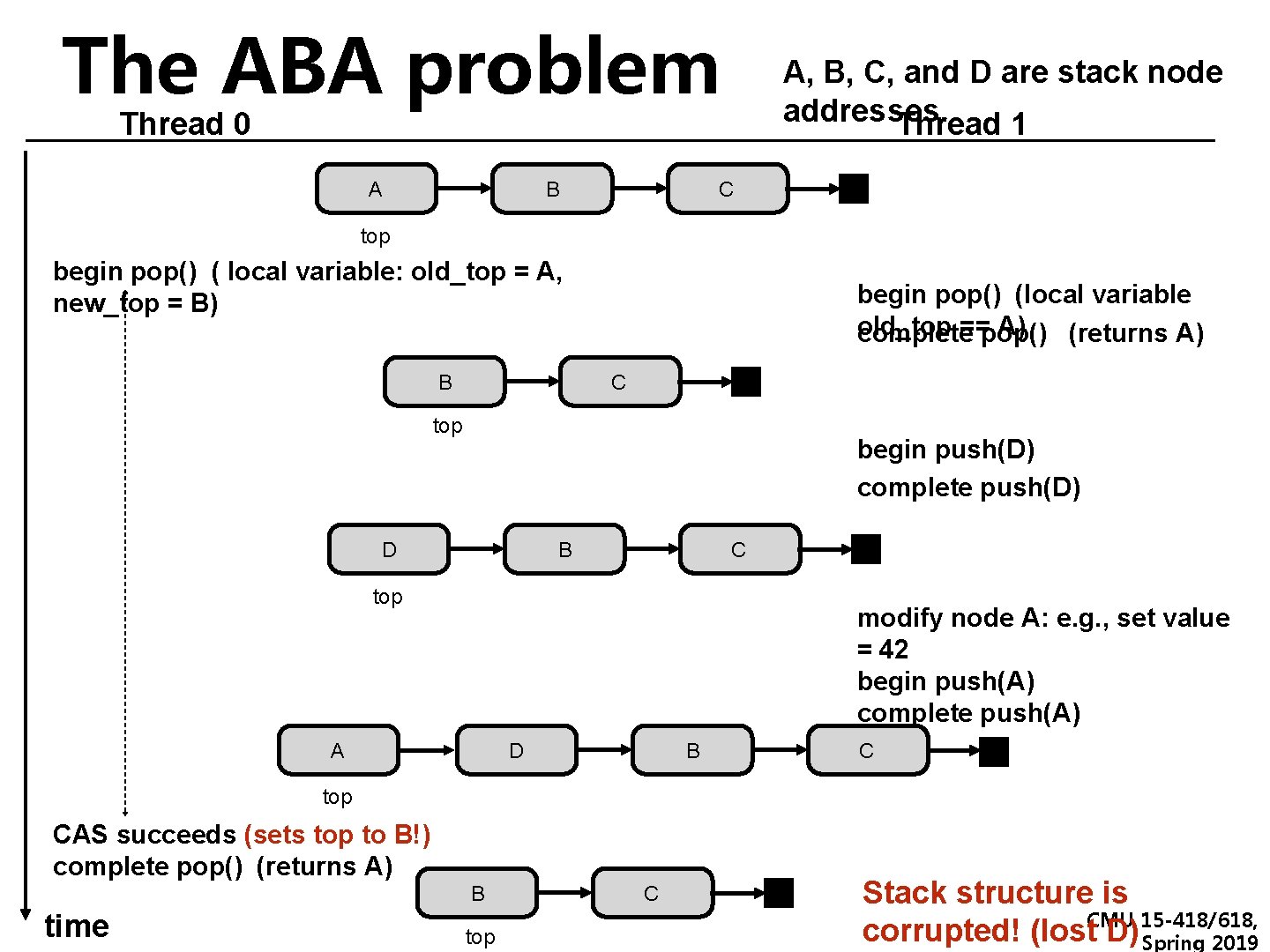
The ABA problem A, B, C, and D are stack node addresses. Thread 1 Thread 0 A B C top begin pop() ( local variable: old_top = A, new_top = B) B begin pop() (local variable old_top ==pop() A) complete (returns A) C top begin push(D) complete push(D) D B C top modify node A: e. g. , set value = 42 begin push(A) complete push(A) D A B C top CAS succeeds (sets top to B!) complete pop() (returns A) B time top C Stack structure is CMU 15 -418/618, corrupted! (lost D) Spring 2019
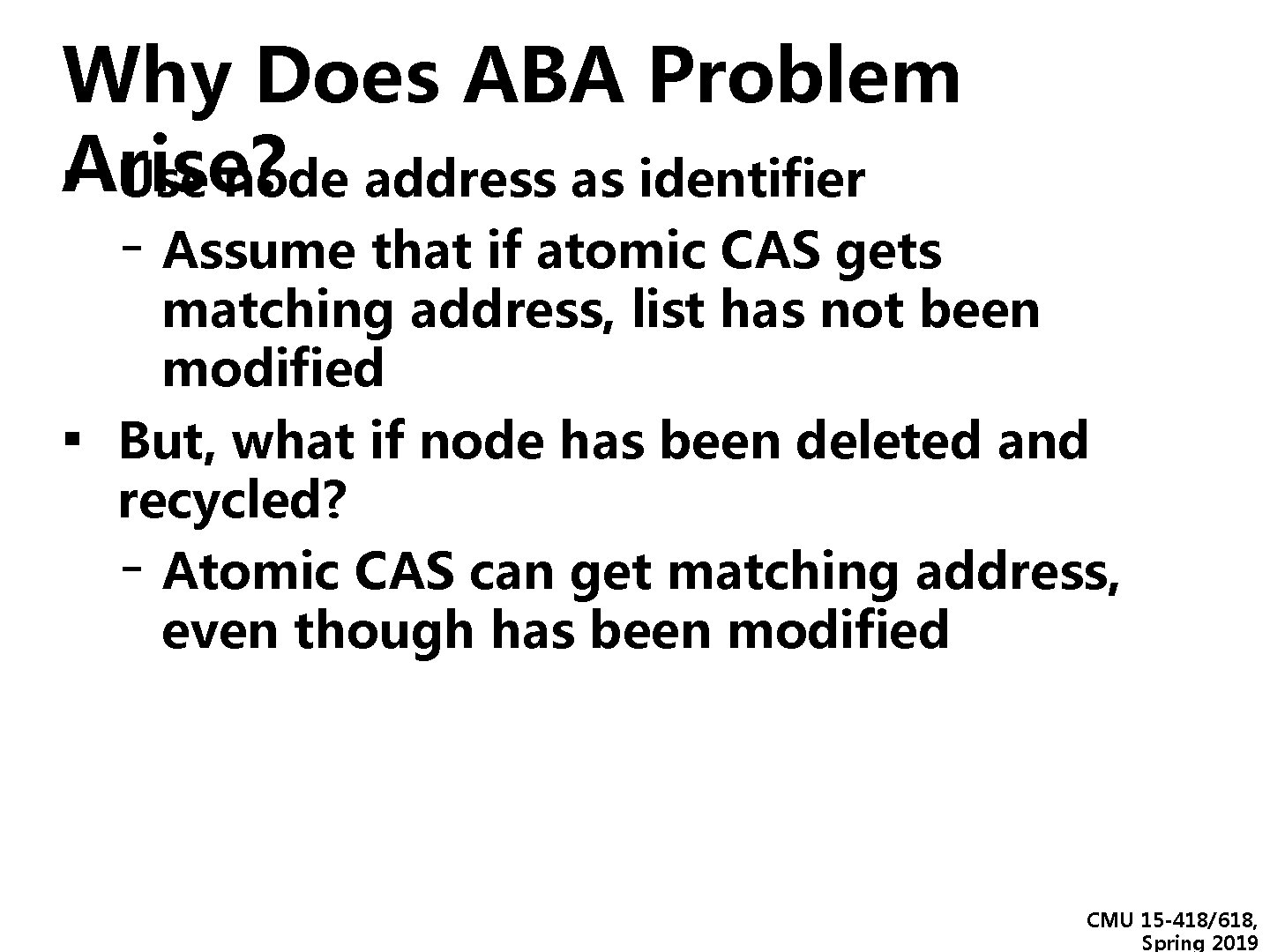
Why Does ABA Problem Arise? ▪ Use node address as identifier - Assume that if atomic CAS gets ▪ matching address, list has not been modified But, what if node has been deleted and recycled? - Atomic CAS can get matching address, even though has been modified CMU 15 -418/618, Spring 2019
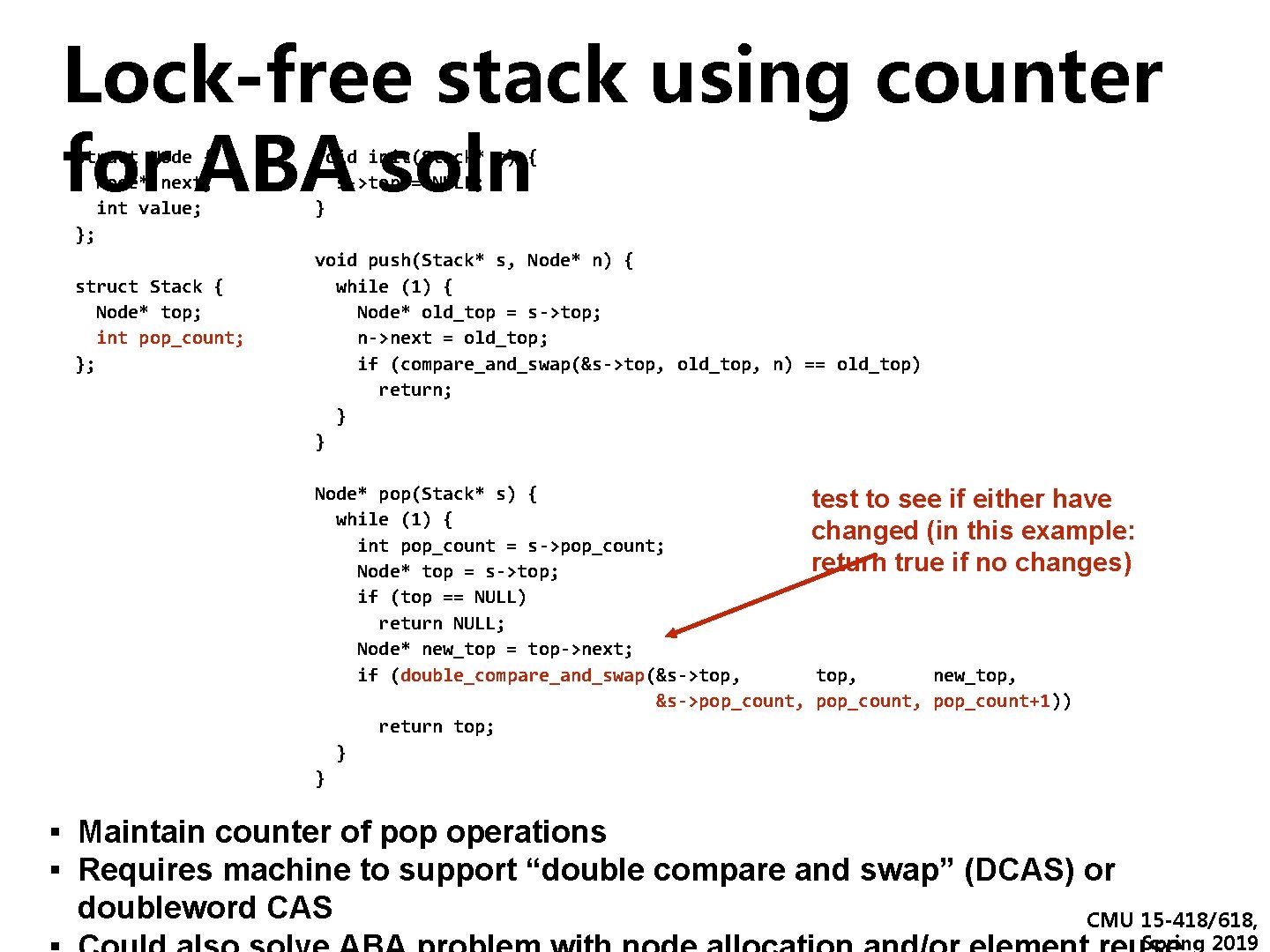
Lock-free stack using counter for ABA soln struct Node { Node* next; int value; }; struct Stack { Node* top; int pop_count; }; void init(Stack* s) { s->top = NULL; } void push(Stack* s, Node* n) { while (1) { Node* old_top = s->top; n->next = old_top; if (compare_and_swap(&s->top, old_top, n) == old_top) return; } } Node* pop(Stack* s) { test to see if either have while (1) { changed (in this example: int pop_count = s->pop_count; return true if no changes) Node* top = s->top; if (top == NULL) return NULL; Node* new_top = top->next; if (double_compare_and_swap(&s->top, new_top, &s->pop_count, pop_count+1)) return top; } } ▪ Maintain counter of pop operations ▪ Requires machine to support “double compare and swap” (DCAS) or doubleword CAS CMU 15 -418/618, Spring 2019
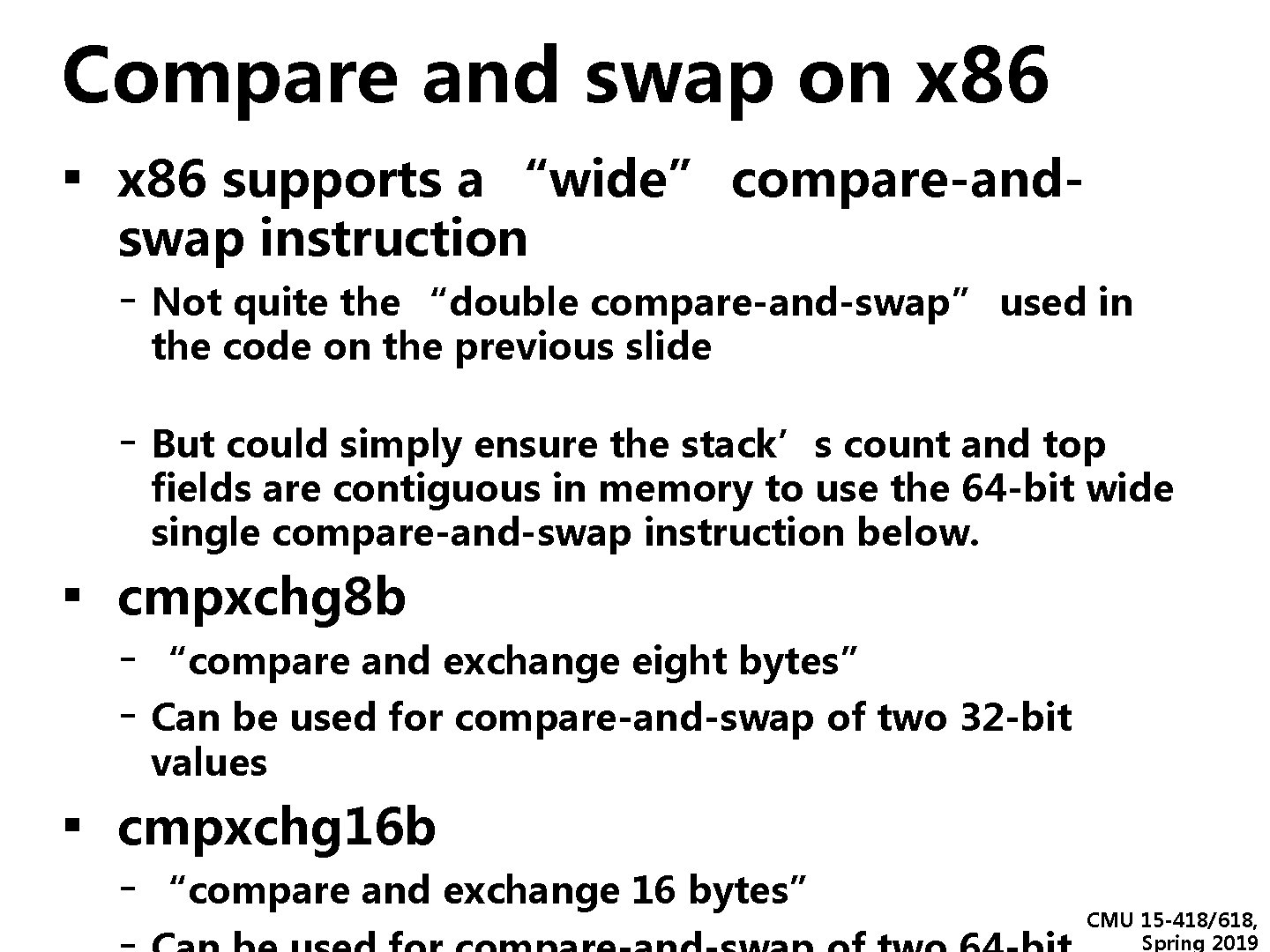
Compare and swap on x 86 ▪ x 86 supports a “wide” compare-and- swap instruction - Not quite the “double compare-and-swap” used in the code on the previous slide - But could simply ensure the stack’s count and top fields are contiguous in memory to use the 64 -bit wide single compare-and-swap instruction below. ▪ cmpxchg 8 b - “compare and exchange eight bytes” - Can be used for compare-and-swap of two 32 -bit values ▪ cmpxchg 16 b - “compare and exchange 16 bytes” CMU 15 -418/618, Spring 2019
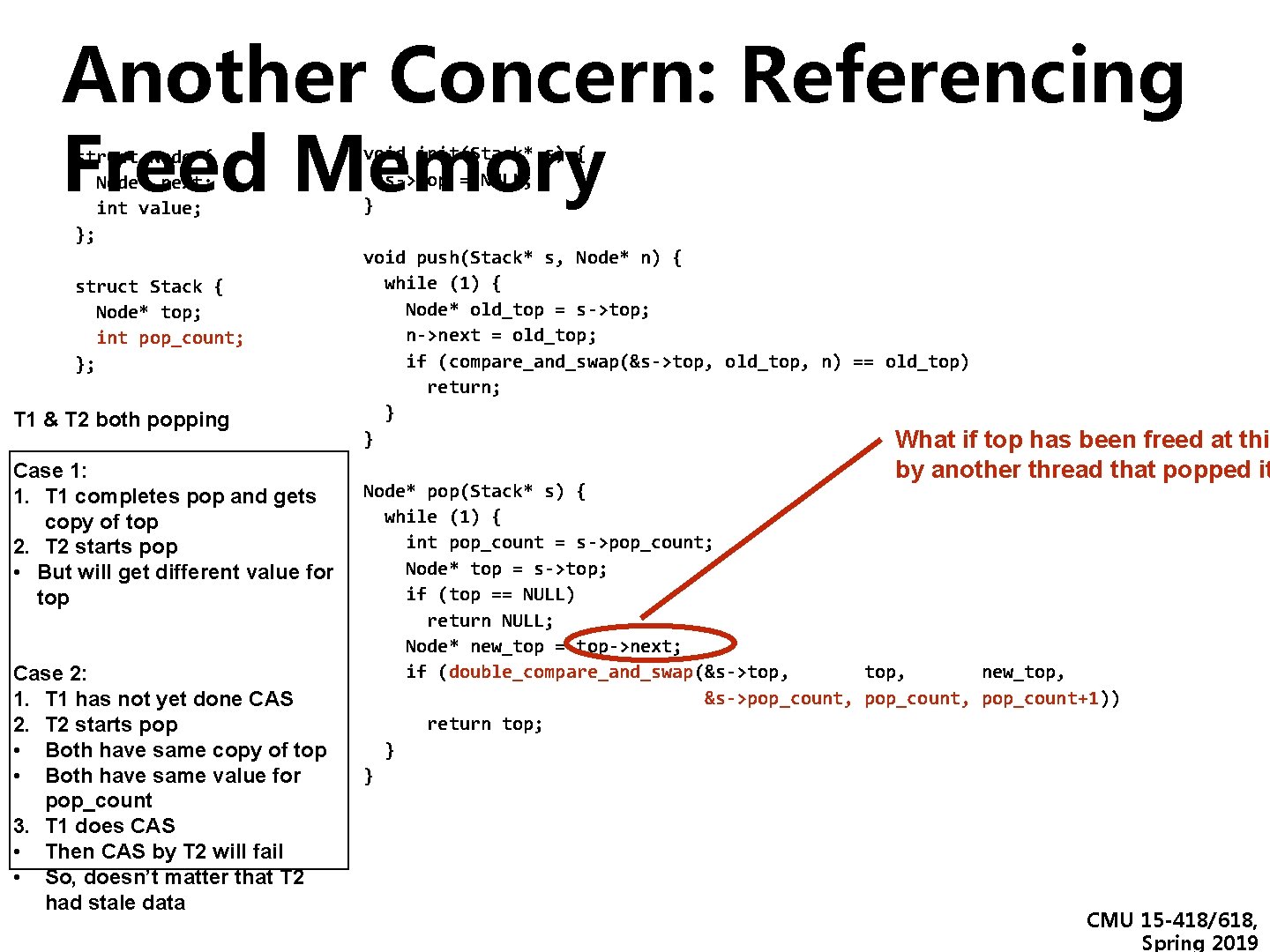
Another Concern: Referencing Freed Memory struct Node { Node* next; int value; }; struct Stack { Node* top; int pop_count; }; T 1 & T 2 both popping Case 1: 1. T 1 completes pop and gets copy of top 2. T 2 starts pop • But will get different value for top Case 2: 1. T 1 has not yet done CAS 2. T 2 starts pop • Both have same copy of top • Both have same value for pop_count 3. T 1 does CAS • Then CAS by T 2 will fail • So, doesn’t matter that T 2 had stale data void init(Stack* s) { s->top = NULL; } void push(Stack* s, Node* n) { while (1) { Node* old_top = s->top; n->next = old_top; if (compare_and_swap(&s->top, old_top, n) == old_top) return; } } What if top has been freed at this by another thread that popped it Node* pop(Stack* s) { while (1) { int pop_count = s->pop_count; Node* top = s->top; if (top == NULL) return NULL; Node* new_top = top->next; if (double_compare_and_swap(&s->top, new_top, &s->pop_count, pop_count+1)) return top; } } CMU 15 -418/618, Spring 2019
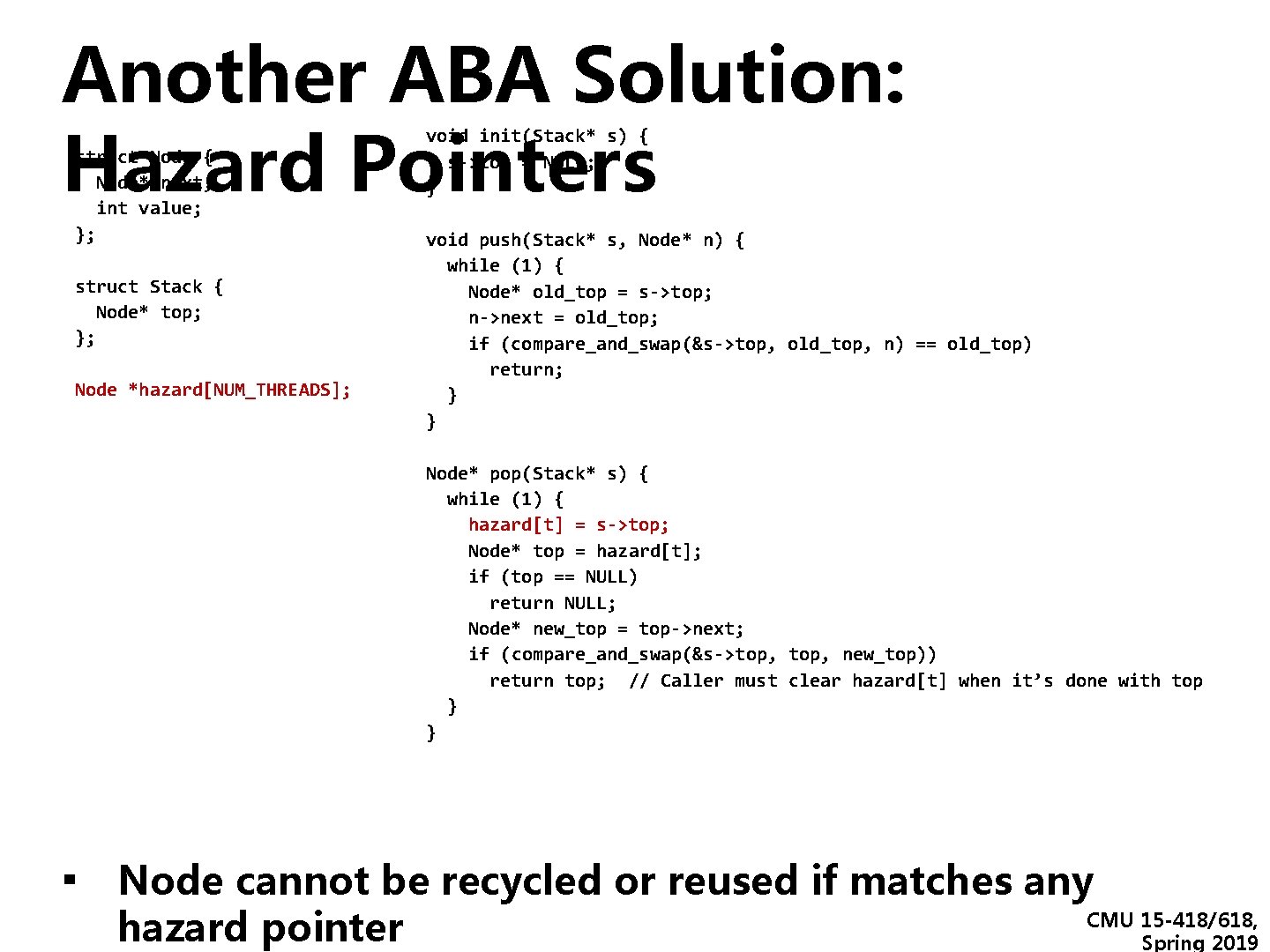
Another ABA Solution: Hazard Pointers struct Node { Node* next; int value; }; struct Stack { Node* top; }; Node *hazard[NUM_THREADS]; void init(Stack* s) { s->top = NULL; } void push(Stack* s, Node* n) { while (1) { Node* old_top = s->top; n->next = old_top; if (compare_and_swap(&s->top, old_top, n) == old_top) return; } } Node* pop(Stack* s) { while (1) { hazard[t] = s->top; Node* top = hazard[t]; if (top == NULL) return NULL; Node* new_top = top->next; if (compare_and_swap(&s->top, new_top)) return top; // Caller must clear hazard[t] when it’s done with top } } ▪ Node cannot be recycled or reused if matches any hazard pointer CMU 15 -418/618, Spring 2019
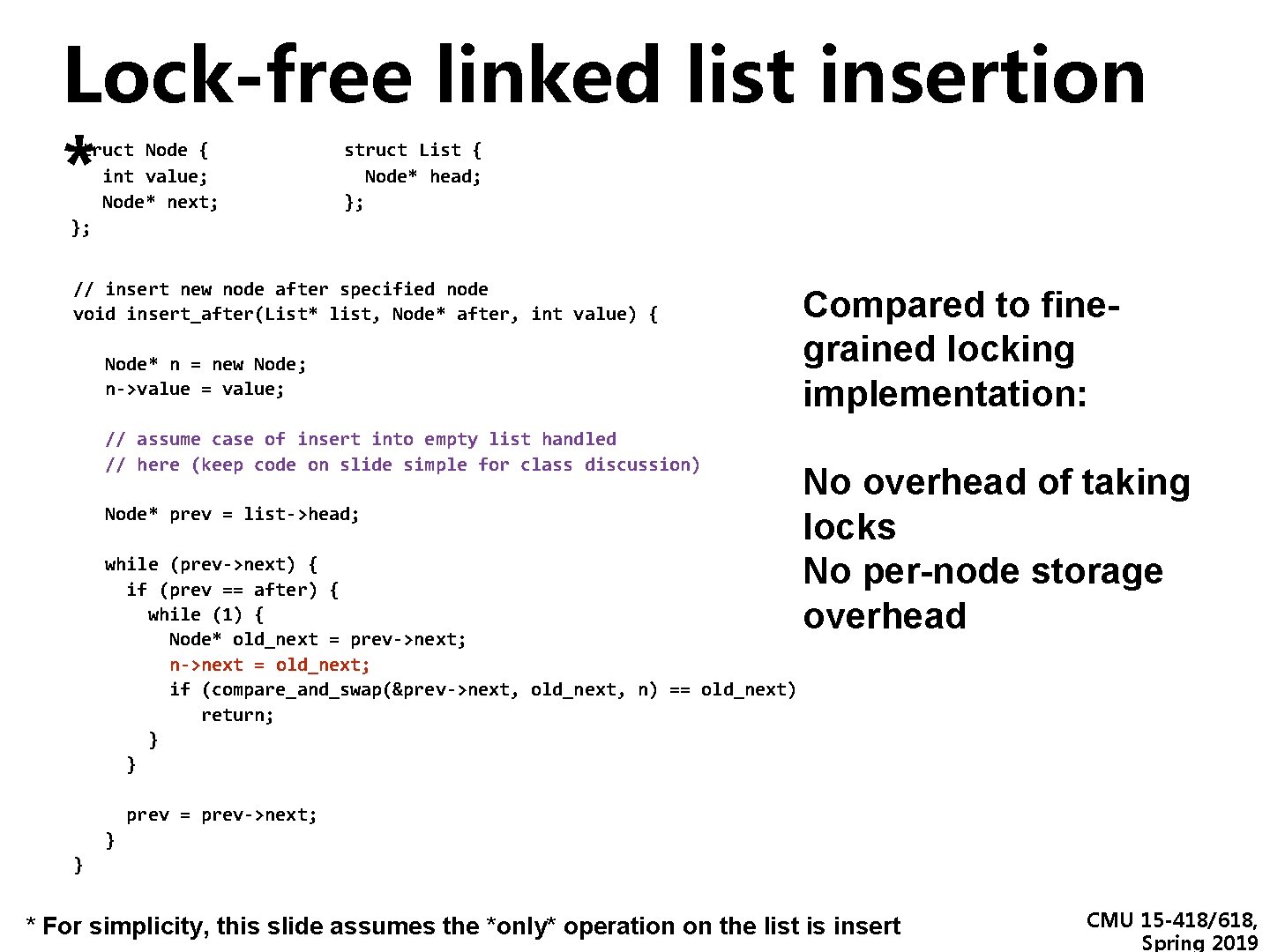
Lock-free linked list insertion * struct Node { int value; Node* next; }; struct List { Node* head; }; // insert new node after specified node void insert_after(List* list, Node* after, int value) { Node* n = new Node; n->value = value; // assume case of insert into empty list handled // here (keep code on slide simple for class discussion) Node* prev = list->head; while (prev->next) { if (prev == after) { while (1) { Node* old_next = prev->next; n->next = old_next; if (compare_and_swap(&prev->next, old_next, n) == old_next) return; } } Compared to finegrained locking implementation: No overhead of taking locks No per-node storage overhead prev = prev->next; } } * For simplicity, this slide assumes the *only* operation on the list is insert CMU 15 -418/618, Spring 2019
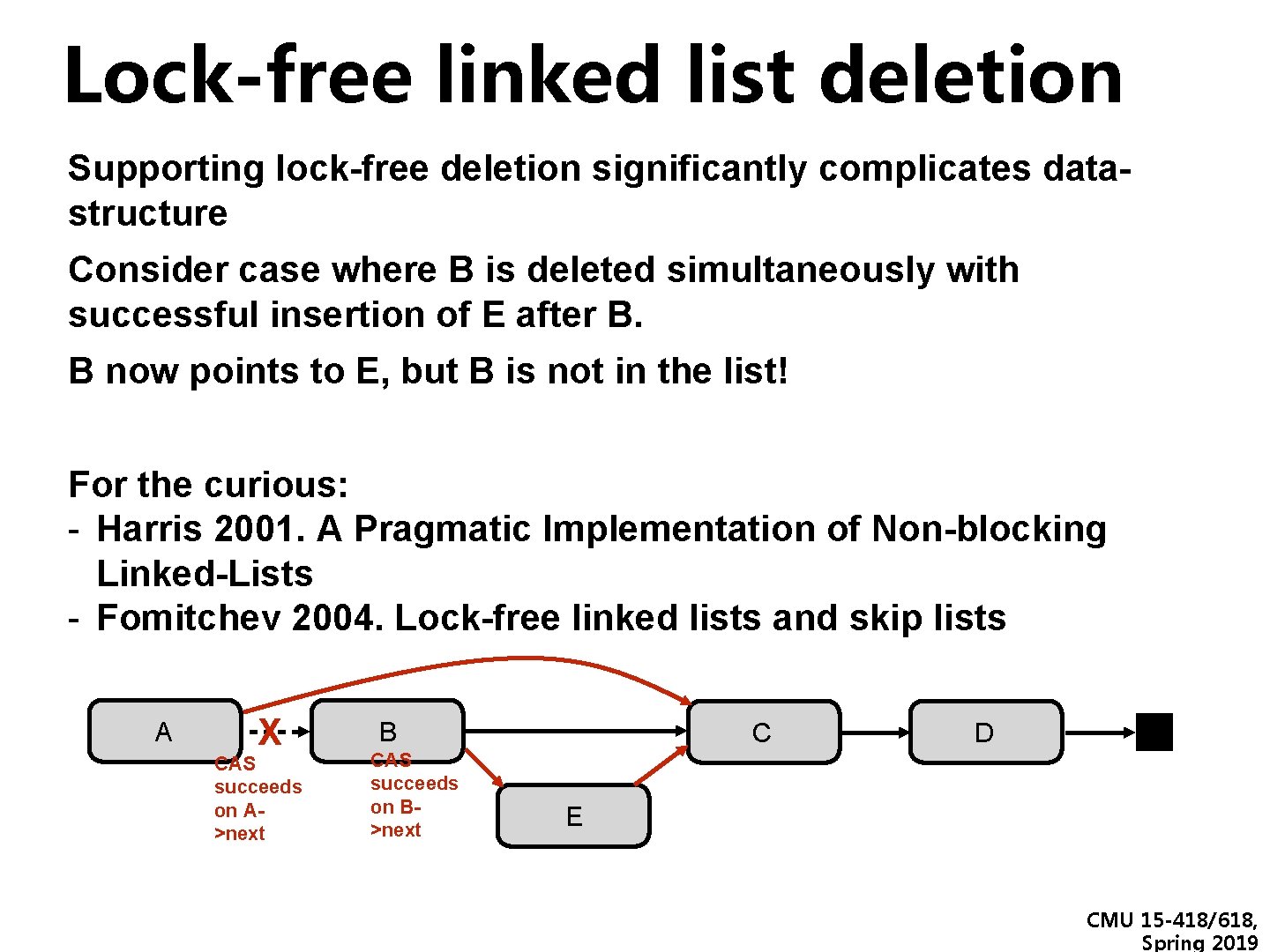
Lock-free linked list deletion Supporting lock-free deletion significantly complicates datastructure Consider case where B is deleted simultaneously with successful insertion of E after B. B now points to E, but B is not in the list! For the curious: - Harris 2001. A Pragmatic Implementation of Non-blocking Linked-Lists - Fomitchev 2004. Lock-free linked lists and skip lists A X CAS succeeds on A>next B CAS succeeds on B>next C D E CMU 15 -418/618, Spring 2019
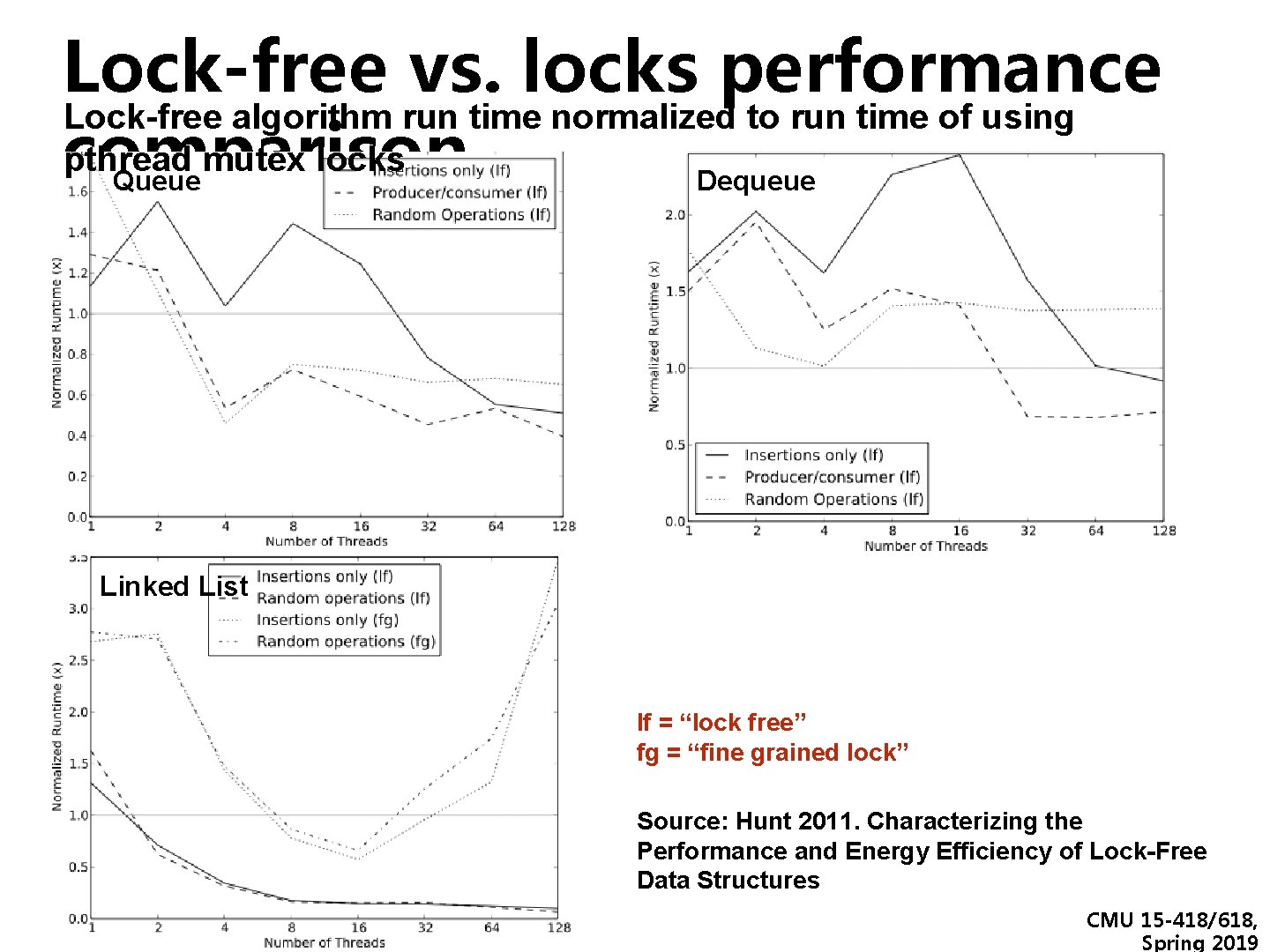
Lock-free vs. locks performance Lock-free algorithm run time normalized to run time of using pthread mutex locks comparison Queue Dequeue Linked List lf = “lock free” fg = “fine grained lock” Source: Hunt 2011. Characterizing the Performance and Energy Efficiency of Lock-Free Data Structures CMU 15 -418/618, Spring 2019
In practice: why lock free data-structures? ▪ When optimizing parallel programs in this class you often assume that only your program is using the machine - Because you care about performance - Typical assumption in scientific computing, graphics, data analytics, etc. ▪ In these cases, well written code with locks can ▪ be as fast (or faster) than lock-free code But there are situations where code with locks can suffer from tricky performance problems - Multi-programmed situations where page faults, pre-emption, - etc. can occur while thread is in a critical section Creates problems like priority inversion, convoying, crashing in critical section, etc. that are often discussed in OS classes CMU 15 -418/618, Spring 2019
Summary ▪ Use fine-grained locking to reduce contention (maximize parallelism) in operations on shared data structures - But fine-granularity can increase code complexity (errors) and increase execution overhead ▪ Lock-free data structures: non-blocking solution to avoid overheads due to locks - But can be tricky to implement (ensuring correctness in a lock- free setting has its own overheads) Still requires appropriate memory fences on modern relaxed consistency hardware ▪ Note: a lock-free design does not eliminate contention CMU 15 -418/618, - Compare-and-swap can fail under heavy contention, requiring Spring 2019
More reading ▪ Michael and Scott 1996. Simple, Fast and Practical Non. Blocking and Blocking Concurrent Queue Algorithms - Multiple reader/writer lock-free queue ▪ Harris 2001. A Pragmatic Implementation of Non-Blocking Linked-Lists ▪ Many good blog posts and articles on the web: - http: //www. drdobbs. com/cpp/lock-free-code-a-false-senseof-security/210600279 - http: //developers. memsql. com/blog/common-pitfalls-inwriting-lock-free-algorithms/ ▪ Often students like to implement lock-free data structures for projects - Linked list, skip-list based maps (Java’s Concurrent. Skip. List. Map), list-based sets, etc. - Recommend using CMU Ph. D. student Michael Sullivan’s CMU 15 -418/618, Spring 2019