
FineGrained Java Script Execution Isolation Using Script Spaces
- Slides: 1
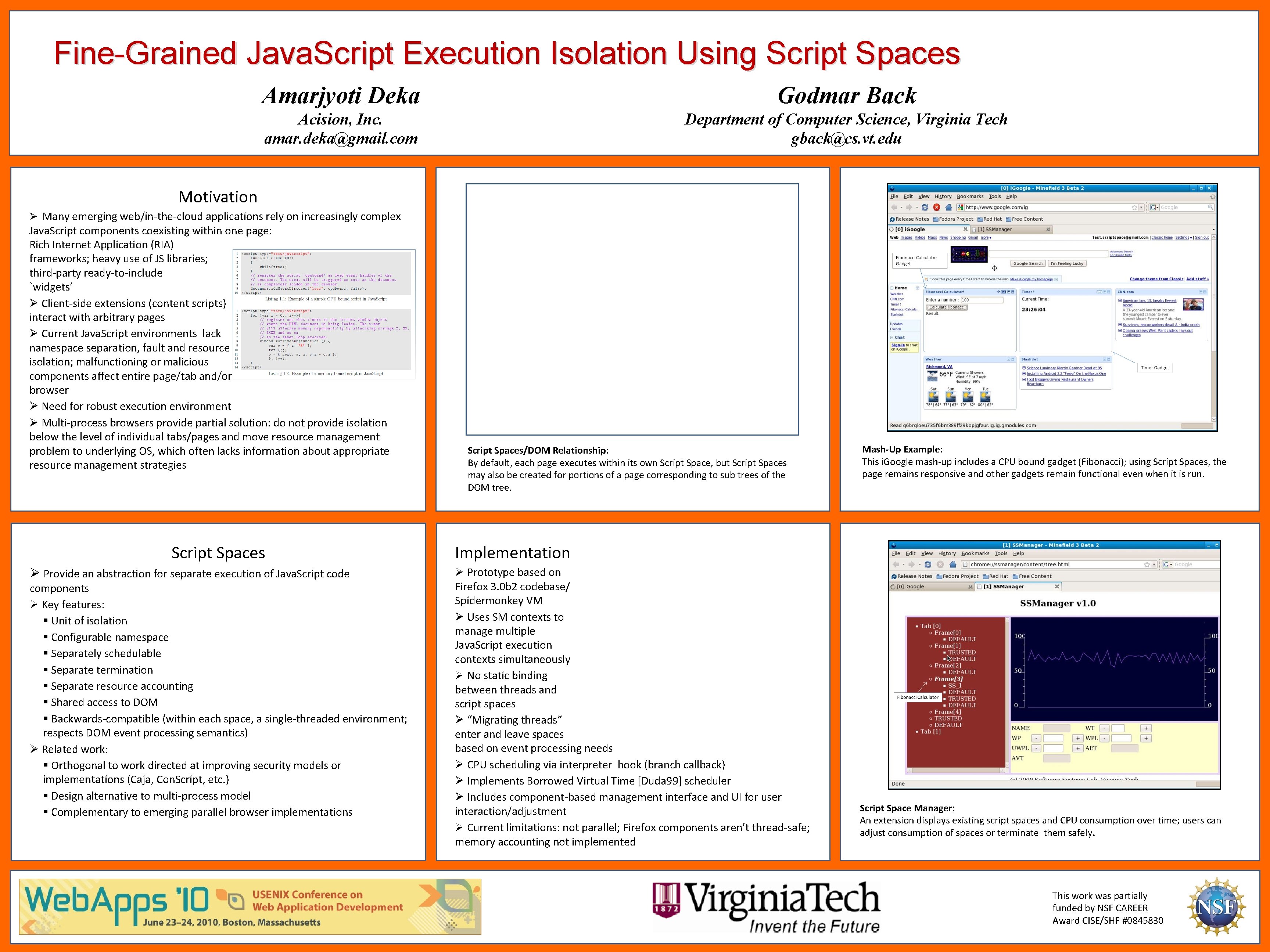
Fine-Grained Java. Script Execution Isolation Using Script Spaces C Amarjyoti Deka Godmar Back Acision, Inc. amar. deka@gmail. com Department of Computer Science, Virginia Tech gback@cs. vt. edu Motivation Ø Many emerging web/in-the-cloud applications rely on increasingly complex Script Spaces Ø Provide an abstraction for separate execution of Java. Script code components Ø Key features: § Unit of isolation § Configurable namespace § Separately schedulable § Separate termination § Separate resource accounting § Shared access to DOM § Backwards-compatible (within each space, a single-threaded environment; respects DOM event processing semantics) Ø Related work: § Orthogonal to work directed at improving security models or implementations (Caja, Con. Script, etc. ) § Design alternative to multi-process model § Complementary to emerging parallel browser implementations C C Script Spaces/DOM Relationship: By default, each page executes within its own Script Space, but Script Spaces may also be created for portions of a page corresponding to sub trees of the DOM tree. C Mash-Up Example: This i. Google mash-up includes a CPU bound gadget (Fibonacci); using Script Spaces, the page remains responsive and other gadgets remain functional even when it is run. Implementation Ø Prototype based on Firefox 3. 0 b 2 codebase/ Spidermonkey VM Ø Uses SM contexts to manage multiple Java. Script execution contexts simultaneously Ø No static binding between threads and script spaces Ø “Migrating threads” enter and leave spaces based on event processing needs Ø CPU scheduling via interpreter hook (branch callback) Ø Implements Borrowed Virtual Time [Duda 99] scheduler Ø Includes component-based management interface and UI for user interaction/adjustment Ø Current limitations: not parallel; Firefox components aren’t thread-safe; memory accounting not implemented C Java. Script components coexisting within one page: Rich Internet Application (RIA) frameworks; heavy use of JS libraries; third-party ready-to-include `widgets’ Ø Client-side extensions (content scripts) interact with arbitrary pages Ø Current Java. Script environments lack namespace separation, fault and resource isolation; malfunctioning or malicious components affect entire page/tab and/or browser Ø Need for robust execution environment Ø Multi-process browsers provide partial solution: do not provide isolation below the level of individual tabs/pages and move resource management problem to underlying OS, which often lacks information about appropriate resource management strategies C Script Space Manager: An extension displays existing script spaces and CPU consumption over time; users can adjust consumption of spaces or terminate them safely. This work was partially funded by NSF CAREER Award CISE/SHF #0845830