
FINE STRUCTURE AND FINER DETAILS CHAPTER 40 PANU

- Slides: 10
FINE STRUCTURE AND FINER DETAILS CHAPTER 40 PANU VIITAHARJU
MOTIVATION • If high spatial resolution is important, you can’t obtain this additional information by any other technique but Electron energy loss spectroscopy (EELS)
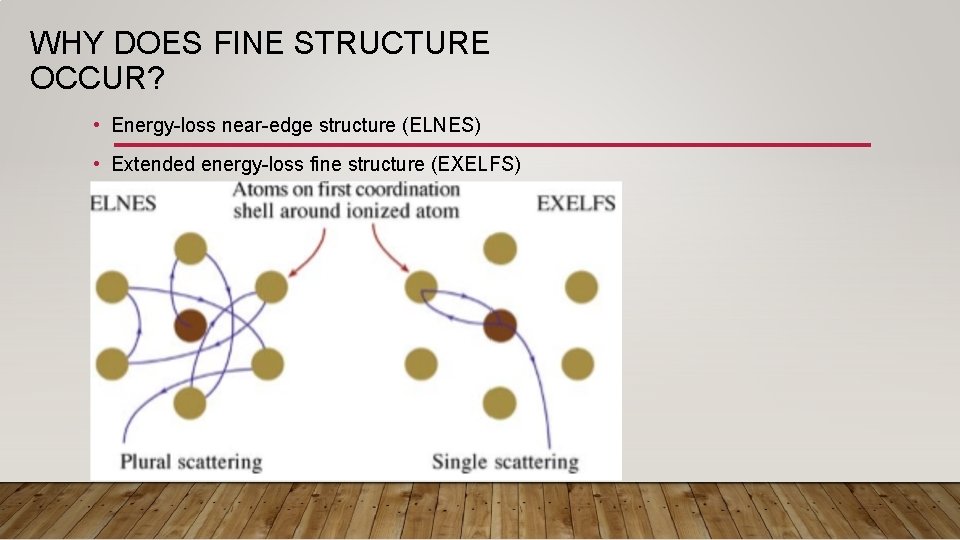
WHY DOES FINE STRUCTURE OCCUR? • Energy-loss near-edge structure (ELNES) • Extended energy-loss fine structure (EXELFS)
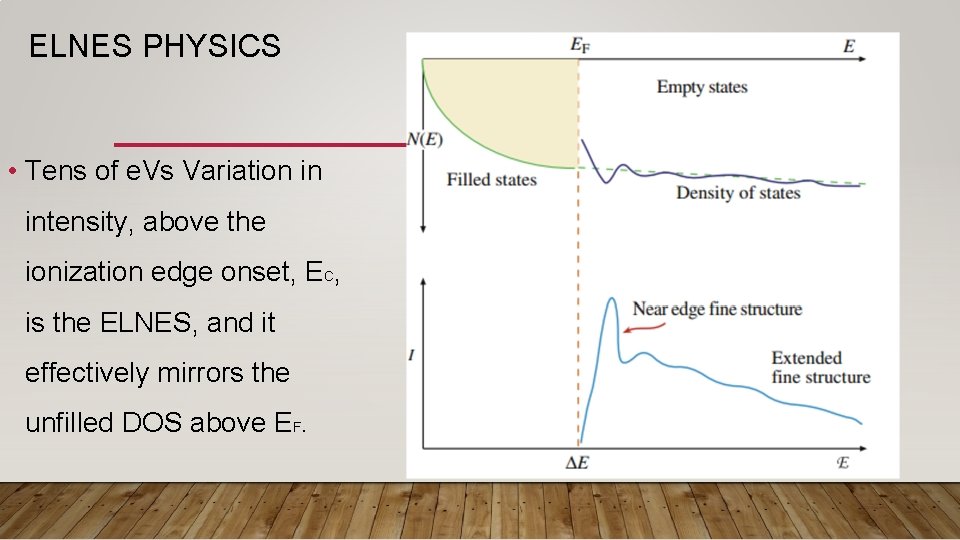
ELNES PHYSICS • Tens of e. Vs Variation in intensity, above the ionization edge onset, EC, is the ELNES, and it effectively mirrors the unfilled DOS above EF.
APPLICATION OF ELNES • Local atomic environment details • Elecronic structure • Material properties
ELNES CALCULATIONS • ELNES is directly related to the details of the electronic structure • Calculating the electronic structure in solids involves solving the Schrodinger equation and Coulomb • Band structure • Electron states • The effect of multiple scattering of the electron wave
EXELFS • ELNES is multiple scattering and EXELFS is single scattering • After ionization, electron does not fill an empty state but escapes and acts like a free electron – Single scatter effect
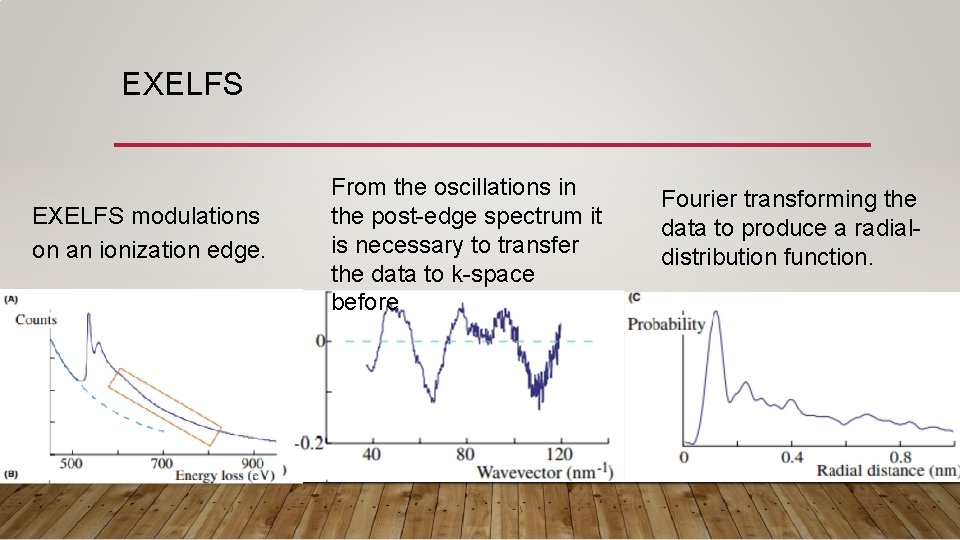
EXELFS modulations on an ionization edge. From the oscillations in the post-edge spectrum it is necessary to transfer the data to k-space before Fourier transforming the data to produce a radialdistribution function.
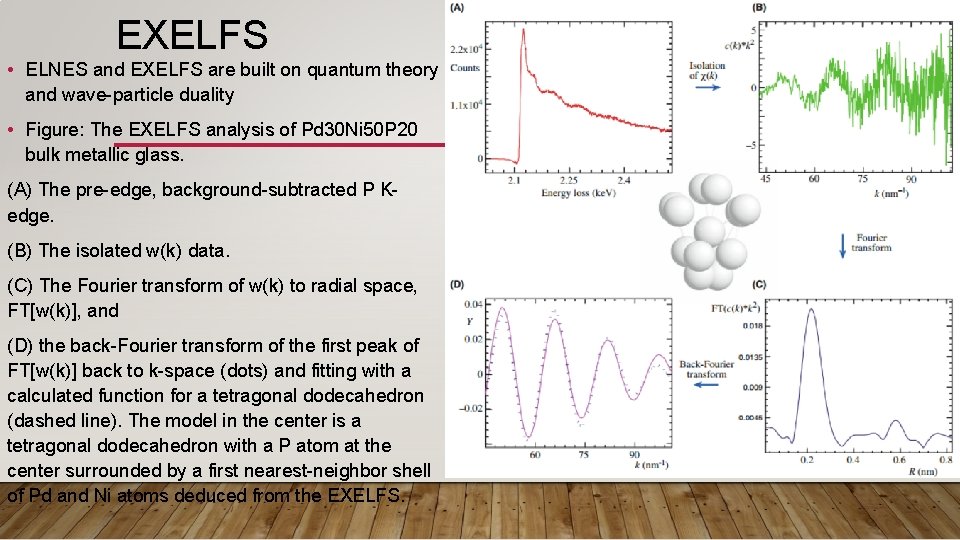
EXELFS • ELNES and EXELFS are built on quantum theory and wave-particle duality • Figure: The EXELFS analysis of Pd 30 Ni 50 P 20 bulk metallic glass. (A) The pre-edge, background-subtracted P Kedge. (B) The isolated w(k) data. (C) The Fourier transform of w(k) to radial space, FT[w(k)], and (D) the back-Fourier transform of the first peak of FT[w(k)] back to k-space (dots) and fitting with a calculated function for a tetragonal dodecahedron (dashed line). The model in the center is a tetragonal dodecahedron with a P atom at the center surrounded by a first nearest-neighbor shell of Pd and Ni atoms deduced from the EXELFS.
SUMMARY • Much information of fine details can be found from ELNES and EXELFS • Interpretation of the data is still limited by our lack of knowledge of the physics of the electron-specimen interactions