
Fine Structure and Analysis of Eukaryotic Genes Split

- Slides: 29
Fine Structure and Analysis of Eukaryotic Genes Split genes Multigene families Functional analysis of eukaryotic genes
Split genes and introns • The m. RNA-coding portion of a gene can be split by DNA sequences that do not encode mature m. RNA • Exons code for m. RNA, introns are segments of genes that do not encode m. RNA. • Introns are found in most genes in eukaryotes • Also found in some bacteriophage genes and in some genes in archae
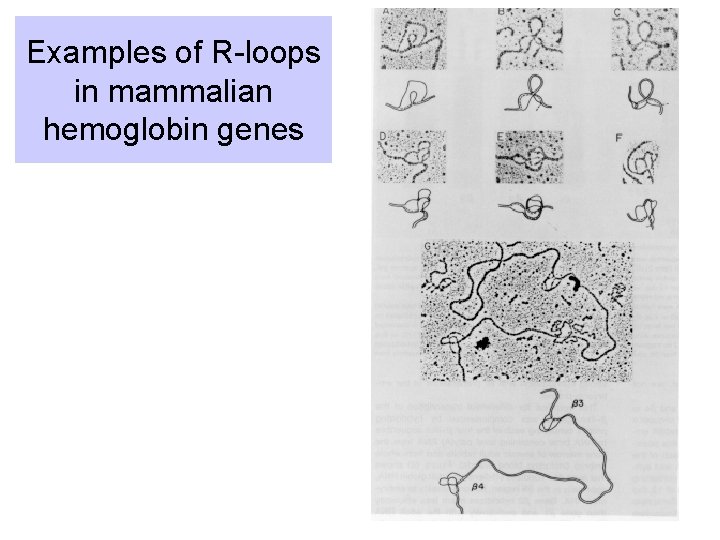
R-loops can reveal introns
Examples of R-loops in mammalian hemoglobin genes
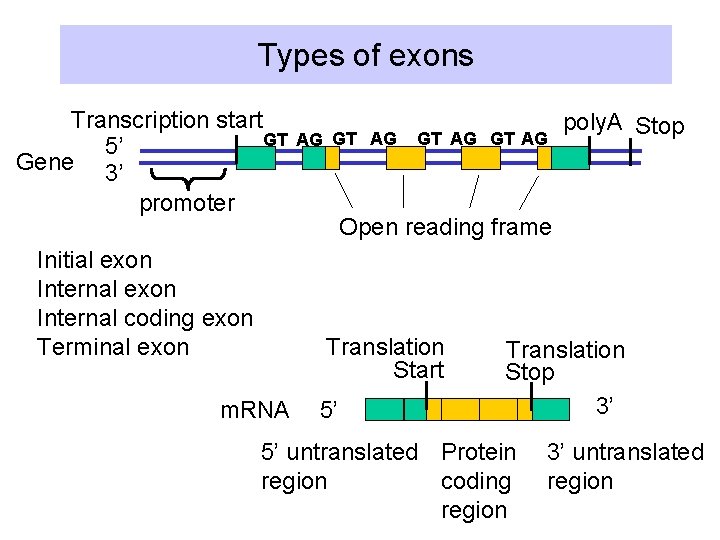
Types of exons Transcription start GT 5’ Gene 3’ promoter Initial exon Internal coding exon Terminal exon AG GT AG Open reading frame Translation Start m. RNA poly. A Stop 5’ Translation Stop 3’ 5’ untranslated Protein region coding region 3’ untranslated region
Finding exons with computers • Ab initio computation – E. g. Genscan: http: //genes. mit. edu/GENSCAN. html – Uses an explicit, sophisticated model of gene structure, splice site properties, etc to predict exons • Compare c. DNA sequence with genomic sequence – BLAST 2 alignments between c. DNA and genomic sequences – http: //www. ncbi. nlm. nih. gov/blast/ – Better: Use sim 4 • Takes into account terminal redundancy at ends of introns • http: //bio. cse. psu. edu • Follow link to “sim 4 server in France”
Find exons for HBB • Sequence for human beta-globin gene (HBB): – Accession number L 48217 – Thalassemia variant • Sequence for HBB m. RNA – NM_000518 • Retrieve those from Gen. Bank at NCBI (or the course website) – http: //www. ncbi. nlm. nih. gov – Get the files in FASTA format • Run Genscan and BLAST 2 sequences
Genscan analysis of HBB gene
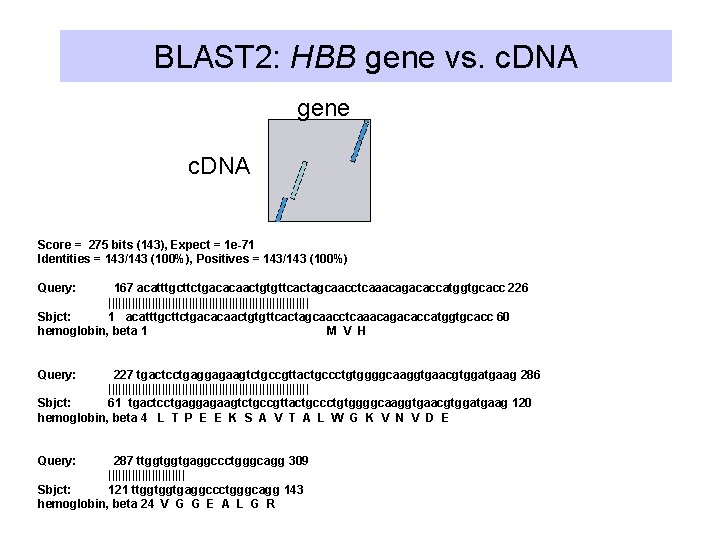
BLAST 2: HBB gene vs. c. DNA gene c. DNA Score = 275 bits (143), Expect = 1 e-71 Identities = 143/143 (100%), Positives = 143/143 (100%) Query: 167 acatttgcttctgacacaactgtgttcactagcaacctcaaacagacaccatggtgcacc 226 |||||||||||||||||||||||||||||| Sbjct: 1 acatttgcttctgacacaactgtgttcactagcaacctcaaacagacaccatggtgcacc 60 hemoglobin, beta 1 M V H Query: 227 tgactcctgaggagaagtctgccgttactgccctgtggggcaaggtgaacgtggatgaag 286 |||||||||||||||||||||||||||||| Sbjct: 61 tgactcctgaggagaagtctgccgttactgccctgtggggcaaggtgaacgtggatgaag 120 hemoglobin, beta 4 L T P E E K S A V T A L W G K V N V D E Query: 287 ttggtggtgaggccctgggcagg 309 |||||||||||| Sbjct: 121 ttggtggtgaggccctgggcagg 143 hemoglobin, beta 24 V G G E A L G R
Introns are removed by splicing RNA precursors
Alternative splicing can generate multiple polypeptides from a single gene
Alternative splicing can generate multiple polypeptides from a single gene, part 2
Multigene families, e. g. encoding hemoglobin
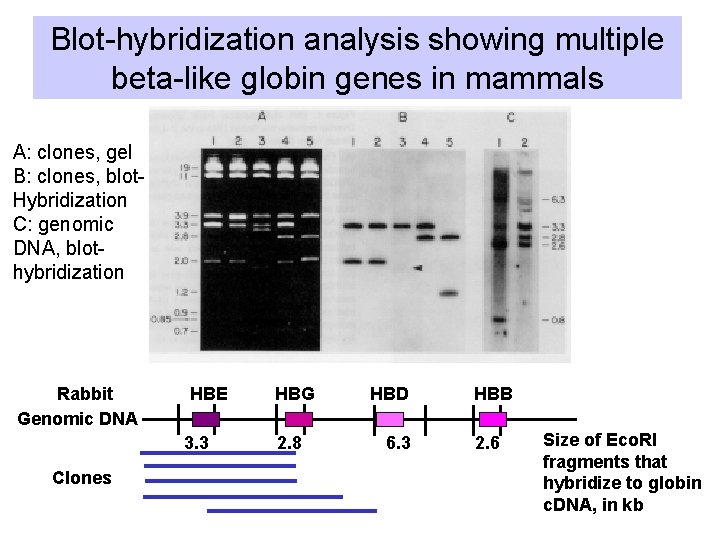
Blot-hybridization analysis showing multiple beta-like globin genes in mammals A: clones, gel B: clones, blot. Hybridization C: genomic DNA, blothybridization Rabbit Genomic DNA HBE 3. 3 Clones HBG 2. 8 HBD 6. 3 HBB 2. 6 Size of Eco. RI fragments that hybridize to globin c. DNA, in kb
Functional analysis of isolated genes
Gene Expression: where and how much? • A gene is expressed when a functional product is made from it. • One wants to know many things about how a gene is expressed, e. g. – In which tissues? – At what developmental stages? – In response to which environmental conditions? – At which stages of the cell cycle? – How much product is made?
RNA blot-hybridizations = Northerns
RNA blot-hybridization: Stage specificity
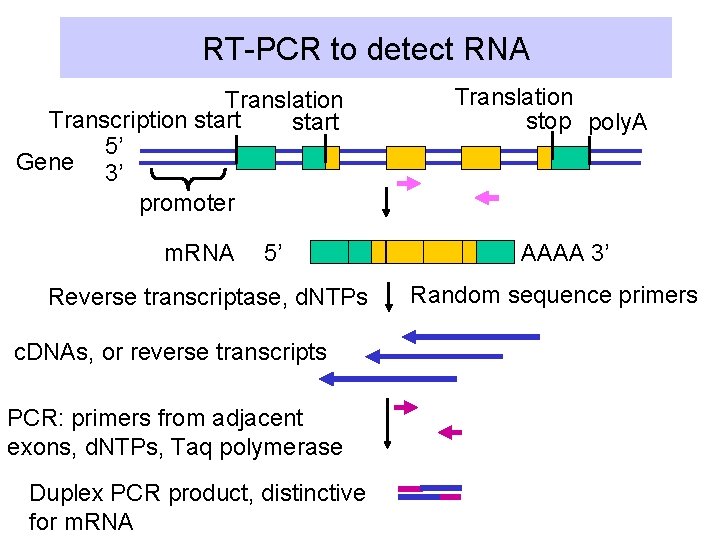
RT-PCR to detect RNA Translation Transcription start 5’ Gene 3’ promoter m. RNA 5’ Reverse transcriptase, d. NTPs c. DNAs, or reverse transcripts PCR: primers from adjacent exons, d. NTPs, Taq polymerase Duplex PCR product, distinctive for m. RNA Translation stop poly. A AAAA 3’ Random sequence primers
In situ hybridization and immunoreactions
Sequence everything, find function later • Determine the sequence of hundreds of thousands of c. DNA clones from libraries constructed from many different tissues and stages of development of organism of interest. • Initially, the sequences are partials, and are referred to as expressed sequence tags (ESTs). • Use these c. DNAs in high-throughput screening and testing, e. g. expression microarrays (next presentation).
Massively parallel screening of high-density chip arrays • Once the sequence of an entire genome has been determined, a diagnostic sequence can be generated for all the genes. • Synthesize this diagnostic sequence (a tag) for each gene on a high-density array on a chip, e. g. 6000 to 20, 000 gene tags per chip. • Hybridize the chip with labeled c. DNA from each of the cellular states being examined. • Measure the level of hybridization signal from each gene under each state. • Identify the genes whose expression level differs in each state. The genes are already available.
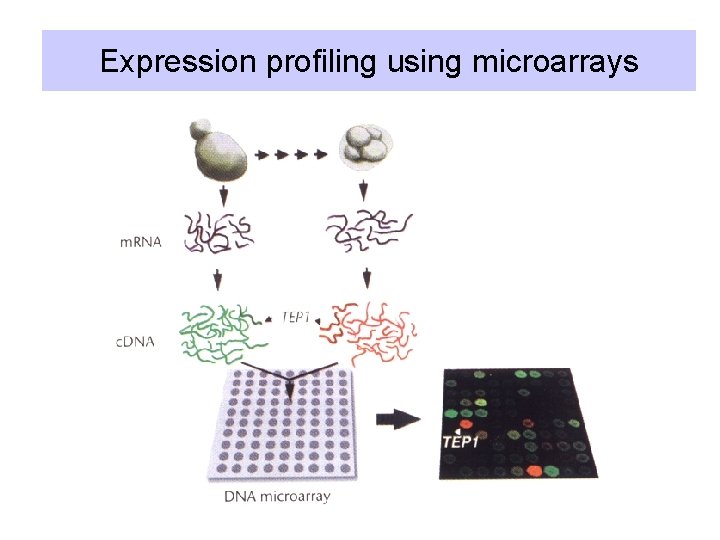
Expression profiling using microarrays
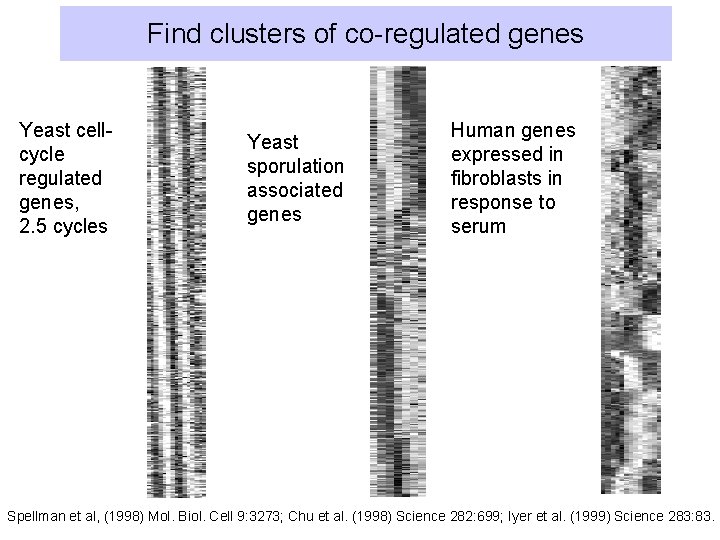
Find clusters of co-regulated genes Yeast cellcycle regulated genes, 2. 5 cycles Yeast sporulation associated genes Human genes expressed in fibroblasts in response to serum Spellman et al, (1998) Mol. Biol. Cell 9: 3273; Chu et al. (1998) Science 282: 699; Iyer et al. (1999) Science 283: 83.
Search the databases • What can be learned from the DNA sequence of a novel gene or polypeptide? • Many metabolic functions are carried out by proteins conserved from bacteria or yeast to humans - one may find a homolog with a known function. • Many sequence motifs are associated with a specific biochemical function (e. g. kinase, ATPase). A match to such a motif identifies a potential class of reactions for the novel polypeptide.
Databases, cont’d • One may find a match to other genes with no known function, but their pattern of expression may be known. • Types of databases: – Whole and partial genomic DNA sequences – Partial c. DNAs from tissues (ESTs = expressed sequence tags) – Databases on gene expression – Genetic maps
Express the protein product • Express the protein in large amounts – In bacteria – In mammalian cells – In insect cells (baculovirus vectors) • Purify it • Assay for various enzymatic or other activities, guided by (e. g. ) – The way you screened for the clone – Sequence matches
Phenotype of directed mutation • Mutate the gene in the organism of interest, and then test for a phenotype • Gain of function – Over-expression – Ectopic expression (where normally is silent) • Loss of function – Knock-out expression of the endogenous gene (homologous recombination, antisense) – Express dominant negative alleles – Conditional loss-of-function, e. g. knock-out by recombination only in selected tissues
Localization on a gene map • E. g. , use gene-specific probes for in situ hybridizations to mitotic chromosomes. Align the hybridization pattern with the banding pattern • Are there any previously mapped genes in this region that provide some insight into your gene?