
FINE PARTICULATE MATTER AND CARDIOVASCULAR ADMISSIONS IN NY

- Slides: 18
FINE PARTICULATE MATTER AND CARDIOVASCULAR ADMISSIONS IN NY STATE: AN ASSESSMENT OF EXPOSURE MODEL CHOICE SENSITIVITY AND SPATIAL-TEMPORAL EFFECT MODIFICATION MIKE HE mike. he@columbia. edu TEMPO Health Conference October 10, 2019 1
Introduction • Air pollution and health – widely studied, effects well-documented • Historically, time-series studies used monitoring data (e. g. AQS) 2
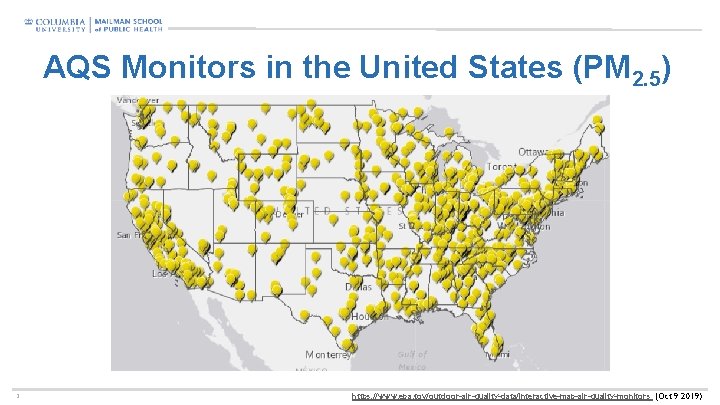
AQS Monitors in the United States (PM 2. 5) 3 https: //www. epa. gov/outdoor-air-quality-data/interactive-map-air-quality-monitors (Oct 9 2019)
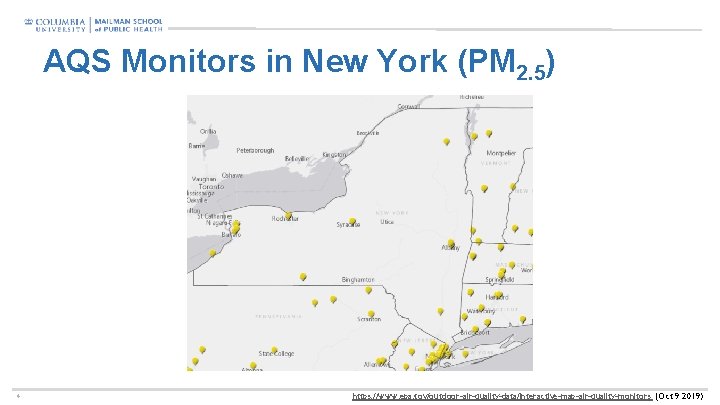
AQS Monitors in New York (PM 2. 5) 4 https: //www. epa. gov/outdoor-air-quality-data/interactive-map-air-quality-monitors (Oct 9 2019)
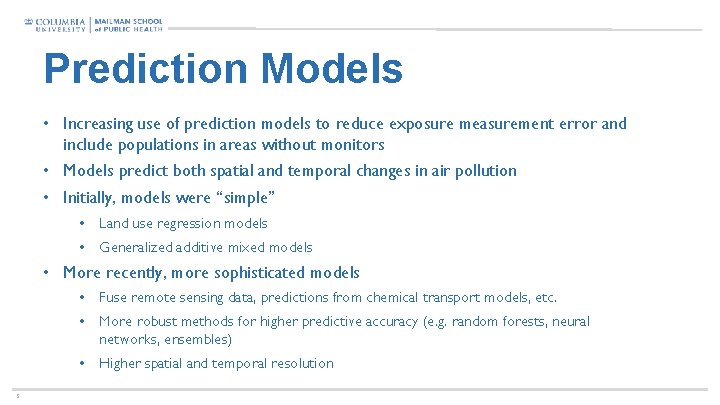
Prediction Models • Increasing use of prediction models to reduce exposure measurement error and include populations in areas without monitors • Models predict both spatial and temporal changes in air pollution • Initially, models were “simple” • Land use regression models • Generalized additive mixed models • More recently, more sophisticated models • Fuse remote sensing data, predictions from chemical transport models, etc. • More robust methods for higher predictive accuracy (e. g. random forests, neural networks, ensembles) • Higher spatial and temporal resolution 5
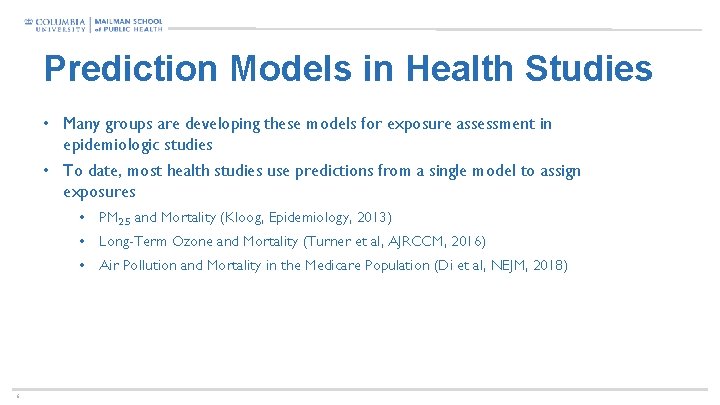
Prediction Models in Health Studies • Many groups are developing these models for exposure assessment in epidemiologic studies • To date, most health studies use predictions from a single model to assign exposures • PM 2. 5 and Mortality (Kloog, Epidemiology, 2013) • Long-Term Ozone and Mortality (Turner et al, AJRCCM, 2016) • Air Pollution and Mortality in the Medicare Population (Di et al, NEJM, 2018) 6
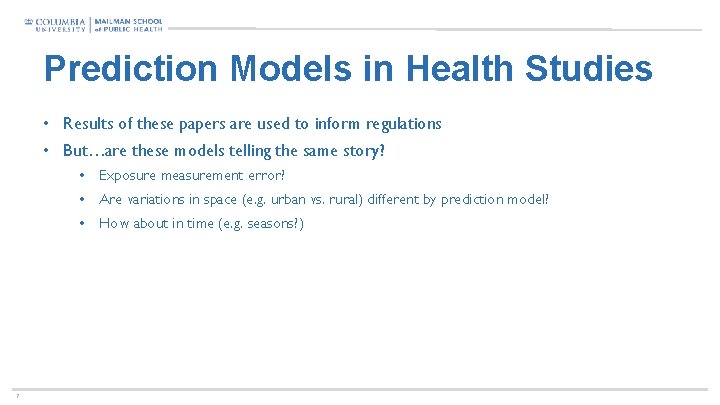
Prediction Models in Health Studies • Results of these papers are used to inform regulations • But…are these models telling the same story? • Exposure measurement error? • Are variations in space (e. g. urban vs. rural) different by prediction model? • How about in time (e. g. seasons? ) 7
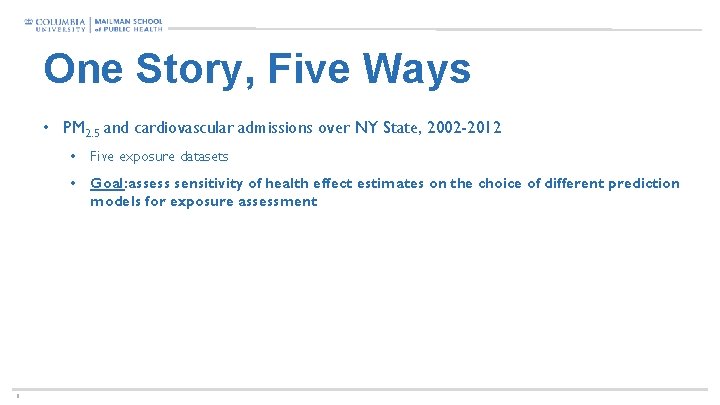
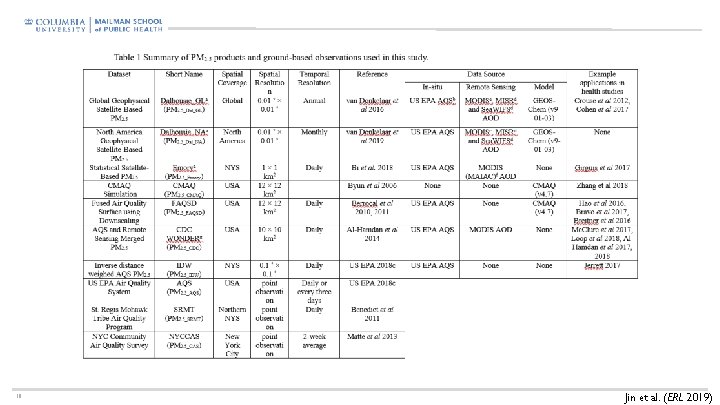
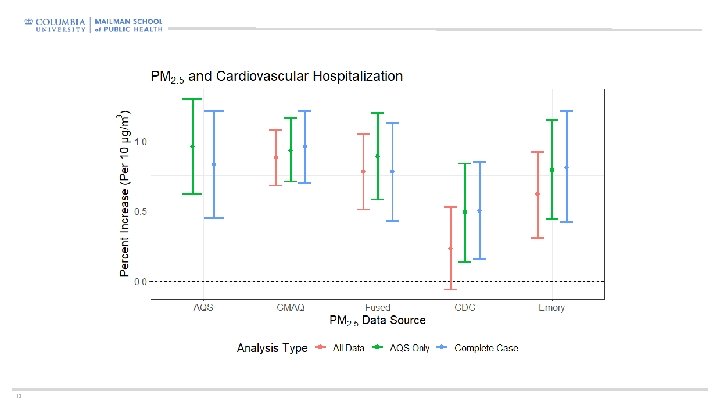
One Story, Five Ways • PM 2. 5 and cardiovascular admissions over NY State, 2002 -2012 • Five exposure datasets • Goal: assess sensitivity of health effect estimates on the choice of different prediction models for exposure assessment 8
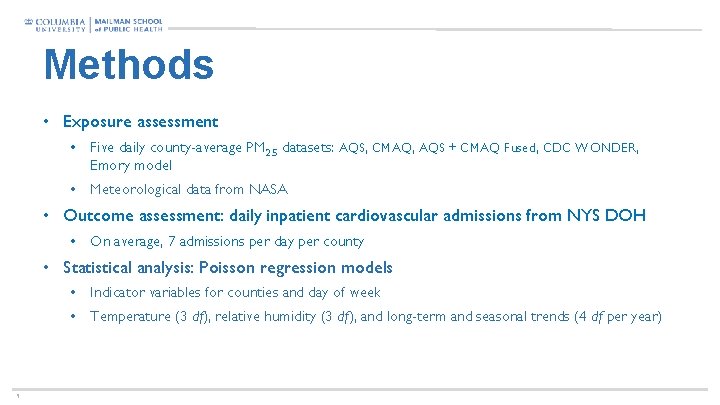
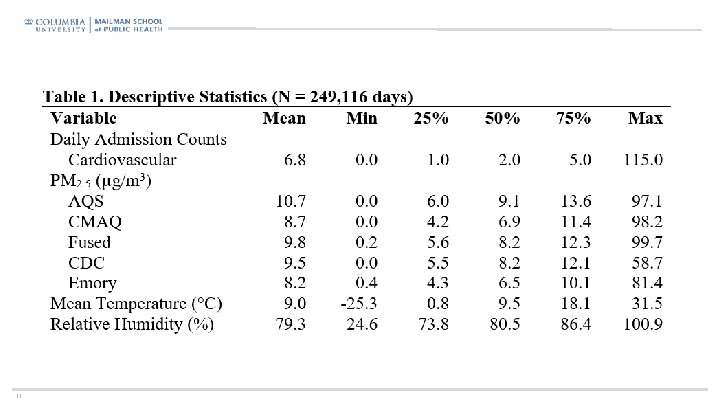
Methods • Exposure assessment • Five daily county-average PM 2. 5 datasets: AQS, CMAQ, AQS + CMAQ Fused, CDC WONDER, Emory model • Meteorological data from NASA • Outcome assessment: daily inpatient cardiovascular admissions from NYS DOH • On average, 7 admissions per day per county • Statistical analysis: Poisson regression models • Indicator variables for counties and day of week • Temperature (3 df), relative humidity (3 df), and long-term and seasonal trends (4 df per year) 9
10 Jin et al. (ERL 2019)
11
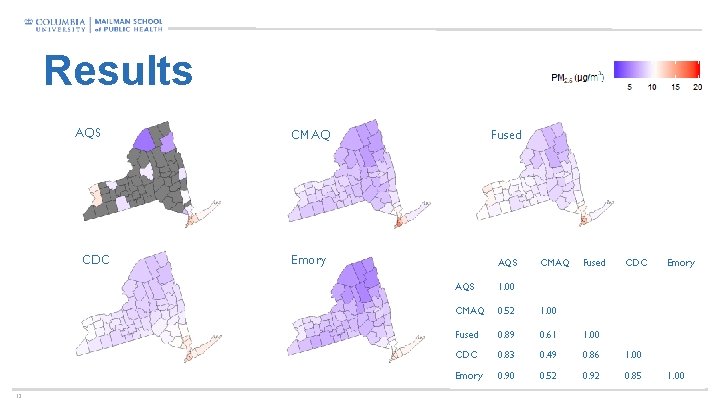
Results AQS CDC 12 CMAQ Fused Emory AQS CMAQ Fused CDC AQS 1. 00 CMAQ 0. 52 1. 00 Fused 0. 89 0. 61 1. 00 CDC 0. 83 0. 49 0. 86 1. 00 Emory 0. 90 0. 52 0. 92 0. 85 Emory 1. 00
13
14
15
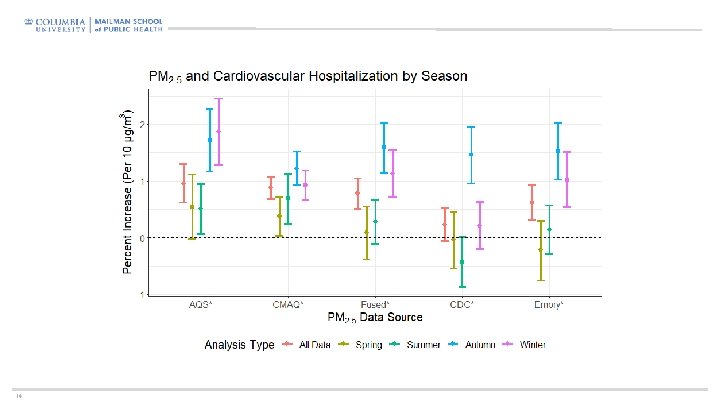
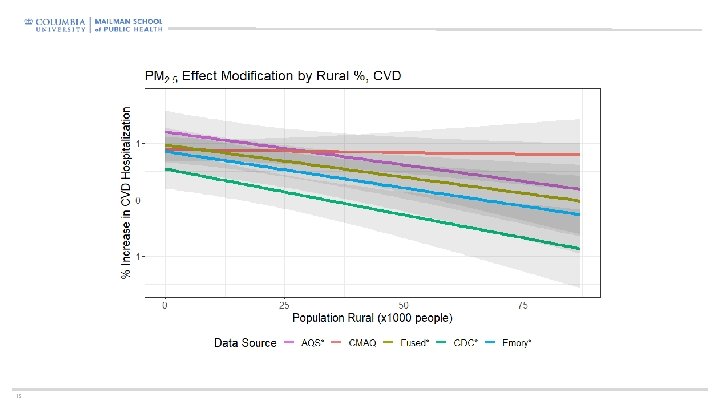
Conclusions • Significant, positive associations between PM 2. 5 and cardiovascular admissions for all (but one) model • Some fluctuation in effect estimates depending on analysis type • Differences could be due to measurement error • However, conclusion remains the same! • Effect modification: • Spatial: higher estimates in more urban areas • Temporal: generally higher estimates in fall/winter, but some differences across models 16
Acknowledgments Collaborators: Funding: MARIANTHI-ANNA KIOUMOURTZOGLOU 1 PATRICK KINNEY 2 ARLENE FIORE 1 XIAOMENG JIN 1 VIVIAN DO 1 SILIANG LIU 1 TABASSUM INSAF 3 ADRIAN MICHALSKI 3 NIEHS Individual Fellowship F 31 ES 029372 NIH Institutional Research T 32 ES 023770 NIEHS Center Core P 30 ES 009089 NASA HAQAST Grant (#NNX 16 AQ 20 G) NASA HAQAST 5 Travel Award NYSERDA Grant (#91268) 1 Columbia University 3 NYS Dept. of Health 2 Boston 17
Thank You! 18