
Fine Motor Programme Supporting learners to develop fine
- Slides: 22
Fine Motor Programme Supporting learners to develop fine motor skills The Occupational Therapy Team has devised the following programme which includes the progression of developing bilateral arm skills and fine motor skills. This is for learners where it has been identified on their EHCP or initial Occupational Therapy assessment that they would benefit from the development of their fine motor skills to influence performance in day to day activities. Occupational Therapy 2019 -2020
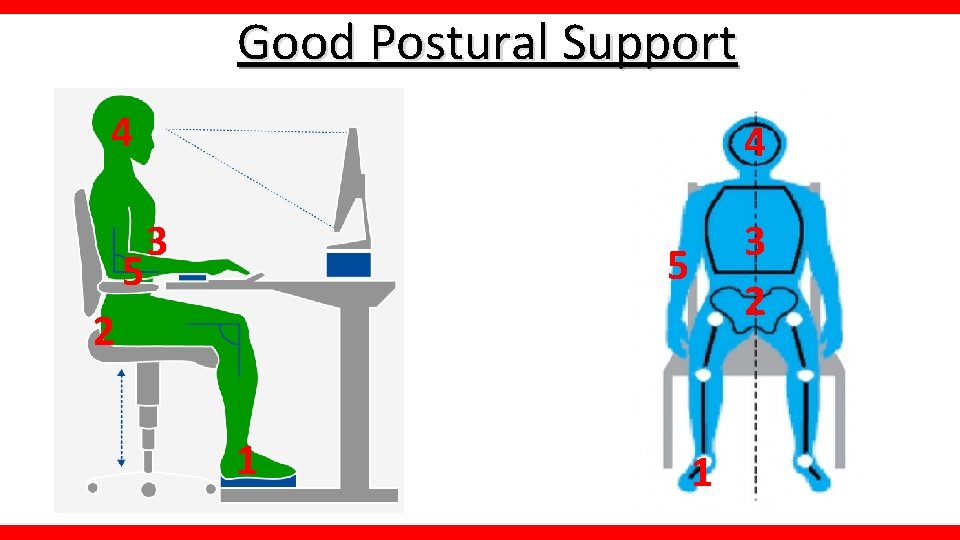
Good Postural Support 4 5 4 3 3 2 5 2 1 1
Our learners need to be in this position whether using a standard chair, adapted chair or wheelchair. Without the correct positioning when sitting, a person will have increased difficulty with trunk control, arm and shoulder stability and the ability to isolate and concentrate on their fine motor skills (ie. their hand finger skills. ) Look at someone’s posture by working up from the floor to their heads then down their arms: 1. Feet supported on foot rests 2. Bottom at the back of the chair (especially seen in wheelchairs) 3. Trunk-sat upright not leaning off to the side 4. Head upright position looking in direction of activity. 5. Arms have something to rest on Without the core support of our trunk we will not be able to use our arms and then fingers to complete day to day activities.
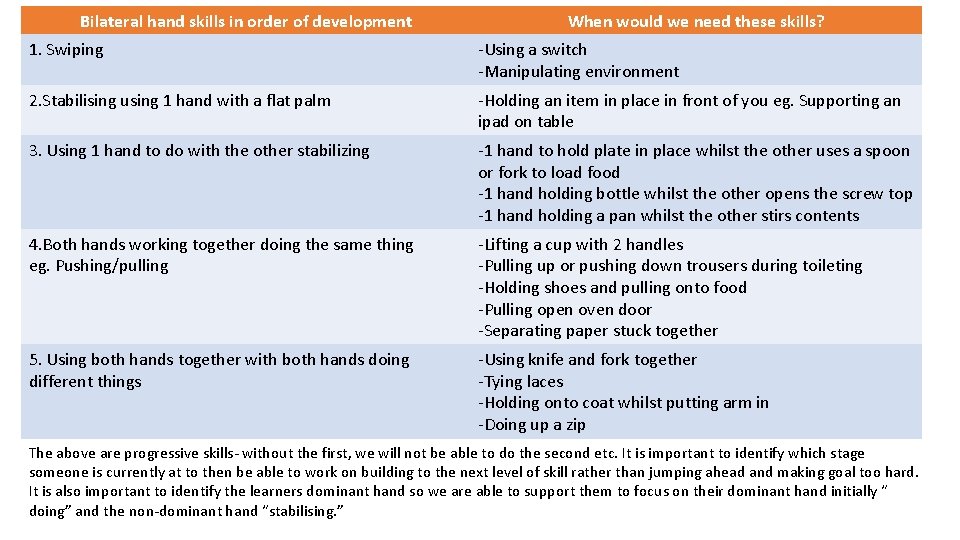
Bilateral hand skills in order of development When would we need these skills? 1. Swiping -Using a switch -Manipulating environment 2. Stabilising using 1 hand with a flat palm -Holding an item in place in front of you eg. Supporting an ipad on table 3. Using 1 hand to do with the other stabilizing -1 hand to hold plate in place whilst the other uses a spoon or fork to load food -1 hand holding bottle whilst the other opens the screw top -1 hand holding a pan whilst the other stirs contents 4. Both hands working together doing the same thing eg. Pushing/pulling -Lifting a cup with 2 handles -Pulling up or pushing down trousers during toileting -Holding shoes and pulling onto food -Pulling open oven door -Separating paper stuck together 5. Using both hands together with both hands doing different things -Using knife and fork together -Tying laces -Holding onto coat whilst putting arm in -Doing up a zip The above are progressive skills- without the first, we will not be able to do the second etc. It is important to identify which stage someone is currently at to then be able to work on building to the next level of skill rather than jumping ahead and making goal too hard. It is also important to identify the learners dominant hand so we are able to support them to focus on their dominant hand initially “ doing” and the non-dominant hand “stabilising. ”
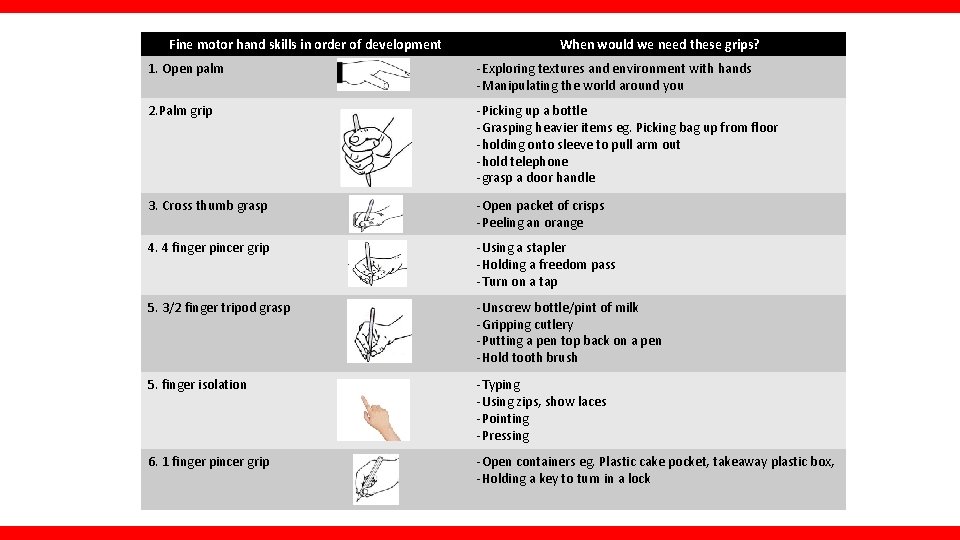
Fine motor hand skills in order of development When would we need these grips? 1. Open palm -Exploring textures and environment with hands -Manipulating the world around you 2. Palm grip -Picking up a bottle -Grasping heavier items eg. Picking bag up from floor -holding onto sleeve to pull arm out -hold telephone -grasp a door handle 3. Cross thumb grasp -Open packet of crisps -Peeling an orange 4. 4 finger pincer grip -Using a stapler -Holding a freedom pass -Turn on a tap 5. 3/2 finger tripod grasp -Unscrew bottle/pint of milk -Gripping cutlery -Putting a pen top back on a pen -Hold tooth brush 5. finger isolation -Typing -Using zips, show laces -Pointing -Pressing 6. 1 finger pincer grip -Open containers eg. Plastic cake pocket, takeaway plastic box, -Holding a key to turn in a lock
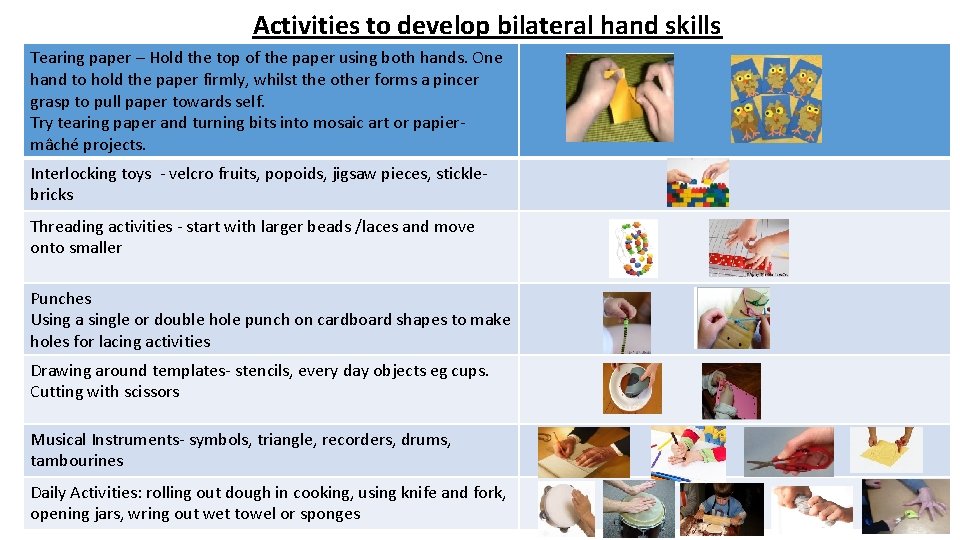
Activities to develop bilateral hand skills Tearing paper – Hold the top of the paper using both hands. One hand to hold the paper firmly, whilst the other forms a pincer grasp to pull paper towards self. Try tearing paper and turning bits into mosaic art or papiermâché projects. Interlocking toys - velcro fruits, popoids, jigsaw pieces, sticklebricks Threading activities - start with larger beads /laces and move onto smaller Punches Using a single or double hole punch on cardboard shapes to make holes for lacing activities Drawing around templates- stencils, every day objects eg cups. Cutting with scissors Musical Instruments- symbols, triangle, recorders, drums, tambourines Daily Activities: rolling out dough in cooking, using knife and fork, opening jars, wring out wet towel or sponges
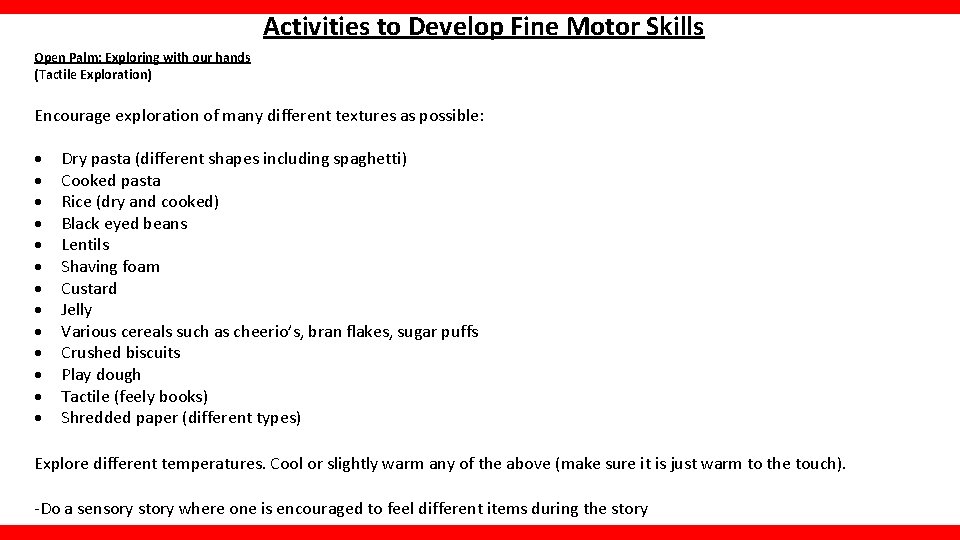
Activities to Develop Fine Motor Skills Open Palm: Exploring with our hands (Tactile Exploration) Encourage exploration of many different textures as possible: Dry pasta (different shapes including spaghetti) Cooked pasta Rice (dry and cooked) Black eyed beans Lentils Shaving foam Custard Jelly Various cereals such as cheerio’s, bran flakes, sugar puffs Crushed biscuits Play dough Tactile (feely books) Shredded paper (different types) Explore different temperatures. Cool or slightly warm any of the above (make sure it is just warm to the touch). -Do a sensory story where one is encouraged to feel different items during the story
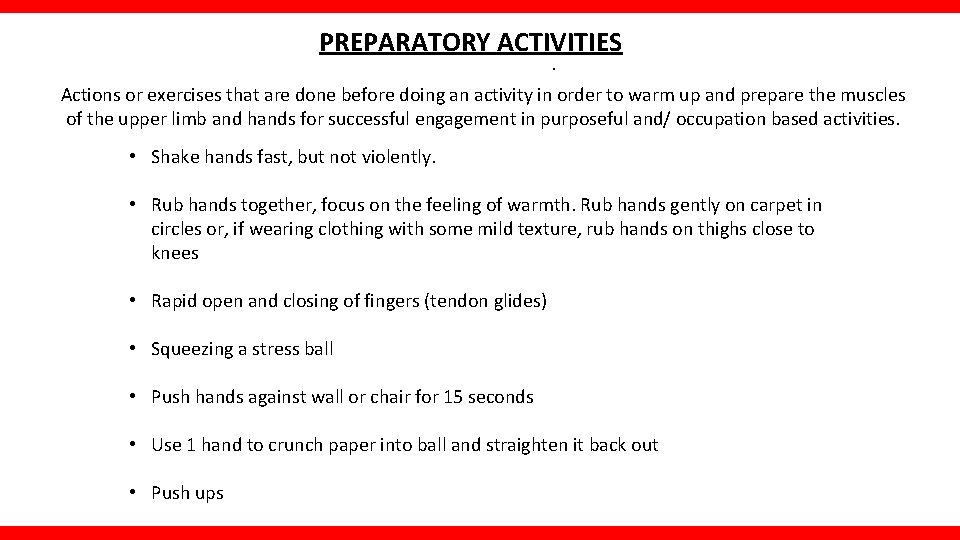
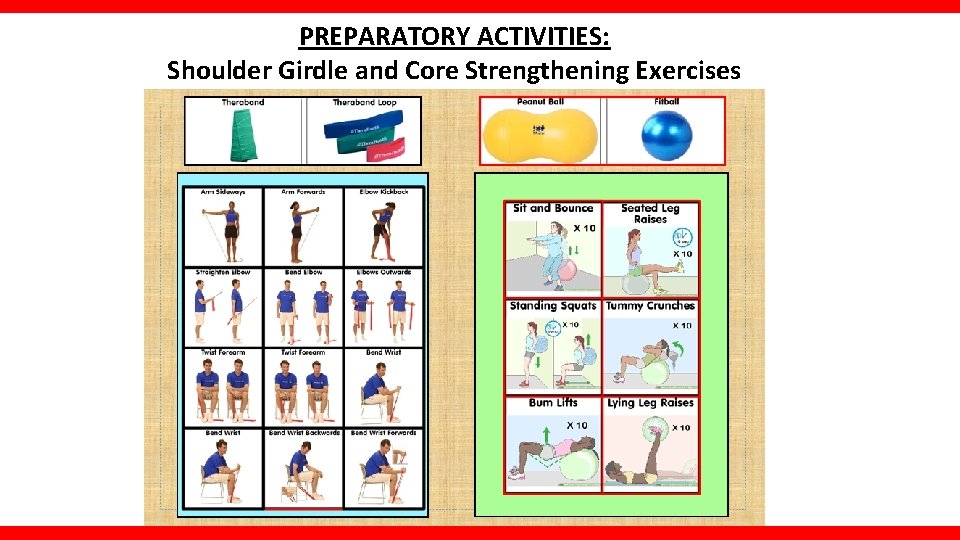
PREPARATORY ACTIVITIES. Actions or exercises that are done before doing an activity in order to warm up and prepare the muscles of the upper limb and hands for successful engagement in purposeful and/ occupation based activities. • Shake hands fast, but not violently. • Rub hands together, focus on the feeling of warmth. Rub hands gently on carpet in circles or, if wearing clothing with some mild texture, rub hands on thighs close to knees • Rapid open and closing of fingers (tendon glides) • Squeezing a stress ball • Push hands against wall or chair for 15 seconds • Use 1 hand to crunch paper into ball and straighten it back out • Push ups
PREPARATORY ACTIVITIES: . Shoulder Girdle and Core Strengthening Exercises
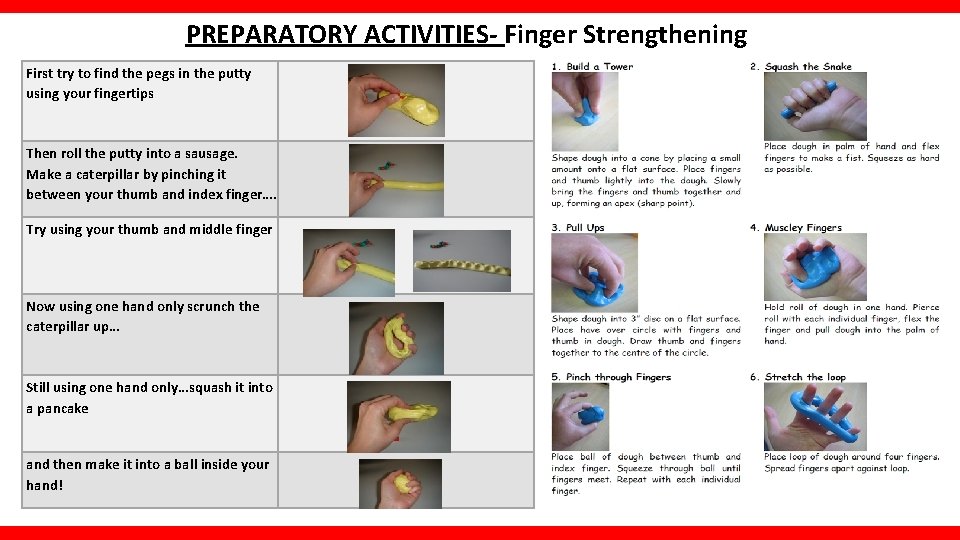
PREPARATORY ACTIVITIES- Finger Strengthening First try to find the pegs in the putty using your fingertips Then roll the putty into a sausage. Make a caterpillar by pinching it between your thumb and index finger…. Try using your thumb and middle finger Now using one hand only scrunch the caterpillar up… Still using one hand only…squash it into a pancake and then make it into a ball inside your hand! .
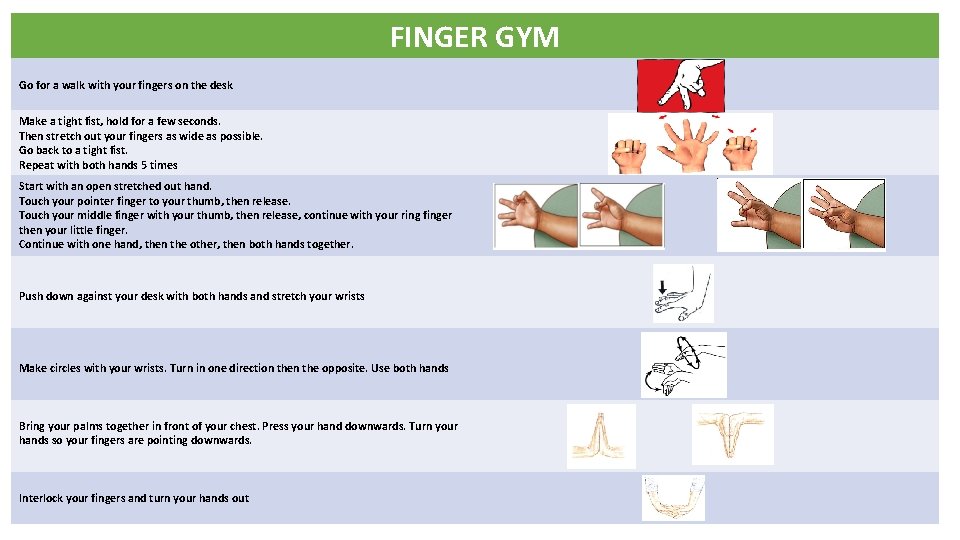
FINGER GYM Go for a walk with your fingers on the desk Make a tight fist, hold for a few seconds. Then stretch out your fingers as wide as possible. Go back to a tight fist. Repeat with both hands 5 times Start with an open stretched out hand. Touch your pointer finger to your thumb, then release. Touch your middle finger with your thumb, then release, continue with your ring finger then your little finger. Continue with one hand, then the other, then both hands together. Push down against your desk with both hands and stretch your wrists Make circles with your wrists. Turn in one direction the opposite. Use both hands Bring your palms together in front of your chest. Press your hand downwards. Turn your hands so your fingers are pointing downwards. Interlock your fingers and turn your hands out
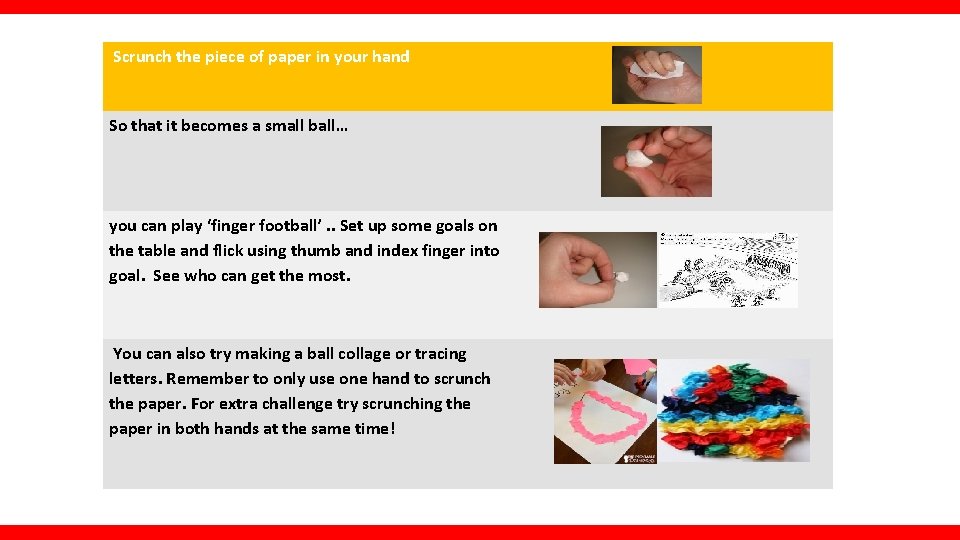
Scrunch the piece of paper in your hand So that it becomes a small ball… you can play ‘finger football’. . Set up some goals on the table and flick using thumb and index finger into goal. See who can get the most. You can also try making a ball collage or tracing letters. Remember to only use one hand to scrunch the paper. For extra challenge try scrunching the paper in both hands at the same time!
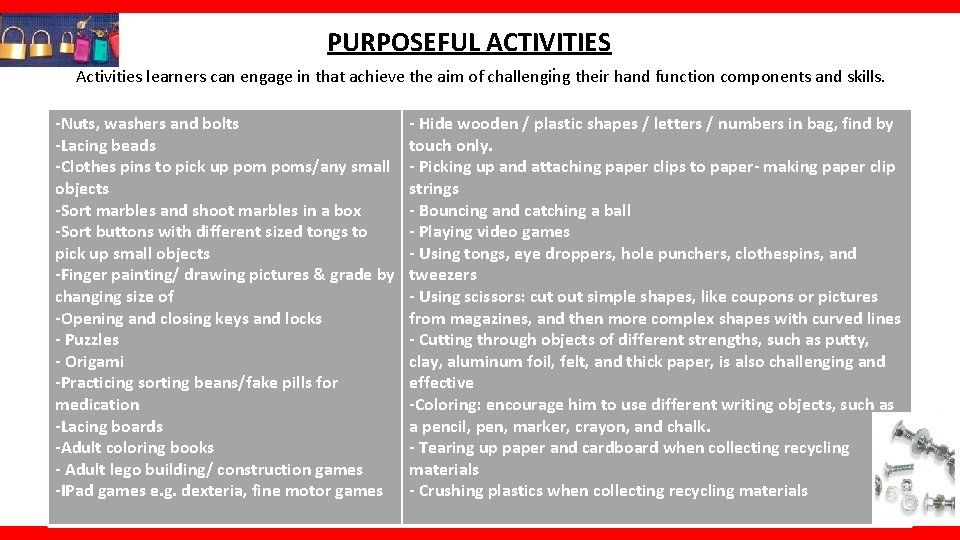
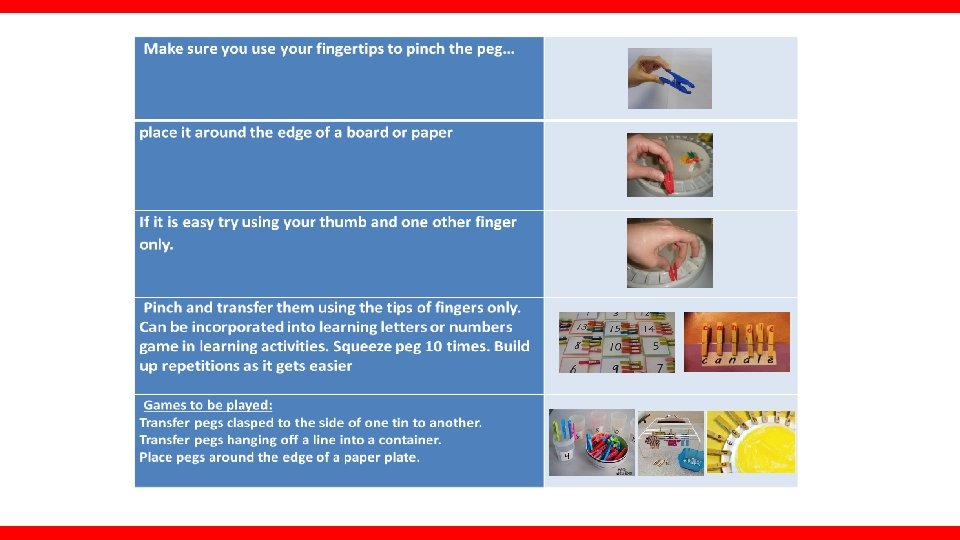
PURPOSEFUL ACTIVITIES . Activities learners can engage in that achieve the aim of challenging their hand function components and skills. -Nuts, washers and bolts -Lacing beads -Clothes pins to pick up poms/any small objects -Sort marbles and shoot marbles in a box -Sort buttons with different sized tongs to pick up small objects -Finger painting/ drawing pictures & grade by changing size of -Opening and closing keys and locks - Puzzles - Origami -Practicing sorting beans/fake pills for medication -Lacing boards -Adult coloring books - Adult lego building/ construction games -IPad games e. g. dexteria, fine motor games - Hide wooden / plastic shapes / letters / numbers in bag, find by touch only. - Picking up and attaching paper clips to paper- making paper clip strings - Bouncing and catching a ball - Playing video games - Using tongs, eye droppers, hole punchers, clothespins, and tweezers - Using scissors: cut out simple shapes, like coupons or pictures from magazines, and then more complex shapes with curved lines - Cutting through objects of different strengths, such as putty, clay, aluminum foil, felt, and thick paper, is also challenging and effective -Coloring: encourage him to use different writing objects, such as a pencil, pen, marker, crayon, and chalk. - Tearing up paper and cardboard when collecting recycling materials - Crushing plastics when collecting recycling materials
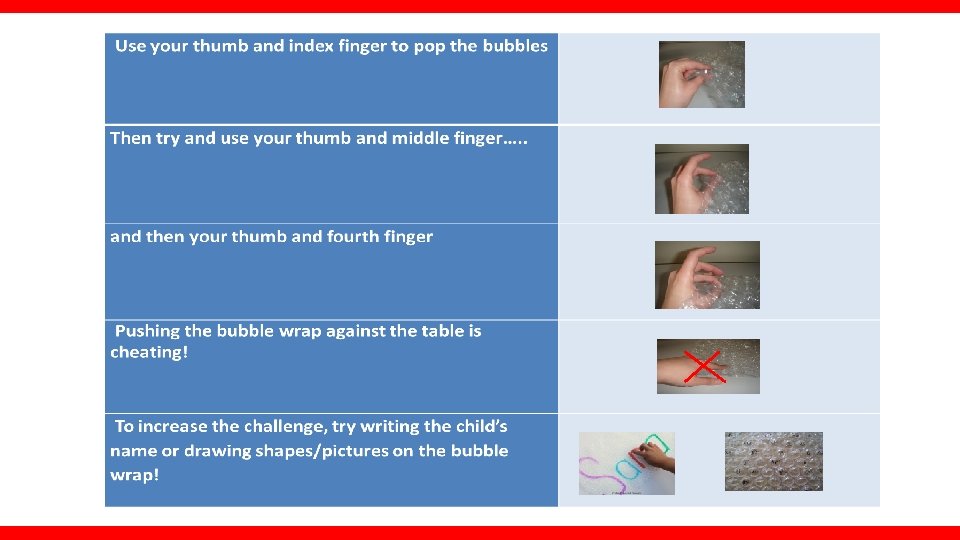
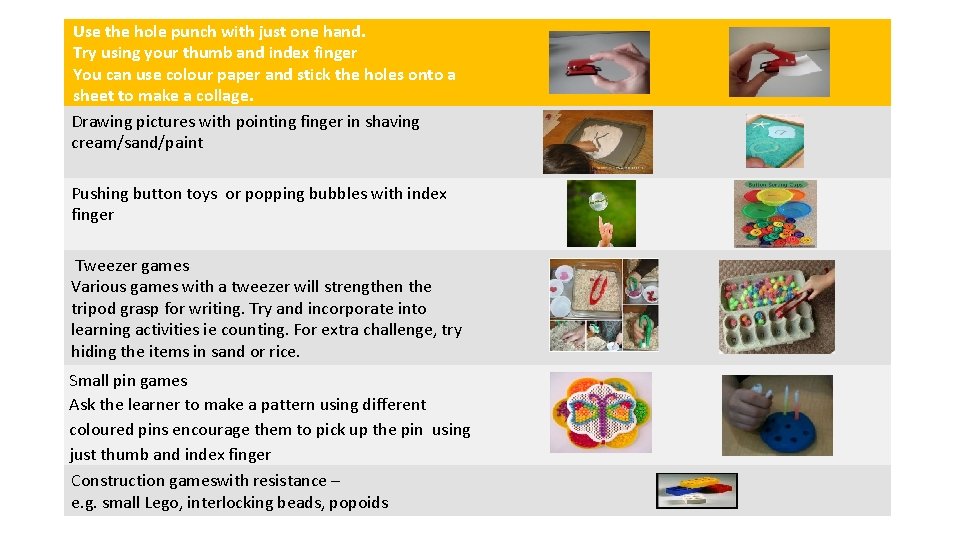
Use the hole punch with just one hand. Try using your thumb and index finger You can use colour paper and stick the holes onto a sheet to make a collage. Drawing pictures with pointing finger in shaving cream/sand/paint Pushing button toys or popping bubbles with index finger Tweezer games Various games with a tweezer will strengthen the tripod grasp for writing. Try and incorporate into learning activities ie counting. For extra challenge, try hiding the items in sand or rice. Small pin games Ask the learner to make a pattern using different coloured pins encourage them to pick up the pin using just thumb and index finger Construction gameswith resistance – e. g. small Lego, interlocking beads, popoids
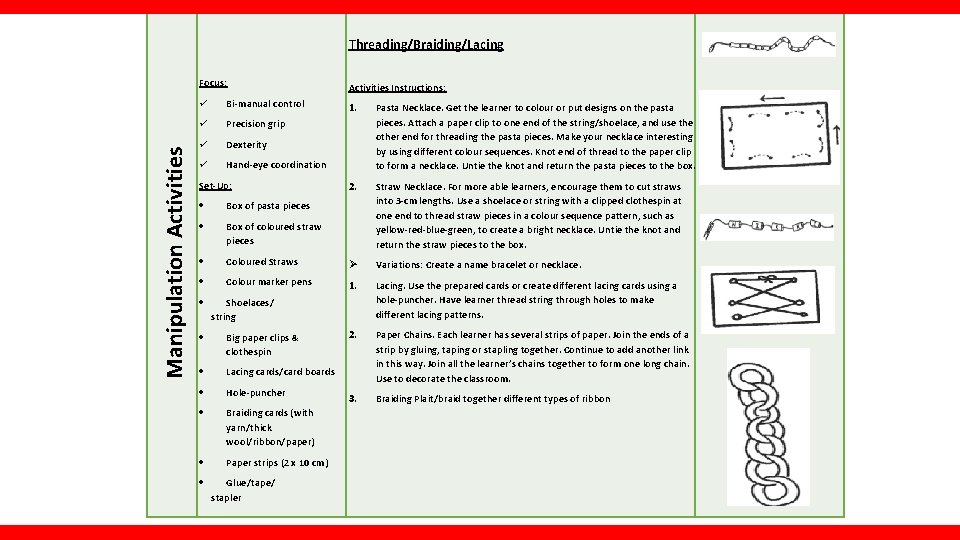
Threading/Braiding/Lacing Manipulation Activities Focus: Bi-manual control Precision grip Dexterity Hand-eye coordination Set-Up: Activities Instructions: 1. Pasta Necklace. Get the learner to colour or put designs on the pasta pieces. Attach a paper clip to one end of the string/shoelace, and use the other end for threading the pasta pieces. Make your necklace interesting by using different colour sequences. Knot end of thread to the paper clip to form a necklace. Untie the knot and return the pasta pieces to the box. 2. Straw Necklace. For more able learners, encourage them to cut straws into 3 -cm lengths. Use a shoelace or string with a clipped clothespin at one end to thread straw pieces in a colour sequence pattern, such as yellow-red-blue-green, to create a bright necklace. Untie the knot and return the straw pieces to the box. Box of pasta pieces Box of coloured straw pieces Coloured Straws Variations: Create a name bracelet or necklace. Colour marker pens 1. Lacing. Use the prepared cards or create different lacing cards using a hole-puncher. Have learner thread string through holes to make different lacing patterns. 2. Paper Chains. Each learner has several strips of paper. Join the ends of a strip by gluing, taping or stapling together. Continue to add another link in this way. Join all the learner’s chains together to form one long chain. Use to decorate the classroom. 3. Braiding Plait/braid together different types of ribbon Shoelaces/ string Big paper clips & clothespin Lacing cards/card boards Hole-puncher Braiding cards (with yarn/thick wool/ribbon/paper) Paper strips (2 x 10 cm) Glue/tape/ stapler
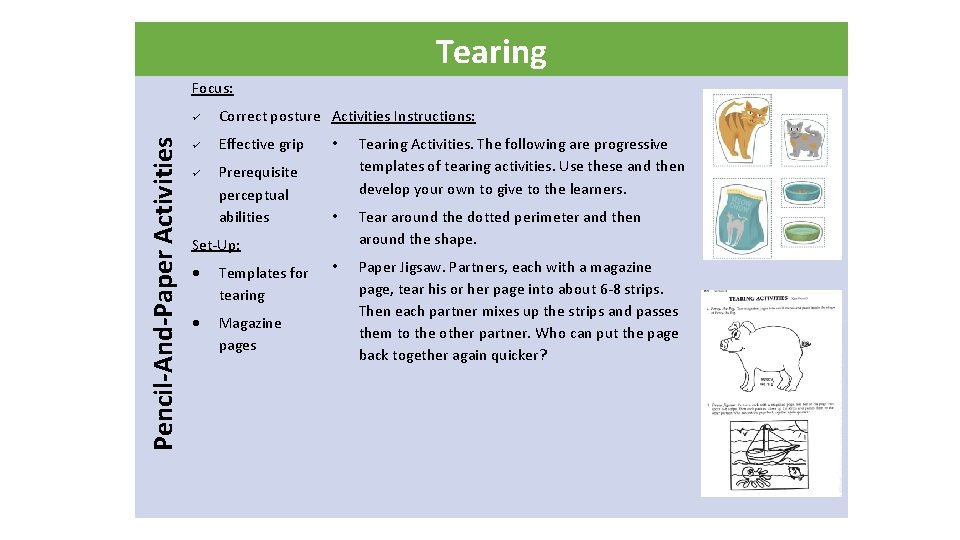
Tearing Pencil-And-Paper Activities Focus: Correct posture Activities Instructions: Effective grip • Prerequisite perceptual abilities Tearing Activities. The following are progressive templates of tearing activities. Use these and then develop your own to give to the learners. • Tear around the dotted perimeter and then around the shape. • Paper Jigsaw. Partners, each with a magazine page, tear his or her page into about 6 -8 strips. Then each partner mixes up the strips and passes them to the other partner. Who can put the page back together again quicker? Set-Up: Templates for tearing Magazine pages
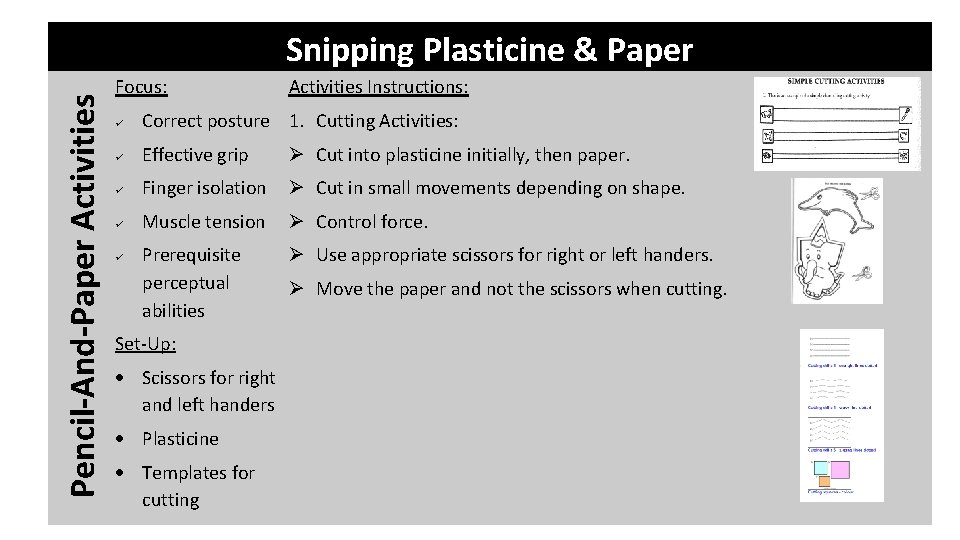
Pencil-And-Paper Activities Snipping Plasticine & Paper Focus: Activities Instructions: Correct posture 1. Cutting Activities: Effective grip Cut into plasticine initially, then paper. Finger isolation Cut in small movements depending on shape. Muscle tension Control force. Prerequisite perceptual abilities Use appropriate scissors for right or left handers. Set-Up: Scissors for right and left handers Plasticine Templates for cutting Move the paper and not the scissors when cutting.
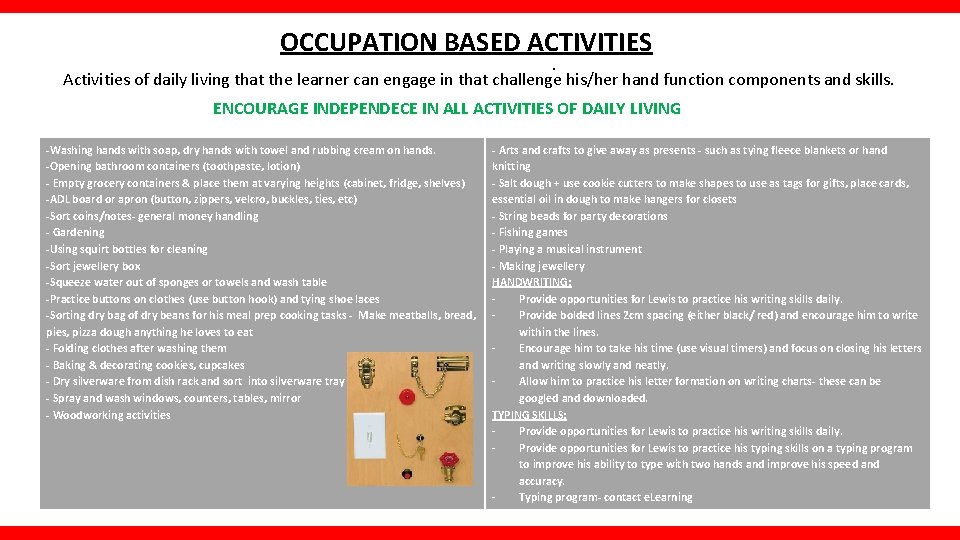
OCCUPATION BASED ACTIVITIES . Activities of daily living that the learner can engage in that challenge his/her hand function components and skills. ENCOURAGE INDEPENDECE IN ALL ACTIVITIES OF DAILY LIVING -Washing hands with soap, dry hands with towel and rubbing cream on hands. -Opening bathroom containers (toothpaste, lotion) - Empty grocery containers & place them at varying heights (cabinet, fridge, shelves) -ADL board or apron (button, zippers, velcro, buckles, ties, etc) -Sort coins/notes- general money handling - Gardening -Using squirt bottles for cleaning -Sort jewellery box -Squeeze water out of sponges or towels and wash table -Practice buttons on clothes (use button hook) and tying shoe laces -Sorting dry bag of dry beans for his meal prep cooking tasks - Make meatballs, bread, pies, pizza dough anything he loves to eat - Folding clothes after washing them - Baking & decorating cookies, cupcakes - Dry silverware from dish rack and sort into silverware tray - Spray and wash windows, counters, tables, mirror - Woodworking activities - Arts and crafts to give away as presents - such as tying fleece blankets or hand knitting - Salt dough + use cookie cutters to make shapes to use as tags for gifts, place cards, essential oil in dough to make hangers for closets - String beads for party decorations - Fishing games - Playing a musical instrument - Making jewellery HANDWRITING: Provide opportunities for Lewis to practice his writing skills daily. Provide bolded lines 2 cm spacing (either black/ red) and encourage him to write within the lines. Encourage him to take his time (use visual timers) and focus on closing his letters and writing slowly and neatly. Allow him to practice his letter formation on writing charts- these can be googled and downloaded. TYPING SKILLS: Provide opportunities for Lewis to practice his writing skills daily. Provide opportunities for Lewis to practice his typing skills on a typing program to improve his ability to type with two hands and improve his speed and accuracy. Typing program- contact e. Learning
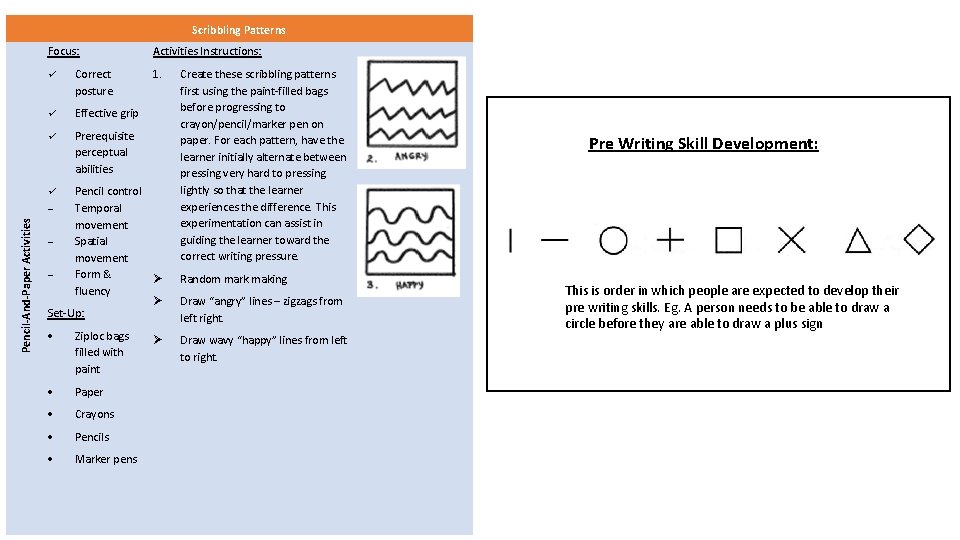
Scribbling Patterns Focus: Correct posture Effective grip Prerequisite perceptual abilities Activities Instructions: 1. Pencil control Temporal movement Spatial movement Form & fluency Set-Up: Pencil-And-Paper Activities Ziploc bags filled with paint Paper Crayons Pencils Marker pens Create these scribbling patterns first using the paint-filled bags before progressing to crayon/pencil/marker pen on paper. For each pattern, have the learner initially alternate between pressing very hard to pressing lightly so that the learner experiences the difference. This experimentation can assist in guiding the learner toward the correct writing pressure. Random mark making Draw “angry” lines – zigzags from left right. Draw wavy “happy” lines from left to right. Pre Writing Skill Development: This is order in which people are expected to develop their pre writing skills. Eg. A person needs to be able to draw a circle before they are able to draw a plus sign
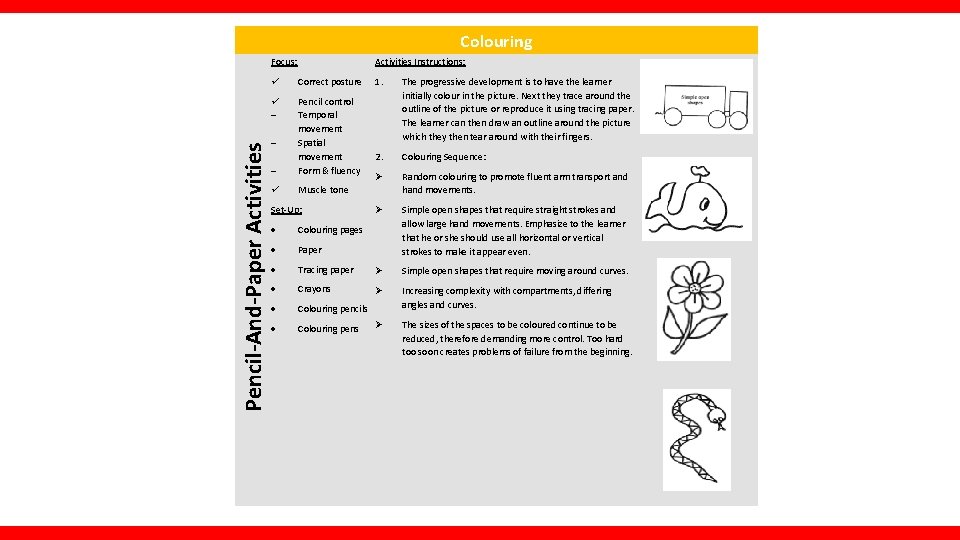
Colouring Pencil-And-Paper Activities Focus: Activities Instructions: Correct posture Pencil control Temporal movement Spatial movement Form & fluency Muscle tone Set-Up: 1. The progressive development is to have the learner initially colour in the picture. Next they trace around the outline of the picture or reproduce it using tracing paper. The learner can then draw an outline around the picture which they then tear around with their fingers. 2. Colouring Sequence: Random colouring to promote fluent arm transport and hand movements. Simple open shapes that require straight strokes and allow large hand movements. Emphasize to the learner that he or she should use all horizontal or vertical strokes to make it appear even. Colouring pages Paper Tracing paper Simple open shapes that require moving around curves. Crayons Colouring pencils Increasing complexity with compartments, differing angles and curves. Colouring pens The sizes of the spaces to be coloured continue to be reduced, therefore demanding more control. Too hard too soon creates problems of failure from the beginning.