
Findings on Childrens Pathways To Diagnosis and Services
- Slides: 16
Findings on Children’s Pathways To Diagnosis and Services NCHS Data Users Conference Lisa J. Colpe, Ph. D, MPH Beverly A. Pringle, Ph. D Division of Services and Intervention Research National Institute of Mental Health
Disclosures • I have no personal financial relationships with commercial interests relevant to this presentation • The views expressed are my own, and do not necessarily represent those of the NIH, NIMH, or the Federal Government
Summary of topics to be covered • Basic demographics of 4 (mutually exclusive) groups of children • Preliminary data on: – – – Initial problems noted by parents Age of child when first diagnosed Types and number of services used by children Types and number of medications used by children Cohort differences in age when first diagnosed
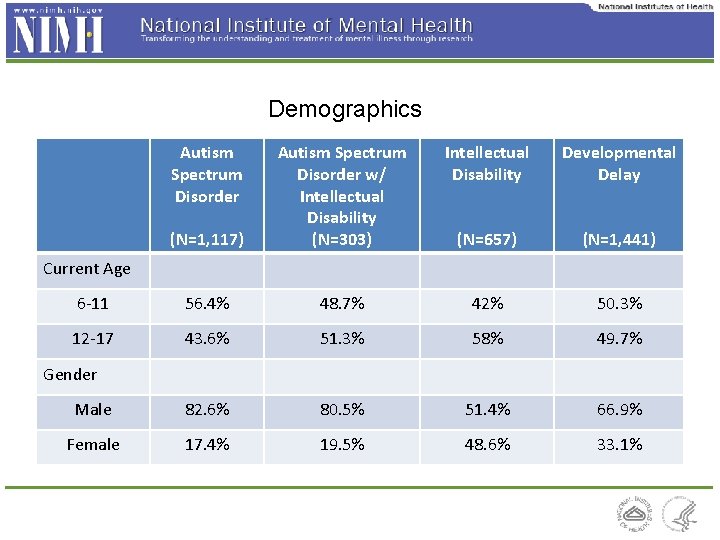
Demographics Autism Spectrum Disorder Intellectual Disability Developmental Delay (N=1, 117) Autism Spectrum Disorder w/ Intellectual Disability (N=303) (N=657) (N=1, 441) 6 -11 56. 4% 48. 7% 42% 50. 3% 12 -17 43. 6% 51. 3% 58% 49. 7% Male 82. 6% 80. 5% 51. 4% 66. 9% Female 17. 4% 19. 5% 48. 6% 33. 1% Current Age Gender
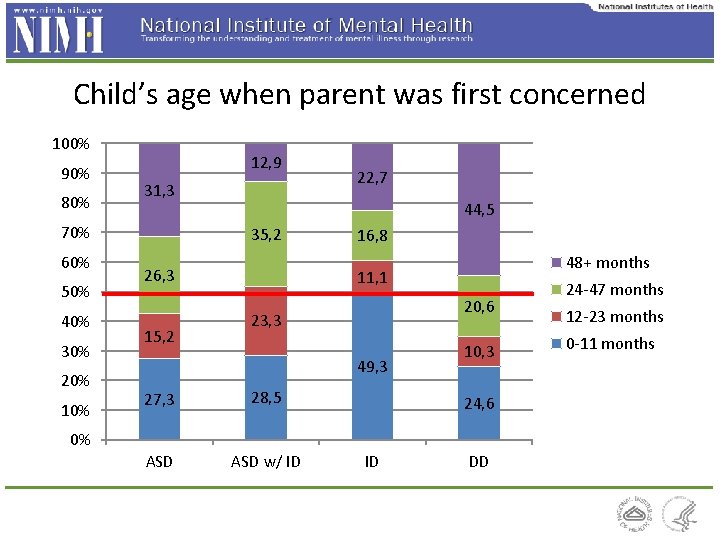
Child’s age when parent was first concerned 100% 90% 80% 12, 9 31, 3 70% 60% 50% 40% 30% 20% 10% 44, 5 35, 2 26, 3 15, 2 22, 7 16, 8 48+ months 11, 1 20, 6 23, 3 49, 3 27, 3 28, 5 ASD w/ ID 10, 3 24, 6 0% ID DD 24 -47 months 12 -23 months 0 -11 months
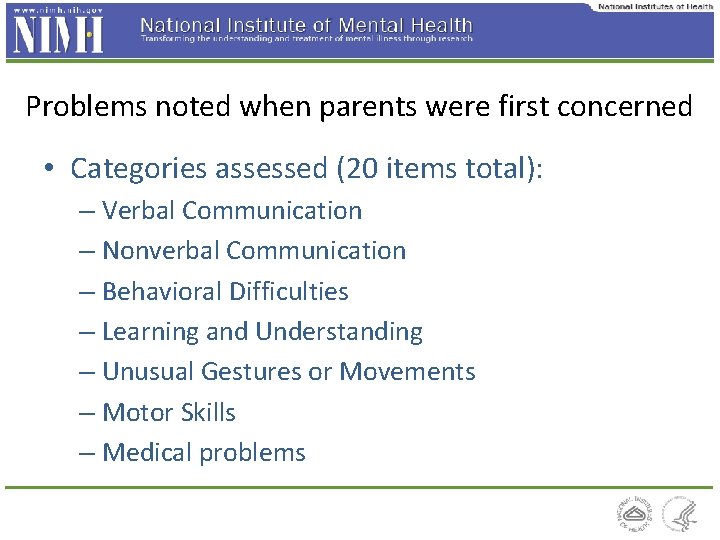
Problems noted when parents were first concerned • Categories assessed (20 items total): – Verbal Communication – Nonverbal Communication – Behavioral Difficulties – Learning and Understanding – Unusual Gestures or Movements – Motor Skills – Medical problems
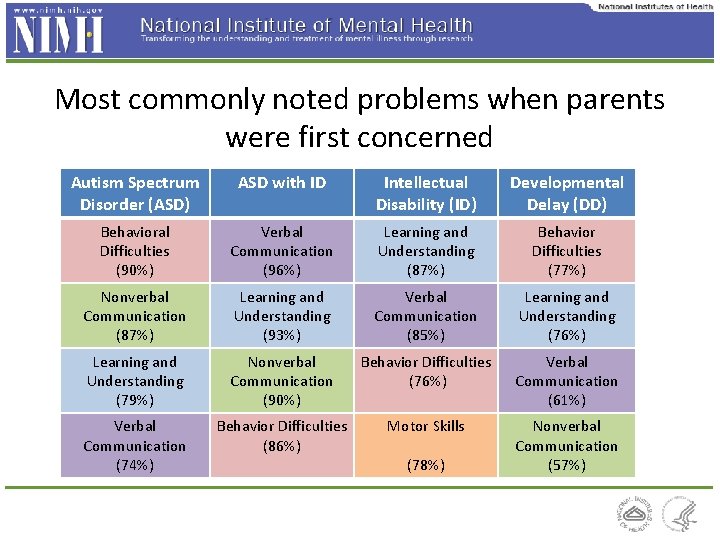
Most commonly noted problems when parents were first concerned Autism Spectrum Disorder (ASD) ASD with ID Intellectual Disability (ID) Developmental Delay (DD) Behavioral Difficulties (90%) Verbal Communication (96%) Learning and Understanding (87%) Behavior Difficulties (77%) Nonverbal Communication (87%) Learning and Understanding (93%) Verbal Communication (85%) Learning and Understanding (76%) Learning and Understanding (79%) Nonverbal Communication (90%) Behavior Difficulties (76%) Verbal Communication (61%) Verbal Communication (74%) Behavior Difficulties (86%) Motor Skills Nonverbal Communication (57%) (78%)
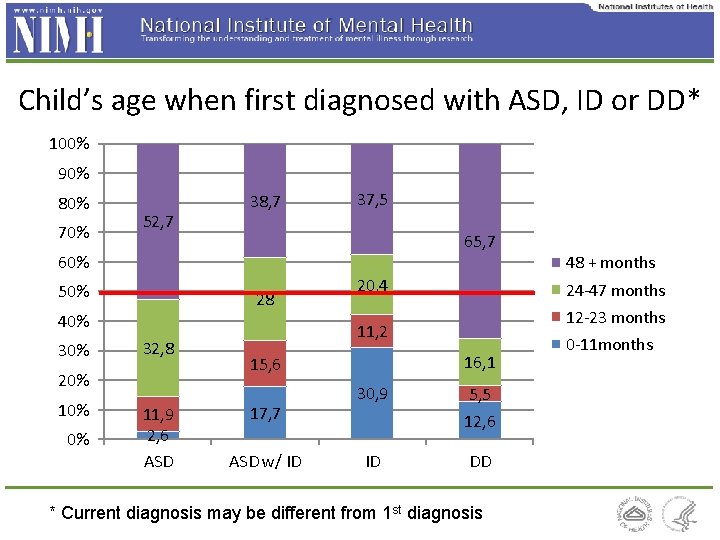
Child’s age when first diagnosed with ASD, ID or DD* 100% 90% 80% 70% 52, 7 38, 7 37, 5 65, 7 60% 48 + months 50% 28 40% 32, 8 20% 10% 0% 11, 9 2, 6 ASD 20, 4 24 -47 months 12 -23 months 11, 2 16, 1 15, 6 17, 7 ASD w/ ID 30, 9 5, 5 12, 6 ID DD * Current diagnosis may be different from 1 st diagnosis 0 -11 months
Types of therapy or training services used • Services assessed: – Behavioral intervention or modification services – Sensory integration therapy – Cognitive based therapy – Occupational therapy – Physical therapy – Social Skills training – Speech or language therapy
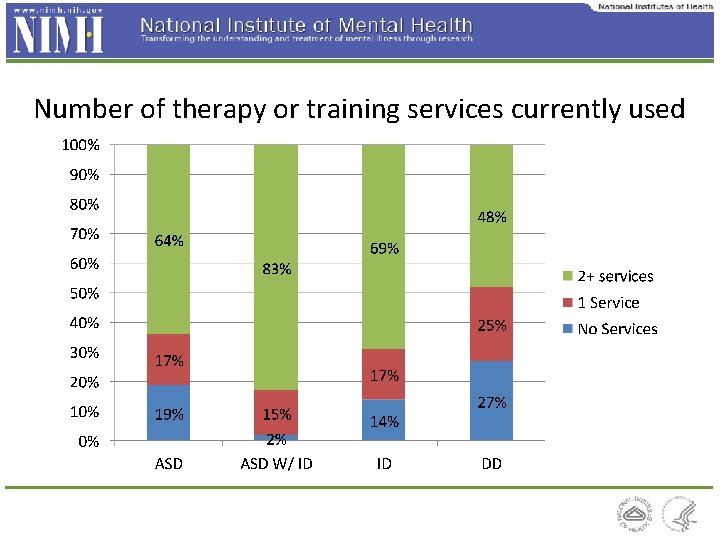
Number of therapy or training services currently used
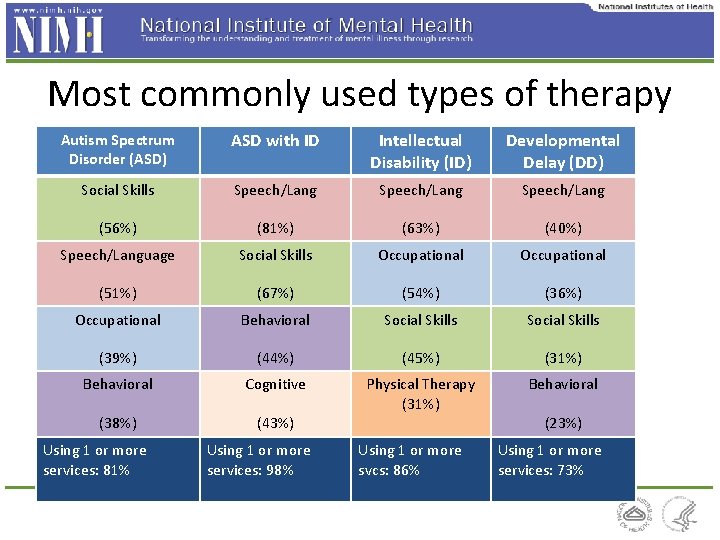
Most commonly used types of therapy with ID Intellectual Developmental or. ASDtraining services Disability (ID) Delay (DD) Autism Spectrum Disorder (ASD) Social Skills Speech/Lang (56%) (81%) (63%) (40%) Speech/Language Social Skills Occupational (51%) (67%) (54%) (36%) Occupational Behavioral Social Skills (39%) (44%) (45%) (31%) Behavioral Cognitive Behavioral (38%) (43%) Physical Therapy (31%) Using 1 or more services: 81% Using 1 or more services: 98% Using 1 or more svcs: 86% (23%) Using 1 or more services: 73%
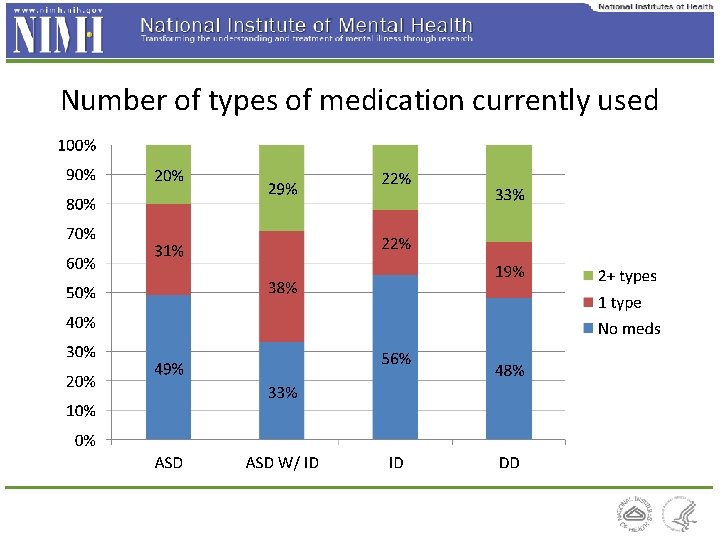
Types of Medication Used • Types of medication assessed: – Stimulant medications – Anti-depressant medications – Anti-anxiety or mood stabilizing medications – Anti-seizure medications – Anti-psychotic medications – Sleep medications
Number of types of medication currently used
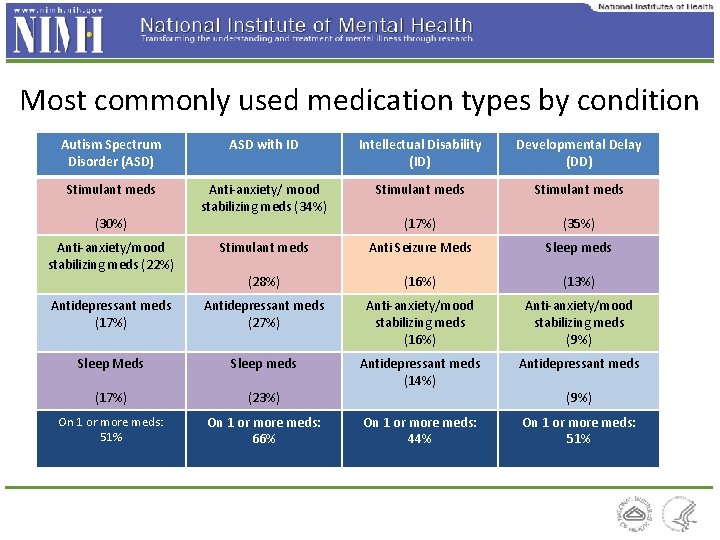
Most commonly used medication types by condition Autism Spectrum Disorder (ASD) ASD with ID Intellectual Disability (ID) Developmental Delay (DD) Stimulant meds Anti-anxiety/ mood stabilizing meds (34%) Stimulant meds (17%) (35%) Anti-anxiety/mood stabilizing meds (22%) Stimulant meds Anti Seizure Meds Sleep meds (28%) (16%) (13%) Antidepressant meds (17%) Antidepressant meds (27%) Anti-anxiety/mood stabilizing meds (16%) Anti-anxiety/mood stabilizing meds (9%) Sleep Meds Sleep meds Antidepressant meds (17%) (23%) Antidepressant meds (14%) On 1 or more meds: 51% On 1 or more meds: 66% On 1 or more meds: 44% On 1 or more meds: 51% (30%) (9%)
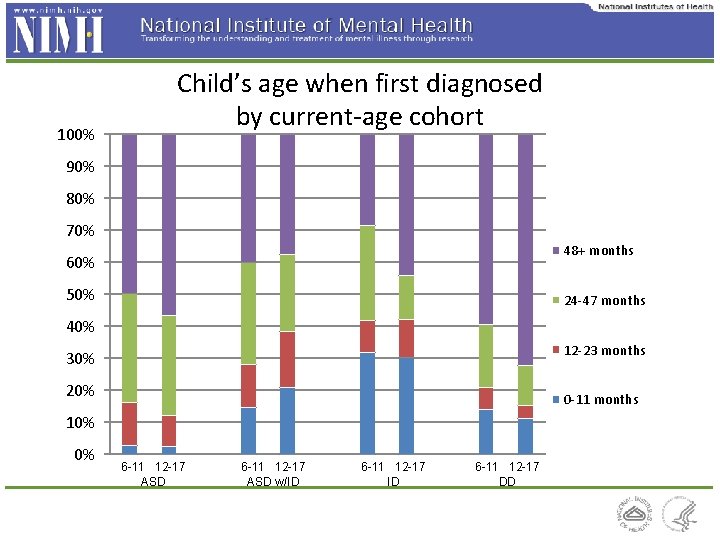
100% Child’s age when first diagnosed by current-age cohort 90% 80% 70% 48+ months 60% 50% 24 -47 months 40% 12 -23 months 30% 20% 0 -11 months 10% 0% 6 -11 12 -17 ASD w/ID 6 -11 12 -17 DD
Special Thanks! • • Stephen Blumberg Rosa Avila Michael Kogan Cathy Rice