
Finding the surface area of a three dimensional
- Slides: 13
Finding the surface area of a three dimensional object
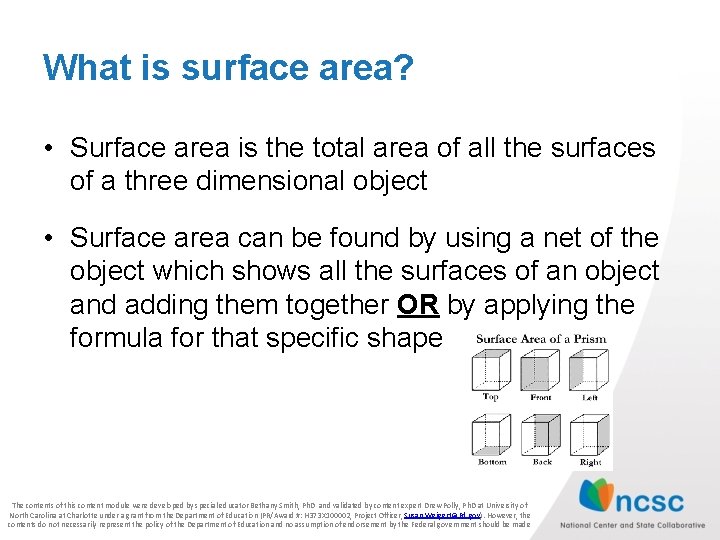
What is surface area? • Surface area is the total area of all the surfaces of a three dimensional object • Surface area can be found by using a net of the object which shows all the surfaces of an object and adding them together OR by applying the formula for that specific shape The contents of this content module were developed by special educator Bethany Smith, Ph. D and validated by content expert Drew Polly, Ph. D at University of North Carolina at Charlotte under a grant from the Department of Education (PR/Award #: H 373 X 100002, Project Officer, Susan. Weigert@Ed. gov). However, the contents do not necessarily represent the policy of the Department of Education and no assumption of endorsement by the Federal government should be made
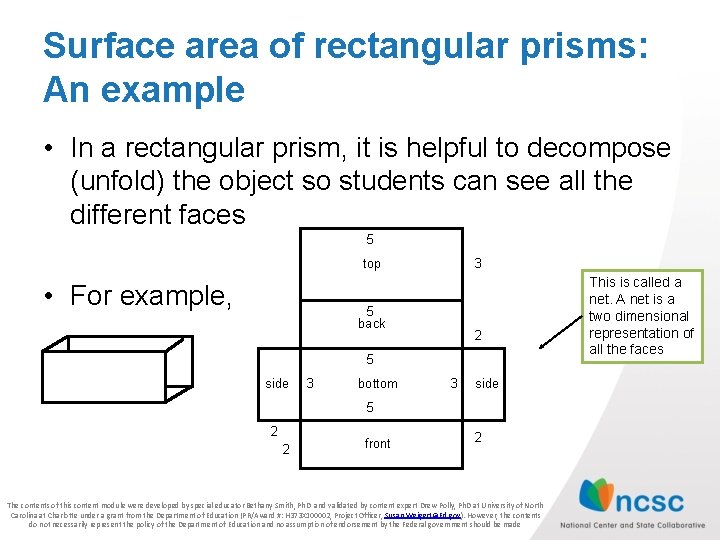
Surface area of rectangular prisms: An example • In a rectangular prism, it is helpful to decompose (unfold) the object so students can see all the different faces 5 top • For example, 3 5 back 2 5 side 3 bottom 3 side 5 2 2 front 2 The contents of this content module were developed by special educator Bethany Smith, Ph. D and validated by content expert Drew Polly, Ph. D at University of North Carolina at Charlotte under a grant from the Department of Education (PR/Award #: H 373 X 100002, Project Officer, Susan. Weigert@Ed. gov). However, the contents do not necessarily represent the policy of the Department of Education and no assumption of endorsement by the Federal government should be made This is called a net. A net is a two dimensional representation of all the faces
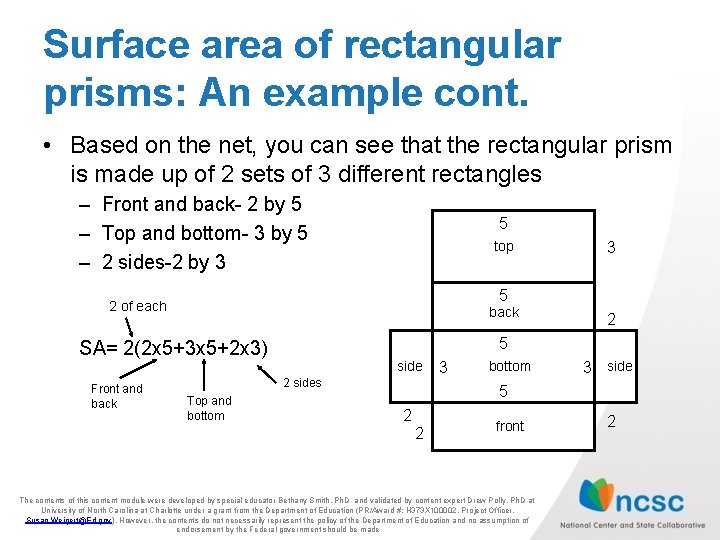
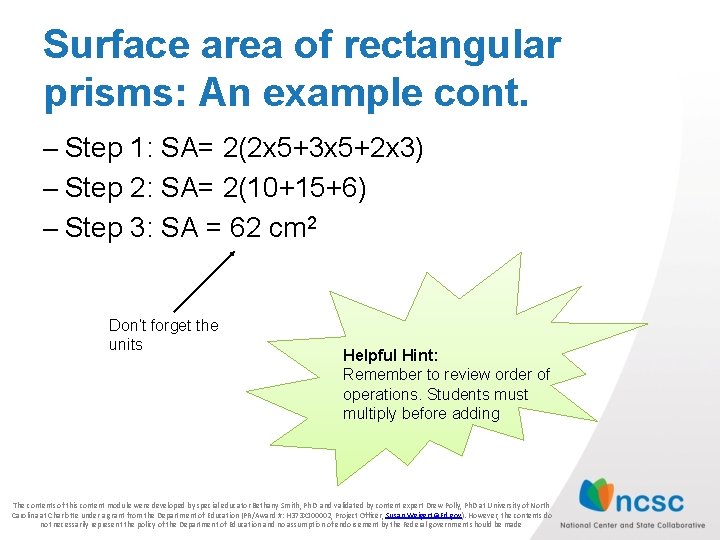
Surface area of rectangular prisms: An example cont. • Based on the net, you can see that the rectangular prism is made up of 2 sets of 3 different rectangles – Front and back- 2 by 5 – Top and bottom- 3 by 5 – 2 sides-2 by 3 5 top 5 2 of each back side 2 sides Top and bottom 2 5 SA= 2(2 x 5+3 x 5+2 x 3) Front and back 3 3 bottom 3 side 5 2 2 front The contents of this content module were developed by special educator Bethany Smith, Ph. D and validated by content expert Drew Polly, Ph. D at University of North Carolina at Charlotte under a grant from the Department of Education (PR/Award #: H 373 X 100002, Project Officer, Susan. Weigert@Ed. gov). However, the contents do not necessarily represent the policy of the Department of Education and no assumption of endorsement by the Federal government should be made 2
Surface area of rectangular prisms: An example cont. – Step 1: SA= 2(2 x 5+3 x 5+2 x 3) – Step 2: SA= 2(10+15+6) – Step 3: SA = 62 cm 2 Don’t forget the units Helpful Hint: Remember to review order of operations. Students must multiply before adding The contents of this content module were developed by special educator Bethany Smith, Ph. D and validated by content expert Drew Polly, Ph. D at University of North Carolina at Charlotte under a grant from the Department of Education (PR/Award #: H 373 X 100002, Project Officer, Susan. Weigert@Ed. gov). However, the contents do not necessarily represent the policy of the Department of Education and no assumption of endorsement by the Federal government should be made
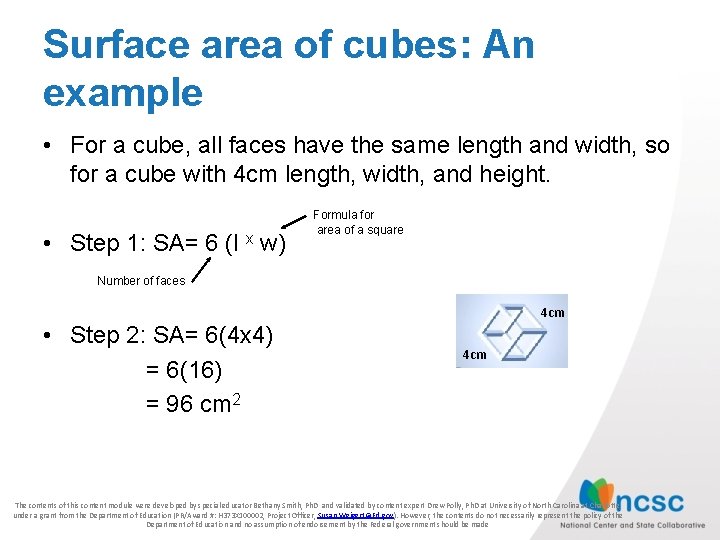
Surface area of cubes: An example • For a cube, all faces have the same length and width, so for a cube with 4 cm length, width, and height. • Step 1: SA= 6 (l x w) Formula for area of a square Number of faces 4 cm • Step 2: SA= 6(4 x 4) = 6(16) = 96 cm 2 4 cm The contents of this content module were developed by special educator Bethany Smith, Ph. D and validated by content expert Drew Polly, Ph. D at University of North Carolina at Charlotte under a grant from the Department of Education (PR/Award #: H 373 X 100002, Project Officer, Susan. Weigert@Ed. gov). However, the contents do not necessarily represent the policy of the Department of Education and no assumption of endorsement by the Federal government should be made
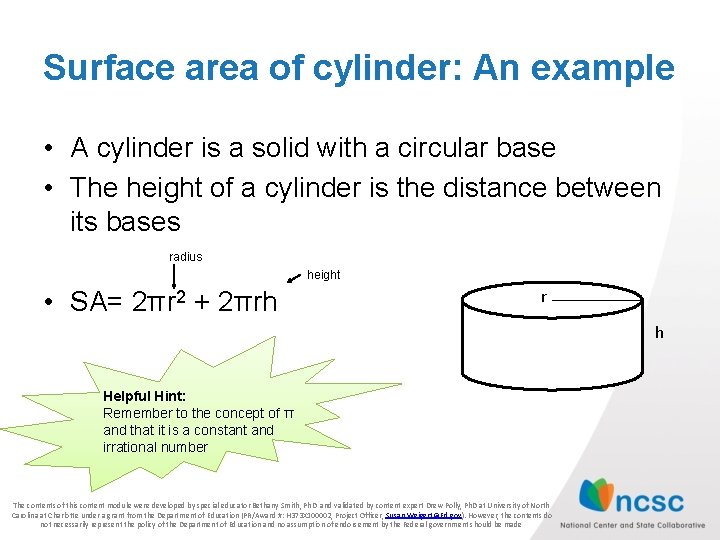
Surface area of cylinder: An example • A cylinder is a solid with a circular base • The height of a cylinder is the distance between its bases radius height • SA= 2πr 2 + 2πrh r h Helpful Hint: Remember to the concept of π and that it is a constant and irrational number The contents of this content module were developed by special educator Bethany Smith, Ph. D and validated by content expert Drew Polly, Ph. D at University of North Carolina at Charlotte under a grant from the Department of Education (PR/Award #: H 373 X 100002, Project Officer, Susan. Weigert@Ed. gov). However, the contents do not necessarily represent the policy of the Department of Education and no assumption of endorsement by the Federal government should be made
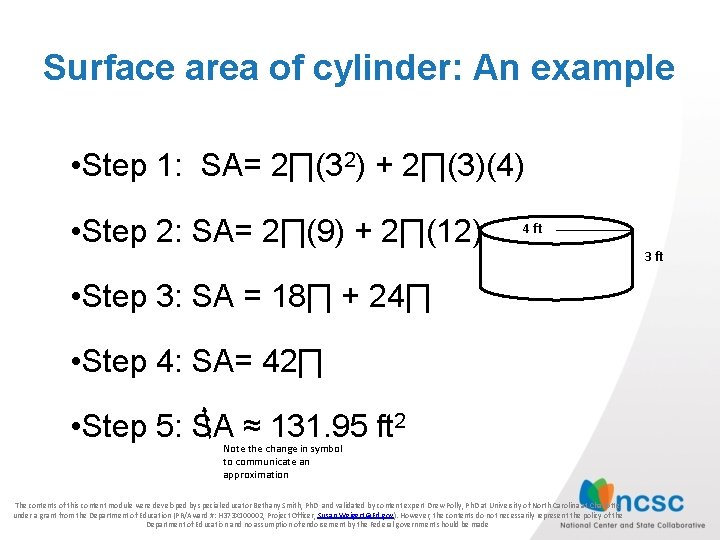
Surface area of cylinder: An example • Step 1: SA= 2∏(32) + 2∏(3)(4) • Step 2: SA= 2∏(9) + 2∏(12) 4 ft • Step 3: SA = 18∏ + 24∏ • Step 4: SA= 42∏ • Step 5: SA ≈ 131. 95 ft 2 Note the change in symbol to communicate an approximation The contents of this content module were developed by special educator Bethany Smith, Ph. D and validated by content expert Drew Polly, Ph. D at University of North Carolina at Charlotte under a grant from the Department of Education (PR/Award #: H 373 X 100002, Project Officer, Susan. Weigert@Ed. gov). However, the contents do not necessarily represent the policy of the Department of Education and no assumption of endorsement by the Federal government should be made 3 ft
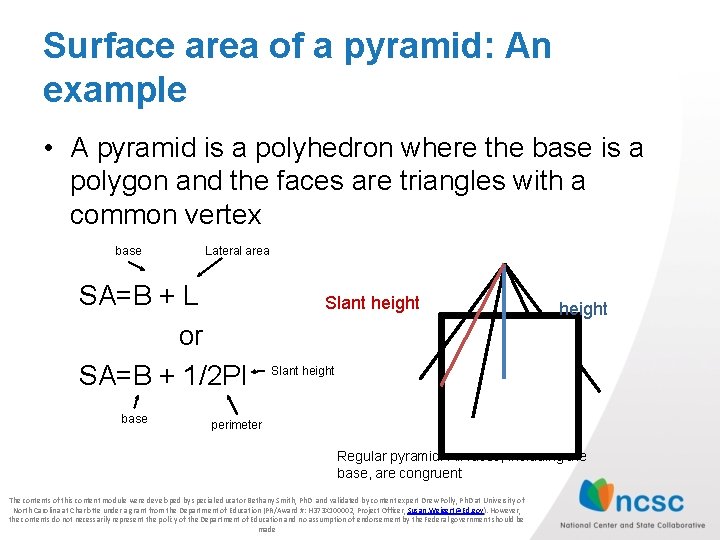
Surface area of a pyramid: An example • A pyramid is a polyhedron where the base is a polygon and the faces are triangles with a common vertex base Lateral area SA=B + L or SA=B + 1/2 Pl base Slant height perimeter Regular pyramid: All faces, including the base, are congruent The contents of this content module were developed by special educator Bethany Smith, Ph. D and validated by content expert Drew Polly, Ph. D at University of North Carolina at Charlotte under a grant from the Department of Education (PR/Award #: H 373 X 100002, Project Officer, Susan. Weigert@Ed. gov). However, the contents do not necessarily represent the policy of the Department of Education and no assumption of endorsement by the Federal government should be made
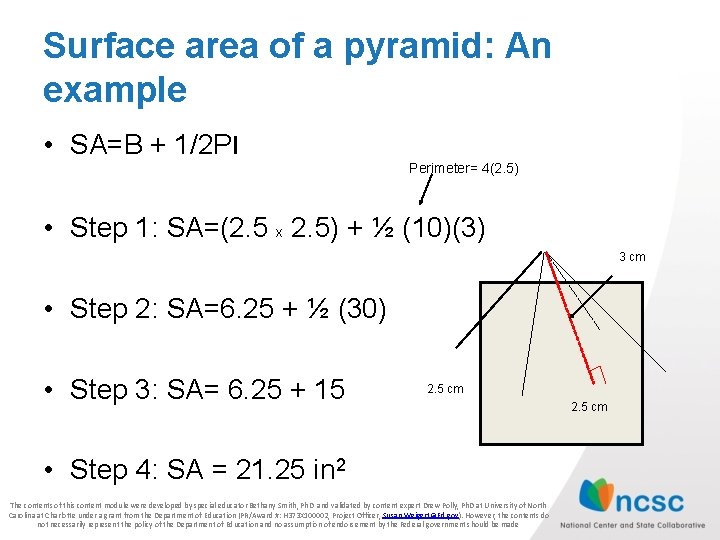
Surface area of a pyramid: An example • SA=B + 1/2 Pl Perimeter= 4(2. 5) • Step 1: SA=(2. 5 x 2. 5) + ½ (10)(3) 3 cm • Step 2: SA=6. 25 + ½ (30) • Step 3: SA= 6. 25 + 15 2. 5 cm • Step 4: SA = 21. 25 in 2 The contents of this content module were developed by special educator Bethany Smith, Ph. D and validated by content expert Drew Polly, Ph. D at University of North Carolina at Charlotte under a grant from the Department of Education (PR/Award #: H 373 X 100002, Project Officer, Susan. Weigert@Ed. gov). However, the contents do not necessarily represent the policy of the Department of Education and no assumption of endorsement by the Federal government should be made 2. 5 cm
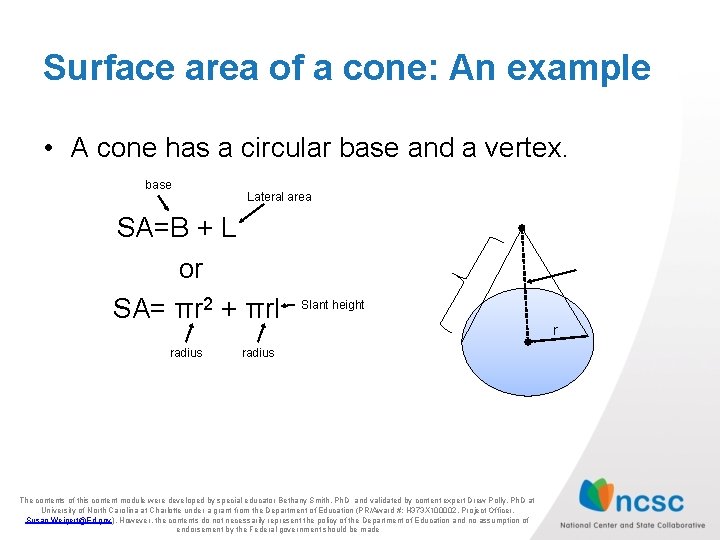
Surface area of a cone: An example • A cone has a circular base and a vertex. base Lateral area SA=B + L or SA= πr 2 + πrl radius Slant height radius The contents of this content module were developed by special educator Bethany Smith, Ph. D and validated by content expert Drew Polly, Ph. D at University of North Carolina at Charlotte under a grant from the Department of Education (PR/Award #: H 373 X 100002, Project Officer, Susan. Weigert@Ed. gov). However, the contents do not necessarily represent the policy of the Department of Education and no assumption of endorsement by the Federal government should be made r
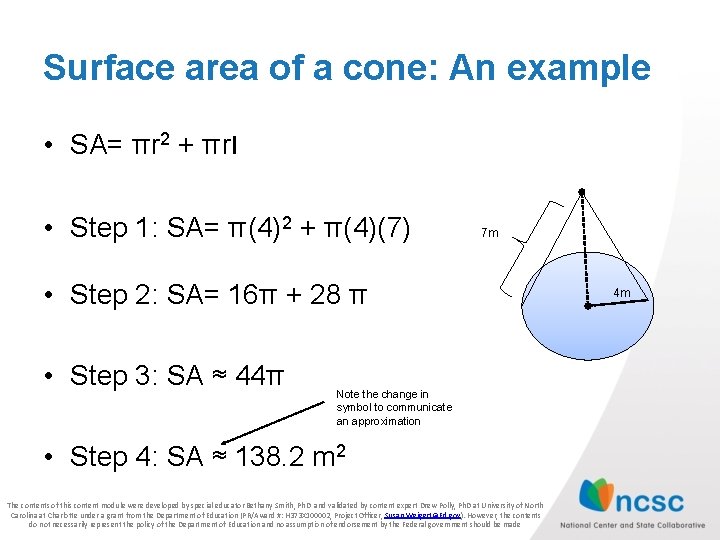
Surface area of a cone: An example • SA= πr 2 + πrl • Step 1: SA= π(4)2 + π(4)(7) 7 m • Step 2: SA= 16π + 28 π • Step 3: SA ≈ 44π Note the change in symbol to communicate an approximation • Step 4: SA ≈ 138. 2 m 2 The contents of this content module were developed by special educator Bethany Smith, Ph. D and validated by content expert Drew Polly, Ph. D at University of North Carolina at Charlotte under a grant from the Department of Education (PR/Award #: H 373 X 100002, Project Officer, Susan. Weigert@Ed. gov). However, the contents do not necessarily represent the policy of the Department of Education and no assumption of endorsement by the Federal government should be made 4 m
Making Connections • Finding the volume of three dimensional objects addresses the following 7 th and 8 th grade Core Content Connectors – 7 -8. NO. 3 c 1 Use the rules for mathematical operations to verify the results when more than one operation is required to solve a problem – 7. GM. 1 h 2 Find the surface area of three-dimensional figures using nets of rectangles or triangles – 7. GM. 1 h 3 Find the area of plane figures and surface area of solid figures – 8. GM. 1 g 1 Recognize congruent and similar figures The contents of this content module were developed by special educator Bethany Smith, Ph. D and validated by content expert Drew Polly, Ph. D at University of North Carolina at Charlotte under a grant from the Department of Education (PR/Award #: H 373 X 100002, Project Officer, Susan. Weigert@Ed. gov). However, the contents do not necessarily represent the policy of the Department of Education and no assumption of endorsement by the Federal government should be made