
Finding the Right Balance for Managing Email Tonights

Finding the Right Balance for Managing E-mail
Tonight’s Agenda What I share with end-users… 1. E-mail - our largest digital problem 2. Sender offenses 3. Problems @ work For IT Professionals only… 1. End-user concerns (what they should be!) 2. Debunking email myths 3. Proposed actions for IT professionals
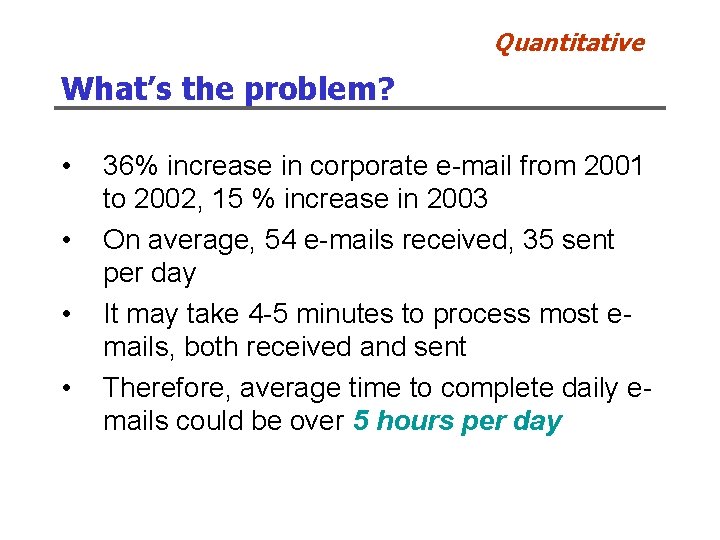
Quantitative What’s the problem? • • 36% increase in corporate e-mail from 2001 to 2002, 15 % increase in 2003 On average, 54 e-mails received, 35 sent per day It may take 4 -5 minutes to process most emails, both received and sent Therefore, average time to complete daily emails could be over 5 hours per day
Qualitative What’s the problem? • • The technology is not the villain The way it is used by people is the villain The attitude it fosters is the villain The absorption of people by machines is the villain Source: Economic and Business Roundtable on Mental Health. July 2000
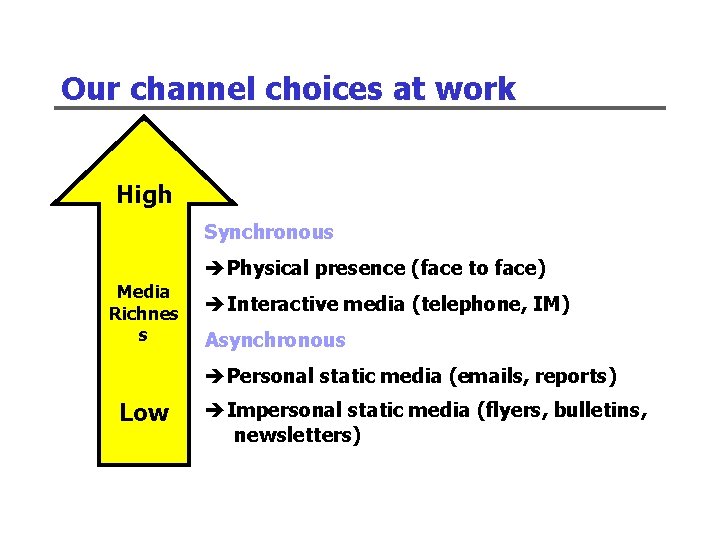
Our channel choices at work High Synchronous èPhysical presence (face to face) Media Richnes s èInteractive media (telephone, IM) Asynchronous èPersonal static media (emails, reports) Low èImpersonal static media (flyers, bulletins, newsletters)
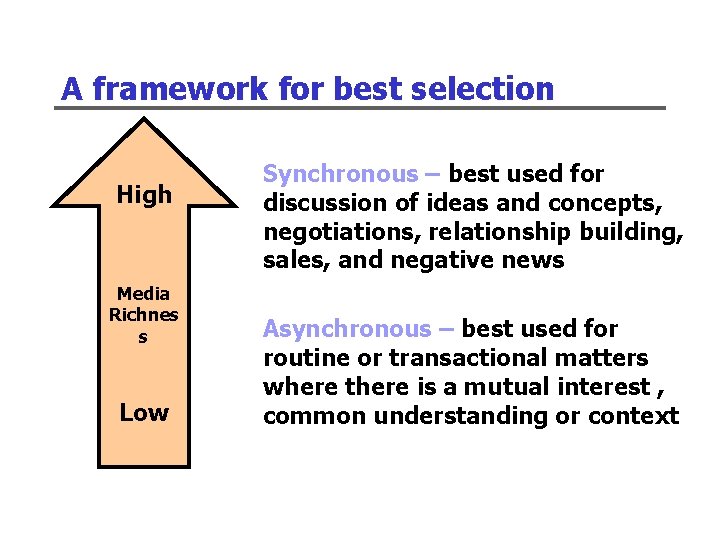
A framework for best selection High Media Richnes s Low Synchronous – best used for discussion of ideas and concepts, negotiations, relationship building, sales, and negative news Asynchronous – best used for routine or transactional matters where there is a mutual interest , common understanding or context
Conclusions on e-mail usage at work 1. E-mail is not as productive as originally envisioned or intended 2. The e-mail communication channel needs further definition and refinement in the workplace 3. Overload has become a serious management issue
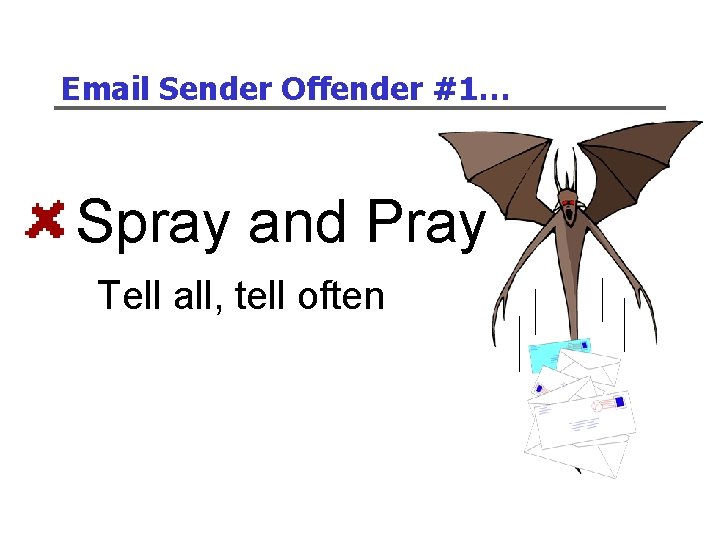
Email Sender Offender #1… Spray and Pray Tell all, tell often
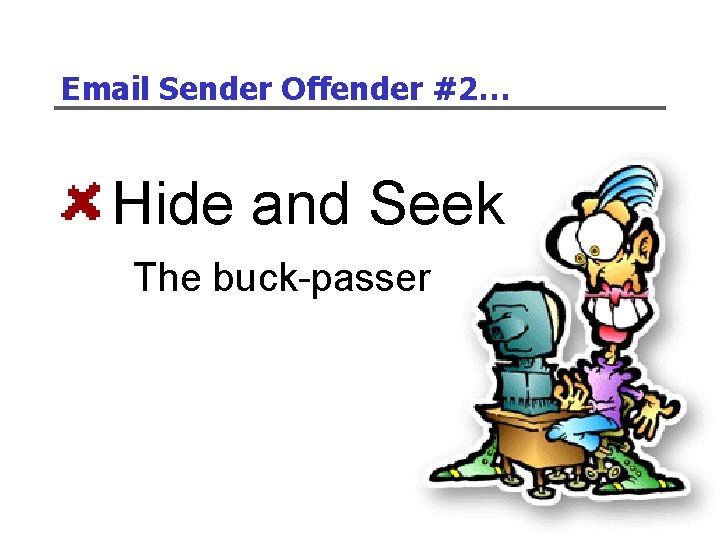
Email Sender Offender #2… Hide and Seek The buck-passer
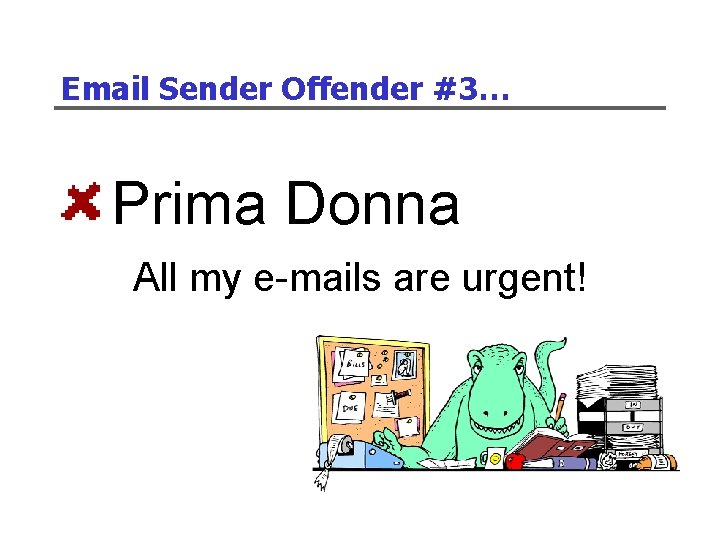
Email Sender Offender #3… Prima Donna All my e-mails are urgent!
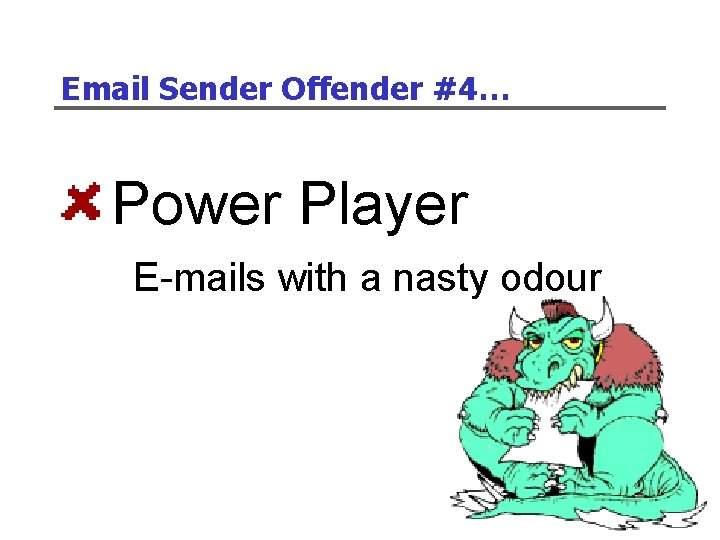
Email Sender Offender #4… Power Player E-mails with a nasty odour
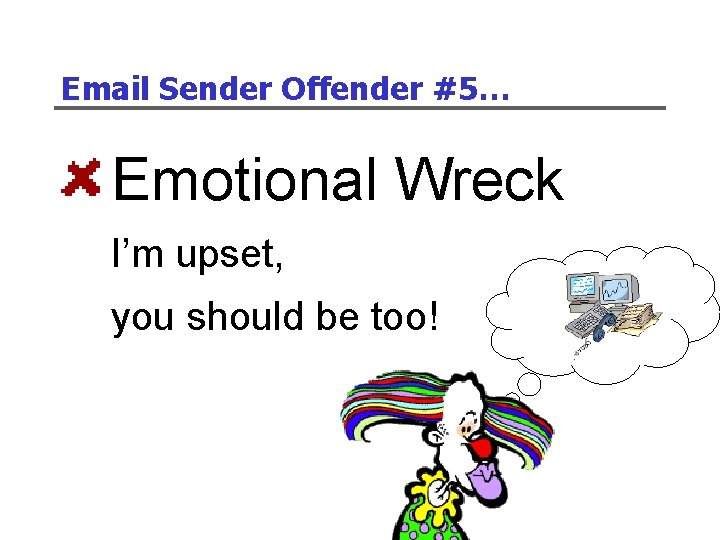
Email Sender Offender #5… Emotional Wreck I’m upset, you should be too!
Most Common E-mail Problems @ Work 1. There are too many low-value emails being routinely sent within organizations on a daily basis. 2. There is an expectation that anything sent by email receives immediate priority. 3. Employees are getting less tolerant about poorly composed or ill-conceived emails. 4. Employees are working longer hours each week managing their email inboxes. 73% of people said that their organizations should lead the initiative to reduce email overload through policies, education and training
End users’ biggest concerns • • Overwhelming volumes Spam and viruses Miscommunication Filing and retrieving messages
You have been attacked by the e-mail monster

End users should be concerned about… Optimizing application use To create efficiencies and improve an organization’s productivity
End users should be concerned about… Process improvements embracing the best of both humans and technology
End users should be concerned about… Their exposure to unanticipated risks Privacy Piracy Policy
End users should be concerned about… Enterprise-wide system management issues Archiving Electronic Searching Expunging
Debunking Myths About Email 1 Email creates the paperless office If you get rid of all the printers!
Debunking Myths About Email 2 Using email is profitable Has increased costs by 12% of corporate payrolls
Debunking Myths About Email 3 Email expands communication flow Its’ misuse creates larger barriers
Debunking Myths About Email 4 IT professionals are email efficiency experts
So? What actions could IT professionals take?
Action plans for IT Professionals Facilitate email application training – Tips, short-courses – Best practice suggestions – Email management enhancements
Action plans for IT Professionals Be an Advisor on email policies – Work with Human Resources and executive management champions • End user guidelines • Email retention • Volume reduction “vigilantes”
Action plans for IT Professionals Act as Change Agent for operating efficiencies – Improved use of corporate Intranets/Extranets – Review of enterprise-wide practices that use email unproductively – Better electronic information searching and retrieval – Introduction of IM to facilitate more synchronous communication
Action plans for IT Professionals Be an electronic risk management Advocate – Moderate types of information committed to the system – Help end-users protect themselves – Provide forensic guidance • Message retention/archiving • Expunge policies
Why have an email policy? • Tells employees what is expected of them • Proactive guidance to help resolve current or emerging email practices • Identifies legal and compliance boundaries for system use • Acts as a preventative measure to protect sensitive information • Offers opportunity for discussion on better use
Electronic Communication Productivity Plan 1. Conscious awareness of over-reliance 2. Assess productivity impacts 3. Supplement with potential for legal exposures 4. Take sensible action that respects the working culture • Treat electronic communication improvements as a public policy issue rather than a mandate for immediate change
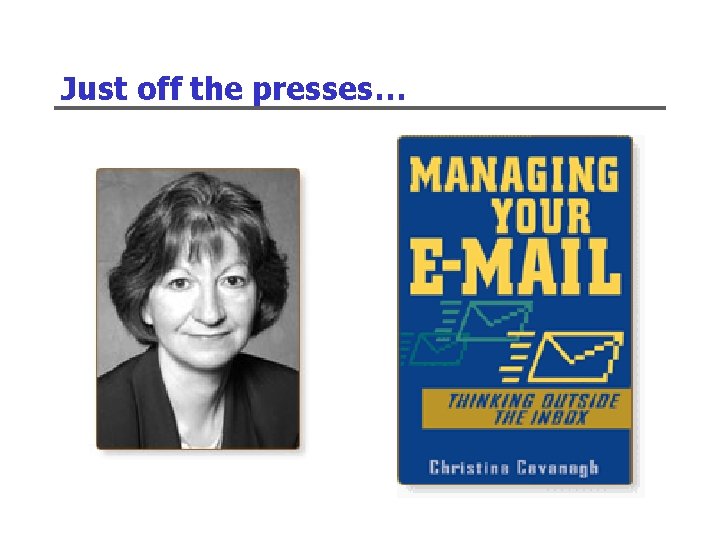
Just off the presses…
Guiding Principals Managing Your E-mail: Thinking Outside the Inbox Defines e-mail communication issues in the workplace Uncovers the root of the problems (including cost estimates and policies) Offers solutions that benefit both individuals and organizations
Is E-mail Managing You? Thank you for your interest! Questions?
- Slides: 35