
Finding the Probability of Combination Problems Binomial Probability

Finding the Probability of Combination Problems (Binomial Probability) Notes #27 (LAST NOTES OF THE YEAR!)
Binomial Probability Theorem What is it? ANS: It calculates the probability for the outcomes of repeated independent and identical trials OR Combination Problems.
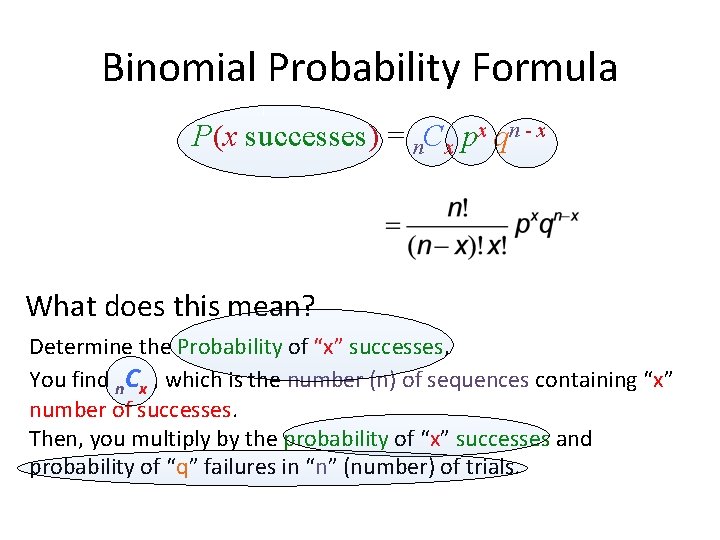
Binomial Probability Formula P(x successes) = n. Cx px qn - x What does this mean? Determine the Probability of “x” successes, You find n. Cx , which is the number (n) of sequences containing “x” number of successes. Then, you multiply by the probability of “x” successes and probability of “q” failures in “n” (number) of trials.
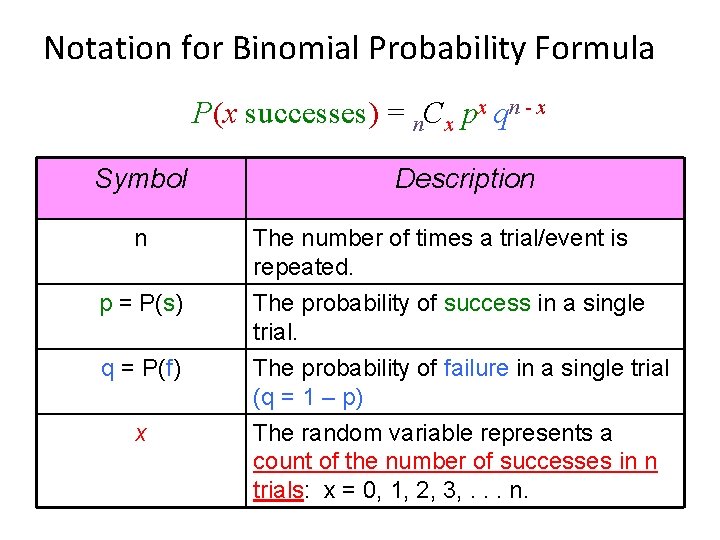
Notation for Binomial Probability Formula P(x successes) = n. Cx px qn - x Symbol n p = P(s) q = P(f) x Description The number of times a trial/event is repeated. The probability of success in a single trial. The probability of failure in a single trial (q = 1 – p) The random variable represents a count of the number of successes in n trials: x = 0, 1, 2, 3, . . . n.
Purpose of using the Binomial Probability Theorem • It counts the number of successes in a certain number of trials.
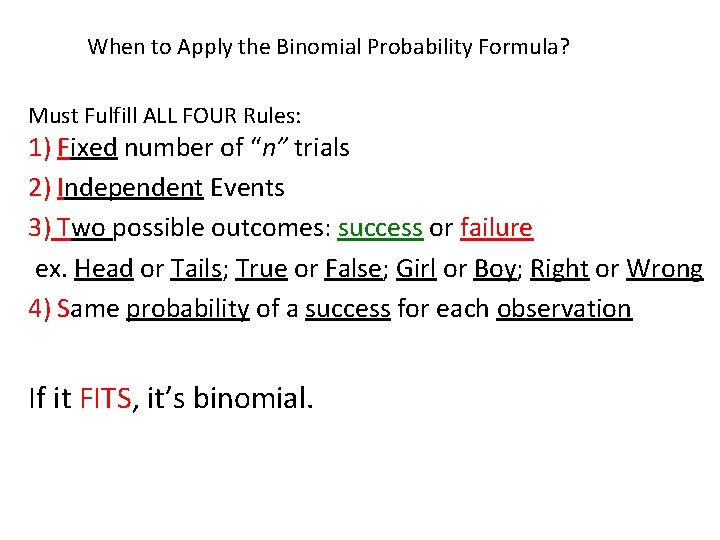
When to Apply the Binomial Probability Formula? Must Fulfill ALL FOUR Rules: 1) Fixed number of “n” trials 2) Independent Events 3) Two possible outcomes: success or failure ex. Head or Tails; True or False; Girl or Boy; Right or Wrong 4) Same probability of a success for each observation If it FITS, it’s binomial.
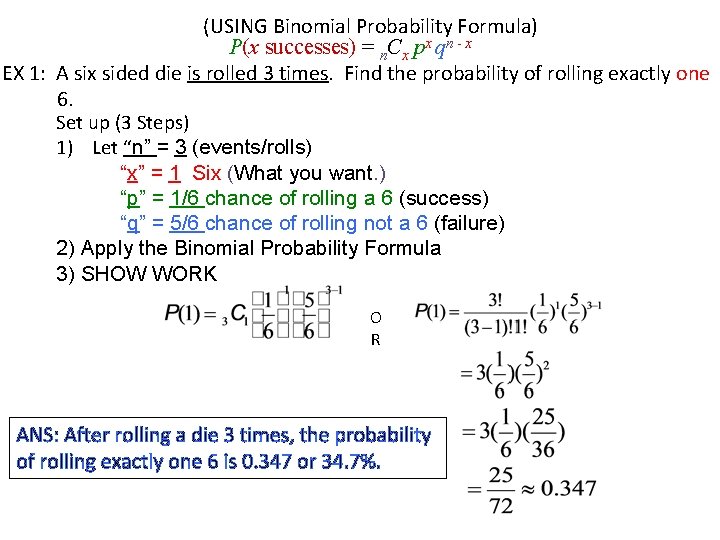
(USING Binomial Probability Formula) P(x successes) = n. Cx px qn - x EX 1: A six sided die is rolled 3 times. Find the probability of rolling exactly one 6. Set up (3 Steps) 1) Let “n” = 3 (events/rolls) “x” = 1 Six (What you want. ) “p” = 1/6 chance of rolling a 6 (success) “q” = 5/6 chance of rolling not a 6 (failure) 2) Apply the Binomial Probability Formula 3) SHOW WORK O R ANS: After rolling a die 3 times, the probability of rolling exactly one 6 is 0. 347 or 34. 7%.
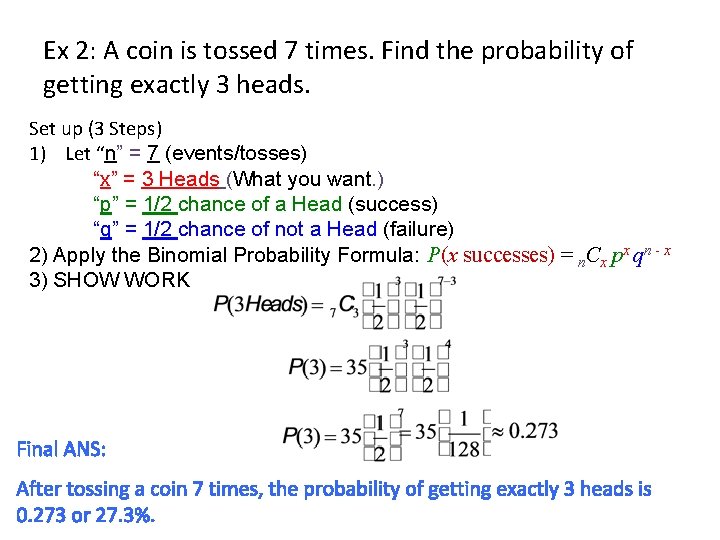
Ex 2: A coin is tossed 7 times. Find the probability of getting exactly 3 heads. Set up (3 Steps) 1) Let “n” = 7 (events/tosses) “x” = 3 Heads (What you want. ) “p” = 1/2 chance of a Head (success) “q” = 1/2 chance of not a Head (failure) 2) Apply the Binomial Probability Formula: P(x successes) = n. Cx px qn - x 3) SHOW WORK Final ANS: After tossing a coin 7 times, the probability of getting exactly 3 heads is 0. 273 or 27. 3%.
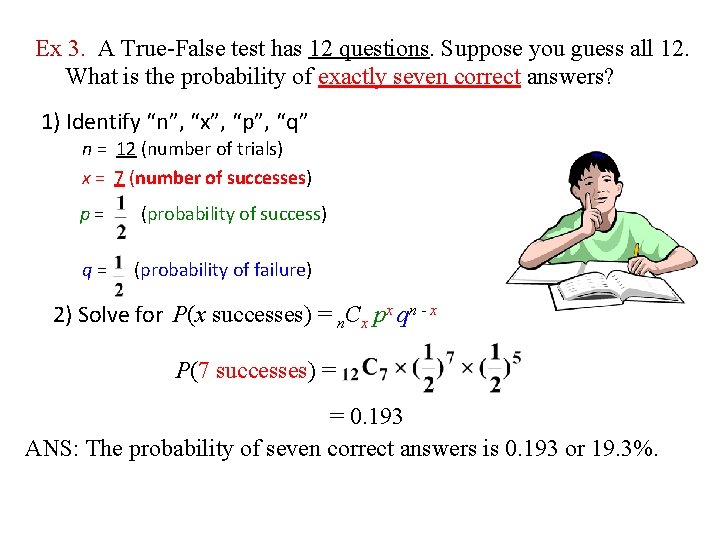
Ex 3. A True-False test has 12 questions. Suppose you guess all 12. What is the probability of exactly seven correct answers? 1) Identify “n”, “x”, “p”, “q” n = 12 (number of trials) x = 7 (number of successes) p= q= (probability of success) (probability of failure) 2) Solve for P(x successes) = n. Cx px qn - x P(7 successes) = = 0. 193 ANS: The probability of seven correct answers is 0. 193 or 19. 3%.
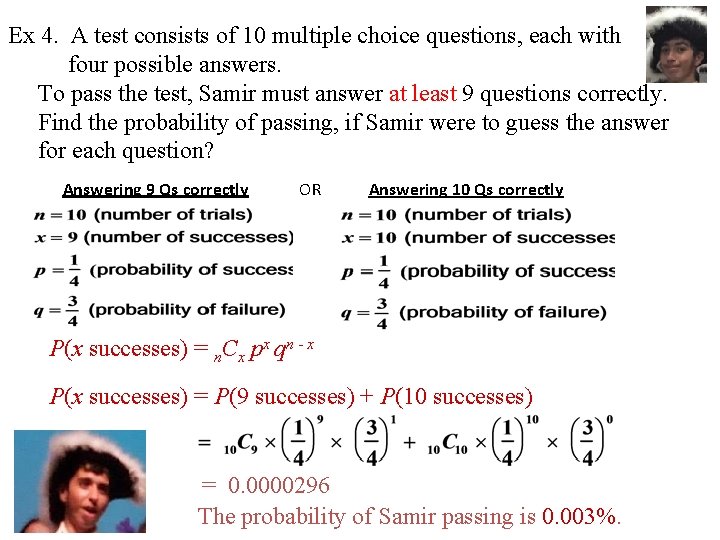
Ex 4. A test consists of 10 multiple choice questions, each with four possible answers. To pass the test, Samir must answer at least 9 questions correctly. Find the probability of passing, if Samir were to guess the answer for each question? Answering 9 Qs correctly OR Answering 10 Qs correctly P(x successes) = n. Cx px qn - x P(x successes) = P(9 successes) + P(10 successes) = 0. 0000296 The probability of Samir passing is 0. 003%.
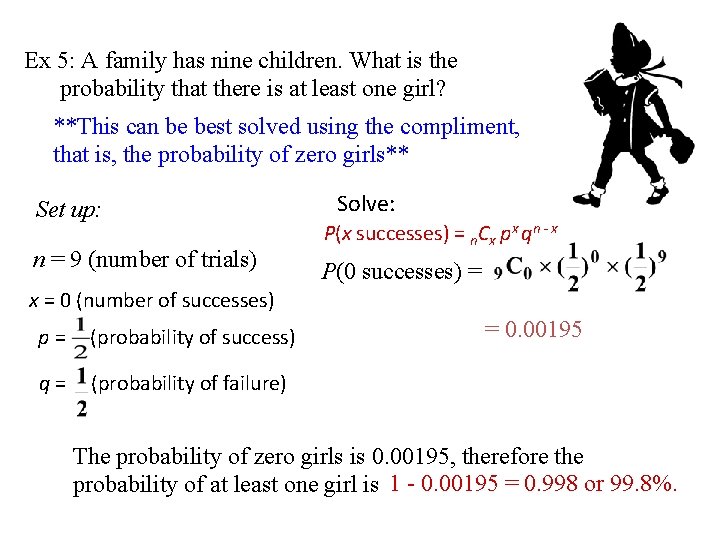
Ex 5: A family has nine children. What is the probability that there is at least one girl? **This can be best solved using the compliment, that is, the probability of zero girls** Set up: n = 9 (number of trials) Solve: P(x successes) = n. Cx px qn - x P(0 successes) = x = 0 (number of successes) p= (probability of success) q= (probability of failure) = 0. 00195 The probability of zero girls is 0. 00195, therefore the probability of at least one girl is 1 - 0. 00195 = 0. 998 or 99. 8%.
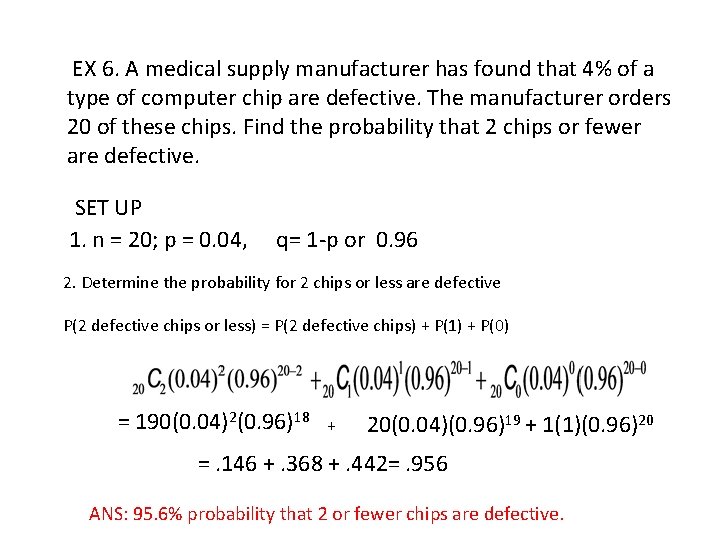
EX 6. A medical supply manufacturer has found that 4% of a type of computer chip are defective. The manufacturer orders 20 of these chips. Find the probability that 2 chips or fewer are defective. SET UP 1. n = 20; p = 0. 04, q= 1 -p or 0. 96 2. Determine the probability for 2 chips or less are defective P(2 defective chips or less) = P(2 defective chips) + P(1) + P(0) = 190(0. 04)2(0. 96)18 + 20(0. 04)(0. 96)19 + 1(1)(0. 96)20 =. 146 +. 368 +. 442=. 956 ANS: 95. 6% probability that 2 or fewer chips are defective.
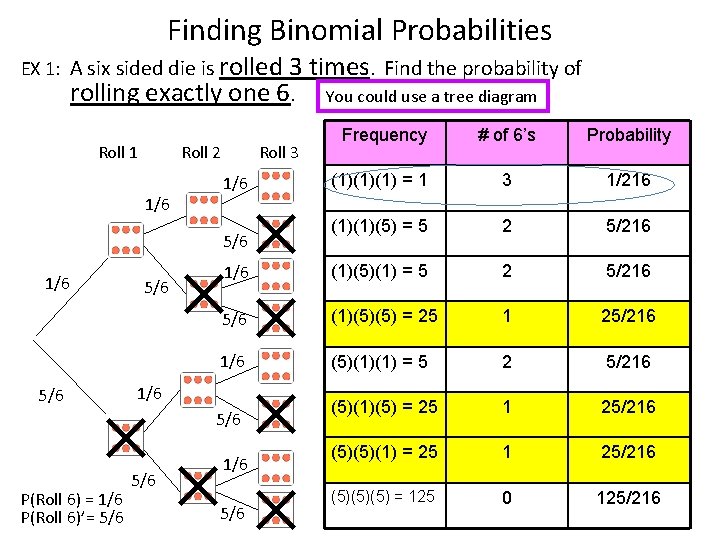
Finding Binomial Probabilities EX 1: A six sided die is rolled 3 times. Find the probability of rolling exactly one 6. You could use a tree diagram Roll 1 # of 6’s Probability (1)(1)(1) = 1 3 1/216 (1)(1)(5) = 5 2 5/216 1/6 (1)(5)(1) = 5 2 5/216 5/6 (1)(5)(5) = 25 1 25/216 1/6 (5)(1)(1) = 5 2 5/216 (5)(1)(5) = 25 1 25/216 (5)(5)(1) = 25 1 25/216 (5)(5)(5) = 125 0 125/216 Roll 3 Roll 2 1/6 5/6 P(Roll 6) = 1/6 P(Roll 6)’= 5/6 1/6 5/6 Frequency
- Slides: 13