
Finding the Magnitude of a Vector A vector
- Slides: 11
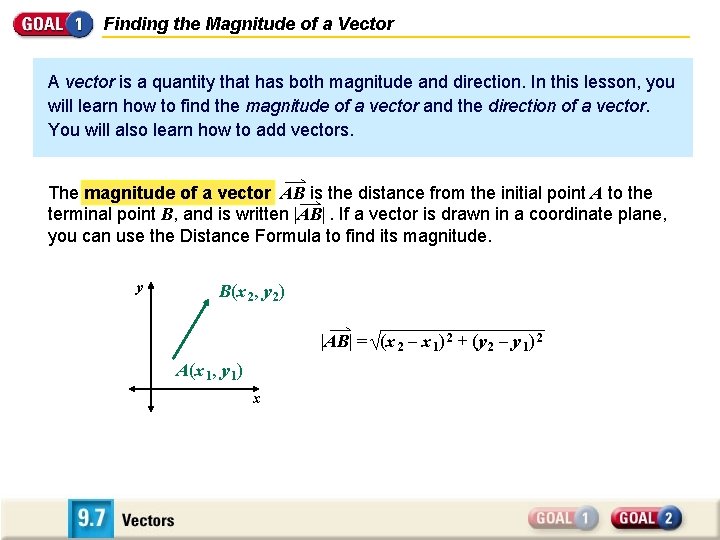
Finding the Magnitude of a Vector A vector is a quantity that has both magnitude and direction. In this lesson, you will learn how to find the magnitude of a vector and the direction of a vector. You will also learn how to add vectors. The magnitude of a vector AB is the distance from the initial point A to the terminal point B, and is written |AB|. If a vector is drawn in a coordinate plane, you can use the Distance Formula to find its magnitude. y B(x 2, y 2) |AB| = (x 2 – x 1) 2 + (y 2 – y 1) 2 A(x 1, y 1) x
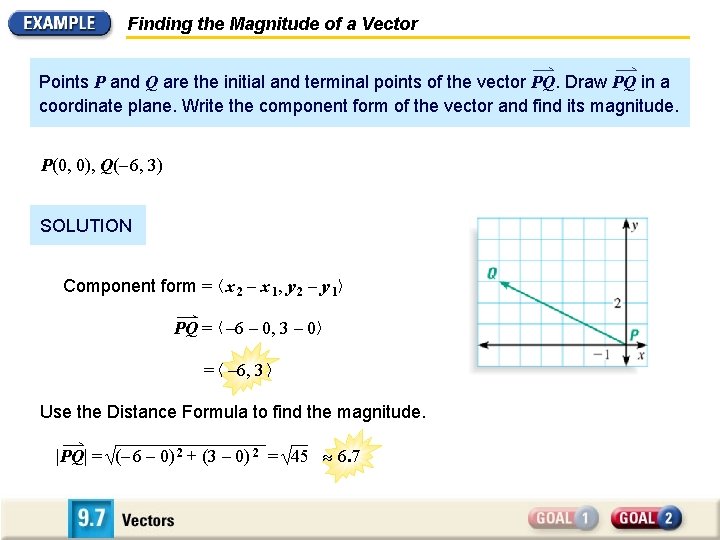
Finding the Magnitude of a Vector Points P and Q are the initial and terminal points of the vector PQ. Draw PQ in a coordinate plane. Write the component form of the vector and find its magnitude. P(0, 0), Q(– 6, 3) SOLUTION Component form = x 2 – x 1, y 2 – y 1 PQ = – 6 – 0, 3 – 0 = – 6, 3 Use the Distance Formula to find the magnitude. |PQ| = (– 6 – 0) 2 + (3 – 0) 2 = 45 6. 7
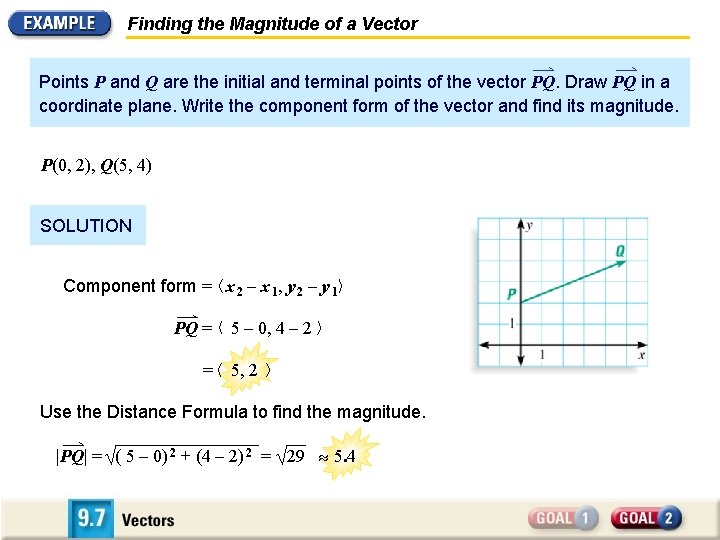
Finding the Magnitude of a Vector Points P and Q are the initial and terminal points of the vector PQ. Draw PQ in a coordinate plane. Write the component form of the vector and find its magnitude. P(0, 2), Q(5, 4) SOLUTION Component form = x 2 – x 1, y 2 – y 1 PQ = = 5 – 0, 4 – 2 5, 2 Use the Distance Formula to find the magnitude. |PQ| = ( 5 – 0) 2 + (4 – 2) 2 = 29 5. 4
Finding the Magnitude of a Vector The direction of a vector is determined by the angle it makes with a horizontal line. In real-life applications, the direction angle is described relative to the directions north, east, south, and west. In a coordinate plane, the x-axis represents an east-west line. The y-axis represents a north-south line.
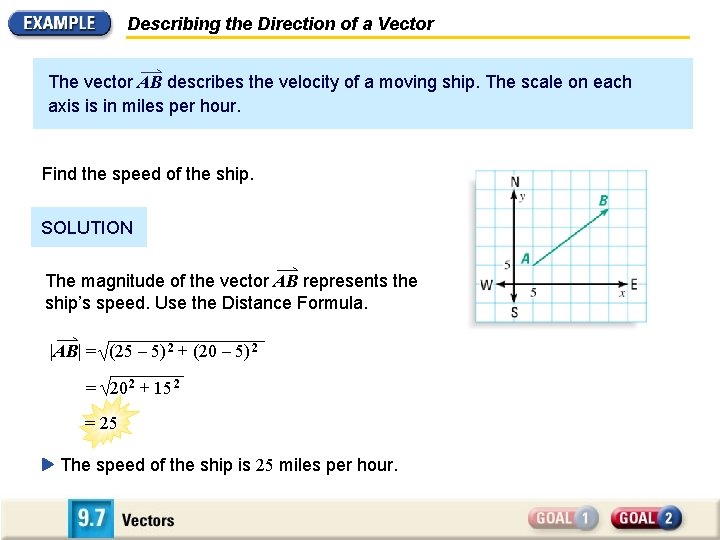
Describing the Direction of a Vector The vector AB describes the velocity of a moving ship. The scale on each axis is in miles per hour. Find the speed of the ship. SOLUTION The magnitude of the vector AB represents the ship’s speed. Use the Distance Formula. |AB| = (25 – 5) 2 + (20 – 5) 2 = 20 2 + 15 2 = 25 The speed of the ship is 25 miles per hour.
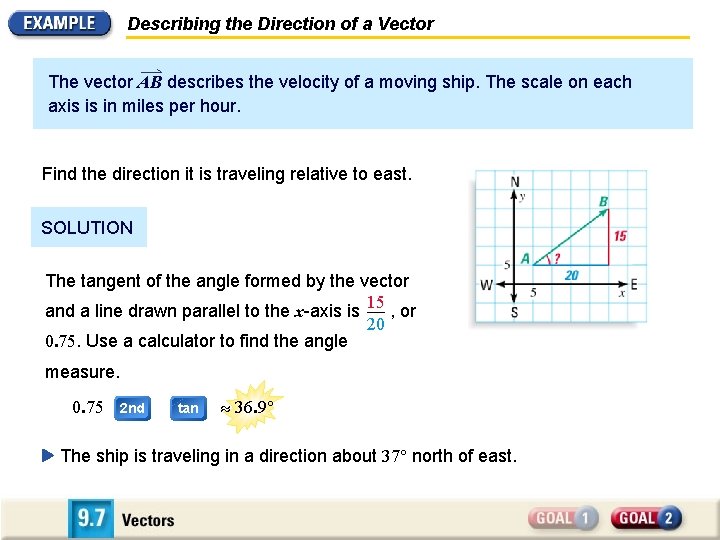
Describing the Direction of a Vector The vector AB describes the velocity of a moving ship. The scale on each axis is in miles per hour. Find the direction it is traveling relative to east. SOLUTION The tangent of the angle formed by the vector 15 and a line drawn parallel to the x-axis is , or 20 0. 75. Use a calculator to find the angle measure. 0. 75 2 nd tan 36. 9° The ship is traveling in a direction about 37° north of east.
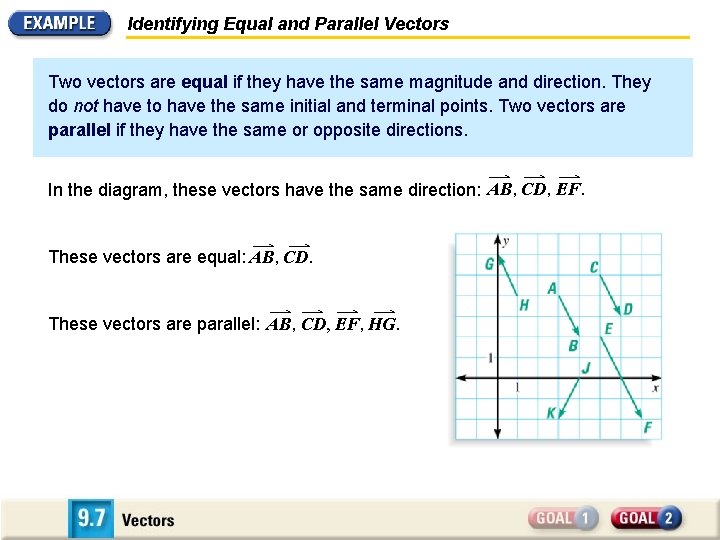
Identifying Equal and Parallel Vectors Two vectors are equal if they have the same magnitude and direction. They do not have to have the same initial and terminal points. Two vectors are parallel if they have the same or opposite directions. In the diagram, these vectors have the same direction: AB, CD, EF. These vectors are equal: AB, CD. These vectors are parallel: AB, CD, EF, HG.
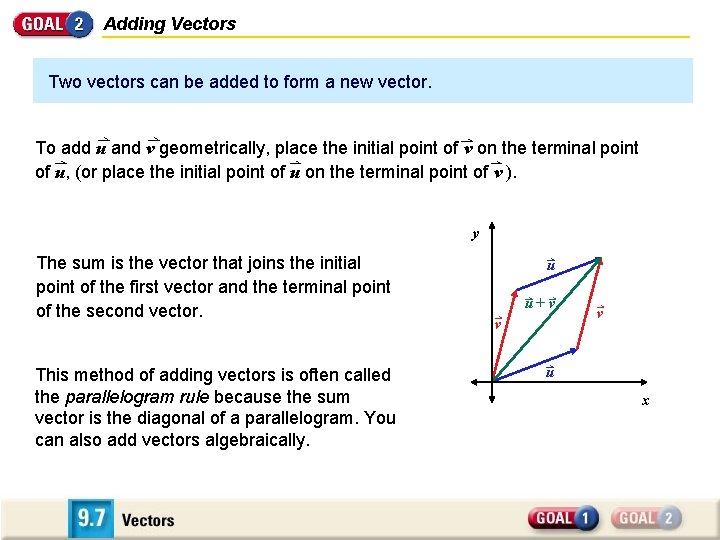
Adding Vectors Two vectors can be added to form a new vector. To add u and v geometrically, place the initial point of v on the terminal point of u, (or place the initial point of u on the terminal point of v ). y The sum is the vector that joins the initial point of the first vector and the terminal point of the second vector. This method of adding vectors is often called the parallelogram rule because the sum vector is the diagonal of a parallelogram. You can also add vectors algebraically. u u+v v v u x
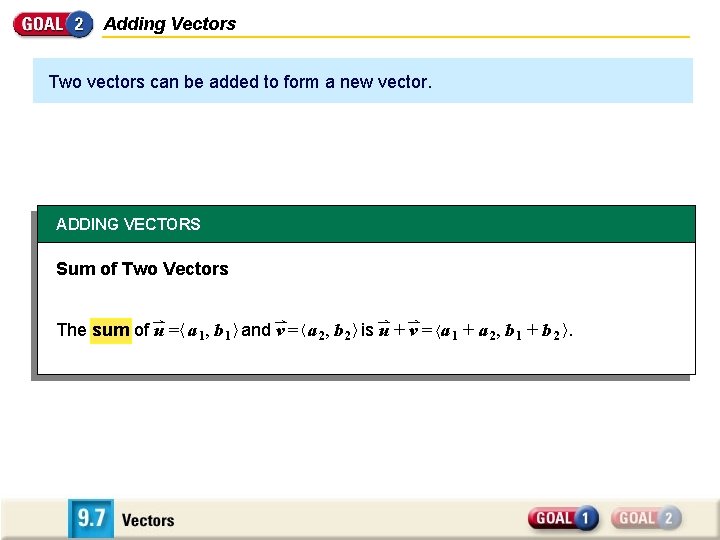
Adding Vectors Two vectors can be added to form a new vector. ADDING VECTORS Sum of Two Vectors The sum of u = a 1, b 1 and v = a 2, b 2 is u + v = a 1 + a 2, b 1 + b 2.
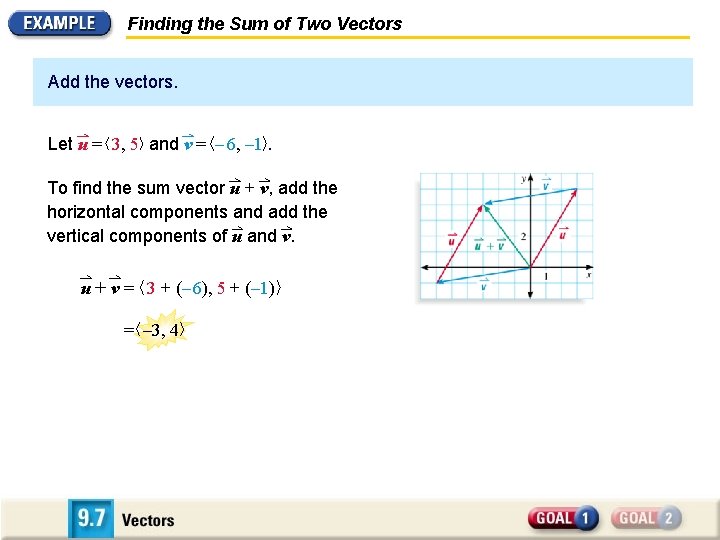
Finding the Sum of Two Vectors Add the vectors. Let u = 3, 5 and v = – 6, – 1. To find the sum vector u + v, add the horizontal components and add the vertical components of u and v. u + v = 3 + (– 6), 5 + (– 1) = – 3, 4
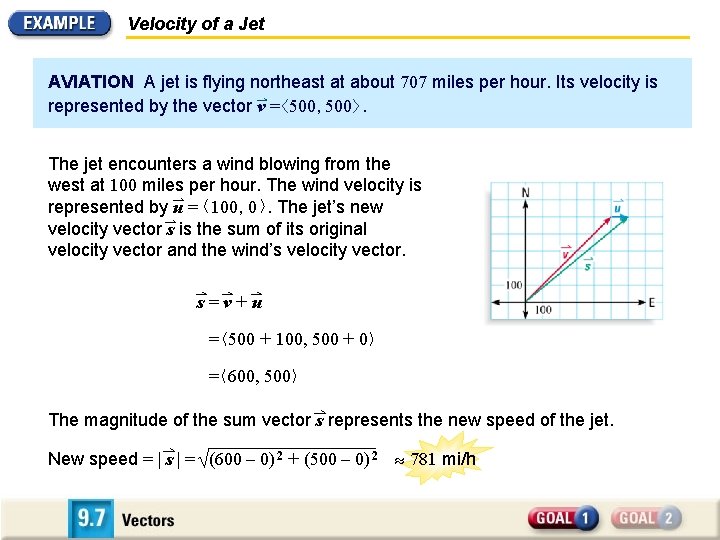
Velocity of a Jet AVIATION A jet is flying northeast at about 707 miles per hour. Its velocity is represented by the vector v = 500, 500. The jet encounters a wind blowing from the west at 100 miles per hour. The wind velocity is represented by u = 100, 0. The jet’s new velocity vector s is the sum of its original velocity vector and the wind’s velocity vector. s=v+u = 500 + 100, 500 + 0 = 600, 500 The magnitude of the sum vector s represents the new speed of the jet. New speed = | s | = (600 – 0) 2 + (500 – 0) 2 781 mi/h