
Finding substrings my sequence gatgcaggctcgctagcggct Does this string
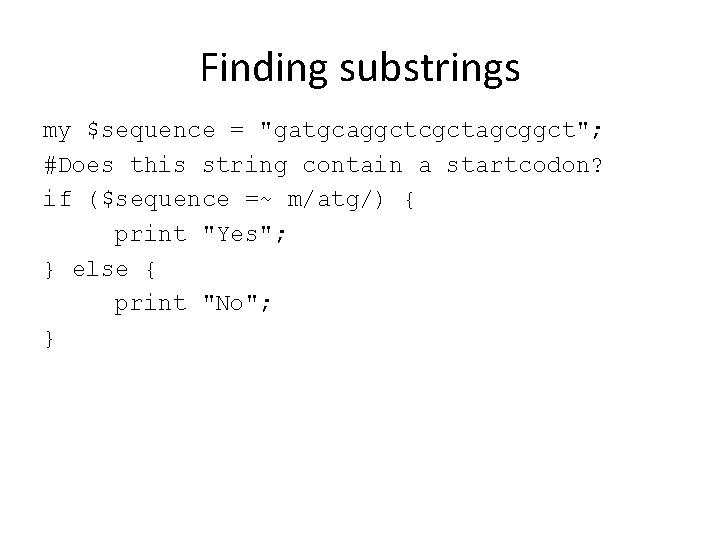
Finding substrings my $sequence = "gatgcaggctcgctagcggct"; #Does this string contain a startcodon? if ($sequence =~ m/atg/) { print "Yes"; } else { print "No"; }
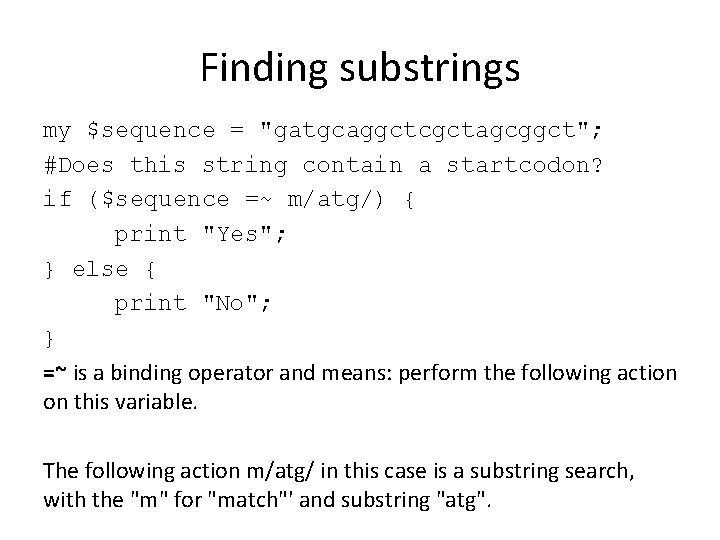
Finding substrings my $sequence = "gatgcaggctcgctagcggct"; #Does this string contain a startcodon? if ($sequence =~ m/atg/) { print "Yes"; } else { print "No"; } =~ is a binding operator and means: perform the following action on this variable. The following action m/atg/ in this case is a substring search, with the "m" for "match"' and substring "atg".
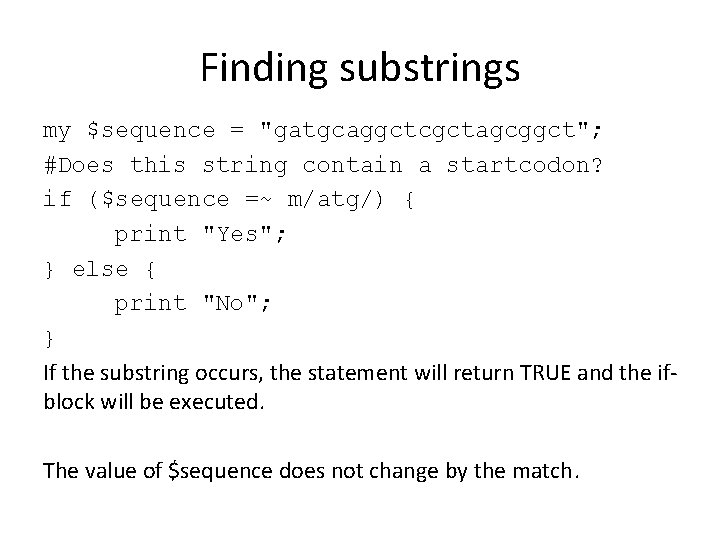
Finding substrings my $sequence = "gatgcaggctcgctagcggct"; #Does this string contain a startcodon? if ($sequence =~ m/atg/) { print "Yes"; } else { print "No"; } If the substring occurs, the statement will return TRUE and the ifblock will be executed. The value of $sequence does not change by the match.
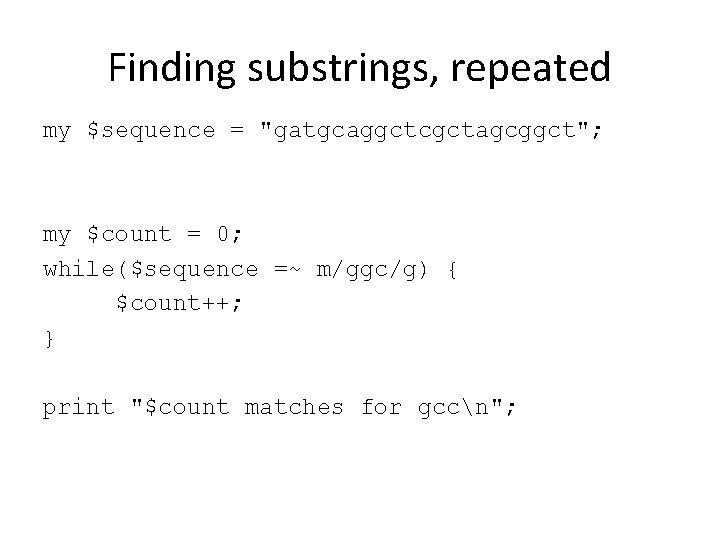
Finding substrings, repeated my $sequence = "gatgcaggctcgctagcggct"; my $count = 0; while($sequence =~ m/ggc/g) { $count++; } print "$count matches for gccn";
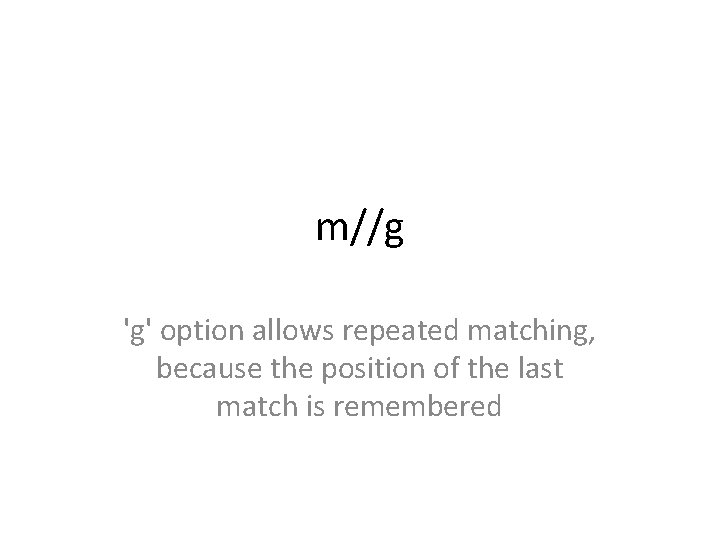
m//g 'g' option allows repeated matching, because the position of the last match is remembered
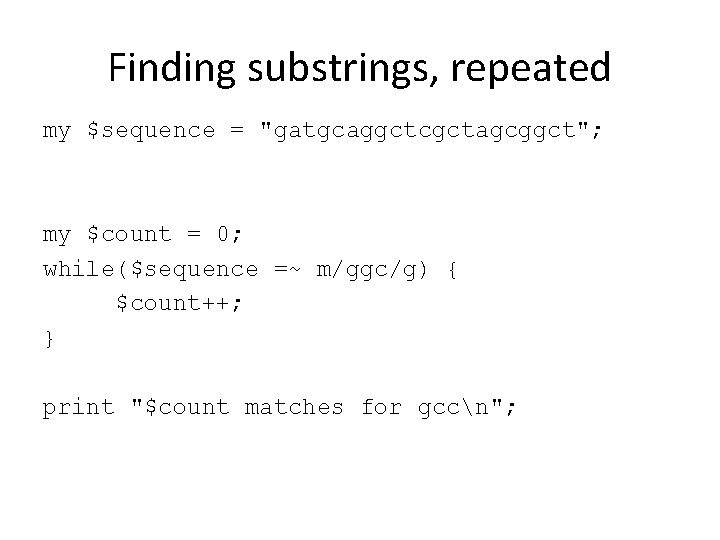
Finding substrings, repeated my $sequence = "gatgcaggctcgctagcggct"; my $count = 0; while($sequence =~ m/ggc/g) { $count++; } print "$count matches for gccn";
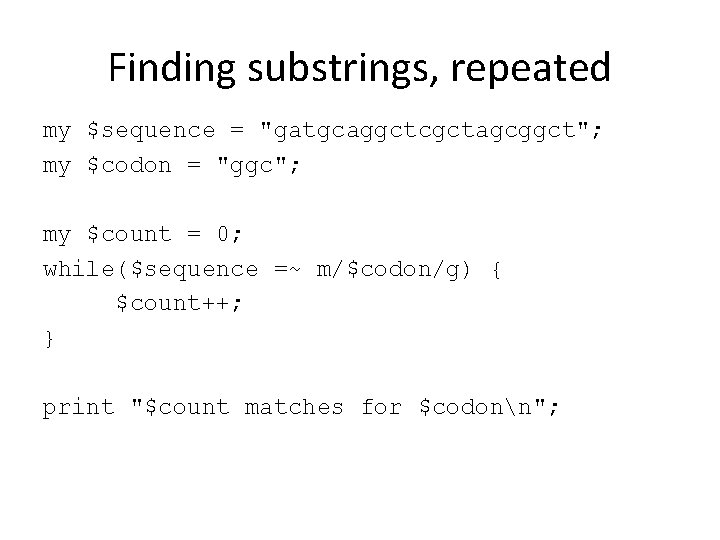
Finding substrings, repeated my $sequence = "gatgcaggctcgctagcggct"; my $codon = "ggc"; my $count = 0; while($sequence =~ m/$codon/g) { $count++; } print "$count matches for $codonn";
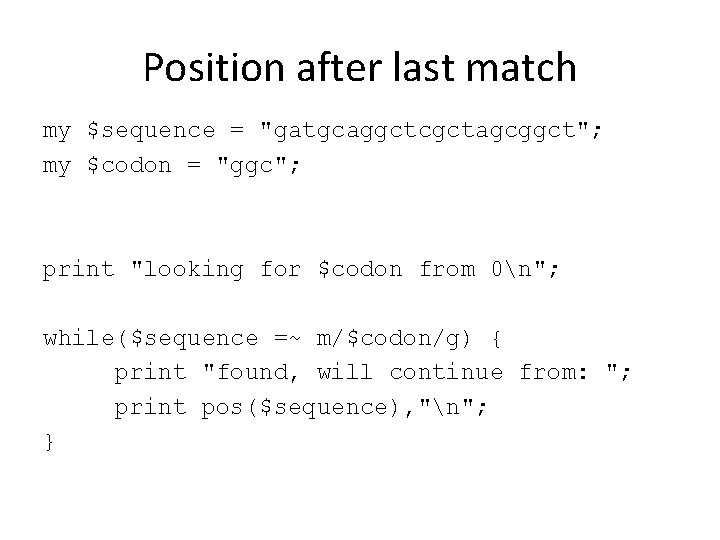
Position after last match my $sequence = "gatgcaggctcgctagcggct"; my $codon = "ggc"; print "looking for $codon from 0n"; while($sequence =~ m/$codon/g) { print "found, will continue from: "; print pos($sequence), "n"; }
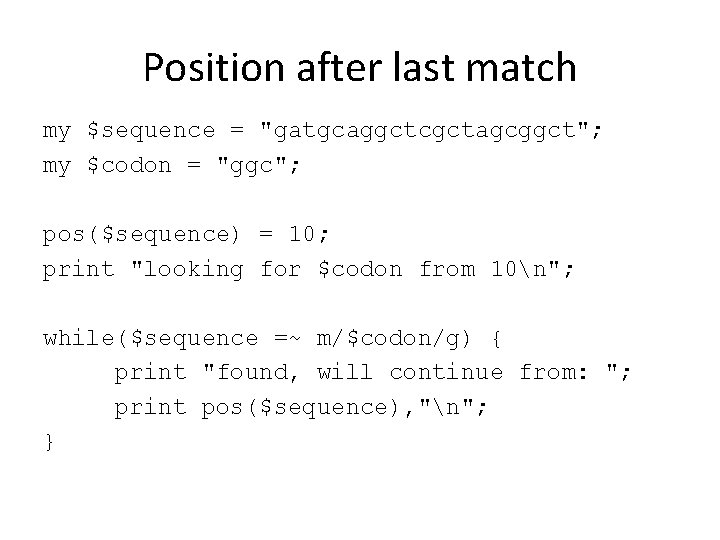
Position after last match my $sequence = "gatgcaggctcgctagcggct"; my $codon = "ggc"; pos($sequence) = 10; print "looking for $codon from 10n"; while($sequence =~ m/$codon/g) { print "found, will continue from: "; print pos($sequence), "n"; }
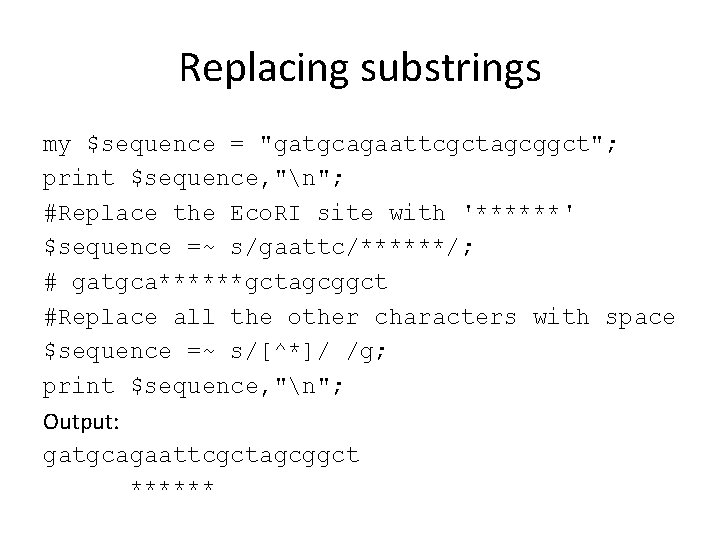
Replacing substrings my $sequence = "gatgcagaattcgctagcggct"; print $sequence, "n"; #Replace the Eco. RI site with '******' $sequence =~ s/gaattc/******/; # gatgca******gctagcggct #Replace all the other characters with space $sequence =~ s/[^*]/ /g; print $sequence, "n"; Output: gatgcagaattcgctagcggct ******
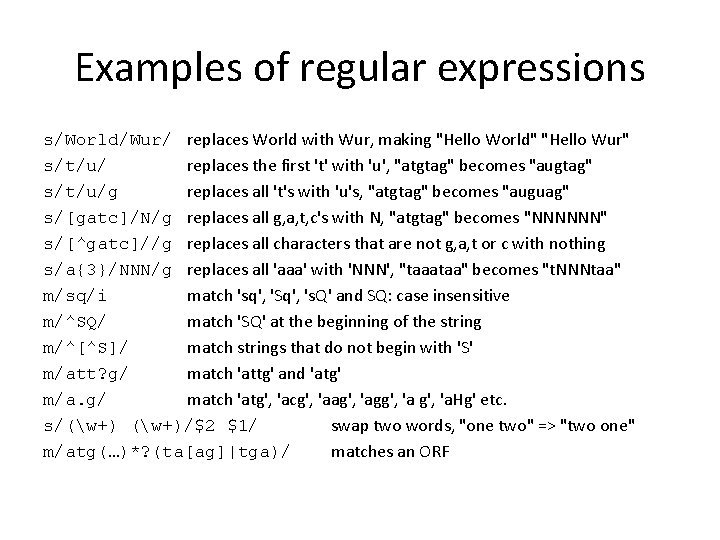
Examples of regular expressions s/World/Wur/ replaces World with Wur, making "Hello World" "Hello Wur" s/t/u/ replaces the first 't' with 'u', "atgtag" becomes "augtag" s/t/u/g replaces all 't's with 'u's, "atgtag" becomes "auguag" s/[gatc]/N/g replaces all g, a, t, c's with N, "atgtag" becomes "NNNNNN" s/[^gatc]//g replaces all characters that are not g, a, t or c with nothing s/a{3}/NNN/g replaces all 'aaa' with 'NNN', "taaataa" becomes "t. NNNtaa" m/sq/i match 'sq', 'Sq', 's. Q' and SQ: case insensitive m/^SQ/ match 'SQ' at the beginning of the string m/^[^S]/ match strings that do not begin with 'S' m/att? g/ match 'attg' and 'atg' m/a. g/ match 'atg', 'acg', 'aag', 'agg', 'a. Hg' etc. s/(w+)/$2 $1/ swap two words, "one two" => "two one" m/atg(…)*? (ta[ag]|tga)/ matches an ORF
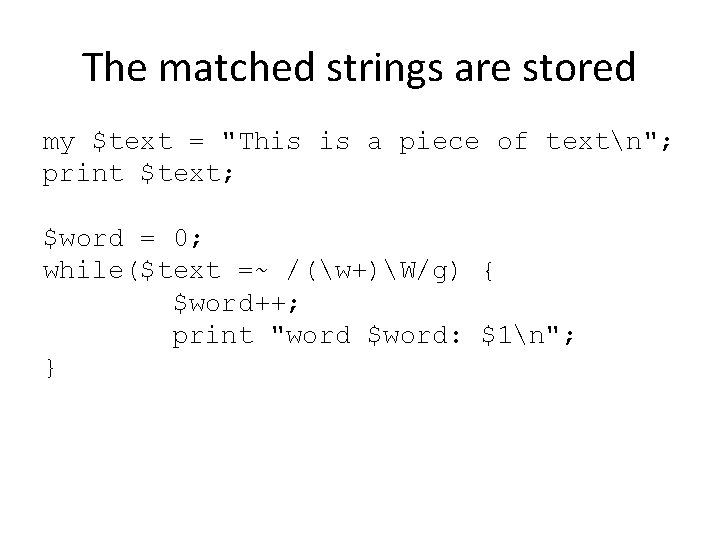
The matched strings are stored my $text = "This is a piece of textn"; print $text; $word = 0; while($text =~ /(w+)W/g) { $word++; print "word $word: $1n"; }
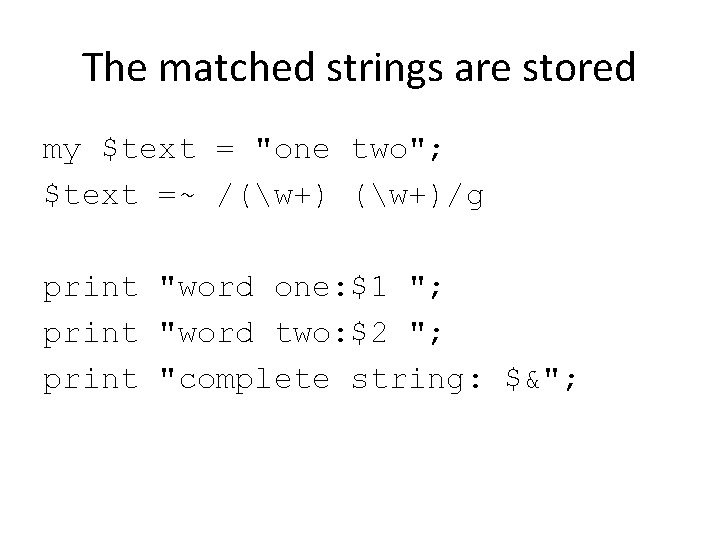
The matched strings are stored my $text = "one two"; $text =~ /(w+)/g print "word one: $1 "; print "word two: $2 "; print "complete string: $&";
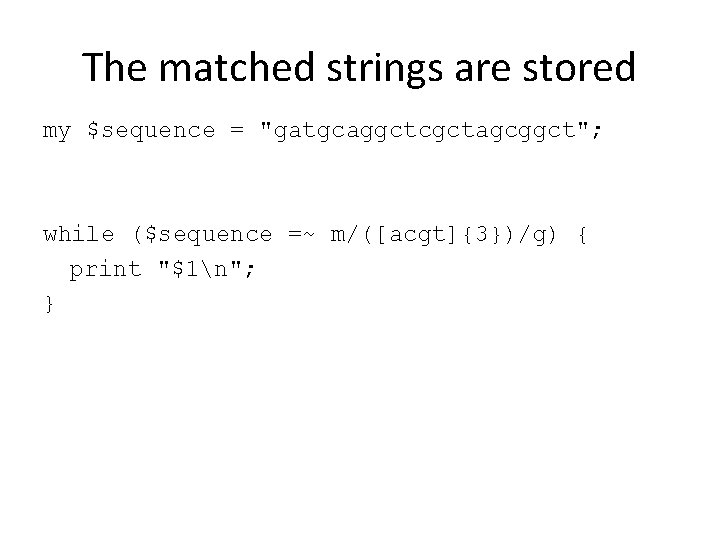
The matched strings are stored my $sequence = "gatgcaggctcgctagcggct"; while ($sequence =~ m/([acgt]{3})/g) { print "$1n"; }
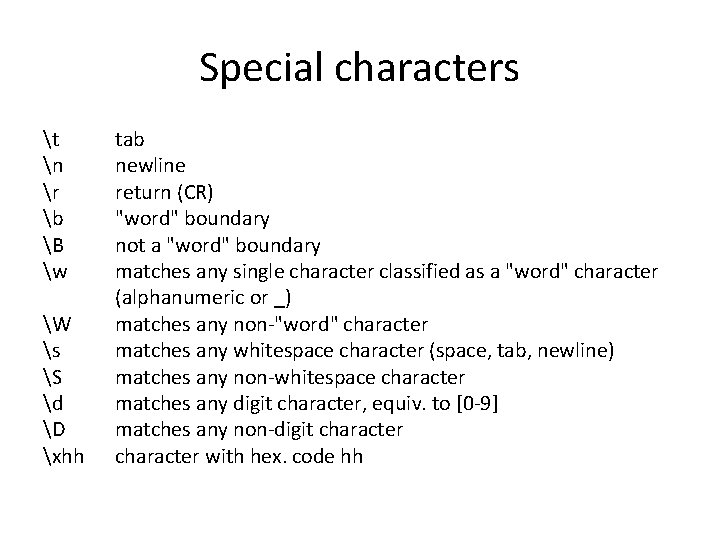
Special characters t n r b B w W s S d D xhh tab newline return (CR) "word" boundary not a "word" boundary matches any single character classified as a "word" character (alphanumeric or _) matches any non-"word" character matches any whitespace character (space, tab, newline) matches any non-whitespace character matches any digit character, equiv. to [0 -9] matches any non-digit character with hex. code hh
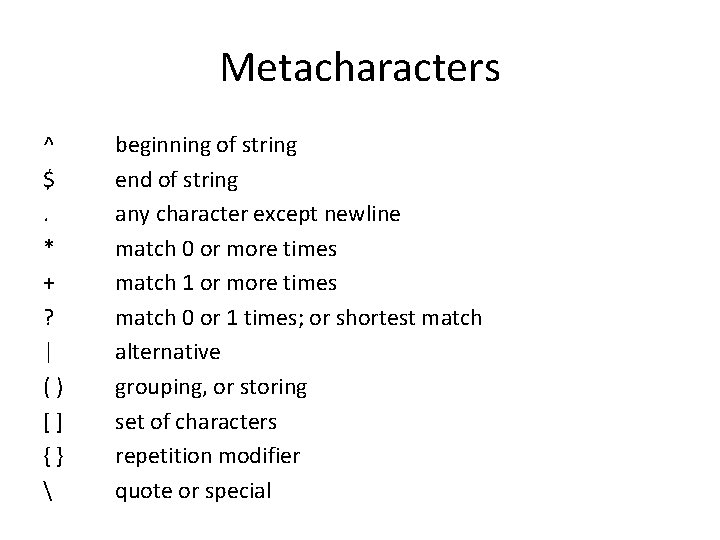
Metacharacters ^ $. * + ? | () [] {} beginning of string end of string any character except newline match 0 or more times match 1 or more times match 0 or 1 times; or shortest match alternative grouping, or storing set of characters repetition modifier quote or special
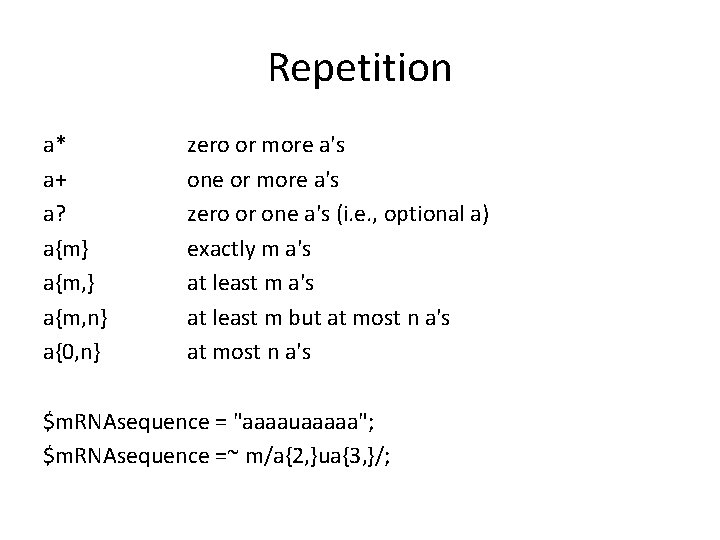
Repetition a* a+ a? a{m} a{m, n} a{0, n} zero or more a's one or more a's zero or one a's (i. e. , optional a) exactly m a's at least m but at most n a's $m. RNAsequence = "aaaauaaaaa"; $m. RNAsequence =~ m/a{2, }ua{3, }/;
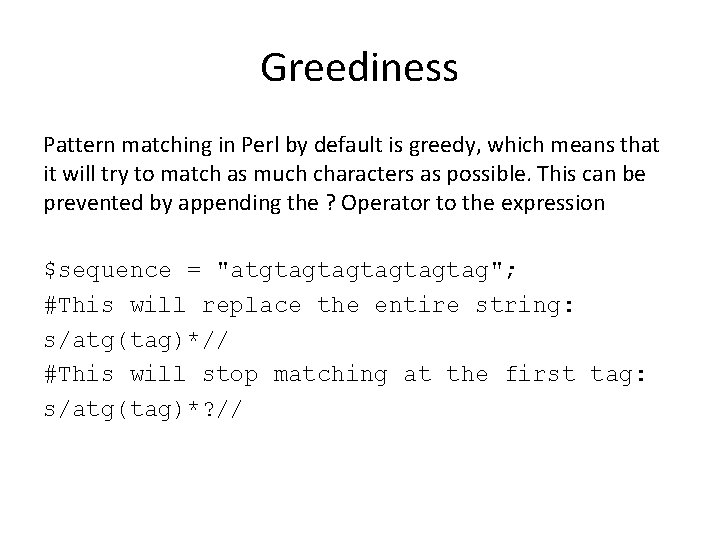
Greediness Pattern matching in Perl by default is greedy, which means that it will try to match as much characters as possible. This can be prevented by appending the ? Operator to the expression $sequence = "atgtagtagtag"; #This will replace the entire string: s/atg(tag)*// #This will stop matching at the first tag: s/atg(tag)*? //
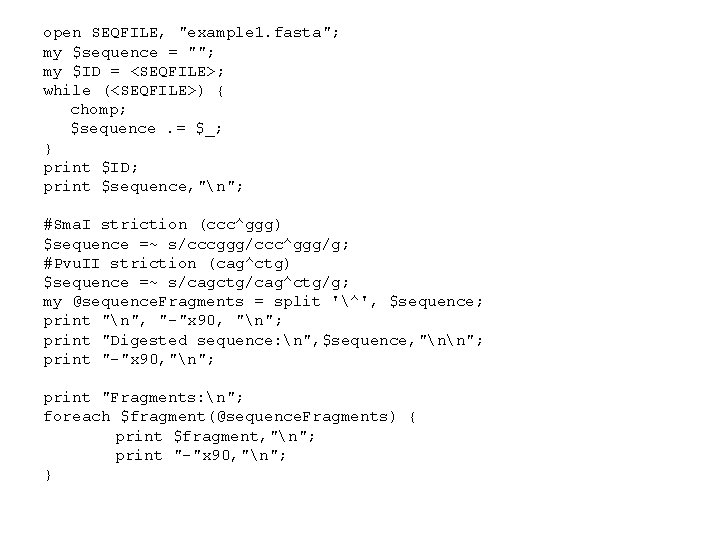
open SEQFILE, "example 1. fasta"; my $sequence = ""; my $ID = <SEQFILE>; while (<SEQFILE>) { chomp; $sequence. = $_; } print $ID; print $sequence, "n"; #Sma. I striction (ccc^ggg) $sequence =~ s/cccggg/ccc^ggg/g; #Pvu. II striction (cag^ctg) $sequence =~ s/cagctg/cag^ctg/g; my @sequence. Fragments = split '^', $sequence; print "n", "-"x 90, "n"; print "Digested sequence: n", $sequence, "nn"; print "-"x 90, "n"; print "Fragments: n"; foreach $fragment(@sequence. Fragments) { print $fragment, "n"; print "-"x 90, "n"; }
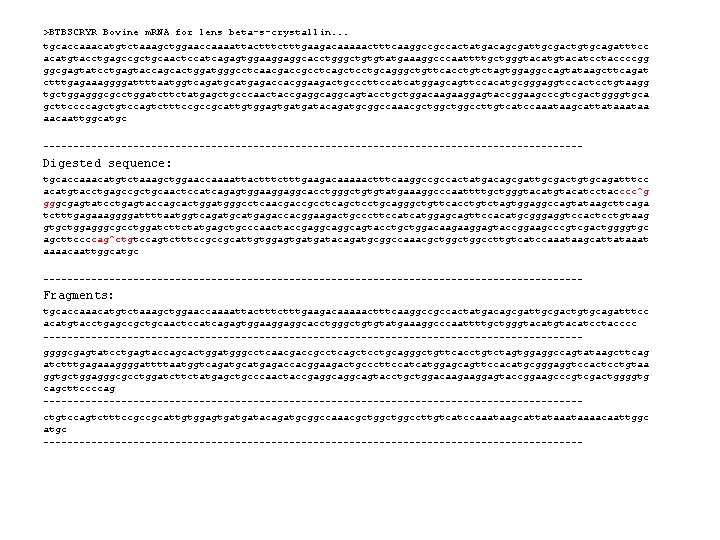
>BTBSCRYR Bovine m. RNA for lens beta-s-crystallin. . . tgcaccaaacatgtctaaagctggaaccaaaattactttgaagacaaaaactttcaaggccgccactatgacagcgattgcgactgtgcagatttcc acatgtacctgagccgctgcaactccatcagagtggaaggaggcacctgggctgtgtatgaaaggcccaattttgctgggtacatcctaccccgg ggcgagtatcctgagtaccagcactggatgggcctcaacgaccgcctcagctcctgcagggctgttcacctgtctagtggaggccagtataagcttcagat ctttgagaaaggggattttaatggtcagatgcatgagaccacggaagactgcccttccatcatggagcagttccacatgcgggaggtccactcctgtaagg tgctggagggcgcctggatcttctatgagctgcccaactaccgaggcagtacctgctggacaagaaggagtaccggaagcccgtcgactggggtgca gcttccccagctgtccagtctttccgccgcattgtggagtgatgatacagatgcggccaaacgctggccttgtcatccaaataagcattataa aacaattggcatgc --------------------------------------------- Digested sequence: tgcaccaaacatgtctaaagctggaaccaaaattactttgaagacaaaaactttcaaggccgccactatgacagcgattgcgactgtgcagatttcc acatgtacctgagccgctgcaactccatcagagtggaaggaggcacctgggctgtgtatgaaaggcccaattttgctgggtacatcctacccc^g gggcgagtatcctgagtaccagcactggatgggcctcaacgaccgcctcagctcctgcagggctgttcacctgtctagtggaggccagtataagcttcaga tctttgagaaaggggattttaatggtcagatgcatgagaccacggaagactgcccttccatcatggagcagttccacatgcgggaggtccactcctgtaag gtgctggagggcgcctggatcttctatgagctgcccaactaccgaggcagtacctgctggacaagaaggagtaccggaagcccgtcgactggggtgc agcttccccag^ctgtccagtctttccgccgcattgtggagtgatgatacagatgcggccaaacgctggccttgtcatccaaataagcattataaat aaaacaattggcatgc --------------------------------------------- Fragments: tgcaccaaacatgtctaaagctggaaccaaaattactttgaagacaaaaactttcaaggccgccactatgacagcgattgcgactgtgcagatttcc acatgtacctgagccgctgcaactccatcagagtggaaggaggcacctgggctgtgtatgaaaggcccaattttgctgggtacatcctacccc ---------------------------------------------ggggcgagtatcctgagtaccagcactggatgggcctcaacgaccgcctcagctcctgcagggctgttcacctgtctagtggaggccagtataagcttcag atctttgagaaaggggattttaatggtcagatgcatgagaccacggaagactgcccttccatcatggagcagttccacatgcgggaggtccactcctgtaa ggtgctggagggcgcctggatcttctatgagctgcccaactaccgaggcagtacctgctggacaagaaggagtaccggaagcccgtcgactggggtg cagcttccccag ---------------------------------------------ctgtccagtctttccgccgcattgtggagtgatgatacagatgcggccaaacgctggccttgtcatccaaataagcattataaaacaattggc atgc ---------------------------------------------
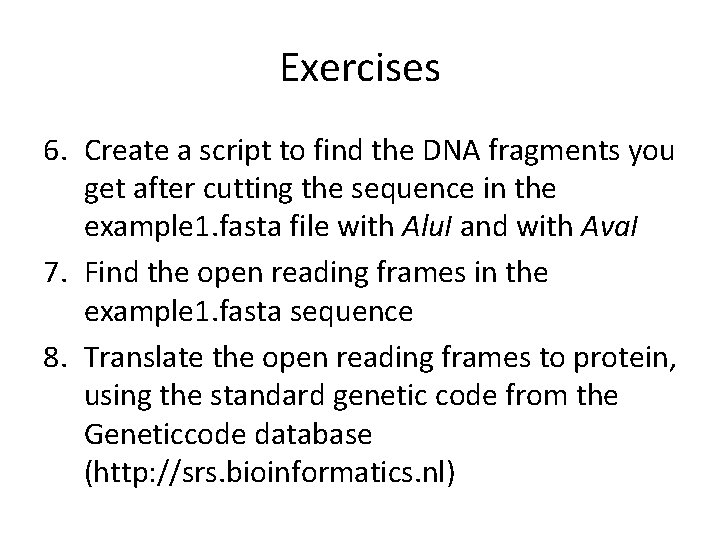
Exercises 6. Create a script to find the DNA fragments you get after cutting the sequence in the example 1. fasta file with Alu. I and with Ava. I 7. Find the open reading frames in the example 1. fasta sequence 8. Translate the open reading frames to protein, using the standard genetic code from the Geneticcode database (http: //srs. bioinformatics. nl)
- Slides: 21