
Finding Similar Items Introduction A fundamental datamining problem

Finding Similar Items
Introduction • A fundamental data-mining problem is to examine data for “Similar” items or how close two items are. • Measuring Similarity(Similarity Measures): A similarity measure S(A, B) indicates the closeness between sets A and B. • Measuring similarity and correlations is basic building locks for clustering, classification and anomaly detection. • Its Applications: –Collaborative Filtering –Advertiser keyword suggestions –Web search- Finding textually similar documents
Nearest Neighbor Search • Also known as Proximity Search / Similarity Search / Closest Point Search. • An optimization problem for finding closest (most similar) points. • NN search problem is defined as : Given a set S of points in a space M and a query point q Є M, find the set of closest points in S to q.
Nearest Neighbor Search • NN finds numerous applications in varied domain such as; Multimedia, Biology, Finance, Sensor, Surveillance, Social Network etc. • For example ü Given a query image, find similar images in photo database. ü Given a user profile, find similar users in user database or social network. ü Given a stock trend curve, find similar stock from stock history data. ü Given an event from sensor data, find similar events from sensors network data log.
Nearest Neighbor Search • Given a vector dataset and a query vector, how to find the vector(s) in the dataset closet to the query. • Suppose there is a dataset X with n points X={Xi; i=1, …, n} Given a query point q and a distance metric D(s, t), Find q’s nearest neighbor Xnn in X, that is D(Xnn, q)<=D(Xi, q), i=1, . . , n ie. Given a set, find similar sets from a large dataset. This basically results in finding the size of the intersection of two sets to evaluate similarity. ü This notion of similarity is called Jaccard Similarity of sets.
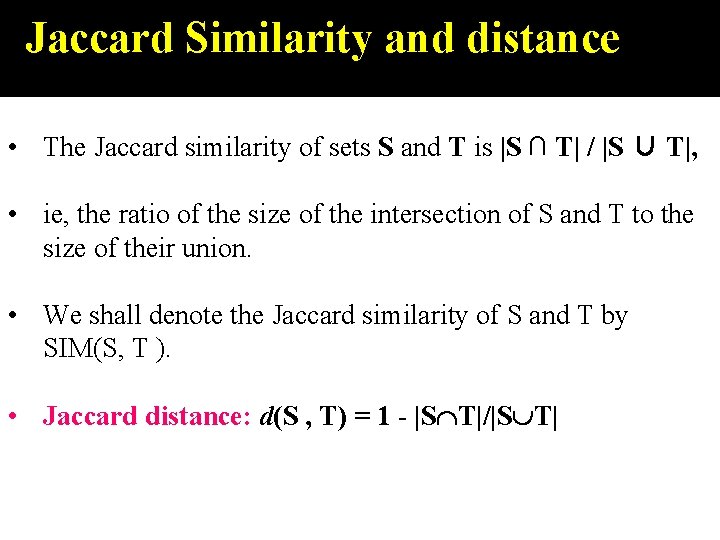
Jaccard Similarity and distance • The Jaccard similarity of sets S and T is |S ∩ T| / |S ∪ T|, • ie, the ratio of the size of the intersection of S and T to the size of their union. • We shall denote the Jaccard similarity of S and T by SIM(S, T ). • Jaccard distance: d(S , T) = 1 - |S T|/|S T|
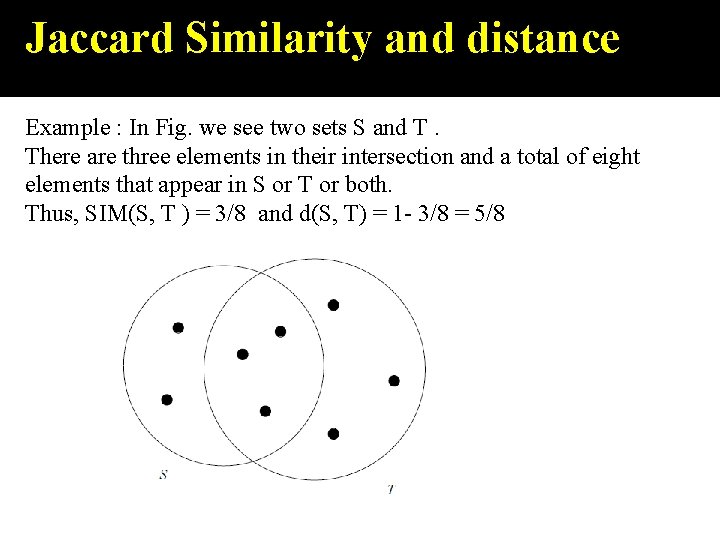
Jaccard Similarity and distance Example : In Fig. we see two sets S and T. There are three elements in their intersection and a total of eight elements that appear in S or T or both. Thus, SIM(S, T ) = 3/8 and d(S, T) = 1 - 3/8 = 5/8
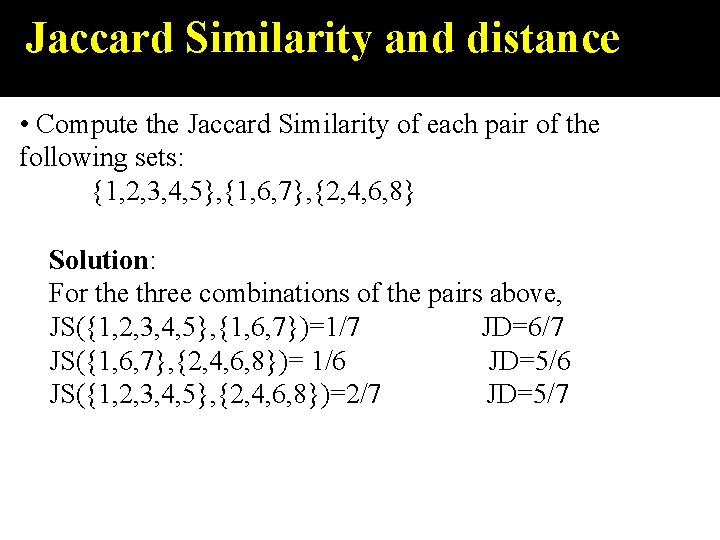
Jaccard Similarity and distance • Compute the Jaccard Similarity of each pair of the following sets: {1, 2, 3, 4, 5}, {1, 6, 7}, {2, 4, 6, 8} Solution: For the three combinations of the pairs above, JS({1, 2, 3, 4, 5}, {1, 6, 7})=1/7 JD=6/7 JS({1, 6, 7}, {2, 4, 6, 8})= 1/6 JD=5/6 JS({1, 2, 3, 4, 5}, {2, 4, 6, 8})=2/7 JD=5/7
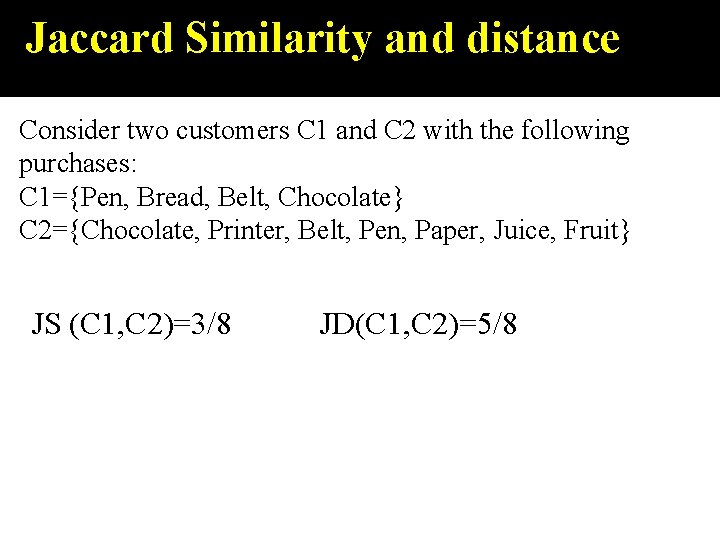
Jaccard Similarity and distance Consider two customers C 1 and C 2 with the following purchases: C 1={Pen, Bread, Belt, Chocolate} C 2={Chocolate, Printer, Belt, Pen, Paper, Juice, Fruit} JS (C 1, C 2)=3/8 JD(C 1, C 2)=5/8
Applications of Nearest Neighbor Search § § Optical Character Recognition (OCR) Content-based image retrieval Collaborative filtering Document Similarity

Similarity of Documents Need? ? ? q Character-level similarity not semantic similarity q Applications: ü Near-duplicate detection to improve search results quality in search engines ü HR applications: automated CV to job description matching or finding similar employees ü Document clustering (eg. Yahoo) ü Plagiarism detection (tools: Turnitin, i. Thenticate) ü News Aggregators (eg. Google News)
Collaborative Filtering as a Similar-Sets Problem • Filtering methods are based on collecting and analyzing a large amount of information on user’s behaviors, activities or preferences and predicting what users will like based on their similarity to other users. • Not rely on machine analyzable content. • Capable of accurately recommending complex items such as products, movies… • Application: Online Retail.
Distance Measures • Indicates the degree of dissimilarity between the two items. • Numerical measure of how different two data objects are. • Is lower when objects are more alike. • Is 0 when comparing an object with itself.
Distance Measures Suppose we have a set of points, called a space. A distance measure on this space is a function d(x, y) that takes two points in the space as arguments and produces a real number, and satisfies the following axioms: 1. 2. 3. 4. d(x, y) ≥ 0 (no negative distances). d(x, y) = 0 if and only if x = y d(x, y) = d(y, x) (distance is symmetric). d(x, y) ≤ d(x, z) + d(z, y) (the triangle inequality).
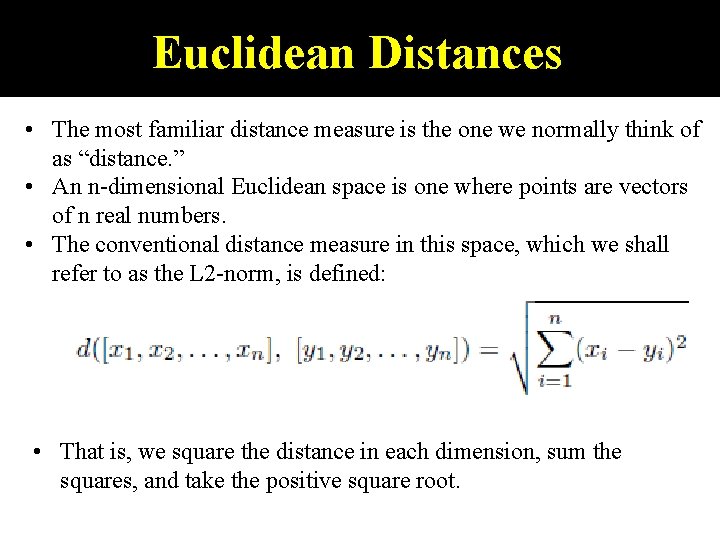
Euclidean Distances • The most familiar distance measure is the one we normally think of as “distance. ” • An n-dimensional Euclidean space is one where points are vectors of n real numbers. • The conventional distance measure in this space, which we shall refer to as the L 2 -norm, is defined: • That is, we square the distance in each dimension, sum the squares, and take the positive square root.
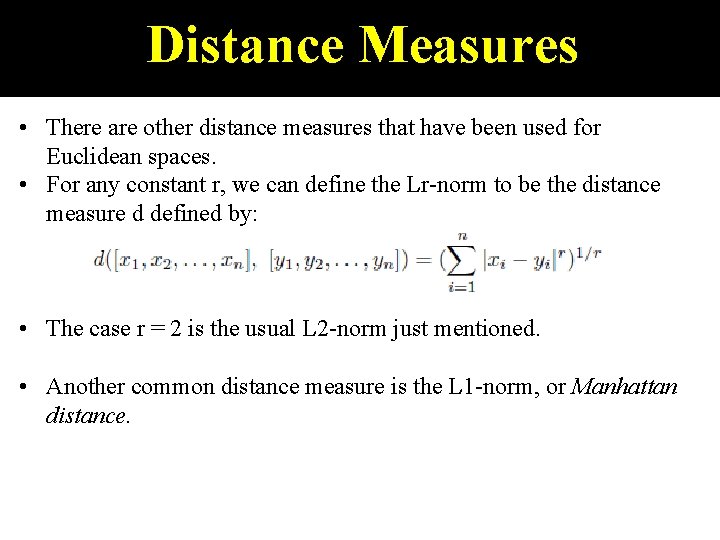
Distance Measures • There are other distance measures that have been used for Euclidean spaces. • For any constant r, we can define the Lr-norm to be the distance measure d defined by: • The case r = 2 is the usual L 2 -norm just mentioned. • Another common distance measure is the L 1 -norm, or Manhattan distance.
Distance Measures Manhattan distance. The distance between two points is the sum of the magnitudes of the differences in each dimension. It is called “Manhattan distance” because it is the distance one would have to travel between points if one were constrained to travel along grid lines, as on the streets of a city such as Manhattan.
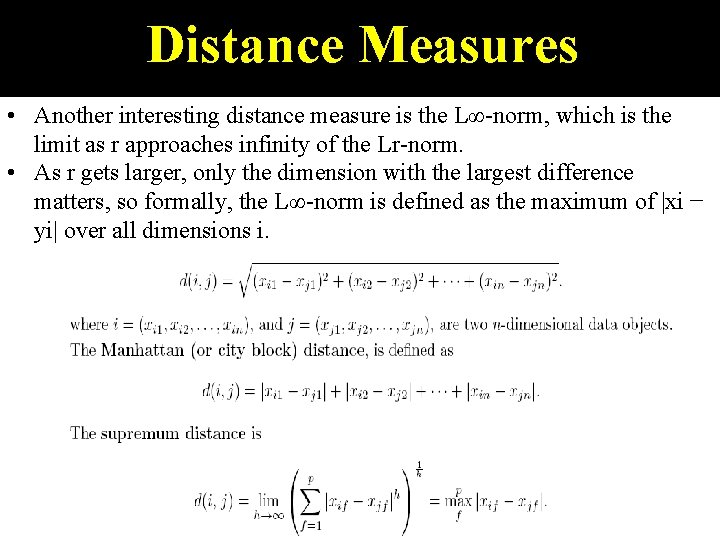
Distance Measures • Another interesting distance measure is the L∞-norm, which is the limit as r approaches infinity of the Lr-norm. • As r gets larger, only the dimension with the largest difference matters, so formally, the L∞-norm is defined as the maximum of |xi − yi| over all dimensions i.
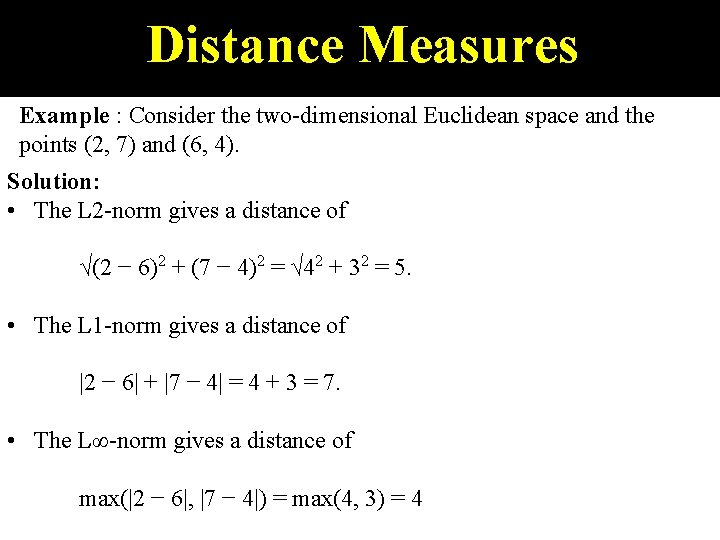
Distance Measures Example : Consider the two-dimensional Euclidean space and the points (2, 7) and (6, 4). Solution: • The L 2 -norm gives a distance of √(2 − 6)2 + (7 − 4)2 = √ 42 + 32 = 5. • The L 1 -norm gives a distance of |2 − 6| + |7 − 4| = 4 + 3 = 7. • The L∞-norm gives a distance of max(|2 − 6|, |7 − 4|) = max(4, 3) = 4
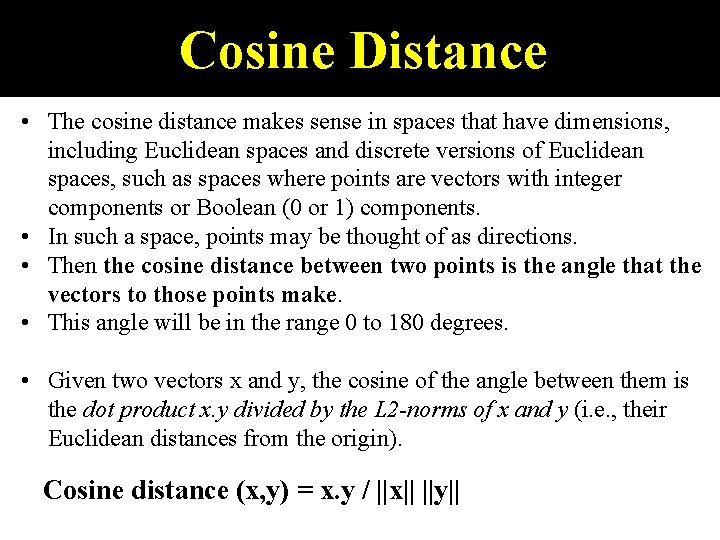
Cosine Distance • The cosine distance makes sense in spaces that have dimensions, including Euclidean spaces and discrete versions of Euclidean spaces, such as spaces where points are vectors with integer components or Boolean (0 or 1) components. • In such a space, points may be thought of as directions. • Then the cosine distance between two points is the angle that the vectors to those points make. • This angle will be in the range 0 to 180 degrees. • Given two vectors x and y, the cosine of the angle between them is the dot product x. y divided by the L 2 -norms of x and y (i. e. , their Euclidean distances from the origin). Cosine distance (x, y) = x. y / ||x|| ||y||
![Cosine Distance Example: Let our two vectors be x = [1, 2, − 1]](http://slidetodoc.com/presentation_image_h2/2555fb24434404e601773e9591e5c055/image-21.jpg "Cosine Distance Example: Let our two vectors be x = [1, 2, − 1]")
Cosine Distance Example: Let our two vectors be x = [1, 2, − 1] and y = [2, 1, 1]. Solution: The dot product x. y is 1 × 2 + 2 × 1 + (− 1) × 1 = 3. The L 2 -norm of both vectors is √ 6. For example, x has L 2 -norm √ 12 + 22 + (− 1)2 = √ 6. Thus, the cosine of the angle between x and y is 3/(√ 6√ 6) or 1/2. The angle whose cosine is 1/2 is 60 degrees, so that is the cosine distance between x and y.
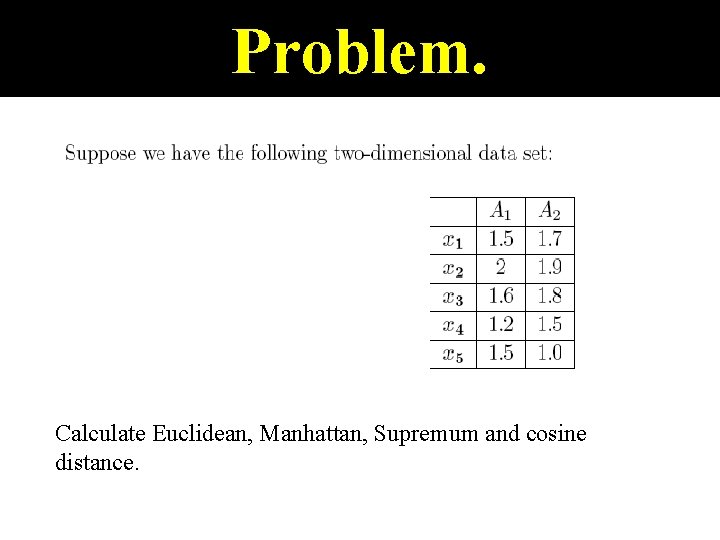
Problem. Calculate Euclidean, Manhattan, Supremum and cosine distance.
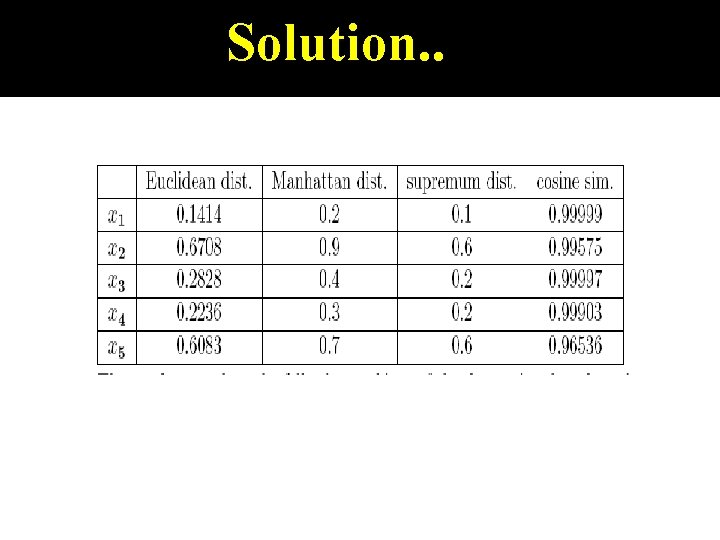
Solution. .
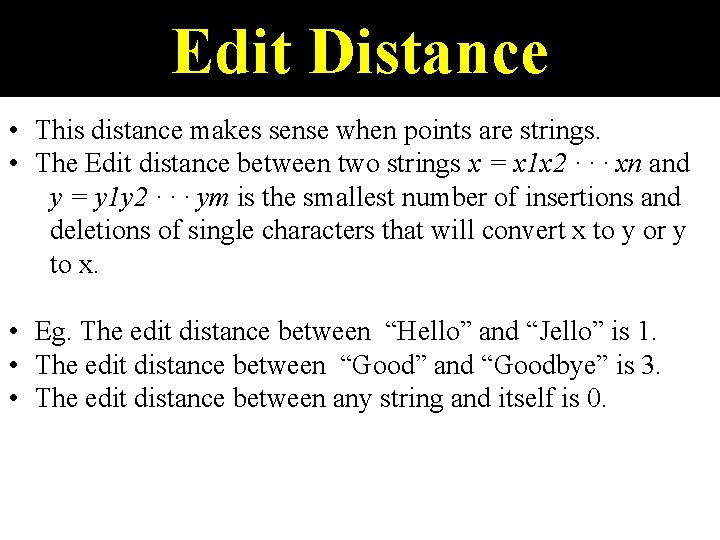
Edit Distance • This distance makes sense when points are strings. • The Edit distance between two strings x = x 1 x 2 · · · xn and y = y 1 y 2 · · · ym is the smallest number of insertions and deletions of single characters that will convert x to y or y to x. • Eg. The edit distance between “Hello” and “Jello” is 1. • The edit distance between “Good” and “Goodbye” is 3. • The edit distance between any string and itself is 0.
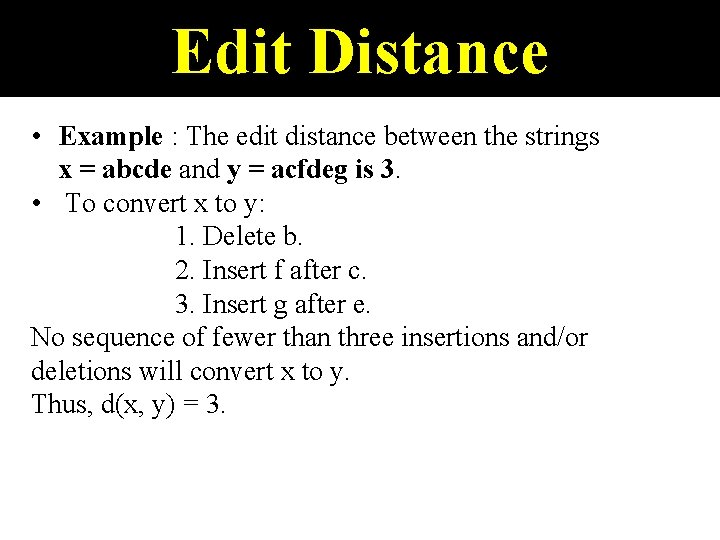
Edit Distance • Example : The edit distance between the strings x = abcde and y = acfdeg is 3. • To convert x to y: 1. Delete b. 2. Insert f after c. 3. Insert g after e. No sequence of fewer than three insertions and/or deletions will convert x to y. Thus, d(x, y) = 3.
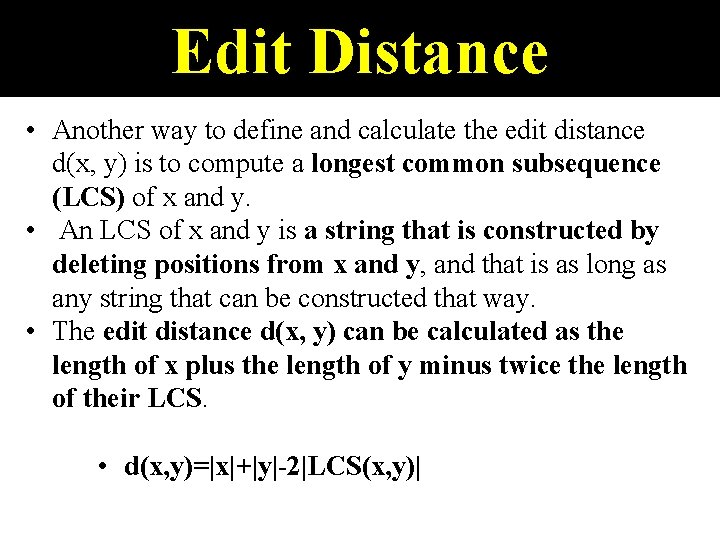
Edit Distance • Another way to define and calculate the edit distance d(x, y) is to compute a longest common subsequence (LCS) of x and y. • An LCS of x and y is a string that is constructed by deleting positions from x and y, and that is as long as any string that can be constructed that way. • The edit distance d(x, y) can be calculated as the length of x plus the length of y minus twice the length of their LCS. • d(x, y)=|x|+|y|-2|LCS(x, y)|
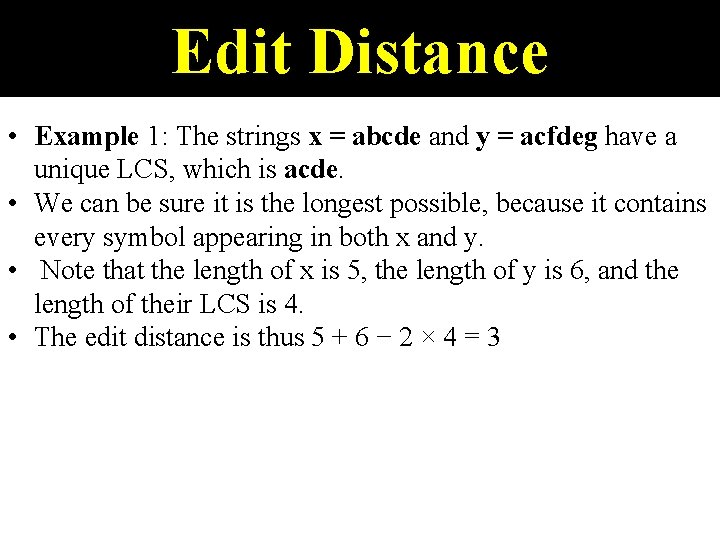
Edit Distance • Example 1: The strings x = abcde and y = acfdeg have a unique LCS, which is acde. • We can be sure it is the longest possible, because it contains every symbol appearing in both x and y. • Note that the length of x is 5, the length of y is 6, and the length of their LCS is 4. • The edit distance is thus 5 + 6 − 2 × 4 = 3
Edit Distance • Example 2, consider x = aba and y = bab. • Their edit distance is 2. • For example, we can convert x to y by deleting the first a and then inserting b at the end. • There are two LCS’s: ab and ba. Each can be obtained by deleting one symbol from each string. As must be the case for multiple LCS’s of the same pair of strings, both LCS’s have the same length. • Therefore, we may compute the edit distance as 3 + 3 − 2 × 2 = 2.
Hamming Distance • Given a space of vectors, we define the Hamming distance between two vectors to be the number of components in which they differ. • It should be obvious that Hamming distance is a distance measure. • Clearly the Hamming distance cannot be negative, and if it is zero, then the vectors are identical. • Most commonly, Hamming distance is used when the vectors are Boolean; they consist of 0’s and 1’s only. • However, in principle, the vectors can have components from any set.
Hamming Distance • Example 1: The Hamming distance between the vectors 10101 and 11110 is 3. That is, these vectors differ in the second, fourth, and fifth components, while they agree in the first and third components. • Example 2: Consider two vectors, p 1=10101; p 2=10011. then d(p 1, p 2)=2, because the bit-vectors differ in the 3 rd and 4 th positions.
Exercise 1. Find the Jaccard distances between the following pairs of sets: (a) {1, 2, 3, 4} and {2, 3, 4, 5}. (b) {1, 2, 3} and {4, 5, 6}. 2. Compute the cosines of the angles between each of the following pairs of vectors. (a) (3, − 1, 2) and (− 2, 3, 1). (b) (1, 2, 3) and (2, 4, 6). (c) (5, 0, − 4) and (− 1, − 6, 2). (d) (0, 1, 1, 0, 1, 1) and (0, 0, 1, 0, 0, 0).
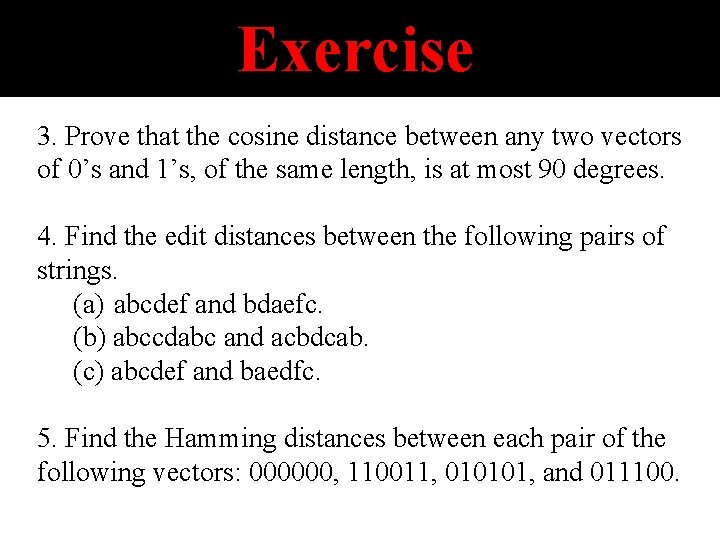
Exercise 3. Prove that the cosine distance between any two vectors of 0’s and 1’s, of the same length, is at most 90 degrees. 4. Find the edit distances between the following pairs of strings. (a) abcdef and bdaefc. (b) abccdabc and acbdcab. (c) abcdef and baedfc. 5. Find the Hamming distances between each pair of the following vectors: 000000, 110011, 010101, and 011100.
- Slides: 32