
Finding Similar Items Application Similar Documents Shingling Minhashing



- Slides: 46
Finding Similar Items Application: Similar Documents Shingling Minhashing Locality-Sensitive Hashing Jeffrey D. Ullman Stanford University
The Big Picture �It has been said that the mark of a computer scientist is that they believe hashing is real. § I. e. , it is possible to insert, delete, and lookup items in a large set in O(1) time per operation. �Locality-Sensitive Hashing (LSH) is another type of magic that, like Bigfoot, is hard to believe is real, until you’ve seen it. �It lets you find pairs of similar items in a large set, without the quadratic cost of examining each pair. 2
LSH: The Bigfoot of CS �LSH is really a family of related techniques. �In general, one throws items into buckets using several different “hash functions. ” �You examine only those pairs of items that share a bucket for at least one of these hashings. �Upside: designed correctly, only a small fraction of pairs are ever examined. �Downside: there are false negatives – pairs of similar items that never even get considered. 3
Some Applications �We shall first study in detail the problem of finding (lexically) similar documents. �Later, two other problems: § Entity resolution (records that refer to the same person or other entity). § News-article similarity. 4
Similar Documents �Given a body of documents, e. g. , the Web, find pairs of documents with a lot of text in common, such as: § Mirror sites, or approximate mirrors. § Application: Don’t want to show both in a search. § Plagiarism, including large quotations. § Similar news articles at many news sites. § Application: Cluster articles by “same story. ” �Warning: LSH not designed for “same topic. ” 5
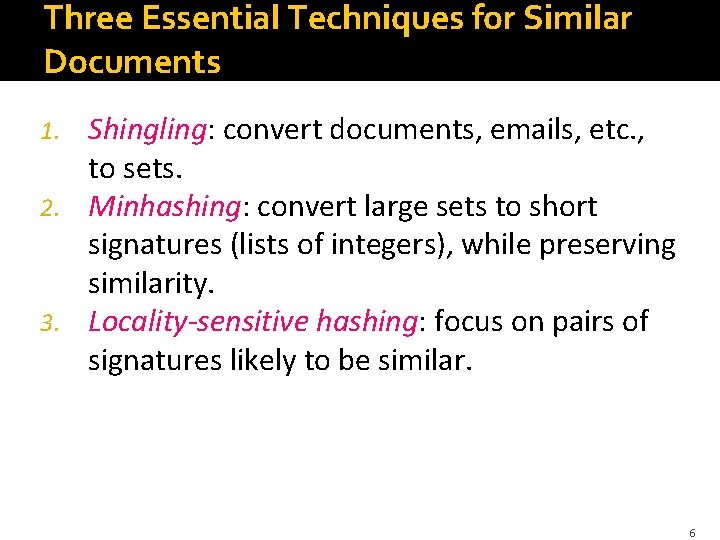
Three Essential Techniques for Similar Documents Shingling: convert documents, emails, etc. , to sets. 2. Minhashing: convert large sets to short signatures (lists of integers), while preserving similarity. 3. Locality-sensitive hashing: focus on pairs of signatures likely to be similar. 1. 6
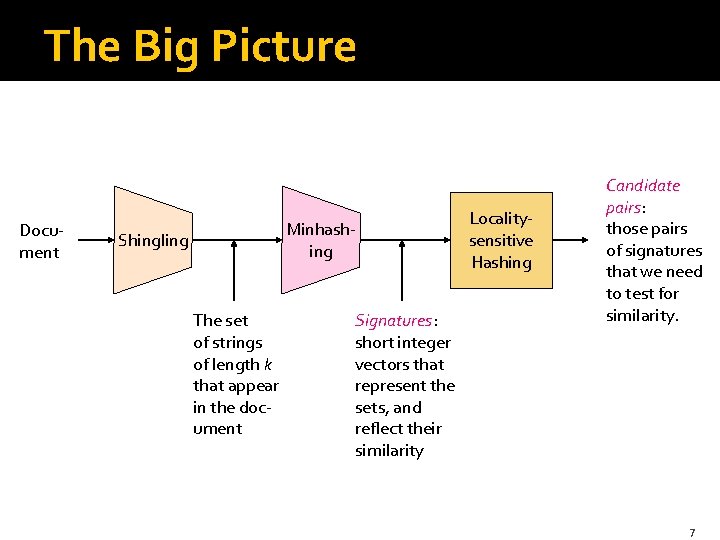
The Big Picture Document Minhashing Shingling The set of strings of length k that appear in the document Signatures: short integer vectors that represent the sets, and reflect their similarity Localitysensitive Hashing Candidate pairs: those pairs of signatures that we need to test for similarity. 7
Shingles �A k-shingle (or k-gram) for a document is a sequence of k characters that appears in the document. �Example: k = 2; doc = abcab. Set of 2 -shingles = {ab, bc, ca}. �Represent a doc by its set of k-shingles. 8
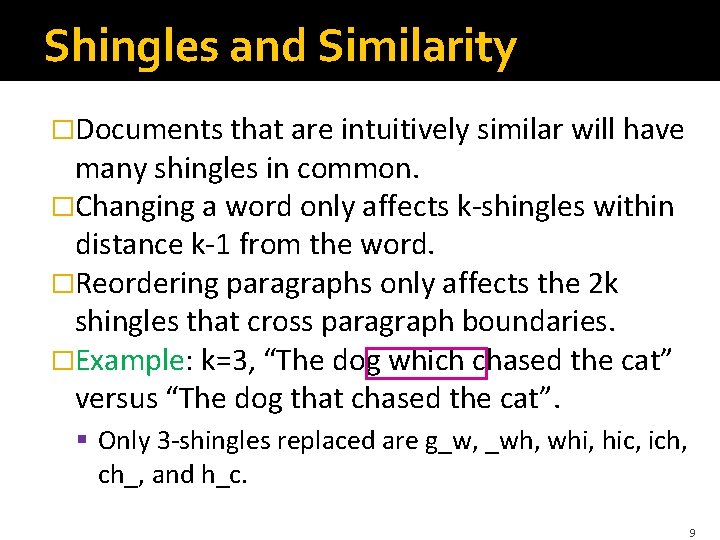
Shingles and Similarity �Documents that are intuitively similar will have many shingles in common. �Changing a word only affects k-shingles within distance k-1 from the word. �Reordering paragraphs only affects the 2 k shingles that cross paragraph boundaries. �Example: k=3, “The dog which chased the cat” versus “The dog that chased the cat”. § Only 3 -shingles replaced are g_w, _wh, whi, hic, ich, ch_, and h_c. 9
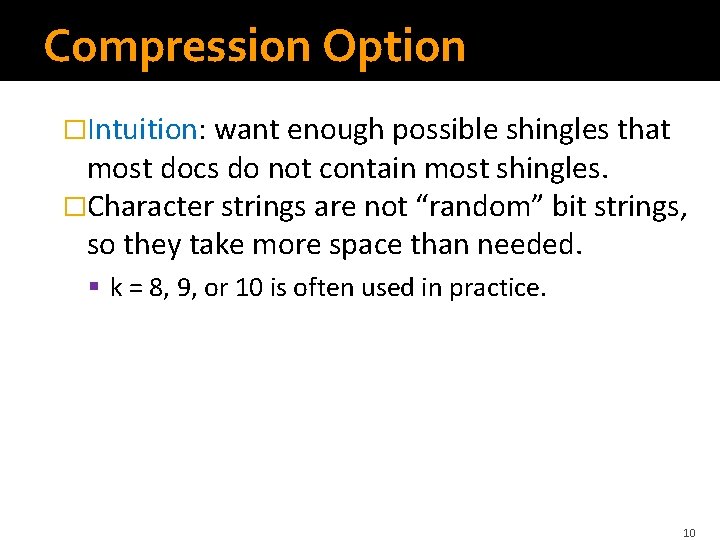
Compression Option �Intuition: want enough possible shingles that most docs do not contain most shingles. �Character strings are not “random” bit strings, so they take more space than needed. § k = 8, 9, or 10 is often used in practice. 10
Tokens �To save space but still make each shingle rare, we can hash them to (say) 4 bytes. § Called tokens. �Represent a doc by its tokens, that is, the set of hash values of its k-shingles. �Two documents could (rarely) appear to have shingles in common, when in fact only the hash-values were shared. 11
Minhashing Jaccard Similarity Measure Constructing Signatures
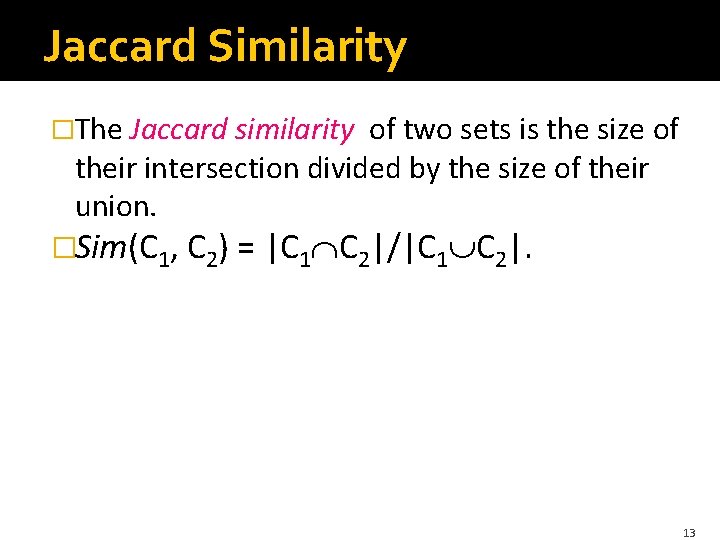
Jaccard Similarity �The Jaccard similarity of two sets is the size of their intersection divided by the size of their union. �Sim(C 1, C 2) = |C 1 C 2|/|C 1 C 2|. 13
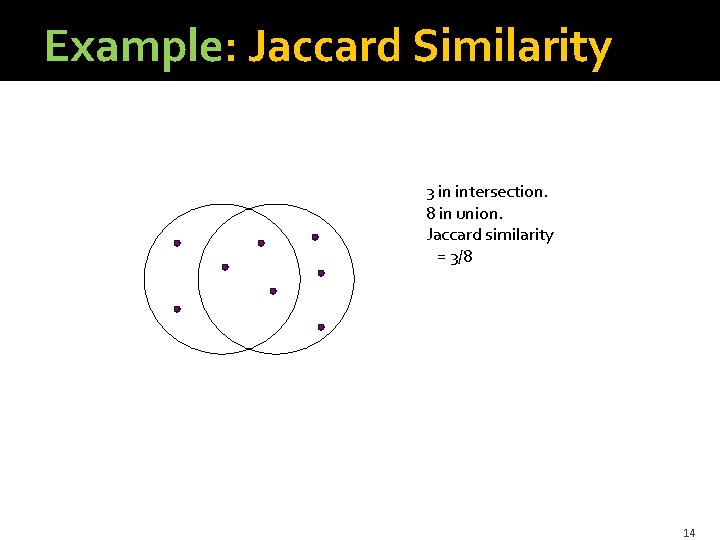
Example: Jaccard Similarity 3 in intersection. 8 in union. Jaccard similarity = 3/8 14
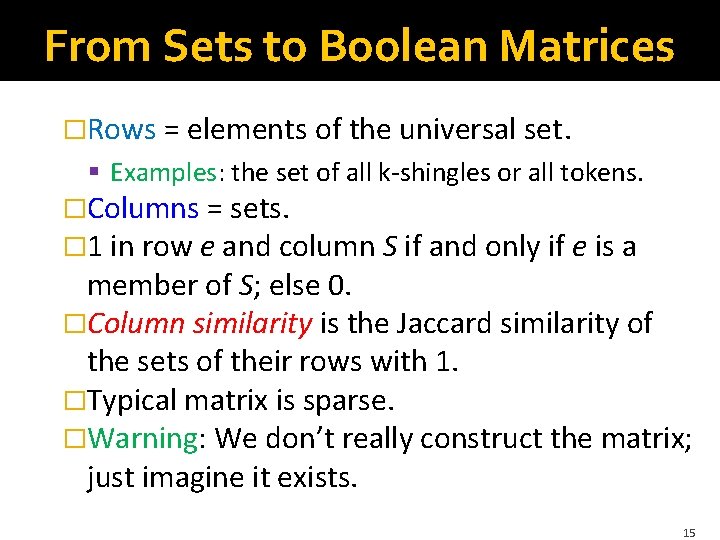
From Sets to Boolean Matrices �Rows = elements of the universal set. § Examples: the set of all k-shingles or all tokens. �Columns = sets. � 1 in row e and column S if and only if e is a member of S; else 0. �Column similarity is the Jaccard similarity of the sets of their rows with 1. �Typical matrix is sparse. �Warning: We don’t really construct the matrix; just imagine it exists. 15
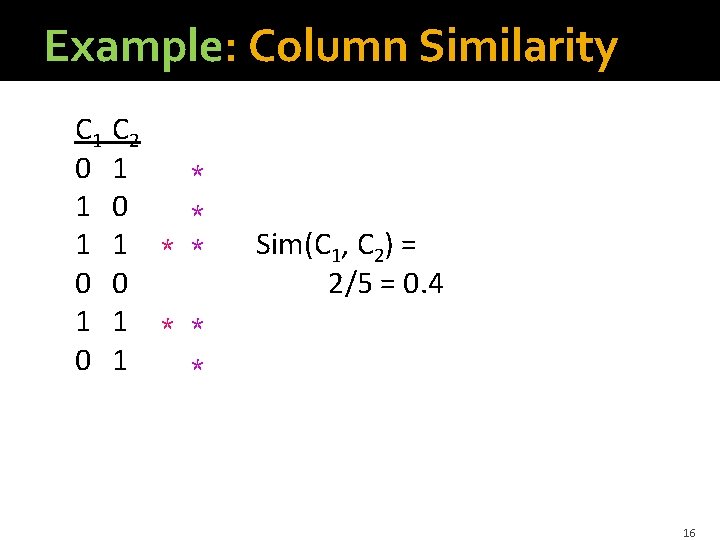
Example: Column Similarity C 1 0 1 0 C 2 1 * 0 * 1 * * 0 1 * * 1 * Sim(C 1, C 2) = 2/5 = 0. 4 16
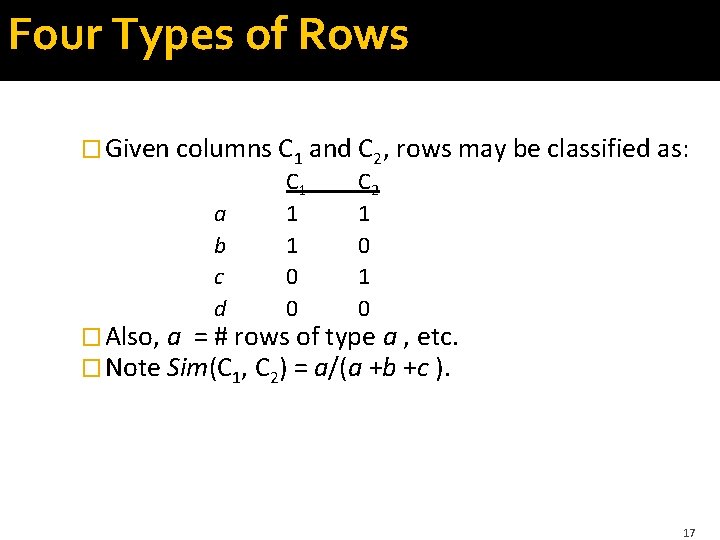
Four Types of Rows � Given columns C 1 and C 2, rows may be classified as: C 1 C 2 a 1 1 b 1 0 c 0 1 d 0 0 � Also, a = # rows of type a , etc. � Note Sim(C 1, C 2) = a/(a +b +c ). 17
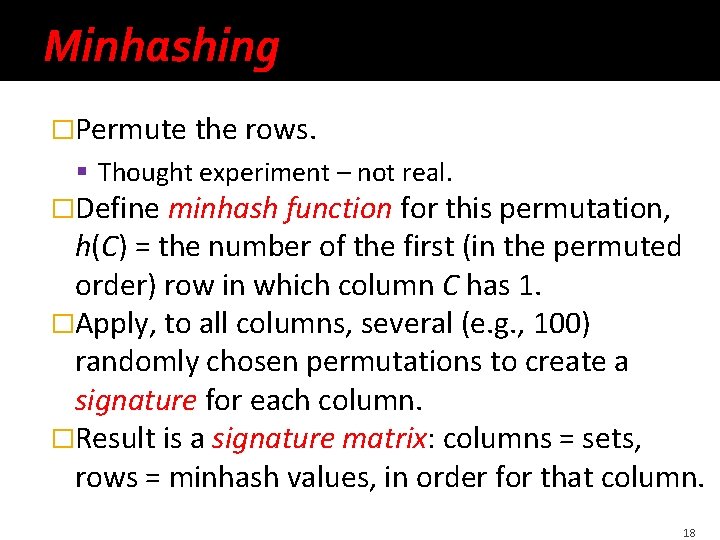
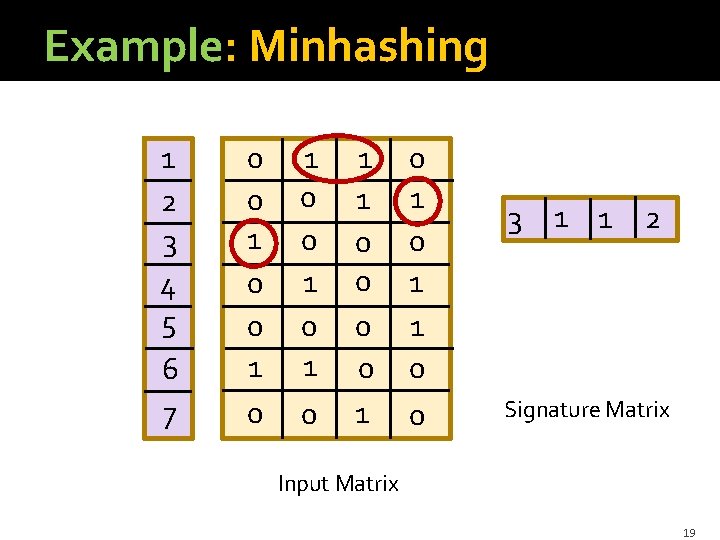
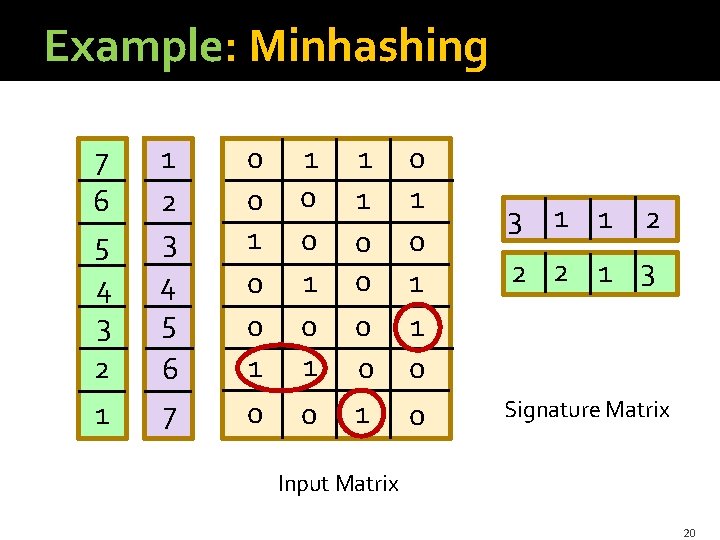
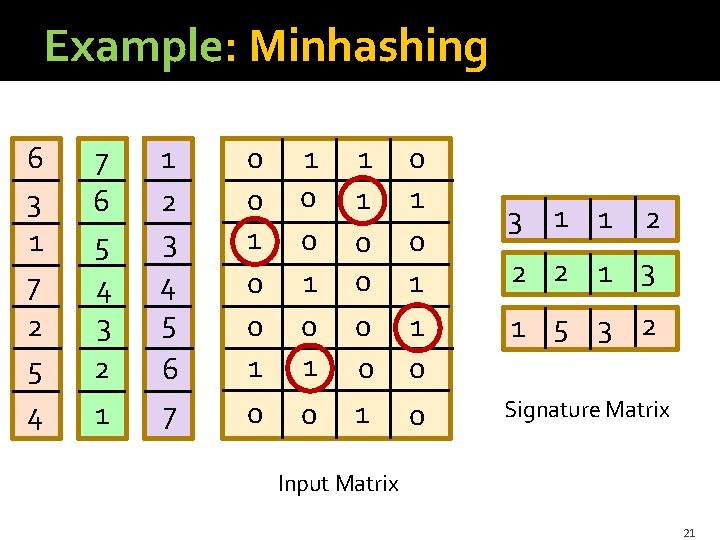
Minhashing �Permute the rows. § Thought experiment – not real. �Define minhash function for this permutation, h(C) = the number of the first (in the permuted order) row in which column C has 1. �Apply, to all columns, several (e. g. , 100) randomly chosen permutations to create a signature for each column. �Result is a signature matrix: columns = sets, rows = minhash values, in order for that column. 18
Example: Minhashing 1 2 3 4 5 6 7 0 0 1 0 1 1 0 0 1 0 1 1 0 0 3 1 1 2 Signature Matrix Input Matrix 19
Example: Minhashing 7 6 5 4 3 2 1 1 2 3 4 5 6 7 0 0 1 0 1 1 0 0 1 0 1 1 0 0 3 1 1 2 2 2 1 3 Signature Matrix Input Matrix 20
Example: Minhashing 6 3 1 7 2 5 4 7 6 5 4 3 2 1 1 2 3 4 5 6 7 0 0 1 0 1 1 0 0 1 0 1 1 0 0 3 1 1 2 2 2 1 3 1 5 3 2 Signature Matrix Input Matrix 21
A Subtle Point �People sometimes ask whether the minhash value should be the original number of the row, or the number in the permuted order (as we did in our example). �Answer: it doesn’t matter. �You only need to be consistent, and assure that two columns get the same value if and only if their first 1’s in the permuted order are in the same row. 22
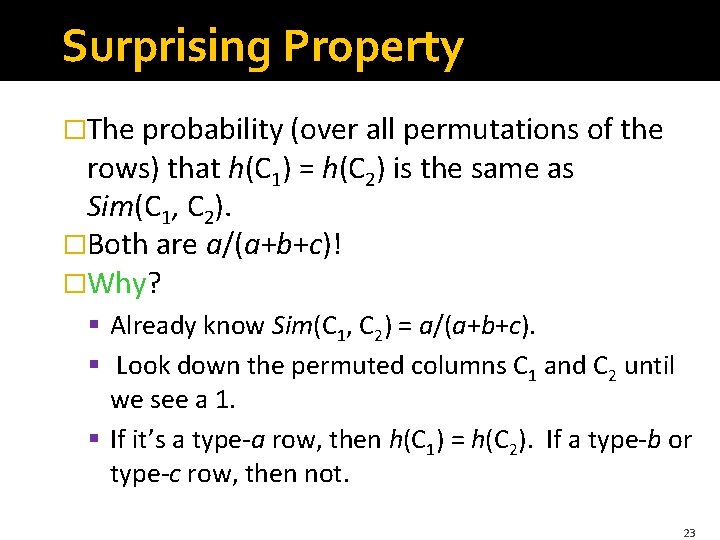
Surprising Property �The probability (over all permutations of the rows) that h(C 1) = h(C 2) is the same as Sim(C 1, C 2). �Both are a/(a+b+c)! �Why? § Already know Sim(C 1, C 2) = a/(a+b+c). § Look down the permuted columns C 1 and C 2 until we see a 1. § If it’s a type-a row, then h(C 1) = h(C 2). If a type-b or type-c row, then not. 23
Similarity for Signatures �The similarity of signatures is the fraction of the minhash functions (rows) in which they agree. �Thus, the expected similarity of two signatures equals the Jaccard similarity of the columns or sets that the signatures represent. § And the longer the signatures, the smaller will be the expected error. 24
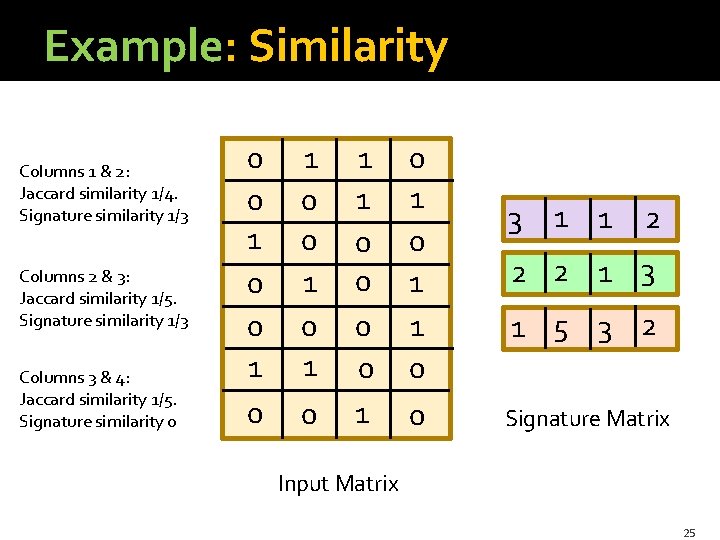
Example: Similarity Columns 1 & 2: Jaccard similarity 1/4. Signature similarity 1/3 Columns 2 & 3: Jaccard similarity 1/5. Signature similarity 1/3 Columns 3 & 4: Jaccard similarity 1/5. Signature similarity 0 0 0 1 0 1 1 0 0 1 0 1 1 0 0 3 1 1 2 2 2 1 3 1 5 3 2 Signature Matrix Input Matrix 25
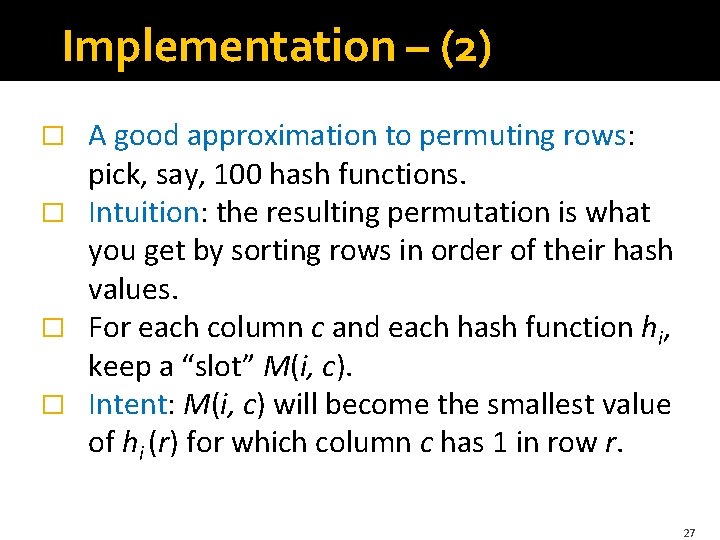
Implementation of Minhashing �Suppose 1 billion rows. �Hard to pick a random permutation of 1…billion. �Representing a random permutation requires 1 billion entries. �Accessing rows in permuted order leads to thrashing. 26
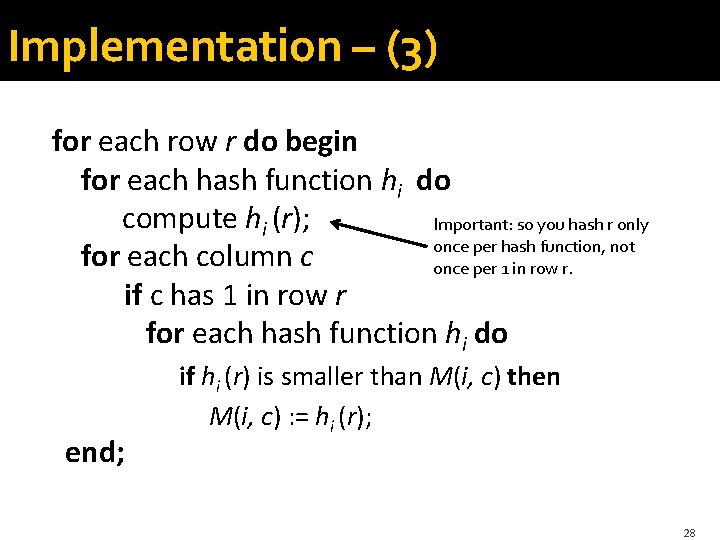
Implementation – (2) A good approximation to permuting rows: pick, say, 100 hash functions. � Intuition: the resulting permutation is what you get by sorting rows in order of their hash values. � For each column c and each hash function hi, keep a “slot” M(i, c). � Intent: M(i, c) will become the smallest value of hi (r) for which column c has 1 in row r. � 27
Implementation – (3) for each row r do begin for each hash function hi do compute hi (r); Important: so you hash r only once per hash function, not for each column c once per 1 in row r. if c has 1 in row r for each hash function hi do end; if hi (r) is smaller than M(i, c) then M(i, c) : = hi (r); 28
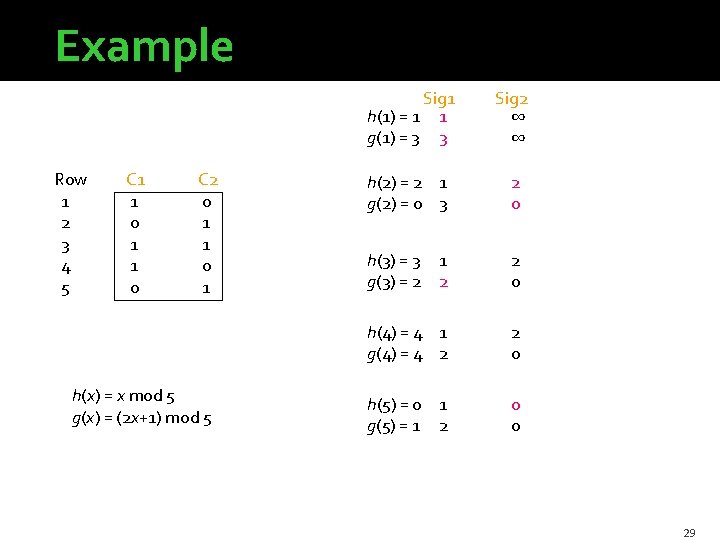
Example Row 1 2 3 4 5 C 1 1 0 C 2 0 1 1 0 1 h(x) = x mod 5 g(x) = (2 x+1) mod 5 Sig 1 h(1) = 1 1 g(1) = 3 3 Sig 2 ∞ ∞ h(2) = 2 1 g(2) = 0 3 2 0 h(3) = 3 g(3) = 2 1 2 2 0 h(4) = 4 1 g(4) = 4 2 2 0 h(5) = 0 1 g(5) = 1 2 0 0 29
Implementation – (4) �Often, data is given by column, not row. § Example: columns = documents, rows = shingles. �If so, sort matrix once so it is by row. § I. e. , generate shingle-doc. ID pairs from the documents and then sort by shingle. 30
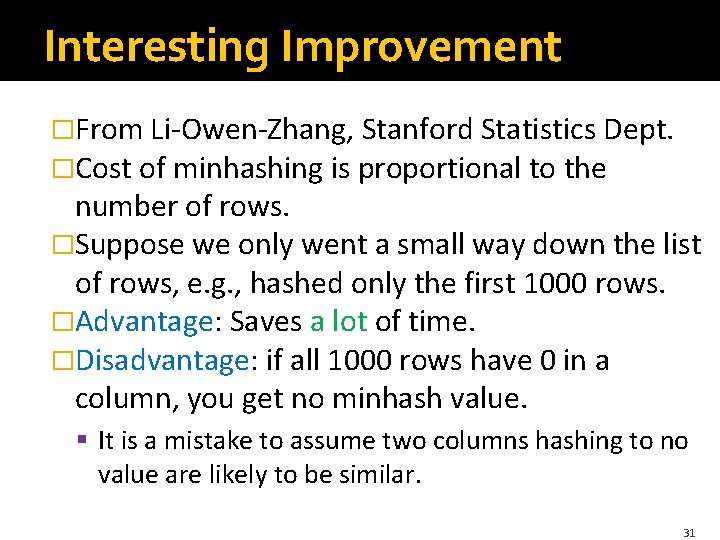
Interesting Improvement �From Li-Owen-Zhang, Stanford Statistics Dept. �Cost of minhashing is proportional to the number of rows. �Suppose we only went a small way down the list of rows, e. g. , hashed only the first 1000 rows. �Advantage: Saves a lot of time. �Disadvantage: if all 1000 rows have 0 in a column, you get no minhash value. § It is a mistake to assume two columns hashing to no value are likely to be similar. 31
Improvement – (2) �Divide the rows into k bands. �As you go down the rows, start a new minhash competition for each band. �Thus, to get a desired number of minhash values, you need to compute only (1/k)th of the number of hash values per row that you would using the original scheme. § But don’t make k so large that you often get “no value” for a minhash. �HW 1 asks you to do the probability calculation. 32
Locality-Sensitive Hashing Focusing on Similar Minhash Signatures Other Applications Will Follow
From Signatures to Buckets �Remember: we want to hash objects such as signatures many times, so that “similar” objects wind up in the same bucket at least once, while other pairs rarely do. § Candidate pairs are those that share a bucket. �Define “similar” by a similarity threshold t = fraction of rows in which signatures must agree. �Trick: divide signature rows into bands. § Each hash function based on one band. 34
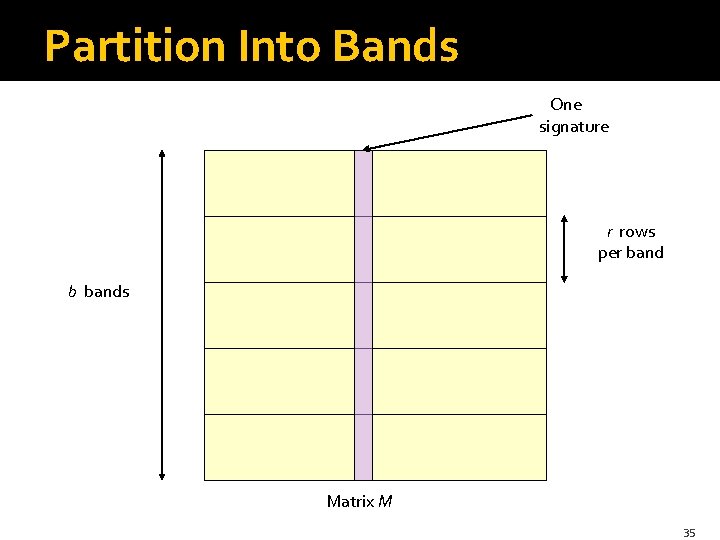
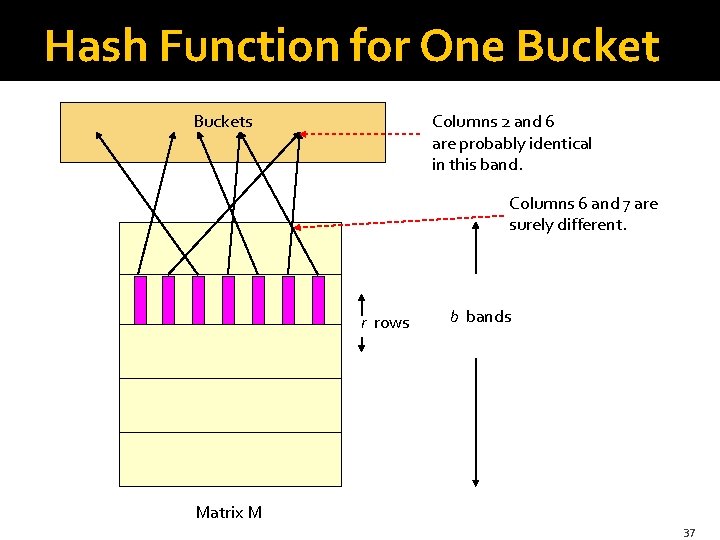
Partition Into Bands One signature r rows per band b bands Matrix M 35
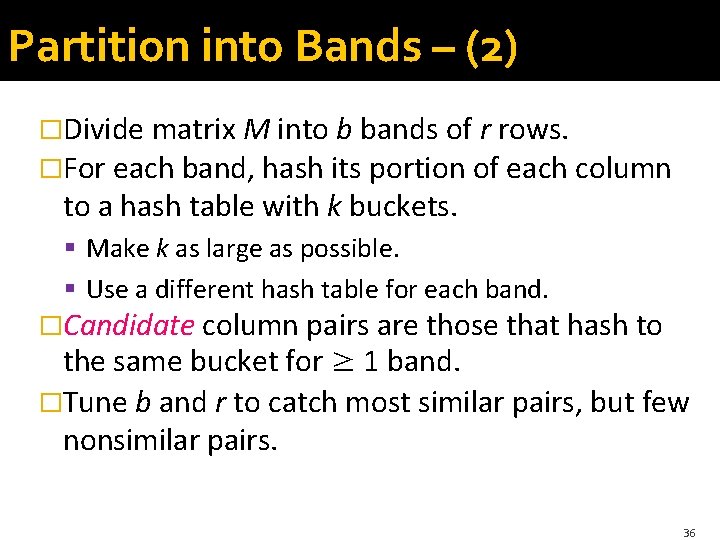
Partition into Bands – (2) �Divide matrix M into b bands of r rows. �For each band, hash its portion of each column to a hash table with k buckets. § Make k as large as possible. § Use a different hash table for each band. �Candidate column pairs are those that hash to the same bucket for ≥ 1 band. �Tune b and r to catch most similar pairs, but few nonsimilar pairs. 36
Hash Function for One Bucket Columns 2 and 6 are probably identical in this band. Buckets Columns 6 and 7 are surely different. r rows b bands Matrix M 37
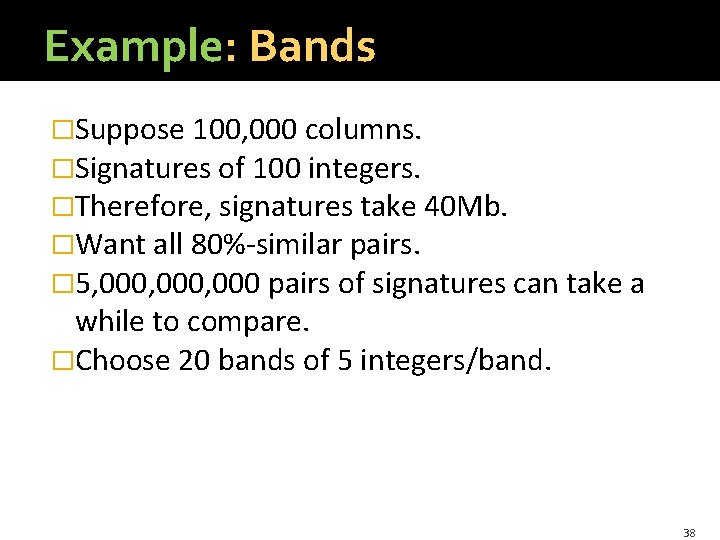
Example: Bands �Suppose 100, 000 columns. �Signatures of 100 integers. �Therefore, signatures take 40 Mb. �Want all 80%-similar pairs. � 5, 000, 000 pairs of signatures can take a while to compare. �Choose 20 bands of 5 integers/band. 38
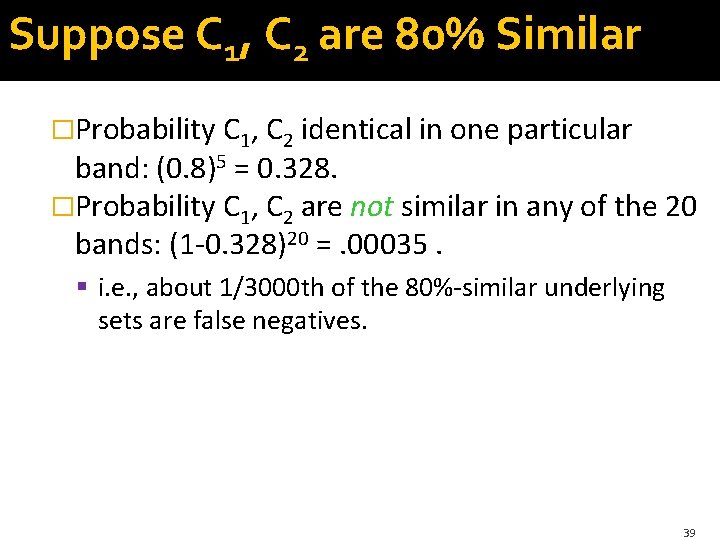
Suppose C 1, C 2 are 80% Similar �Probability C 1, C 2 identical in one particular band: (0. 8)5 = 0. 328. �Probability C 1, C 2 are not similar in any of the 20 bands: (1 -0. 328)20 =. 00035. § i. e. , about 1/3000 th of the 80%-similar underlying sets are false negatives. 39
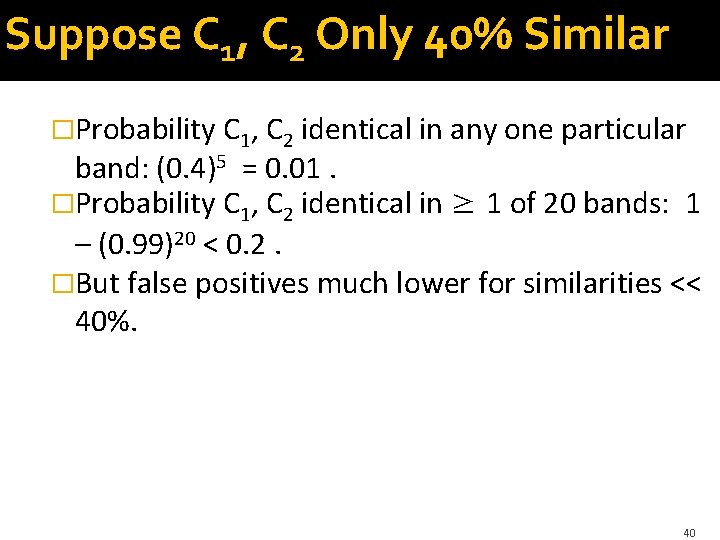
Suppose C 1, C 2 Only 40% Similar �Probability C 1, C 2 identical in any one particular band: (0. 4)5 = 0. 01. �Probability C 1, C 2 identical in ≥ 1 of 20 bands: 1 – (0. 99)20 < 0. 2. �But false positives much lower for similarities << 40%. 40
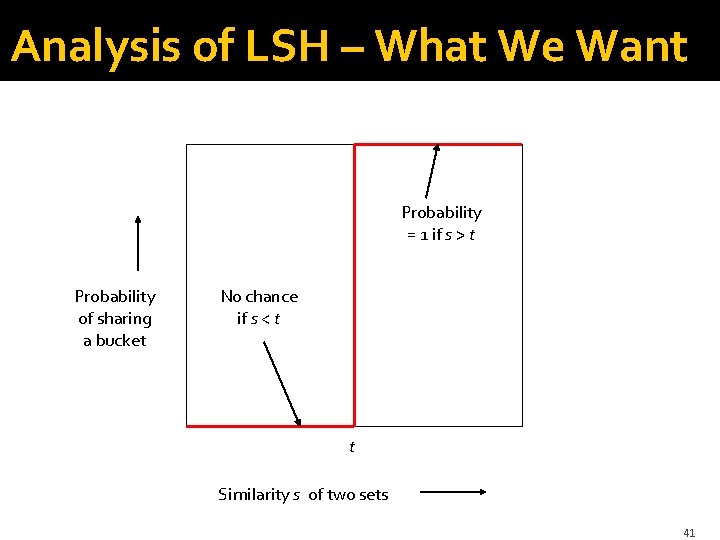
Analysis of LSH – What We Want Probability = 1 if s > t Probability of sharing a bucket No chance if s < t t Similarity s of two sets 41
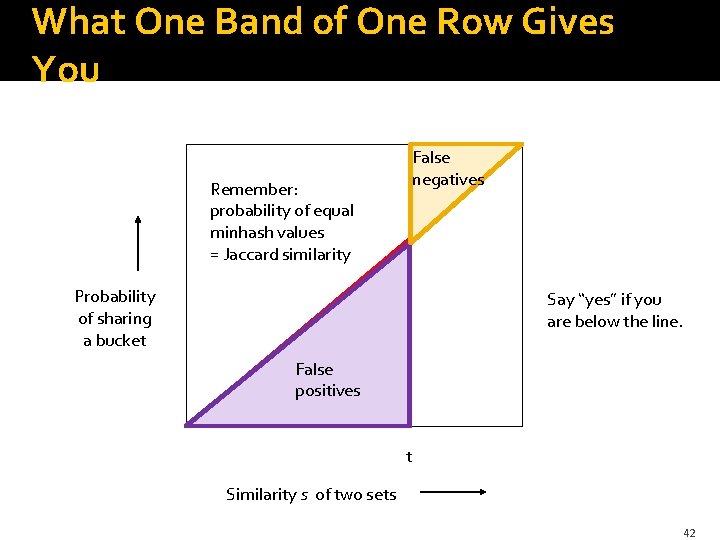
What One Band of One Row Gives You Remember: probability of equal minhash values = Jaccard similarity False negatives Probability of sharing a bucket Say “yes” if you are below the line. False positives t Similarity s of two sets 42
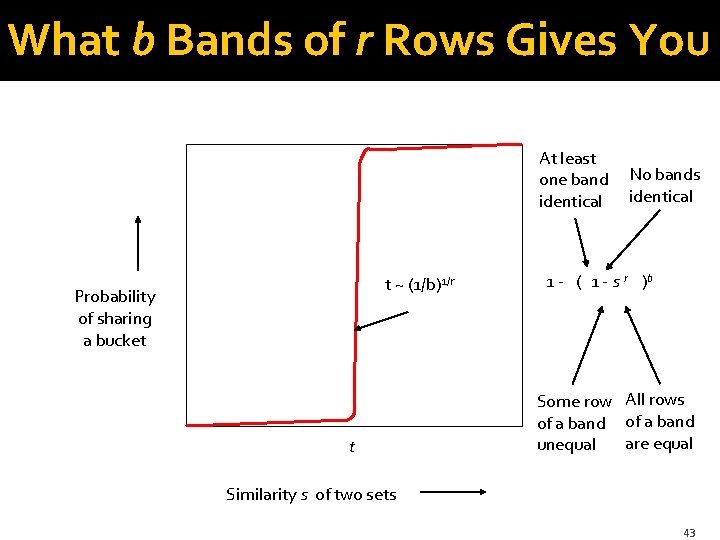
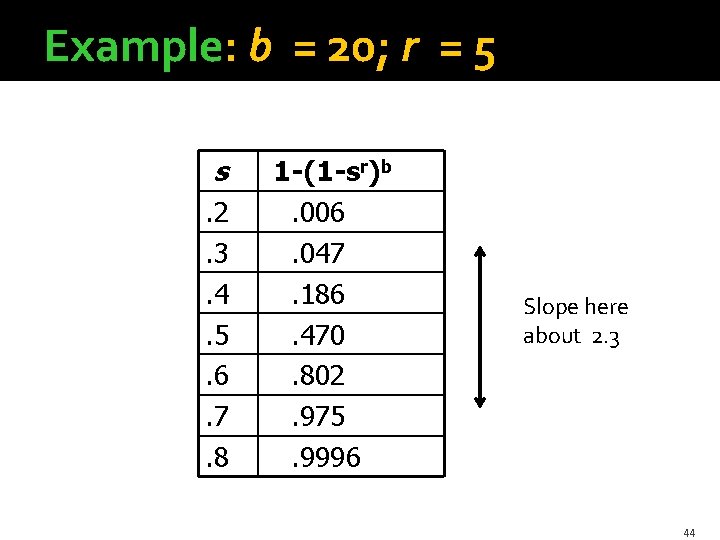
What b Bands of r Rows Gives You At least one band identical t ~ (1/b)1/r Probability of sharing a bucket t No bands identical 1 - ( 1 - s r )b Some row All rows of a band are equal unequal Similarity s of two sets 43
Example: b = 20; r = 5 s. 2. 3. 4. 5. 6. 7. 8 1 -(1 -sr)b. 006. 047. 186. 470. 802. 975. 9996 Slope here about 2. 3 44
LSH for Documents: Summary �Tune b and r to get almost all pairs with similar signatures, but eliminate most pairs that do not have similar signatures. �Check that candidate pairs really do have similar signatures. �Optional: In another pass through data, check that the remaining candidate pairs really represent similar sets. 45
Question For Thought �I ran a MOOC based on CS 246 in the fall, and one of the students posed the following question, apparently based on a real problem he was having at work. �He had about a million sets of which he wanted to find the most similar pairs. �But the universal set had only 52 elements. �He asked whether he could use the method just outlined to find the similar sets. �Do you see any problems? 46