
Finding Application Errors and Security Flaws Using PQL
![SQL Injection �Part of a system called Securi. Fly [MLL’ 06] �Static greatly optimizes](https://slidetodoc.com/presentation_image_h/a6629923a73c97c58989a6b9b1c07594/image-34.jpg "SQL Injection �Part of a system called Securi. Fly [MLL’ 06] �Static greatly optimizes")
- Slides: 42
Finding Application Errors and Security Flaws Using PQL: A Program Query Language Michael Martin, Ben Livshits, Monica S. Lam Stanford University First presented at OOPSLA 2005
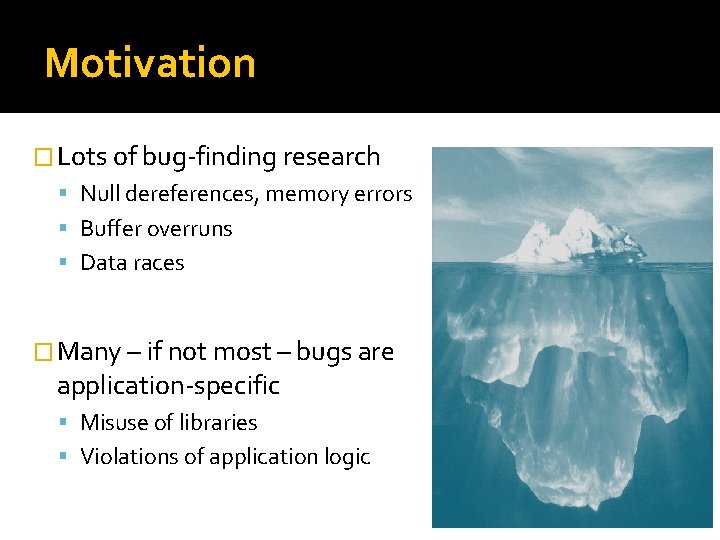
Motivation � Lots of bug-finding research Null dereferences, memory errors Buffer overruns Data races � Many – if not most – bugs are application-specific Misuse of libraries Violations of application logic
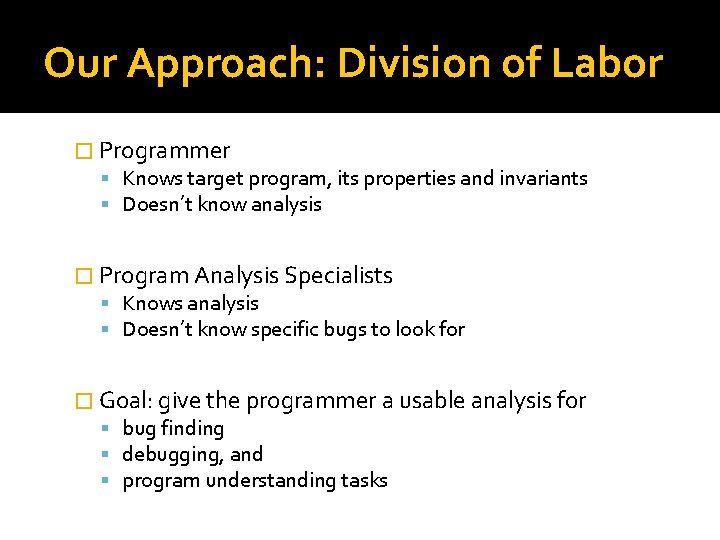
Our Approach: Division of Labor � Programmer Knows target program, its properties and invariants Doesn’t know analysis � Program Analysis Specialists Knows analysis Doesn’t know specific bugs to look for � Goal: give the programmer a usable analysis for bug finding debugging, and program understanding tasks
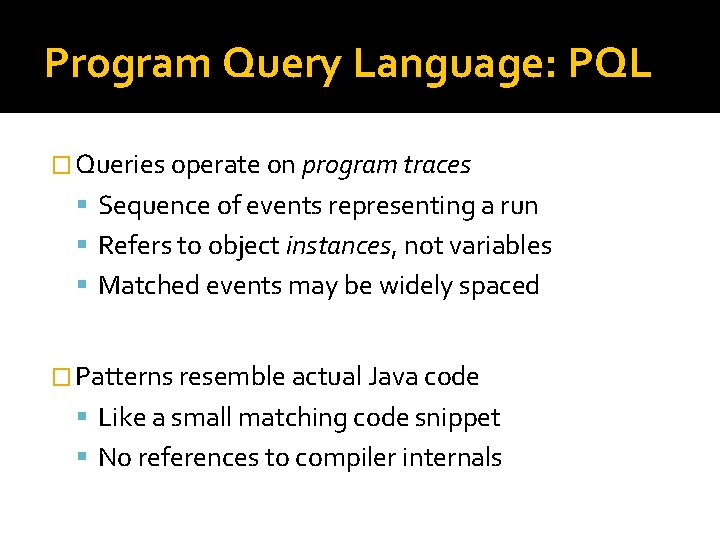
Program Query Language: PQL � Queries operate on program traces Sequence of events representing a run Refers to object instances, not variables Matched events may be widely spaced � Patterns resemble actual Java code Like a small matching code snippet No references to compiler internals
Talk Outline �Motivation for PQL �PQL language by example �Dynamic PQL query matcher �Static PQL query matcher �Experimental results
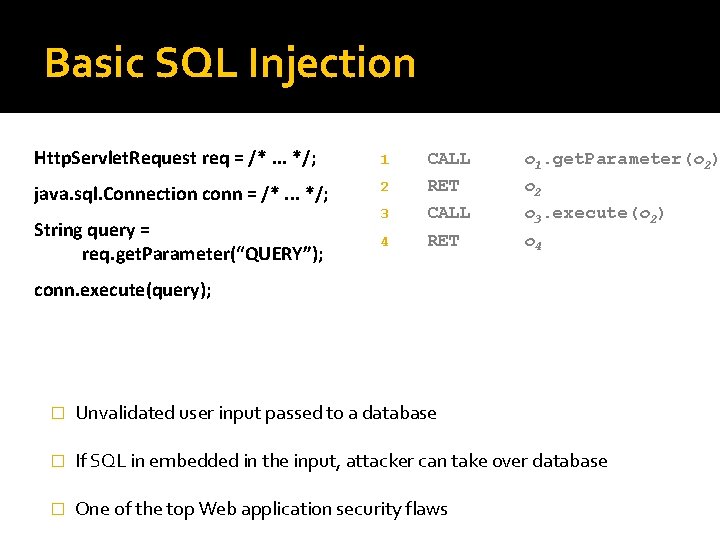
Basic SQL Injection Http. Servlet. Request req = /*. . . */; 1 CALL o 1. get. Parameter(o 2) java. sql. Connection conn = /*. . . */; 2 RET o 2 3 CALL o 3. execute(o 2) 4 RET o 4 String query = req. get. Parameter(“QUERY”); conn. execute(query); � Unvalidated user input passed to a database � If SQL in embedded in the input, attacker can take over database � One of the top Web application security flaws
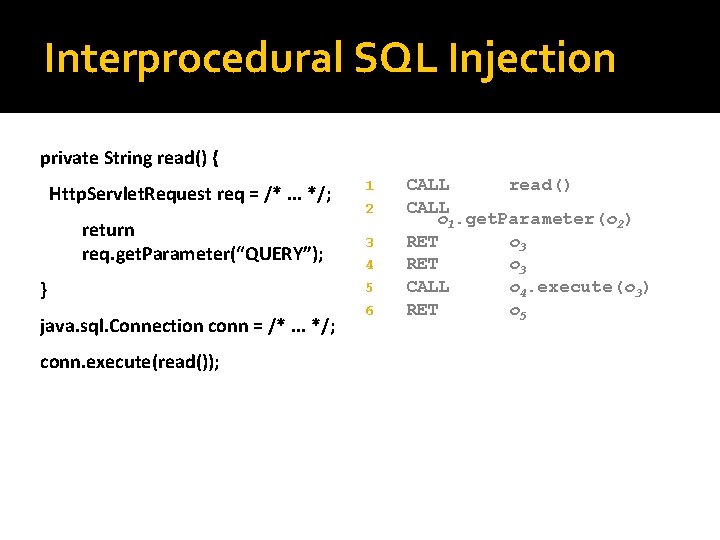
Interprocedural SQL Injection private String read() { Http. Servlet. Request req = /*. . . */; return req. get. Parameter(“QUERY”); } java. sql. Connection conn = /*. . . */; conn. execute(read()); 1 2 3 4 5 6 CALL read() CALL o 1. get. Parameter(o 2) RET o 3 CALL o 4. execute(o 3) RET o 5
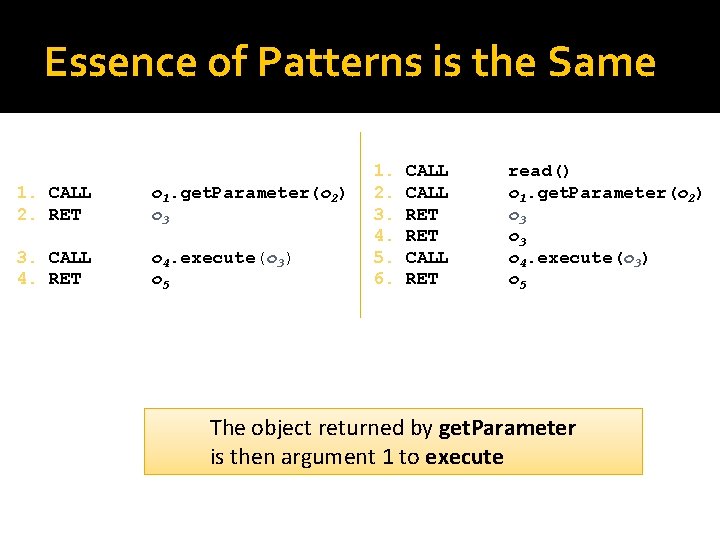
Essence of Patterns is the Same 1. CALL 2. RET o 1. get. Parameter(o 2) o 3 3. CALL 4. RET o 4. execute(o 3) o 5 1. 2. 3. 4. 5. 6. CALL RET read() o 1. get. Parameter(o 2) o 3 o 4. execute(o 3) o 5 The object returned by get. Parameter is then argument 1 to execute
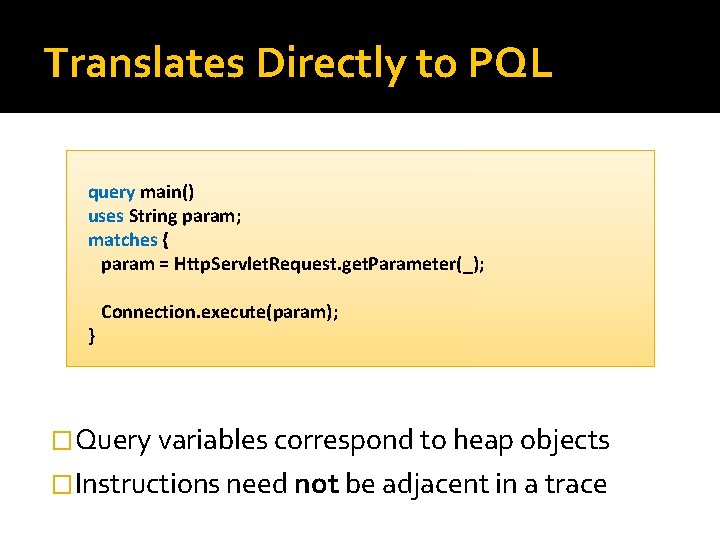
Translates Directly to PQL query main() uses String param; matches { param = Http. Servlet. Request. get. Parameter(_); } Connection. execute(param); �Query variables correspond to heap objects �Instructions need not be adjacent in a trace
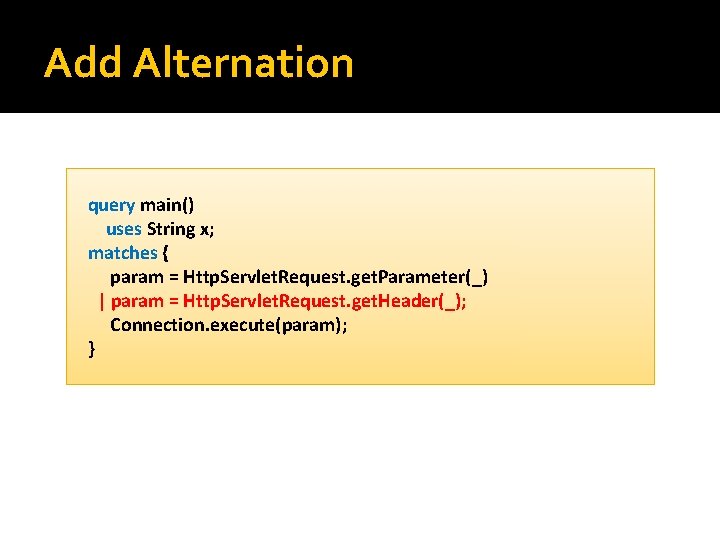
Add Alternation query main() uses String x; matches { param = Http. Servlet. Request. get. Parameter(_) | param = Http. Servlet. Request. get. Header(_); Connection. execute(param); }
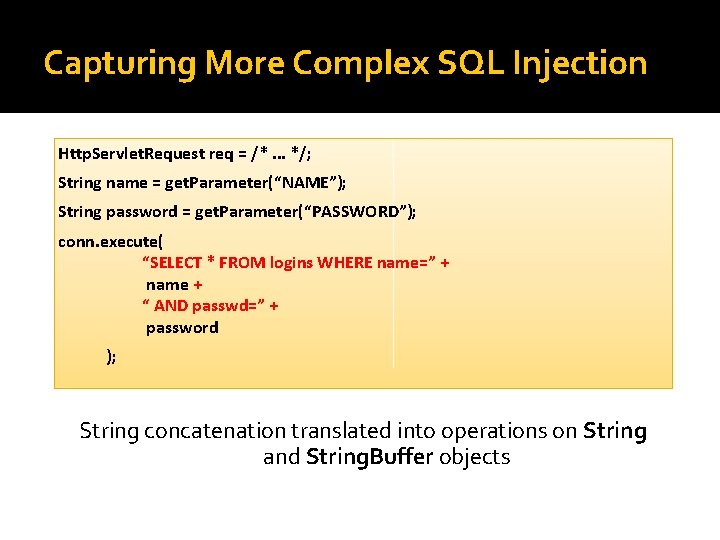
Capturing More Complex SQL Injection Http. Servlet. Request req = /*. . . */; String name = get. Parameter(“NAME”); String password = get. Parameter(“PASSWORD”); conn. execute( “SELECT * FROM logins WHERE name=” + name + “ AND passwd=” + password ); String concatenation translated into operations on String and String. Buffer objects
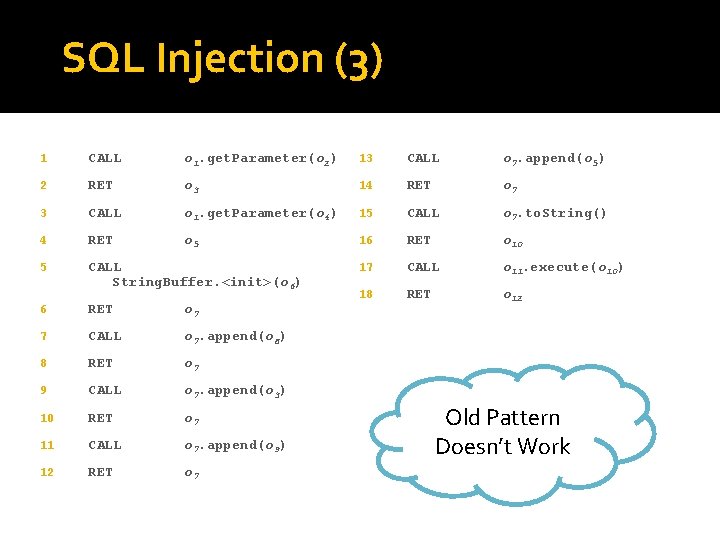
SQL Injection (3) 1 CALL o 1. get. Parameter(o 2) 13 CALL o 7. append(o 5) 2 RET o 3 14 RET o 7 3 CALL o 1. get. Parameter(o 4) 15 CALL o 7. to. String() 4 RET o 5 16 RET o 10 5 CALL String. Buffer. <init>(o 6) 17 CALL o 11. execute(o 10) 18 RET o 12 6 RET o 7 7 CALL o 7. append(o 8) 8 RET o 7 9 CALL o 7. append(o 3) 10 RET o 7 11 CALL o 7. append(o 9) 12 RET o 7 Old Pattern Doesn’t Work
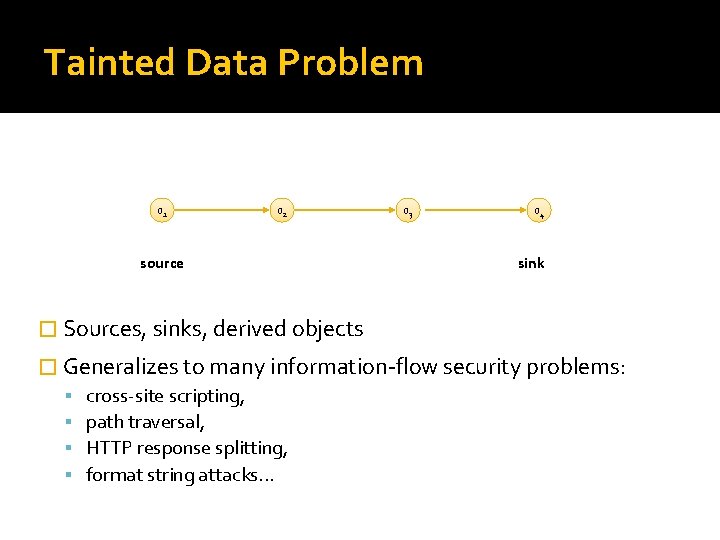
Tainted Data Problem o 1 o 2 source o 3 o 4 sink � Sources, sinks, derived objects � Generalizes to many information-flow security problems: cross-site scripting, path traversal, HTTP response splitting, format string attacks. . .
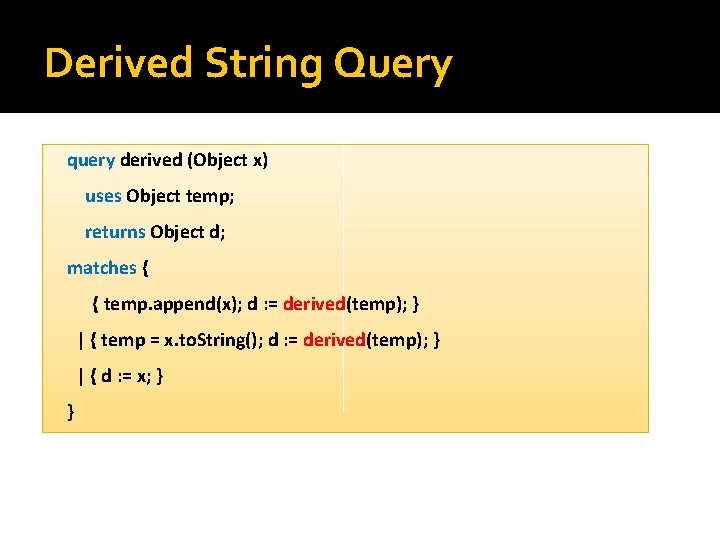
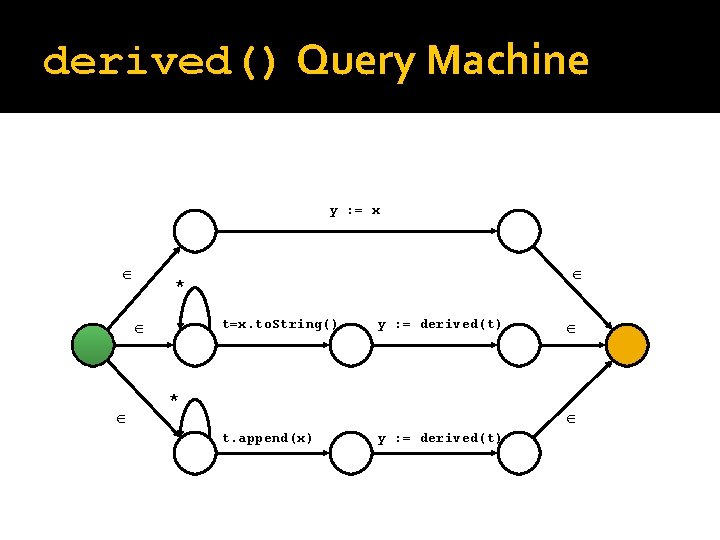
Derived String Query query derived (Object x) uses Object temp; returns Object d; matches { { temp. append(x); d : = derived(temp); } | { temp = x. to. String(); d : = derived(temp); } | { d : = x; } }
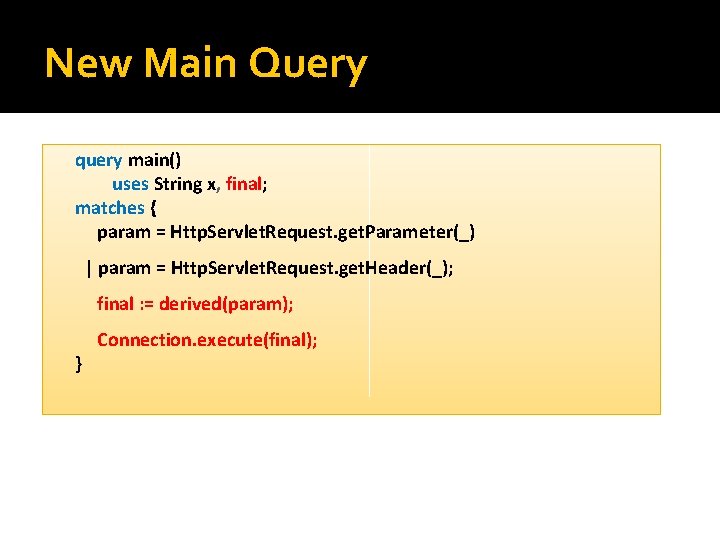
New Main Query query main() uses String x, final; matches { param = Http. Servlet. Request. get. Parameter(_) | param = Http. Servlet. Request. get. Header(_); final : = derived(param); } Connection. execute(final);
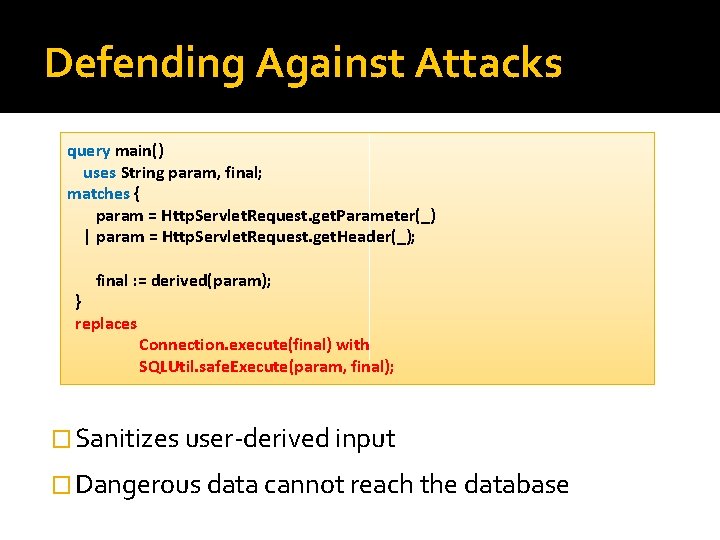
Defending Against Attacks query main() uses String param, final; matches { param = Http. Servlet. Request. get. Parameter(_) | param = Http. Servlet. Request. get. Header(_); final : = derived(param); } replaces Connection. execute(final) with SQLUtil. safe. Execute(param, final); � Sanitizes user-derived input � Dangerous data cannot reach the database
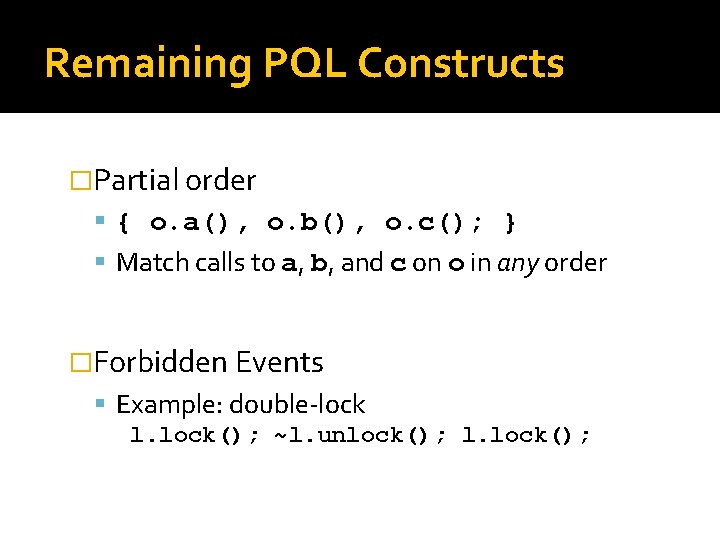
Remaining PQL Constructs �Partial order { o. a(), o. b(), o. c(); } Match calls to a, b, and c on o in any order �Forbidden Events Example: double-lock l. lock(); ~l. unlock(); l. lock();
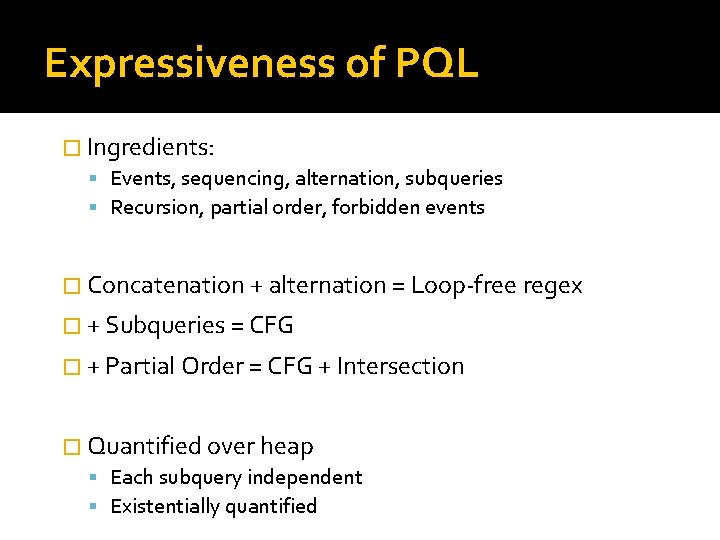
Expressiveness of PQL � Ingredients: Events, sequencing, alternation, subqueries Recursion, partial order, forbidden events � Concatenation + alternation = Loop-free regex � + Subqueries = CFG � + Partial Order = CFG + Intersection � Quantified over heap Each subquery independent Existentially quantified
Talk Outline �Motivation for PQL �PQL language by example �Dynamic PQL query matcher �Static PQL query matcher �Experimental results
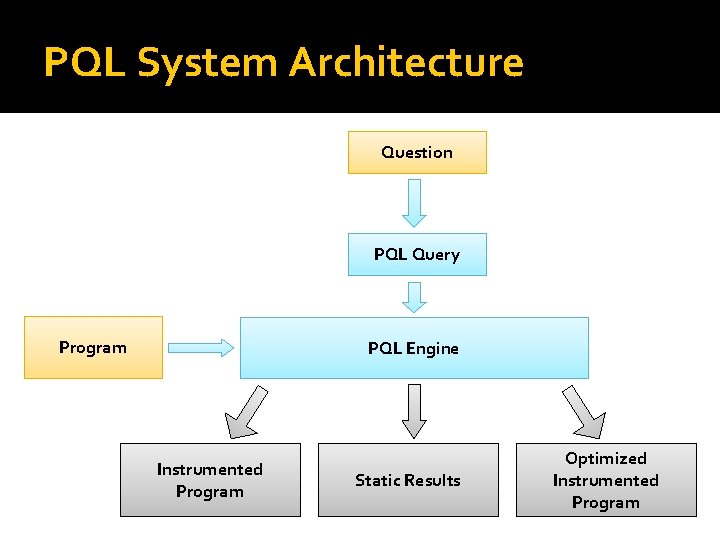
PQL System Architecture Question PQL Query Program PQL Engine Instrumented Program Static Results Optimized Instrumented Program
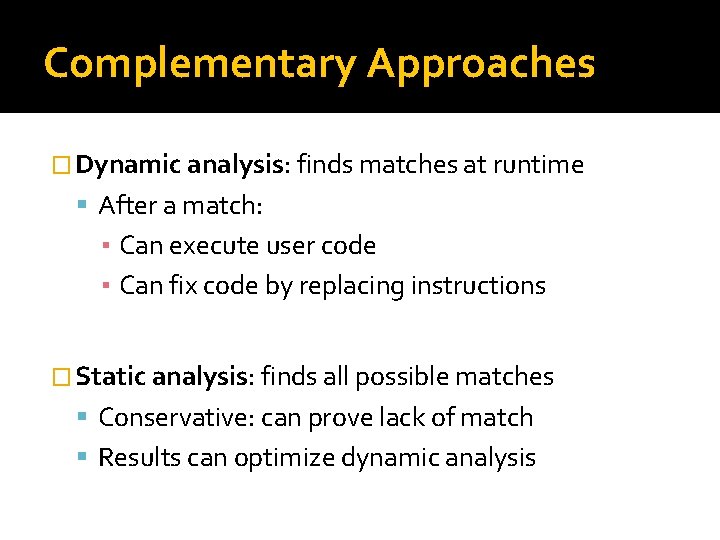
Complementary Approaches � Dynamic analysis: finds matches at runtime After a match: ▪ Can execute user code ▪ Can fix code by replacing instructions � Static analysis: finds all possible matches Conservative: can prove lack of match Results can optimize dynamic analysis
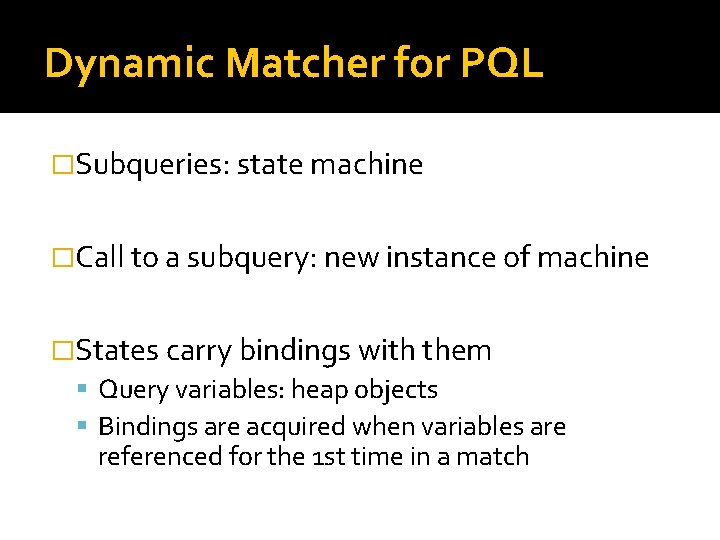
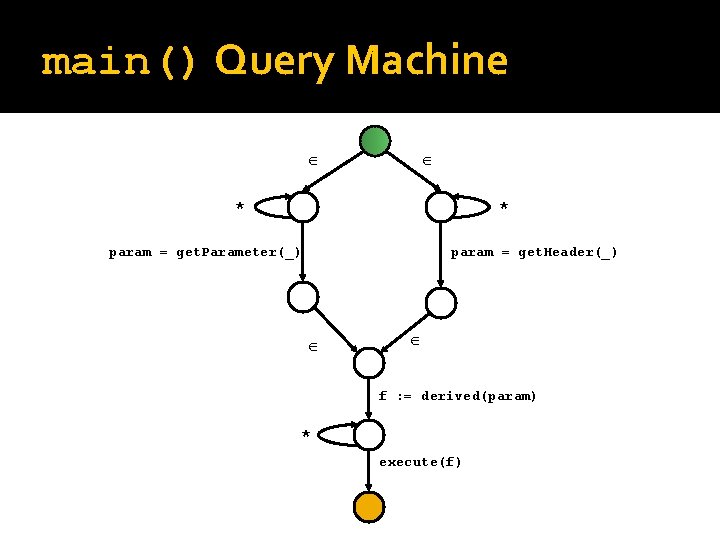
Dynamic Matcher for PQL �Subqueries: state machine �Call to a subquery: new instance of machine �States carry bindings with them Query variables: heap objects Bindings are acquired when variables are referenced for the 1 st time in a match
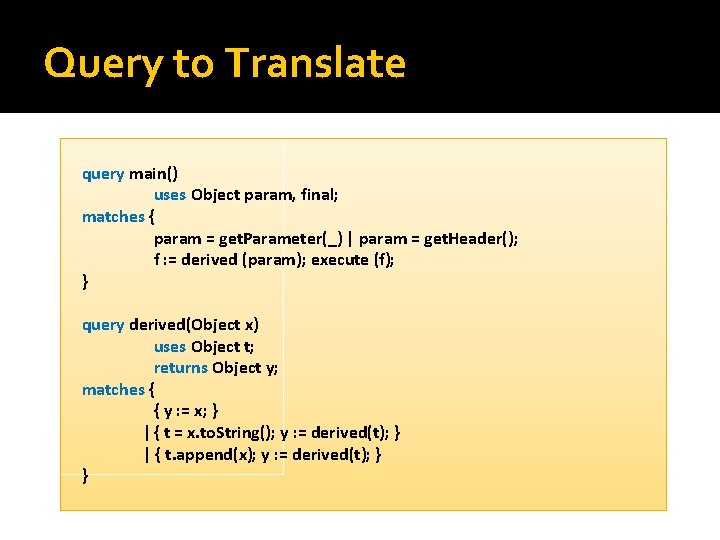
Query to Translate query main() uses Object param, final; matches { param = get. Parameter(_) | param = get. Header(); f : = derived (param); execute (f); } query derived(Object x) uses Object t; returns Object y; matches { { y : = x; } | { t = x. to. String(); y : = derived(t); } | { t. append(x); y : = derived(t); } }
main() Query Machine * * param = get. Parameter(_) param = get. Header(_) f : = derived(param) * execute(f)
derived() Query Machine y : = x * t=x. to. String() y : = derived(t) * t. append(x) y : = derived(t)
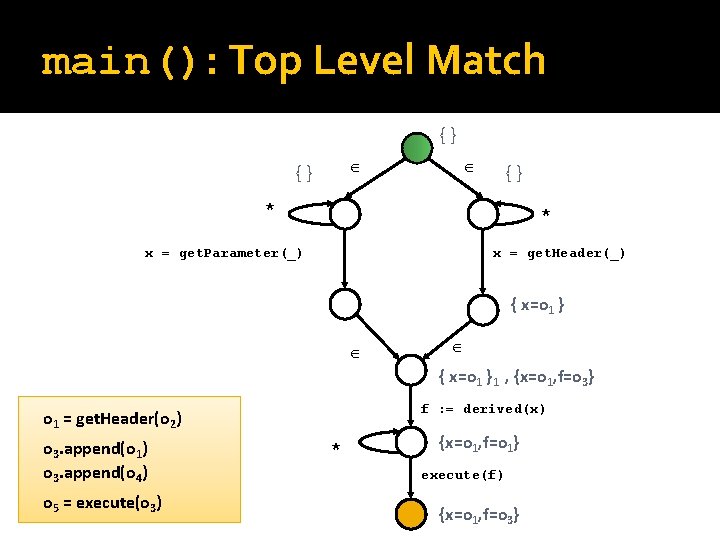
main(): Top Level Match {} {} * * x = get. Parameter(_) x = get. Header(_) { x=o 1 }1 , {x=o 1, f=o 3} f : = derived(x) o 1 = get. Header(o 2) o 3. append(o 1) o 3. append(o 4) o 5 = execute(o 3) * {x=o 1, f=o 1} execute(f) {x=o 1, f=o 3}
Talk Outline �Motivation for PQL �PQL language by example �Dynamic PQL query matcher �Static PQL query matcher �Experimental results
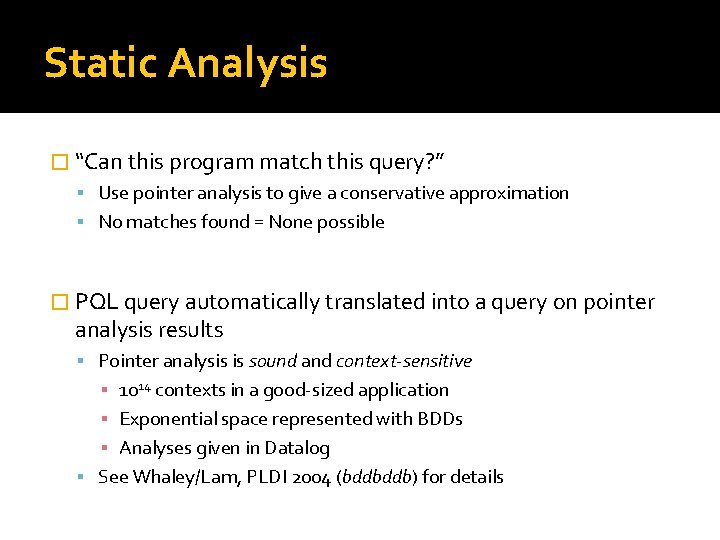
Static Analysis � “Can this program match this query? ” Use pointer analysis to give a conservative approximation No matches found = None possible � PQL query automatically translated into a query on pointer analysis results Pointer analysis is sound and context-sensitive ▪ 1014 contexts in a good-sized application ▪ Exponential space represented with BDDs ▪ Analyses given in Datalog See Whaley/Lam, PLDI 2004 (bddbddb) for details
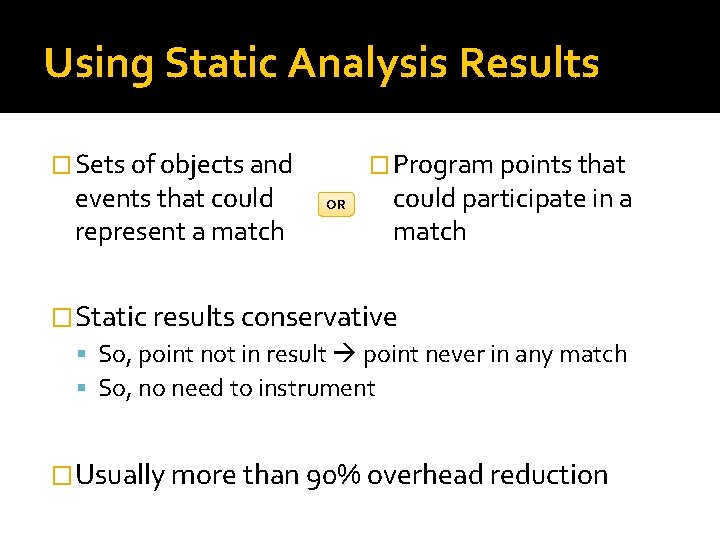
Using Static Analysis Results � Program points that � Sets of objects and events that could represent a match OR could participate in a match �Static results conservative So, point not in result point never in any match So, no need to instrument �Usually more than 90% overhead reduction
Talk Outline �Motivation for PQL �PQL language by example �Dynamic PQL query matcher �Static PQL query matcher �Experimental results
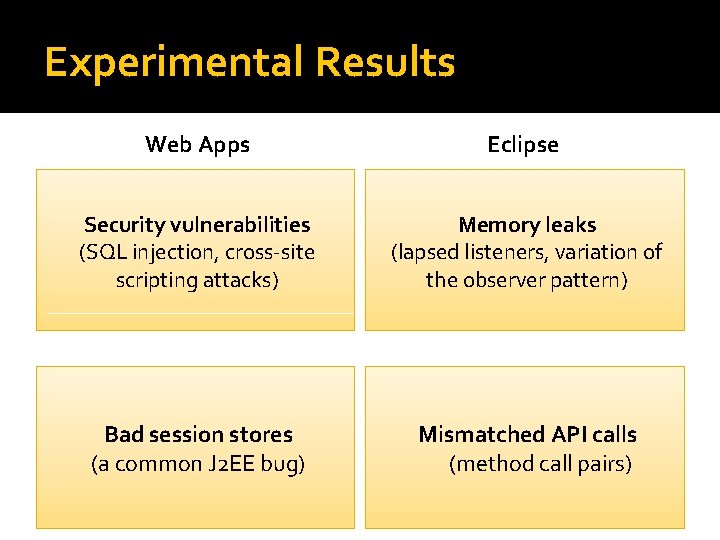
Experimental Results Web Apps Eclipse Security vulnerabilities (SQL injection, cross-site scripting attacks) Memory leaks (lapsed listeners, variation of the observer pattern) Bad session stores (a common J 2 EE bug) Mismatched API calls (method call pairs)
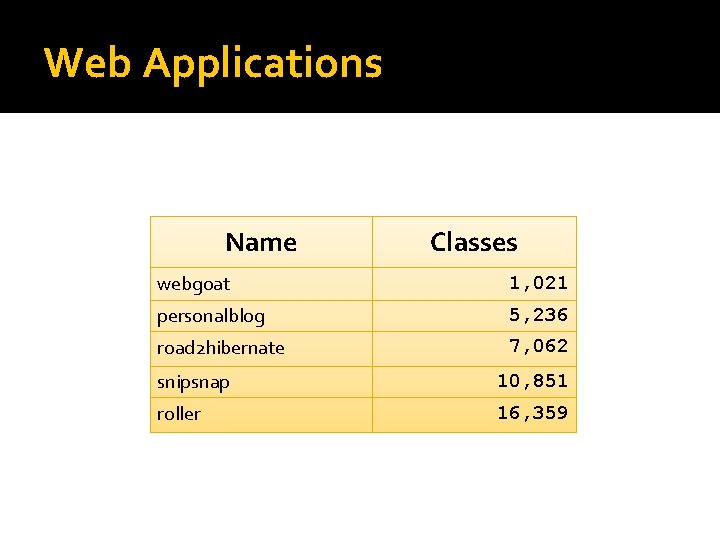
Web Applications Name Classes webgoat 1, 021 personalblog 5, 236 road 2 hibernate 7, 062 snipsnap 10, 851 roller 16, 359
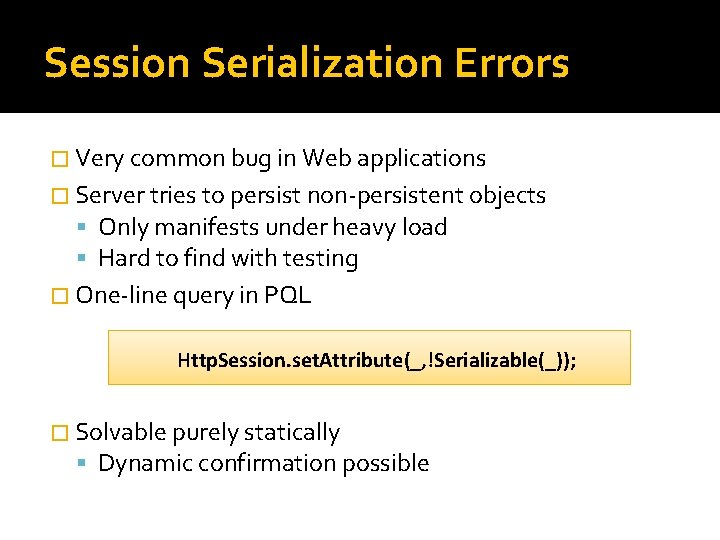
Session Serialization Errors � Very common bug in Web applications � Server tries to persist non-persistent objects Only manifests under heavy load Hard to find with testing � One-line query in PQL Http. Session. set. Attribute(_, !Serializable(_)); � Solvable purely statically Dynamic confirmation possible
SQL Injection �Part of a system called Securi. Fly [MLL’ 06] �Static greatly optimizes overhead 92%-99. 8% reduction of points 2 -3 x speedup � 4 injections, 2 exploitable Blocked both exploits
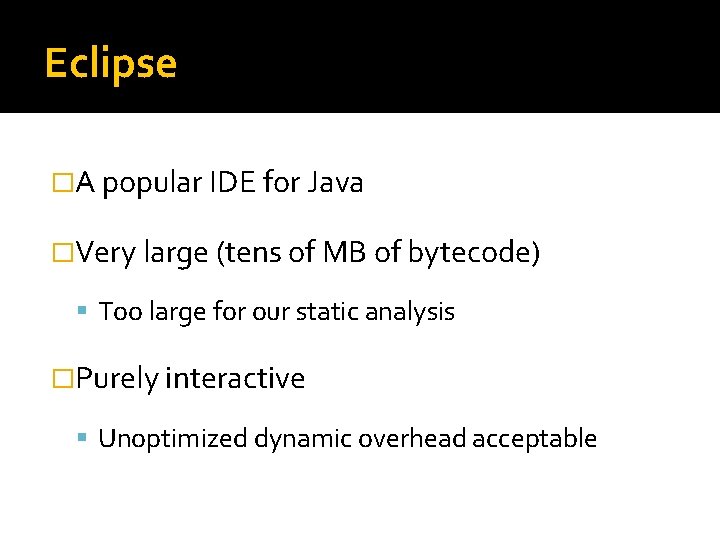
Eclipse �A popular IDE for Java �Very large (tens of MB of bytecode) Too large for our static analysis �Purely interactive Unoptimized dynamic overhead acceptable
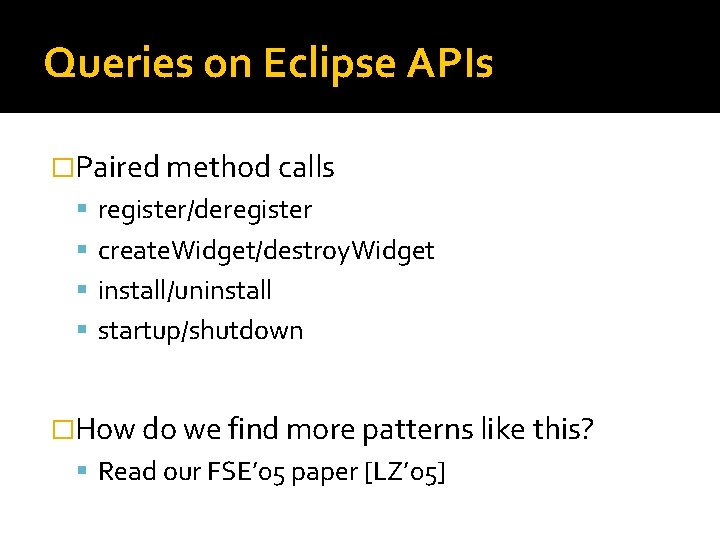
Queries on Eclipse APIs �Paired method calls register/deregister create. Widget/destroy. Widget install/uninstall startup/shutdown �How do we find more patterns like this? Read our FSE’ 05 paper [LZ’ 05]
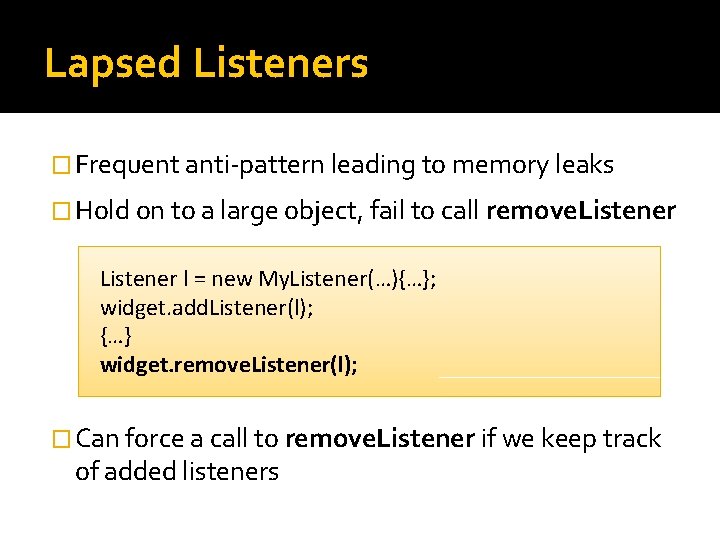
Lapsed Listeners � Frequent anti-pattern leading to memory leaks � Hold on to a large object, fail to call remove. Listener l = new My. Listener(…){…}; widget. add. Listener(l); {…} widget. remove. Listener(l); � Can force a call to remove. Listener if we keep track of added listeners
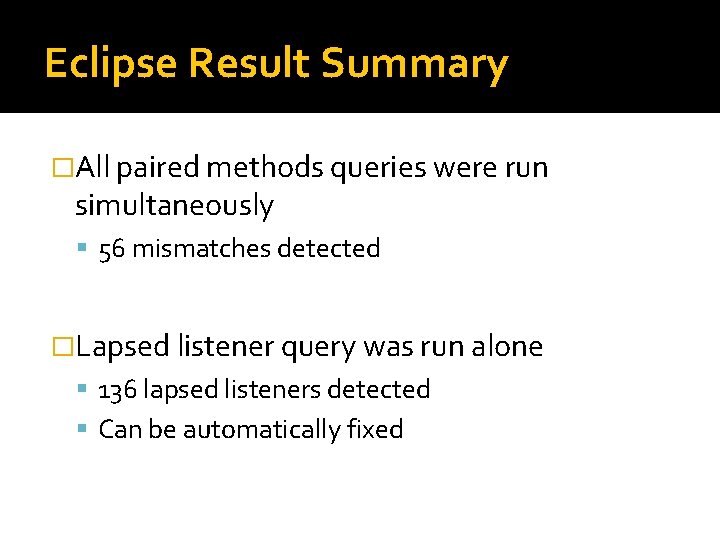
Eclipse Result Summary �All paired methods queries were run simultaneously 56 mismatches detected �Lapsed listener query was run alone 136 lapsed listeners detected Can be automatically fixed
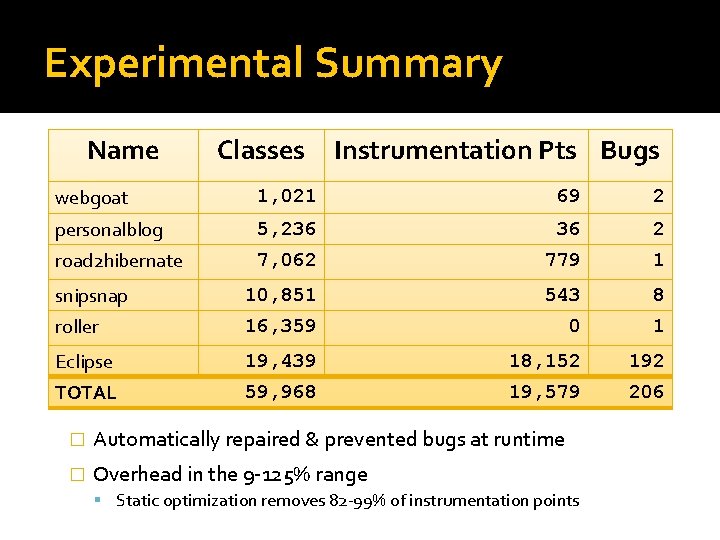
Experimental Summary Name Classes Instrumentation Pts Bugs webgoat 1, 021 69 2 personalblog 5, 236 36 2 road 2 hibernate 7, 062 779 1 snipsnap 10, 851 543 8 roller 16, 359 0 1 Eclipse 19, 439 18, 152 192 TOTAL 59, 968 19, 579 206 � Automatically repaired & prevented bugs at runtime � Overhead in the 9 -125% range Static optimization removes 82 -99% of instrumentation points
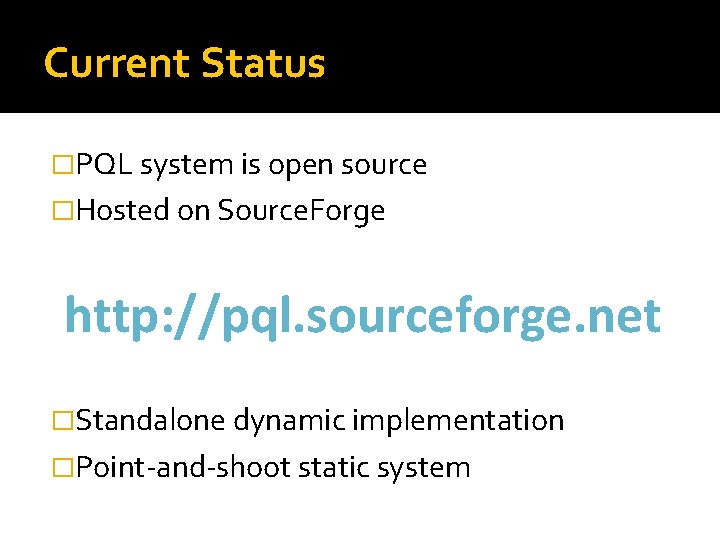
Current Status �PQL system is open source �Hosted on Source. Forge http: //pql. sourceforge. net �Standalone dynamic implementation �Point-and-shoot static system
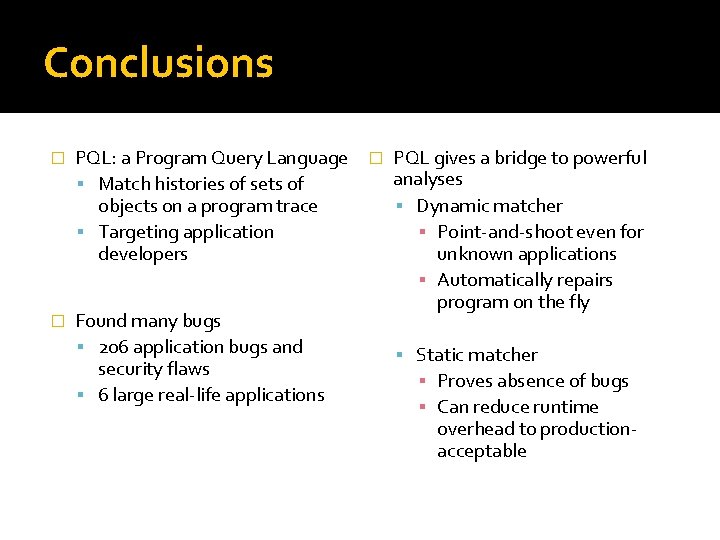
Conclusions PQL: a Program Query Language � PQL gives a bridge to powerful analyses Match histories of sets of objects on a program trace Dynamic matcher ▪ Point-and-shoot even for Targeting application developers unknown applications ▪ Automatically repairs program on the fly � Found many bugs 206 application bugs and Static matcher security flaws ▪ Proves absence of bugs 6 large real-life applications ▪ Can reduce runtime overhead to productionacceptable �
Discussion � Domains for bug recovery Securi. Fly (sanitize when necessary) Failure-oblivious computing � Distributed monitors Consider gmail Can we monitor properties of such a client/server application? � Dynamic monitors Long-running applications Add and remove monitoring rules as time