
Finding Answers to Clinical Questions Efficiently Effectively EBP

Finding Answers to Clinical Questions: Efficiently & Effectively

EBP evidence-based practice Evidence Based Practice
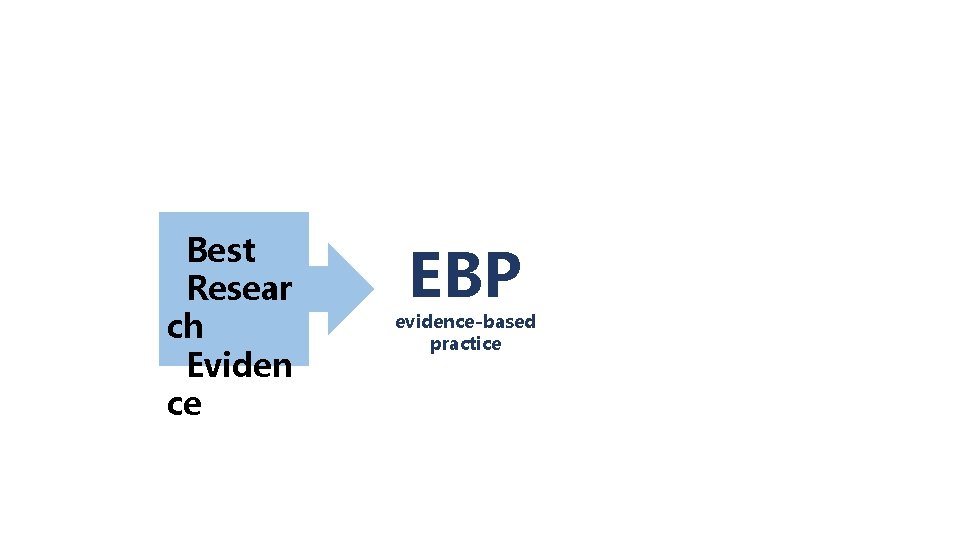
Best Resear ch Eviden ce Evidence Based Practice EBP evidence-based practice
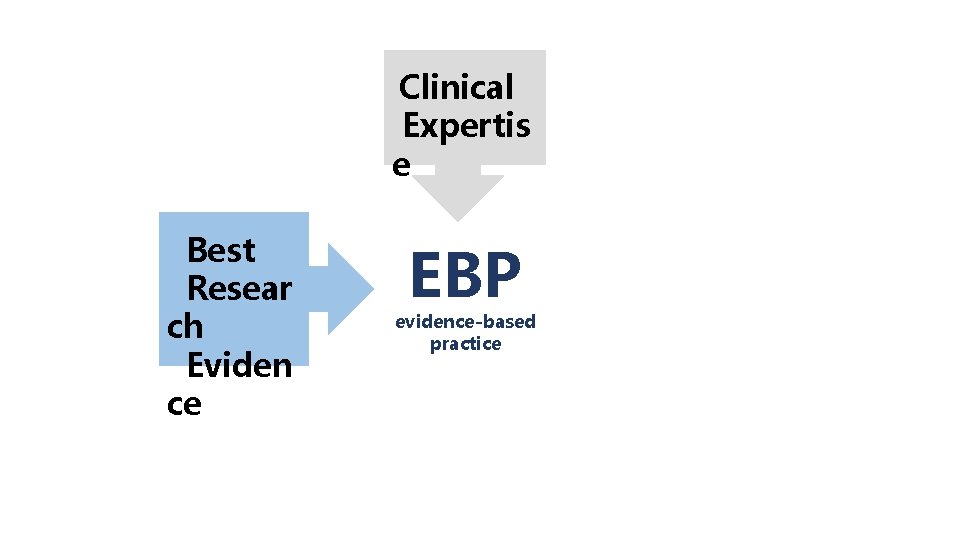
Clinical Expertis e Best Resear ch Eviden ce Evidence Based Practice EBP evidence-based practice

Clinical Expertis e Best Resear ch Eviden ce Evidence Based Practice EBP evidence-based practice Patient Values & Preferen ces
Assess the patient A clinical problem or question arises from the care of the patient. Evidence Based Practice
Assess the patient A clinical problem or question arises from the care of the patient. Ask the question Construct a well built clinical question derived from the case. Evidence Based Practice
Assess the patient A clinical problem or question arises from the care of the patient. Ask the question Construct a well built clinical question derived from the case. Acquire the evidence Select appropriate resources and conduct a search to gather the best evidence to answer the question. Evidence Based Practice
Assess the patient A clinical problem or question arises from the care of the patient. Ask the question Construct a well built clinical question derived from the case. Acquire the evidence Select appropriate resources and conduct a search to gather the best evidence to answer the question. Appraise the evidence Critically evaluate the evidence for validity (closeness to the truth), applicability (usefulness in clinical practice), and impact. Evidence Based Practice
Assess the patient A clinical problem or question arises from the care of the patient. Ask the question Construct a well built clinical question derived from the case. Acquire the evidence Select appropriate resources and conduct a search to gather the best evidence to answer the question. Appraise the evidence Critically evaluate the evidence for validity (closeness to the truth), applicability (usefulness in clinical practice), and impact. Apply to clinical practice Integrate your critical appraisal with your clinical expertise and the patient's unique biology, values, and circumstances. Evidence Based Practice
Assess the patient A clinical problem or question arises from the care of the patient. Ask the question Construct a well built clinical question derived from the case. Acquire the evidence Select appropriate resources and conduct a search to gather the best evidence to answer the question. Appraise the evidence Critically evaluate the evidence for validity (closeness to the truth), applicability (usefulness in clinical practice), and impact. Apply to clinical practice Integrate your critical appraisal with your clinical expertise and the patient's unique biology, values, and circumstances. Evaluate the efficiency and effectiveness of your performance, and seek ways to improve. Evidence Based Practice
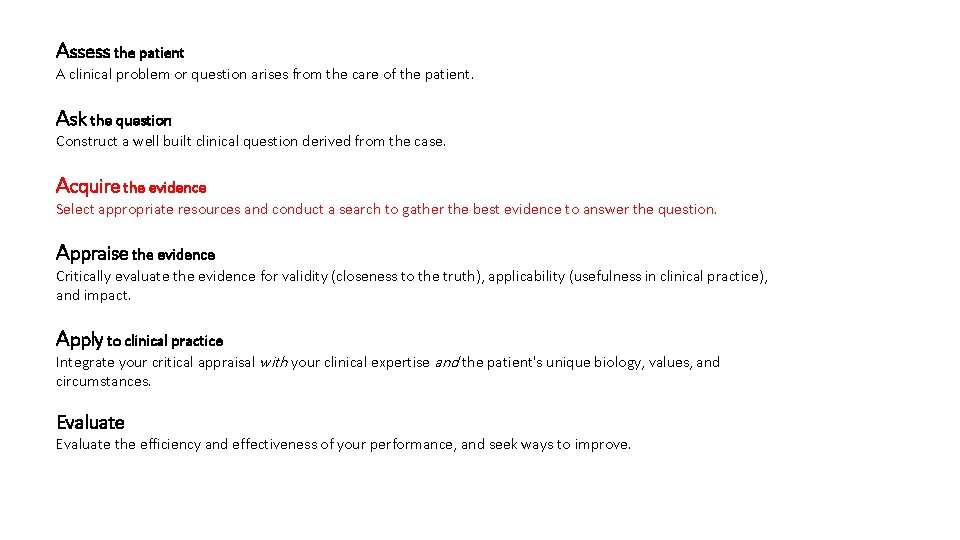
Assess the patient A clinical problem or question arises from the care of the patient. Ask the question Construct a well built clinical question derived from the case. Acquire the evidence Select appropriate resources and conduct a search to gather the best evidence to answer the question. Appraise the evidence Critically evaluate the evidence for validity (closeness to the truth), applicability (usefulness in clinical practice), and impact. Apply to clinical practice Integrate your critical appraisal with your clinical expertise and the patient's unique biology, values, and circumstances. Evaluate the efficiency and effectiveness of your performance, and seek ways to improve. Evidence Based Practice
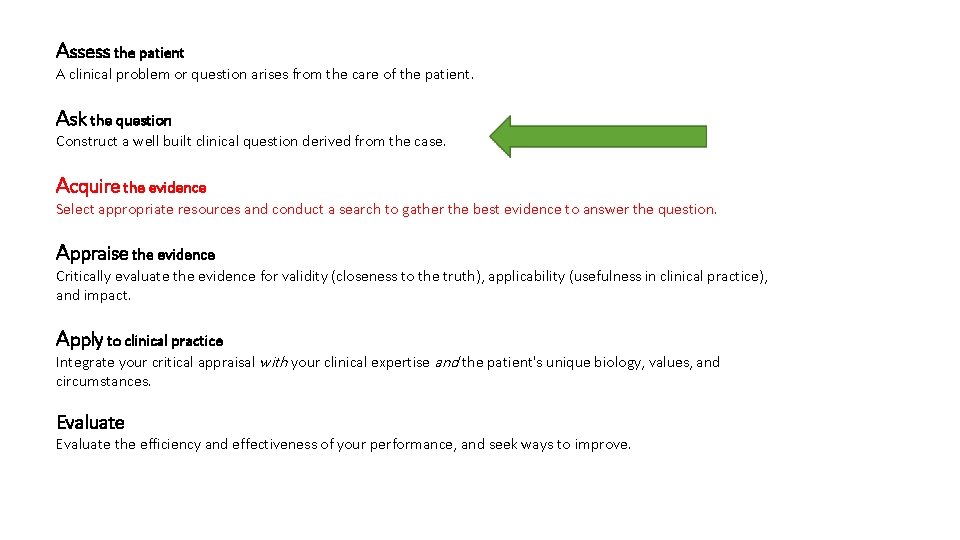
Assess the patient A clinical problem or question arises from the care of the patient. Ask the question Construct a well built clinical question derived from the case. Acquire the evidence Select appropriate resources and conduct a search to gather the best evidence to answer the question. Appraise the evidence Critically evaluate the evidence for validity (closeness to the truth), applicability (usefulness in clinical practice), and impact. Apply to clinical practice Integrate your critical appraisal with your clinical expertise and the patient's unique biology, values, and circumstances. Evaluate the efficiency and effectiveness of your performance, and seek ways to improve. Evidence Based Practice
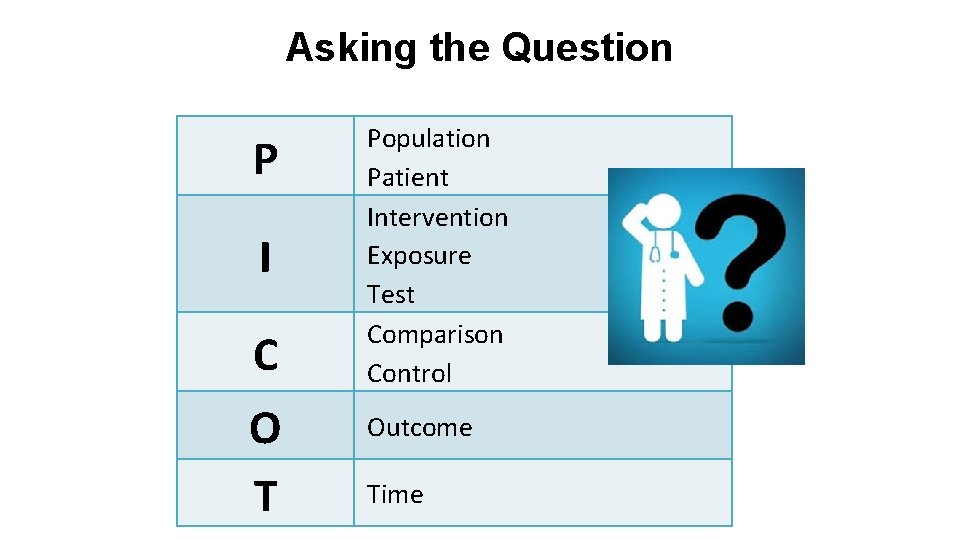
Asking the Question P I C O T Population Patient Intervention Exposure Test Comparison Control Outcome Time
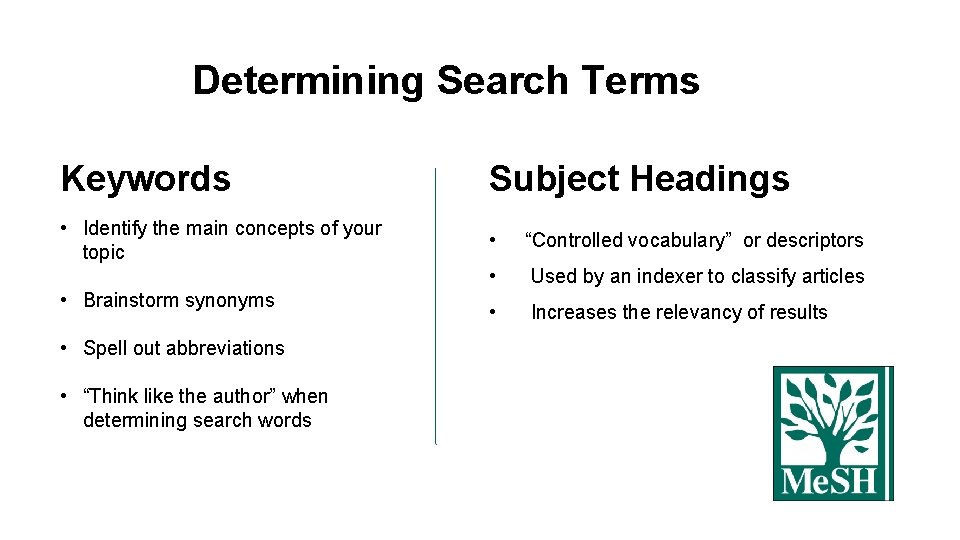
Determining Search Terms Keywords Subject Headings • Identify the main concepts of your topic • “Controlled vocabulary” or descriptors • Used by an indexer to classify articles • Increases the relevancy of results • Brainstorm synonyms • Spell out abbreviations • “Think like the author” when determining search words
Executing Your Search • Boolean Operators • Truncation • Phrase searching • Wild cards • Adjacency/proximity • Parentheses • Limits
Boolean Operators Use Boolean Operators to connect keywords AND = both combine terms and narrow search OR = either combine terms and expand search NOT = without exclude terms and narrow search
Boolean Operators ü Always use CAPITAL LETTERS for Boolean operators to make sure the database recognizes them ü Many databases allow you to use Boolean operators to combine not only keywords but entire searches
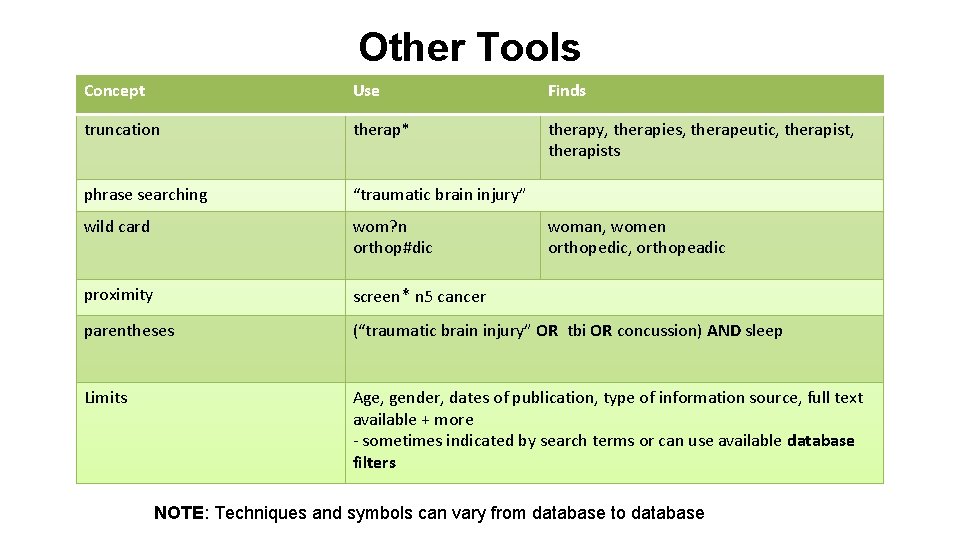
Other Tools Concept Use Finds truncation therap* therapy, therapies, therapeutic, therapists phrase searching “traumatic brain injury” wild card wom? n orthop#dic proximity screen* n 5 cancer parentheses (“traumatic brain injury” OR tbi OR concussion) AND sleep Limits Age, gender, dates of publication, type of information source, full text available + more - sometimes indicated by search terms or can use available database filters woman, women orthopedic, orthopeadic NOTE: Techniques and symbols can vary from database to database
Databases • Explore more than one • Use advanced search features • Try a variety of keyword terms & combinations • Use limits to narrow search • Create a free account so you can: - Save search records into folders - Save your search history - Set-up search alerts
Refining your search by limiting scope • Study design • Publication date • Language • Age groups • Full-text
ADJUST YOUR SEARCH STRATEGY Change your: • search terms • database • combinations • limits • narrow • expand Be flexible!
Tip! Use a seed article
Use a Seed Article Look BACK at references in an article bibliography - works cited - reference list Look FORWARD at who cites the article Find Similar or Related articles Look at the subject headings and keywords assigned to an article
- Slides: 25