
Finding and Strengthening Informal Peer Communities in the
- Slides: 17
Finding and Strengthening Informal Peer Communities in the GHG Toolkit for Alberta Municipalities Project Presented by Linda Harvey Upwind Downwind Conference, Hamilton, Ontario February 27, 2012 s
Overview • Drivers behind the Toolkit project – 2009 context • • • How the Toolkit concept evolved Research & learning Lessons learned Legacy Conclusion
2009 Context • Calgary Community GHG Reduction Plan – Funded by FCM, AENV and The City of Calgary • Alberta 2008 Climate Change Strategy policies emerging – Municipal Climate Change Action Plans • AUMA Municipal Climate Change Action Centre • Alberta Climate Dialogue community engagement
Furious activity is no substitute for understanding. H. H. Williams
Two questions • What’s the best way to develop the municipal climate change action plans? – Collaborate and coordinate • How can the province ensure that municipalities are engaged in policy development? – Resources, empowerment
Collaboration & coordination • City of Calgary, City of Edmonton • Alberta Environment & Water • Alberta Energy • Association of Urban Municipalities of Alberta (AUMA) • Pembina Institute • Alberta Climate Dialogue • Federation of Canadian Municipalities
Resources & empowerment • The Alberta Toolkit project emerged as a way to: – Leverage resource investment and establish synergies between the Calgary Community GHG Reduction Plan project and other initiatives. – Ensure municipal expertise adds to development of the Alberta Municipal Climate Change Action Plans – Provide citizens and their municipalities with deliberative processes and new systems and structures to effectively address complex issues such as climate change.
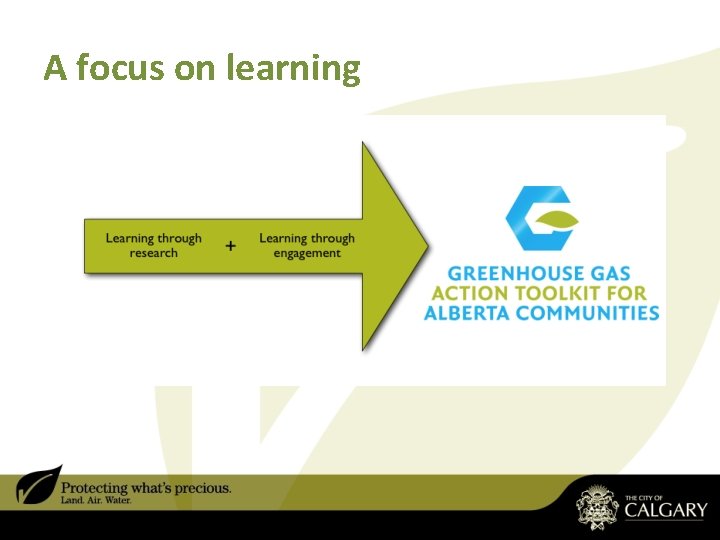
Two products: • A user-friendly “document” – a collectively developed resource for municipalities working on community GHG reduction programs—Intelligent Futures • An ongoing, collaborative network (community of practice) – to leverage the initial investment of resources and continue the peer dialogue and learning that was established along the way —Intelligent Futures
A focus on learning
Specific research • “Governance Options for GHG Reduction” Report— Pembina Institute • “Community GHG Measurement System Review”— ICLEI • Peer learning – Action research that would increase the knowledge and capacity of participants
Specific research (cont’d) • Deliberative democracy & appreciative enquiry --Alberta Climate Dialogue – Unique academic & professional insight to a municipally-led engagement program – Increased municipal awareness of new methods of public engagement through access to a significant body of knowledge (beyond what is typical) – Advice on managing local variables with replicable practices for success (i. e. a toolkit, not a template)
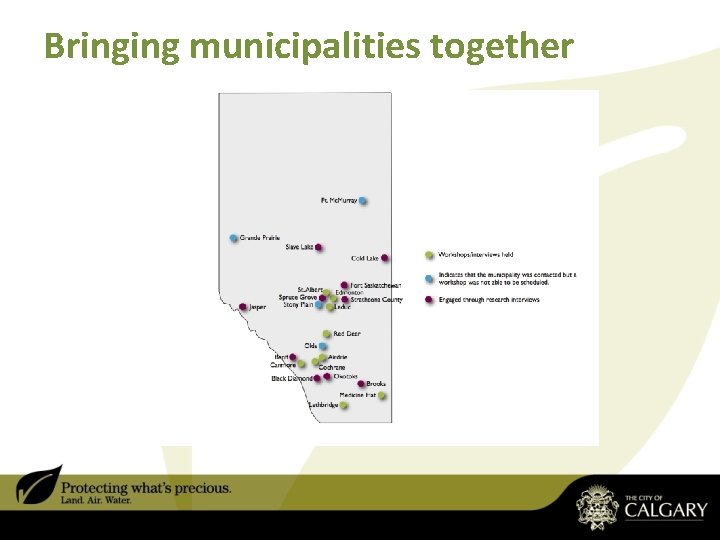
Bringing municipalities together
Lessons Learned: Peer Communities • Municipalities are effective as an informal peer community as well as being a partner in multistakeholder groups. • Informal peer communities provide different insight than formal peer communities.
Lessons Learned: Technology • Efficient formal support for informal peer communities • A tool for municipalities to meet their local need for action, measurement and engagement • Can’t replace, but can enhance the face-to-face collaboration that has produced results in the past • Extends the life of project engagement
The legacy – for now … • City of Calgary completes the project with Intelligent Futures – December 2011 • Alberta Environment & Water funds the Alberta Municipal Climate Change Action Centre (AMCCA) • AMCCA incorporates operation of the Toolkit into their mandate • Calgary hands the Toolkit over to AMCCA
Conclusion • Informal peer communities may be hiding in plain sight—they may be an untapped resource for achieving [environmental] goals.
Linda Harvey The City of Calgary Environmental and Safety Management linda. harvey@calgary. ca