
Find the Kth largest number Special topics in

Find the Kth largest number Special topics in Advanced Algorithms -Slides prepared by Raghu Srinivasan
Problem • Input: Unsorted set of numbers and an integer k • Output: kth largest number from the given set of numbers • Deterministic Solution – Using median of medians – Runtime: Linear i. e. , O(n)
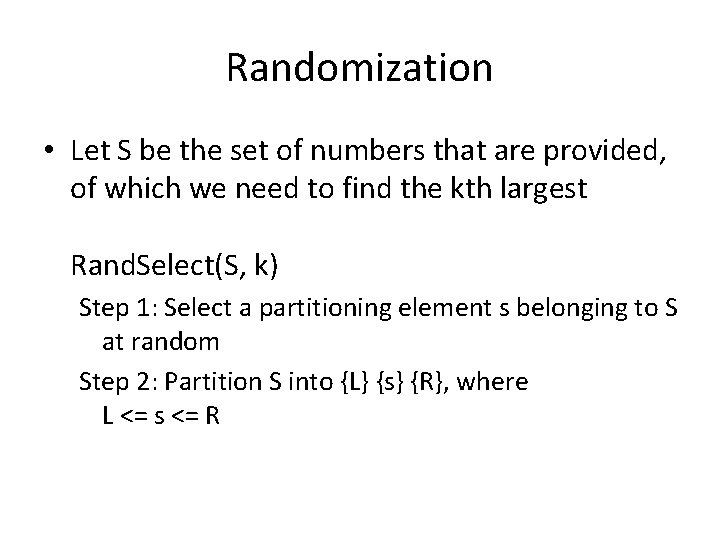
Randomization • Let S be the set of numbers that are provided, of which we need to find the kth largest Rand. Select(S, k) Step 1: Select a partitioning element s belonging to S at random Step 2: Partition S into {L} {s} {R}, where L <= s <= R
![Randomization (Contd…) Step 3: If |L| = k-1, then return s else if [L]](http://slidetodoc.com/presentation_image_h2/148e14abaefce7a0e9dd6221c2793176/image-4.jpg "Randomization (Contd…) Step 3: If |L| = k-1, then return s else if [L]")
Randomization (Contd…) Step 3: If |L| = k-1, then return s else if [L] >= k then return Rand. Select(L, k) else return Rand. Select(R, k-|L|-1) What is the expected number of recursive calls?
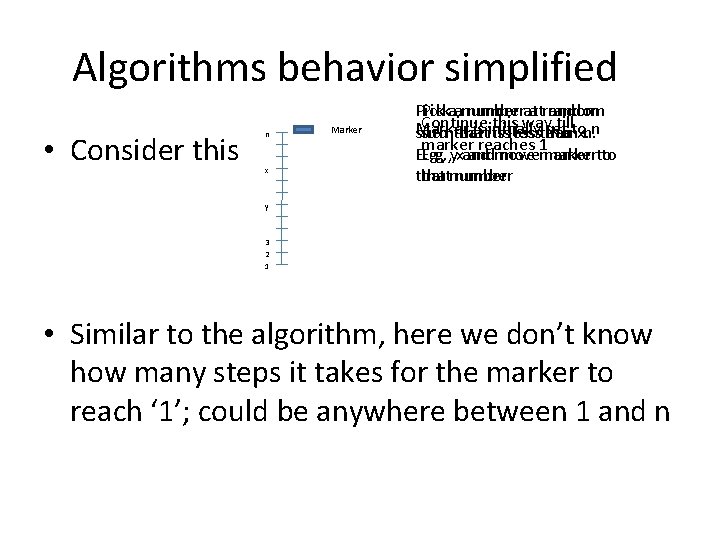
Algorithms behavior simplified • Consider this n x Marker Pickaanumberatatrandom Continue this way till n Marker is its initially set suchthat itslessthanto x. n. marker reaches 1 E. g. , yxand andmovemarkerto to thatnumber y 3 2 1 • Similar to the algorithm, here we don’t know how many steps it takes for the marker to reach ‘ 1’; could be anywhere between 1 and n
Intuition • The randomly selected element, for most of the runs will divide the given set of numbers equally. • From the above intuition, the estimated number of steps or recursive calls for most of the runs would be, O(log n)
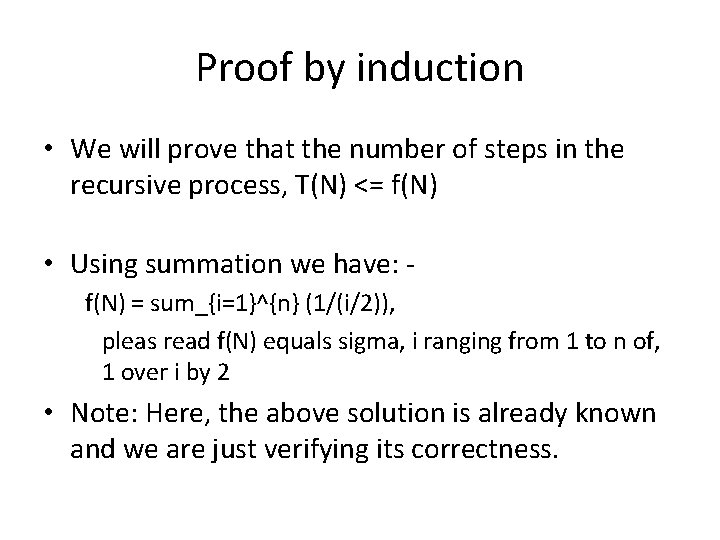
Proof by induction • We will prove that the number of steps in the recursive process, T(N) <= f(N) • Using summation we have: f(N) = sum_{i=1}^{n} (1/(i/2)), pleas read f(N) equals sigma, i ranging from 1 to n of, 1 over i by 2 • Note: Here, the above solution is already known and we are just verifying its correctness.
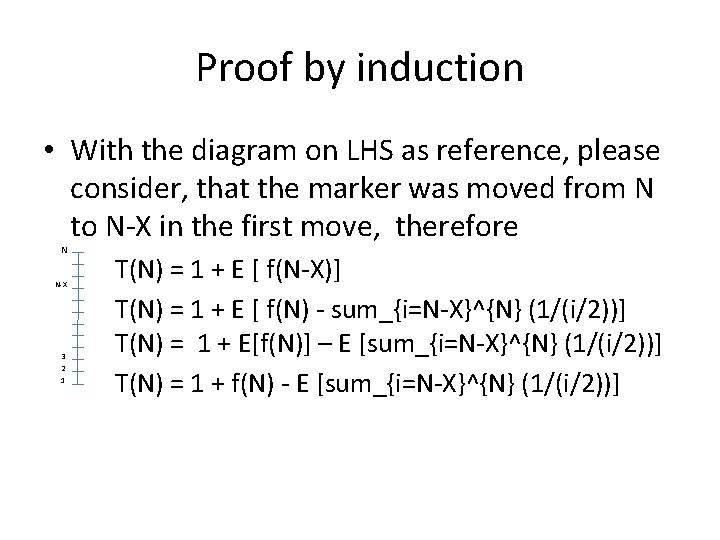
Proof by induction • With the diagram on LHS as reference, please consider, that the marker was moved from N to N-X in the first move, therefore N N-X 3 2 1 T(N) = 1 + E [ f(N-X)] T(N) = 1 + E [ f(N) - sum_{i=N-X}^{N} (1/(i/2))] T(N) = 1 + E[f(N)] – E [sum_{i=N-X}^{N} (1/(i/2))] T(N) = 1 + f(N) - E [sum_{i=N-X}^{N} (1/(i/2))]
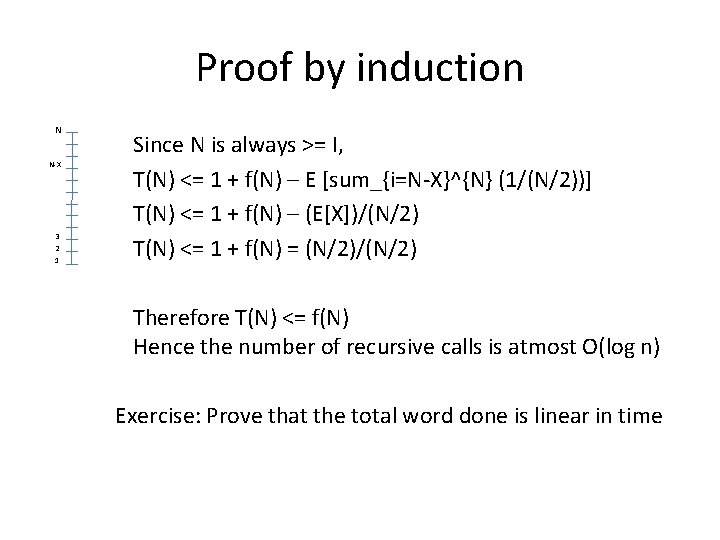
Proof by induction N N-X 3 2 1 Since N is always >= I, T(N) <= 1 + f(N) – E [sum_{i=N-X}^{N} (1/(N/2))] T(N) <= 1 + f(N) – (E[X])/(N/2) T(N) <= 1 + f(N) = (N/2)/(N/2) Therefore T(N) <= f(N) Hence the number of recursive calls is atmost O(log n) Exercise: Prove that the total word done is linear in time
References • Class notes on 01/30/2008 • Randomized Algorithms, by Rajeev Motwani and Prabhakar Raghavan
- Slides: 10