
Financing Retained Risk Peter Willitts Structure What is
- Slides: 19
Financing Retained Risk Peter Willitts
Structure – What is a Captive? • Insurance subsidiary of a commercial/financial company, or a consortium or an association of individuals • Formed to primarily insure, or reinsure the risks of its parent, or of a number of parties with risks in common or unrelated risk • Usually formed in a specialized environment or “domicile” – “onshore” or “offshore”
Why are Captives Formed • Reduce Risk Financing costs • Solve problems • Profit center
Reducing Risk Management Costs • Controlling destiny through progressive retentions • Access to Reinsurance • Reduced Dollar Swapping • Improved Loss Control incentive • Tax savings
Tax • Acceleration of deduction – Humana – Non-Related • • Arbitrating U. S. Tax Rate 953(d) Election Pooling Premium Tax
Solving Problems • Coverage – e. g. • D&O • E&O • Product Recall • Administrative – Consolidation of Programs – Rationalization of Deductibles
Profit Center • Customer Programs – Warranty – Disaster Recovery – Cell Phone – Credit Life • Other – Suppliers – Contractors
Structure – Types of Captives • Single Owner • Multi-owner or Association • Rent-a-Captive – multiple non-owner • Protected or Segregated Cell Captive (PCC, SPC, SAC) – any of the above
Association Captives • Generally a hard market phenomenon • Commitment to feasibility essential • Risk Sharing must be understood • Most effective when solving a common problem • Homogenous or Heterogenous
Rent-a-Captives • Sponsored by insurers or brokers • Rent-a-Captive vs Segregated Cell • Relationship established through Shareholders Agreement • Indemnity Provision • Dividend distribution process
Decision Making Process • Level of Retention • Form of Retention • If captive, which domicile • Feasibility study should address all 3
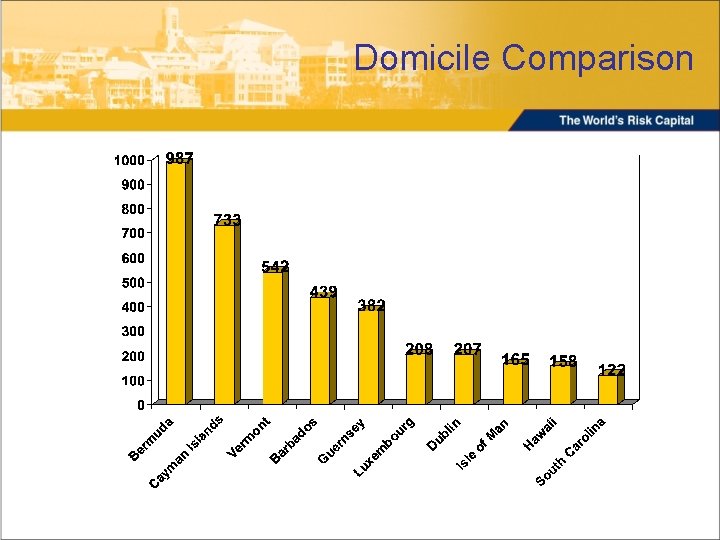
Domicile Comparison
Why Bermuda • Why not? • Experience • The Insurance and Reinsurance Market • Geography • Flexibility
Bermuda Incorporation Procedure • Select a Law firm • Select a Manager • Select a Name • Submit Shareholder information for approval • Submit Pre-Incorporation information • Submit Form 1 B for registration together with confirmation capital is paid in
Types of Business • Related • Unrelated • Connected • Affiliated
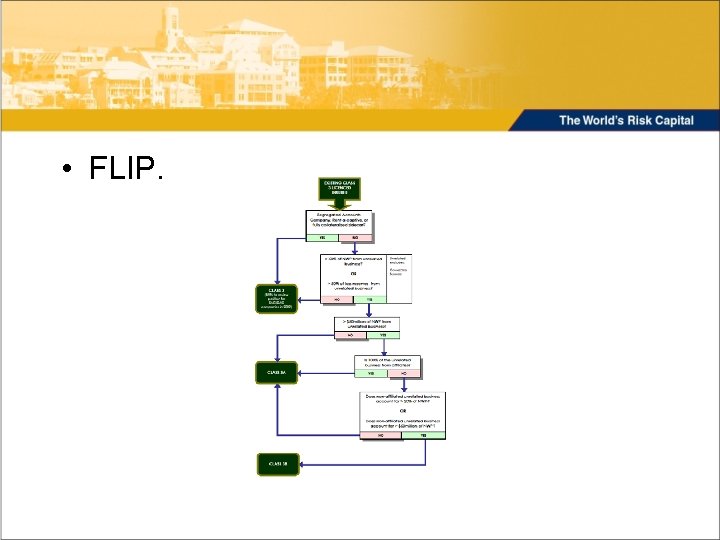
Established License Classes • Established “Classes of Insurers” – Class 1 – Single Parent Captive – Class 2 – Association Captive/20% unrelated – Class 3 – Catch all – “third party company” – Class 3 A - 50% Unrelated, less than $50 M – Class 3 B – 50% unrelated, more than $50 M – Special Purpose Insurer – Class 4 – CAT Companies/Publicly listed companies
• FLIP.
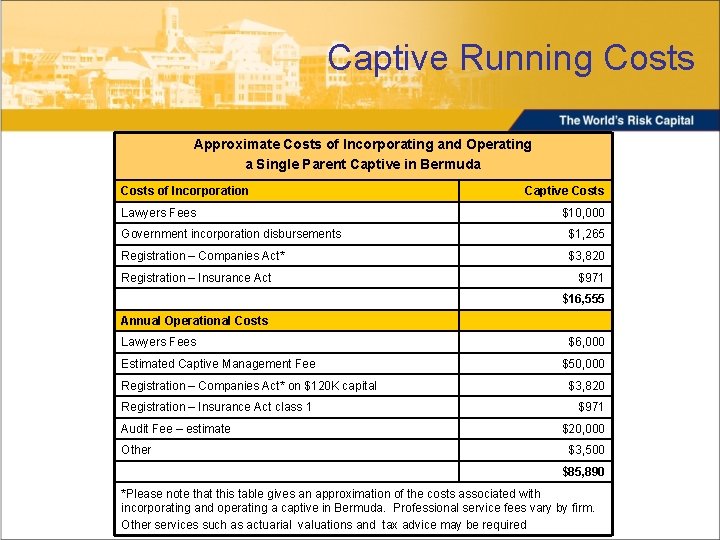
Captive Running Costs Approximate Costs of Incorporating and Operating a Single Parent Captive in Bermuda Costs of Incorporation Lawyers Fees Captive Costs $10, 000 Government incorporation disbursements $1, 265 Registration – Companies Act* $3, 820 Registration – Insurance Act $971 $16, 555 Annual Operational Costs Lawyers Fees Estimated Captive Management Fee Registration – Companies Act* on $120 K capital Registration – Insurance Act class 1 Audit Fee – estimate Other $6, 000 $50, 000 $3, 820 $971 $20, 000 $3, 500 $85, 890 *Please note that this table gives an approximation of the costs associated with incorporating and operating a captive in Bermuda. Professional service fees vary by firm. Other services such as actuarial valuations and tax advice may be required
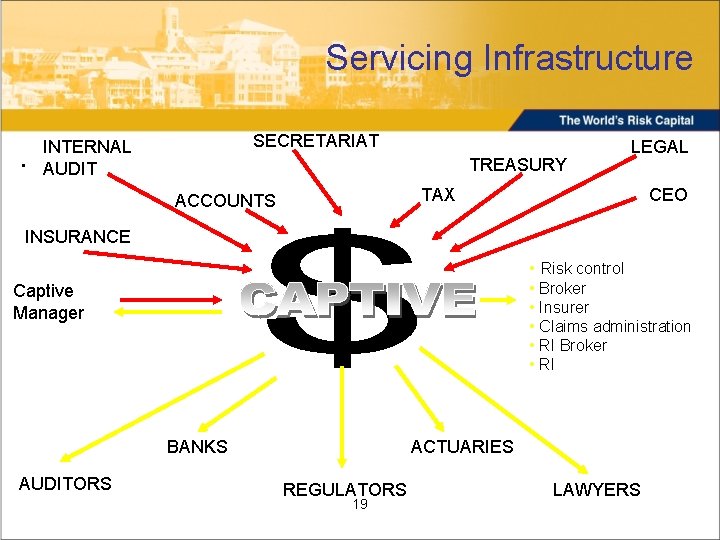
Servicing Infrastructure. SECRETARIAT INTERNAL AUDIT TREASURY LEGAL TAX ACCOUNTS CEO INSURANCE • Risk control • Broker • Insurer • Claims administration • RI Broker • RI Captive Manager BANKS AUDITORS ACTUARIES REGULATORS 19 LAWYERS